4/21/2013
Stephanie Dixon 1
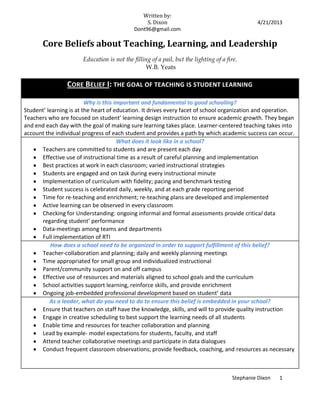
Core Beliefs about Teaching, Learning, and Leadership
Education is not the filling of a pail, but the lighting of a fire.
W.B. Yeats
CORE BELIEF I: THE GOAL OF TEACHING IS STUDENT LEARNING
Why is this important and fundamental to good schooling?
Student’ learning is at the heart of education. It drives every facet of school organization and operation.
Teachers who are focused on student’ learning design instruction to ensure academic growth. They began
and end each day with the goal of making sure learning takes place. Learner-centered teaching takes into
account the individual progress of each student and provides a path by which academic success can occur.
What does it look like in a school?
Teachers are committed to students and are present each day
Effective use of instructional time as a result of careful planning and implementation
Best practices at work in each classroom; varied instructional strategies
Students are engaged and on task during every instructional minute
Implementation of curriculum with fidelity; pacing and benchmark testing
Student success is celebrated daily, weekly, and at each grade reporting period
Time for re-teaching and enrichment; re-teaching plans are developed and implemented
Active learning can be observed in every classroom
Checking for Understanding: ongoing informal and formal assessments provide critical data
regarding student’ performance
Data-meetings among teams and departments
Full implementation of RTI
How does a school need to be organized in order to support fulfillment of this belief?
Teacher-collaboration and planning; daily and weekly planning meetings
Time appropriated for small group and individualized instructional
Parent/community support on and off campus
Effective use of resources and materials aligned to school goals and the curriculum
School activities support learning, reinforce skills, and provide enrichment
Ongoing job-embedded professional development based on student’ data
As a leader, what do you need to do to ensure this belief is embedded in your school?
Ensure that teachers on staff have the knowledge, skills, and will to provide quality instruction
Engage in creative scheduling to best support the learning needs of all students
Enable time and resources for teacher collaboration and planning
Lead by example- model expectations for students, faculty, and staff
Attend teacher collaborative meetings and participate in data dialogues
Conduct frequent classroom observations; provide feedback, coaching, and resources as necessary
Written by:
S. Dixon
Dont96@gmail.com
4/21/2013
Stephanie Dixon 2
CORE BELIEF II: LEARNING IS BEST SUPPORTED BY A POSITIVE,
COMMUNITY-CENTERED APPROACH
Why is this important and fundamental to good schooling?
Students succeed in environments where they feel a sense of identity and belonging. Community-
centered approach to learning is based on the precept that the classroom is the community. This approach
involves aligning student with the overall expectations of the school and classroom. Community-centered
approaches are vital to the school environment because they provide necessary structure and consistency
for students. In such environments, accountability for student’ learning is shared by all stake-holders.
Collective beliefs help maintain high morale among the students and faculty and positive attitudes about
learning.
What does it look like in a school?
Classroom norms are implemented school-wide
Cultural differences are recognized and celebrated
Students, staff, and faculty feel respected
Peer-led, team learning; inquiry-based, problem-solving learning activities
Think-Pair-Share during lessons; students facilitating discussions and challenging one another
Collaborative learning opportunities via professional learning communities create a network of
resources and support for new and “not new” teachers
Intellectual camaraderie exist among students and faculty
Team teaching supports the needs of students with specific learning needs
Students are involved in activities that cultivate team building and citizenship
Daily rituals involve students and faculty
Community-partnerships that support student’ learning
Parental participation in decision-making and planning
How does a school need to be organized in order to support fulfillment of this belief?
Homeroom and mentoring activities
School-wide and classroom expectations are fully implemented (PBIS/CHAMPS)
Open communication between school and home (phone calls, email, and conferences)
Cultural competency and diversity training for all faculty and staff
Shared belief systems drive all school activities and instruction
Parent advisory committees have integral roles in decision making
As a leader, what do you need to do to ensure this belief is embedded in your school?
Foster a community of learning and excellence among faculty and students
Build relationships and a sense of value among faculty, staff, and study body
Enforce discipline policies firmly, fairly, and consistently
Provide resources for sustained professional development and professional learning communities
Initiate communication and partnerships with families and community businesses and
organizations
4/21/2013
Stephanie Dixon 3
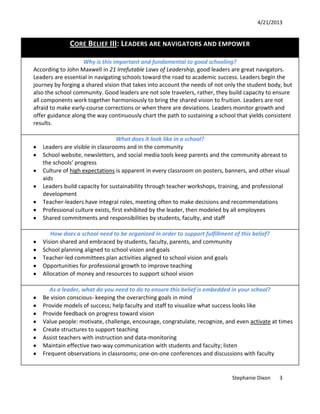
CORE BELIEF III: LEADERS ARE NAVIGATORS AND EMPOWER
Why is this important and fundamental to good schooling?
According to John Maxwell in 21 Irrefutable Laws of Leadership, good leaders are great navigators.
Leaders are essential in navigating schools toward the road to academic success. Leaders begin the
journey by forging a shared vision that takes into account the needs of not only the student body, but
also the school community. Good leaders are not sole travelers, rather, they build capacity to ensure
all components work together harmoniously to bring the shared vision to fruition. Leaders are not
afraid to make early-course corrections or when there are deviations. Leaders monitor growth and
offer guidance along the way continuously chart the path to sustaining a school that yields consistent
results.
What does it look like in a school?
Leaders are visible in classrooms and in the community
School website, newsletters, and social media tools keep parents and the community abreast to
the schools’ progress
Culture of high expectations is apparent in every classroom on posters, banners, and other visual
aids
Leaders build capacity for sustainability through teacher workshops, training, and professional
development
Teacher-leaders have integral roles, meeting often to make decisions and recommendations
Professional culture exists, first exhibited by the leader, then modeled by all employees
Shared commitments and responsibilities by students, faculty, and staff
How does a school need to be organized in order to support fulfillment of this belief?
Vision shared and embraced by students, faculty, parents, and community
School planning aligned to school vision and goals
Teacher-led committees plan activities aligned to school vision and goals
Opportunities for professional growth to improve teaching
Allocation of money and resources to support school vision
As a leader, what do you need to do to ensure this belief is embedded in your school?
Be vision conscious- keeping the overarching goals in mind
Provide models of success; help faculty and staff to visualize what success looks like
Provide feedback on progress toward vision
Value people: motivate, challenge, encourage, congratulate, recognize, and even activate at times
Create structures to support teaching
Assist teachers with instruction and data-monitoring
Maintain effective two-way communication with students and faculty; listen
Frequent observations in classrooms; one-on-one conferences and discussions with faculty

Core beliefs about teaching

  • 1.
    4/21/2013 Stephanie Dixon 1 CoreBeliefs about Teaching, Learning, and Leadership Education is not the filling of a pail, but the lighting of a fire. W.B. Yeats CORE BELIEF I: THE GOAL OF TEACHING IS STUDENT LEARNING Why is this important and fundamental to good schooling? Student’ learning is at the heart of education. It drives every facet of school organization and operation. Teachers who are focused on student’ learning design instruction to ensure academic growth. They began and end each day with the goal of making sure learning takes place. Learner-centered teaching takes into account the individual progress of each student and provides a path by which academic success can occur. What does it look like in a school? Teachers are committed to students and are present each day Effective use of instructional time as a result of careful planning and implementation Best practices at work in each classroom; varied instructional strategies Students are engaged and on task during every instructional minute Implementation of curriculum with fidelity; pacing and benchmark testing Student success is celebrated daily, weekly, and at each grade reporting period Time for re-teaching and enrichment; re-teaching plans are developed and implemented Active learning can be observed in every classroom Checking for Understanding: ongoing informal and formal assessments provide critical data regarding student’ performance Data-meetings among teams and departments Full implementation of RTI How does a school need to be organized in order to support fulfillment of this belief? Teacher-collaboration and planning; daily and weekly planning meetings Time appropriated for small group and individualized instructional Parent/community support on and off campus Effective use of resources and materials aligned to school goals and the curriculum School activities support learning, reinforce skills, and provide enrichment Ongoing job-embedded professional development based on student’ data As a leader, what do you need to do to ensure this belief is embedded in your school? Ensure that teachers on staff have the knowledge, skills, and will to provide quality instruction Engage in creative scheduling to best support the learning needs of all students Enable time and resources for teacher collaboration and planning Lead by example- model expectations for students, faculty, and staff Attend teacher collaborative meetings and participate in data dialogues Conduct frequent classroom observations; provide feedback, coaching, and resources as necessary Written by: S. Dixon Dont96@gmail.com
  • 2.
    4/21/2013 Stephanie Dixon 2 COREBELIEF II: LEARNING IS BEST SUPPORTED BY A POSITIVE, COMMUNITY-CENTERED APPROACH Why is this important and fundamental to good schooling? Students succeed in environments where they feel a sense of identity and belonging. Community- centered approach to learning is based on the precept that the classroom is the community. This approach involves aligning student with the overall expectations of the school and classroom. Community-centered approaches are vital to the school environment because they provide necessary structure and consistency for students. In such environments, accountability for student’ learning is shared by all stake-holders. Collective beliefs help maintain high morale among the students and faculty and positive attitudes about learning. What does it look like in a school? Classroom norms are implemented school-wide Cultural differences are recognized and celebrated Students, staff, and faculty feel respected Peer-led, team learning; inquiry-based, problem-solving learning activities Think-Pair-Share during lessons; students facilitating discussions and challenging one another Collaborative learning opportunities via professional learning communities create a network of resources and support for new and “not new” teachers Intellectual camaraderie exist among students and faculty Team teaching supports the needs of students with specific learning needs Students are involved in activities that cultivate team building and citizenship Daily rituals involve students and faculty Community-partnerships that support student’ learning Parental participation in decision-making and planning How does a school need to be organized in order to support fulfillment of this belief? Homeroom and mentoring activities School-wide and classroom expectations are fully implemented (PBIS/CHAMPS) Open communication between school and home (phone calls, email, and conferences) Cultural competency and diversity training for all faculty and staff Shared belief systems drive all school activities and instruction Parent advisory committees have integral roles in decision making As a leader, what do you need to do to ensure this belief is embedded in your school? Foster a community of learning and excellence among faculty and students Build relationships and a sense of value among faculty, staff, and study body Enforce discipline policies firmly, fairly, and consistently Provide resources for sustained professional development and professional learning communities Initiate communication and partnerships with families and community businesses and organizations
  • 3.
    4/21/2013 Stephanie Dixon 3 COREBELIEF III: LEADERS ARE NAVIGATORS AND EMPOWER Why is this important and fundamental to good schooling? According to John Maxwell in 21 Irrefutable Laws of Leadership, good leaders are great navigators. Leaders are essential in navigating schools toward the road to academic success. Leaders begin the journey by forging a shared vision that takes into account the needs of not only the student body, but also the school community. Good leaders are not sole travelers, rather, they build capacity to ensure all components work together harmoniously to bring the shared vision to fruition. Leaders are not afraid to make early-course corrections or when there are deviations. Leaders monitor growth and offer guidance along the way continuously chart the path to sustaining a school that yields consistent results. What does it look like in a school? Leaders are visible in classrooms and in the community School website, newsletters, and social media tools keep parents and the community abreast to the schools’ progress Culture of high expectations is apparent in every classroom on posters, banners, and other visual aids Leaders build capacity for sustainability through teacher workshops, training, and professional development Teacher-leaders have integral roles, meeting often to make decisions and recommendations Professional culture exists, first exhibited by the leader, then modeled by all employees Shared commitments and responsibilities by students, faculty, and staff How does a school need to be organized in order to support fulfillment of this belief? Vision shared and embraced by students, faculty, parents, and community School planning aligned to school vision and goals Teacher-led committees plan activities aligned to school vision and goals Opportunities for professional growth to improve teaching Allocation of money and resources to support school vision As a leader, what do you need to do to ensure this belief is embedded in your school? Be vision conscious- keeping the overarching goals in mind Provide models of success; help faculty and staff to visualize what success looks like Provide feedback on progress toward vision Value people: motivate, challenge, encourage, congratulate, recognize, and even activate at times Create structures to support teaching Assist teachers with instruction and data-monitoring Maintain effective two-way communication with students and faculty; listen Frequent observations in classrooms; one-on-one conferences and discussions with faculty