Tertiary Level/ 
Higher 
Education in 
the Philippines
The advancements in education in Asia 
have been pioneered in the Philippines. 
In fact, the Philippines was home to the 
first modern public schooling system in 
Asia and also home to the oldest 
universities, colleges, and vocational 
schools.
During the 1970′s and 1980′s President 
Marcos decentralized the office that 
oversaw education in the Philippines, 
and it eventually became the Ministry 
of Education and Culture.
Today Philippines welcomes students 
from abroad, with the vast majority of 
foreign students coming from the 
America, Korea, and Taiwan. With more 
than 1500 institutions to choose from.
The Philippines offers enough 
universities have to foreign exchange 
student can find the kind of program 
that they want and take advantage of 
many of the benefits of studying abroad.
• Records from CHED showed that the 
country had 1,573 private institutions 
and 607 state-run colleges and 
universities, a total of 2,080 HEIs as 
of August 2010. 
• Generally classified as public or private.
• Public universities are all non-sectarian 
entities, and are further classified as 
State University and College (SUC) or 
Local College and University (LCU). 
• SUCs are fully funded by the national 
government as determined by the 
Philippine Congress. 
• LCUs, on the other hand, are run by 
local government units.
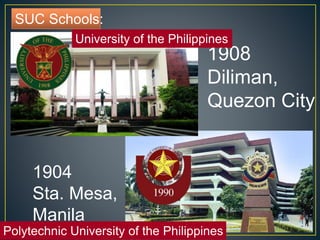
SUC Schools: 
University of the Philippines 
1904 
Sta. Mesa, 
Manila 
1908 
Diliman, 
Quezon City 
Polytechnic University of the Philippines
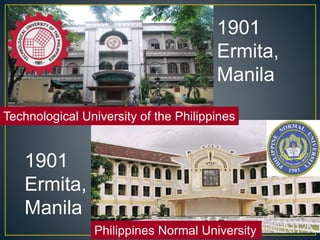
1901 
Ermita, 
Manila 
Technological University of the Philippines 
Philippines Normal University 
1901 
Ermita, 
Manila
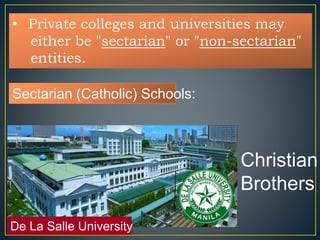
• Private colleges and universities may 
either be "sectarian" or "non-sectarian" 
entities. 
Sectarian (Catholic) Schools: 
Christian 
Brothers 
De La Salle University
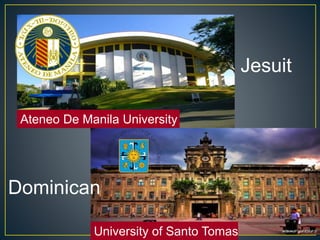
Jesuit 
Ateneo De Manila University 
Dominican 
University of Santo Tomas
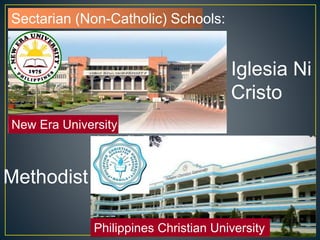
Sectarian (Non-Catholic) Schools: 
Iglesia Ni 
Cristo 
New Era University 
Methodist 
Philippines Christian University
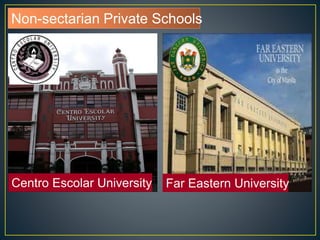
Non-sectarian Private Schools 
Centro Escolar University Far Eastern University
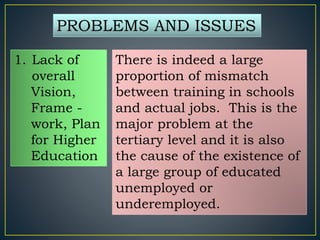
PROBLEMS AND ISSUES 
1. Lack of 
overall 
Vision, 
Frame - 
work, Plan 
for Higher 
Education 
There is indeed a large 
proportion of mismatch 
between training in schools 
and actual jobs. This is the 
major problem at the 
tertiary level and it is also 
the cause of the existence of 
a large group of educated 
unemployed or 
underemployed.
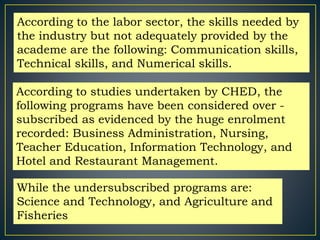
According to the labor sector, the skills needed by 
the industry but not adequately provided by the 
academe are the following: Communication skills, 
Technical skills, and Numerical skills. 
According to studies undertaken by CHED, the 
following programs have been considered over - 
subscribed as evidenced by the huge enrolment 
recorded: Business Administration, Nursing, 
Teacher Education, Information Technology, and 
Hotel and Restaurant Management. 
While the undersubscribed programs are: 
Science and Technology, and Agriculture and 
Fisheries
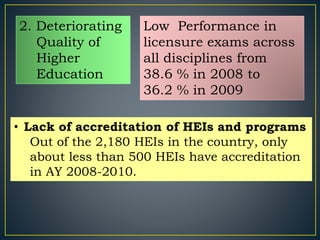
2. Deteriorating 
Quality of 
Higher 
Education 
Low Performance in 
licensure exams across 
all disciplines from 
38.6 % in 2008 to 
36.2 % in 2009 
• Lack of accreditation of HEIs and programs 
Out of the 2,180 HEIs in the country, only 
about less than 500 HEIs have accreditation 
in AY 2008-2010.
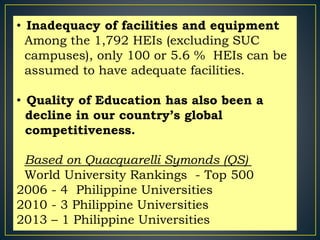
• Inadequacy of facilities and equipment 
Among the 1,792 HEIs (excluding SUC 
campuses), only 100 or 5.6 % HEIs can be 
assumed to have adequate facilities. 
• Quality of Education has also been a 
decline in our country’s global 
competitiveness. 
Based on Quacquarelli Symonds (QS) 
World University Rankings - Top 500 
2006 - 4 Philippine Universities 
2010 - 3 Philippine Universities 
2013 – 1 Philippine Universities
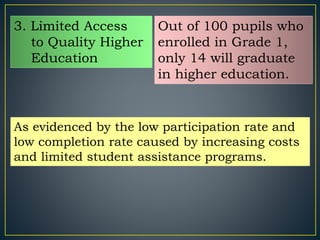
3. Limited Access 
to Quality Higher 
Education 
Out of 100 pupils who 
enrolled in Grade 1, 
only 14 will graduate 
in higher education. 
As evidenced by the low participation rate and 
low completion rate caused by increasing costs 
and limited student assistance programs.
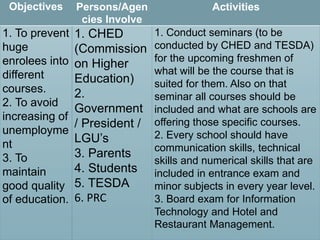
Objectives Persons/Agen 
cies Involve 
Activities 
1. To prevent 
huge 
enrolees into 
different 
courses. 
2. To avoid 
increasing of 
unemployme 
nt 
3. To 
maintain 
good quality 
of education. 
1. CHED 
(Commission 
on Higher 
Education) 
2. 
Government 
/ President / 
LGU’s 
3. Parents 
4. Students 
5. TESDA 
6. PRC 
1. Conduct seminars (to be 
conducted by CHED and TESDA) 
for the upcoming freshmen of 
what will be the course that is 
suited for them. Also on that 
seminar all courses should be 
included and what are schools are 
offering those specific courses. 
2. Every school should have 
communication skills, technical 
skills and numerical skills that are 
included in entrance exam and 
minor subjects in every year level. 
3. Board exam for Information 
Technology and Hotel and 
Restaurant Management.
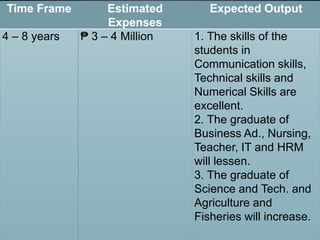
Time Frame Estimated 
Expenses 
Expected Output 
4 – 8 years ₱ 3 – 4 Million 1. The skills of the 
students in 
Communication skills, 
Technical skills and 
Numerical Skills are 
excellent. 
2. The graduate of 
Business Ad., Nursing, 
Teacher, IT and HRM 
will lessen. 
3. The graduate of 
Science and Tech. and 
Agriculture and 
Fisheries will increase.
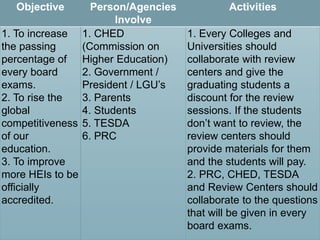
Objective Person/Agencies 
Involve 
Activities 
1. To increase 
the passing 
percentage of 
every board 
exams. 
2. To rise the 
global 
competitiveness 
of our 
education. 
3. To improve 
more HEIs to be 
officially 
accredited. 
1. CHED 
(Commission on 
Higher Education) 
2. Government / 
President / LGU’s 
3. Parents 
4. Students 
5. TESDA 
6. PRC 
1. Every Colleges and 
Universities should 
collaborate with review 
centers and give the 
graduating students a 
discount for the review 
sessions. If the students 
don’t want to review, the 
review centers should 
provide materials for them 
and the students will pay. 
2. PRC, CHED, TESDA 
and Review Centers should 
collaborate to the questions 
that will be given in every 
board exams.
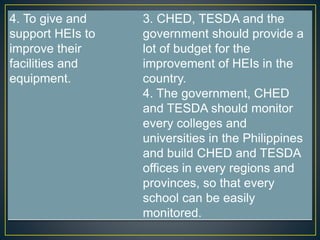
4. To give and 
support HEIs to 
improve their 
facilities and 
equipment. 
3. CHED, TESDA and the 
government should provide a 
lot of budget for the 
improvement of HEIs in the 
country. 
4. The government, CHED 
and TESDA should monitor 
every colleges and 
universities in the Philippines 
and build CHED and TESDA 
offices in every regions and 
provinces, so that every 
school can be easily 
monitored.
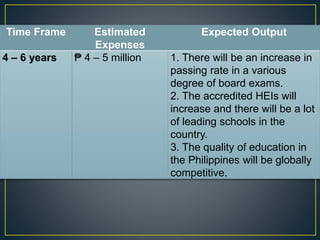
Time Frame Estimated 
Expenses 
Expected Output 
4 – 6 years ₱ 4 – 5 million 1. There will be an increase in 
passing rate in a various 
degree of board exams. 
2. The accredited HEIs will 
increase and there will be a lot 
of leading schools in the 
country. 
3. The quality of education in 
the Philippines will be globally 
competitive.
Objectives Person/Agencies 
Involve 
Activities 
1. To give 
different kinds 
of scholarships 
for 
unprivileged 
students. 
2. To promote 
cheaper but 
good quality of 
education. 
3. To be a 
competitive 
country in 
terms of a 
good quality of 
education. 
1. CHED 
(Commission on 
Higher Education) 
2. Government / 
President / LGU’s 
3. Parents 
4. Students 
5. TESDA 
6. Private 
Companies 
7. An individual who 
are willing to help 
1. CHED and different 
private 
companies/individual will 
build organizations for 
those unprivileged 
students. They will open 
for donations and 
scholarships. 
2. Aside from scholarships 
the government, CHED 
and TESDA should 
promote cheap tuition fees 
for the public universities 
and colleges.
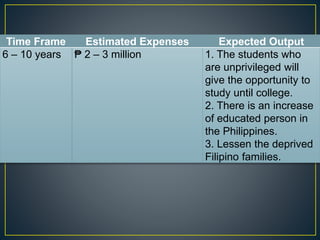
Time Frame Estimated Expenses Expected Output 
6 – 10 years ₱ 2 – 3 million 1. The students who 
are unprivileged will 
give the opportunity to 
study until college. 
2. There is an increase 
of educated person in 
the Philippines. 
3. Lessen the deprived 
Filipino families.
Reported by: 
Yonese Giselle F. Gonzales 
Jean F. Villones 
(MAED – Educational Management)

Problems and Issues in Tertiary Level

  • 1.
    Tertiary Level/ Higher Education in the Philippines
  • 2.
    The advancements ineducation in Asia have been pioneered in the Philippines. In fact, the Philippines was home to the first modern public schooling system in Asia and also home to the oldest universities, colleges, and vocational schools.
  • 3.
    During the 1970′sand 1980′s President Marcos decentralized the office that oversaw education in the Philippines, and it eventually became the Ministry of Education and Culture.
  • 4.
    Today Philippines welcomesstudents from abroad, with the vast majority of foreign students coming from the America, Korea, and Taiwan. With more than 1500 institutions to choose from.
  • 5.
    The Philippines offersenough universities have to foreign exchange student can find the kind of program that they want and take advantage of many of the benefits of studying abroad.
  • 6.
    • Records fromCHED showed that the country had 1,573 private institutions and 607 state-run colleges and universities, a total of 2,080 HEIs as of August 2010. • Generally classified as public or private.
  • 7.
    • Public universitiesare all non-sectarian entities, and are further classified as State University and College (SUC) or Local College and University (LCU). • SUCs are fully funded by the national government as determined by the Philippine Congress. • LCUs, on the other hand, are run by local government units.
  • 8.
    SUC Schools: Universityof the Philippines 1904 Sta. Mesa, Manila 1908 Diliman, Quezon City Polytechnic University of the Philippines
  • 9.
    1901 Ermita, Manila Technological University of the Philippines Philippines Normal University 1901 Ermita, Manila
  • 10.
    • Private collegesand universities may either be "sectarian" or "non-sectarian" entities. Sectarian (Catholic) Schools: Christian Brothers De La Salle University
  • 11.
    Jesuit Ateneo DeManila University Dominican University of Santo Tomas
  • 12.
    Sectarian (Non-Catholic) Schools: Iglesia Ni Cristo New Era University Methodist Philippines Christian University
  • 13.
    Non-sectarian Private Schools Centro Escolar University Far Eastern University
  • 15.
    PROBLEMS AND ISSUES 1. Lack of overall Vision, Frame - work, Plan for Higher Education There is indeed a large proportion of mismatch between training in schools and actual jobs. This is the major problem at the tertiary level and it is also the cause of the existence of a large group of educated unemployed or underemployed.
  • 16.
    According to thelabor sector, the skills needed by the industry but not adequately provided by the academe are the following: Communication skills, Technical skills, and Numerical skills. According to studies undertaken by CHED, the following programs have been considered over - subscribed as evidenced by the huge enrolment recorded: Business Administration, Nursing, Teacher Education, Information Technology, and Hotel and Restaurant Management. While the undersubscribed programs are: Science and Technology, and Agriculture and Fisheries
  • 17.
    2. Deteriorating Qualityof Higher Education Low Performance in licensure exams across all disciplines from 38.6 % in 2008 to 36.2 % in 2009 • Lack of accreditation of HEIs and programs Out of the 2,180 HEIs in the country, only about less than 500 HEIs have accreditation in AY 2008-2010.
  • 18.
    • Inadequacy offacilities and equipment Among the 1,792 HEIs (excluding SUC campuses), only 100 or 5.6 % HEIs can be assumed to have adequate facilities. • Quality of Education has also been a decline in our country’s global competitiveness. Based on Quacquarelli Symonds (QS) World University Rankings - Top 500 2006 - 4 Philippine Universities 2010 - 3 Philippine Universities 2013 – 1 Philippine Universities
  • 19.
    3. Limited Access to Quality Higher Education Out of 100 pupils who enrolled in Grade 1, only 14 will graduate in higher education. As evidenced by the low participation rate and low completion rate caused by increasing costs and limited student assistance programs.
  • 22.
    Objectives Persons/Agen ciesInvolve Activities 1. To prevent huge enrolees into different courses. 2. To avoid increasing of unemployme nt 3. To maintain good quality of education. 1. CHED (Commission on Higher Education) 2. Government / President / LGU’s 3. Parents 4. Students 5. TESDA 6. PRC 1. Conduct seminars (to be conducted by CHED and TESDA) for the upcoming freshmen of what will be the course that is suited for them. Also on that seminar all courses should be included and what are schools are offering those specific courses. 2. Every school should have communication skills, technical skills and numerical skills that are included in entrance exam and minor subjects in every year level. 3. Board exam for Information Technology and Hotel and Restaurant Management.
  • 23.
    Time Frame Estimated Expenses Expected Output 4 – 8 years ₱ 3 – 4 Million 1. The skills of the students in Communication skills, Technical skills and Numerical Skills are excellent. 2. The graduate of Business Ad., Nursing, Teacher, IT and HRM will lessen. 3. The graduate of Science and Tech. and Agriculture and Fisheries will increase.
  • 24.
    Objective Person/Agencies Involve Activities 1. To increase the passing percentage of every board exams. 2. To rise the global competitiveness of our education. 3. To improve more HEIs to be officially accredited. 1. CHED (Commission on Higher Education) 2. Government / President / LGU’s 3. Parents 4. Students 5. TESDA 6. PRC 1. Every Colleges and Universities should collaborate with review centers and give the graduating students a discount for the review sessions. If the students don’t want to review, the review centers should provide materials for them and the students will pay. 2. PRC, CHED, TESDA and Review Centers should collaborate to the questions that will be given in every board exams.
  • 25.
    4. To giveand support HEIs to improve their facilities and equipment. 3. CHED, TESDA and the government should provide a lot of budget for the improvement of HEIs in the country. 4. The government, CHED and TESDA should monitor every colleges and universities in the Philippines and build CHED and TESDA offices in every regions and provinces, so that every school can be easily monitored.
  • 26.
    Time Frame Estimated Expenses Expected Output 4 – 6 years ₱ 4 – 5 million 1. There will be an increase in passing rate in a various degree of board exams. 2. The accredited HEIs will increase and there will be a lot of leading schools in the country. 3. The quality of education in the Philippines will be globally competitive.
  • 27.
    Objectives Person/Agencies Involve Activities 1. To give different kinds of scholarships for unprivileged students. 2. To promote cheaper but good quality of education. 3. To be a competitive country in terms of a good quality of education. 1. CHED (Commission on Higher Education) 2. Government / President / LGU’s 3. Parents 4. Students 5. TESDA 6. Private Companies 7. An individual who are willing to help 1. CHED and different private companies/individual will build organizations for those unprivileged students. They will open for donations and scholarships. 2. Aside from scholarships the government, CHED and TESDA should promote cheap tuition fees for the public universities and colleges.
  • 28.
    Time Frame EstimatedExpenses Expected Output 6 – 10 years ₱ 2 – 3 million 1. The students who are unprivileged will give the opportunity to study until college. 2. There is an increase of educated person in the Philippines. 3. Lessen the deprived Filipino families.
  • 29.
    Reported by: YoneseGiselle F. Gonzales Jean F. Villones (MAED – Educational Management)