IPR and Human Rights:
an introduction
Dr. Sabuj Kumar Chaudhuri
DLIS, University of Calcutta, WB, India
Contact>>>>sabujkchaudhuri@gmail.com
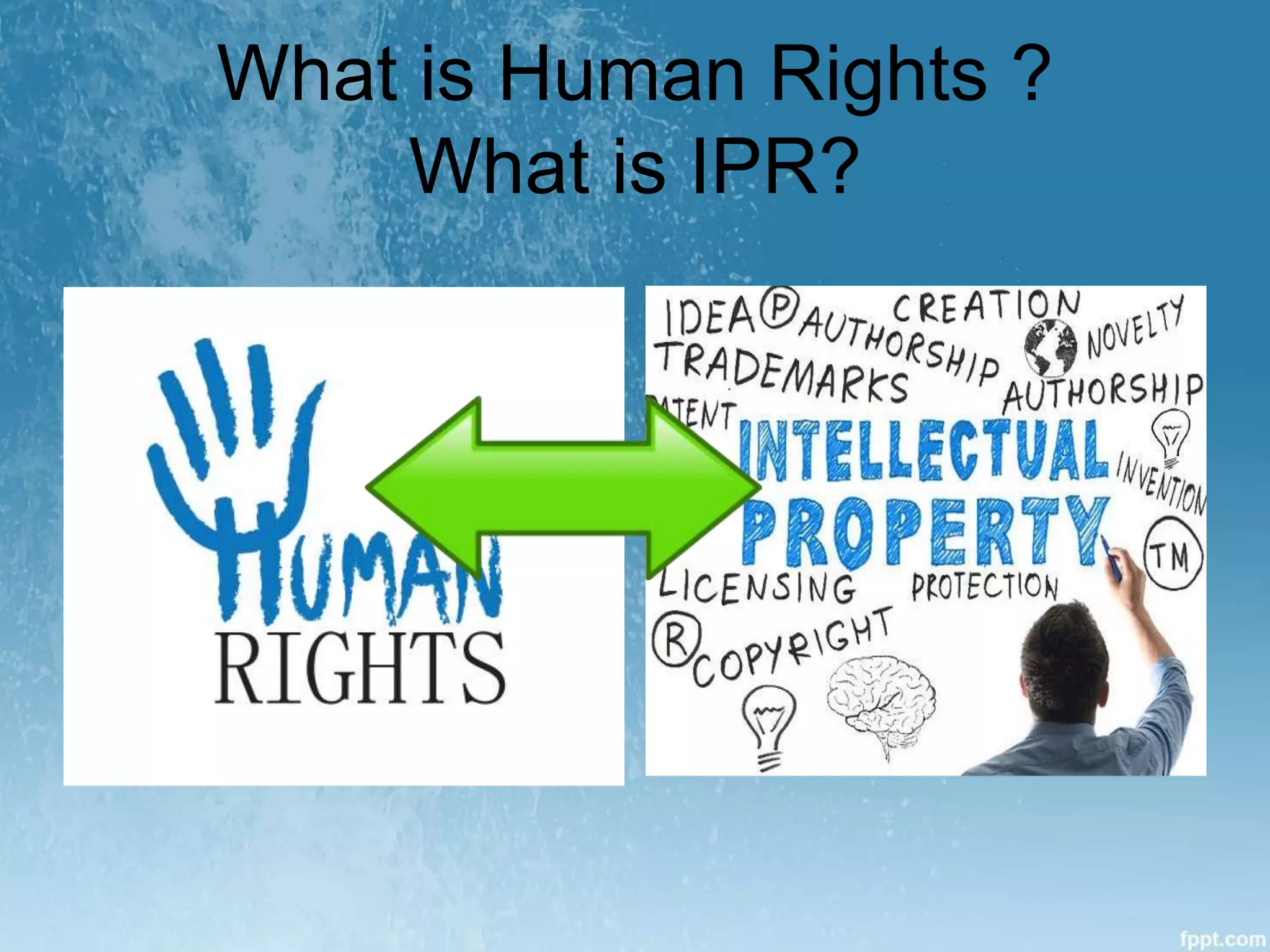
What is Human Rights ?
What is IPR?
Let us understand...
• What is a human ?
• What is right ?
Human + Right = Human Right
Look Back at the Genesis...
• The Cyrus Cylinder (539 BC), a clay tablet is considered as the first
human rights declaration in history. It is translated into all six
official languages of the United Nations and its provisions
parallel the first four Articles of the Universal Declaration of
Human Rights.
• 1215: The Magna Carta—gave people new rights and made the
king subject to the law.
1628: The Petition of Right—set out the rights of the people.
1776: The United States Declaration of Independence—
proclaimed the right to life, liberty and the pursuit of happiness.
1789: The Declaration of the Rights of Man and of the Citizen—a
document of France, stating that all citizens are equal under the
law.
Story of Human Rights
Contd...
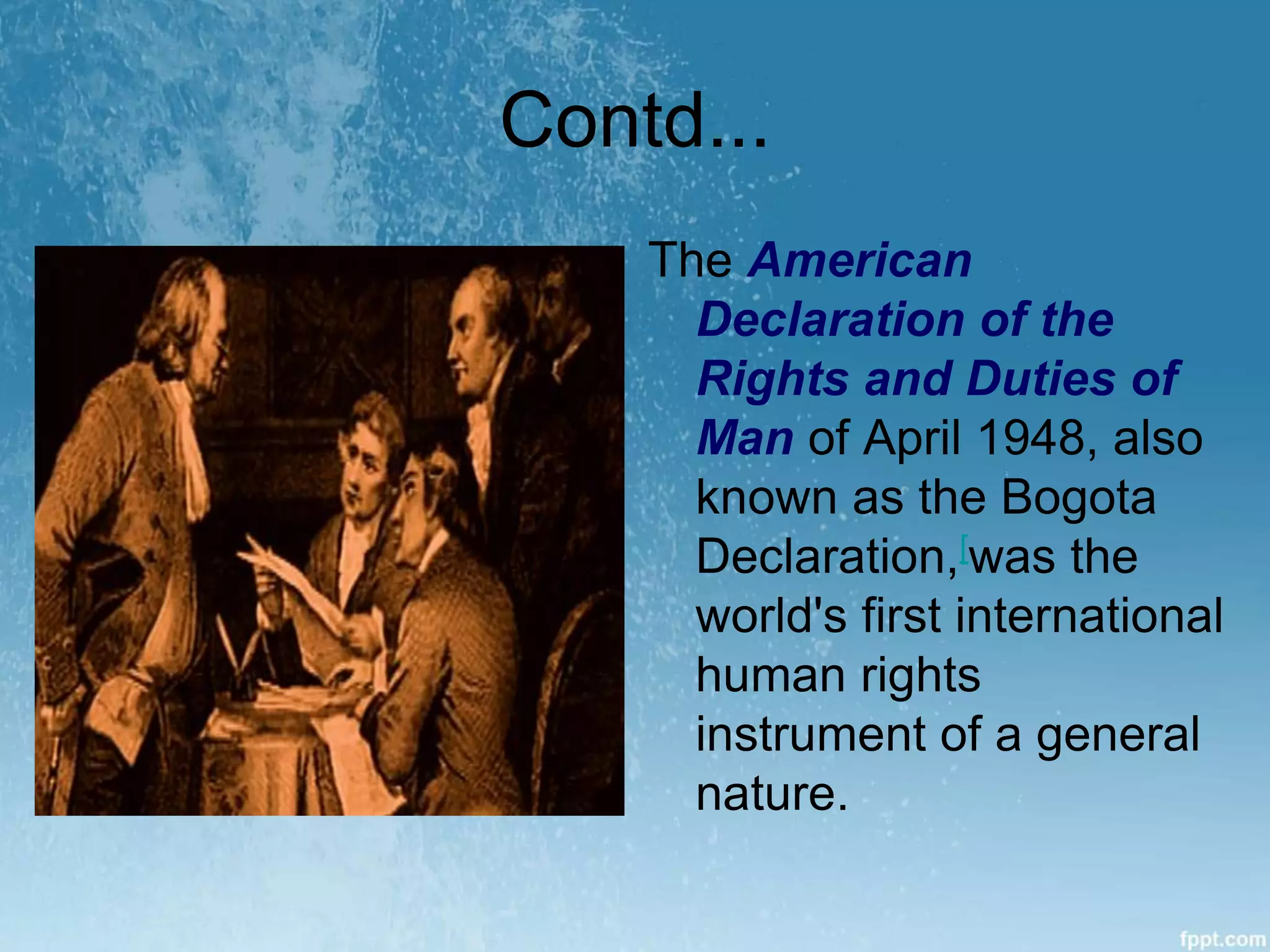
The American
Declaration of the
Rights and Duties of
Man of April 1948, also
known as the Bogota
Declaration,[was the
world's first international
human rights
instrument of a general
nature.
Contd...
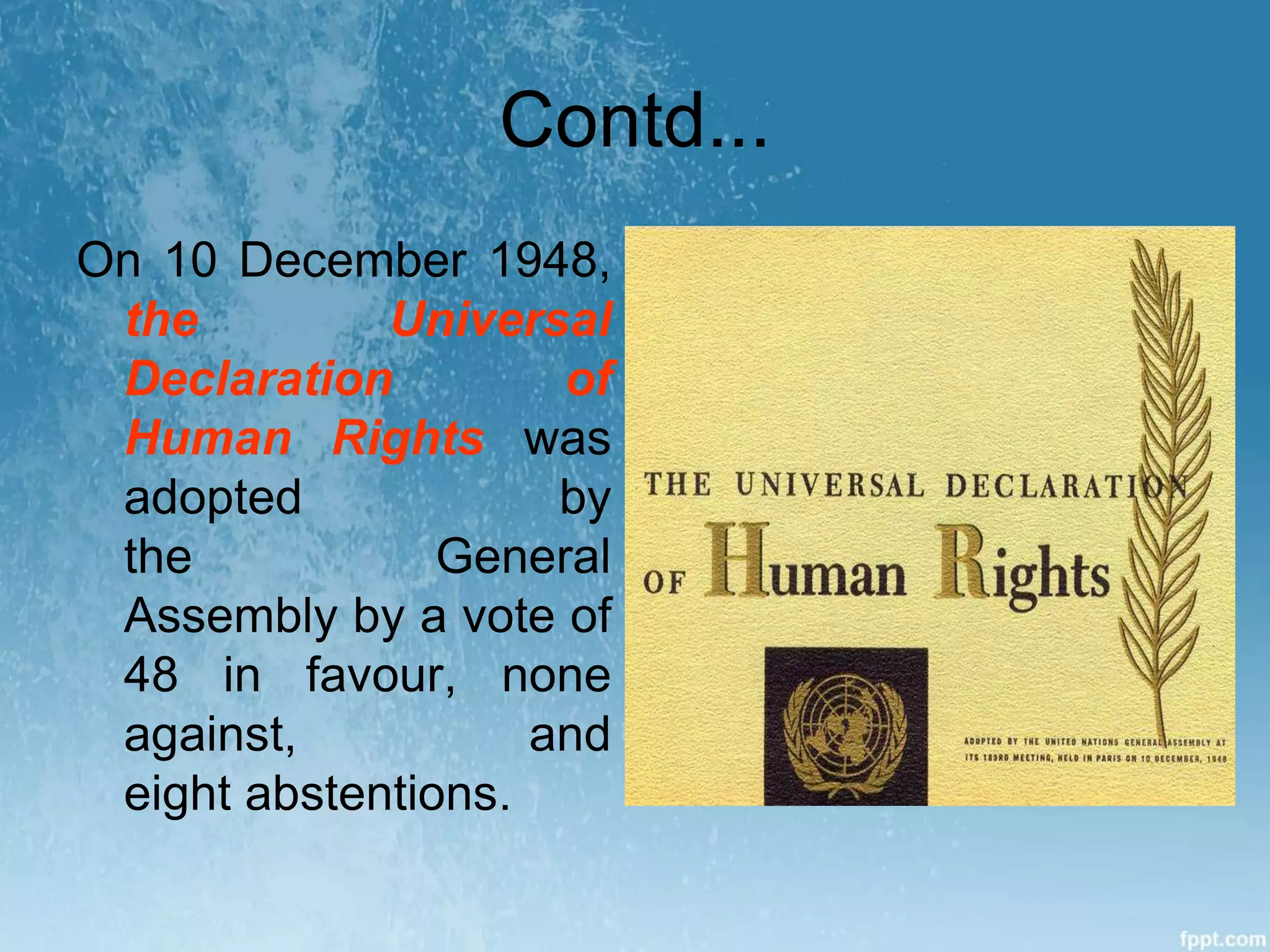
On 10 December 1948,
the Universal
Declaration of
Human Rights was
adopted by
the General
Assembly by a vote of
48 in favour, none
against, and
eight abstentions.
The Universal Declaration of Human Rights—the first
document listing the 30 rights to which everyone is entitled
Basics of IPR
• What is property?
• What is Intellectual property (IP)?
• What is Intellectual Property
Rights(IPR)?
10 December 2016
Property
• The term is extraordinarily difficult to answer.
• Ordinary person defines property as ‘thing’ but attorney defines it
as ‘right’. It has three understandings :
• Legal Understandings:
Property is the inclusion of rights of exclusive use and alienability
• Economic Understandings:
Property includes all rights of individuals to valuable resources.
• Scientific Understandings:
Properties are attributes, characteristics or qualities that can be
applied generally to a group of objects.
10 December 2016
• Begin with Reeve's (1986, p. 11) definition
of property. Owner A owns property P if
and only if:
• 1) A has the right to use P;
• 2) A may exclude others from using P;
• 3) A may transfer rights
Property involves a bundle of rights,
including the rights of usufruct,
exclusivity, and alienability. The entire
bundle can be held by one person or
divided among multiple parties. Property
rights confer power.
10 December 2016
Types of Property
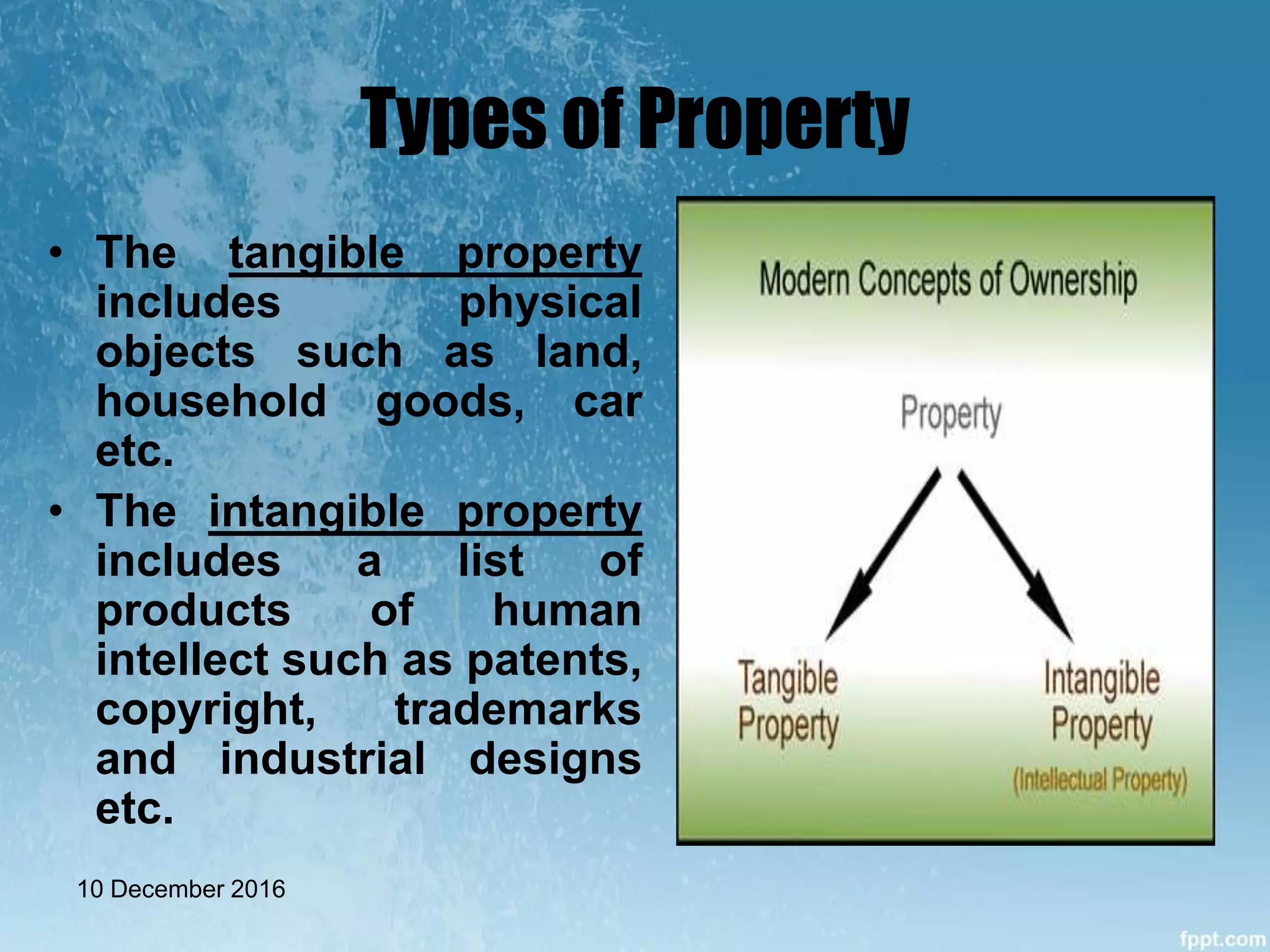
• The tangible property
includes physical
objects such as land,
household goods, car
etc.
• The intangible property
includes a list of
products of human
intellect such as patents,
copyright, trademarks
and industrial designs
etc.
10 December 2016
Rights of A Property Owner
• Right to own
• Right to exclusive use
• Right to disallow
others from its use
• Right to sell
• Right to transfer
• Right to donate
• Right to rent
• Right to lend
• Right to derive profit
out of it
• Property involves a
bundle of rights
• The entire bundle can
be held by one person
or divided among
multiple parties.
• Property rights confer
power.
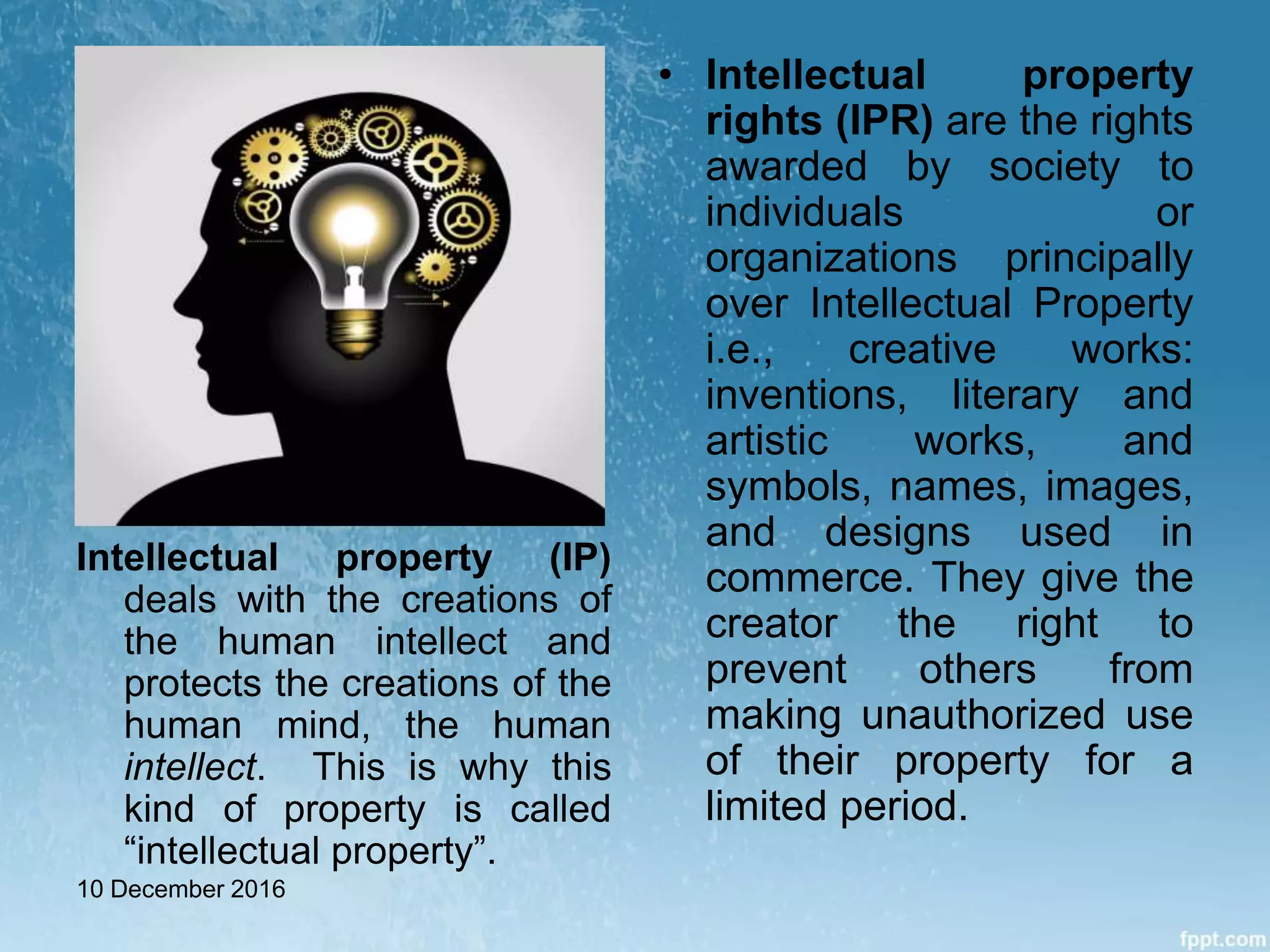
Intellectual property (IP)
deals with the creations of
the human intellect and
protects the creations of the
human mind, the human
intellect. This is why this
kind of property is called
“intellectual property”.
• Intellectual property
rights (IPR) are the rights
awarded by society to
individuals or
organizations principally
over Intellectual Property
i.e., creative works:
inventions, literary and
artistic works, and
symbols, names, images,
and designs used in
commerce. They give the
creator the right to
prevent others from
making unauthorized use
of their property for a
limited period.
10 December 2016
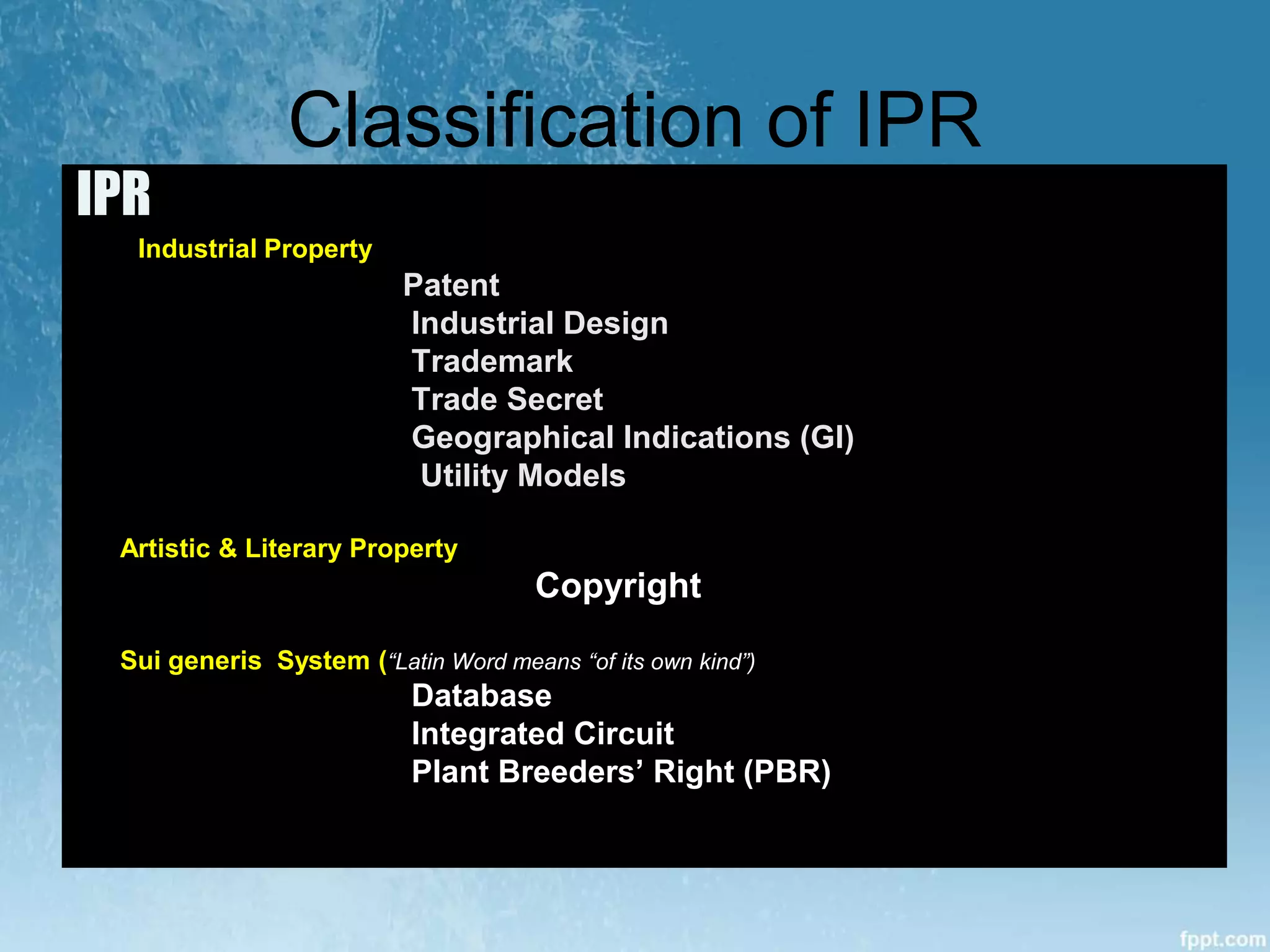
Classification of IPR
IPR
Industrial Property
Patent
Industrial Design
Trademark
Trade Secret
Geographical Indications (GI)
Utility Models
Artistic & Literary Property
Copyright
Sui generis System (“Latin Word means “of its own kind”)
Database
Integrated Circuit
Plant Breeders’ Right (PBR)
India’s International Obligations
• India is a member of WTO (World Trade
Organization) and many international
agreements and conventions. Thus India
is bound to comply with all these
agreements and conventions through a
series of acts and ratifications to discharge
of her international obligations in the field
of intellectual property rights to many
international agreements are:
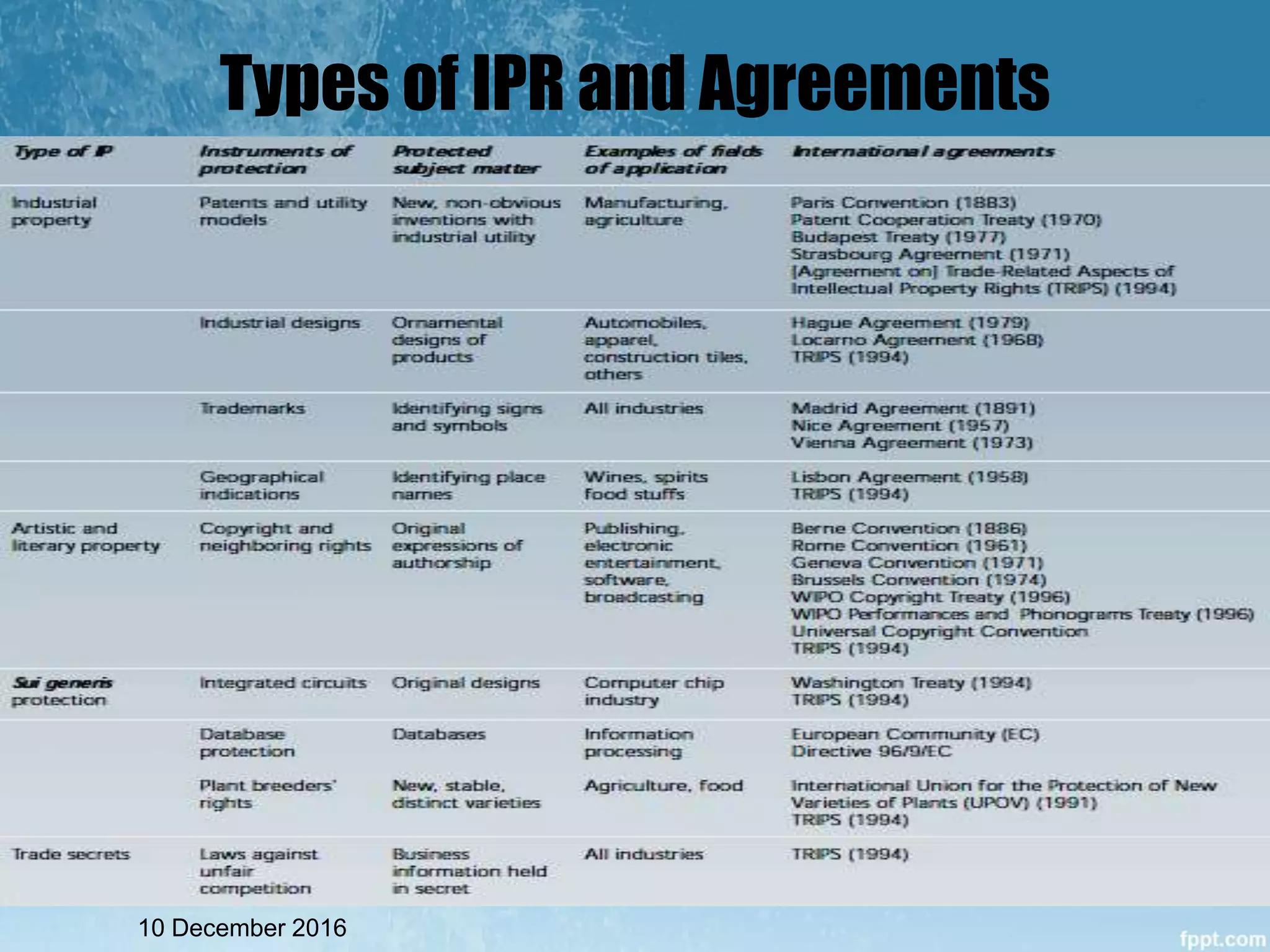
Types of IPR and Agreements
10 December 2016
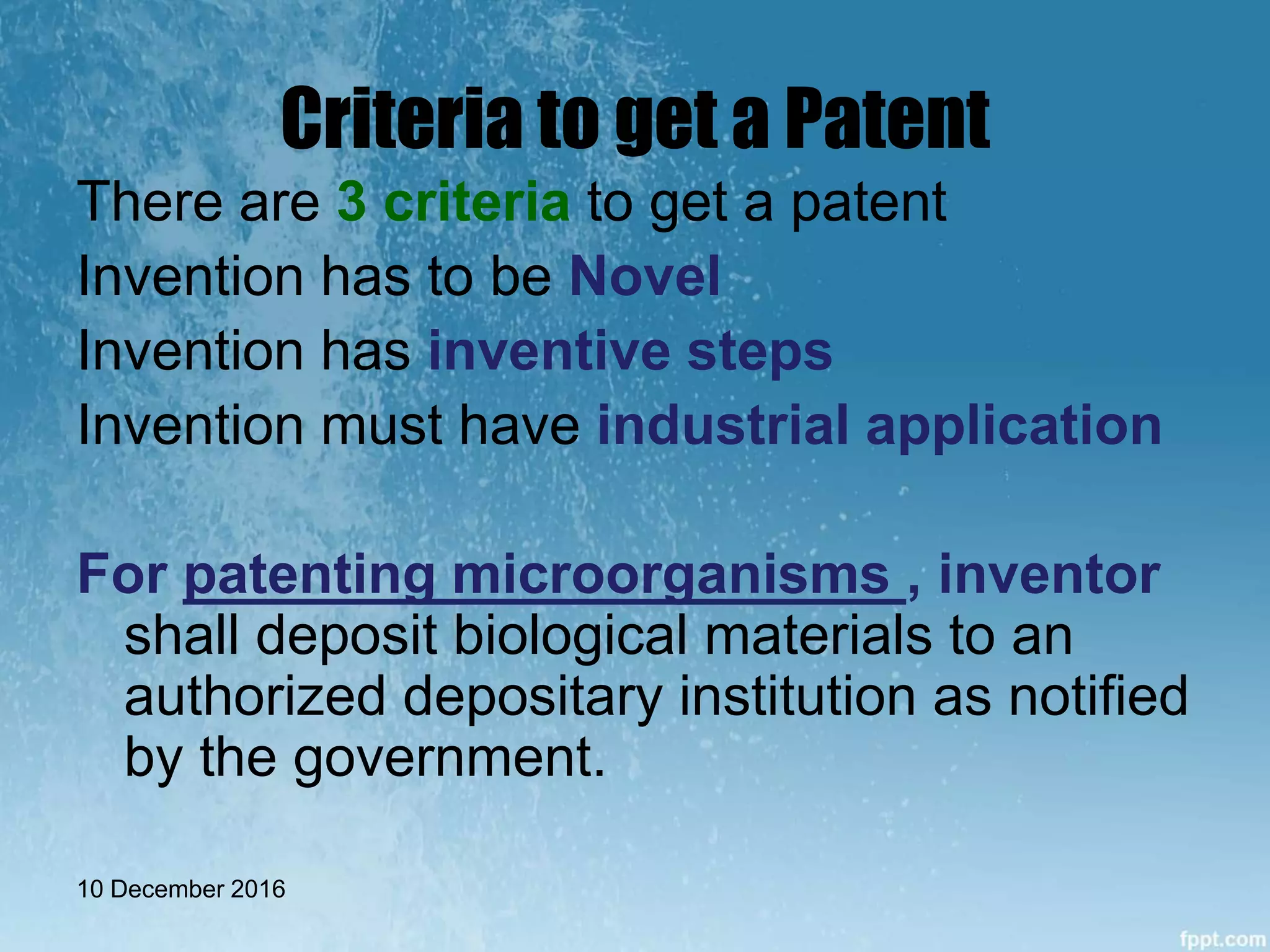
Criteria to get a Patent
There are 3 criteria to get a patent
Invention has to be Novel
Invention has inventive steps
Invention must have industrial application
For patenting microorganisms , inventor
shall deposit biological materials to an
authorized depositary institution as notified
by the government.
10 December 2016
First Patent
• The first recorded
patent for an
industrial invention
was granted in 1421
in Florence to the
architect and
engineer Filippo
Brunelleschi. The
patent gave him a
three-year monopoly
on the manufacture
of a barge with
hoisting gear used to
transport marble.
10 December 2016
Landmark Patents
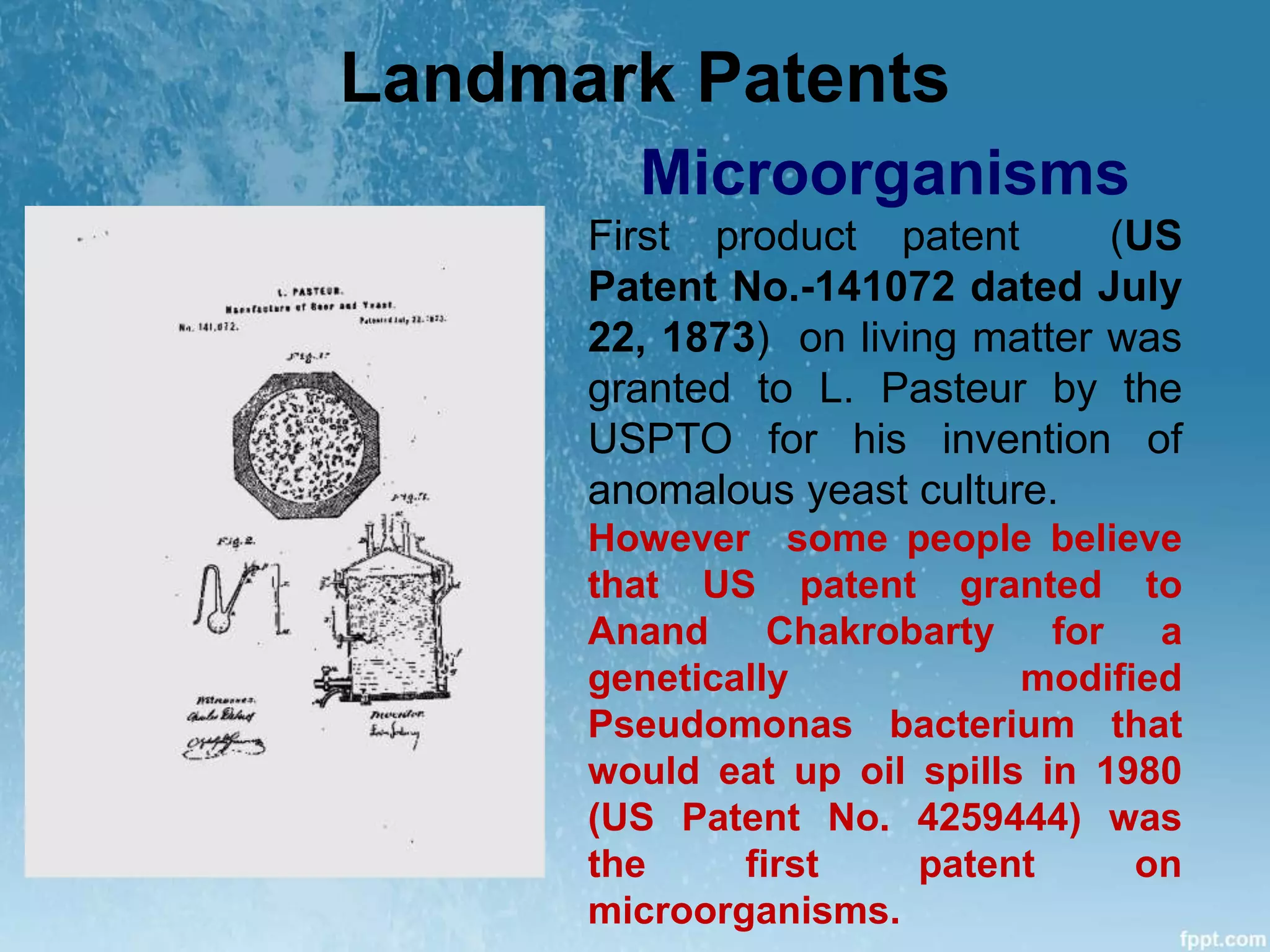
Microorganisms
First product patent (US
Patent No.-141072 dated July
22, 1873) on living matter was
granted to L. Pasteur by the
USPTO for his invention of
anomalous yeast culture.
However some people believe
that US patent granted to
Anand Chakrobarty for a
genetically modified
Pseudomonas bacterium that
would eat up oil spills in 1980
(US Patent No. 4259444) was
the first patent on
microorganisms.
Plants
In 1930, the United States
began granting patents for
plants and in 1931, the first
plant patent was issued to
Henry Bosenberg for his
climbing, ever-blooming rose
by the USPTO (Patent No.-
PP00001 dated 18th August,
1931). Under patent law, the
inventor of a plant is the person
who first appreciates the
distinctive qualities of a plant
and reproduces it asexually.
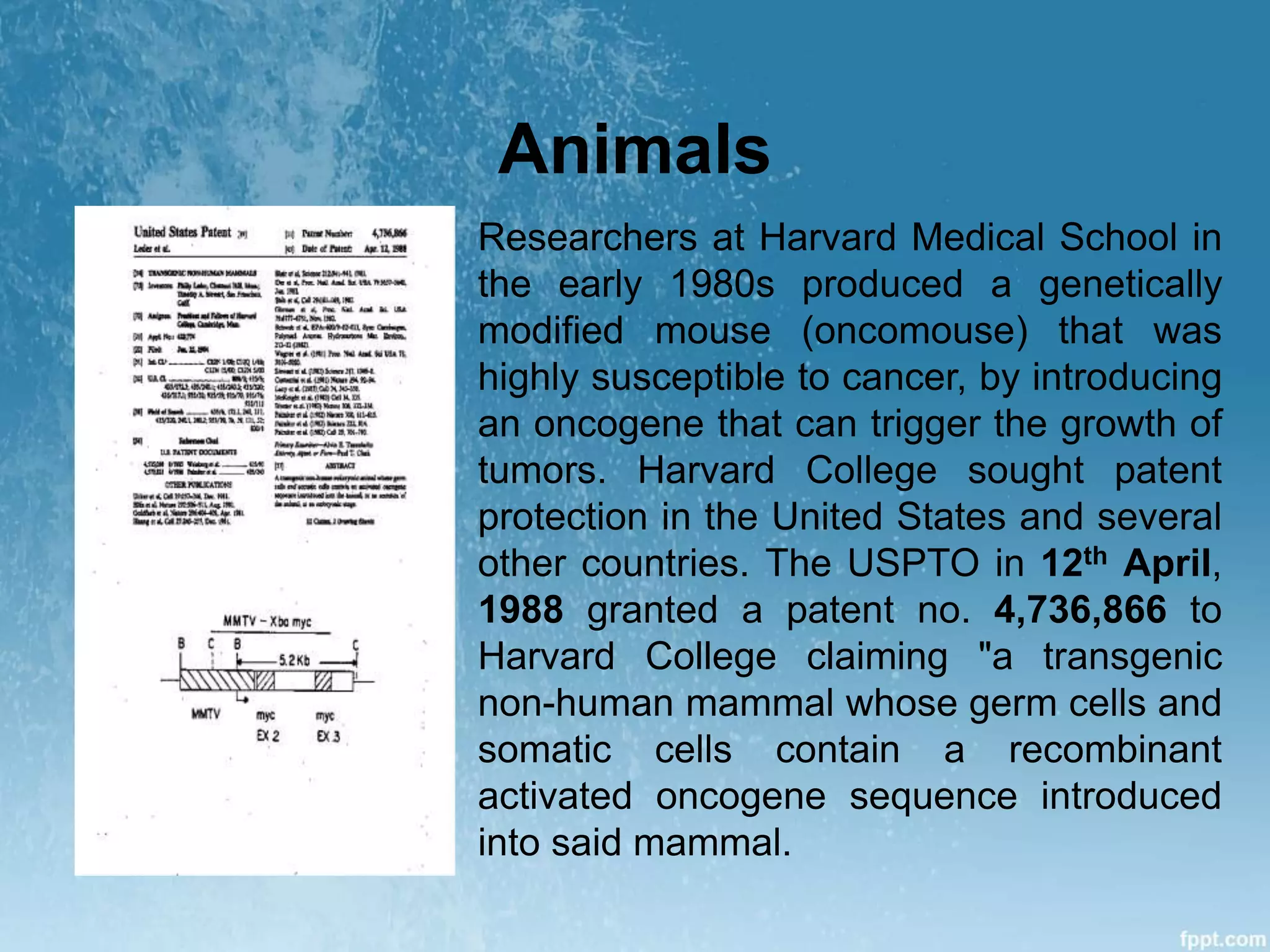
Animals
Researchers at Harvard Medical School in
the early 1980s produced a genetically
modified mouse (oncomouse) that was
highly susceptible to cancer, by introducing
an oncogene that can trigger the growth of
tumors. Harvard College sought patent
protection in the United States and several
other countries. The USPTO in 12th April,
1988 granted a patent no. 4,736,866 to
Harvard College claiming "a transgenic
non-human mammal whose germ cells and
somatic cells contain a recombinant
activated oncogene sequence introduced
into said mammal.
Patent on Biological Resources
10 December 2016
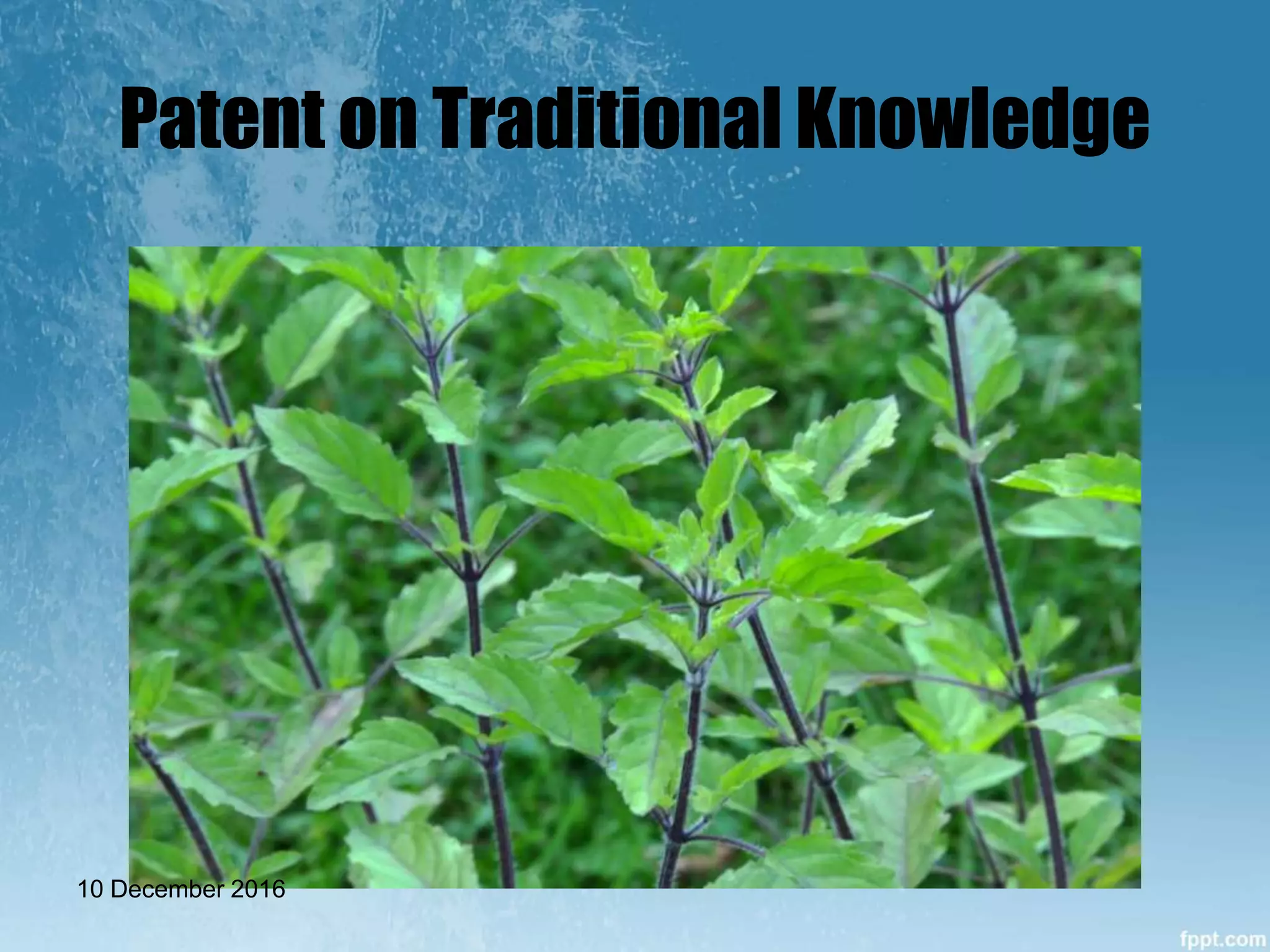
Patent on Traditional Knowledge
10 December 2016
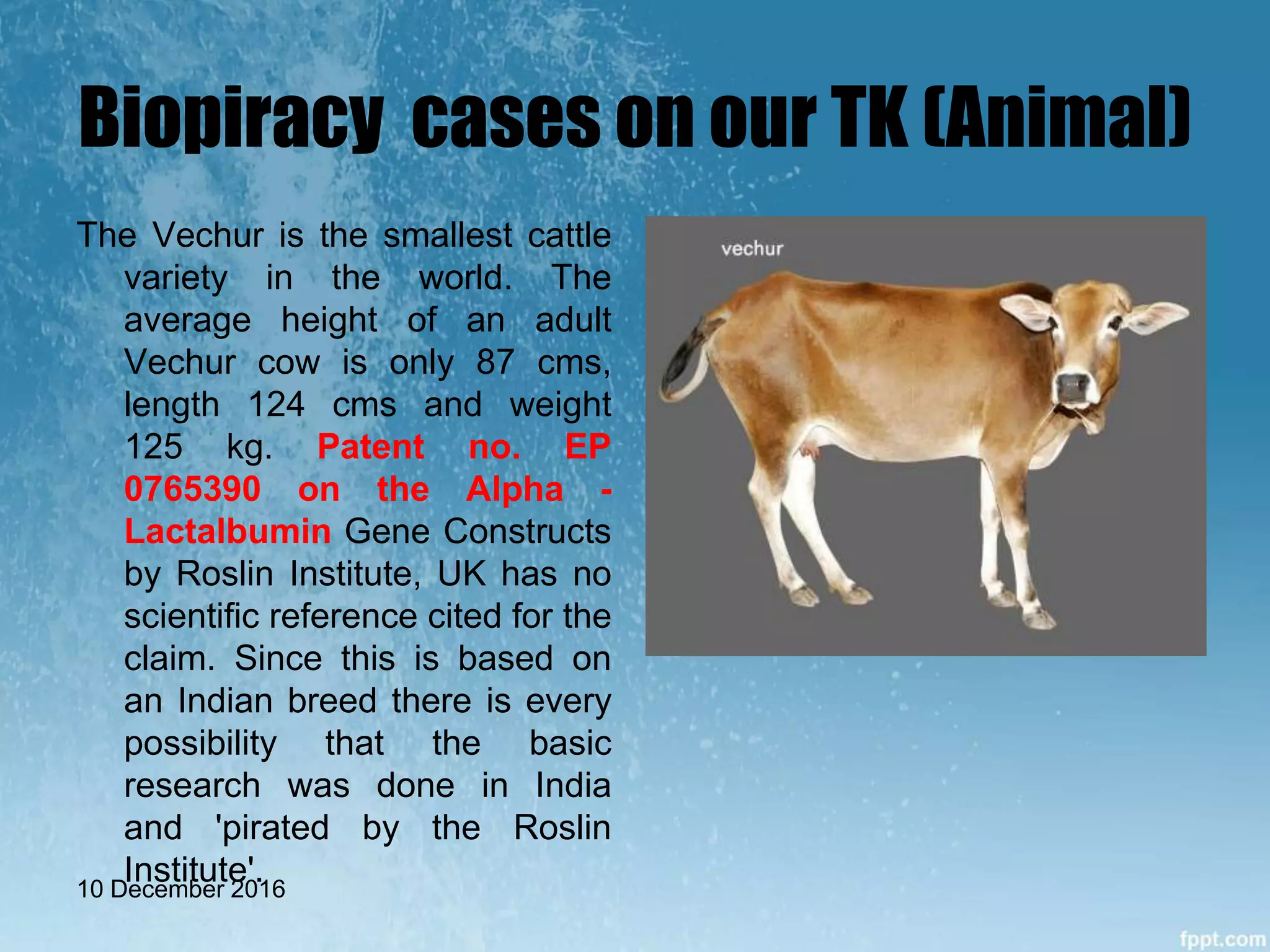
Biopiracy cases on our TK (Animal)
The Vechur is the smallest cattle
variety in the world. The
average height of an adult
Vechur cow is only 87 cms,
length 124 cms and weight
125 kg. Patent no. EP
0765390 on the Alpha -
Lactalbumin Gene Constructs
by Roslin Institute, UK has no
scientific reference cited for the
claim. Since this is based on
an Indian breed there is every
possibility that the basic
research was done in India
and 'pirated by the Roslin
Institute'.10 December 2016
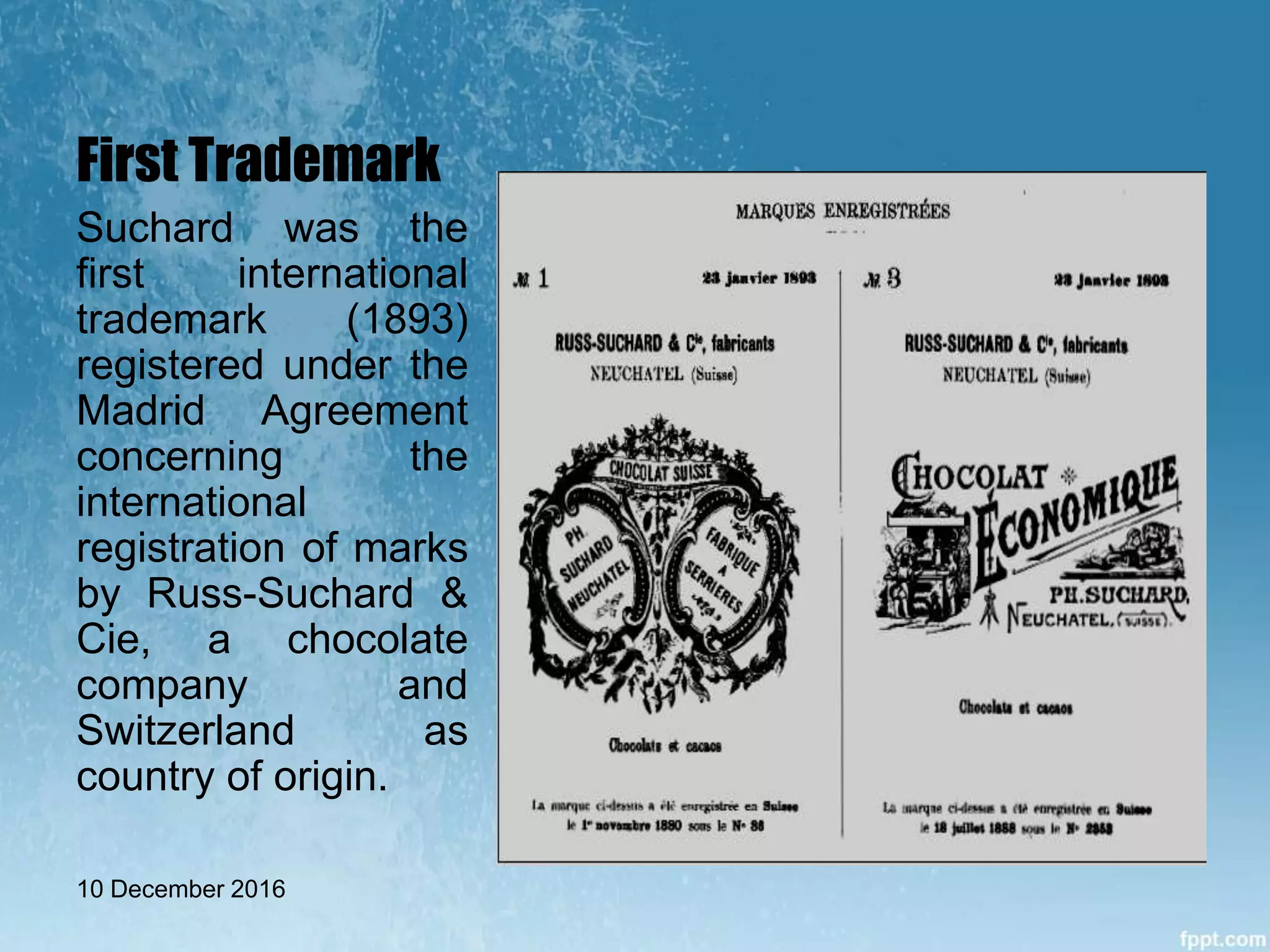
First Trademark
Suchard was the
first international
trademark (1893)
registered under the
Madrid Agreement
concerning the
international
registration of marks
by Russ-Suchard &
Cie, a chocolate
company and
Switzerland as
country of origin.
10 December 2016
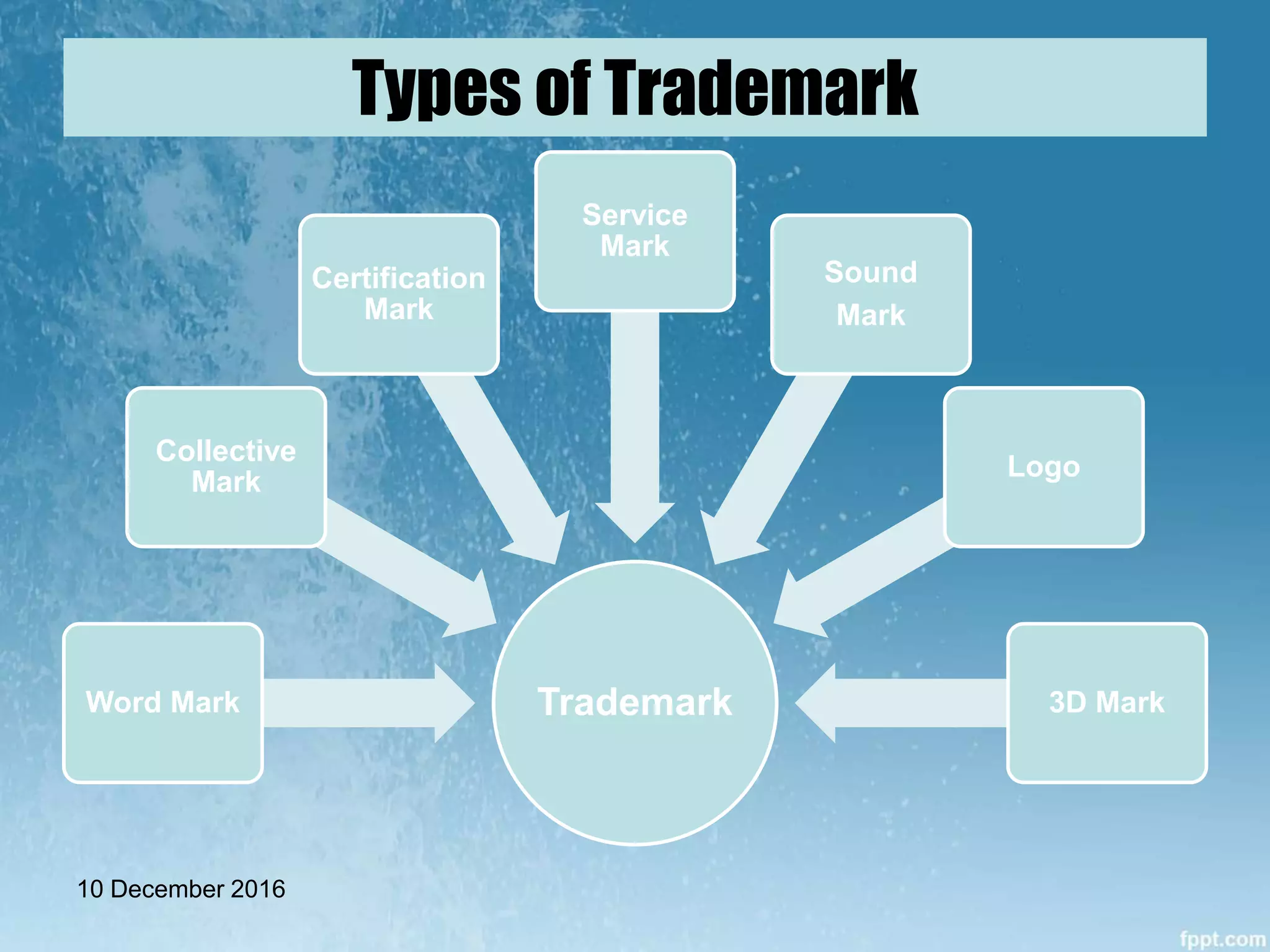
Types of Trademark
TrademarkWord Mark
Collective
Mark
Certification
Mark
Service
Mark
Sound
Mark
Logo
3D Mark
10 December 2016
First Design
George Bruce (July 5,
1781 – July 6,
1866) was an American
printer, industrialist and
inventor. On 9
November 1842 he
was awarded the
first design patent (a
new form
of patent authorized
by Act of Congress)
for fonts(printing
typefaces and borders).
10 December 2016
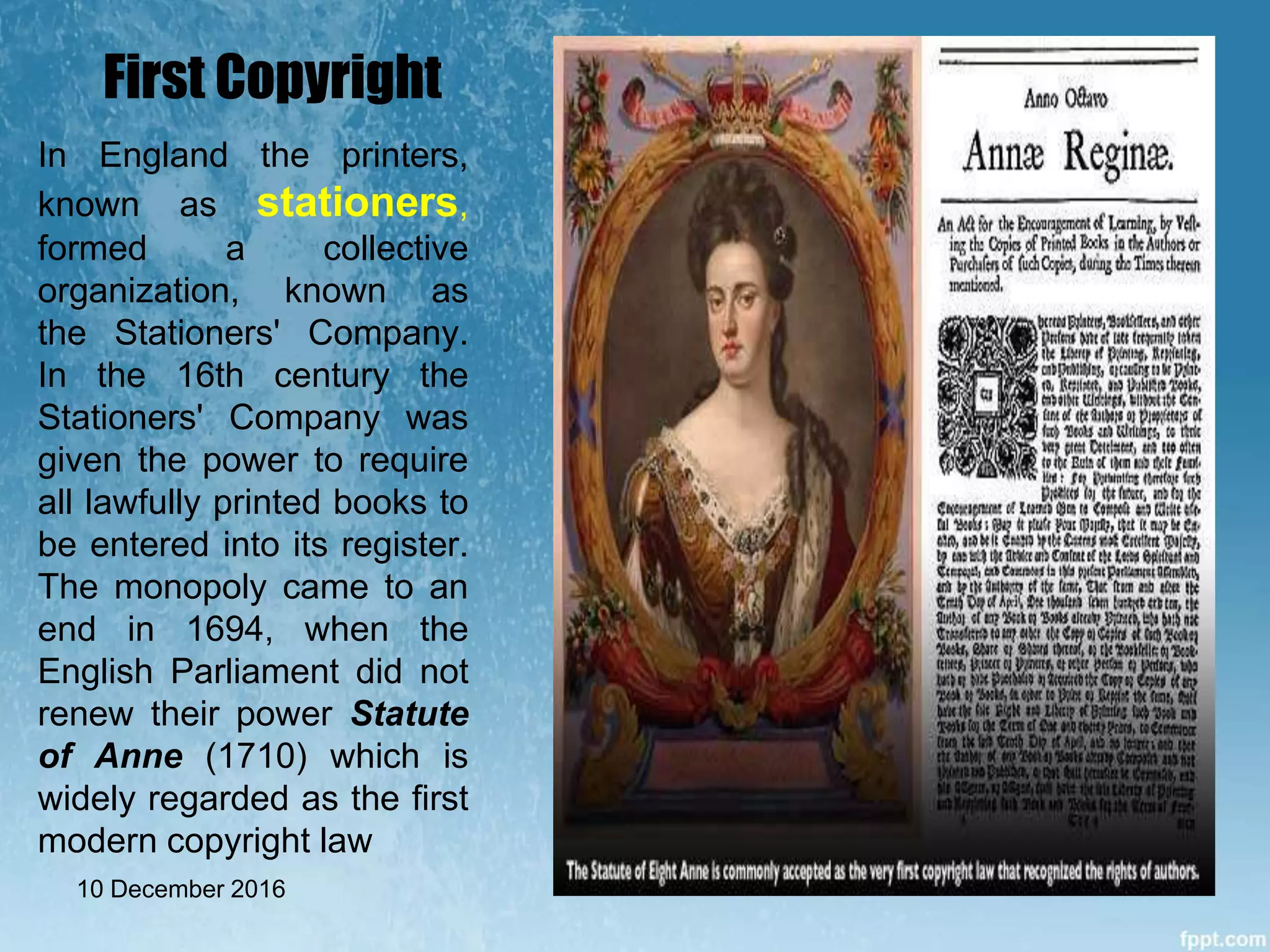
First Copyright
In England the printers,
known as stationers,
formed a collective
organization, known as
the Stationers' Company.
In the 16th century the
Stationers' Company was
given the power to require
all lawfully printed books to
be entered into its register.
The monopoly came to an
end in 1694, when the
English Parliament did not
renew their power Statute
of Anne (1710) which is
widely regarded as the first
modern copyright law
10 December 2016
Interplay of Human Rights & IPR
Key international
human-rights
instruments have
acknowledged that
intellectual products
have an intrinsic
value as an
expression of
human creativity
and dignity
• Article 27 section 1 of the
UDHR states that everyone has
the right to the protection of
the moral and material interests
resulting from any scientific,
literary or artistic production of
which he is the author.
• This right is linked to another
provision section 2 of Article
27: ‘Everyone has the right
freely to participate in the
cultural life of the community, to
enjoy the arts and to share in
scientific advancement and its
benefits.
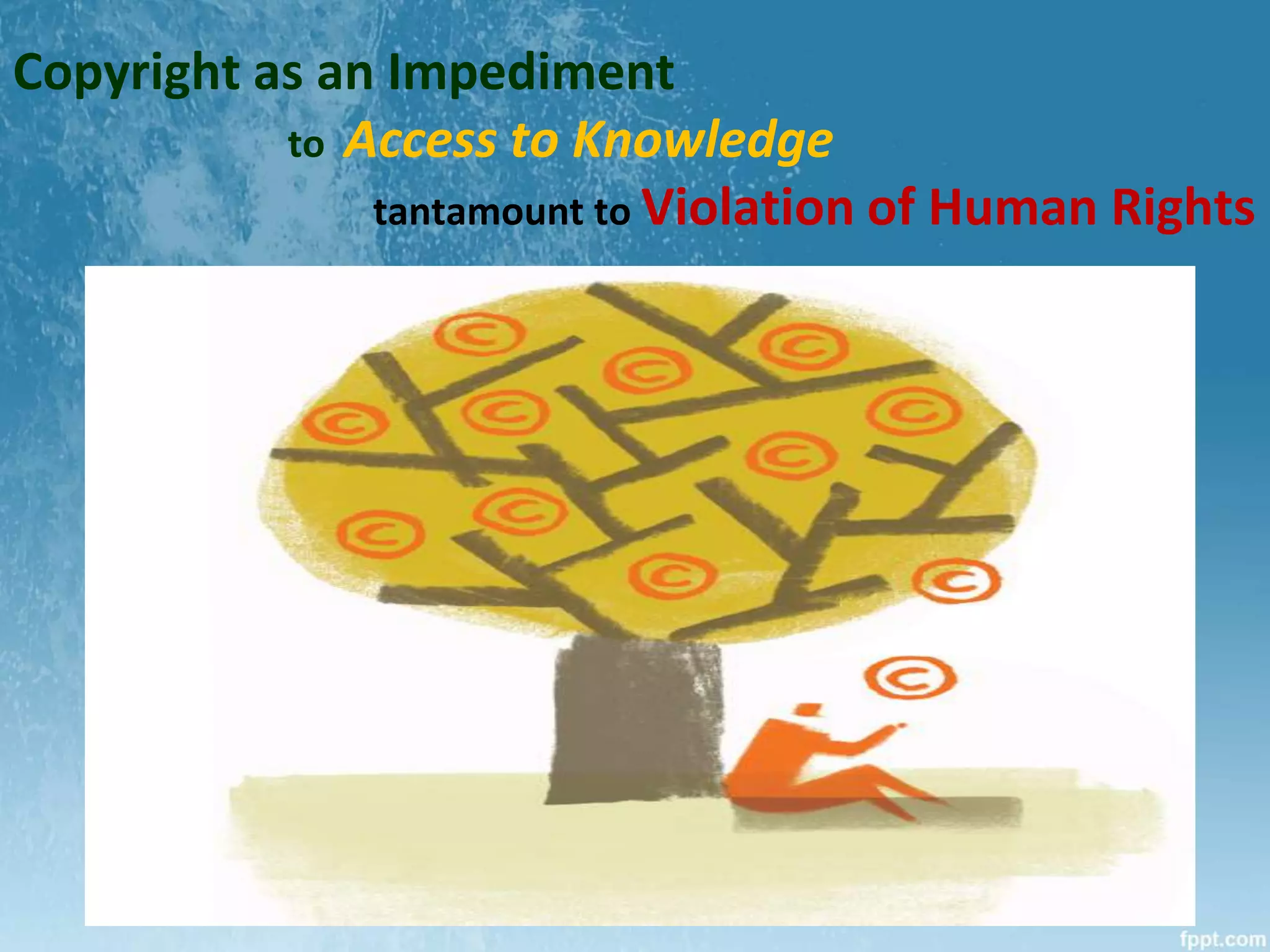
Copyright as an Impediment
to Access to Knowledge
tantamount to Violation of Human Rights
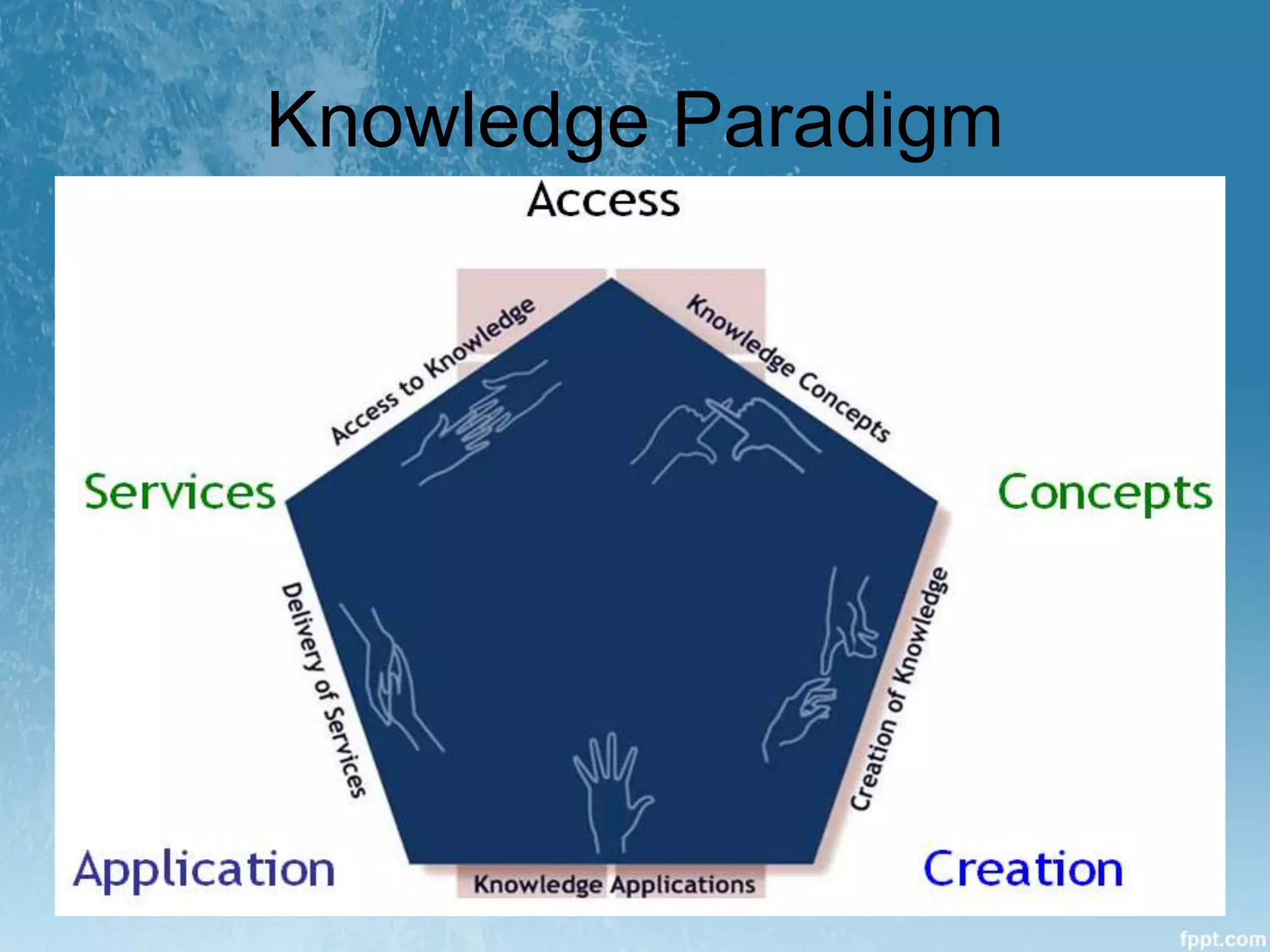
Knowledge Paradigm
33
A Few Realities in Academia
12/10/2016 34
Knowledge Criminals!!!
12/10/2016
40
Copyright is a kind of Intellectual Property Rights (IPR)
Copyright is a right given by the law to creators of
literary, dramatic, musical and artistic works and
producers of cinematograph films and sound recordings
for a limited period of time after that it goes into the
public domain.
For copyright protection:
•The work must be original.
•The work must be fixed, or presented in a tangible form such
as writing, film, or photography.
• Created by any qualified person
Let Us Discuss The Functional
Aspects… of Copyright
Rights of Copyright Owners
• Copyright is in essence a bundle of rights covering the following:
Rights for reproduction, i.e. exclusive rights to make copies of the
work.
Rights for modification/adaptation, i.e. exclusive rights to modify and
make adaptations and create derivative works.
Rights for distribution, i.e. the rights distribute the work to the public.
Rights for public performance, i.e. the right to recite, play, dance, or
act with or without the aid of a machine.
Rights for public display, i.e. the right to display the work anywhere
that is open to the public
12/10/2016
Copyright as Economic or Moral Right
Copyright
Economic Right Moral Right
assigned, licensed Can not be
or reserved transferred
12/10/2016
Basic values and ideology of copyright
The basic values and ideology of
copyright are attached with 4 elements
namely,
• Individualism
• Commodification
• Reward
• Consumerism
(The Copy/South Research Group April 2006)
12/10/2016 45
Sharp Contradiction
IP protection is a
necessary tool for
development.
IP is viewed as the
indispensable
ingredient in the
complex process of
knowledge and
wealth creation
Berne Convention
Berne Convention (1886)
is the WIPO driven CR
Convention incorporated
into the TRIPS agreement
India is a member of Berne
Convention (1928-04-01)
India has been a WTO member
since 1 January 1995
India joins TRIPS on January 1,
2005
Early Days of the Convention
France, Germany, and the UK signed the Berne Convention
in 1886, they effectively committed their colonies to the
Convention’s Obligations.
 British India signed Berne Convention in 1928
When colonies across the South became formally
independent countries, many during the 1950s and 1960s
including India, they were forced to comply with the Berne
Convention.
Berne Convention is a particularly rigid ,
Inflexible and Colonial convention
New need with Independence
• Economic growth and
development often led the list
of their national priorities. Their
needs in the information field –
greatly expanded levels of
literacy, the rapid
establishment of schools,
colleges and universities at all
levels, getting even limited
access to printed materials,
especially in technical and
scientific fields – were very
different from those of rich
nations.
Conflict of Interest
• Most countries in the
South quickly realized
that international
copyright conventions
had not been set up
with their particular
interests or
requirements in mind
rather they are
essentially European
in orientation
Violation of Human Rights
Controlling Knowledge
through strong Copyright
regime globally is a strong
violation of HUMAN
RIGHTS in the global
South or developing
nations
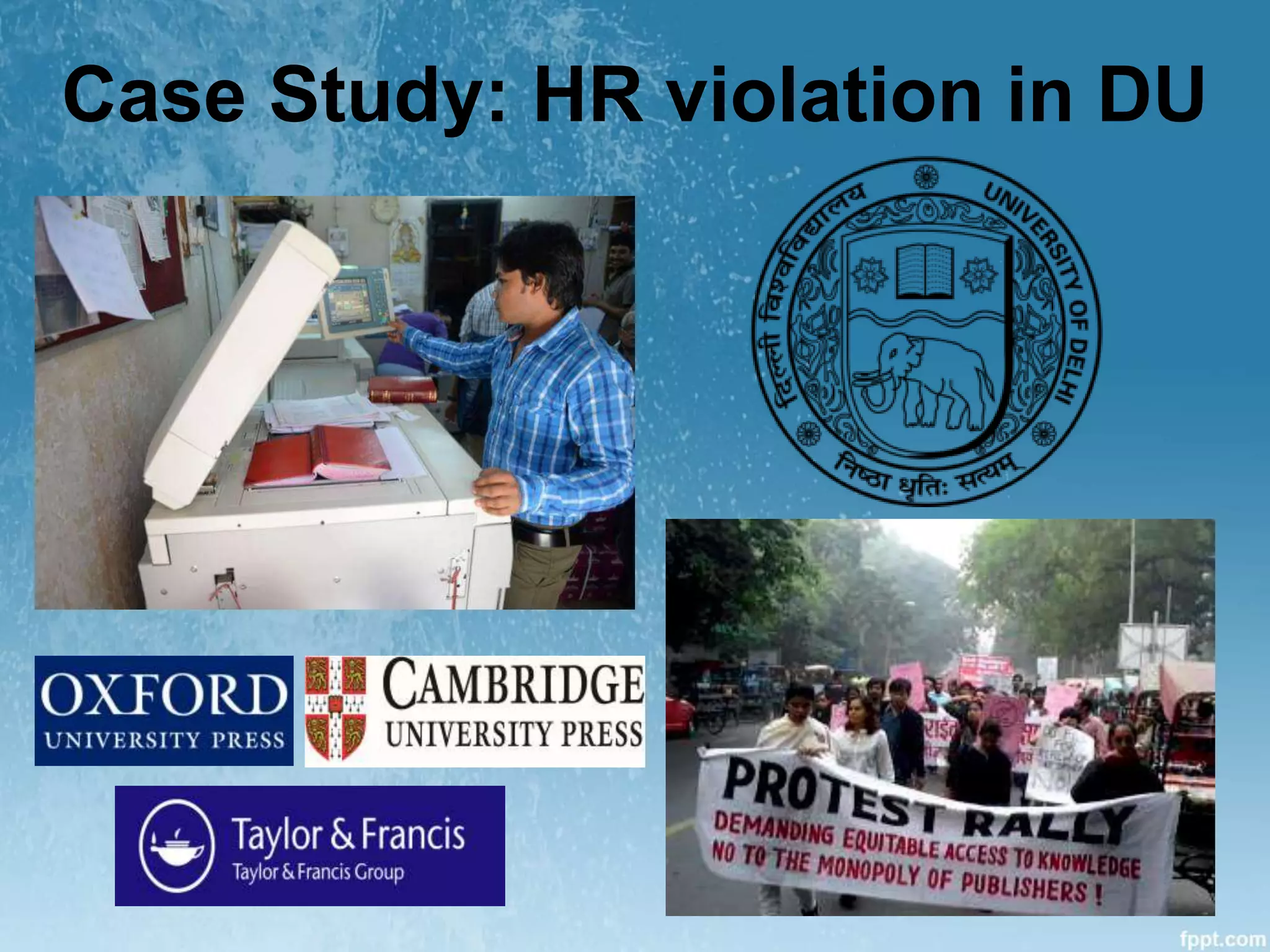
Case Study: HR violation in DU
Contd...
• The petition was filed by three publishers—Oxford
University Press, Cambridge University Press and
Taylor & Francis —against the University of Delhi
and Rameshwari Photocopy Services, alleged to
have violated India’s copyright law by selling
photocopied compilations of study material as
‘course packs’. The petitioners argue that this
amounts to a parallel publishing enterprise of sorts
that is not just illegal, but also harms their market
sales.
Contd...
Article 26 (section 1) of
the UDHR says that
• Everyone has the right to
education. Education shall
be free, at least in the
elementary and fundamental
stages. Elementary
education shall be
compulsory. Technical and
professional education shall
be made generally available
and higher education shall
be equally accessible to all
on the basis of merit.
• Section 52 of the Indian
Copyright Act, 1957 says
that
• Certain acts not to be
infringement of
copyright that
constitutes Fair Dealing
for purposes of private
study, research,
criticism, review, or
newspaper summary
Copying-Qualitative or Quantitative ?
Copying
21-12-2015
What is Fair Use ?
21-12-2015
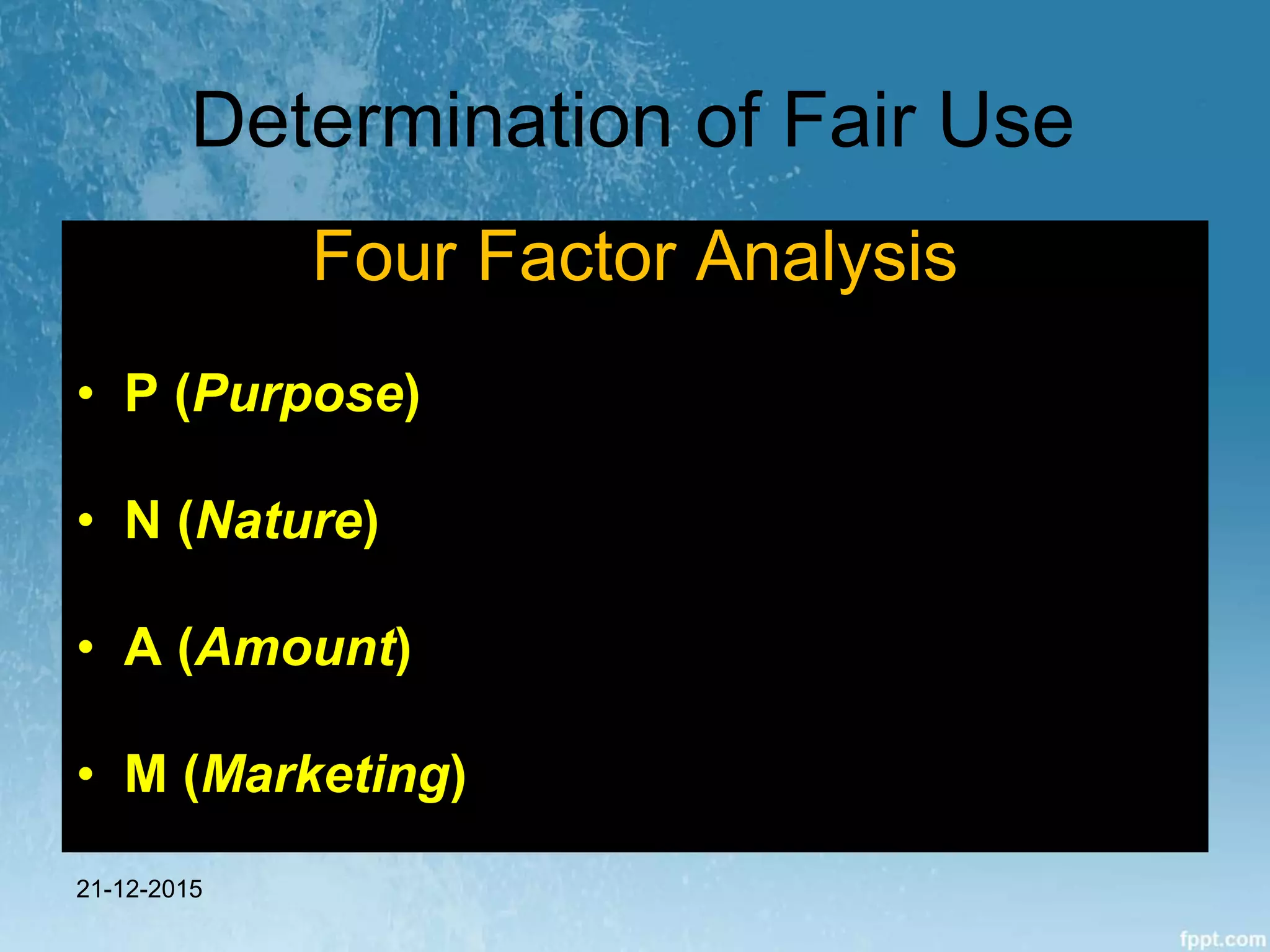
Determination of Fair Use
Four Factor Analysis
• P (Purpose)
• N (Nature)
• A (Amount)
• M (Marketing)
21-12-2015
Contd...
• The University of Delhi and
Rameshwari Photocopy Service have
been restrained from photocopying
extracts and compiling them into
course packs for students. The
injunction order has been passed by
the Delhi High Court in September
2012.
Contd...
• In the Indian scenario, the law provisions are
fairly straightforward – Photocopying extracts is
legal under Section 52(1)(a) of the Indian
Copyright Act that permits ‘fair dealing for private
use, including research’ and 52(1)(i) that allows
‘reproduction in the course of instruction by a
teacher or pupil’. Unfortunately, the injunction
order passed by the Delhi High Court was based
on an alleged ‘admission’, which was in fact a
good faith defence by the University under
Section 76 of the Copyright Act.
Contd...
• The photocopy shop here is only an
extension of the University of Delhi and
Ratan Tata Library and is even located within
the university campus. They receive instructions
from the Department on what exactly to
photocopy, based on reading lists made
available by professors and are barred from
undertaking any ‘outside jobs’. There is a
formalized license agreement, with rules and
guidelines, including the price that must be
charged.
Final Judgement
• Finally, Delhi High Court on 16th September 2016 in a
landmark judgement rejected the plea placed by a group
of publishers including Oxford University Press,
Cambridge University Press and Taylor & Francis and
said that “Copyright is not a divine right". Copyright is
there to promote creativity but not to impede the
knowledge harvesting by the students. Thus labeling
making photocopies by students out of their textbooks
taken out from the library is not crime rather it should be
considered as a process of knowledge harvesting by the
students who otherwise cannot afford costly textbook. It
also comes under the ambit of Section 52 of the Indian
Copyright Act meant for fair dealing of the copyrighted
works of creators.
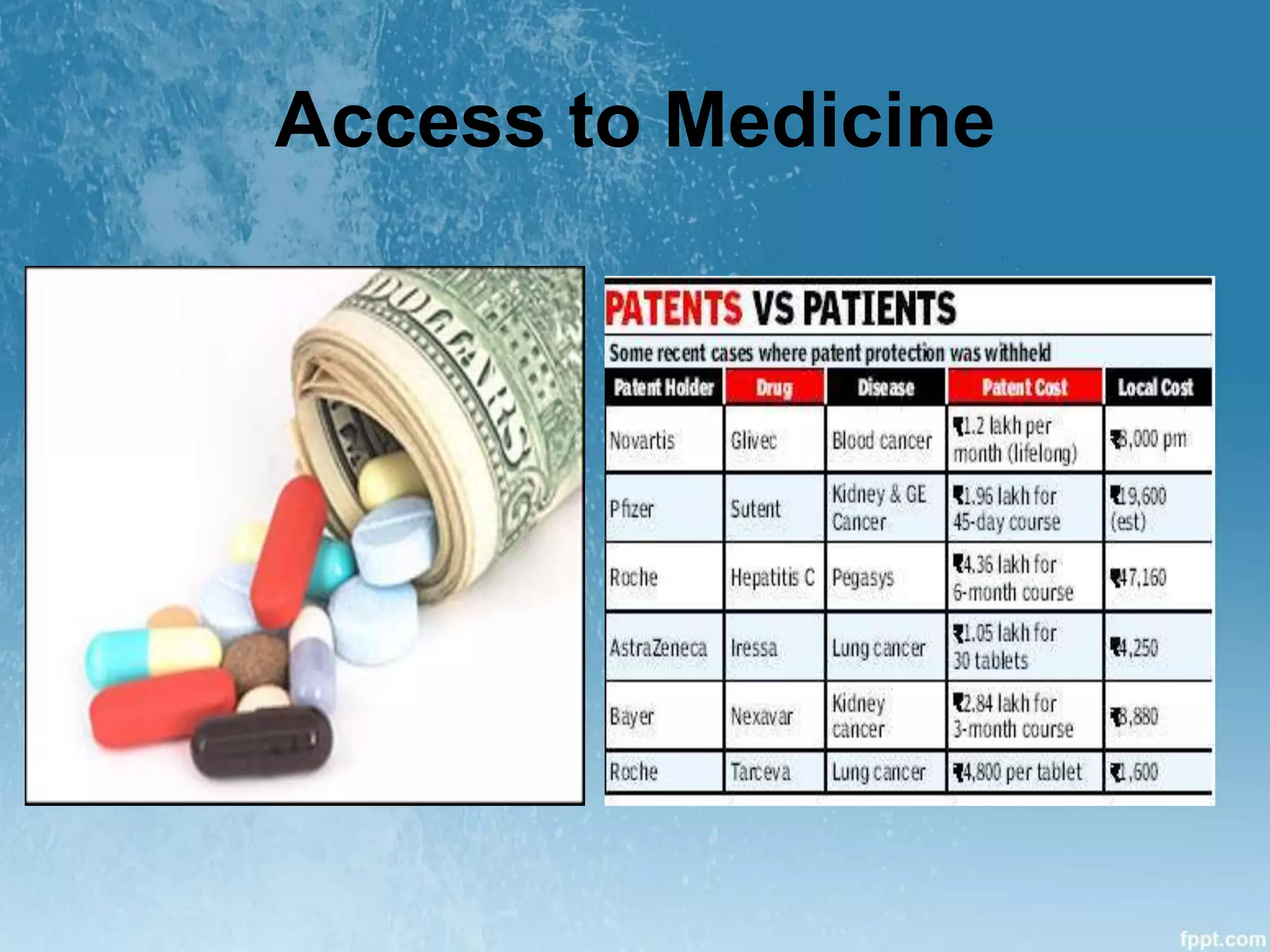
Access to Medicine
Novartis Glivec Case Study
• Glivec (imatinib mesylate), produced by the pharmaceutical
company Novartis, is prescribed in the case of Chronic Myeloid
Leukemia, one of the most common blood cancers in eastern
countries. After more than a decade of legal battles surrounding its
patentability, the Supreme Court of India gave its final decision on
April 1st of 2013, rejecting the appeal of the Swiss giant drug
manufacturer. In 2006, the Indian Patent Office first refused Glivec’s
patent under Section 3(d) of the Indian Patent Act arguing that it was
only a modified version of an existing drug, Imatinib, and therefore
that the drug was not innovative. Novartis replied filing legal
challenges against the Indian government but the final verdict in
April of 2013 ends the battle. Indeed, the Supreme Court stated that
even if the bioavailability of the drug was improved, it did not
demonstrate enhanced efficacy and that Glivec was not patentable.
Contd...
• Imatinib, sold under the brand
names Gleevec and Glivec, is
a medication used in the
treatment of multiple cancers,
most notably Philadelphia
chromosome-positive
(Ph+) chronic myelogenous
leukemia (CML) and
also gastrointestinal stromal
tumors (GIST). Compared to
older drugs imatinib has a
relatively benign side effect
profile, allowing many
patients to live a normal
lifestyle.
Contd...
• Indian companies can
now roll out a generic
and a much cheaper
version of the life
saving cancer drug,
which is a big blow to
Western pharma
firms.
Thank you

IPR and Human Rights: an introduction

  • 1.
    IPR and HumanRights: an introduction Dr. Sabuj Kumar Chaudhuri DLIS, University of Calcutta, WB, India Contact>>>>sabujkchaudhuri@gmail.com
  • 2.
    What is HumanRights ? What is IPR?
  • 3.
    Let us understand... •What is a human ? • What is right ? Human + Right = Human Right
  • 4.
    Look Back atthe Genesis... • The Cyrus Cylinder (539 BC), a clay tablet is considered as the first human rights declaration in history. It is translated into all six official languages of the United Nations and its provisions parallel the first four Articles of the Universal Declaration of Human Rights. • 1215: The Magna Carta—gave people new rights and made the king subject to the law. 1628: The Petition of Right—set out the rights of the people. 1776: The United States Declaration of Independence— proclaimed the right to life, liberty and the pursuit of happiness. 1789: The Declaration of the Rights of Man and of the Citizen—a document of France, stating that all citizens are equal under the law.
  • 5.
  • 6.
    Contd... The American Declaration ofthe Rights and Duties of Man of April 1948, also known as the Bogota Declaration,[was the world's first international human rights instrument of a general nature.
  • 7.
    Contd... On 10 December1948, the Universal Declaration of Human Rights was adopted by the General Assembly by a vote of 48 in favour, none against, and eight abstentions.
  • 8.
    The Universal Declarationof Human Rights—the first document listing the 30 rights to which everyone is entitled
  • 9.
    Basics of IPR •What is property? • What is Intellectual property (IP)? • What is Intellectual Property Rights(IPR)? 10 December 2016
  • 10.
    Property • The termis extraordinarily difficult to answer. • Ordinary person defines property as ‘thing’ but attorney defines it as ‘right’. It has three understandings : • Legal Understandings: Property is the inclusion of rights of exclusive use and alienability • Economic Understandings: Property includes all rights of individuals to valuable resources. • Scientific Understandings: Properties are attributes, characteristics or qualities that can be applied generally to a group of objects. 10 December 2016
  • 11.
    • Begin withReeve's (1986, p. 11) definition of property. Owner A owns property P if and only if: • 1) A has the right to use P; • 2) A may exclude others from using P; • 3) A may transfer rights Property involves a bundle of rights, including the rights of usufruct, exclusivity, and alienability. The entire bundle can be held by one person or divided among multiple parties. Property rights confer power. 10 December 2016
  • 12.
    Types of Property •The tangible property includes physical objects such as land, household goods, car etc. • The intangible property includes a list of products of human intellect such as patents, copyright, trademarks and industrial designs etc. 10 December 2016
  • 13.
    Rights of AProperty Owner • Right to own • Right to exclusive use • Right to disallow others from its use • Right to sell • Right to transfer • Right to donate • Right to rent • Right to lend • Right to derive profit out of it • Property involves a bundle of rights • The entire bundle can be held by one person or divided among multiple parties. • Property rights confer power.
  • 14.
    Intellectual property (IP) dealswith the creations of the human intellect and protects the creations of the human mind, the human intellect. This is why this kind of property is called “intellectual property”. • Intellectual property rights (IPR) are the rights awarded by society to individuals or organizations principally over Intellectual Property i.e., creative works: inventions, literary and artistic works, and symbols, names, images, and designs used in commerce. They give the creator the right to prevent others from making unauthorized use of their property for a limited period. 10 December 2016
  • 15.
    Classification of IPR IPR IndustrialProperty Patent Industrial Design Trademark Trade Secret Geographical Indications (GI) Utility Models Artistic & Literary Property Copyright Sui generis System (“Latin Word means “of its own kind”) Database Integrated Circuit Plant Breeders’ Right (PBR)
  • 16.
    India’s International Obligations •India is a member of WTO (World Trade Organization) and many international agreements and conventions. Thus India is bound to comply with all these agreements and conventions through a series of acts and ratifications to discharge of her international obligations in the field of intellectual property rights to many international agreements are:
  • 17.
    Types of IPRand Agreements 10 December 2016
  • 18.
    Criteria to geta Patent There are 3 criteria to get a patent Invention has to be Novel Invention has inventive steps Invention must have industrial application For patenting microorganisms , inventor shall deposit biological materials to an authorized depositary institution as notified by the government. 10 December 2016
  • 19.
    First Patent • Thefirst recorded patent for an industrial invention was granted in 1421 in Florence to the architect and engineer Filippo Brunelleschi. The patent gave him a three-year monopoly on the manufacture of a barge with hoisting gear used to transport marble. 10 December 2016
  • 20.
    Landmark Patents Microorganisms First productpatent (US Patent No.-141072 dated July 22, 1873) on living matter was granted to L. Pasteur by the USPTO for his invention of anomalous yeast culture. However some people believe that US patent granted to Anand Chakrobarty for a genetically modified Pseudomonas bacterium that would eat up oil spills in 1980 (US Patent No. 4259444) was the first patent on microorganisms.
  • 21.
    Plants In 1930, theUnited States began granting patents for plants and in 1931, the first plant patent was issued to Henry Bosenberg for his climbing, ever-blooming rose by the USPTO (Patent No.- PP00001 dated 18th August, 1931). Under patent law, the inventor of a plant is the person who first appreciates the distinctive qualities of a plant and reproduces it asexually.
  • 22.
    Animals Researchers at HarvardMedical School in the early 1980s produced a genetically modified mouse (oncomouse) that was highly susceptible to cancer, by introducing an oncogene that can trigger the growth of tumors. Harvard College sought patent protection in the United States and several other countries. The USPTO in 12th April, 1988 granted a patent no. 4,736,866 to Harvard College claiming "a transgenic non-human mammal whose germ cells and somatic cells contain a recombinant activated oncogene sequence introduced into said mammal.
  • 23.
    Patent on BiologicalResources 10 December 2016
  • 24.
    Patent on TraditionalKnowledge 10 December 2016
  • 25.
    Biopiracy cases onour TK (Animal) The Vechur is the smallest cattle variety in the world. The average height of an adult Vechur cow is only 87 cms, length 124 cms and weight 125 kg. Patent no. EP 0765390 on the Alpha - Lactalbumin Gene Constructs by Roslin Institute, UK has no scientific reference cited for the claim. Since this is based on an Indian breed there is every possibility that the basic research was done in India and 'pirated by the Roslin Institute'.10 December 2016
  • 26.
    First Trademark Suchard wasthe first international trademark (1893) registered under the Madrid Agreement concerning the international registration of marks by Russ-Suchard & Cie, a chocolate company and Switzerland as country of origin. 10 December 2016
  • 27.
    Types of Trademark TrademarkWordMark Collective Mark Certification Mark Service Mark Sound Mark Logo 3D Mark 10 December 2016
  • 28.
    First Design George Bruce(July 5, 1781 – July 6, 1866) was an American printer, industrialist and inventor. On 9 November 1842 he was awarded the first design patent (a new form of patent authorized by Act of Congress) for fonts(printing typefaces and borders). 10 December 2016
  • 29.
    First Copyright In Englandthe printers, known as stationers, formed a collective organization, known as the Stationers' Company. In the 16th century the Stationers' Company was given the power to require all lawfully printed books to be entered into its register. The monopoly came to an end in 1694, when the English Parliament did not renew their power Statute of Anne (1710) which is widely regarded as the first modern copyright law 10 December 2016
  • 30.
    Interplay of HumanRights & IPR Key international human-rights instruments have acknowledged that intellectual products have an intrinsic value as an expression of human creativity and dignity • Article 27 section 1 of the UDHR states that everyone has the right to the protection of the moral and material interests resulting from any scientific, literary or artistic production of which he is the author. • This right is linked to another provision section 2 of Article 27: ‘Everyone has the right freely to participate in the cultural life of the community, to enjoy the arts and to share in scientific advancement and its benefits.
  • 31.
    Copyright as anImpediment to Access to Knowledge tantamount to Violation of Human Rights
  • 32.
  • 33.
    33 A Few Realitiesin Academia
  • 34.
  • 35.
  • 36.
  • 40.
  • 42.
    Copyright is akind of Intellectual Property Rights (IPR) Copyright is a right given by the law to creators of literary, dramatic, musical and artistic works and producers of cinematograph films and sound recordings for a limited period of time after that it goes into the public domain. For copyright protection: •The work must be original. •The work must be fixed, or presented in a tangible form such as writing, film, or photography. • Created by any qualified person Let Us Discuss The Functional Aspects… of Copyright
  • 43.
    Rights of CopyrightOwners • Copyright is in essence a bundle of rights covering the following: Rights for reproduction, i.e. exclusive rights to make copies of the work. Rights for modification/adaptation, i.e. exclusive rights to modify and make adaptations and create derivative works. Rights for distribution, i.e. the rights distribute the work to the public. Rights for public performance, i.e. the right to recite, play, dance, or act with or without the aid of a machine. Rights for public display, i.e. the right to display the work anywhere that is open to the public 12/10/2016
  • 44.
    Copyright as Economicor Moral Right Copyright Economic Right Moral Right assigned, licensed Can not be or reserved transferred 12/10/2016
  • 45.
    Basic values andideology of copyright The basic values and ideology of copyright are attached with 4 elements namely, • Individualism • Commodification • Reward • Consumerism (The Copy/South Research Group April 2006) 12/10/2016 45
  • 46.
    Sharp Contradiction IP protectionis a necessary tool for development. IP is viewed as the indispensable ingredient in the complex process of knowledge and wealth creation
  • 47.
    Berne Convention Berne Convention(1886) is the WIPO driven CR Convention incorporated into the TRIPS agreement India is a member of Berne Convention (1928-04-01) India has been a WTO member since 1 January 1995 India joins TRIPS on January 1, 2005
  • 48.
    Early Days ofthe Convention France, Germany, and the UK signed the Berne Convention in 1886, they effectively committed their colonies to the Convention’s Obligations.  British India signed Berne Convention in 1928 When colonies across the South became formally independent countries, many during the 1950s and 1960s including India, they were forced to comply with the Berne Convention. Berne Convention is a particularly rigid , Inflexible and Colonial convention
  • 49.
    New need withIndependence • Economic growth and development often led the list of their national priorities. Their needs in the information field – greatly expanded levels of literacy, the rapid establishment of schools, colleges and universities at all levels, getting even limited access to printed materials, especially in technical and scientific fields – were very different from those of rich nations.
  • 50.
    Conflict of Interest •Most countries in the South quickly realized that international copyright conventions had not been set up with their particular interests or requirements in mind rather they are essentially European in orientation
  • 51.
    Violation of HumanRights Controlling Knowledge through strong Copyright regime globally is a strong violation of HUMAN RIGHTS in the global South or developing nations
  • 52.
    Case Study: HRviolation in DU
  • 53.
    Contd... • The petitionwas filed by three publishers—Oxford University Press, Cambridge University Press and Taylor & Francis —against the University of Delhi and Rameshwari Photocopy Services, alleged to have violated India’s copyright law by selling photocopied compilations of study material as ‘course packs’. The petitioners argue that this amounts to a parallel publishing enterprise of sorts that is not just illegal, but also harms their market sales.
  • 54.
    Contd... Article 26 (section1) of the UDHR says that • Everyone has the right to education. Education shall be free, at least in the elementary and fundamental stages. Elementary education shall be compulsory. Technical and professional education shall be made generally available and higher education shall be equally accessible to all on the basis of merit. • Section 52 of the Indian Copyright Act, 1957 says that • Certain acts not to be infringement of copyright that constitutes Fair Dealing for purposes of private study, research, criticism, review, or newspaper summary
  • 55.
  • 56.
    What is FairUse ? 21-12-2015
  • 57.
    Determination of FairUse Four Factor Analysis • P (Purpose) • N (Nature) • A (Amount) • M (Marketing) 21-12-2015
  • 58.
    Contd... • The Universityof Delhi and Rameshwari Photocopy Service have been restrained from photocopying extracts and compiling them into course packs for students. The injunction order has been passed by the Delhi High Court in September 2012.
  • 59.
    Contd... • In theIndian scenario, the law provisions are fairly straightforward – Photocopying extracts is legal under Section 52(1)(a) of the Indian Copyright Act that permits ‘fair dealing for private use, including research’ and 52(1)(i) that allows ‘reproduction in the course of instruction by a teacher or pupil’. Unfortunately, the injunction order passed by the Delhi High Court was based on an alleged ‘admission’, which was in fact a good faith defence by the University under Section 76 of the Copyright Act.
  • 60.
    Contd... • The photocopyshop here is only an extension of the University of Delhi and Ratan Tata Library and is even located within the university campus. They receive instructions from the Department on what exactly to photocopy, based on reading lists made available by professors and are barred from undertaking any ‘outside jobs’. There is a formalized license agreement, with rules and guidelines, including the price that must be charged.
  • 61.
    Final Judgement • Finally,Delhi High Court on 16th September 2016 in a landmark judgement rejected the plea placed by a group of publishers including Oxford University Press, Cambridge University Press and Taylor & Francis and said that “Copyright is not a divine right". Copyright is there to promote creativity but not to impede the knowledge harvesting by the students. Thus labeling making photocopies by students out of their textbooks taken out from the library is not crime rather it should be considered as a process of knowledge harvesting by the students who otherwise cannot afford costly textbook. It also comes under the ambit of Section 52 of the Indian Copyright Act meant for fair dealing of the copyrighted works of creators.
  • 62.
  • 63.
    Novartis Glivec CaseStudy • Glivec (imatinib mesylate), produced by the pharmaceutical company Novartis, is prescribed in the case of Chronic Myeloid Leukemia, one of the most common blood cancers in eastern countries. After more than a decade of legal battles surrounding its patentability, the Supreme Court of India gave its final decision on April 1st of 2013, rejecting the appeal of the Swiss giant drug manufacturer. In 2006, the Indian Patent Office first refused Glivec’s patent under Section 3(d) of the Indian Patent Act arguing that it was only a modified version of an existing drug, Imatinib, and therefore that the drug was not innovative. Novartis replied filing legal challenges against the Indian government but the final verdict in April of 2013 ends the battle. Indeed, the Supreme Court stated that even if the bioavailability of the drug was improved, it did not demonstrate enhanced efficacy and that Glivec was not patentable.
  • 64.
    Contd... • Imatinib, soldunder the brand names Gleevec and Glivec, is a medication used in the treatment of multiple cancers, most notably Philadelphia chromosome-positive (Ph+) chronic myelogenous leukemia (CML) and also gastrointestinal stromal tumors (GIST). Compared to older drugs imatinib has a relatively benign side effect profile, allowing many patients to live a normal lifestyle.
  • 65.
    Contd... • Indian companiescan now roll out a generic and a much cheaper version of the life saving cancer drug, which is a big blow to Western pharma firms.
  • 66.