Copyright, Fair Use, and Creative
Commons Licensing for Educators
1
Guest: Billy Meinke, Distance Course Design & Consulting group,
College of Education, UH Manoa
Sunyeen (Sunny) Pai, Digital Initiatives Librarian
Kapi`olani Community College
March 10, 2016
Unless otherwise indicated, Copyright, Fair Use, and Creative Commons Licensing for Educators
by Sunyeen Pai and Billy Meinke is licensed under a Creative Commons Attribution 4.0 International
License.
Please note
2
This is not legal advice
on copyright and licensing
We’ll review informational resources that may
help you make decisions about your work.
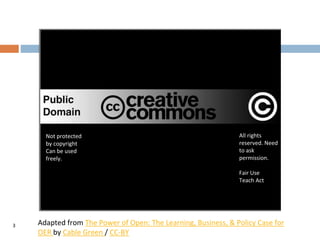
Adapted from The Power of Open: The Learning, Business, & Policy Case for
OER by Cable Green / CC-BY
Not protected
by copyright
Can be used
freely. freely
All rights
reserved. Need
to ask
permission.
Fair Use
Teach Actly
3
Public domain
4
• Works not copyrightable or under copyright
• Most works by the US Federal Government
– Does not apply to works by grant recipients or
contractors
• Works for which copyright has expired
–Under US law, public domain 70 years after
the death of the author.
All works published in the US before 1923
http://fairuse.stanford.edu/overview/public-domain/
http://knowyourcopyrights
Coursera.org: Copyright for Educators and Librarians CC-BY!!
Public domain
5
• Works for which copyright has expired
- Works published before 1964 for which
copyrights were not renewed.
- Works published without a copyright notice in
the US before March 1, 1989.
- Works designated public domain by owner
http://fairuse.stanford.edu/overview/public-domain/
http://knowyourcopyrights
http://www.publicdomainsherpa.com/calculator.html
Copyrighted materials
6
• Monopoly created by law to give authors and
creators a set of exclusive rights over the
things they create.
• Copyright exists as soon as creative
expression is fixed in tangible form
• The creator or author may be asked to
transfer to a publisher, relinquishing their
own rights over the material
Coursera.org: Copyright for Educators and Librarians, https://www.coursera.org/learn/copyright-for-
education
The Rights
7
• Owner reserves rights to
– Reproduce
– Prepare derivative works (e.g. editions, translations,
sequels)
– Distribute copies
– Perform in public
– Display the work publicly
– Perform in public through digital audio transmission
• An owner can both give a right and keep the right,
“grant a permission”
Coursera.org: Copyright for Educators and Librarians,
https://www.coursera.org/learn/copyright-for-education
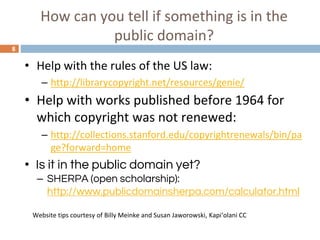
How can you tell if something is in the
public domain?
8
• Help with the rules of the US law:
– http://librarycopyright.net/resources/genie/
• Help with works published before 1964 for
which copyright was not renewed:
– http://collections.stanford.edu/copyrightrenewals/bin/pa
ge?forward=home
• Is it in the public domain yet?
– SHERPA (open scholarship):
http://www.publicdomainsherpa.com/calculator.html
Website tips courtesy of Billy Meinke and Susan Jaworowski, Kapiʻolani CC
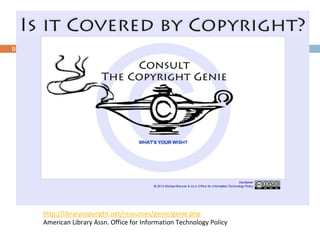
9
http://librarycopyright.net/resources/genie/genie.php
American Library Assn. Office for Information Technology Policy
IF it is NOT in the public domain and is
copyrighted (and is NOT OER)
10
• Assess if your use may fall under Fair Use
• Link when possible and don’t make copies
– Link to articles in library databases (already paid
for, handsomely)
– Institutional repositories, author’s homepages,
open access journals
• Ask for permission from the copyright holder
– Need to be specific about the requested rights
Quiz 1
11
Do you need permission to copy, alter, and distribute
works in the public domain?
◻ Yes
◻ No
§ 107 . Limitations on exclusive rights: Fair use
12
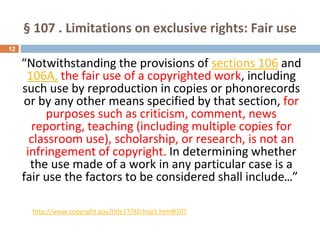
“Notwithstanding the provisions of sections 106 and
106A, the fair use of a copyrighted work, including
such use by reproduction in copies or phonorecords
or by any other means specified by that section, for
purposes such as criticism, comment, news
reporting, teaching (including multiple copies for
classroom use), scholarship, or research, is not an
infringement of copyright. In determining whether
the use made of a work in any particular case is a
fair use the factors to be considered shall include...”
http://www.copyright.gov/title17/92chap1.html#107
Fair Use: Purpose and character
13
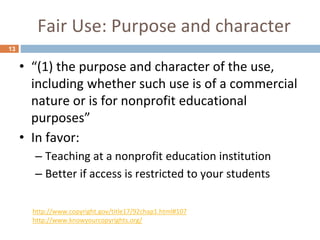
• “(1) the purpose and character of the use,
including whether such use is of a commercial
nature or is for nonprofit educational
purposes”
• In favor:
– Teaching at a nonprofit education institution
– Better if access is restricted to your students
http://www.copyright.gov/title17/92chap1.html#107
http://www.knowyourcopyrights.org/
The nature of the copyrighted work
14
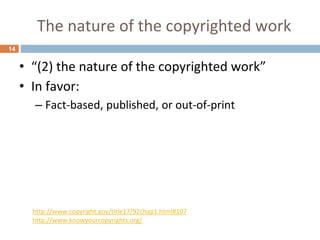
• “(2) the nature of the copyrighted work”
• In favor:
– Fact-based, published, or out-of-print
http://www.copyright.gov/title17/92chap1.html#107
http://www.knowyourcopyrights.org/
Amount and substantiality
15
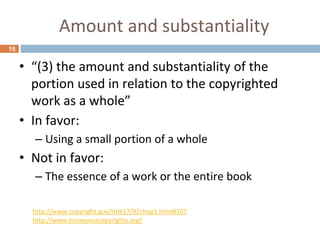
• “(3) the amount and substantiality of the
portion used in relation to the copyrighted
work as a whole”
• In favor:
– Using a small portion of a whole
• Not in favor:
– The essence of a work or the entire book
http://www.copyright.gov/title17/92chap1.html#107
http://www.knowyourcopyrights.org/
Market effect
16
• “(4) the effect of the use upon the potential
market for or value of the copyrighted work”
• In favor:
– It won’t affect book sales negatively
• Not in favor:
– Scanning chapters from a commercial textbook
http://www.copyright.gov/title17/92chap1.html#107
http://www.knowyourcopyrights.org/
Golden Rule of Fair Use
17
“If you were the copyright holder, would you
see the use as fair and not expect to be asked
for permission?”
Assn. of Research Libraries: http://www.knowyourcopyrights.org/
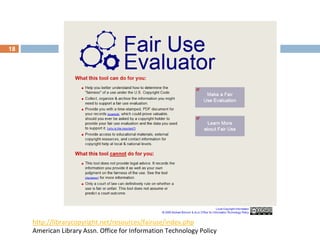
18
http://librarycopyright.net/resources/fairuse/index.php
American Library Assn. Office for Information Technology Policy
Quiz #2
19
2. Fair Use balances the rights of the
1. Creator
2. Educator
3. Copyright owner (if not the creator)
4. All of the above
Information and tools
20
• Information:
– Overview of copyright law: http://www.copyright.gov/title17/92chap1.html
– Fair use: http://www.copyright.gov/title17/92chap1.html#107
– US Copyright Office brochure: http://www.copyright.gov/circs/circ21.pdf
– Coursera.org: Copyright for Educators and Librarians (free MOOC),
https://www.coursera.org/learn/copyright-for-education
– Stanford University Library: http://fairuse.stanford.edu/
– Assn. of Research Libraries: http://www.knowyourcopyrights.org/
– Copyright Clearance Center and Teach Act: http://www.copyright.com/ ;
https://www.copyright.com/Services/copyrightoncampus/basics/teach.html
• Tools:
– SHERPA (open scholarship):
http://www.publicdomainsherpa.com/calculator.html
– Stanford University Library: http://fairuse.stanford.edu/charts-and-tools/
– Fair Use Evaluator: http://www.librarycopyright.net/resources/fairuse/
– Cornell University, Copyright Terms and the Public Domain in the United States
by Peter Hirtle - http://copyright.cornell.edu/resources/publicdomain.cfm
Open Educational Resources
21
• Reside in the public domain OR
• The copyright owner has released them under
an open license* that permits their free use
and re-purposing by others
*A license specifies what can and cannot be done with a work. It
grants permissions and states restrictions.
Washington State Board for Community and Technical Colleges, OER. How to Use Open
Educational Resources
What is an open license?
22
• Broadly speaking, an open license grants
permission to access, re-use and redistribute a
work with few or no restrictions.
Sources:
Open Definition: http://opendefinition.org/od/
Open Content Definition: http://www.opencontent.org/definition/
5 R’s Framework
Reuse | Revise | Remix | Redistribute | Retain
-David Wiley
Copyright extension
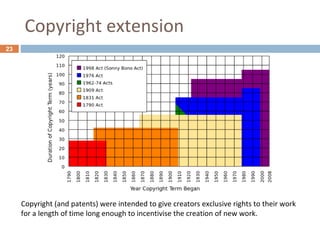
23
Copyright (and patents) were intended to give creators exclusive rights to their work
for a length of time long enough to incentivise the creation of new work.
Happy Birthday song
24
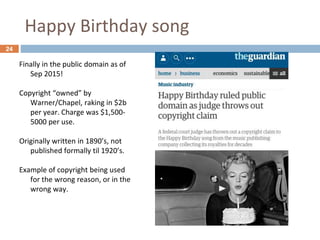
Finally in the public domain as of
Sep 2015!
Copyright “owned” by
Warner/Chapel, raking in $2b
per year. Charge was $1,500-
5000 per use.
Originally written in 1890’s, not
published formally til 1920’s.
Example of copyright being used
for the wrong reason, or in the
wrong way.
Creative Commons, the org
25
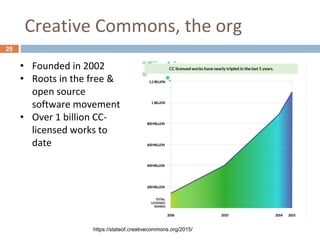
• Founded in 2002
• Roots in the free &
open source
software movement
• Over 1 billion CC-
licensed works to
date
https://stateof.creativecommons.org/2015/
Conditions of a CC license
26
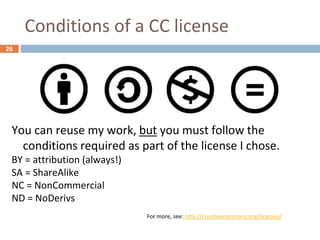
You can reuse my work, but you must follow the
conditions required as part of the license I chose.
BY = attribution (always!)
SA = ShareAlike
NC = NonCommercial
ND = NoDerivs
For more, see: http://creativecommons.org/licenses/
Spectrum of Openness
27
Public Domain
CC0
CC BY
CC BY-SA
CC BY-NC
CC BY-ND
CC BY-NC-SA
CC BY-NC-ND
All rights reserved
more open
less open
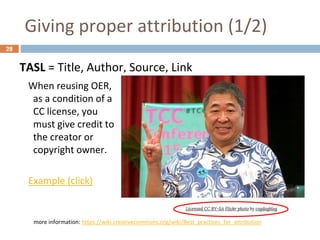
Giving proper attribution (1/2)
28
TASL = Title, Author, Source, Link
more information: https://wiki.creativecommons.org/wiki/Best_practices_for_attribution
When reusing OER,
as a condition of a
CC license, you
must give credit to
the creator or
copyright owner.
Example (click)
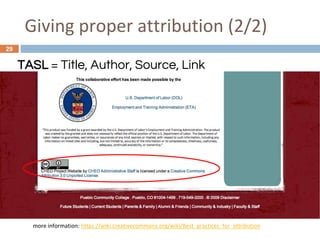
Giving proper attribution (2/2)
29
TASL = Title, Author, Source, Link
more information: https://wiki.creativecommons.org/wiki/Best_practices_for_attribution
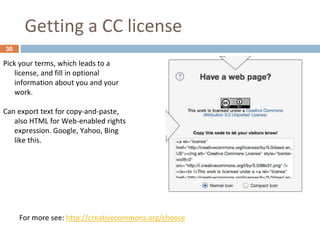
Getting a CC license
30
For more see: http://creativecommons.org/choose
Pick your terms, which leads to a
license, and fill in optional
information about you and your
work.
Can export text for copy-and-paste,
also HTML for Web-enabled rights
expression. Google, Yahoo, Bing
like this.
Things to note about CC licenses
31
• They are irrevocable - What is released under a
CC license stays under a CC license
• You can re-release a work under a new license,
but previous copies will retain the license they
were shared under
• You can only CC license works that you have the
rights to (which is important for collab!)
What if you are the creator and work at UH?
32
• Hawaii Revised Statutes
– Title 20, Chapter 3 UH Patent and Copyright Policy:
http://www.hawaii.edu/offices/bor/adminrules/chapter03.pdf
• UH Policies on Copyright / UHPA Contract
– E5.500: http://hawaii.edu/policy/archives/ep/e5/e5500.pdf
– A5.501: http://hawaii.edu/policy/archives/apm/a500/a5501.pdf
• Applies to faculty and staff
• Is affected, in the case of grants, by the grantor’s licensing
guidance
• In the case of “works for hire”, sometimes the institution
holds copyright.
Thanks to conversations & emails with Susan Jaworowski, Kapiʻolani CC, Brian Huffman, UH
Mānoa Law Library, and Sara Lee, UH Mānoa Library
C4ward certification
◻Write a reflection statement about OER
◻One of the following:
⬜Review an OER resource using the review
template
■A textbook, a chapter, a website, a video, etc.
■Share your review in the UH OER Repository.
⬜Create an OER resource to be used in a class.
■License it with a Creative Commons License in
consultation with a Librarian.
■Share your OER
⬜Create an activity plan
33
Thank you!!
34
Questions?
Sunny Pai: sunyeen@hawaii.edu
Check out: http://oer.hawaii.edu
http://oerkapiolani.weebly.com

Copyright, Fair Use, and Creative Commons, March 2016

  • 1.
    Copyright, Fair Use,and Creative Commons Licensing for Educators 1 Guest: Billy Meinke, Distance Course Design & Consulting group, College of Education, UH Manoa Sunyeen (Sunny) Pai, Digital Initiatives Librarian Kapi`olani Community College March 10, 2016 Unless otherwise indicated, Copyright, Fair Use, and Creative Commons Licensing for Educators by Sunyeen Pai and Billy Meinke is licensed under a Creative Commons Attribution 4.0 International License.
  • 2.
    Please note 2 This isnot legal advice on copyright and licensing We’ll review informational resources that may help you make decisions about your work.
  • 3.
    Adapted from ThePower of Open: The Learning, Business, & Policy Case for OER by Cable Green / CC-BY Not protected by copyright Can be used freely. freely All rights reserved. Need to ask permission. Fair Use Teach Actly 3
  • 4.
    Public domain 4 • Worksnot copyrightable or under copyright • Most works by the US Federal Government – Does not apply to works by grant recipients or contractors • Works for which copyright has expired –Under US law, public domain 70 years after the death of the author. All works published in the US before 1923 http://fairuse.stanford.edu/overview/public-domain/ http://knowyourcopyrights Coursera.org: Copyright for Educators and Librarians CC-BY!!
  • 5.
    Public domain 5 • Worksfor which copyright has expired - Works published before 1964 for which copyrights were not renewed. - Works published without a copyright notice in the US before March 1, 1989. - Works designated public domain by owner http://fairuse.stanford.edu/overview/public-domain/ http://knowyourcopyrights http://www.publicdomainsherpa.com/calculator.html
  • 6.
    Copyrighted materials 6 • Monopolycreated by law to give authors and creators a set of exclusive rights over the things they create. • Copyright exists as soon as creative expression is fixed in tangible form • The creator or author may be asked to transfer to a publisher, relinquishing their own rights over the material Coursera.org: Copyright for Educators and Librarians, https://www.coursera.org/learn/copyright-for- education
  • 7.
    The Rights 7 • Ownerreserves rights to – Reproduce – Prepare derivative works (e.g. editions, translations, sequels) – Distribute copies – Perform in public – Display the work publicly – Perform in public through digital audio transmission • An owner can both give a right and keep the right, “grant a permission” Coursera.org: Copyright for Educators and Librarians, https://www.coursera.org/learn/copyright-for-education
  • 8.
    How can youtell if something is in the public domain? 8 • Help with the rules of the US law: – http://librarycopyright.net/resources/genie/ • Help with works published before 1964 for which copyright was not renewed: – http://collections.stanford.edu/copyrightrenewals/bin/pa ge?forward=home • Is it in the public domain yet? – SHERPA (open scholarship): http://www.publicdomainsherpa.com/calculator.html Website tips courtesy of Billy Meinke and Susan Jaworowski, Kapiʻolani CC
  • 9.
  • 10.
    IF it isNOT in the public domain and is copyrighted (and is NOT OER) 10 • Assess if your use may fall under Fair Use • Link when possible and don’t make copies – Link to articles in library databases (already paid for, handsomely) – Institutional repositories, author’s homepages, open access journals • Ask for permission from the copyright holder – Need to be specific about the requested rights
  • 11.
    Quiz 1 11 Do youneed permission to copy, alter, and distribute works in the public domain? ◻ Yes ◻ No
  • 12.
    § 107 .Limitations on exclusive rights: Fair use 12 “Notwithstanding the provisions of sections 106 and 106A, the fair use of a copyrighted work, including such use by reproduction in copies or phonorecords or by any other means specified by that section, for purposes such as criticism, comment, news reporting, teaching (including multiple copies for classroom use), scholarship, or research, is not an infringement of copyright. In determining whether the use made of a work in any particular case is a fair use the factors to be considered shall include...” http://www.copyright.gov/title17/92chap1.html#107
  • 13.
    Fair Use: Purposeand character 13 • “(1) the purpose and character of the use, including whether such use is of a commercial nature or is for nonprofit educational purposes” • In favor: – Teaching at a nonprofit education institution – Better if access is restricted to your students http://www.copyright.gov/title17/92chap1.html#107 http://www.knowyourcopyrights.org/
  • 14.
    The nature ofthe copyrighted work 14 • “(2) the nature of the copyrighted work” • In favor: – Fact-based, published, or out-of-print http://www.copyright.gov/title17/92chap1.html#107 http://www.knowyourcopyrights.org/
  • 15.
    Amount and substantiality 15 •“(3) the amount and substantiality of the portion used in relation to the copyrighted work as a whole” • In favor: – Using a small portion of a whole • Not in favor: – The essence of a work or the entire book http://www.copyright.gov/title17/92chap1.html#107 http://www.knowyourcopyrights.org/
  • 16.
    Market effect 16 • “(4)the effect of the use upon the potential market for or value of the copyrighted work” • In favor: – It won’t affect book sales negatively • Not in favor: – Scanning chapters from a commercial textbook http://www.copyright.gov/title17/92chap1.html#107 http://www.knowyourcopyrights.org/
  • 17.
    Golden Rule ofFair Use 17 “If you were the copyright holder, would you see the use as fair and not expect to be asked for permission?” Assn. of Research Libraries: http://www.knowyourcopyrights.org/
  • 18.
  • 19.
    Quiz #2 19 2. FairUse balances the rights of the 1. Creator 2. Educator 3. Copyright owner (if not the creator) 4. All of the above
  • 20.
    Information and tools 20 •Information: – Overview of copyright law: http://www.copyright.gov/title17/92chap1.html – Fair use: http://www.copyright.gov/title17/92chap1.html#107 – US Copyright Office brochure: http://www.copyright.gov/circs/circ21.pdf – Coursera.org: Copyright for Educators and Librarians (free MOOC), https://www.coursera.org/learn/copyright-for-education – Stanford University Library: http://fairuse.stanford.edu/ – Assn. of Research Libraries: http://www.knowyourcopyrights.org/ – Copyright Clearance Center and Teach Act: http://www.copyright.com/ ; https://www.copyright.com/Services/copyrightoncampus/basics/teach.html • Tools: – SHERPA (open scholarship): http://www.publicdomainsherpa.com/calculator.html – Stanford University Library: http://fairuse.stanford.edu/charts-and-tools/ – Fair Use Evaluator: http://www.librarycopyright.net/resources/fairuse/ – Cornell University, Copyright Terms and the Public Domain in the United States by Peter Hirtle - http://copyright.cornell.edu/resources/publicdomain.cfm
  • 21.
    Open Educational Resources 21 •Reside in the public domain OR • The copyright owner has released them under an open license* that permits their free use and re-purposing by others *A license specifies what can and cannot be done with a work. It grants permissions and states restrictions. Washington State Board for Community and Technical Colleges, OER. How to Use Open Educational Resources
  • 22.
    What is anopen license? 22 • Broadly speaking, an open license grants permission to access, re-use and redistribute a work with few or no restrictions. Sources: Open Definition: http://opendefinition.org/od/ Open Content Definition: http://www.opencontent.org/definition/ 5 R’s Framework Reuse | Revise | Remix | Redistribute | Retain -David Wiley
  • 23.
    Copyright extension 23 Copyright (andpatents) were intended to give creators exclusive rights to their work for a length of time long enough to incentivise the creation of new work.
  • 24.
    Happy Birthday song 24 Finallyin the public domain as of Sep 2015! Copyright “owned” by Warner/Chapel, raking in $2b per year. Charge was $1,500- 5000 per use. Originally written in 1890’s, not published formally til 1920’s. Example of copyright being used for the wrong reason, or in the wrong way.
  • 25.
    Creative Commons, theorg 25 • Founded in 2002 • Roots in the free & open source software movement • Over 1 billion CC- licensed works to date https://stateof.creativecommons.org/2015/
  • 26.
    Conditions of aCC license 26 You can reuse my work, but you must follow the conditions required as part of the license I chose. BY = attribution (always!) SA = ShareAlike NC = NonCommercial ND = NoDerivs For more, see: http://creativecommons.org/licenses/
  • 27.
    Spectrum of Openness 27 PublicDomain CC0 CC BY CC BY-SA CC BY-NC CC BY-ND CC BY-NC-SA CC BY-NC-ND All rights reserved more open less open
  • 28.
    Giving proper attribution(1/2) 28 TASL = Title, Author, Source, Link more information: https://wiki.creativecommons.org/wiki/Best_practices_for_attribution When reusing OER, as a condition of a CC license, you must give credit to the creator or copyright owner. Example (click)
  • 29.
    Giving proper attribution(2/2) 29 TASL = Title, Author, Source, Link more information: https://wiki.creativecommons.org/wiki/Best_practices_for_attribution
  • 30.
    Getting a CClicense 30 For more see: http://creativecommons.org/choose Pick your terms, which leads to a license, and fill in optional information about you and your work. Can export text for copy-and-paste, also HTML for Web-enabled rights expression. Google, Yahoo, Bing like this.
  • 31.
    Things to noteabout CC licenses 31 • They are irrevocable - What is released under a CC license stays under a CC license • You can re-release a work under a new license, but previous copies will retain the license they were shared under • You can only CC license works that you have the rights to (which is important for collab!)
  • 32.
    What if youare the creator and work at UH? 32 • Hawaii Revised Statutes – Title 20, Chapter 3 UH Patent and Copyright Policy: http://www.hawaii.edu/offices/bor/adminrules/chapter03.pdf • UH Policies on Copyright / UHPA Contract – E5.500: http://hawaii.edu/policy/archives/ep/e5/e5500.pdf – A5.501: http://hawaii.edu/policy/archives/apm/a500/a5501.pdf • Applies to faculty and staff • Is affected, in the case of grants, by the grantor’s licensing guidance • In the case of “works for hire”, sometimes the institution holds copyright. Thanks to conversations & emails with Susan Jaworowski, Kapiʻolani CC, Brian Huffman, UH Mānoa Law Library, and Sara Lee, UH Mānoa Library
  • 33.
    C4ward certification ◻Write areflection statement about OER ◻One of the following: ⬜Review an OER resource using the review template ■A textbook, a chapter, a website, a video, etc. ■Share your review in the UH OER Repository. ⬜Create an OER resource to be used in a class. ■License it with a Creative Commons License in consultation with a Librarian. ■Share your OER ⬜Create an activity plan 33
  • 34.
    Thank you!! 34 Questions? Sunny Pai:sunyeen@hawaii.edu Check out: http://oer.hawaii.edu http://oerkapiolani.weebly.com