COPYRIGHT, OPEN LICENSING &
CREATIVE COMMONS LICENSES
Meredith Jacob
Public Lead – Creative Commons USA
American University Washington College of Law
ASTE – February 17-20, 2018
Except where noted, all slides licensed CC-BY
4.0 by Creative Commons United States
• Copyright 101
• What is a Creative Commons license
• How Creative Commons licenses work
• How to find and use CC licensed images
• What are Open Educational Resources
(OER)?
• Where OER are being used and places to
find resources
• FAQ
WHAT WE’LL COVER
Copyright law grants to the author or copyright
owner the exclusive right to:
• reproduce, make derivatives of, sell,
distribute to the public, perform or display
publicly, the copyrighted work,
• subject to fair use and other limitations and
exceptions to copyright law.
Copyright owners may assign all the rights in
their copyright, or give limited licenses that
allow others to make specific use of their
works.
WHAT IS COPYRIGHT?
Copyright law applies to intellectual property that are
“original works of authorship.”
• Common types of works protected by copyright
include literary, artistic, and musical works.
• Copyright is automatic, so it applies as soon as
the work has been created.
Copyright protection in the United States lasts for the
life of the author plus 70 years or 95 years for an
institutional author. After this time period has expired,
works fall into the public domain and are free from
copyright restrictions.
WHAT DOES COPYRIGHT PROTECT?
There are a number of exceptions and
limitations to copyright.
Functional concepts, names, and logos are
typically covered by patent or trademark law,
if protected at all, rather than copyright.
Copyright protects the specific expression of
a work - the words - but not the underlying
idea.
ARE THERE LIMITS TO WHAT
COPYRIGHT PROTECTS?
Fair use a allows the use of a copyrighted work
without permission from the copyright holder
under specific circumstances.
News reporting, teaching, and parody are all
examples of uses that could qualify as fair use.
Fair use is evaluated on a case-by-case basis,
and considers the purpose of the use, how
much of the original work is used, and how it
impacts the market for the original work.
WHAT ABOUT FAIR USE?
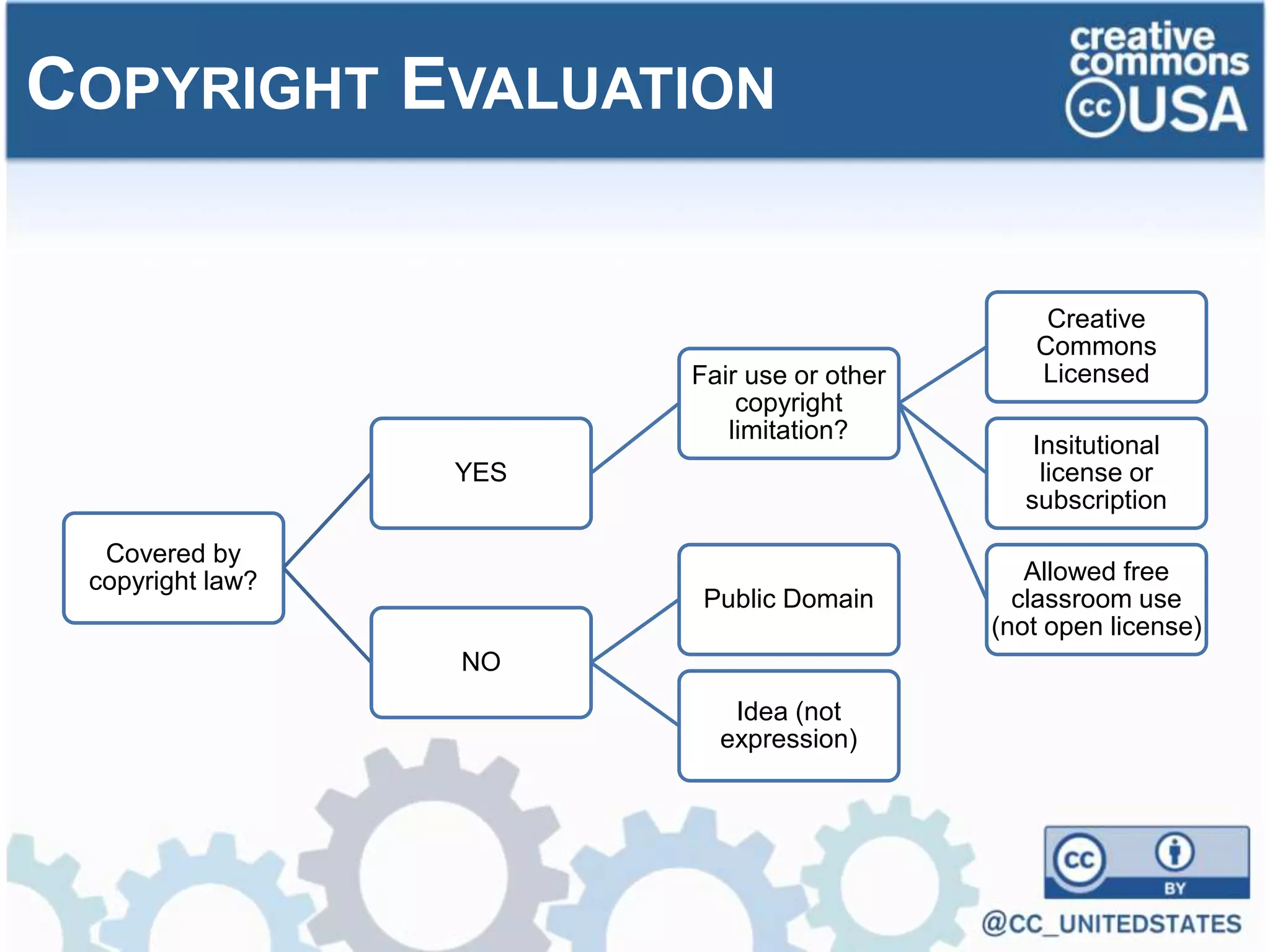
COPYRIGHT EVALUATION
Covered by
copyright law?
YES
Fair use or other
copyright
limitation?
Creative
Commons
Licensed
Insitutional
license or
subscription
Allowed free
classroom use
(not open license)
NO
Public Domain
Idea (not
expression)
• Works within the copyright system
• Author still holds copyright to the work
• Traditional licenses are one to one
(negotiated)
• Open licenses like the Creative Commons
licenses are one to the public/one to many
WHAT IS AN CREATIVE COMMONS
LICENSE?
Advantages
• Takes advantage digital distribution and
authorship
• Ability to improve, remix, and translate
• Makes informal reuse formally permissible
(and possible on the open internet)
WHAT ARE THE ADVANTAGES OF AN
OPEN LICENSE?
• Clearly communicates to the public that
the resource is free to reuse
• Grants the public a license to access,
reproduce, publicly perform, publicly
display, adapt, distribute, and otherwise
use for any purposes
• provided that the licensee gives attribution
to the designated authors of the
intellectual property.
WHAT DOES A CREATIVE COMMONS
LICENSE DO?
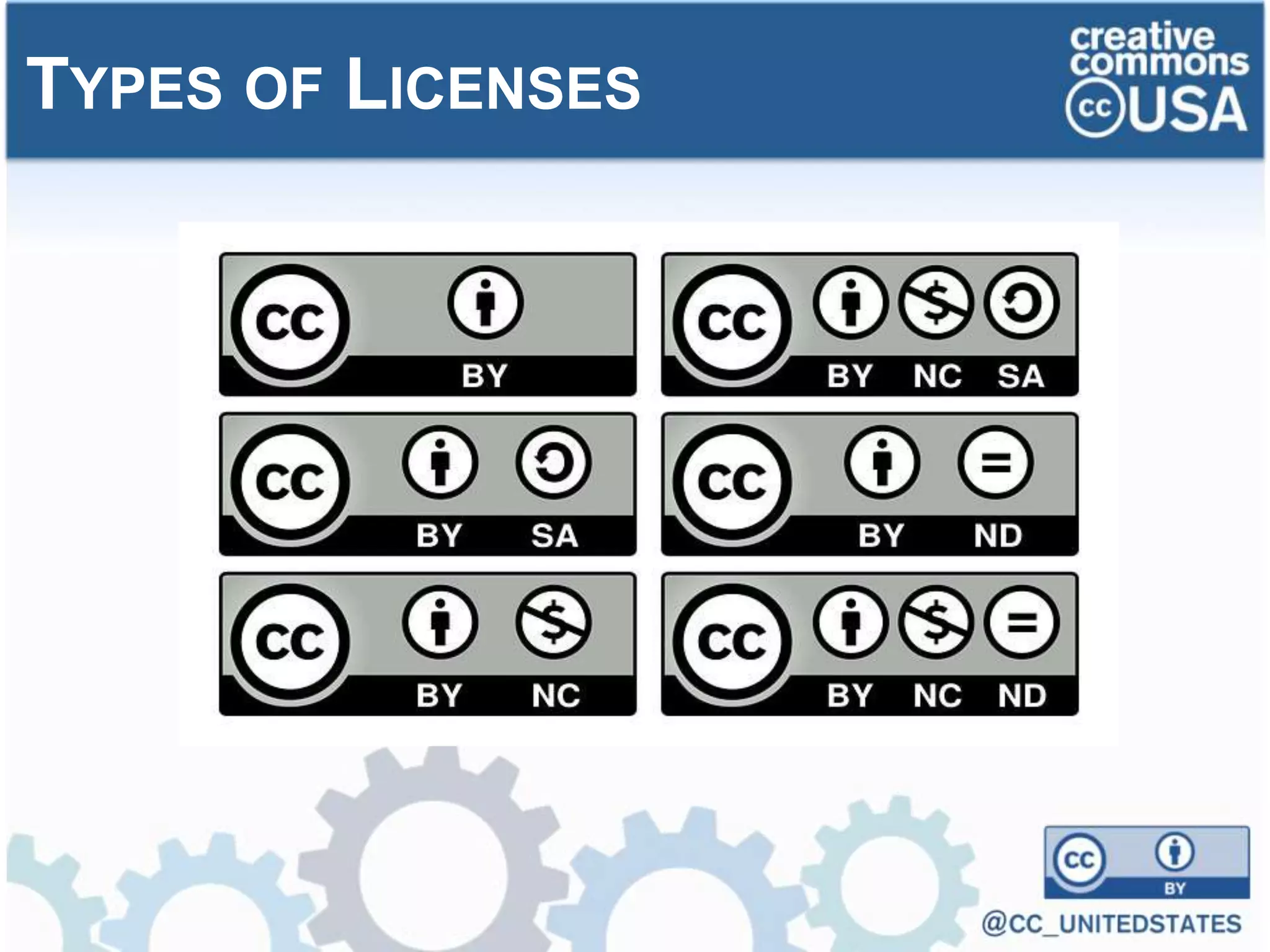
TYPES OF LICENSES
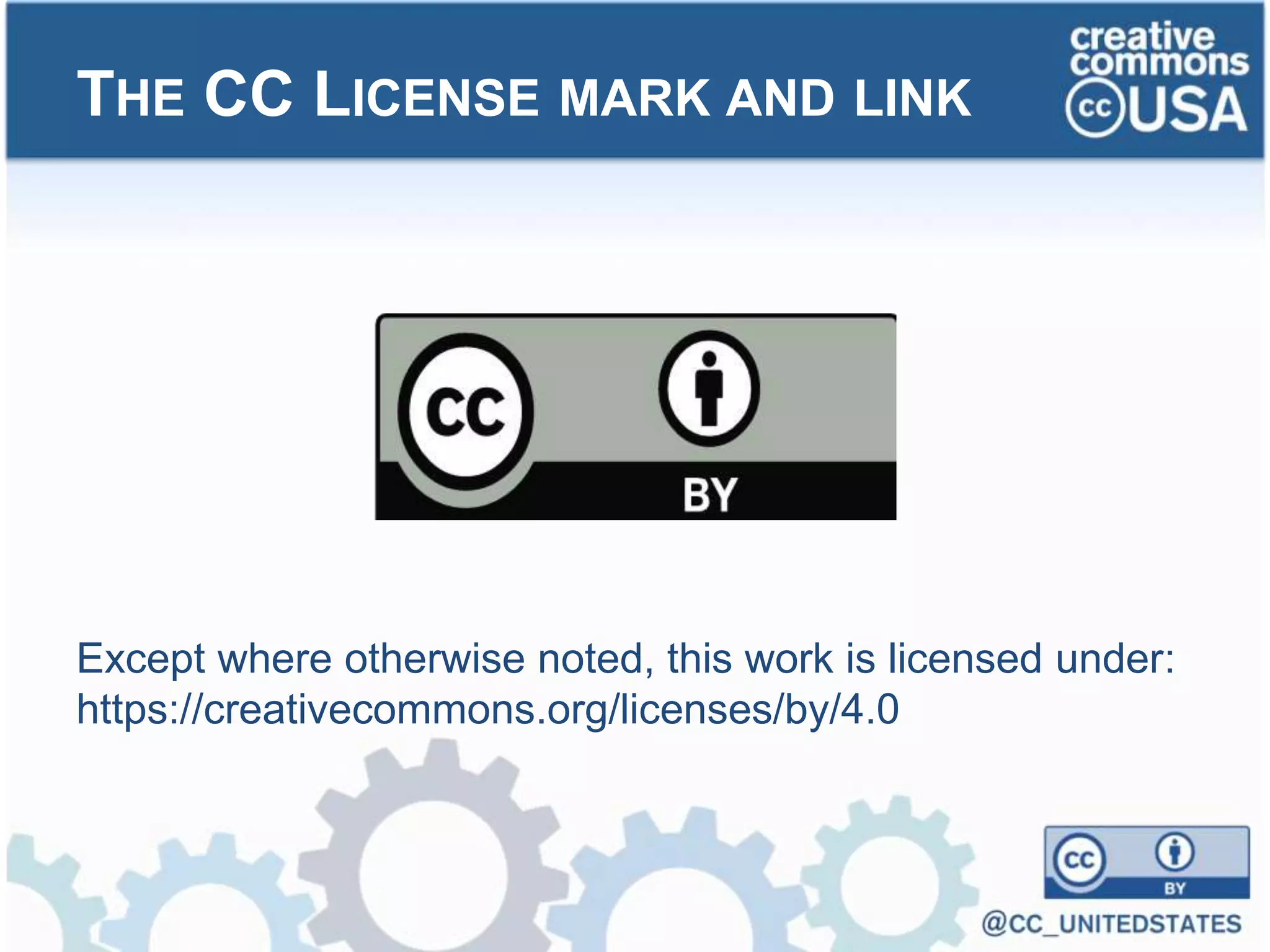
Except where otherwise noted, this work is licensed under:
https://creativecommons.org/licenses/by/4.0
THE CC LICENSE MARK AND LINK
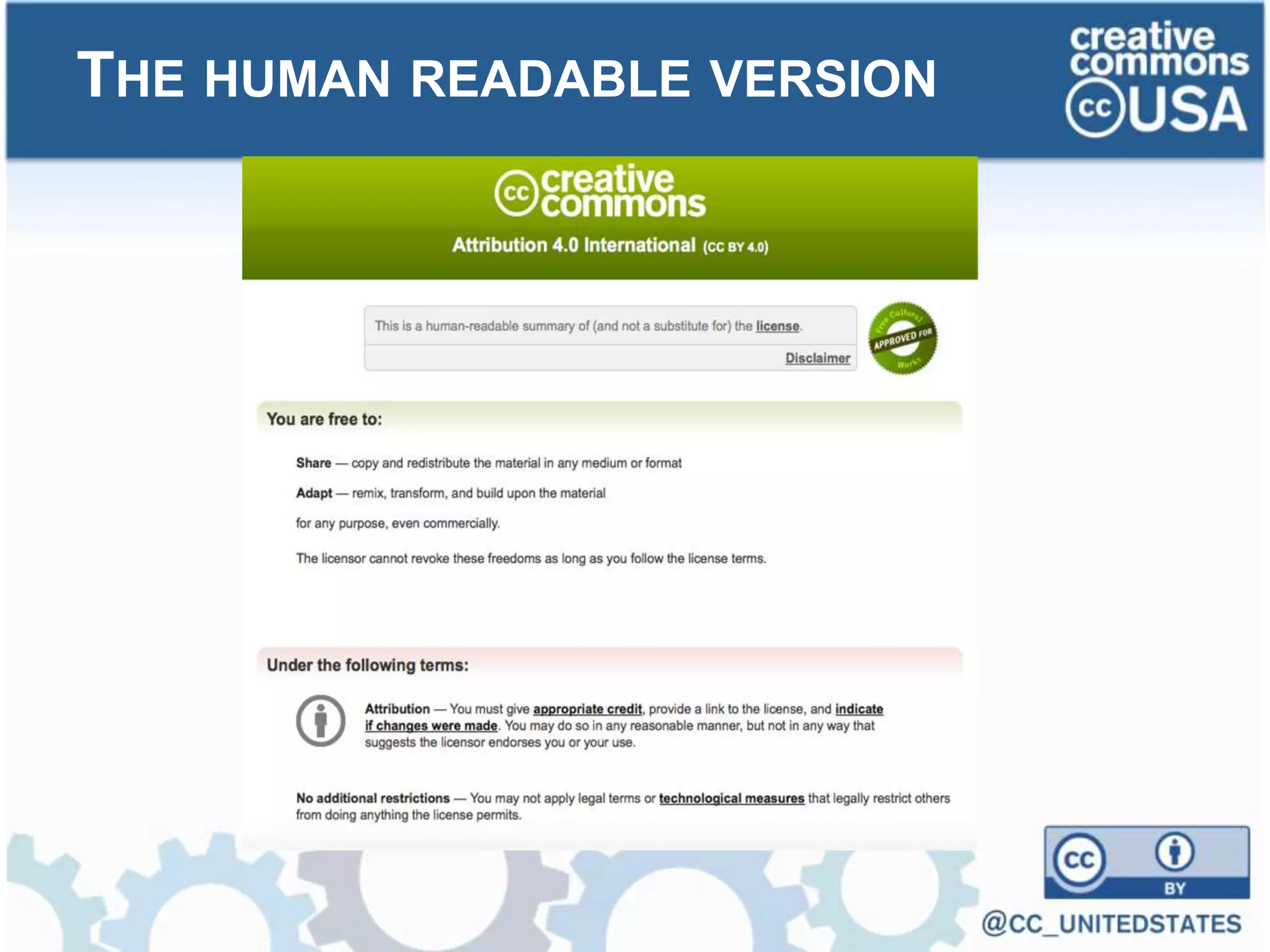
THE HUMAN READABLE VERSION
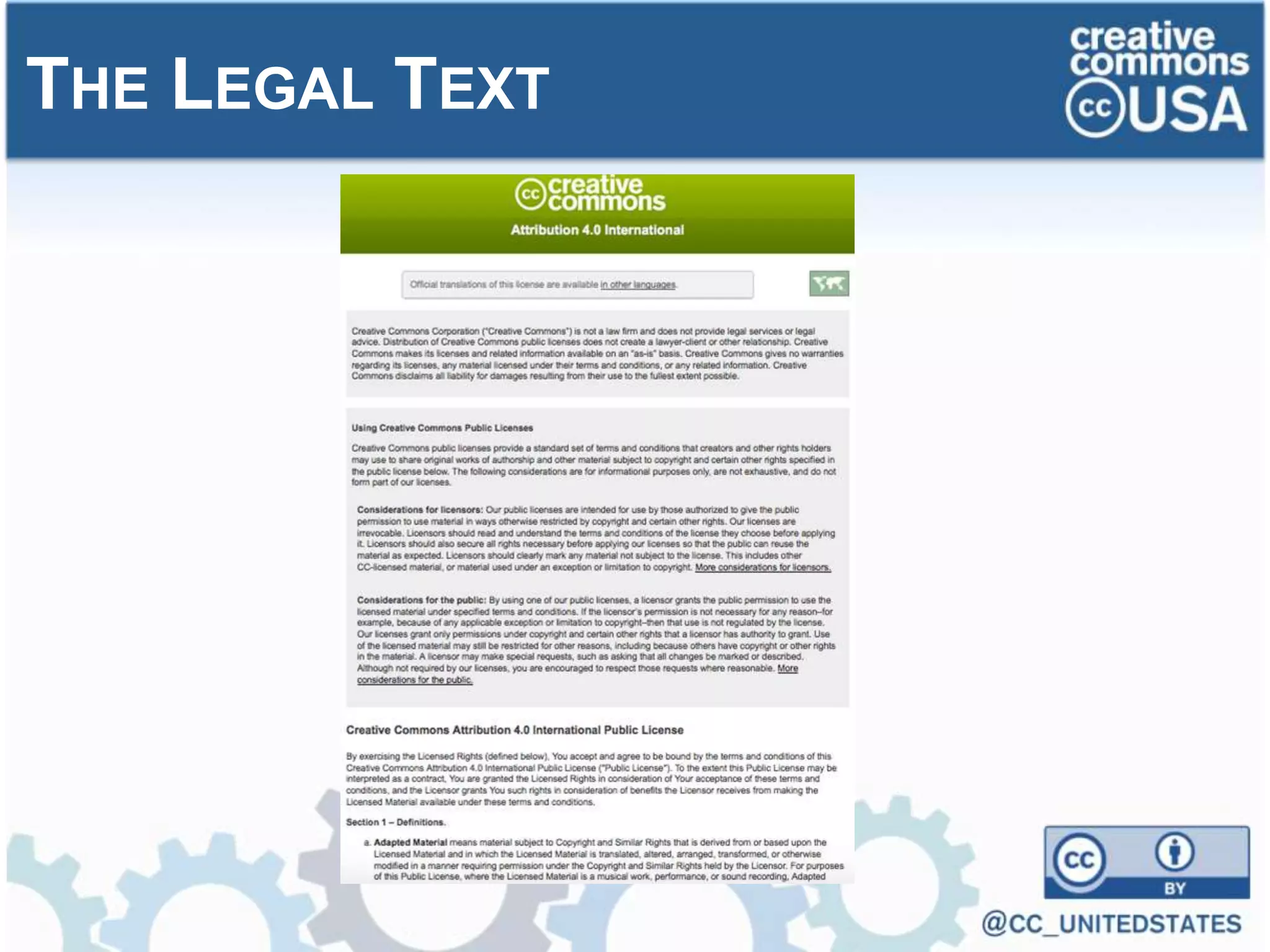
THE LEGAL TEXT
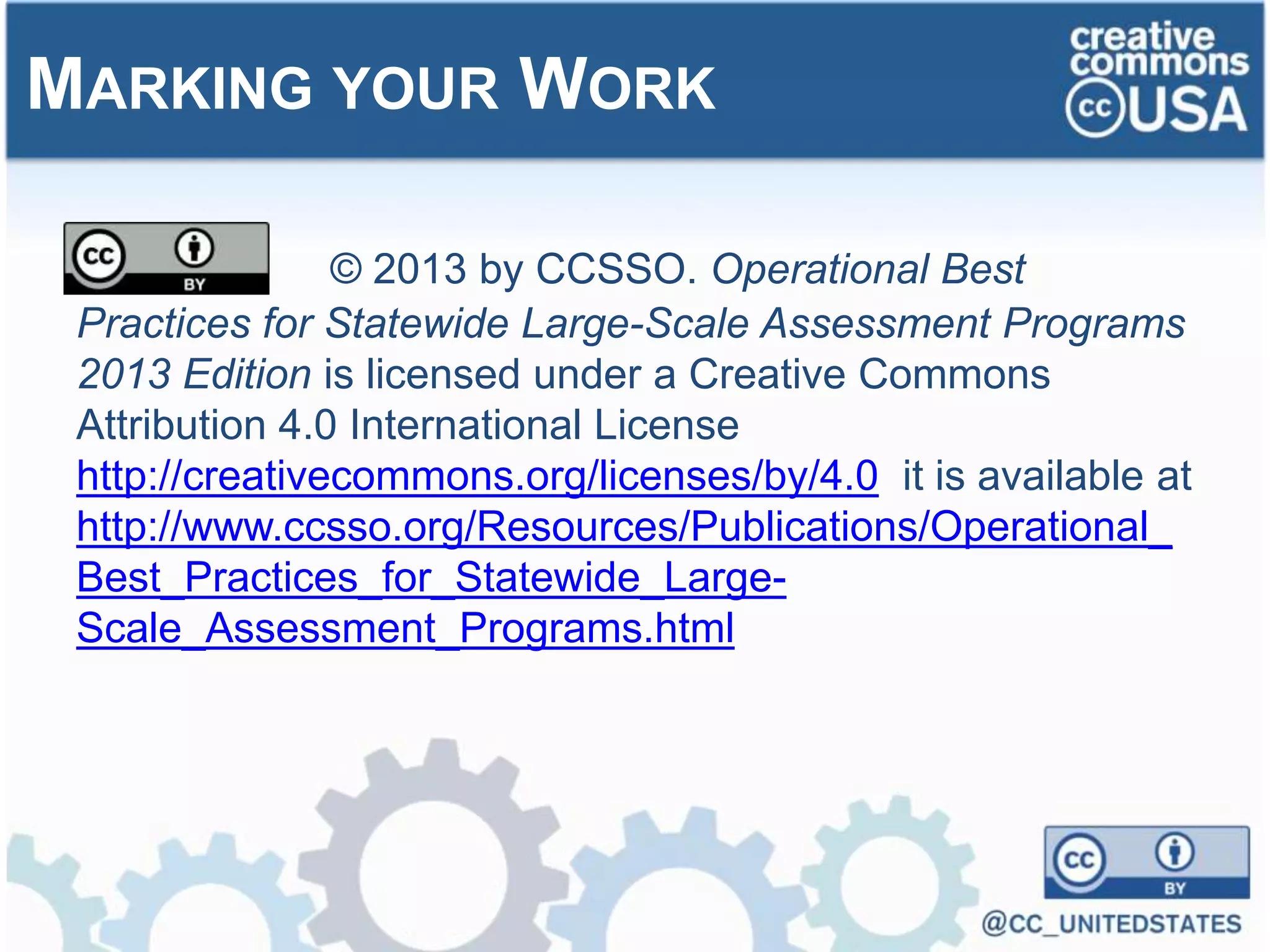
MARKING YOUR WORK
© 2013 by CCSSO. Operational Best
Practices for Statewide Large-Scale Assessment Programs
2013 Edition is licensed under a Creative Commons
Attribution 4.0 International License
http://creativecommons.org/licenses/by/4.0 it is available at
http://www.ccsso.org/Resources/Publications/Operational_
Best_Practices_for_Statewide_Large-
Scale_Assessment_Programs.html
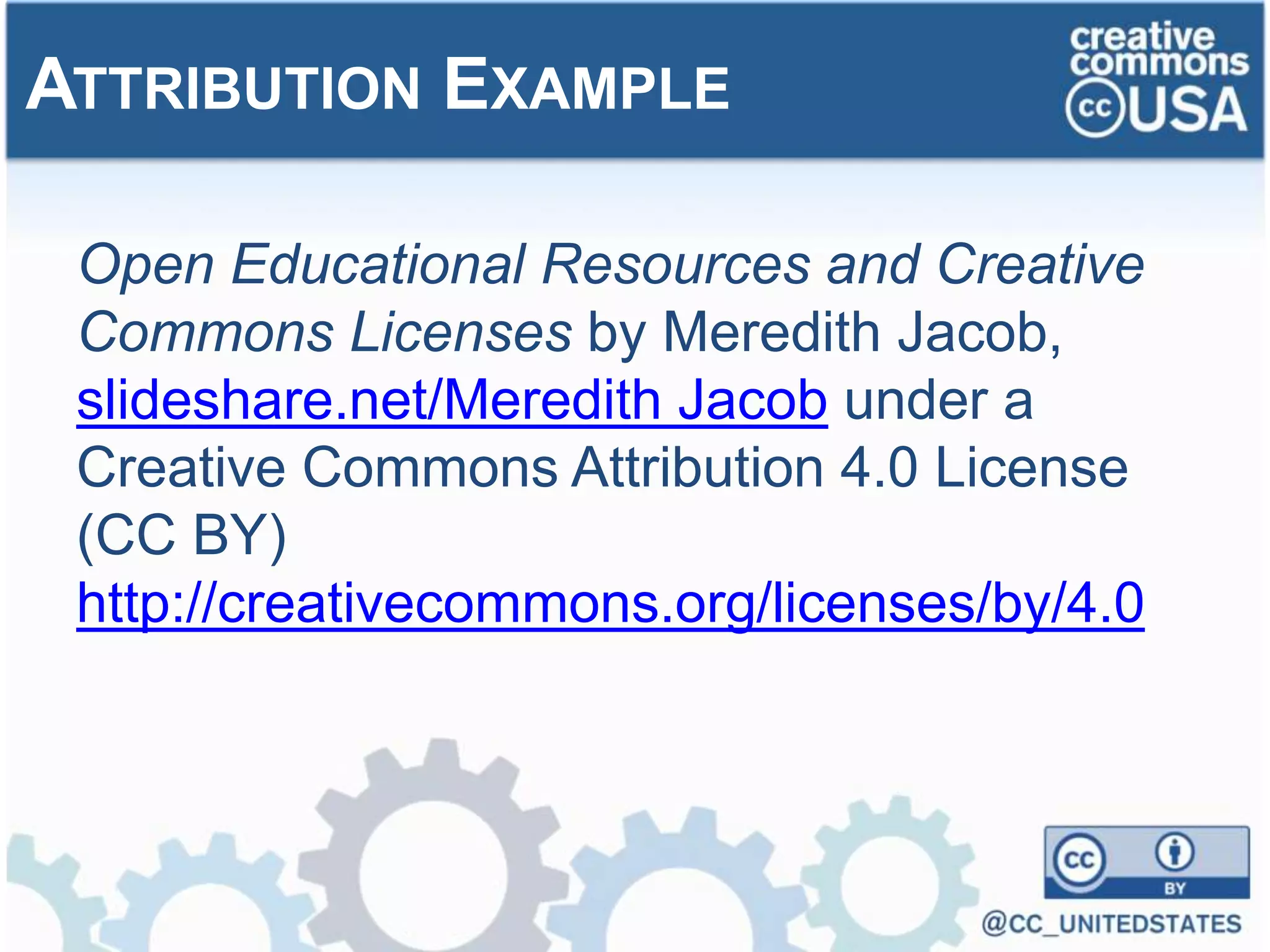
Open Educational Resources and Creative
Commons Licenses by Meredith Jacob,
slideshare.net/Meredith Jacob under a
Creative Commons Attribution 4.0 License
(CC BY)
http://creativecommons.org/licenses/by/4.0
ATTRIBUTION EXAMPLE
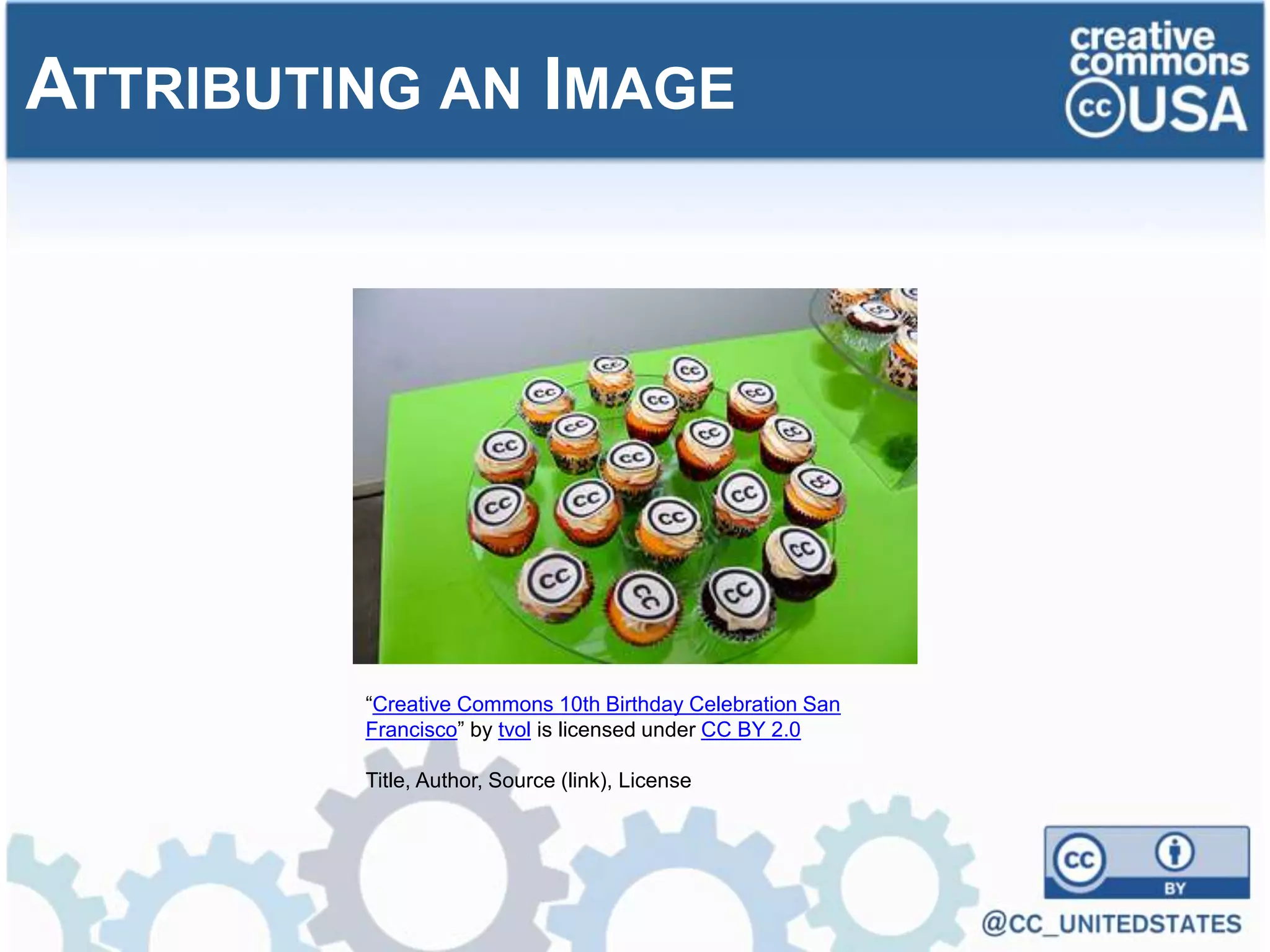
ATTRIBUTING AN IMAGE
“Creative Commons 10th Birthday Celebration San
Francisco” by tvol is licensed under CC BY 2.0
Title, Author, Source (link), License
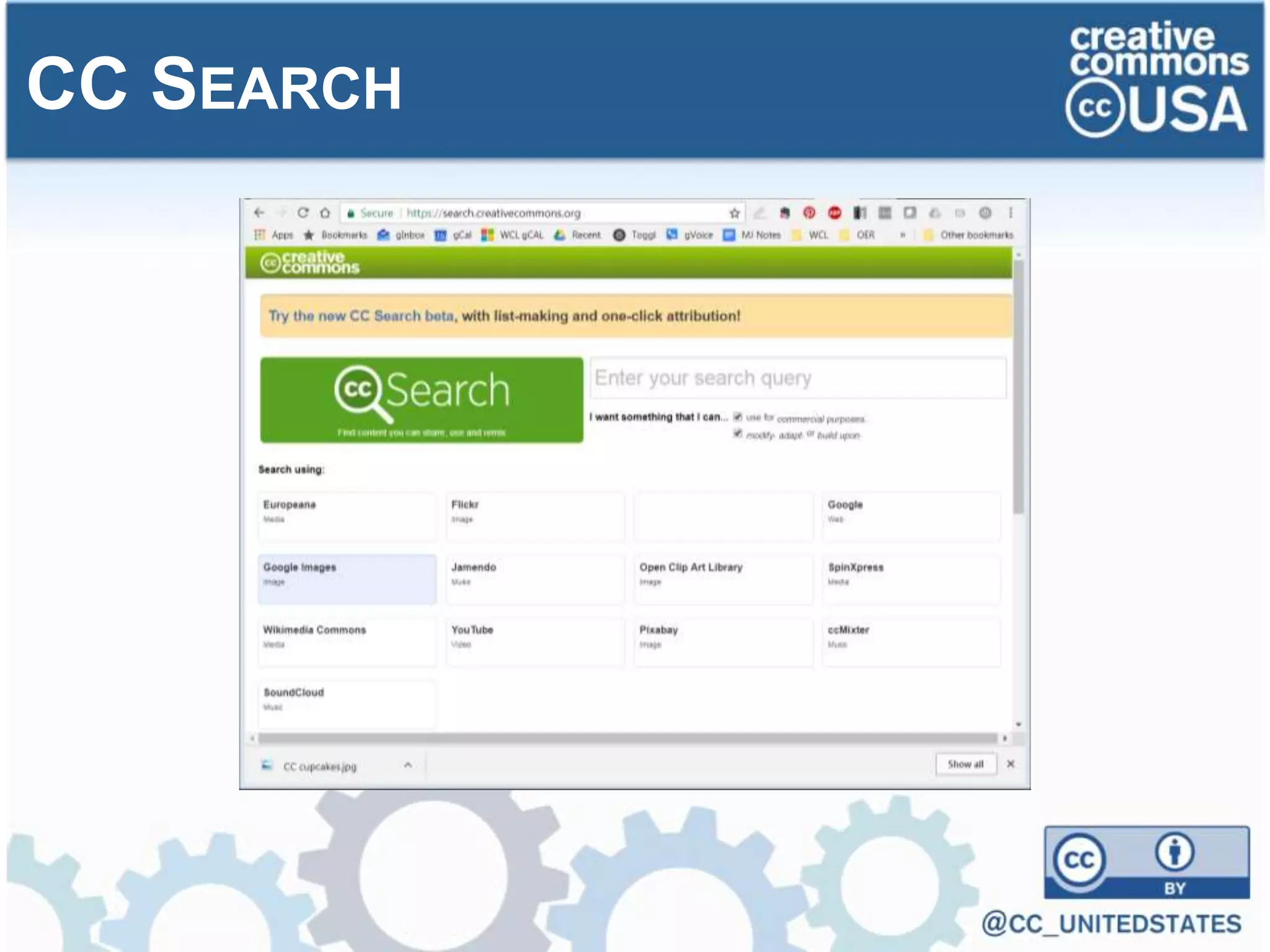
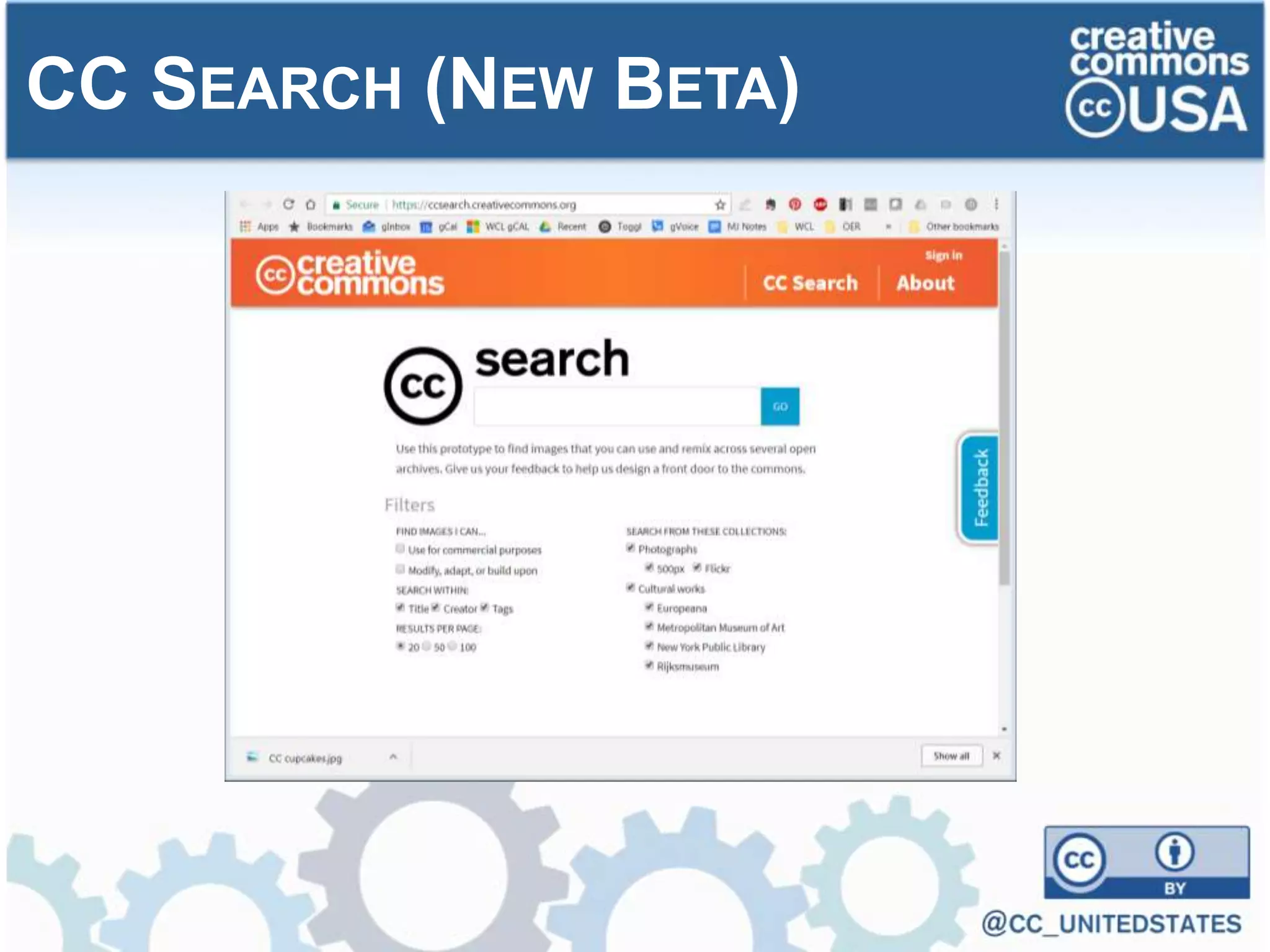
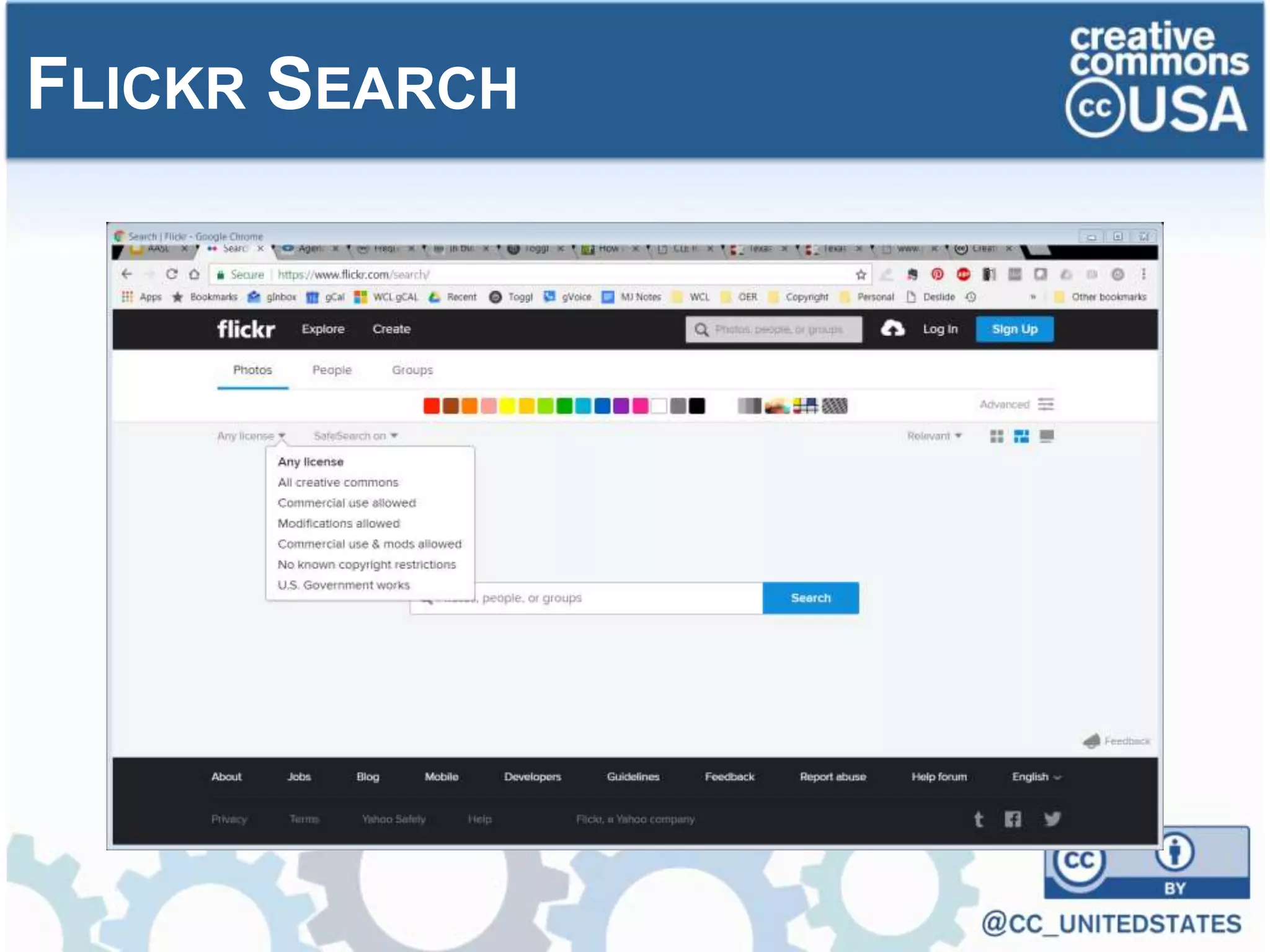
• CC Search: Art, public domain, specific real-world people, things and places
These licenses vary depending on your search. Images with CC BY will require attribution and
those marked CC0 do not require attribution.
– https://ccsearch.creativecommons.org
– https://search.creativecommons.org/
• Stock image replacements: All images on the following sites carry a CC0 Creative Commons
license and therefore can be used in any project and do not require attribution:
– Pixabay: https://pixabay.com/
– Pexels: https://www.pexels.com/
– Librestock: http://librestock.com/
• American Education: Images of Teachers and Students in Action: This gallery contains nearly 300
original print-quality, royalty-free images of preK-12 students and teachers engaged in authentic
learning activities.
– http://deeperlearningforall.org/images/5/?envira_id=13906
• Flickr
WHERE TO FIND OPEN IMAGES
CC SEARCH
CC SEARCH (NEW BETA)
FLICKR SEARCH
Open Educational Resources (OER) are
educational materials that are released
under an open copyright license, rather than
under traditional all rights reserved
copyright.
• Digital distribution and authorship
• Public access and cost savings
• Ability to improve, remix, and translate
OER
Just like traditional teaching materials, OER
can be:
• Textbooks
• Articles
• Slides
• Images
• Videos
• Simulations
SIMILARITIES
Unlike traditional educational materials,
OER have been released under an open
copyright license that allows users to:
• Update and remix
• Translate
• Share new versions
• Post online
DIFFERENCES
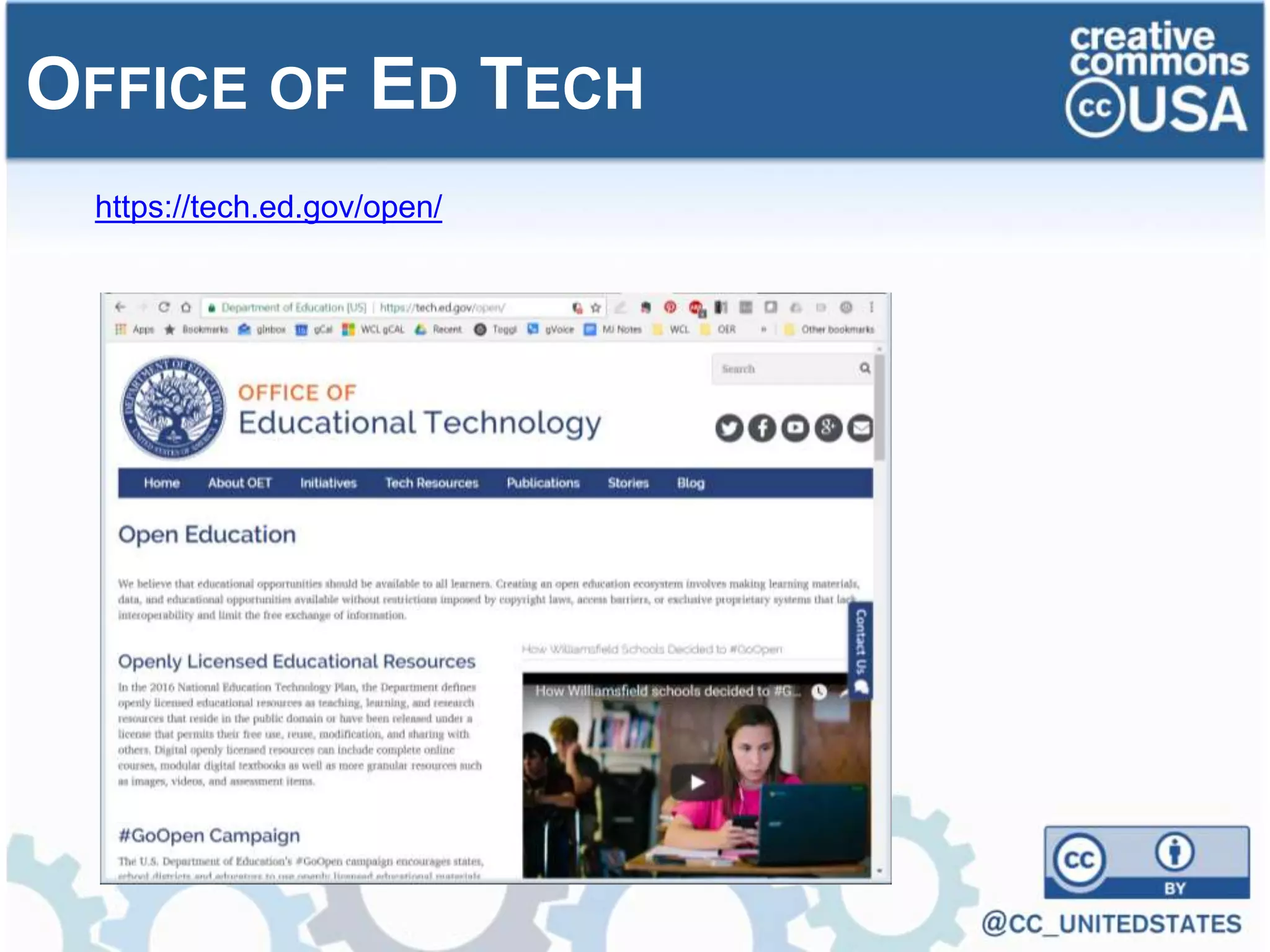
OFFICE OF ED TECH
https://tech.ed.gov/open/
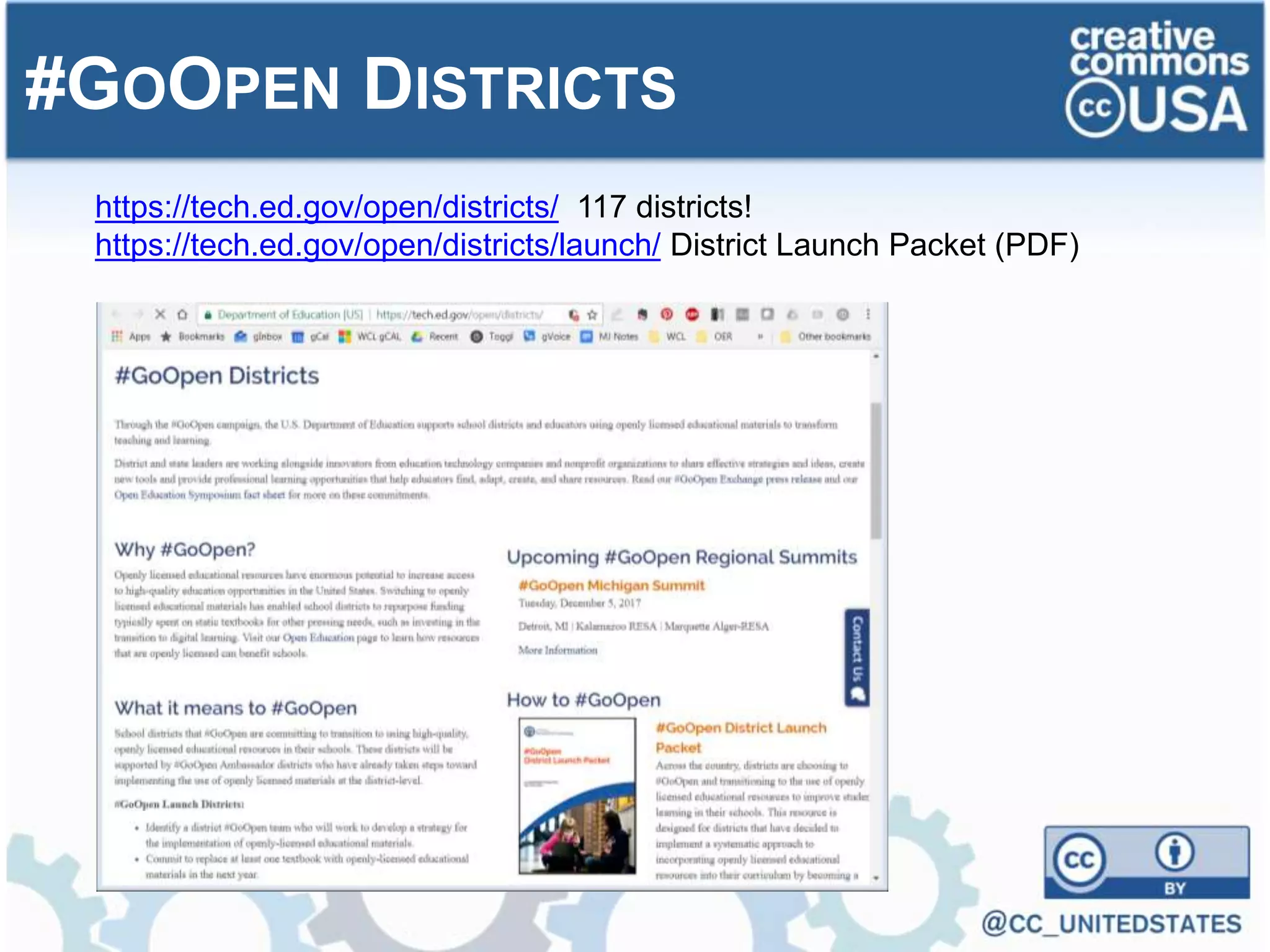
#GOOPEN DISTRICTS
https://tech.ed.gov/open/districts/ 117 districts!
https://tech.ed.gov/open/districts/launch/ District Launch Packet (PDF)
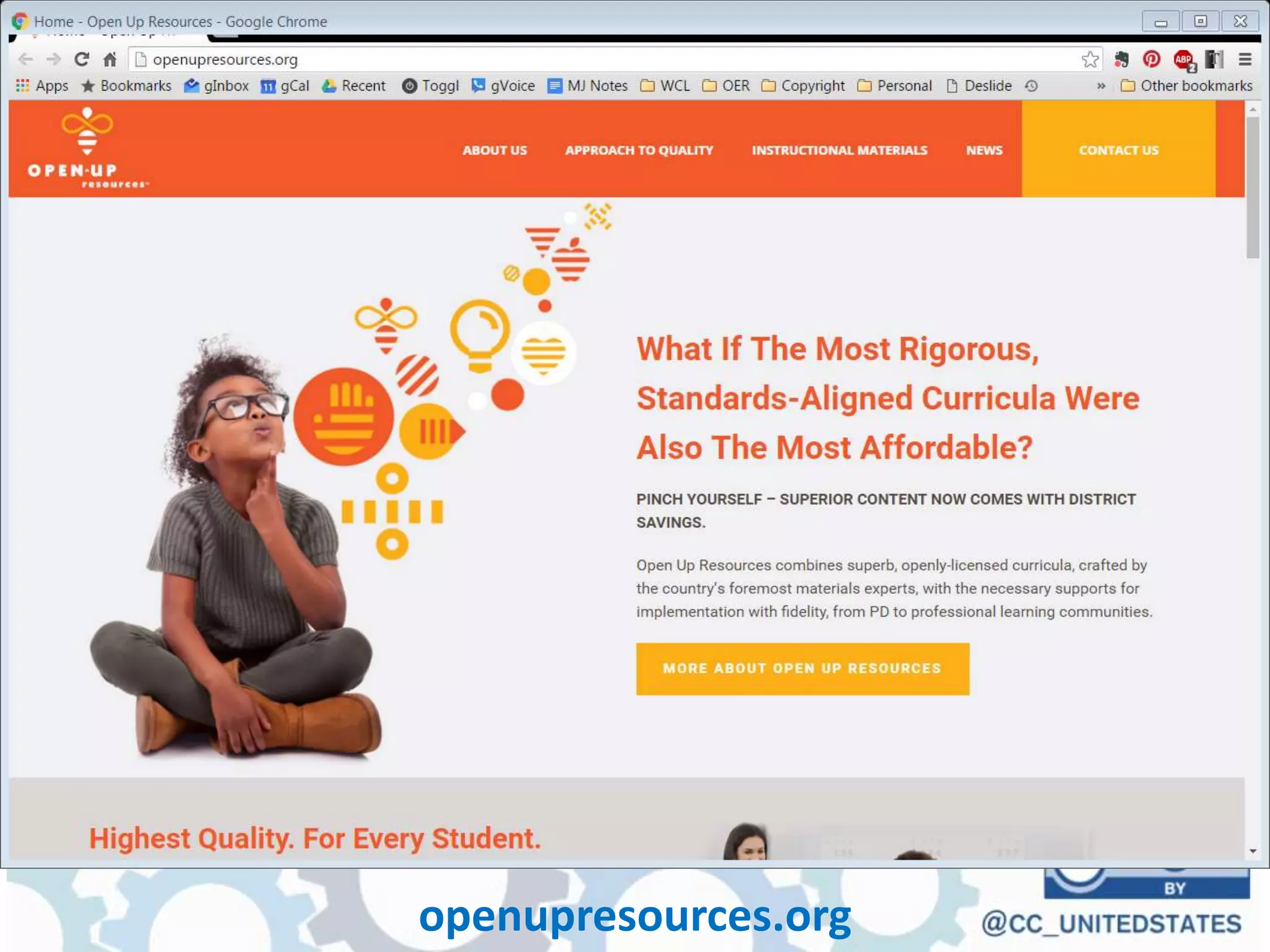
openupresources.org
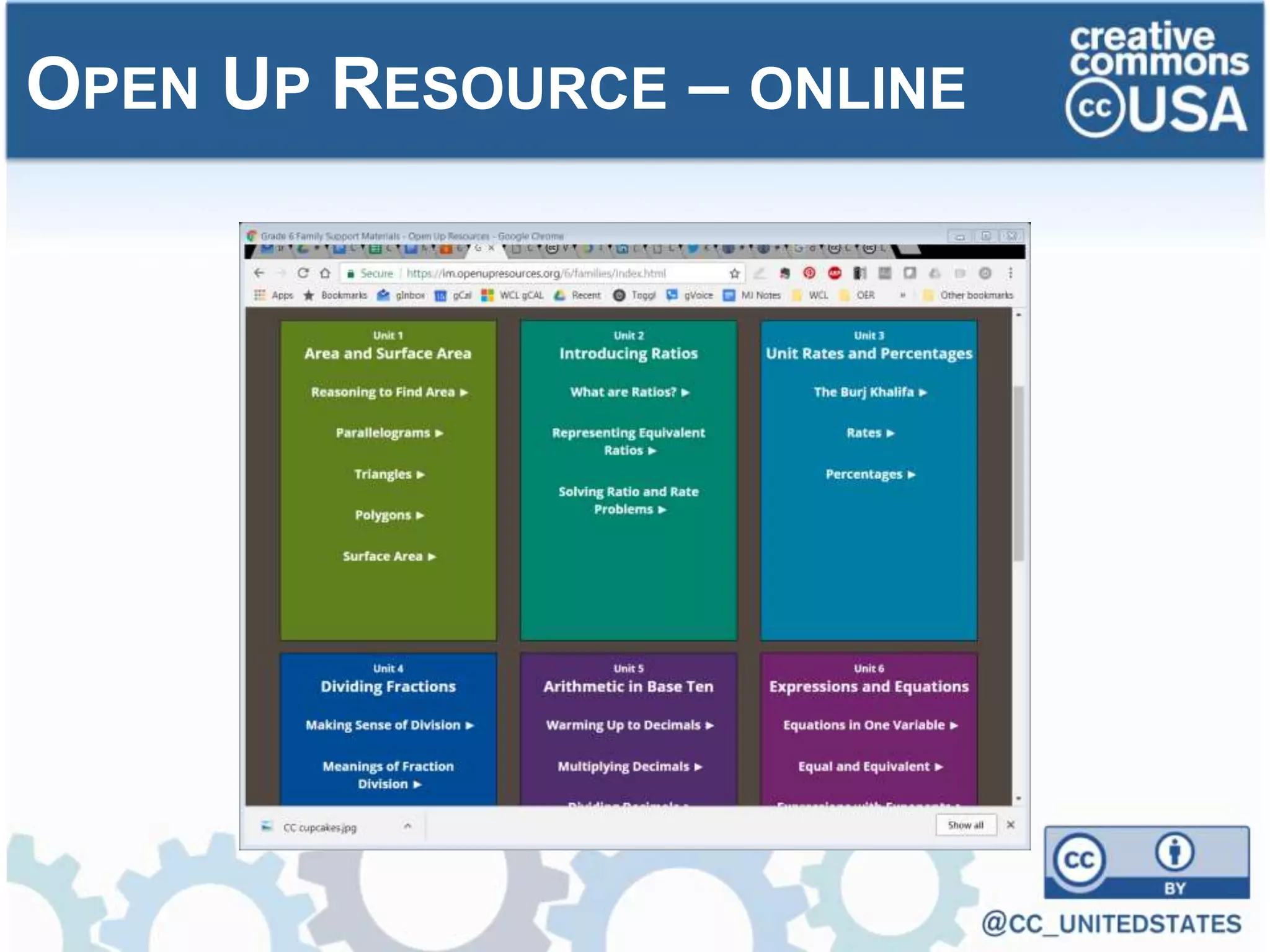
OPEN UP RESOURCE – ONLINE
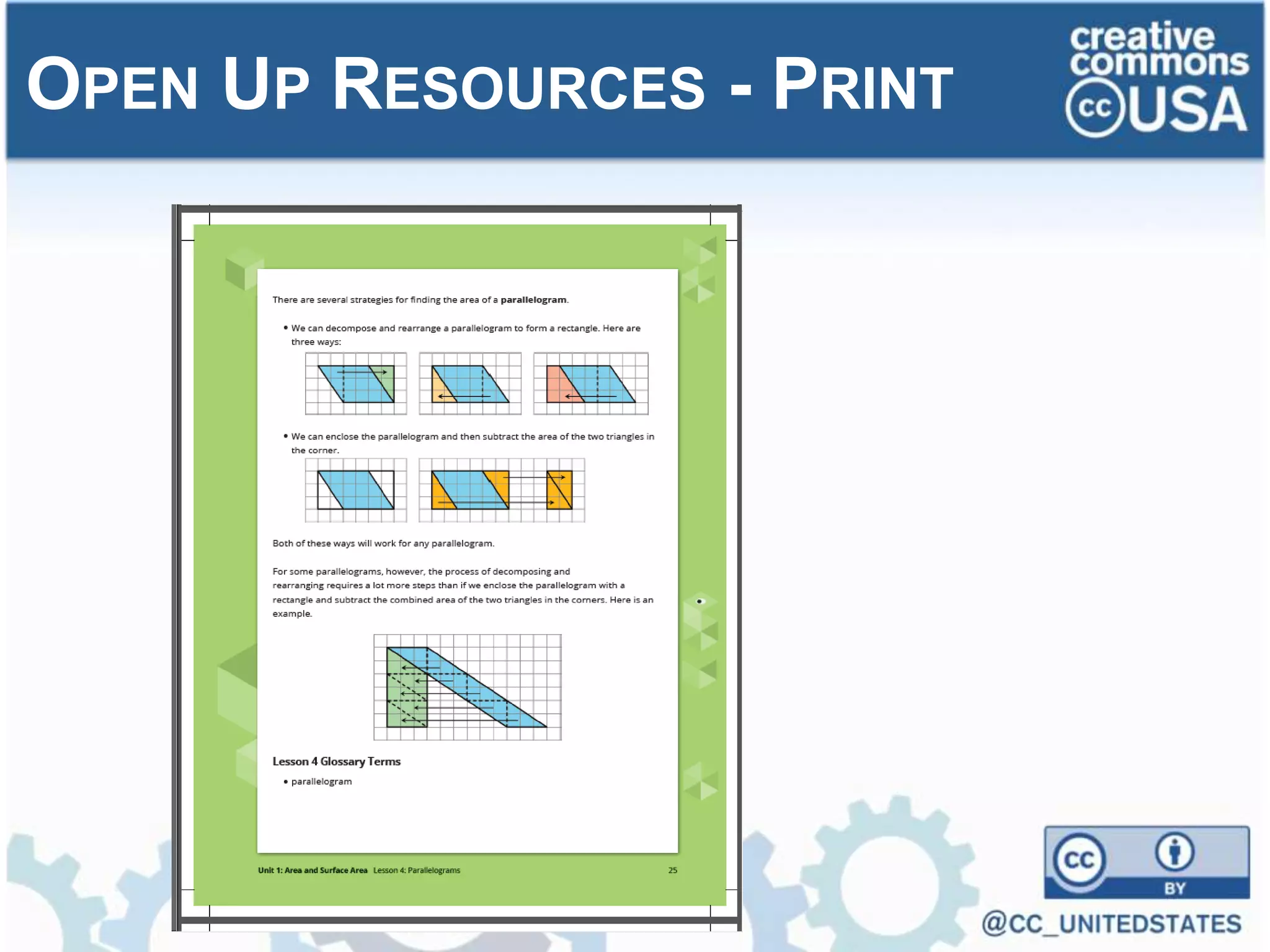
OPEN UP RESOURCES - PRINT
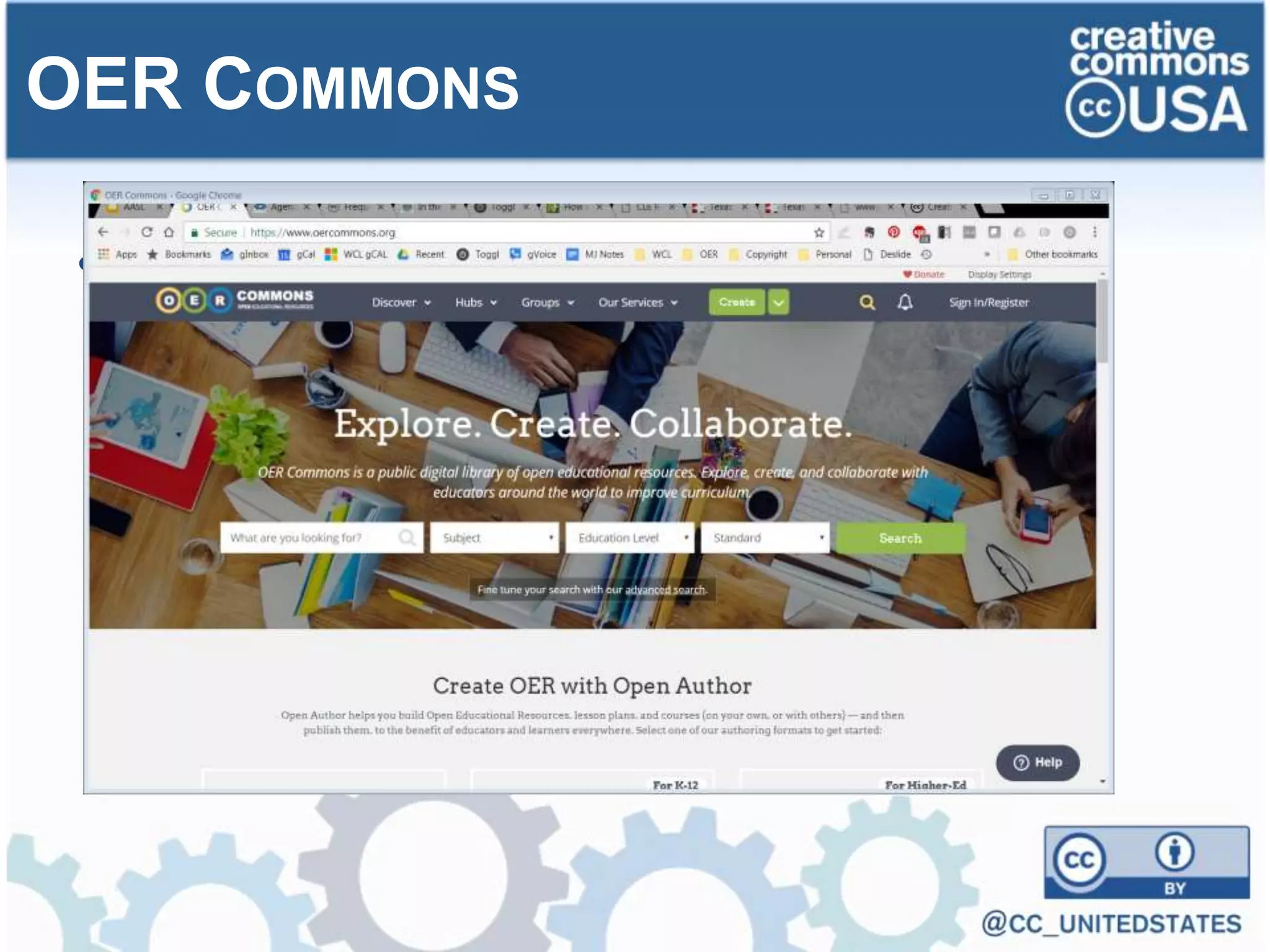
• Search by standard and grade level
OER COMMONS
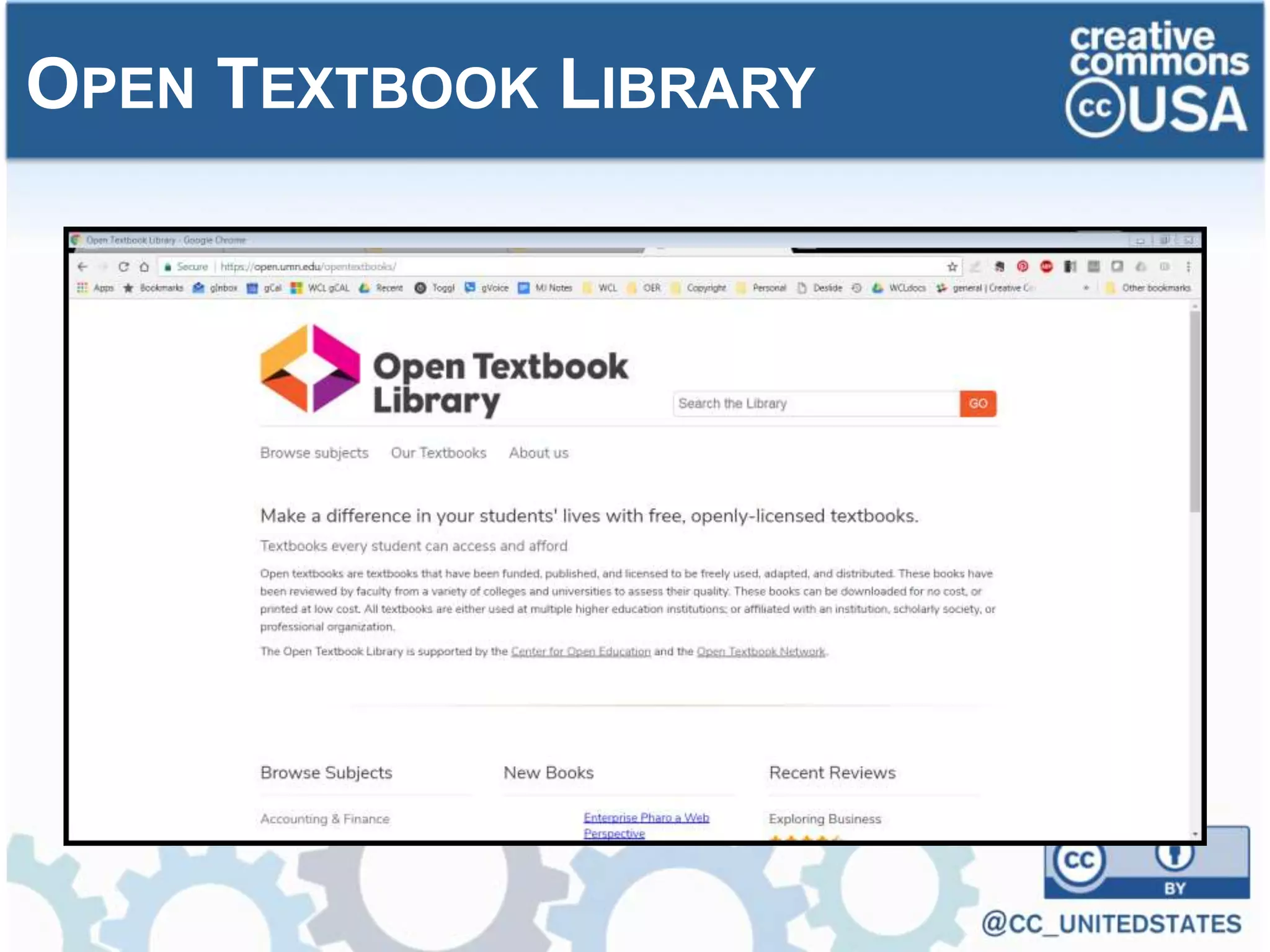
OPEN TEXTBOOK LIBRARY
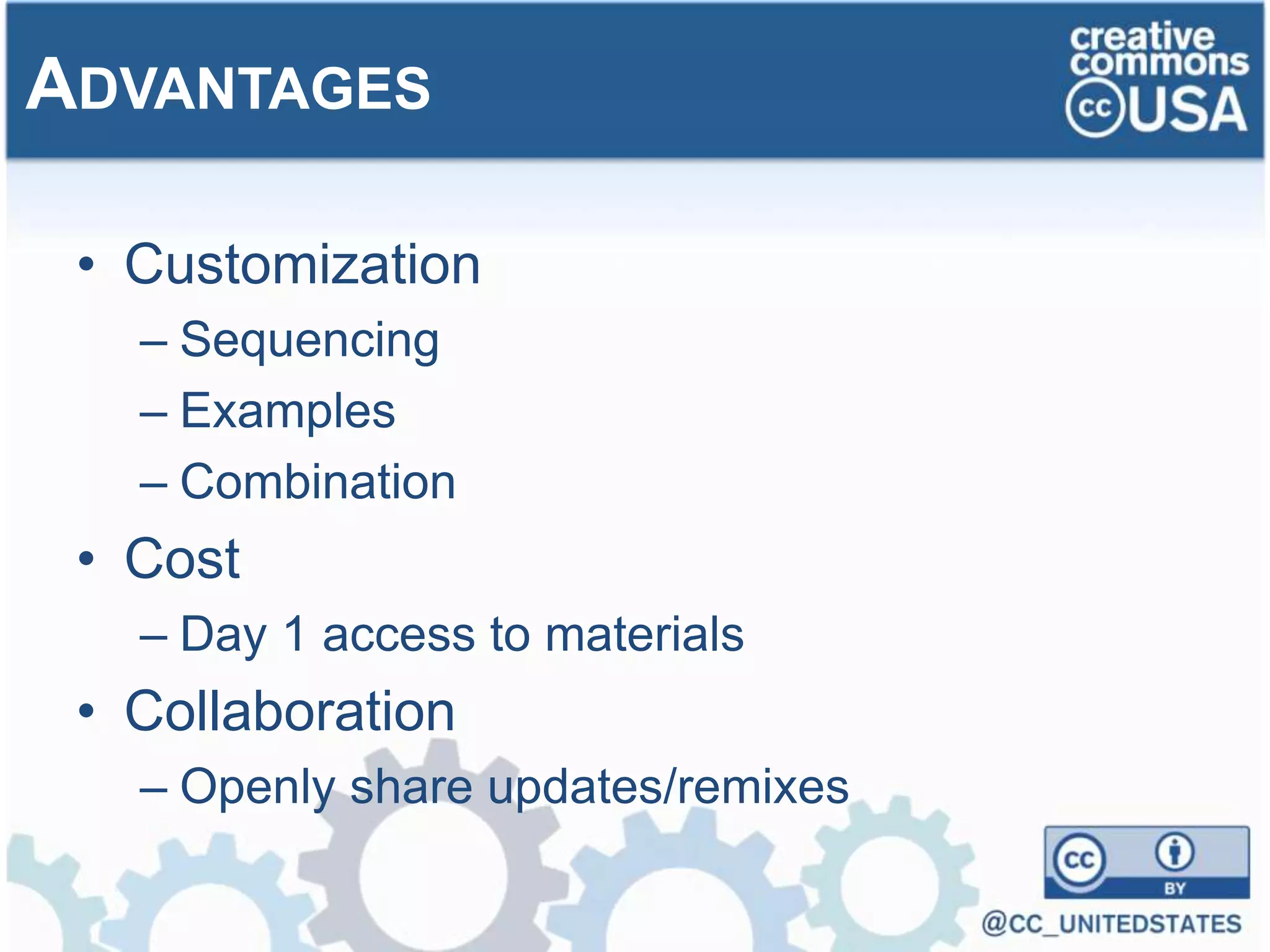
• Customization
– Sequencing
– Examples
– Combination
• Cost
– Day 1 access to materials
• Collaboration
– Openly share updates/remixes
ADVANTAGES
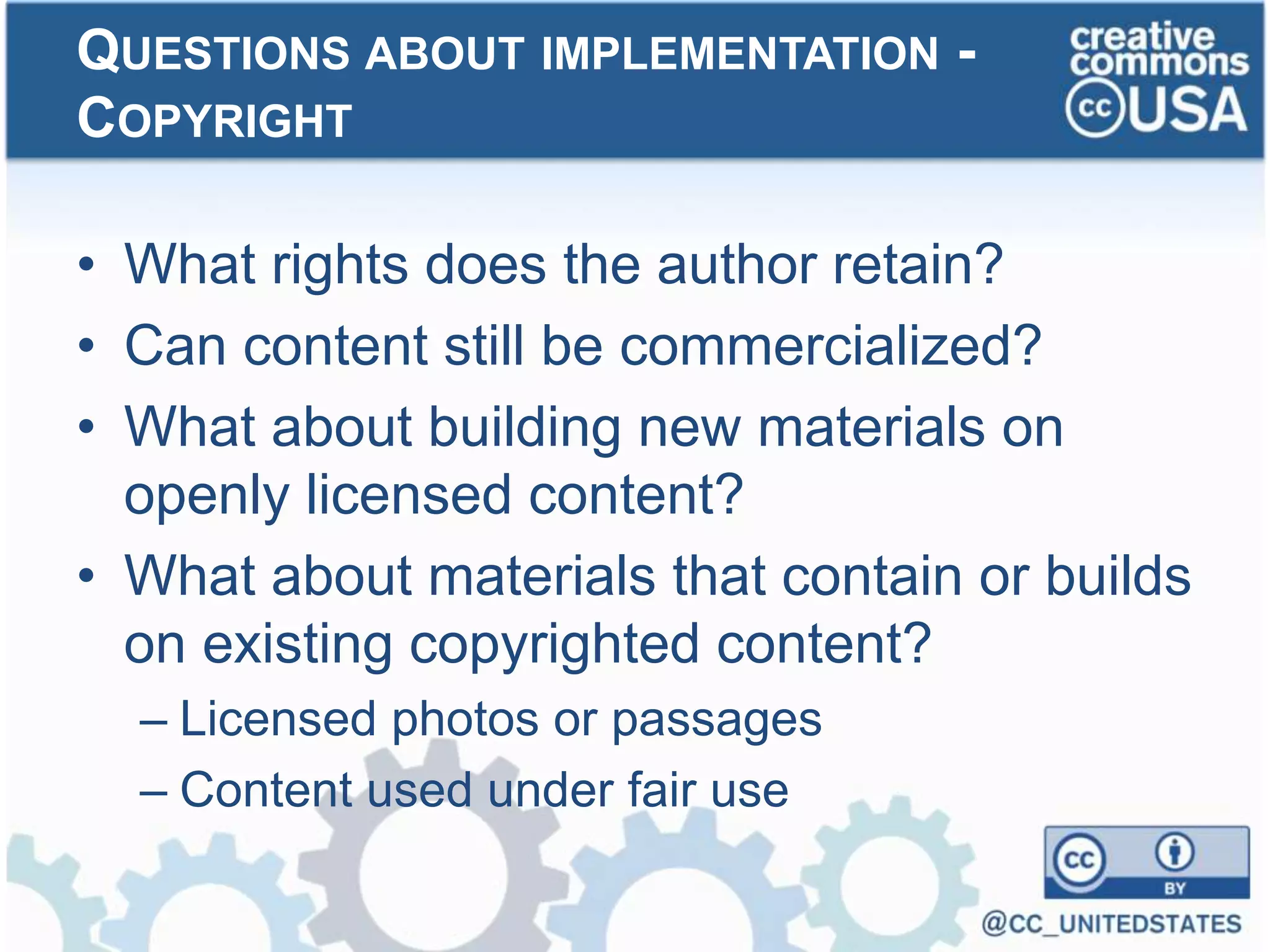
• What rights does the author retain?
• Can content still be commercialized?
• What about building new materials on
openly licensed content?
• What about materials that contain or builds
on existing copyrighted content?
– Licensed photos or passages
– Content used under fair use
QUESTIONS ABOUT IMPLEMENTATION -
COPYRIGHT
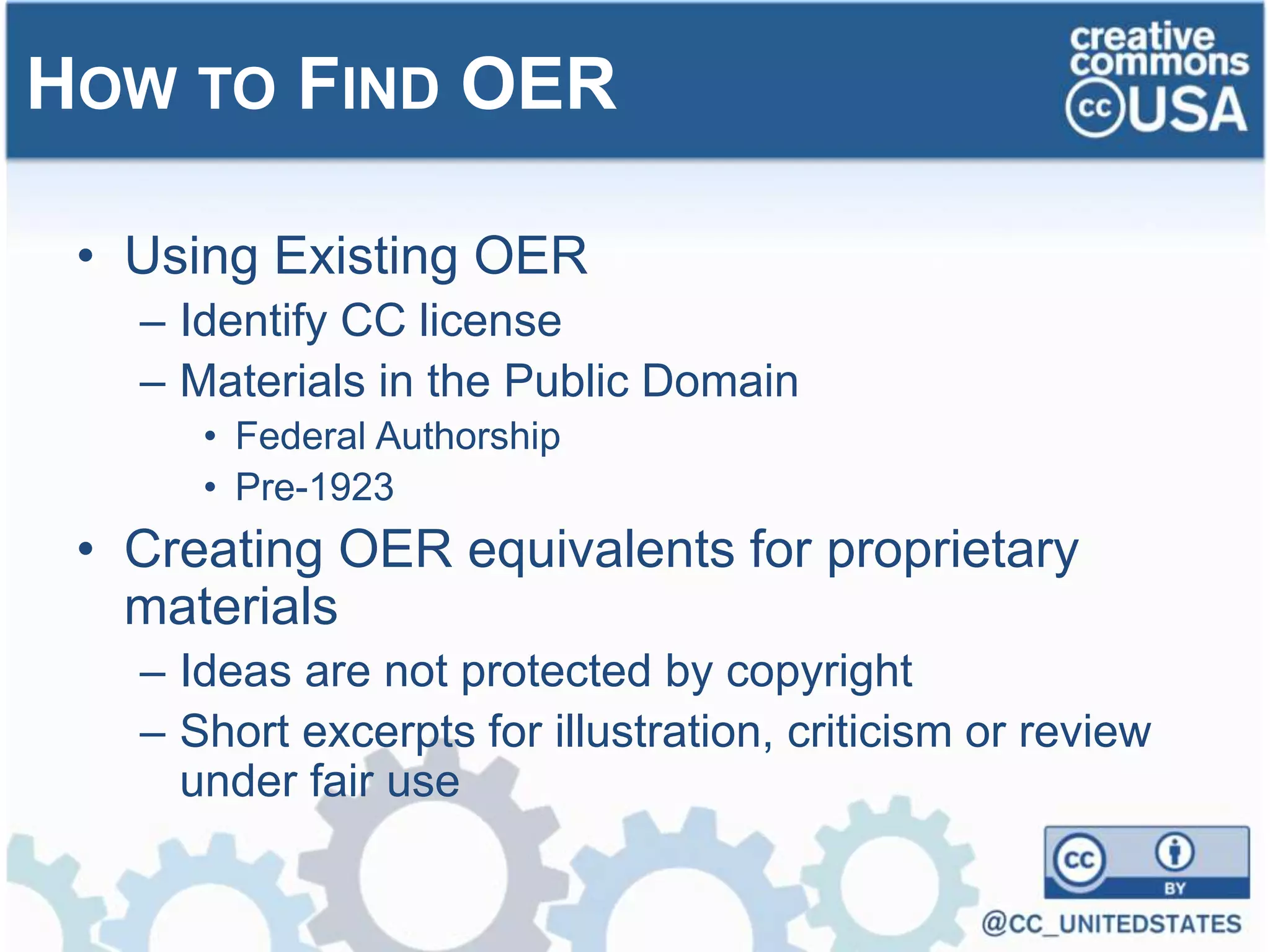
• Using Existing OER
– Identify CC license
– Materials in the Public Domain
• Federal Authorship
• Pre-1923
• Creating OER equivalents for proprietary
materials
– Ideas are not protected by copyright
– Short excerpts for illustration, criticism or review
under fair use
HOW TO FIND OER
• creativecommonsusa.org
• creativecommons.org
• mjacob@wcl.american.edu
• slideshare.net/MeredithJacob
OPPORTUNITIES TO LEARN MORE

ASTE - UPDATED - Open Educational Resources, Copyright & Creative Commons

  • 1.
    COPYRIGHT, OPEN LICENSING& CREATIVE COMMONS LICENSES Meredith Jacob Public Lead – Creative Commons USA American University Washington College of Law ASTE – February 17-20, 2018 Except where noted, all slides licensed CC-BY 4.0 by Creative Commons United States
  • 2.
    • Copyright 101 •What is a Creative Commons license • How Creative Commons licenses work • How to find and use CC licensed images • What are Open Educational Resources (OER)? • Where OER are being used and places to find resources • FAQ WHAT WE’LL COVER
  • 3.
    Copyright law grantsto the author or copyright owner the exclusive right to: • reproduce, make derivatives of, sell, distribute to the public, perform or display publicly, the copyrighted work, • subject to fair use and other limitations and exceptions to copyright law. Copyright owners may assign all the rights in their copyright, or give limited licenses that allow others to make specific use of their works. WHAT IS COPYRIGHT?
  • 4.
    Copyright law appliesto intellectual property that are “original works of authorship.” • Common types of works protected by copyright include literary, artistic, and musical works. • Copyright is automatic, so it applies as soon as the work has been created. Copyright protection in the United States lasts for the life of the author plus 70 years or 95 years for an institutional author. After this time period has expired, works fall into the public domain and are free from copyright restrictions. WHAT DOES COPYRIGHT PROTECT?
  • 5.
    There are anumber of exceptions and limitations to copyright. Functional concepts, names, and logos are typically covered by patent or trademark law, if protected at all, rather than copyright. Copyright protects the specific expression of a work - the words - but not the underlying idea. ARE THERE LIMITS TO WHAT COPYRIGHT PROTECTS?
  • 6.
    Fair use aallows the use of a copyrighted work without permission from the copyright holder under specific circumstances. News reporting, teaching, and parody are all examples of uses that could qualify as fair use. Fair use is evaluated on a case-by-case basis, and considers the purpose of the use, how much of the original work is used, and how it impacts the market for the original work. WHAT ABOUT FAIR USE?
  • 7.
    COPYRIGHT EVALUATION Covered by copyrightlaw? YES Fair use or other copyright limitation? Creative Commons Licensed Insitutional license or subscription Allowed free classroom use (not open license) NO Public Domain Idea (not expression)
  • 8.
    • Works withinthe copyright system • Author still holds copyright to the work • Traditional licenses are one to one (negotiated) • Open licenses like the Creative Commons licenses are one to the public/one to many WHAT IS AN CREATIVE COMMONS LICENSE?
  • 9.
    Advantages • Takes advantagedigital distribution and authorship • Ability to improve, remix, and translate • Makes informal reuse formally permissible (and possible on the open internet) WHAT ARE THE ADVANTAGES OF AN OPEN LICENSE?
  • 10.
    • Clearly communicatesto the public that the resource is free to reuse • Grants the public a license to access, reproduce, publicly perform, publicly display, adapt, distribute, and otherwise use for any purposes • provided that the licensee gives attribution to the designated authors of the intellectual property. WHAT DOES A CREATIVE COMMONS LICENSE DO?
  • 11.
  • 12.
    Except where otherwisenoted, this work is licensed under: https://creativecommons.org/licenses/by/4.0 THE CC LICENSE MARK AND LINK
  • 13.
  • 14.
  • 15.
    MARKING YOUR WORK ©2013 by CCSSO. Operational Best Practices for Statewide Large-Scale Assessment Programs 2013 Edition is licensed under a Creative Commons Attribution 4.0 International License http://creativecommons.org/licenses/by/4.0 it is available at http://www.ccsso.org/Resources/Publications/Operational_ Best_Practices_for_Statewide_Large- Scale_Assessment_Programs.html
  • 16.
    Open Educational Resourcesand Creative Commons Licenses by Meredith Jacob, slideshare.net/Meredith Jacob under a Creative Commons Attribution 4.0 License (CC BY) http://creativecommons.org/licenses/by/4.0 ATTRIBUTION EXAMPLE
  • 17.
    ATTRIBUTING AN IMAGE “CreativeCommons 10th Birthday Celebration San Francisco” by tvol is licensed under CC BY 2.0 Title, Author, Source (link), License
  • 18.
    • CC Search:Art, public domain, specific real-world people, things and places These licenses vary depending on your search. Images with CC BY will require attribution and those marked CC0 do not require attribution. – https://ccsearch.creativecommons.org – https://search.creativecommons.org/ • Stock image replacements: All images on the following sites carry a CC0 Creative Commons license and therefore can be used in any project and do not require attribution: – Pixabay: https://pixabay.com/ – Pexels: https://www.pexels.com/ – Librestock: http://librestock.com/ • American Education: Images of Teachers and Students in Action: This gallery contains nearly 300 original print-quality, royalty-free images of preK-12 students and teachers engaged in authentic learning activities. – http://deeperlearningforall.org/images/5/?envira_id=13906 • Flickr WHERE TO FIND OPEN IMAGES
  • 19.
  • 20.
  • 21.
  • 22.
    Open Educational Resources(OER) are educational materials that are released under an open copyright license, rather than under traditional all rights reserved copyright. • Digital distribution and authorship • Public access and cost savings • Ability to improve, remix, and translate OER
  • 23.
    Just like traditionalteaching materials, OER can be: • Textbooks • Articles • Slides • Images • Videos • Simulations SIMILARITIES
  • 24.
    Unlike traditional educationalmaterials, OER have been released under an open copyright license that allows users to: • Update and remix • Translate • Share new versions • Post online DIFFERENCES
  • 25.
    OFFICE OF EDTECH https://tech.ed.gov/open/
  • 26.
    #GOOPEN DISTRICTS https://tech.ed.gov/open/districts/ 117districts! https://tech.ed.gov/open/districts/launch/ District Launch Packet (PDF)
  • 27.
  • 28.
    OPEN UP RESOURCE– ONLINE
  • 29.
  • 30.
    • Search bystandard and grade level OER COMMONS
  • 32.
  • 33.
    • Customization – Sequencing –Examples – Combination • Cost – Day 1 access to materials • Collaboration – Openly share updates/remixes ADVANTAGES
  • 34.
    • What rightsdoes the author retain? • Can content still be commercialized? • What about building new materials on openly licensed content? • What about materials that contain or builds on existing copyrighted content? – Licensed photos or passages – Content used under fair use QUESTIONS ABOUT IMPLEMENTATION - COPYRIGHT
  • 35.
    • Using ExistingOER – Identify CC license – Materials in the Public Domain • Federal Authorship • Pre-1923 • Creating OER equivalents for proprietary materials – Ideas are not protected by copyright – Short excerpts for illustration, criticism or review under fair use HOW TO FIND OER
  • 36.
    • creativecommonsusa.org • creativecommons.org •mjacob@wcl.american.edu • slideshare.net/MeredithJacob OPPORTUNITIES TO LEARN MORE