Still Confused? A Conversation about Copyright, Fair Use & Remix Culture By Joyce Valenza and Renee Hobbs
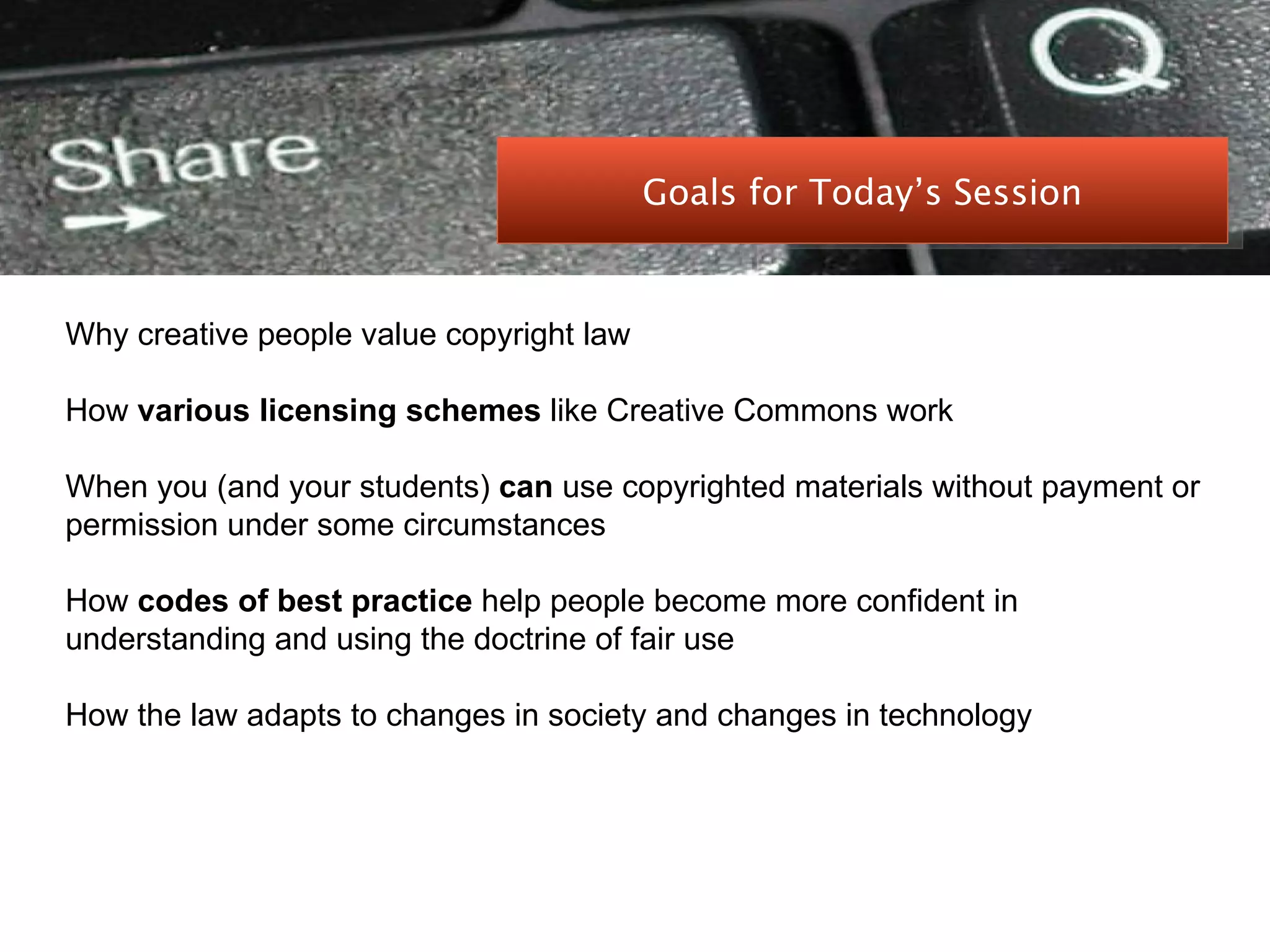
PEER-TO-PEER FILE SHARING Why creative people value copyright law How  various licensing schemes  like Creative Commons work When you (and your students)  can  use copyrighted materials without payment or permission under some circumstances How  codes of best practice  help people become more confident in understanding and using the doctrine of fair use How the law adapts to changes in society and changes in technology Goals for Today’s Session
PEER-TO-PEER FILE SHARING Why do creative people value copyright law? A Conversation
 
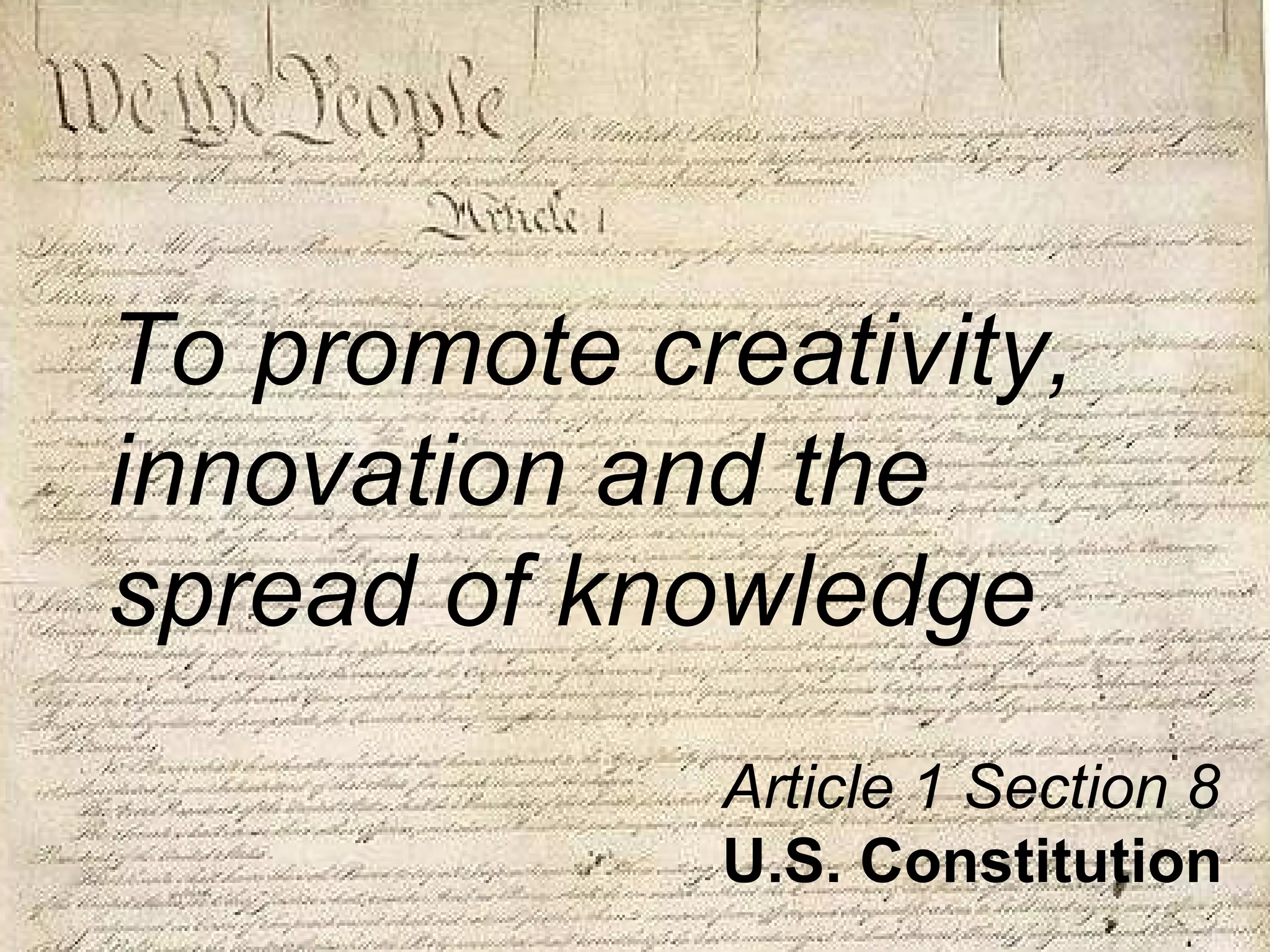
To promote creativity, innovation and the spread of knowledge Article 1 Section 8 U.S. Constitution
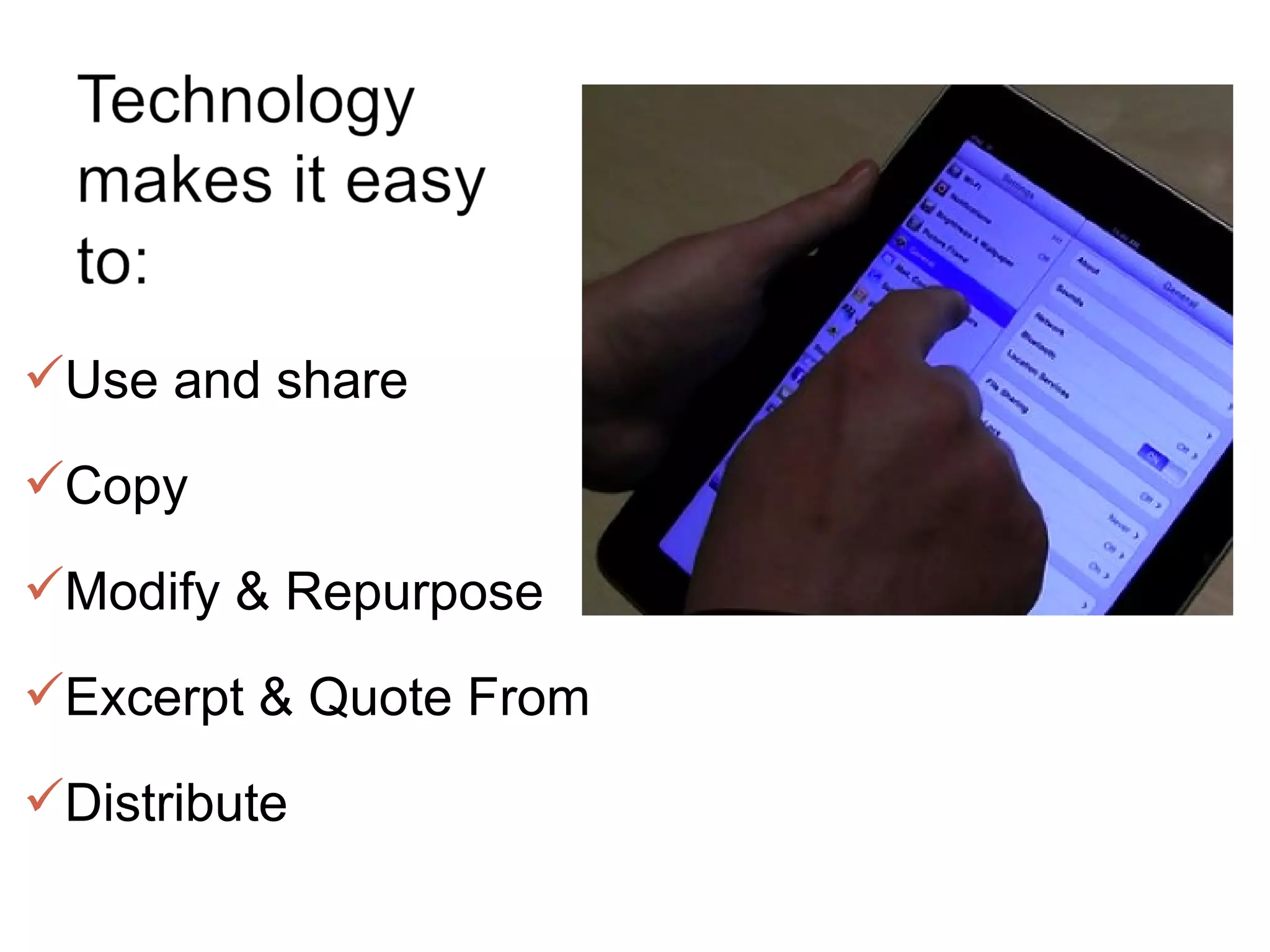
Use and share Copy  Modify & Repurpose Excerpt & Quote From Distribute
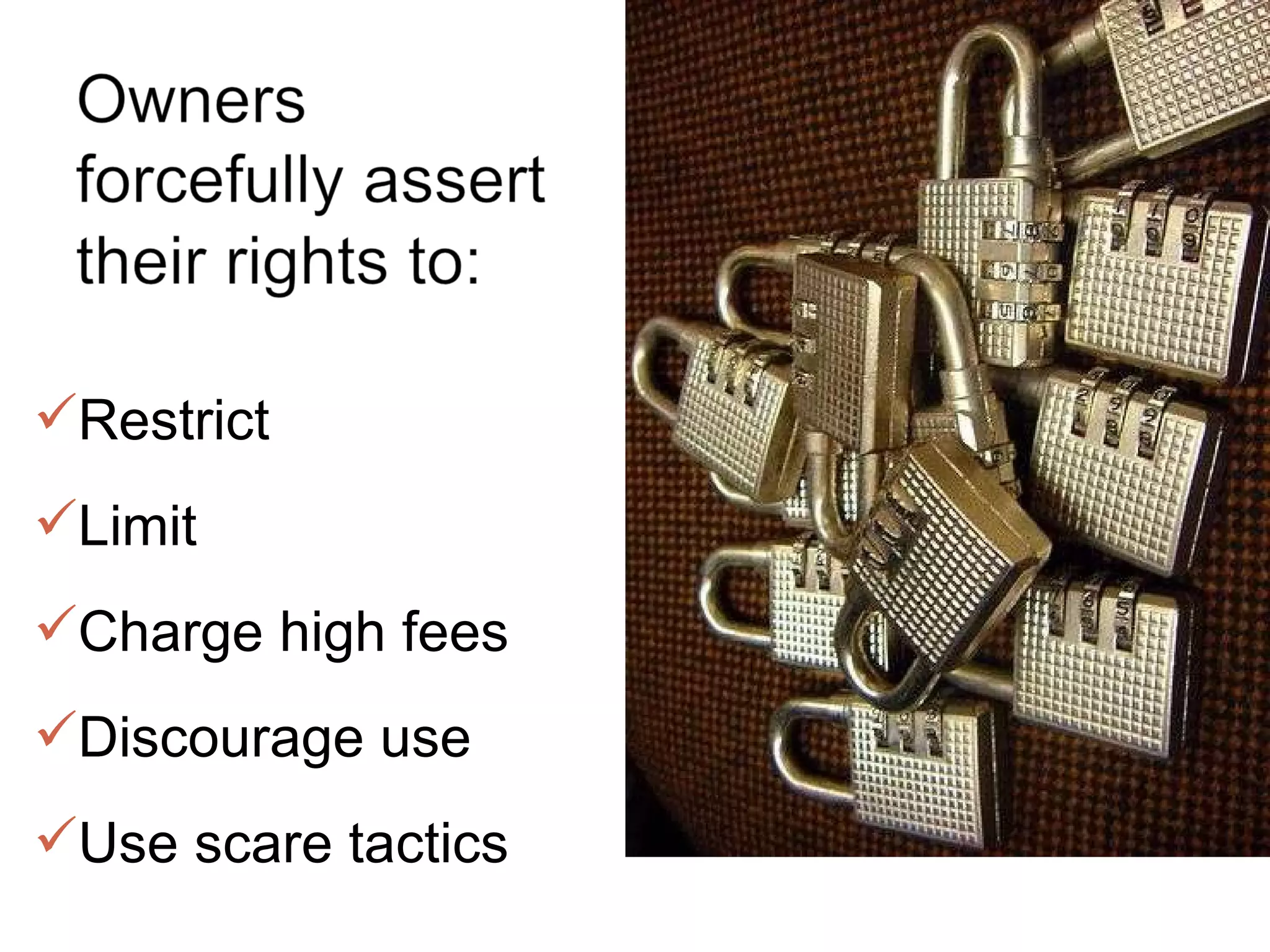
Restrict Limit Charge high fees Discourage use Use scare tactics
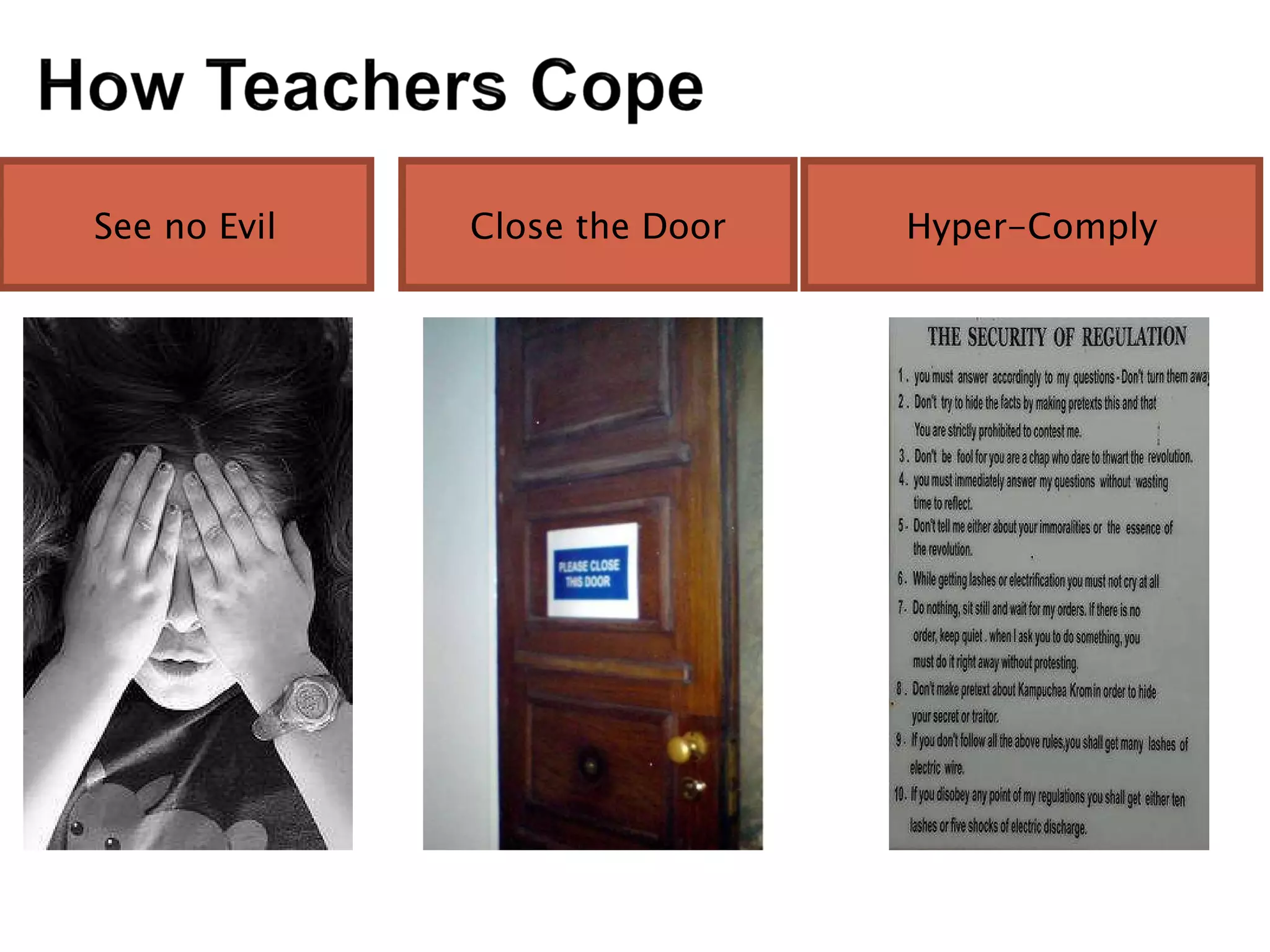
See no Evil Close the Door Hyper-Comply
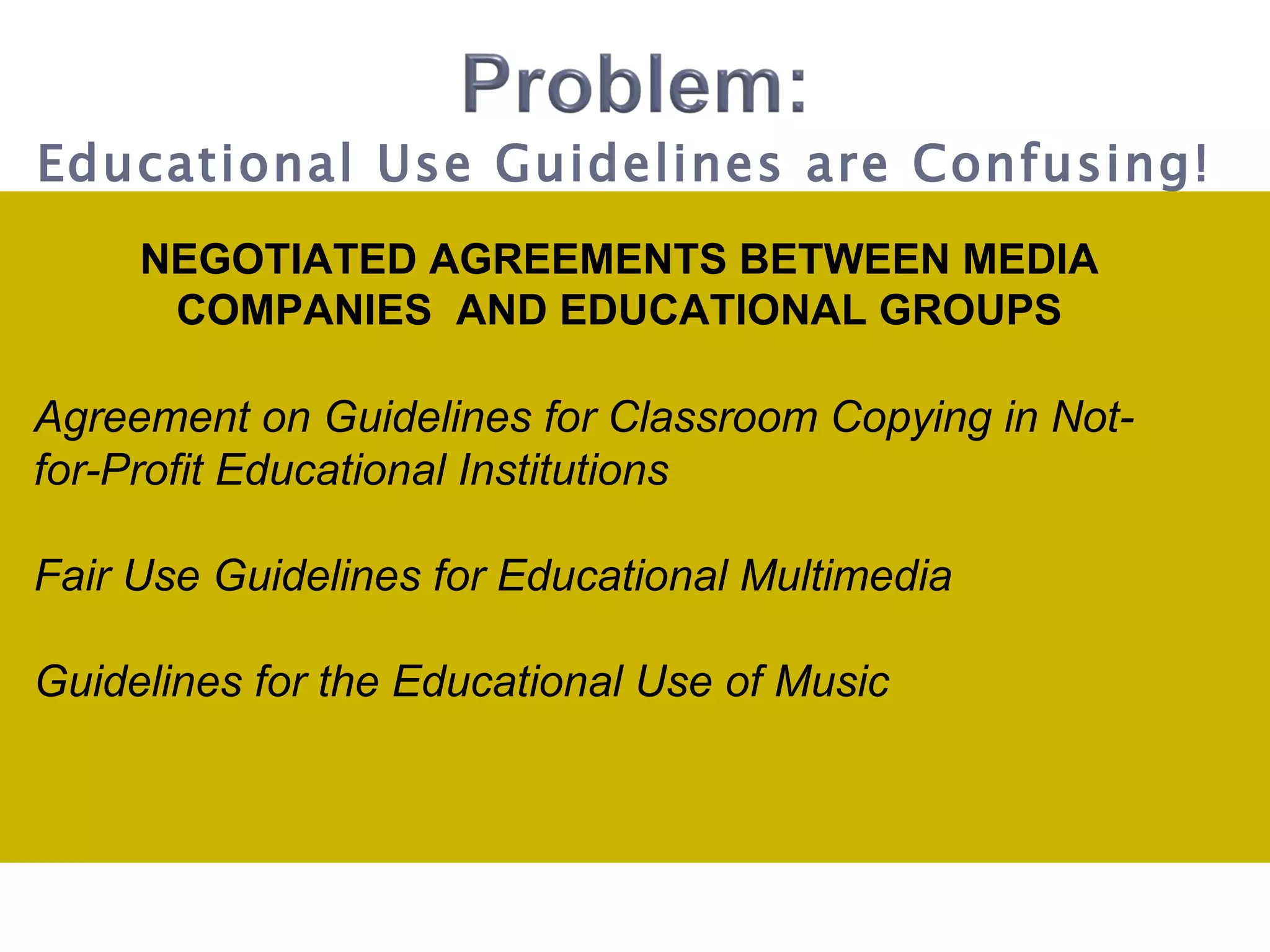
NEGOTIATED AGREEMENTS BETWEEN MEDIA COMPANIES  AND EDUCATIONAL GROUPS Agreement on Guidelines for Classroom Copying in Not-for-Profit Educational Institutions Fair Use Guidelines for Educational Multimedia Guidelines for the Educational Use of Music Educational Use Guidelines are Confusing!
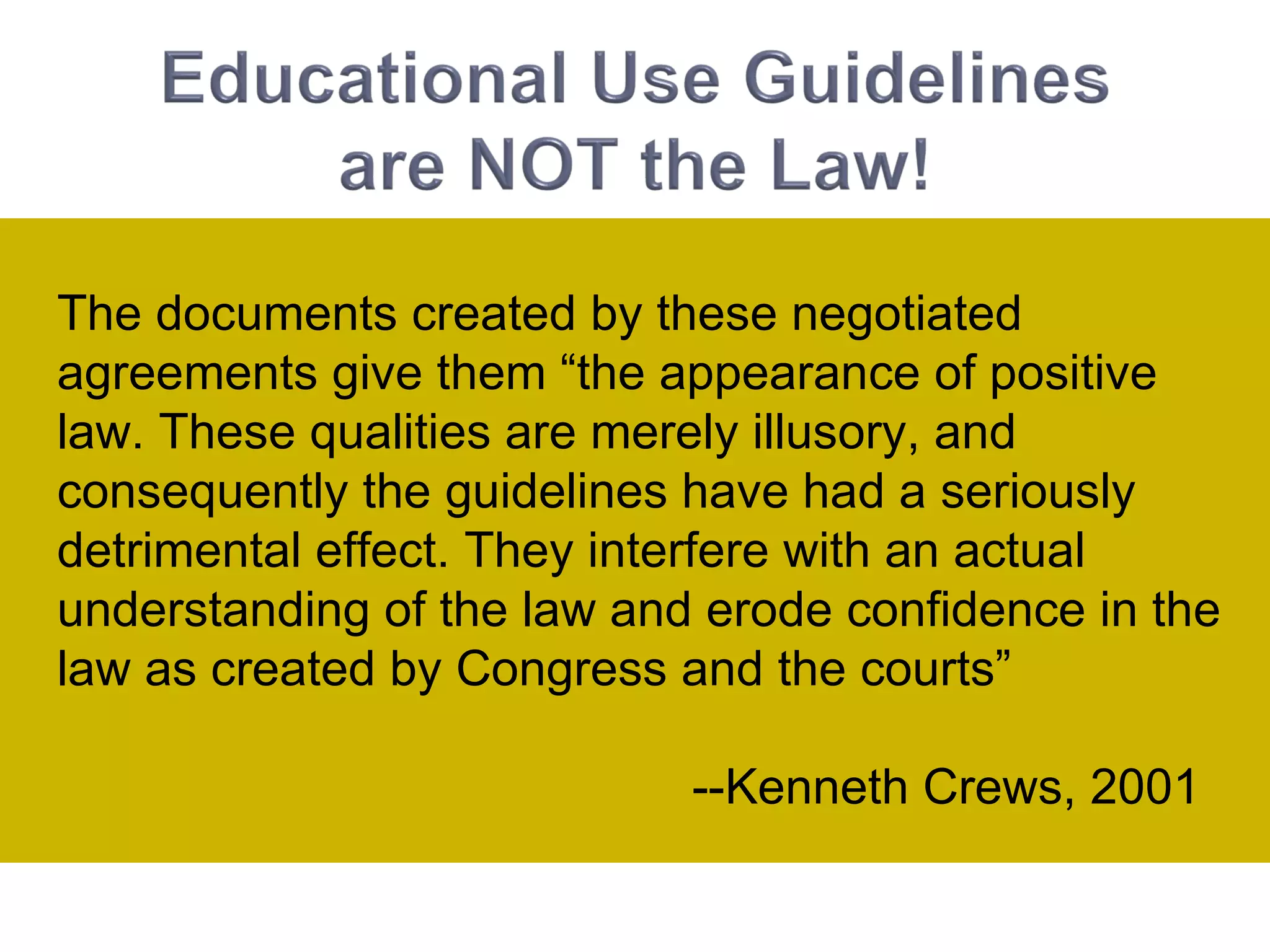
The documents created by these negotiated agreements give them  “the appearance of positive law. These qualities are merely illusory, and consequently the guidelines have had a seriously detrimental effect. They interfere with an actual understanding of the law and erode confidence in the law as created by Congress and the courts”  --Kenneth Crews, 2001
with accurate knowledge
LOVE HATE
Copyright law enables people to control the creative works  they produce LOVE HATE
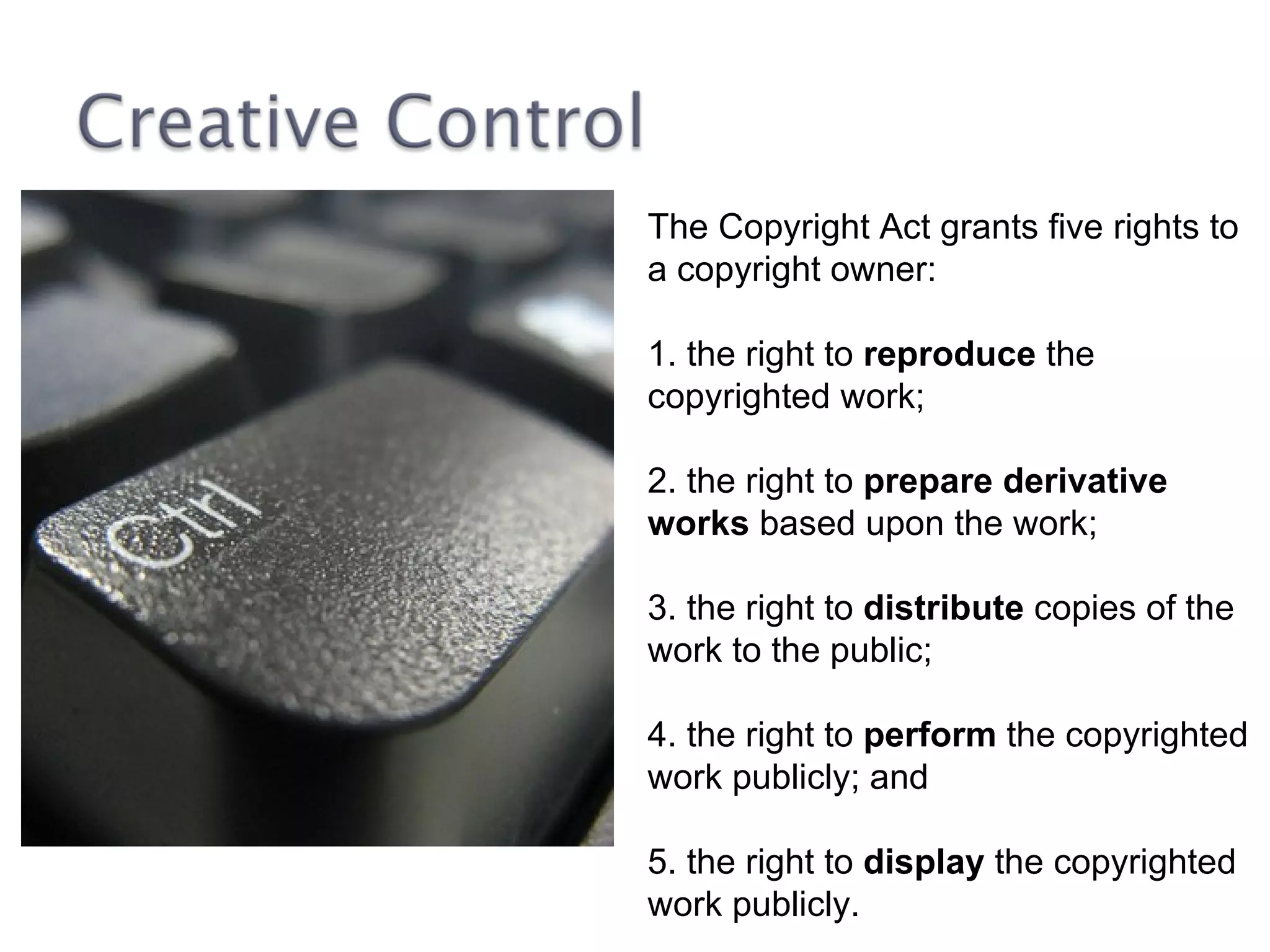
The Copyright Act grants five rights to a copyright owner: 1. the right to  reproduce  the copyrighted work;  2. the right to  prepare derivative works  based upon the work;  3. the right to  distribute  copies of the work to the public;  4. the right to  perform  the copyrighted work publicly; and  5. the right to  display  the copyrighted work publicly.
Violating Copyright Can Be Expensive The Copyright holder may receive statutory damages for all infringements involved in the action… not less than $750 or more than $30,000 as the court considers just. [...]  When infringement was committed willfully, the court in its discretion may increase the award of statutory damages to a sum of not more than $150,000."  LOVE HATE
PEER-TO-PEER FILE SHARING Why do creative people value copyright law? How do various licensing schemes like Creative Commons work? A Conversation
 
http://www.youtube.com/watch?v=1DKm96Ftfko&feature=player_embedded
 
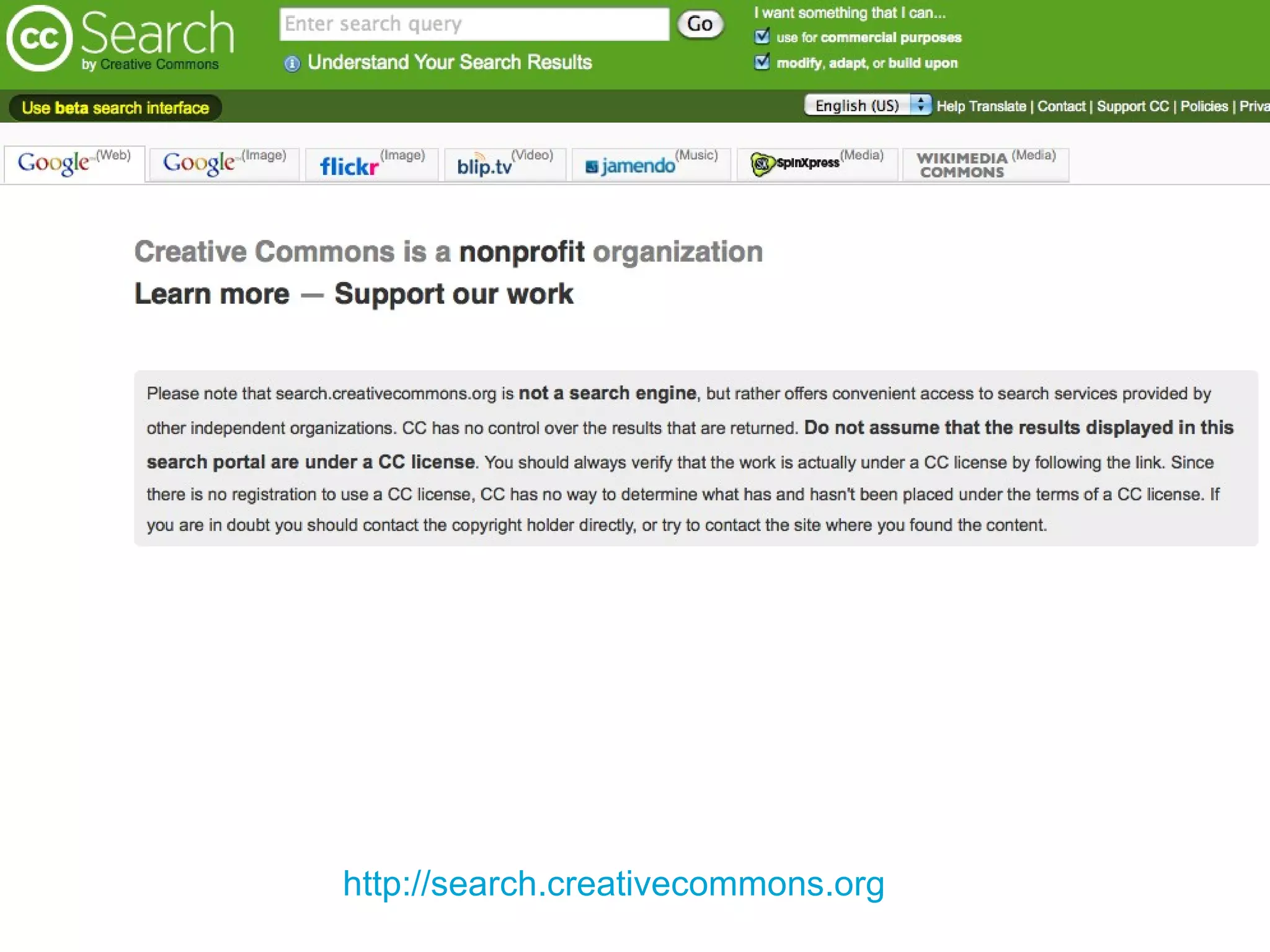
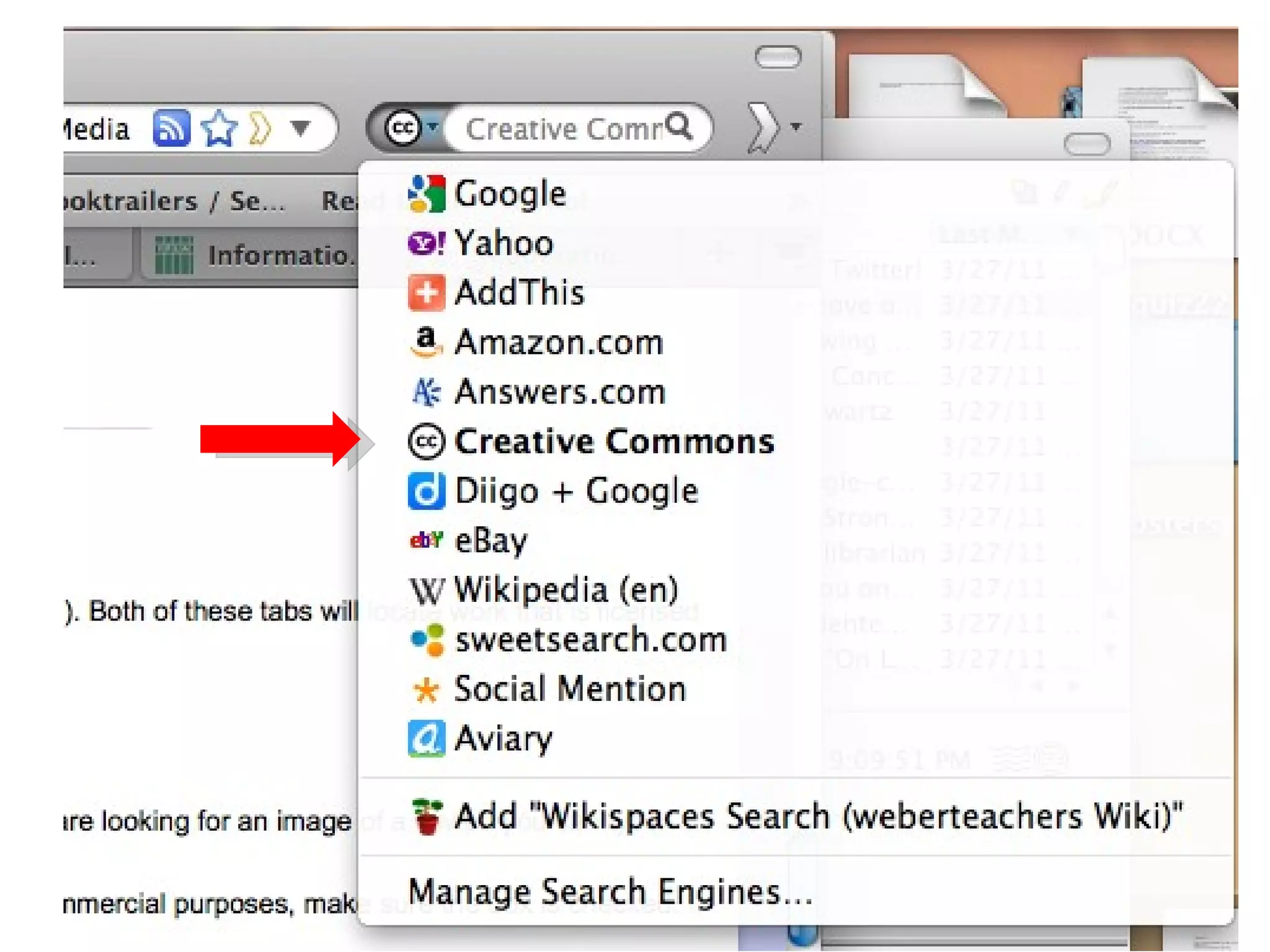
http://search.creativecommons.org
 
 
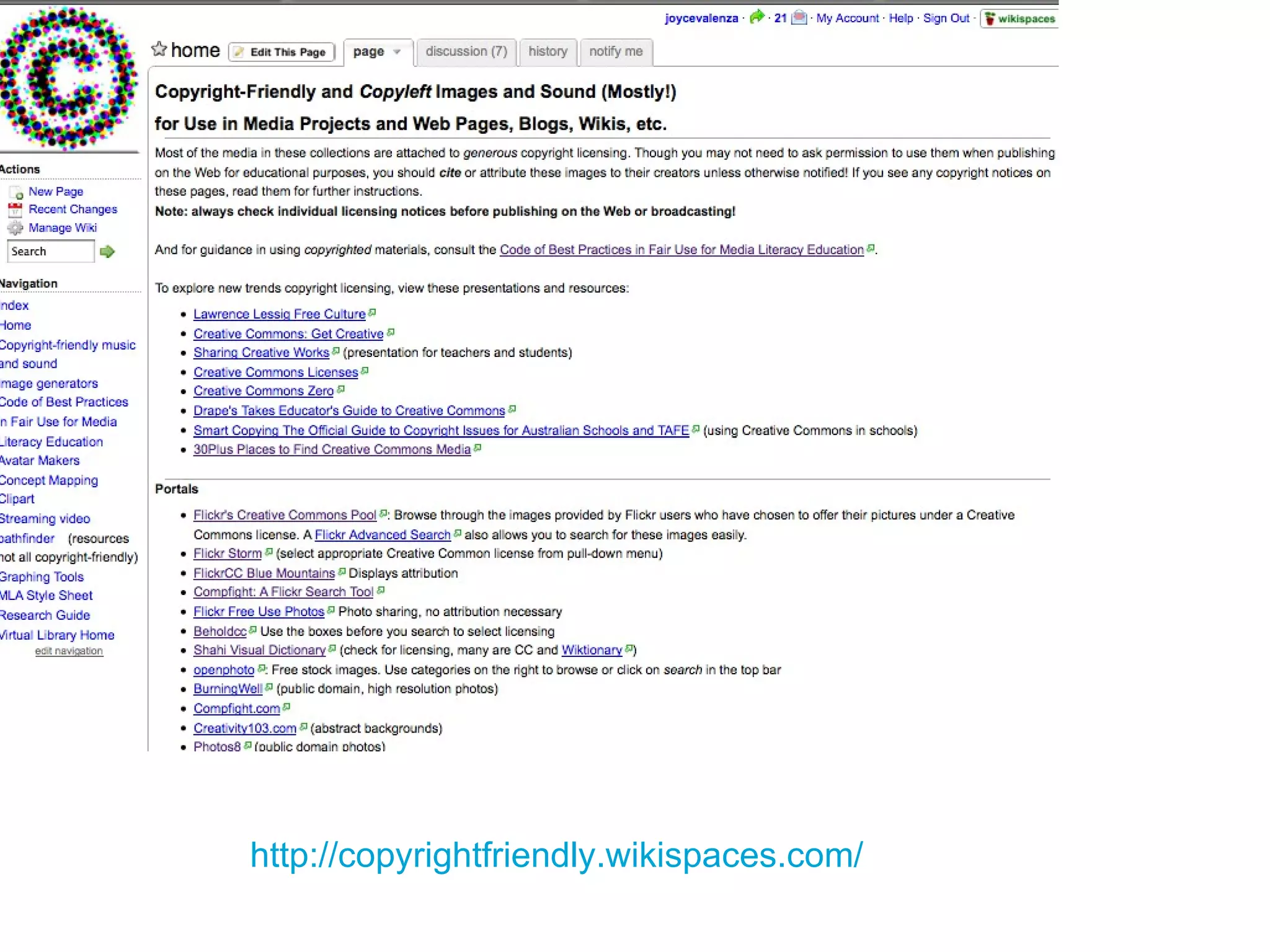
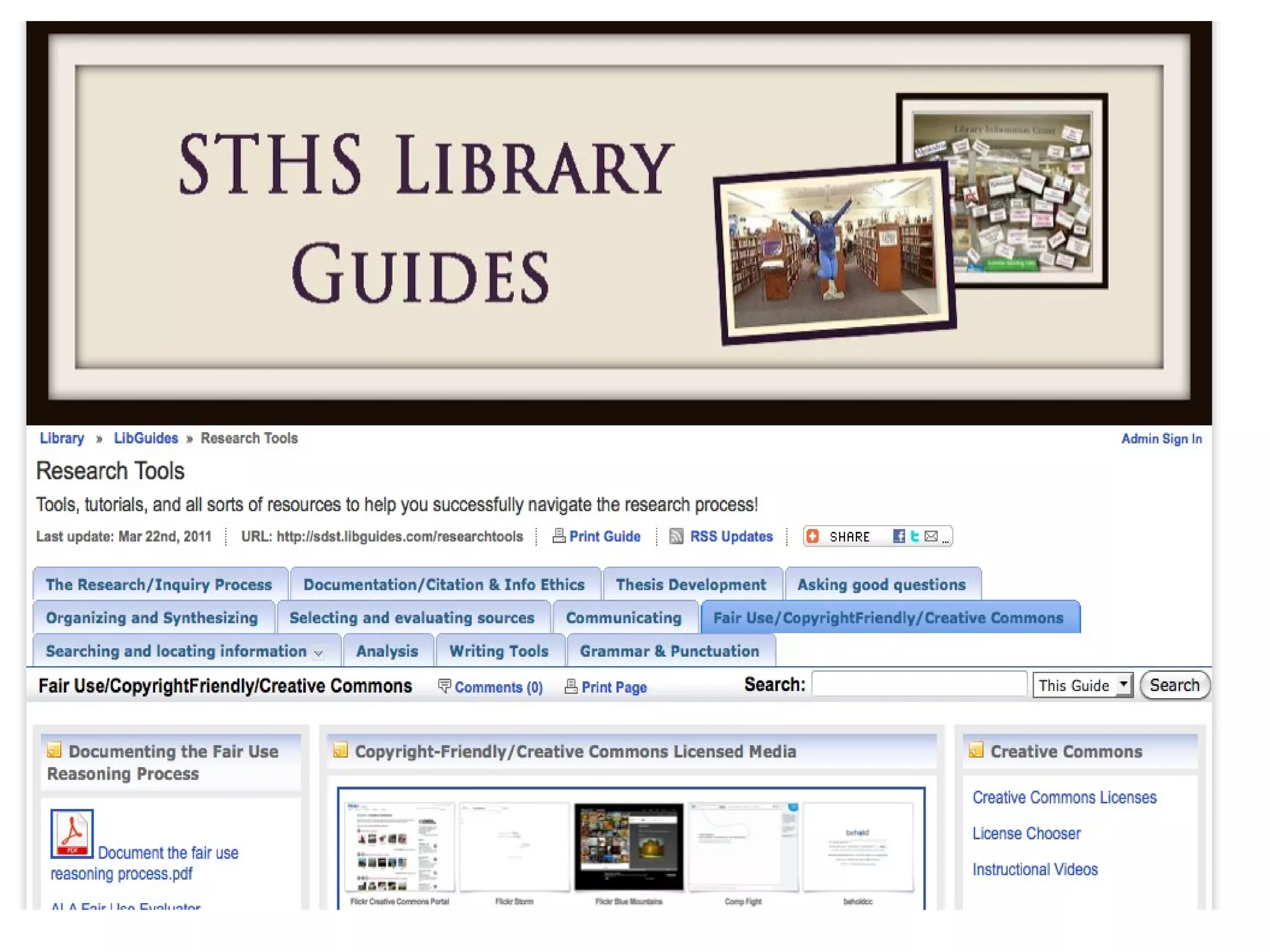
http://copyrightfriendly.wikispaces.com/
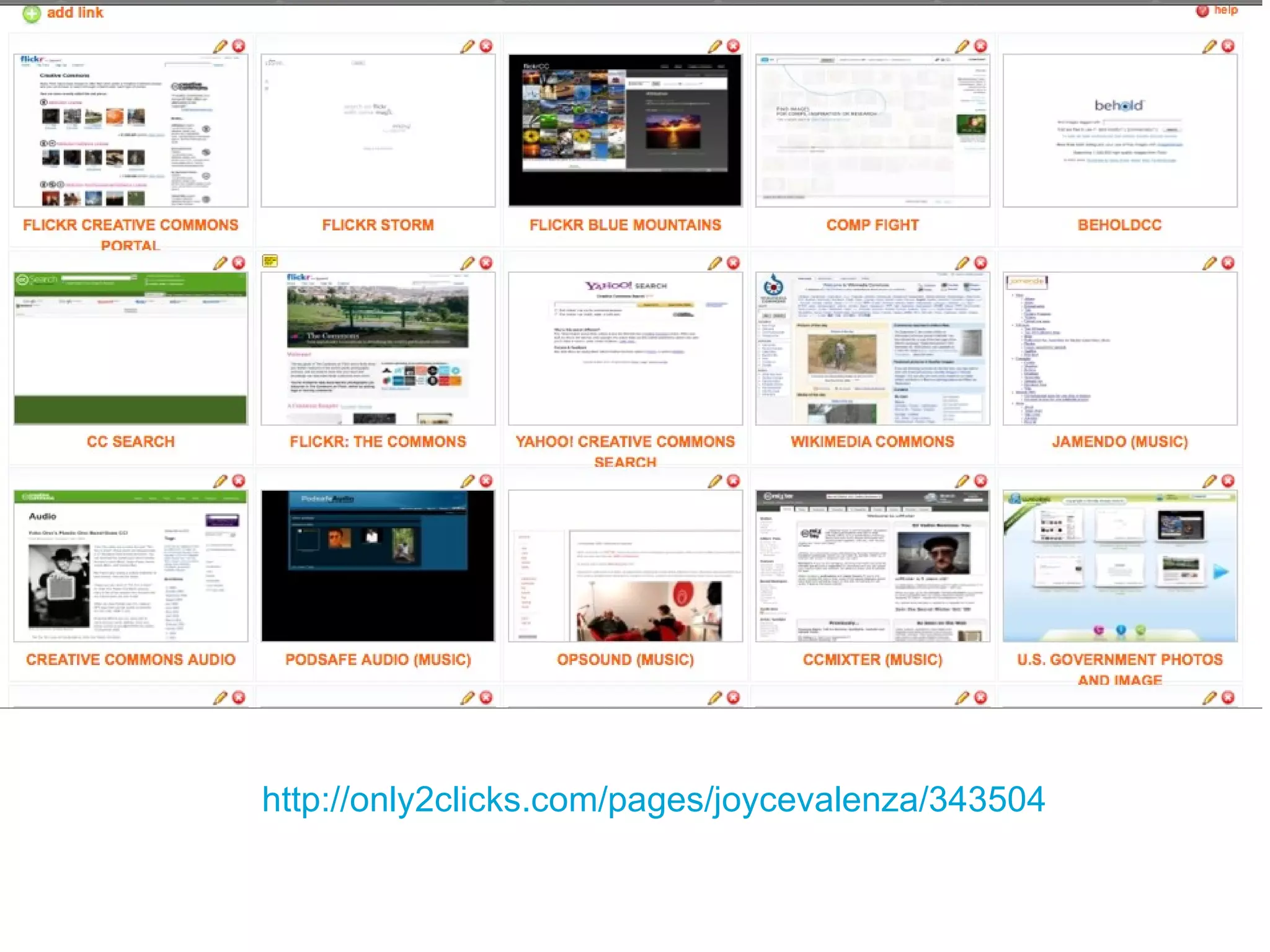
http://only2clicks.com/pages/joycevalenza/343504
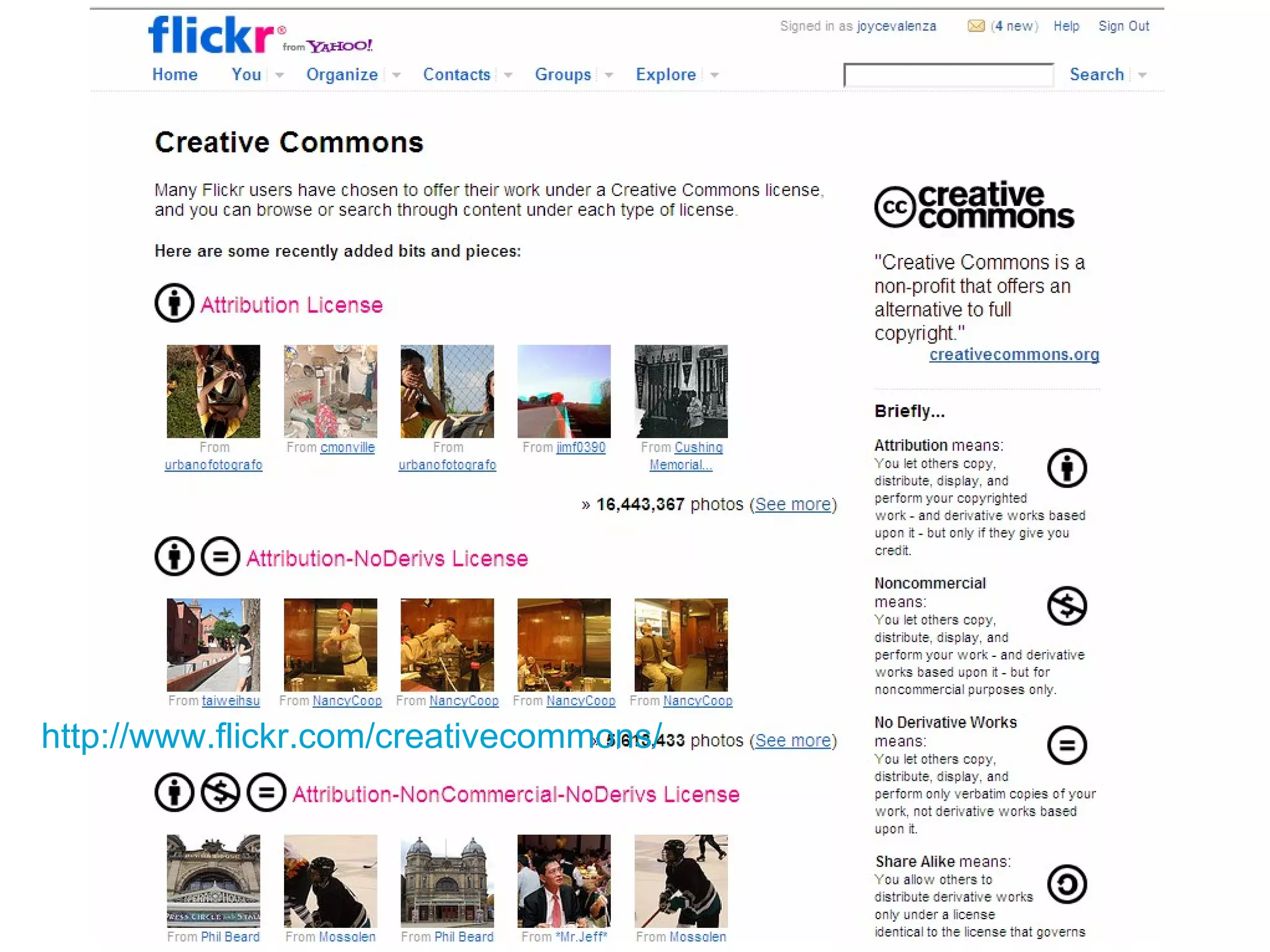
http://www.flickr.com/creativecommons/
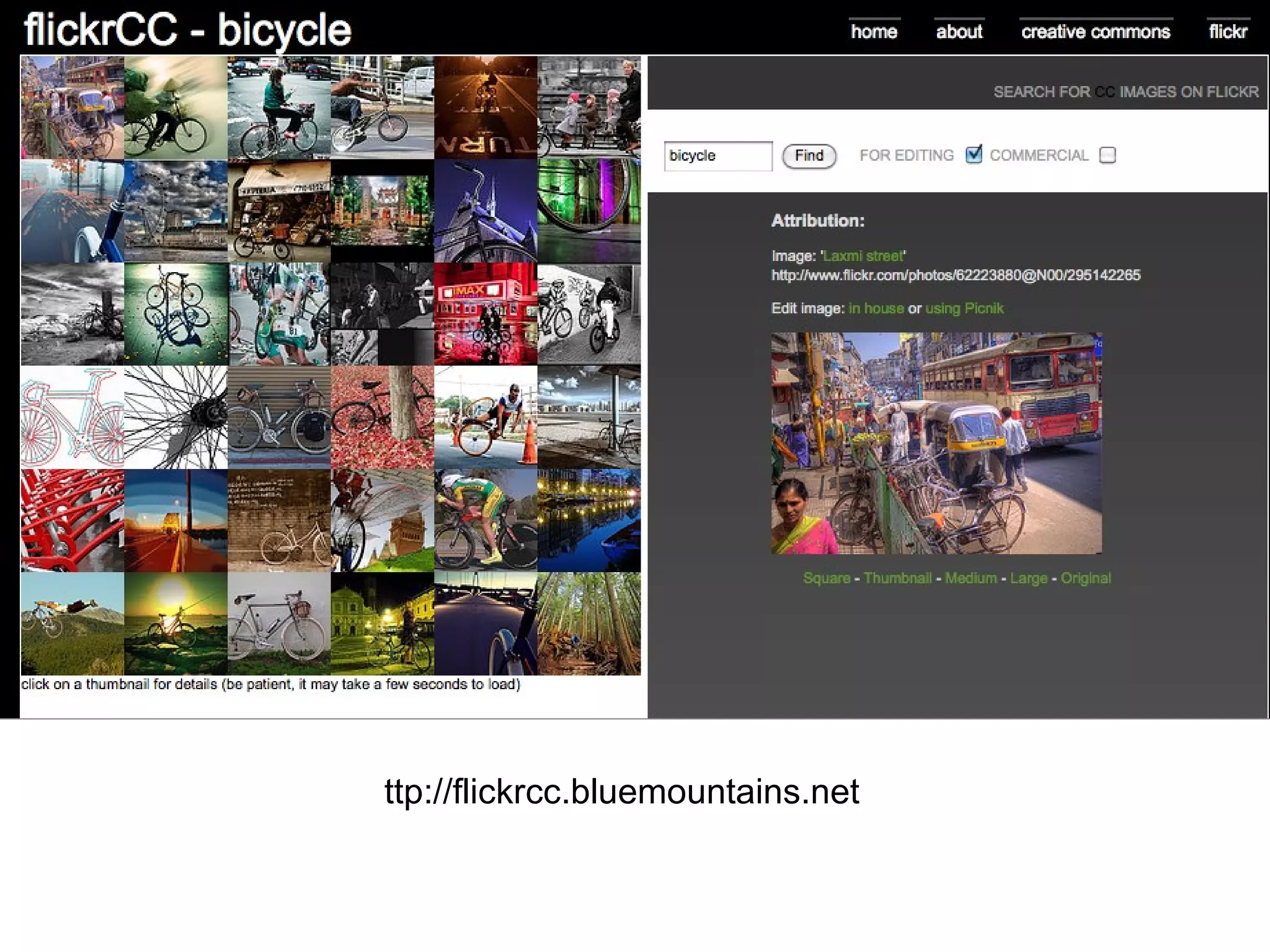
ttp://flickrcc.bluemountains.net
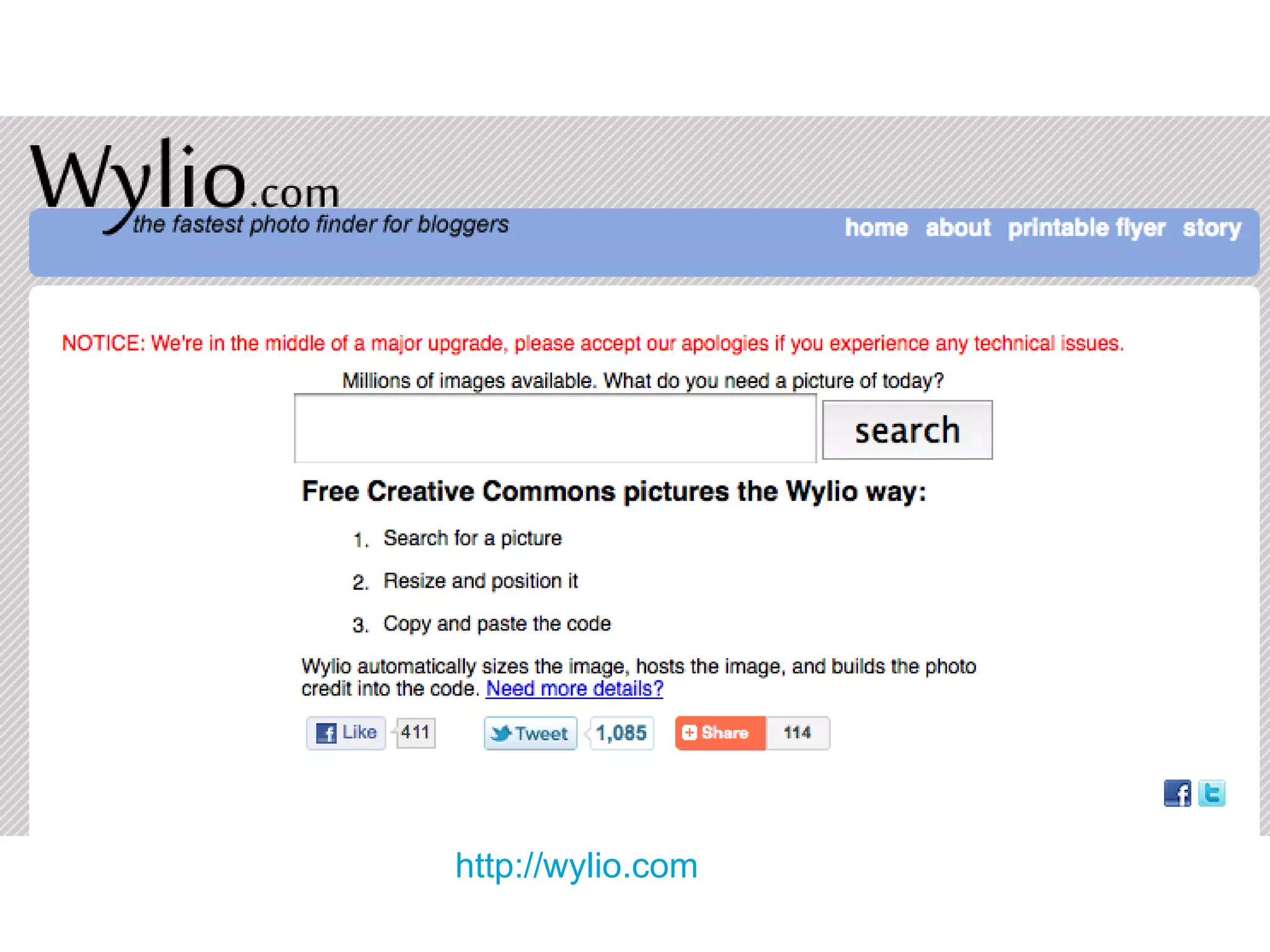
http://wylio.com
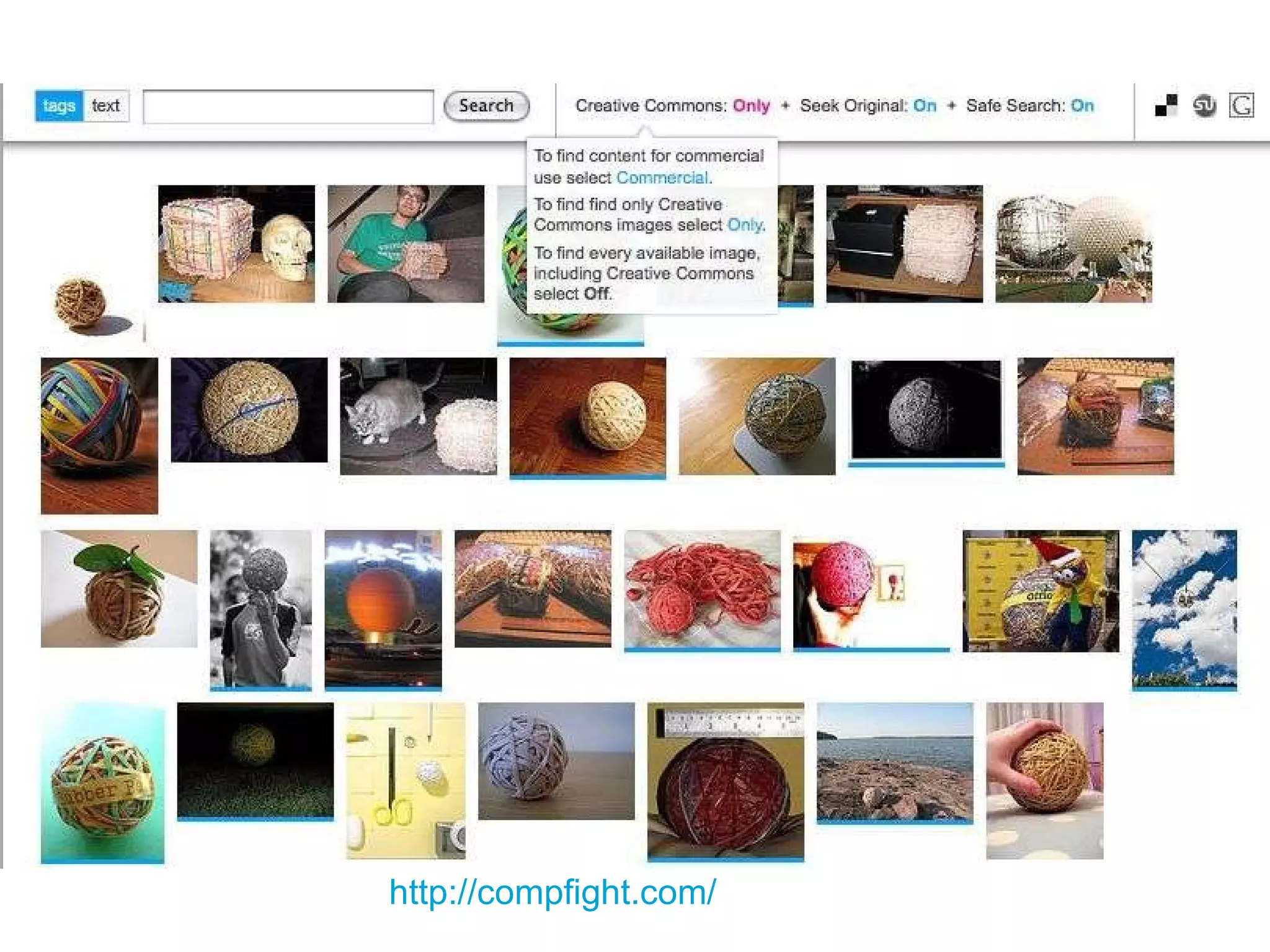
http://compfight.com/
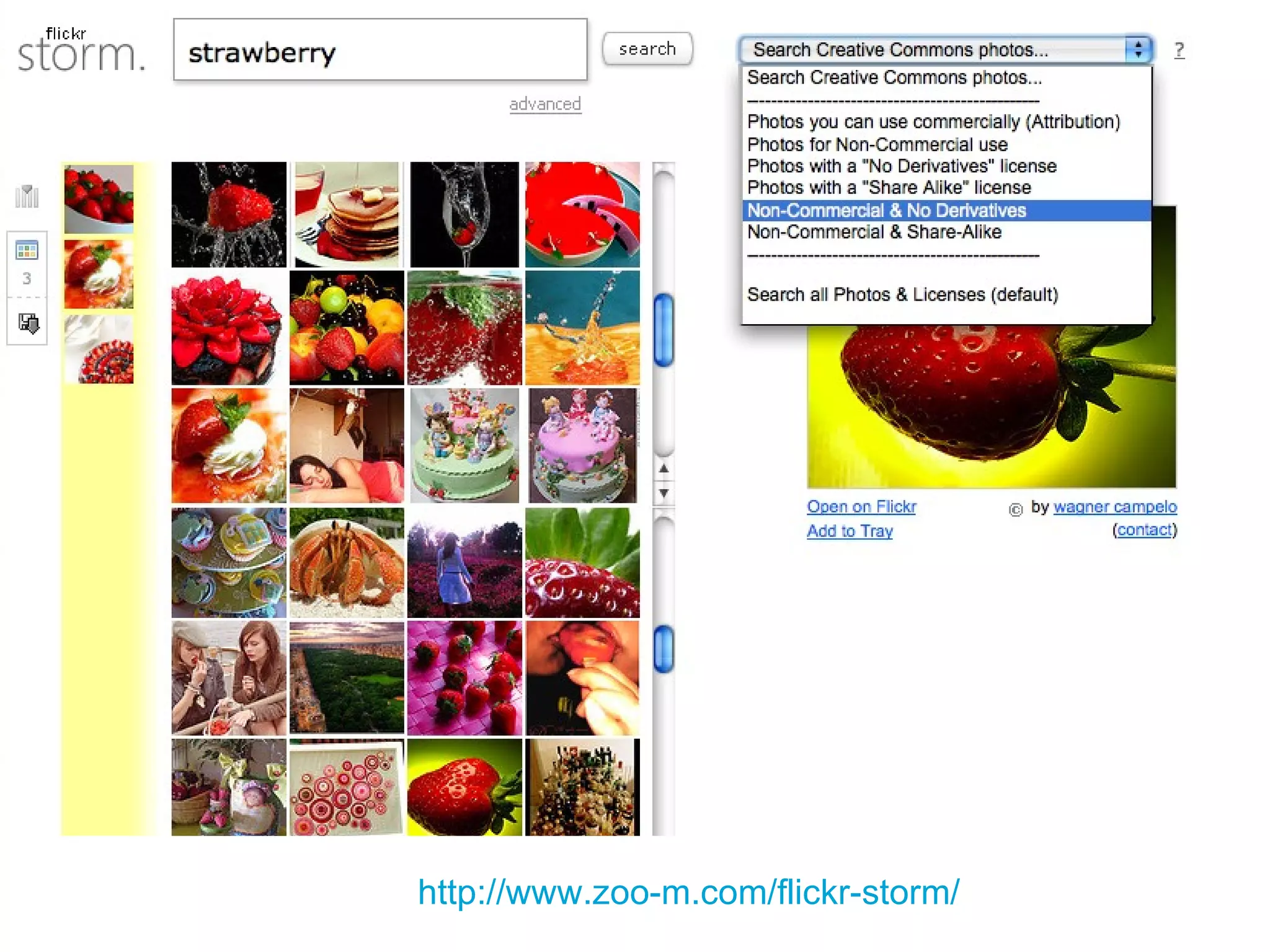
http://www.zoo-m.com/flickr-storm/
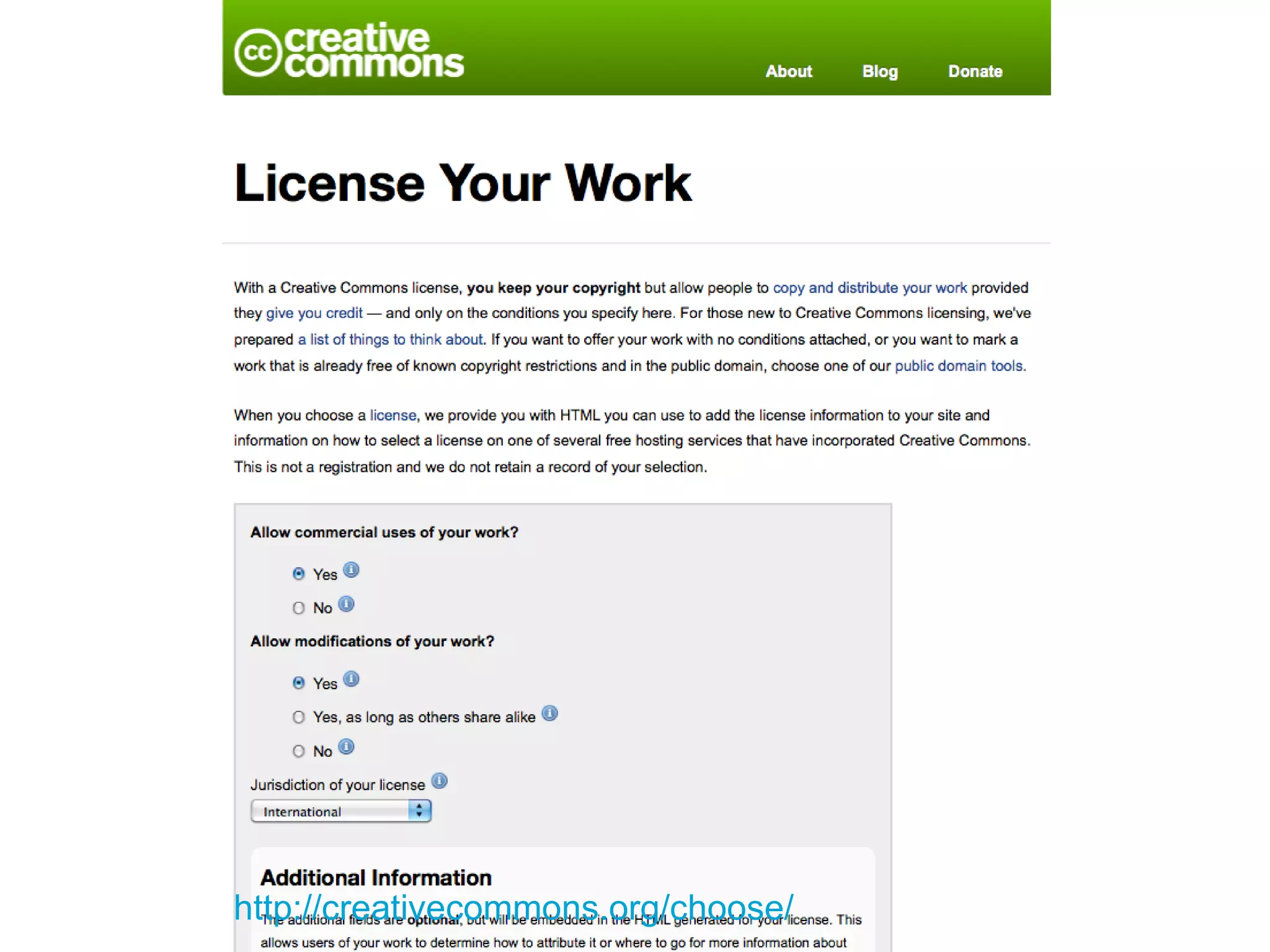
http://creativecommons.org/choose/
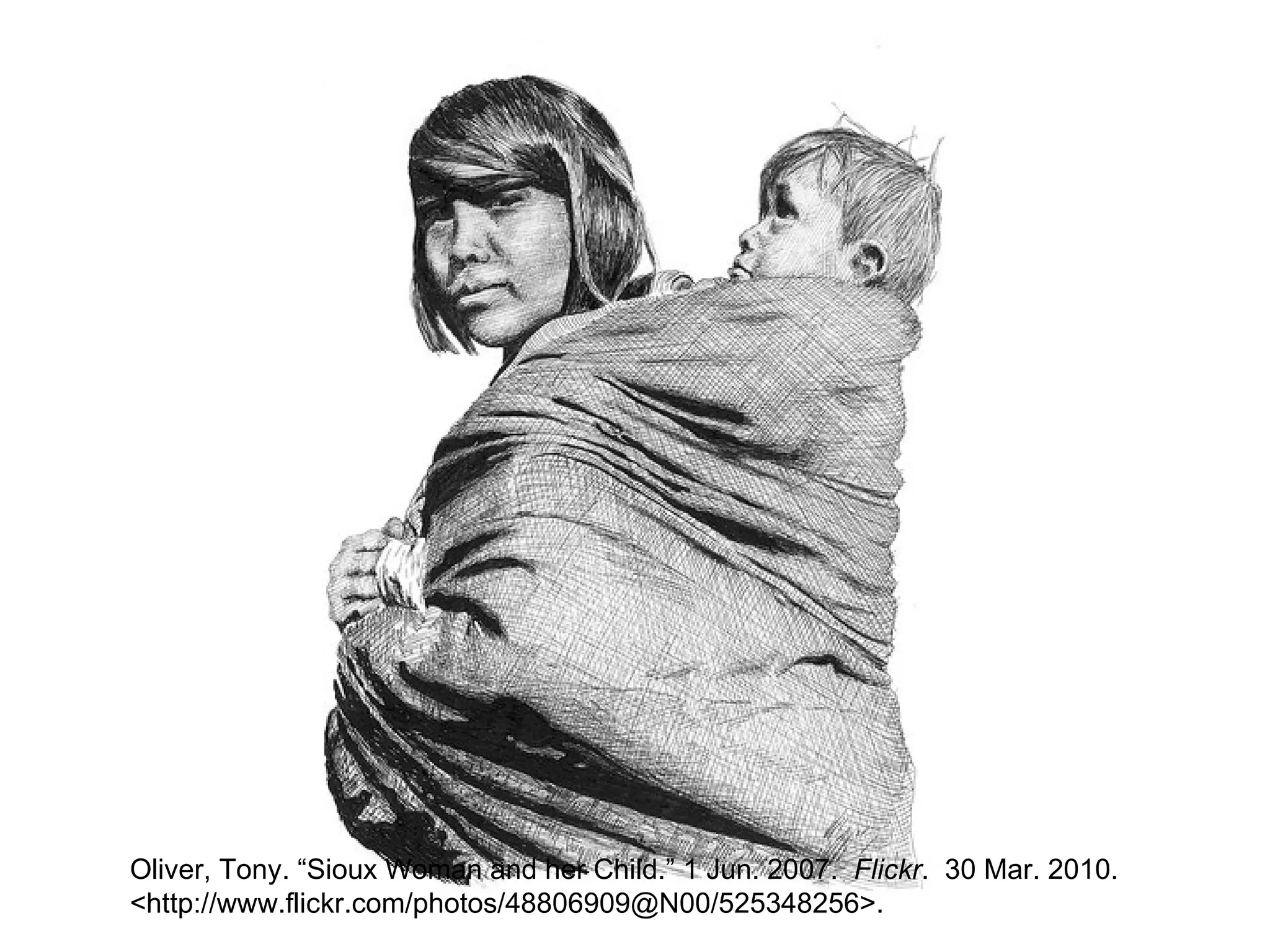
Oliver, Tony. “Sioux Woman and her Child.” 1 Jun. 2007.  Flickr .  30 Mar. 2010. <http://www.flickr.com/photos/48806909@N00/525348256>.
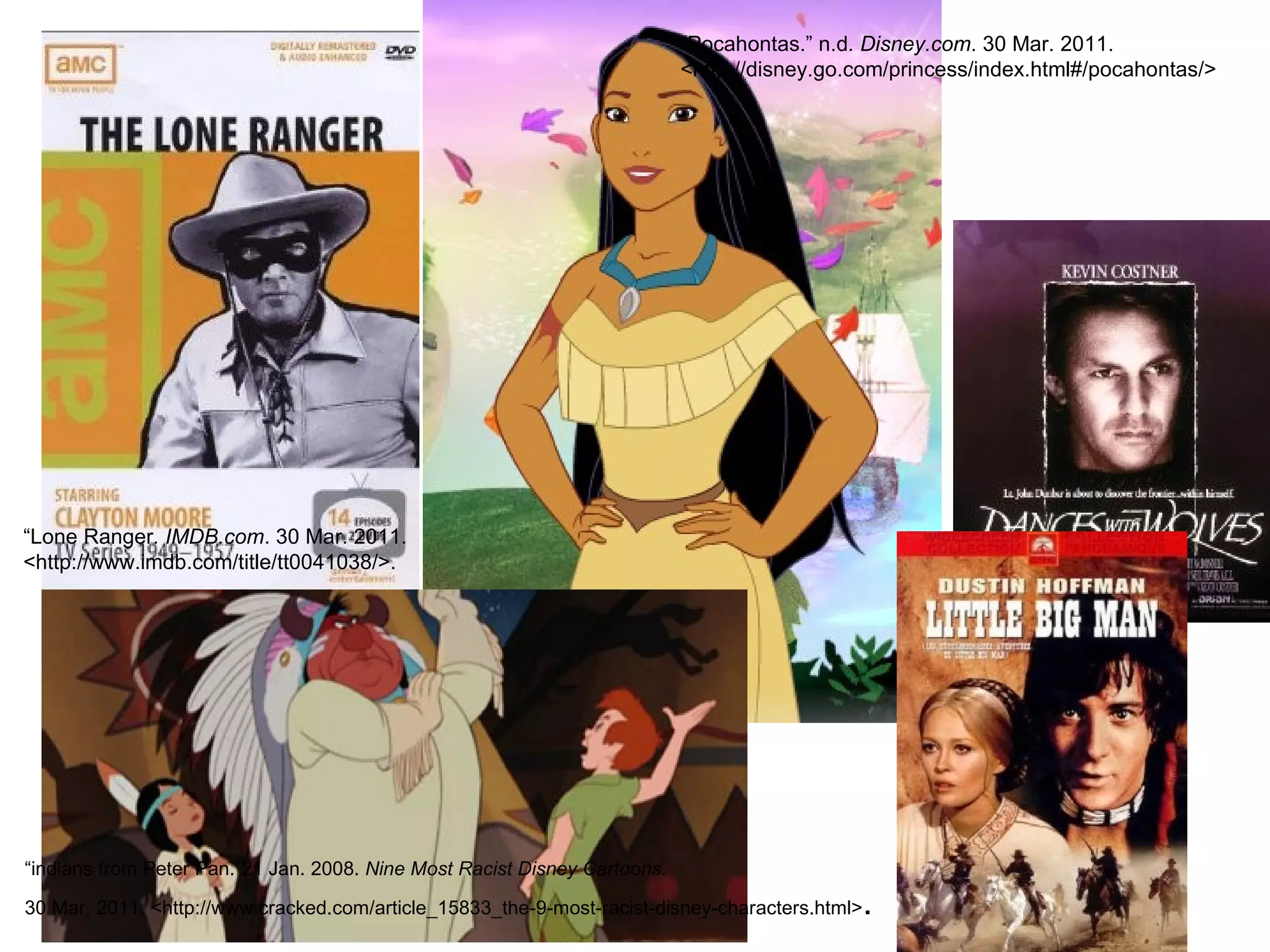
“ Pocahontas.” n.d . Disney.com . 30 Mar. 2011. <http://disney.go.com/princess/index.html#/pocahontas/> “ Lone Ranger . IMDB.com . 30 Mar. 2011. <http://www.imdb.com/title/tt0041038/>. “ indians from Peter Pan. ” 21 Jan. 2008.  Nine Most Racist Disney Cartoons . 30 Mar. 2011. <http://www.cracked.com/article_15833_the-9-most-racist-disney-characters.html> .
PEER-TO-PEER FILE SHARING Why do creative people value copyright law? How do various licensing schemes like Creative Commons work? When can you use copyrighted materials without payment or permission? A Conversation
EVERYTHING  IS COPYRIGHTED
EVERYTHING  IS COPYRIGHTED … BUT THERE ARE EXEMPTIONS
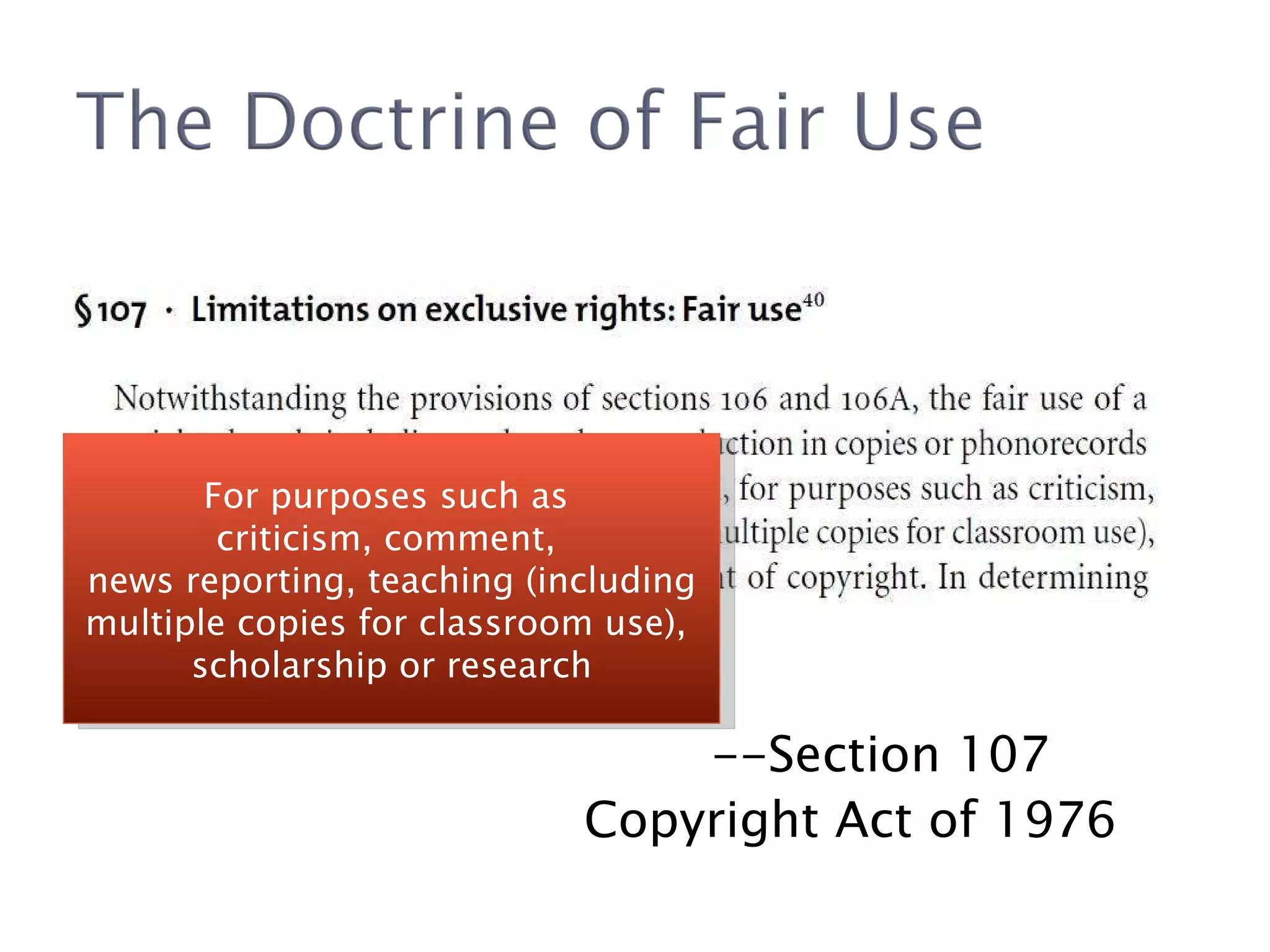
--Section 107 Copyright Act of 1976 For purposes such as  criticism, comment,  news reporting, teaching (including multiple copies for classroom use),  scholarship or research
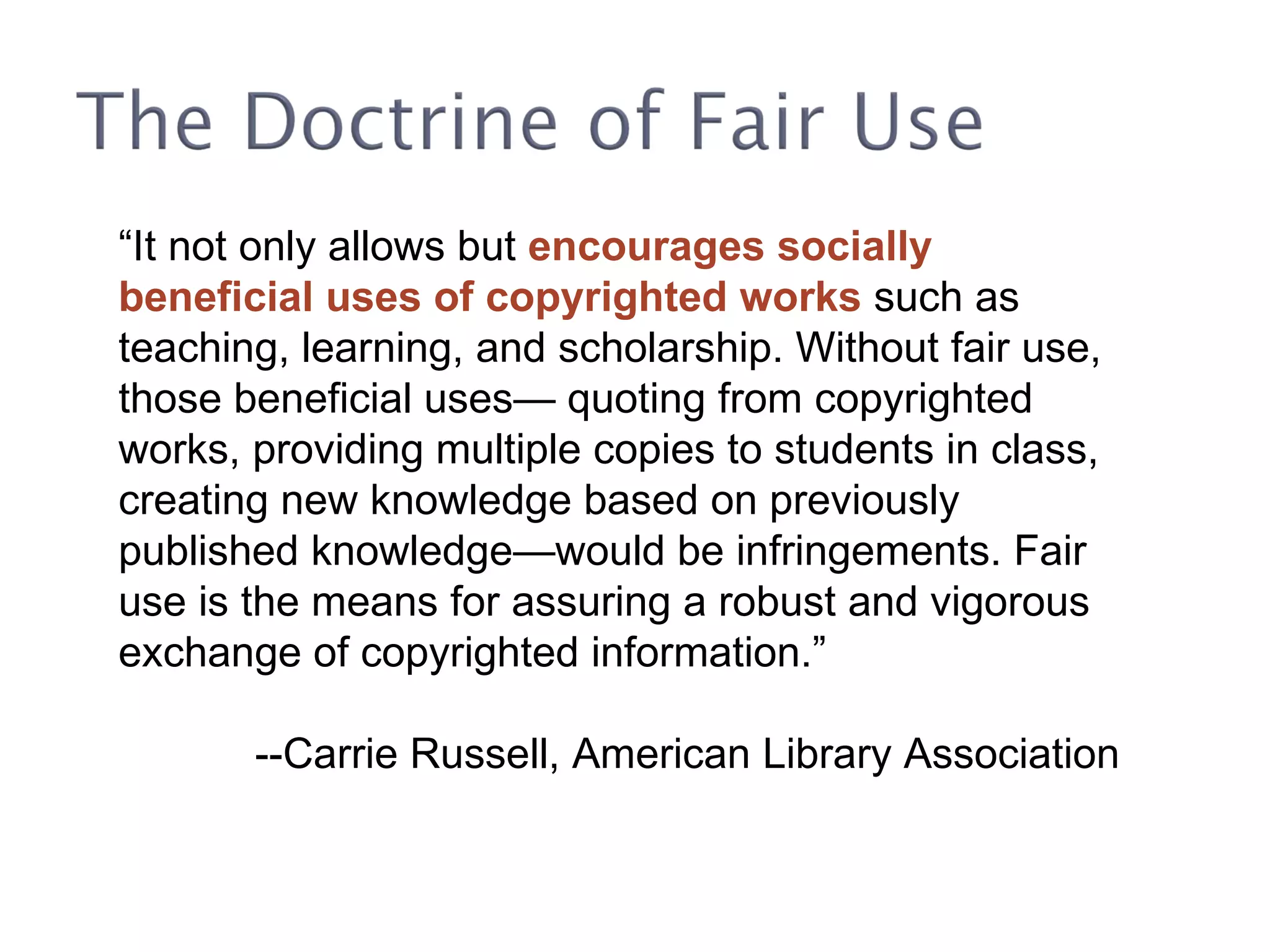
“ It not only allows but  encourages socially beneficial uses of copyrighted works  such as teaching, learning, and scholarship. Without fair use, those beneficial uses— quoting from copyrighted works, providing multiple copies to students in class, creating new knowledge based on previously published knowledge—would be infringements. Fair use is the means for assuring a robust and vigorous exchange of copyrighted information.” --Carrie Russell, American Library Association
 
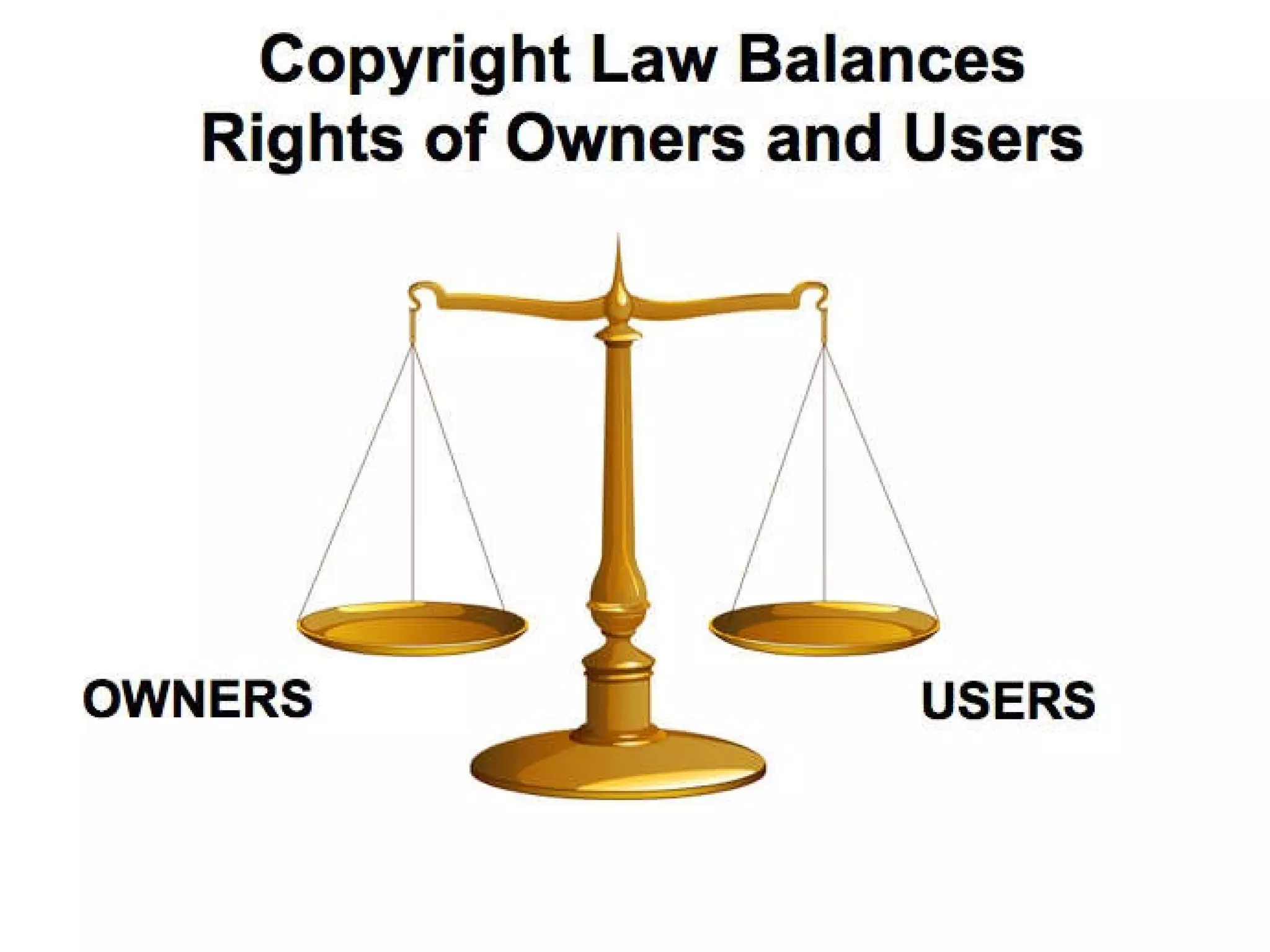
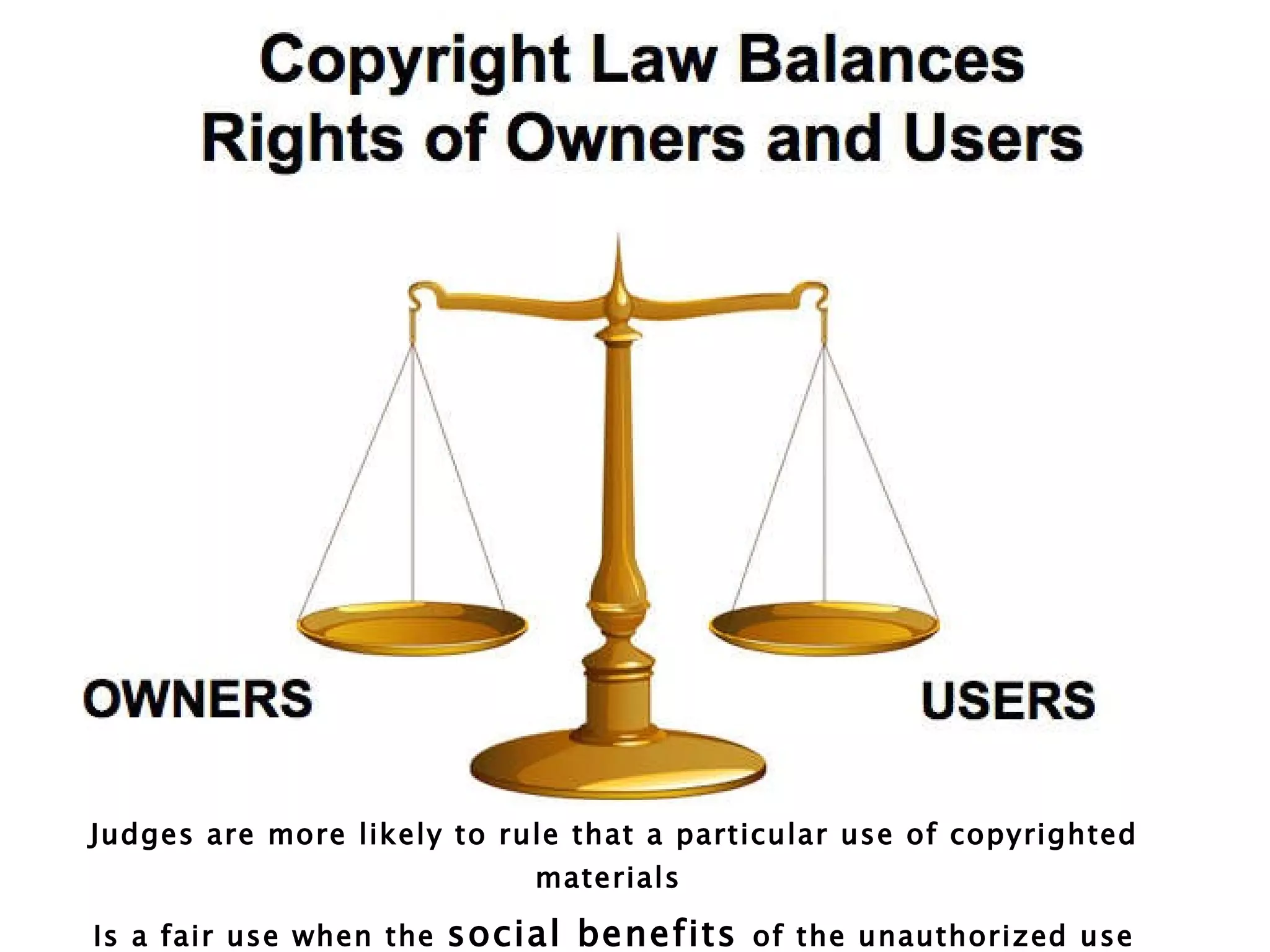
Judges are more likely to rule that a particular use of copyrighted materials  Is a fair use when the  social benefits  of the unauthorized use outweigh the private costs to the copyright holder
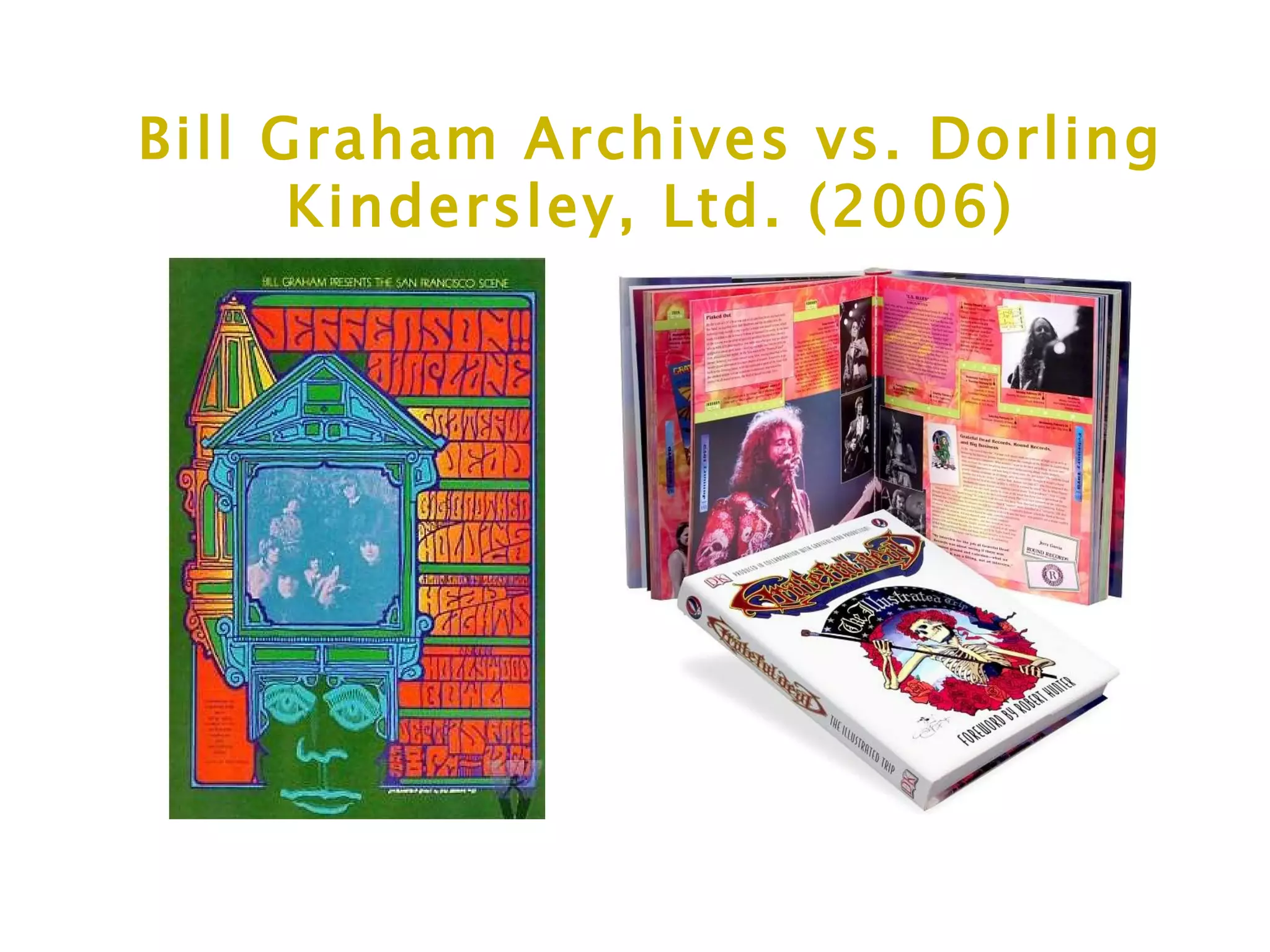
Bill Graham Archives vs. Dorling Kindersley, Ltd. (2006)
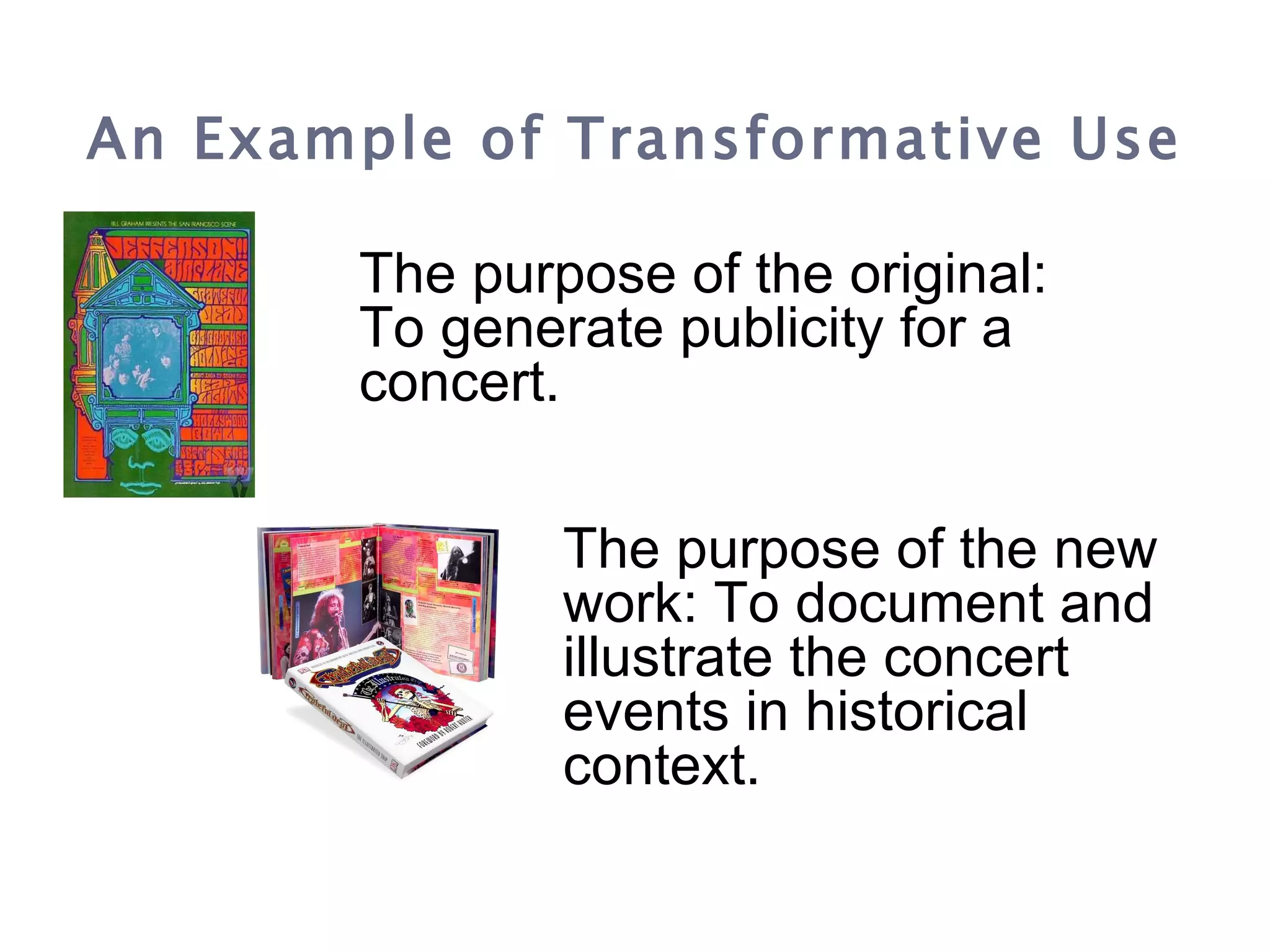
An Example of Transformative Use The purpose of the original: To generate publicity for a concert.   The purpose of the new work: To document and illustrate the concert events in historical context.
Fair Use Music Video  http://www.youtube.com/watch?v=o1XaCBf8PJ8&feature=player_embedded#at=14
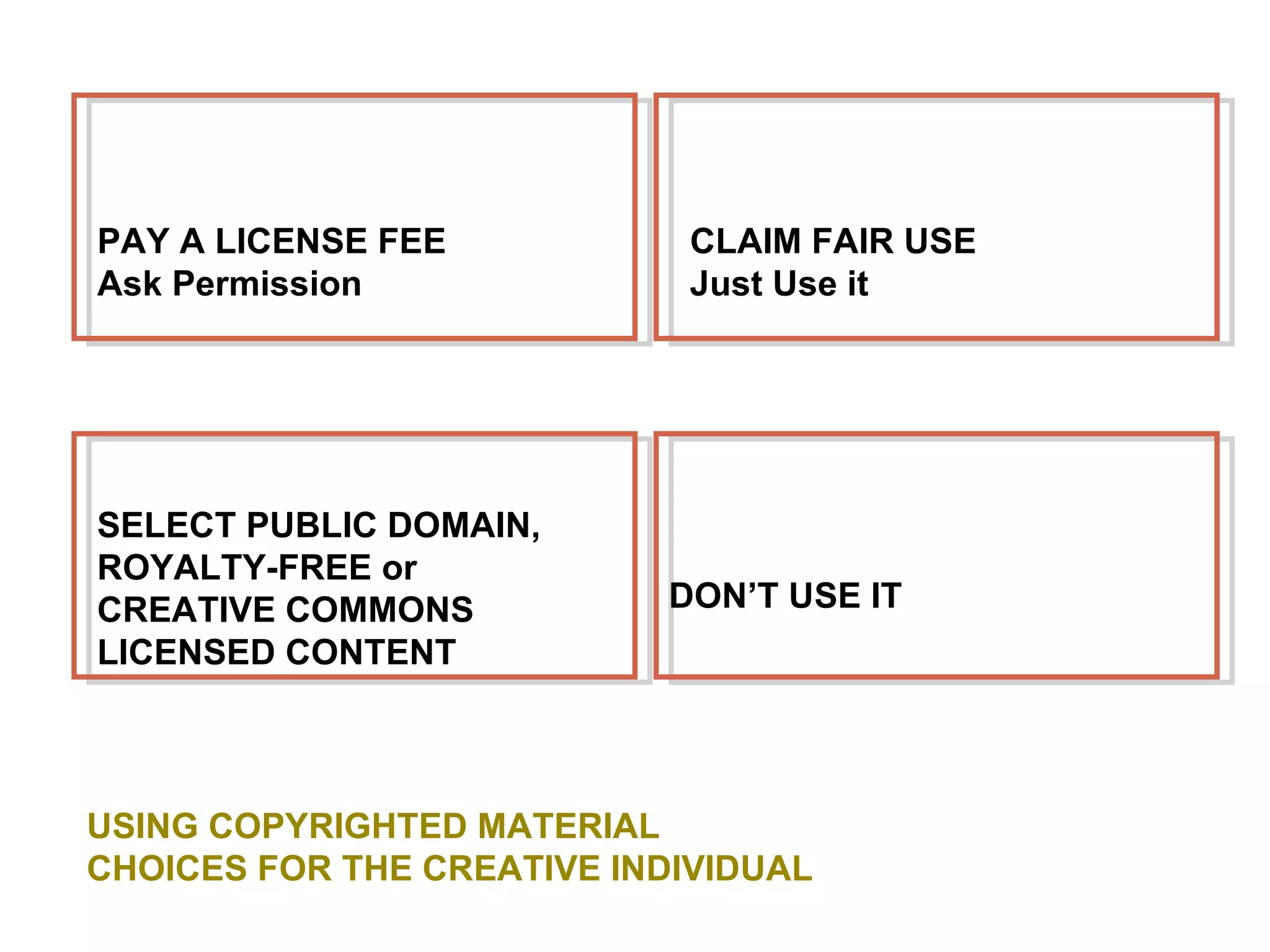
USING COPYRIGHTED MATERIAL CHOICES FOR THE CREATIVE INDIVIDUAL PAY A LICENSE FEE Ask Permission CLAIM FAIR USE Just Use it DON ’T USE IT SELECT PUBLIC DOMAIN, ROYALTY-FREE or  CREATIVE COMMONS LICENSED CONTENT
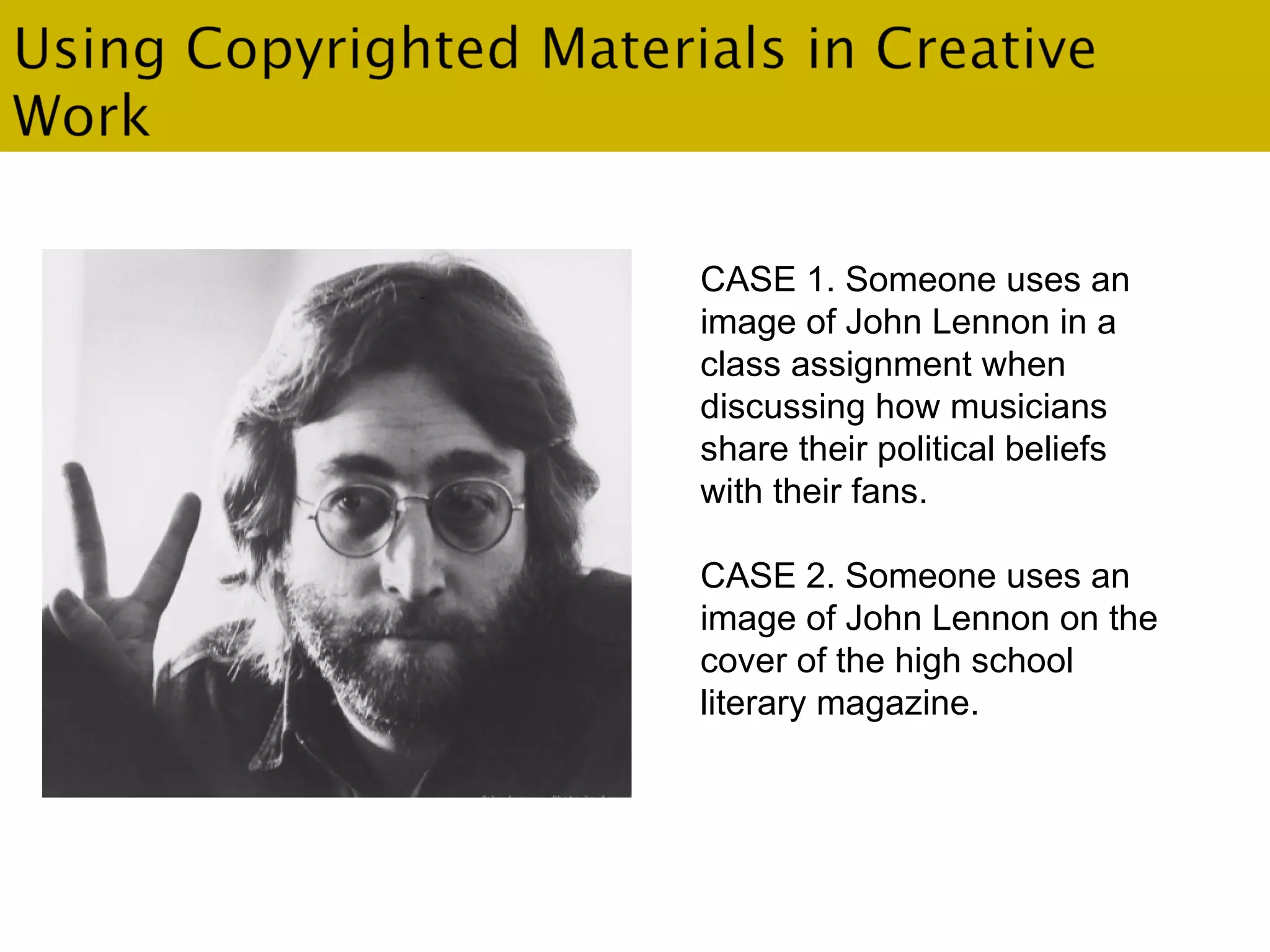
. CASE 1. Someone uses an image of John Lennon in a class assignment when  discussing how musicians share their political beliefs with their fans. CASE 2. Someone uses an image of John Lennon on the cover of the high school literary magazine.
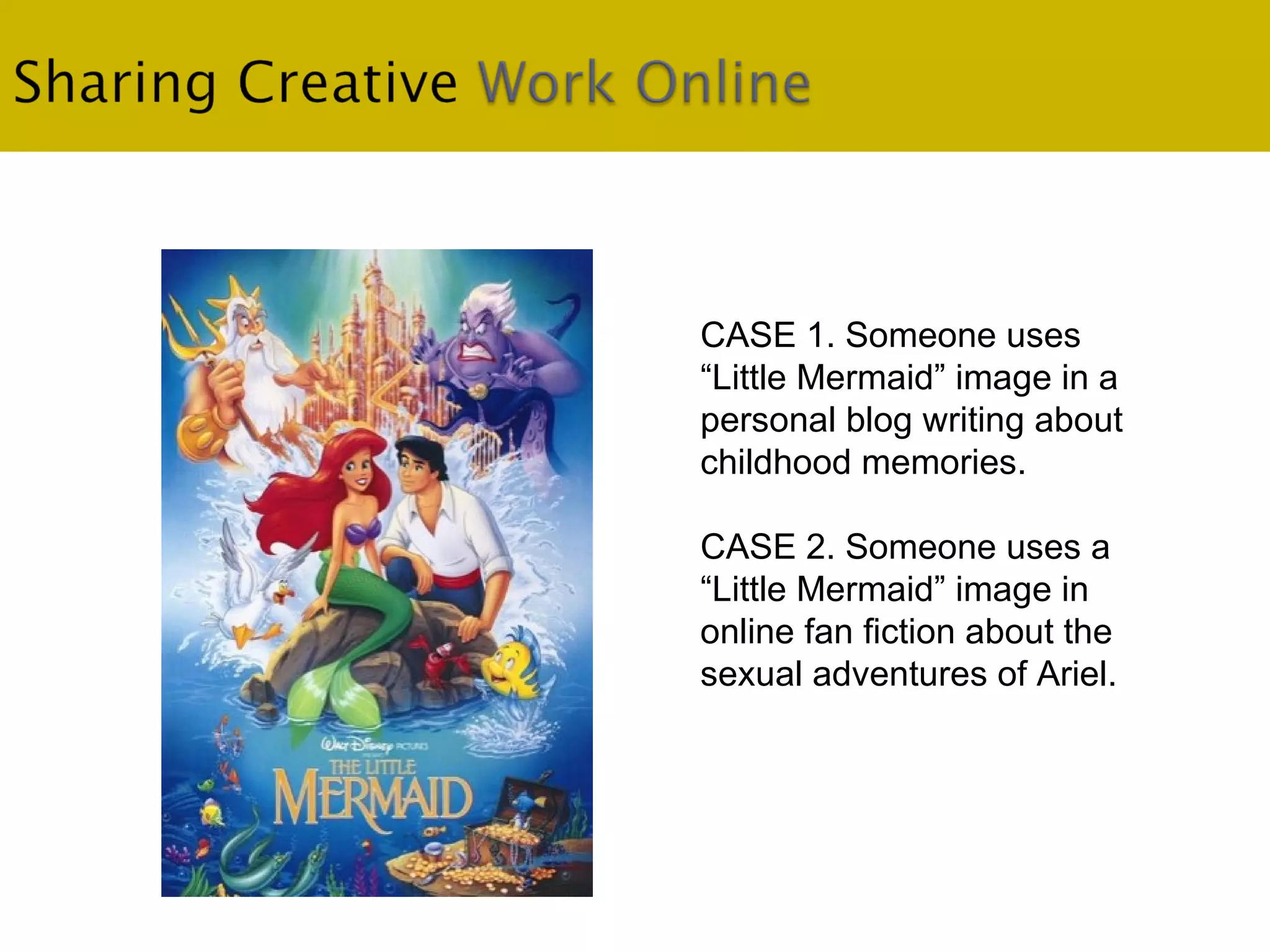
. CASE 1. Someone uses  “Little Mermaid” image in a personal blog writing about childhood memories. CASE 2. Someone uses a  “Little Mermaid” image in online fan fiction about the sexual adventures of Ariel.
 
PEER-TO-PEER FILE SHARING Why do creative people value copyright law? How do various licensing schemes like Creative Commons work? When can you use copyrighted materials without payment or permission? How do codes of best practice build people’s confidence in applying fair use to their practice? A Conversation
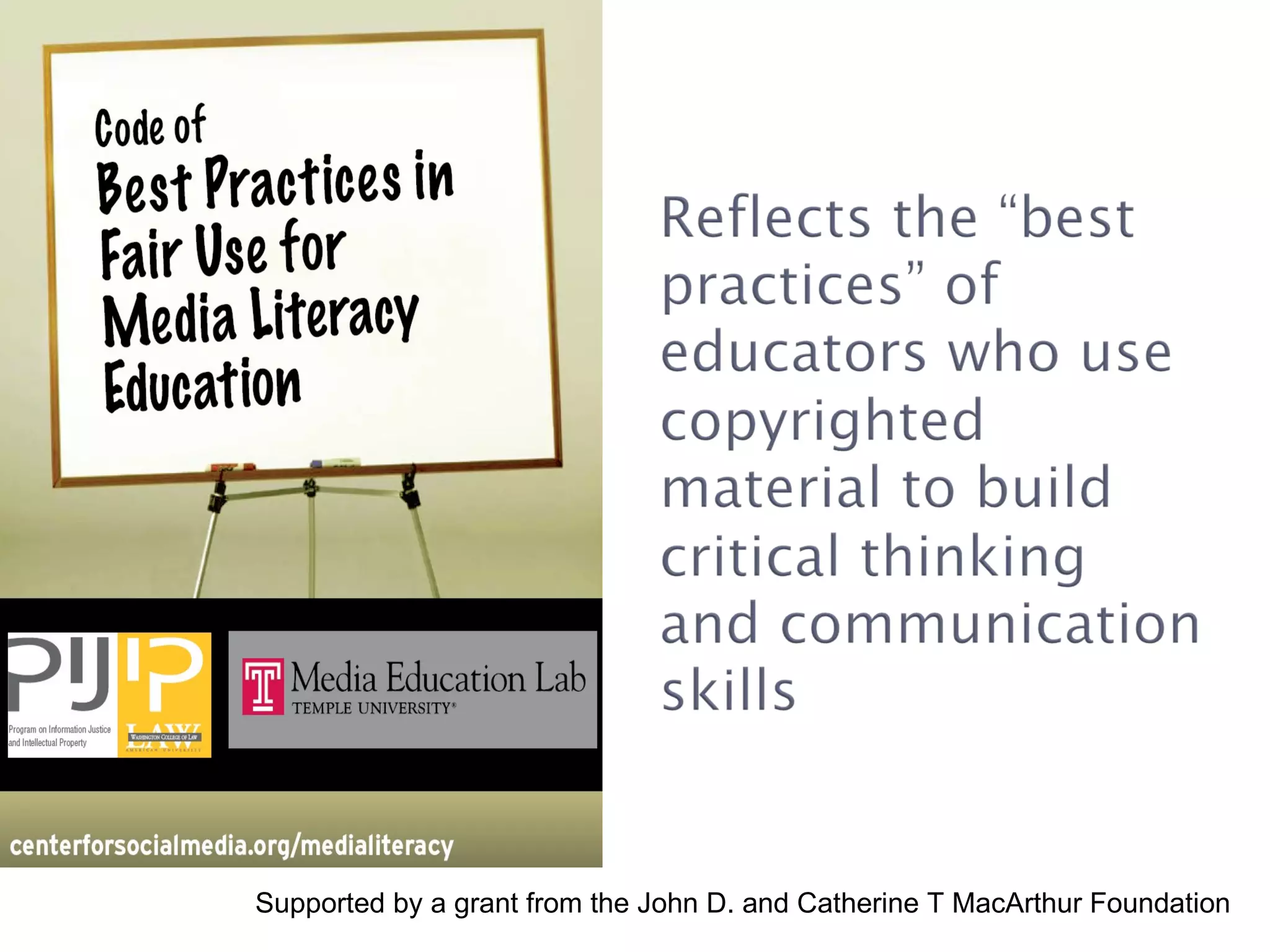
Supported by a grant from the John D. and Catherine T MacArthur Foundation
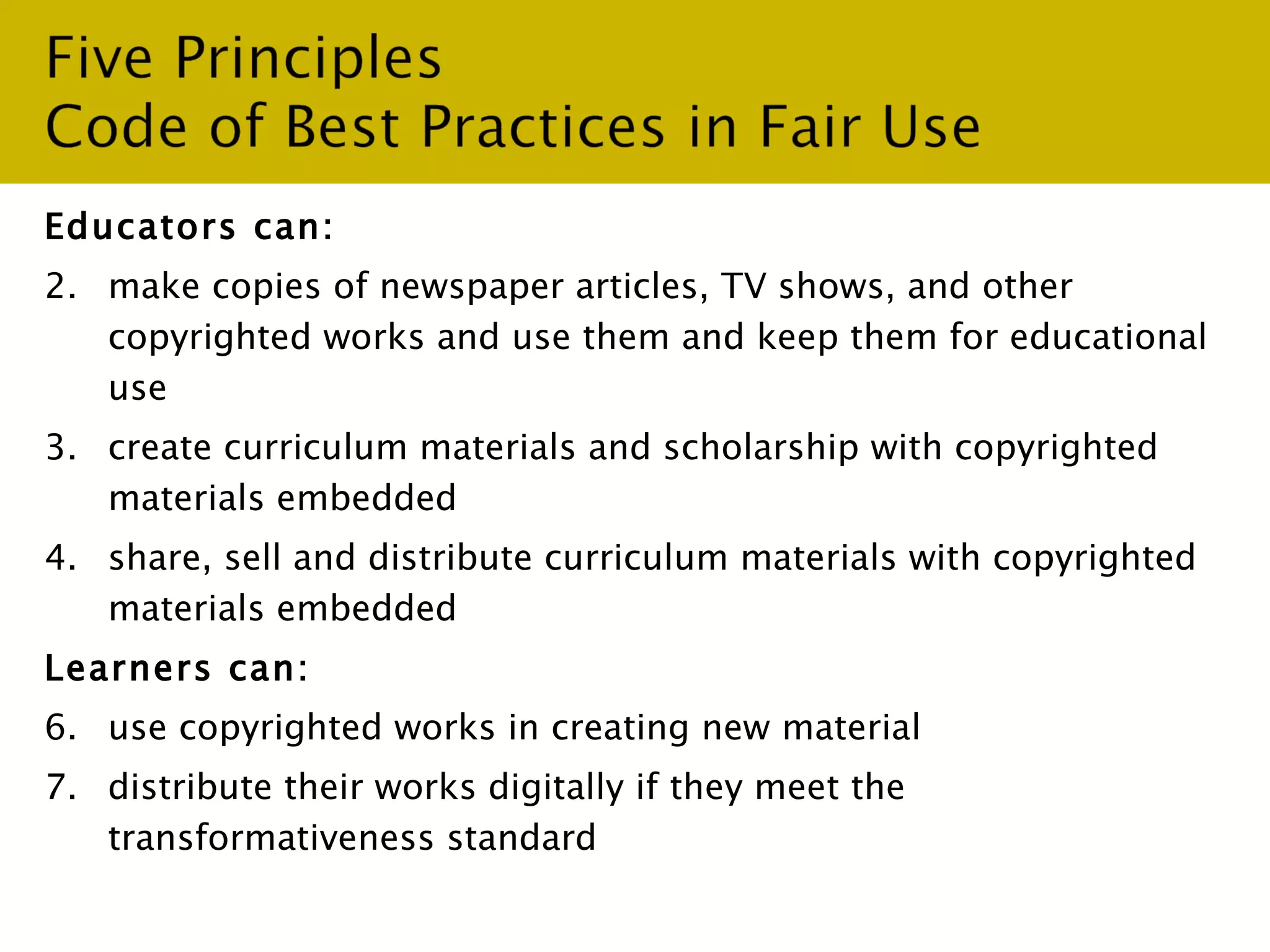
Educators can: make copies of newspaper articles, TV shows, and other copyrighted works and use them and keep them for educational use create curriculum materials and scholarship with copyrighted materials embedded share, sell and distribute curriculum materials with copyrighted materials embedded  Learners can: use copyrighted works in creating new material  distribute their works digitally if they meet the transformativeness standard
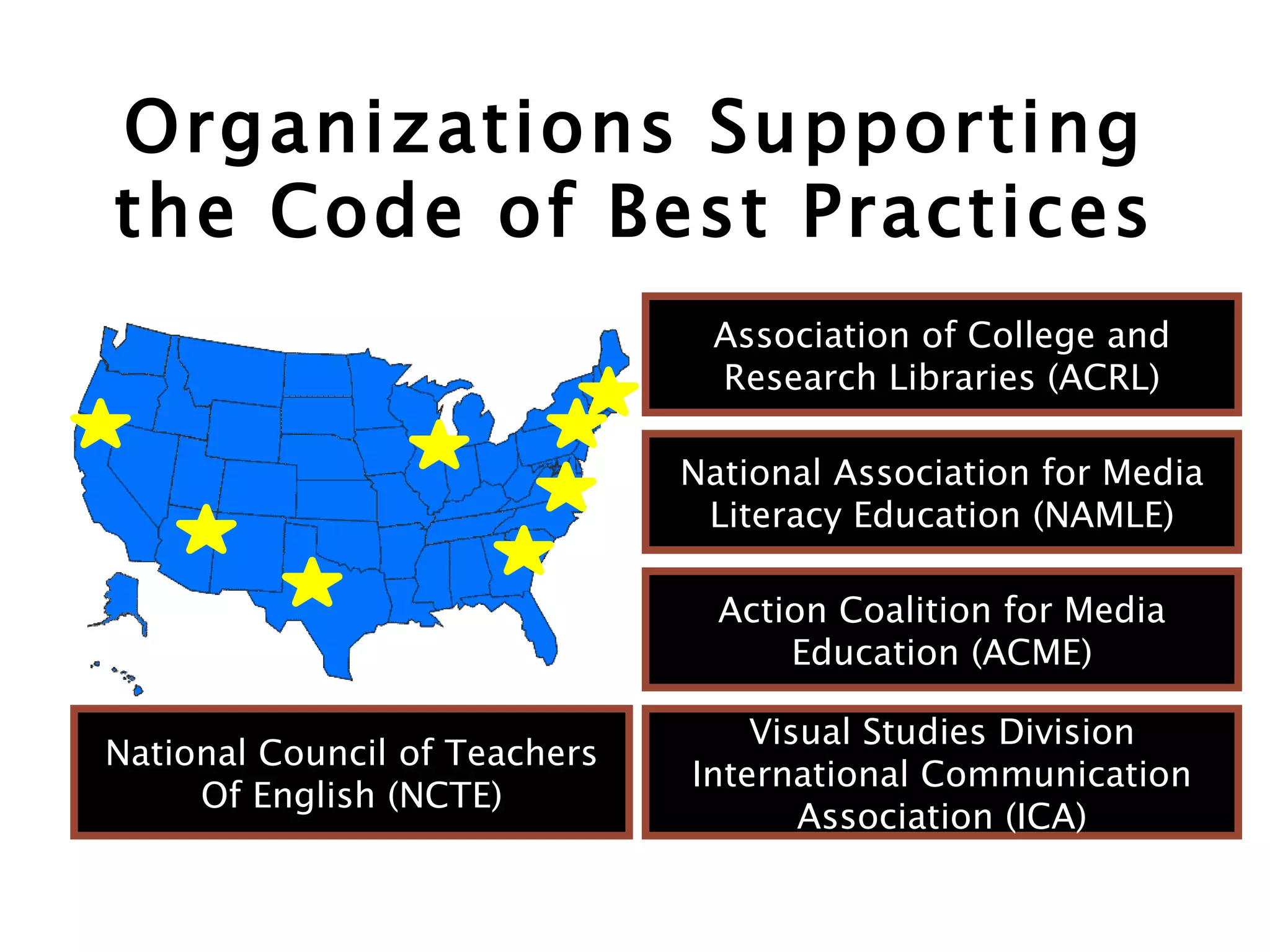
Organizations Supporting the Code of Best Practices Action Coalition for Media Education (ACME) National Association for Media Literacy Education (NAMLE) National Council of Teachers Of English (NCTE) Visual Studies Division International Communication Association (ICA) Association of College and Research Libraries (ACRL)
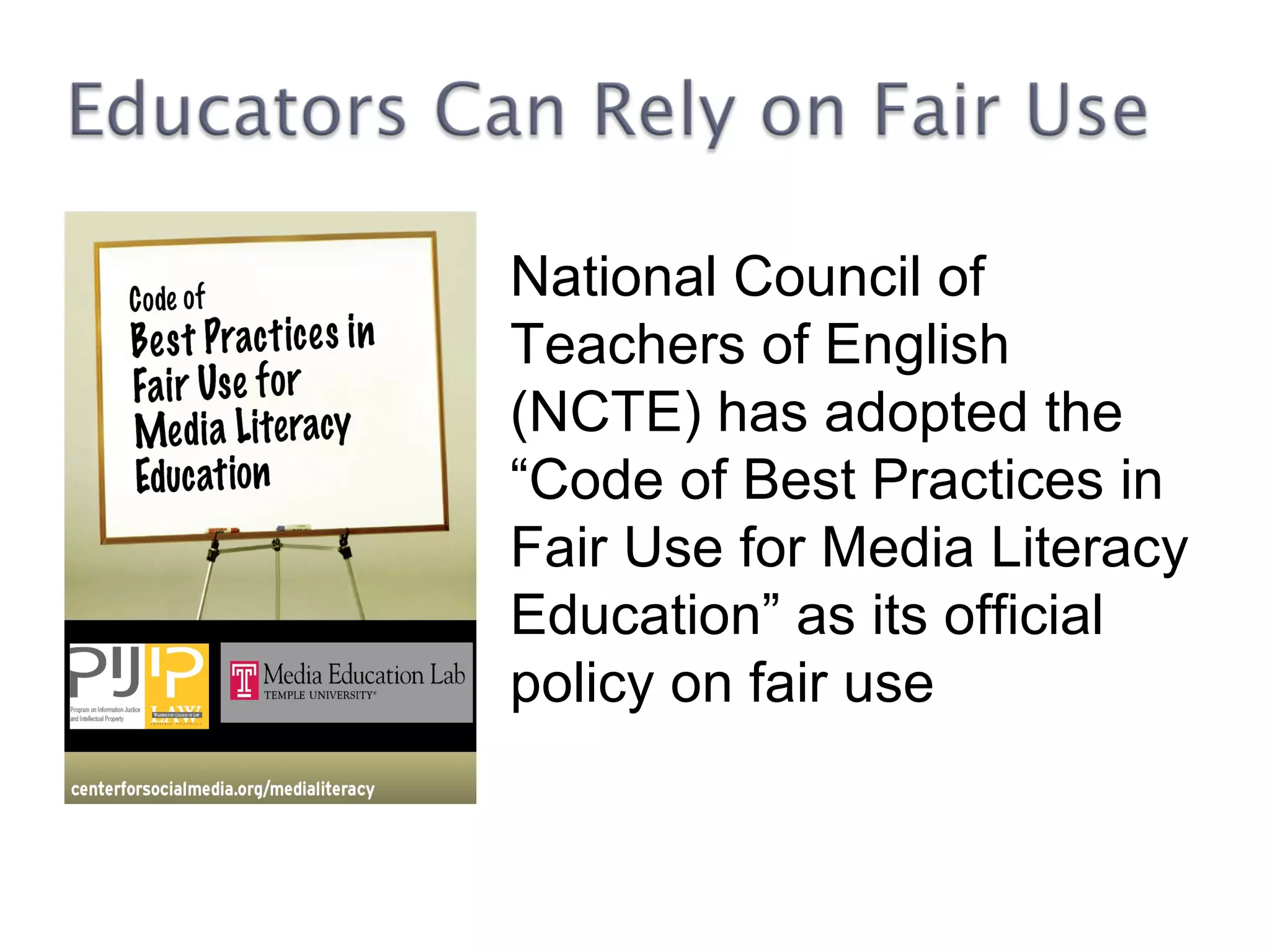
National Council of Teachers of English (NCTE) has adopted the  “Code of Best Practices in Fair Use for Media Literacy  Education” as its official policy on fair use
PEER-TO-PEER FILE SHARING Why do creative people value copyright law? How do various licensing schemes like Creative Commons work? When can you use copyrighted materials without payment or permission? How do codes of best practice build people’s confidence in applying fair use to their practice? How does copyright law adapt to changes in technology and changes in society? A Conversation
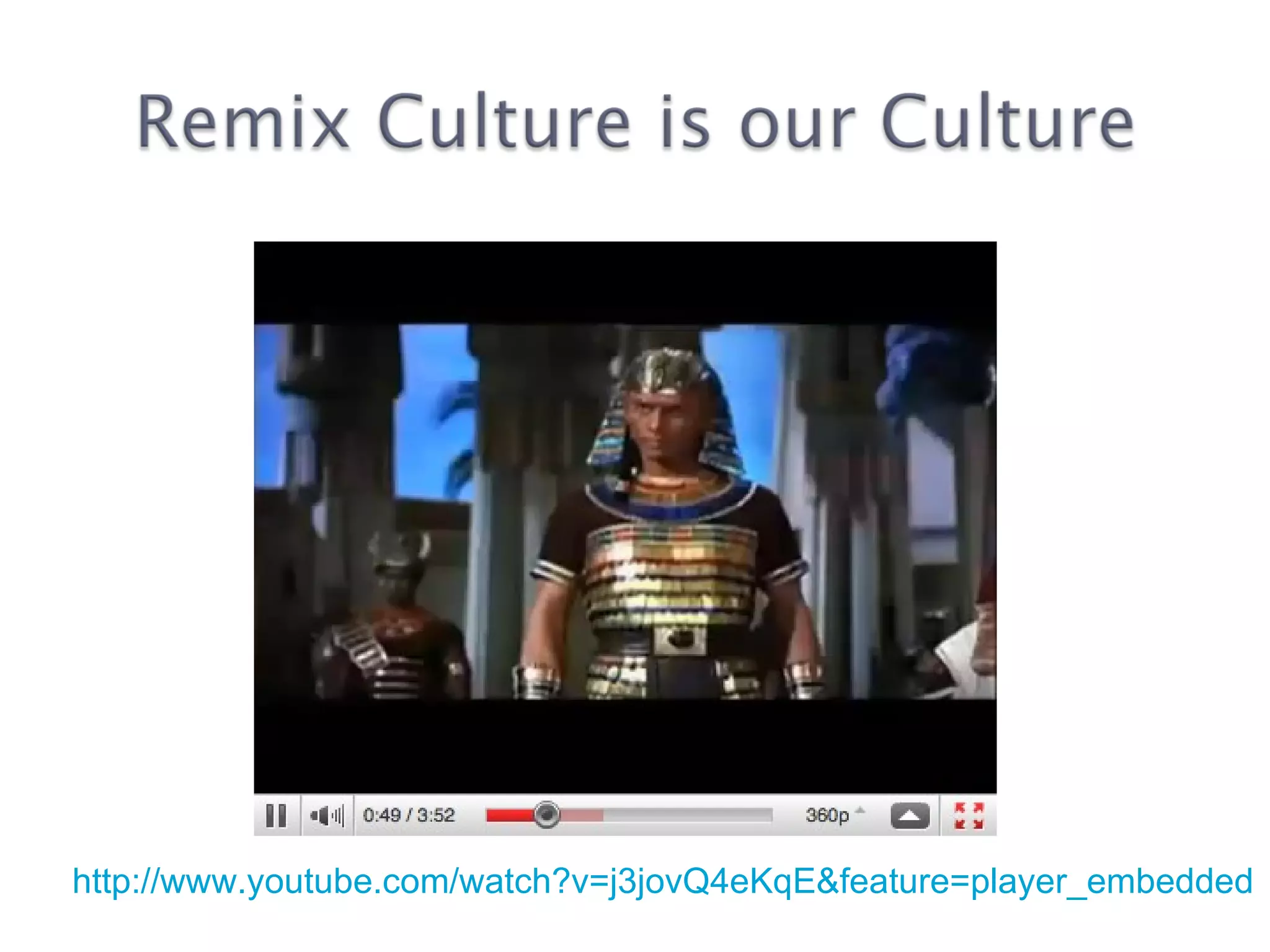
http://www.youtube.com/watch?v=j3jovQ4eKqE&feature=player_embedded
 
RIPPING.  Criminalizes the use of technology, devices, or services intended to circumvent digital rights management (DRM) software that controls access to copyrighted works.  ONLINE TAKEDOWNS.  Protects Internet Service Providers against copyright liability if they promptly block access to allegedly infringing material (or remove such material from their systems) if notified by copyright holder; offers a counter-notification provision if use is exempted under fair use  Digital Millennium Copyright Act of 1998
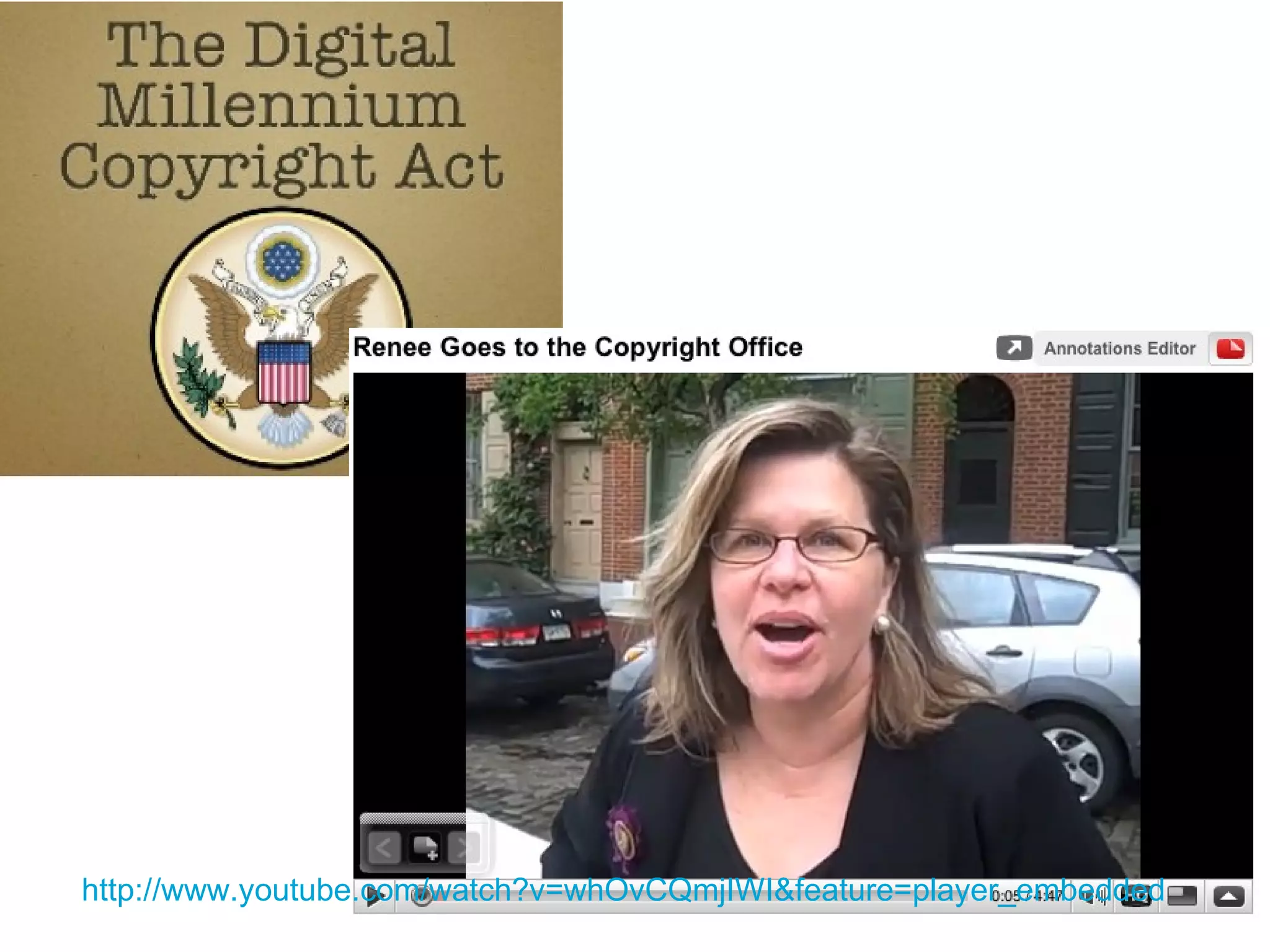
http://www.youtube.com/watch?v=whOvCQmjIWI&feature=player_embedded
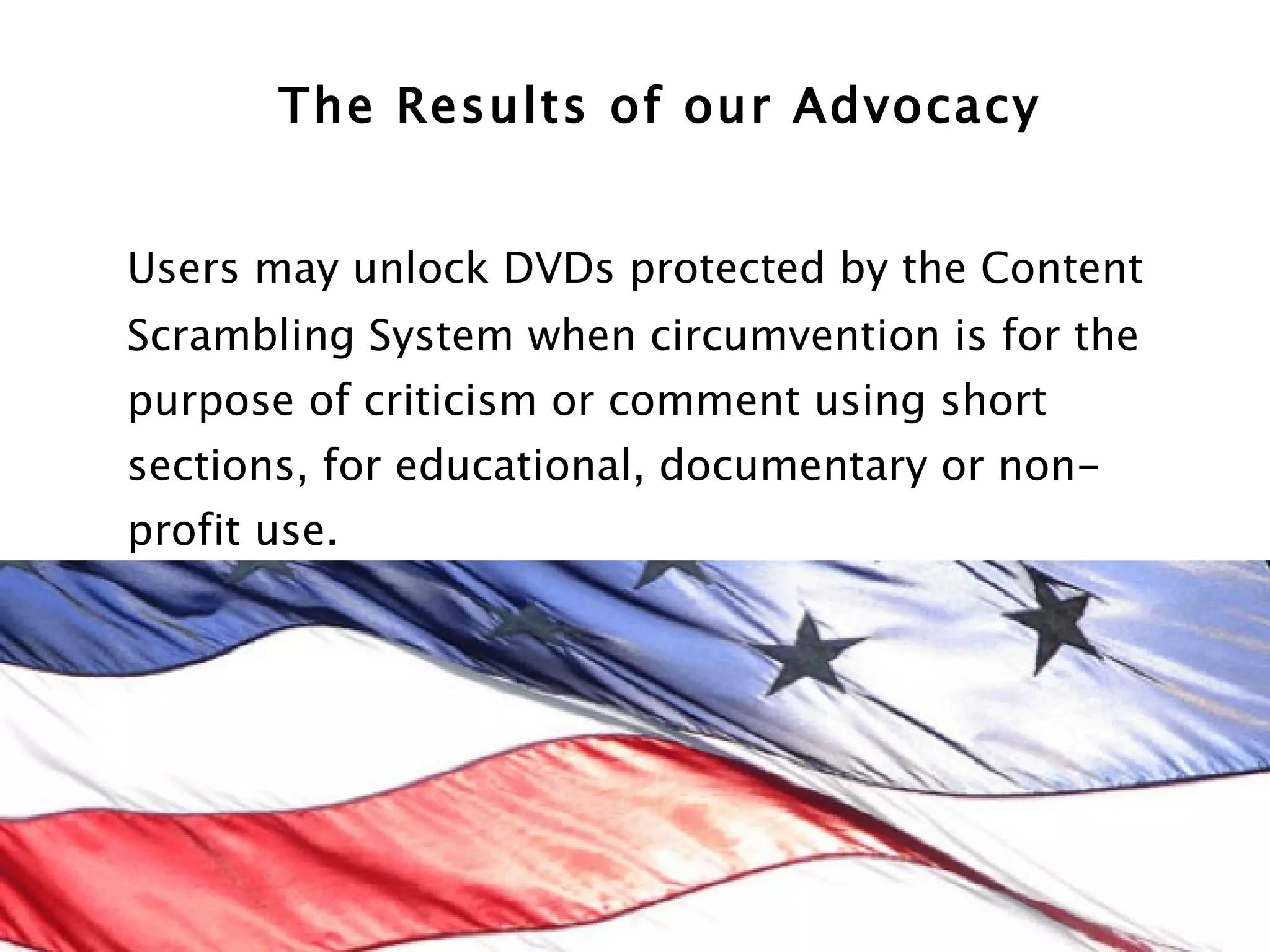
The Results of our Advocacy Users may unlock DVDs protected by the Content Scrambling System when circumvention is for the purpose of criticism or comment using short sections, for educational, documentary or non-profit use.
PEER-TO-PEER FILE SHARING Why creative people value copyright law How  various licensing schemes  like Creative Commons work When you (and your students)  can  use copyrighted materials without payment or permission under some circumstances How  codes of best practice  help people become more confident in understanding and using the doctrine of fair use How the law adapts to changes in society and changes in technology Goals for Today’s Session
SHARE THE GOOD NEWS!
 
 
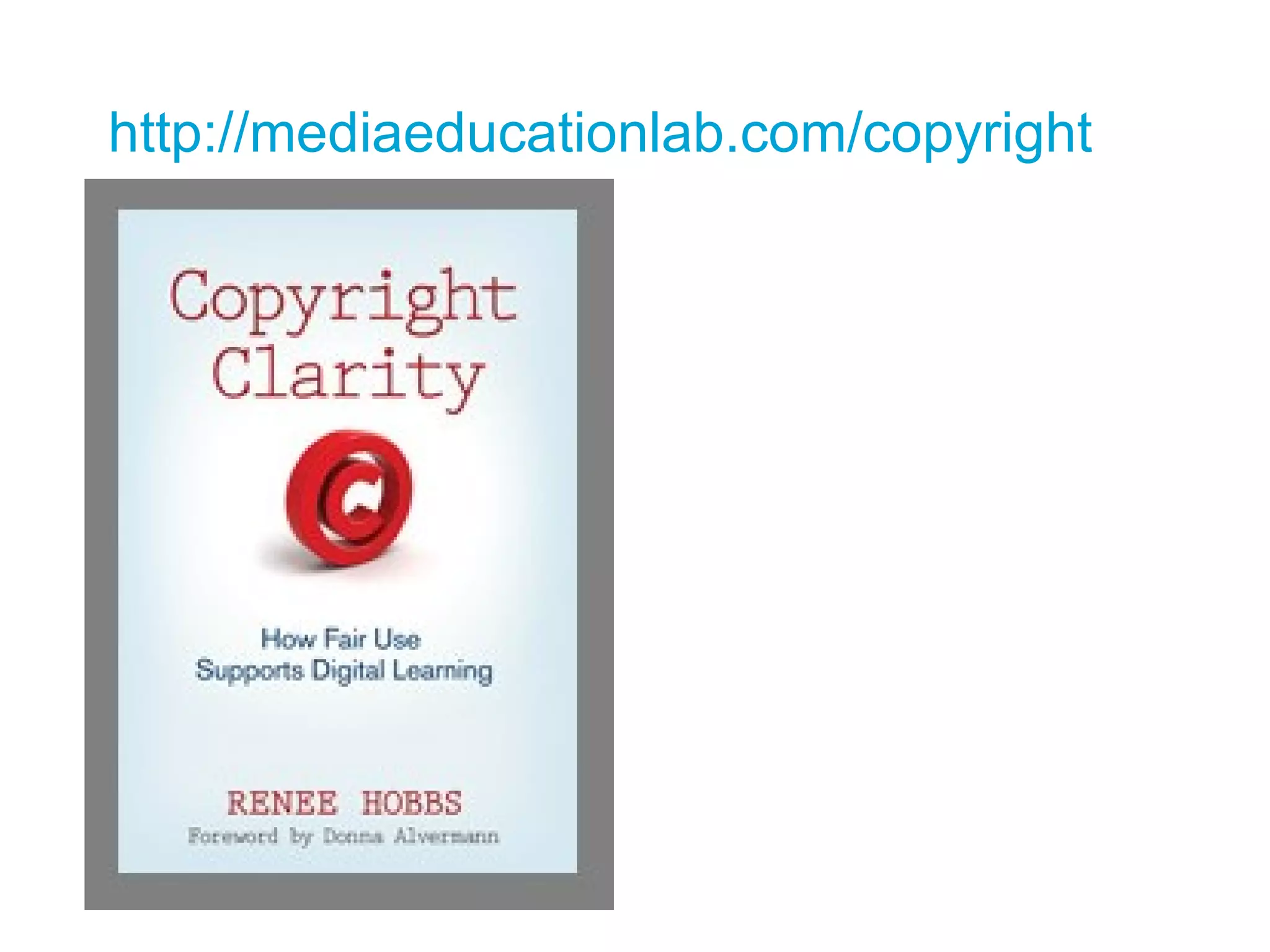
http://mediaeducationlab.com/copyright
Joyce Kasman Valenza Springfield Township High School Email:  [email_address] Web:  http://springfieldlibrary.wikispaces.com/ http://blog.schoollibraryjournal.com/neverendingsearch/ Twitter: @joycevalenza
http://mediaeducationlab.com/copyright Renee Hobbs Temple University Media Education Lab School of Communications and Theater Philadelphia PA Email: renee.hobbs@temple.edu Phone: (215) 204-3255 Twitter: reneehobbs

Hobbs and valenza 4.6.11

  • 1.
    Still Confused? AConversation about Copyright, Fair Use & Remix Culture By Joyce Valenza and Renee Hobbs
  • 2.
    PEER-TO-PEER FILE SHARINGWhy creative people value copyright law How various licensing schemes like Creative Commons work When you (and your students) can use copyrighted materials without payment or permission under some circumstances How codes of best practice help people become more confident in understanding and using the doctrine of fair use How the law adapts to changes in society and changes in technology Goals for Today’s Session
  • 3.
    PEER-TO-PEER FILE SHARINGWhy do creative people value copyright law? A Conversation
  • 4.
  • 5.
    To promote creativity,innovation and the spread of knowledge Article 1 Section 8 U.S. Constitution
  • 6.
    Use and shareCopy Modify & Repurpose Excerpt & Quote From Distribute
  • 7.
    Restrict Limit Chargehigh fees Discourage use Use scare tactics
  • 8.
    See no EvilClose the Door Hyper-Comply
  • 9.
    NEGOTIATED AGREEMENTS BETWEENMEDIA COMPANIES AND EDUCATIONAL GROUPS Agreement on Guidelines for Classroom Copying in Not-for-Profit Educational Institutions Fair Use Guidelines for Educational Multimedia Guidelines for the Educational Use of Music Educational Use Guidelines are Confusing!
  • 10.
    The documents createdby these negotiated agreements give them “the appearance of positive law. These qualities are merely illusory, and consequently the guidelines have had a seriously detrimental effect. They interfere with an actual understanding of the law and erode confidence in the law as created by Congress and the courts” --Kenneth Crews, 2001
  • 11.
  • 12.
  • 13.
    Copyright law enablespeople to control the creative works they produce LOVE HATE
  • 14.
    The Copyright Actgrants five rights to a copyright owner: 1. the right to reproduce the copyrighted work; 2. the right to prepare derivative works based upon the work; 3. the right to distribute copies of the work to the public; 4. the right to perform the copyrighted work publicly; and 5. the right to display the copyrighted work publicly.
  • 15.
    Violating Copyright CanBe Expensive The Copyright holder may receive statutory damages for all infringements involved in the action… not less than $750 or more than $30,000 as the court considers just. [...] When infringement was committed willfully, the court in its discretion may increase the award of statutory damages to a sum of not more than $150,000.&quot; LOVE HATE
  • 16.
    PEER-TO-PEER FILE SHARINGWhy do creative people value copyright law? How do various licensing schemes like Creative Commons work? A Conversation
  • 17.
  • 18.
  • 19.
  • 20.
  • 21.
  • 22.
  • 23.
  • 24.
  • 25.
  • 26.
  • 27.
  • 28.
  • 29.
  • 30.
  • 31.
    Oliver, Tony. “SiouxWoman and her Child.” 1 Jun. 2007. Flickr . 30 Mar. 2010. <http://www.flickr.com/photos/48806909@N00/525348256>.
  • 32.
    “ Pocahontas.” n.d. Disney.com . 30 Mar. 2011. <http://disney.go.com/princess/index.html#/pocahontas/> “ Lone Ranger . IMDB.com . 30 Mar. 2011. <http://www.imdb.com/title/tt0041038/>. “ indians from Peter Pan. ” 21 Jan. 2008. Nine Most Racist Disney Cartoons . 30 Mar. 2011. <http://www.cracked.com/article_15833_the-9-most-racist-disney-characters.html> .
  • 33.
    PEER-TO-PEER FILE SHARINGWhy do creative people value copyright law? How do various licensing schemes like Creative Commons work? When can you use copyrighted materials without payment or permission? A Conversation
  • 34.
    EVERYTHING ISCOPYRIGHTED
  • 35.
    EVERYTHING ISCOPYRIGHTED … BUT THERE ARE EXEMPTIONS
  • 36.
    --Section 107 CopyrightAct of 1976 For purposes such as criticism, comment, news reporting, teaching (including multiple copies for classroom use), scholarship or research
  • 37.
    “ It notonly allows but encourages socially beneficial uses of copyrighted works such as teaching, learning, and scholarship. Without fair use, those beneficial uses— quoting from copyrighted works, providing multiple copies to students in class, creating new knowledge based on previously published knowledge—would be infringements. Fair use is the means for assuring a robust and vigorous exchange of copyrighted information.” --Carrie Russell, American Library Association
  • 38.
  • 39.
    Judges are morelikely to rule that a particular use of copyrighted materials Is a fair use when the social benefits of the unauthorized use outweigh the private costs to the copyright holder
  • 40.
    Bill Graham Archivesvs. Dorling Kindersley, Ltd. (2006)
  • 41.
    An Example ofTransformative Use The purpose of the original: To generate publicity for a concert. The purpose of the new work: To document and illustrate the concert events in historical context.
  • 42.
    Fair Use MusicVideo http://www.youtube.com/watch?v=o1XaCBf8PJ8&feature=player_embedded#at=14
  • 43.
    USING COPYRIGHTED MATERIALCHOICES FOR THE CREATIVE INDIVIDUAL PAY A LICENSE FEE Ask Permission CLAIM FAIR USE Just Use it DON ’T USE IT SELECT PUBLIC DOMAIN, ROYALTY-FREE or CREATIVE COMMONS LICENSED CONTENT
  • 44.
    . CASE 1.Someone uses an image of John Lennon in a class assignment when discussing how musicians share their political beliefs with their fans. CASE 2. Someone uses an image of John Lennon on the cover of the high school literary magazine.
  • 45.
    . CASE 1.Someone uses “Little Mermaid” image in a personal blog writing about childhood memories. CASE 2. Someone uses a “Little Mermaid” image in online fan fiction about the sexual adventures of Ariel.
  • 46.
  • 47.
    PEER-TO-PEER FILE SHARINGWhy do creative people value copyright law? How do various licensing schemes like Creative Commons work? When can you use copyrighted materials without payment or permission? How do codes of best practice build people’s confidence in applying fair use to their practice? A Conversation
  • 48.
    Supported by agrant from the John D. and Catherine T MacArthur Foundation
  • 49.
    Educators can: makecopies of newspaper articles, TV shows, and other copyrighted works and use them and keep them for educational use create curriculum materials and scholarship with copyrighted materials embedded share, sell and distribute curriculum materials with copyrighted materials embedded Learners can: use copyrighted works in creating new material distribute their works digitally if they meet the transformativeness standard
  • 50.
    Organizations Supporting theCode of Best Practices Action Coalition for Media Education (ACME) National Association for Media Literacy Education (NAMLE) National Council of Teachers Of English (NCTE) Visual Studies Division International Communication Association (ICA) Association of College and Research Libraries (ACRL)
  • 51.
    National Council ofTeachers of English (NCTE) has adopted the “Code of Best Practices in Fair Use for Media Literacy Education” as its official policy on fair use
  • 52.
    PEER-TO-PEER FILE SHARINGWhy do creative people value copyright law? How do various licensing schemes like Creative Commons work? When can you use copyrighted materials without payment or permission? How do codes of best practice build people’s confidence in applying fair use to their practice? How does copyright law adapt to changes in technology and changes in society? A Conversation
  • 53.
  • 54.
  • 55.
    RIPPING. Criminalizesthe use of technology, devices, or services intended to circumvent digital rights management (DRM) software that controls access to copyrighted works. ONLINE TAKEDOWNS. Protects Internet Service Providers against copyright liability if they promptly block access to allegedly infringing material (or remove such material from their systems) if notified by copyright holder; offers a counter-notification provision if use is exempted under fair use Digital Millennium Copyright Act of 1998
  • 56.
  • 57.
    The Results ofour Advocacy Users may unlock DVDs protected by the Content Scrambling System when circumvention is for the purpose of criticism or comment using short sections, for educational, documentary or non-profit use.
  • 58.
    PEER-TO-PEER FILE SHARINGWhy creative people value copyright law How various licensing schemes like Creative Commons work When you (and your students) can use copyrighted materials without payment or permission under some circumstances How codes of best practice help people become more confident in understanding and using the doctrine of fair use How the law adapts to changes in society and changes in technology Goals for Today’s Session
  • 59.
  • 60.
  • 61.
  • 62.
  • 63.
    Joyce Kasman ValenzaSpringfield Township High School Email: [email_address] Web: http://springfieldlibrary.wikispaces.com/ http://blog.schoollibraryjournal.com/neverendingsearch/ Twitter: @joycevalenza
  • 64.
    http://mediaeducationlab.com/copyright Renee HobbsTemple University Media Education Lab School of Communications and Theater Philadelphia PA Email: renee.hobbs@temple.edu Phone: (215) 204-3255 Twitter: reneehobbs

Editor's Notes

  • #3 Institute for Policy Innovation global music piracy causes $12.5 billion of economic losses every year, 71,060 U.S. jobs lost, a loss of $2.7 billion in workers&apos; earnings, and a loss of $422 million in tax revenues, $291 million in personal income tax and $131 million in lost corporate income and production taxes. FORTUNATELY: ten million licensed tracks available on more than 400 different services worldwide.  That ’s great news for music fans and the industry alike.
  • #4 Institute for Policy Innovation global music piracy causes $12.5 billion of economic losses every year, 71,060 U.S. jobs lost, a loss of $2.7 billion in workers&apos; earnings, and a loss of $422 million in tax revenues, $291 million in personal income tax and $131 million in lost corporate income and production taxes. FORTUNATELY: ten million licensed tracks available on more than 400 different services worldwide.  That ’s great news for music fans and the industry alike.
  • #6 Article I, Section 8, Clause 8 of the United States Constitution, known as the Copyright Clause, the Copyright and Patent Clause (or Patent and Copyright Clause), the Intellectual Property Clause and the Progressive Clause, empowers the United States Congress: “ To promote the Progress of Science and useful Arts, by securing for limited Times to Authors and Inventors the exclusive Right to their respective Writings and Discoveries.
  • #13 Worst case scenario: $3,3 million – 22 episodes at $150K each If you plead ignorance: possibly only $4,400 ($750 * 22 episodes) PLUS YOUR LEGAL FEES + THEIR LEGAL FEES
  • #14 Worst case scenario: $3,3 million – 22 episodes at $150K each If you plead ignorance: possibly only $4,400 ($750 * 22 episodes) PLUS YOUR LEGAL FEES + THEIR LEGAL FEES
  • #16 Worst case scenario: $3,3 million – 22 episodes at $150K each If you plead ignorance: possibly only $4,400 ($750 * 22 episodes) PLUS YOUR LEGAL FEES + THEIR LEGAL FEES
  • #17 Institute for Policy Innovation global music piracy causes $12.5 billion of economic losses every year, 71,060 U.S. jobs lost, a loss of $2.7 billion in workers&apos; earnings, and a loss of $422 million in tax revenues, $291 million in personal income tax and $131 million in lost corporate income and production taxes. FORTUNATELY: ten million licensed tracks available on more than 400 different services worldwide.  That ’s great news for music fans and the industry alike.
  • #32 Sometimes Creative Commons images are perfect for the information or communication product.
  • #33 Sometimes the use of copyrighted media is critical to the message of the communication product.
  • #34 Institute for Policy Innovation global music piracy causes $12.5 billion of economic losses every year, 71,060 U.S. jobs lost, a loss of $2.7 billion in workers&apos; earnings, and a loss of $422 million in tax revenues, $291 million in personal income tax and $131 million in lost corporate income and production taxes. FORTUNATELY: ten million licensed tracks available on more than 400 different services worldwide.  That ’s great news for music fans and the industry alike.
  • #48 Institute for Policy Innovation global music piracy causes $12.5 billion of economic losses every year, 71,060 U.S. jobs lost, a loss of $2.7 billion in workers&apos; earnings, and a loss of $422 million in tax revenues, $291 million in personal income tax and $131 million in lost corporate income and production taxes. FORTUNATELY: ten million licensed tracks available on more than 400 different services worldwide.  That ’s great news for music fans and the industry alike.
  • #53 Institute for Policy Innovation global music piracy causes $12.5 billion of economic losses every year, 71,060 U.S. jobs lost, a loss of $2.7 billion in workers&apos; earnings, and a loss of $422 million in tax revenues, $291 million in personal income tax and $131 million in lost corporate income and production taxes. FORTUNATELY: ten million licensed tracks available on more than 400 different services worldwide.  That ’s great news for music fans and the industry alike.
  • #59 Institute for Policy Innovation global music piracy causes $12.5 billion of economic losses every year, 71,060 U.S. jobs lost, a loss of $2.7 billion in workers&apos; earnings, and a loss of $422 million in tax revenues, $291 million in personal income tax and $131 million in lost corporate income and production taxes. FORTUNATELY: ten million licensed tracks available on more than 400 different services worldwide.  That ’s great news for music fans and the industry alike.
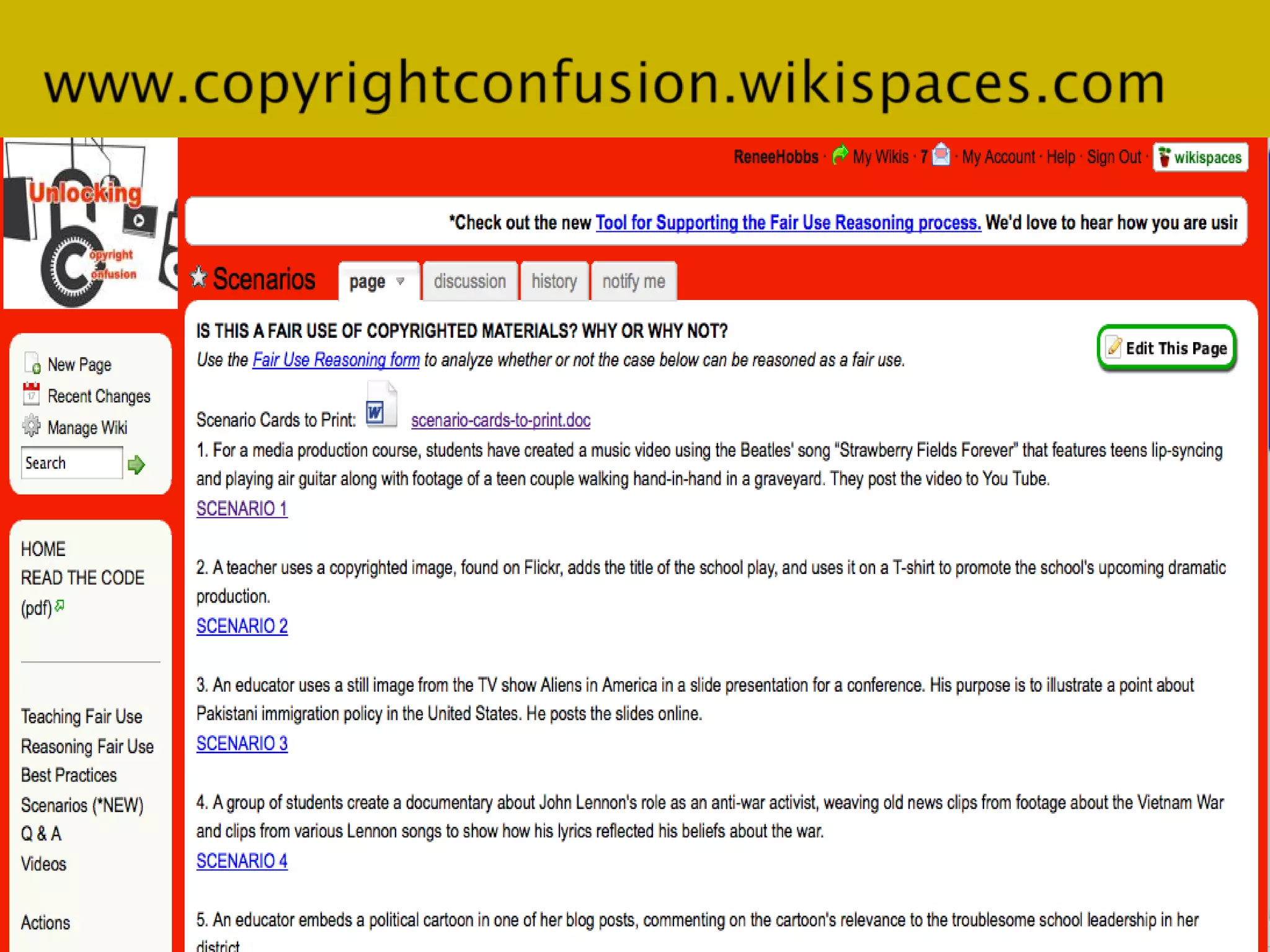
  • #61 http://copyrightconfusion.wikispaces.com