Copyright and Fair UseBritt FagerheimCoordinator of Library Services for Regional Campuses and Distance Education britt.fagerheim@usu.edu 435-797-2643
What is Covered by Copyright?Copyright is automatically granted at the time a new work is created, including  works of literature, music, photography and images, and other creative works.Registration or attaching a copyright notice to a work is not required.Copyright grants the exclusive rights to (or authorizes others to) reproduce the work, display the work, and create derivative works.
What is Covered by CopyrightA work is under copyright for 70 years after the death of the author.Exception: Works created or published before 1923 (in the U.S.) are in the public domain.Exception: Works produced by the U.S. government are not under copyright.Luckily, copyright law includes the principal of “fair use”.
Fair UseLimited use of copyrighted material without permission of holder, for limited purposes.Typically fair use covers using selections of copyrighted material in the classroom for educational purposes.Four factors to consider:Purpose and character of the use (commercial use or nonprofit/educational use)Nature of the copyrighted work, i.e. fiction or non-fiction, published or unpublished
Fair UseFour factors cont:Amount and substantiality of the portion of the work used in relation to work as a wholeEffect of the use upon the potential market for or value of the copyrighted workSee Fair Use checklists (i.e. http://lib.byu.edu/departs/copyright/overview/Checklist_for_Fair_Use.pdf)
Library E-JournalsLibrary e-journals and database content: okay to link directly to content in the database or journal, but typically cannot place material into Blackboard or course site.Look for “durable link” or “permanent link” on the record in the database.See http://libguides.usu.edu/database_links or ask a librarian if you have any questions.
TEACH ActUpdate to copyright law to cover transmission and displays of copyrighted material; applies to online courses and distance education.Requires university to reasonably prevent students from being able to save or print the workInstructors typically need to apply traditional fair use guidelines or seek permission for online course material.
ImagesAssume all images are under copyright. It is not sufficient to merely provide an acknowledgement for a photo or image.Look for a “terms of use” or copyright information on the site and suggested credit information (i.e. http://www.si.edu/copyright) For classroom use, apply fair use rules.
Images on WebsitesSize and resolution of image is a factor, i.e. small or thumbnail images.Use public domain material.Obtain written permission to use imageUse images with a statement of permissible use or open license (Creative Commons).
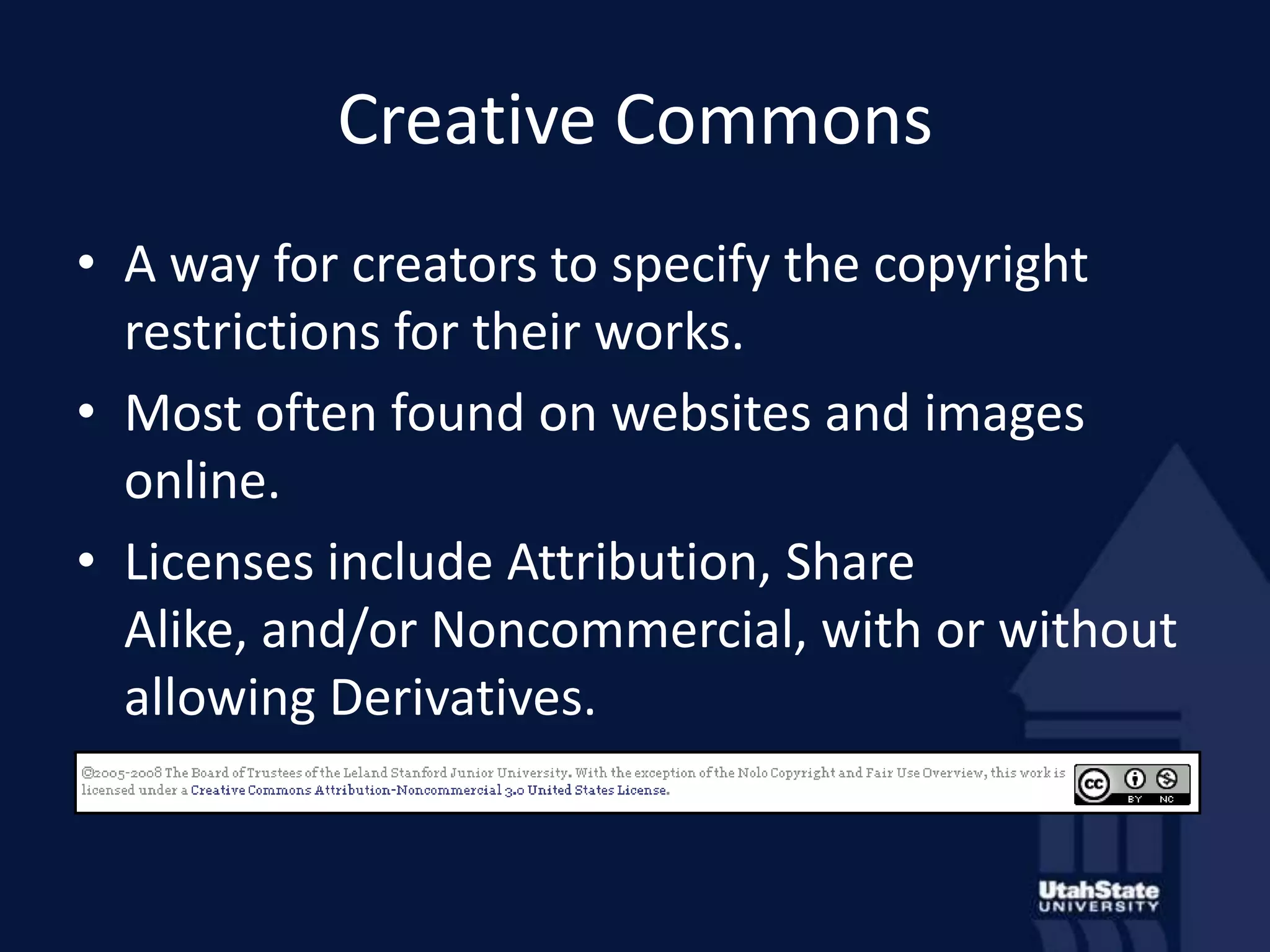
Creative CommonsA way for creators to specify the copyright restrictions for their works.Most often found on websites and images online.Licenses include Attribution, Share Alike, and/or Noncommercial, with or without allowing Derivatives.
Images: SourcesFlickr.com (can limit search to photos with Creative Commons copyright)Fotolia.comIstockphoto.com123rfSome limitations on how you can display the photos.
Revising and Adapting WorksOnly copyright holder, typically the author, has the right to adapt or revise a work, or give this authorization to someone else.Referred to as “Derivative Works”.Even within Fair Use, need to gain permission before revising, adapting, or updating works created by someone else.
Revising and Adapting WorksFor works created at USU, can put Creative Commons copyright on work, enabling other Extension agents to adapt and revise the work.Options: Attribution (others can create derivative works if they give appropriate credit) or CC0 “No Rights Reserved” (waive copyright restrictions to a work and place in public domain to extent permissible by law).
TrademarkA word, phrase, symbol or design that identifies and distinguishes the source of the goods of one party from those of others (US Patent and Trademark Office).Most trademarks and service marks based on use in commerce.® means trademark has been filed with USPTO. ™ only means owner is claiming a trademark.
TrademarkInformational use does not require written permission, i.e. using the Microsoft Word symbol in a help guide for using Word.Search trademarks or find additional information at USPTO: http://www.uspto.gov/main/trademarks.htm.
SourcesGetting Permission: How to License and Clear Copyrighted Materials Online and Off (e-book from Merrill-Cazier Library)BYU Copyright Licensing Office http://www.lib.byu.edu/departs/copyright/Copyright Basics (2007). University of Michigan. http://www.copyright.umich.edu/basics.html
SourcesCopyright and Fair Use: Stanford University Libraries (2007). http://fairuse.stanford.edu/index.htmlCook, W. (2006). Borrowing Images from the Web. Tech Soup Learning Center. http://www.techsoup.org/learningcenter/internet/page5970.cfmHoon, P. (2007). Know Your Copy Rights FAQ. Association of Research Libraries. http://www.knowyourcopyrights.org/resourcesfac/faq/
Specific Questions?Contact a librarian435-797-26431-800-525-7178library.help@usu.eduContact USU General Council435-797-1156

Copyright and Fair Use for USU Extension

  • 1.
    Copyright and FairUseBritt FagerheimCoordinator of Library Services for Regional Campuses and Distance Education britt.fagerheim@usu.edu 435-797-2643
  • 2.
    What is Coveredby Copyright?Copyright is automatically granted at the time a new work is created, including works of literature, music, photography and images, and other creative works.Registration or attaching a copyright notice to a work is not required.Copyright grants the exclusive rights to (or authorizes others to) reproduce the work, display the work, and create derivative works.
  • 3.
    What is Coveredby CopyrightA work is under copyright for 70 years after the death of the author.Exception: Works created or published before 1923 (in the U.S.) are in the public domain.Exception: Works produced by the U.S. government are not under copyright.Luckily, copyright law includes the principal of “fair use”.
  • 4.
    Fair UseLimited useof copyrighted material without permission of holder, for limited purposes.Typically fair use covers using selections of copyrighted material in the classroom for educational purposes.Four factors to consider:Purpose and character of the use (commercial use or nonprofit/educational use)Nature of the copyrighted work, i.e. fiction or non-fiction, published or unpublished
  • 5.
    Fair UseFour factorscont:Amount and substantiality of the portion of the work used in relation to work as a wholeEffect of the use upon the potential market for or value of the copyrighted workSee Fair Use checklists (i.e. http://lib.byu.edu/departs/copyright/overview/Checklist_for_Fair_Use.pdf)
  • 6.
    Library E-JournalsLibrary e-journalsand database content: okay to link directly to content in the database or journal, but typically cannot place material into Blackboard or course site.Look for “durable link” or “permanent link” on the record in the database.See http://libguides.usu.edu/database_links or ask a librarian if you have any questions.
  • 7.
    TEACH ActUpdate tocopyright law to cover transmission and displays of copyrighted material; applies to online courses and distance education.Requires university to reasonably prevent students from being able to save or print the workInstructors typically need to apply traditional fair use guidelines or seek permission for online course material.
  • 8.
    ImagesAssume all imagesare under copyright. It is not sufficient to merely provide an acknowledgement for a photo or image.Look for a “terms of use” or copyright information on the site and suggested credit information (i.e. http://www.si.edu/copyright) For classroom use, apply fair use rules.
  • 9.
    Images on WebsitesSizeand resolution of image is a factor, i.e. small or thumbnail images.Use public domain material.Obtain written permission to use imageUse images with a statement of permissible use or open license (Creative Commons).
  • 10.
    Creative CommonsA wayfor creators to specify the copyright restrictions for their works.Most often found on websites and images online.Licenses include Attribution, Share Alike, and/or Noncommercial, with or without allowing Derivatives.
  • 11.
    Images: SourcesFlickr.com (canlimit search to photos with Creative Commons copyright)Fotolia.comIstockphoto.com123rfSome limitations on how you can display the photos.
  • 12.
    Revising and AdaptingWorksOnly copyright holder, typically the author, has the right to adapt or revise a work, or give this authorization to someone else.Referred to as “Derivative Works”.Even within Fair Use, need to gain permission before revising, adapting, or updating works created by someone else.
  • 13.
    Revising and AdaptingWorksFor works created at USU, can put Creative Commons copyright on work, enabling other Extension agents to adapt and revise the work.Options: Attribution (others can create derivative works if they give appropriate credit) or CC0 “No Rights Reserved” (waive copyright restrictions to a work and place in public domain to extent permissible by law).
  • 14.
    TrademarkA word, phrase,symbol or design that identifies and distinguishes the source of the goods of one party from those of others (US Patent and Trademark Office).Most trademarks and service marks based on use in commerce.® means trademark has been filed with USPTO. ™ only means owner is claiming a trademark.
  • 15.
    TrademarkInformational use doesnot require written permission, i.e. using the Microsoft Word symbol in a help guide for using Word.Search trademarks or find additional information at USPTO: http://www.uspto.gov/main/trademarks.htm.
  • 16.
    SourcesGetting Permission: Howto License and Clear Copyrighted Materials Online and Off (e-book from Merrill-Cazier Library)BYU Copyright Licensing Office http://www.lib.byu.edu/departs/copyright/Copyright Basics (2007). University of Michigan. http://www.copyright.umich.edu/basics.html
  • 17.
    SourcesCopyright and FairUse: Stanford University Libraries (2007). http://fairuse.stanford.edu/index.htmlCook, W. (2006). Borrowing Images from the Web. Tech Soup Learning Center. http://www.techsoup.org/learningcenter/internet/page5970.cfmHoon, P. (2007). Know Your Copy Rights FAQ. Association of Research Libraries. http://www.knowyourcopyrights.org/resourcesfac/faq/
  • 18.
    Specific Questions?Contact alibrarian435-797-26431-800-525-7178library.help@usu.eduContact USU General Council435-797-1156