+
Using Others’ Work in Your Research
Understanding Copyright and Fair Use
Lisa Rathert
+ What is Copyright?
Copyright is a form of legal protection provided to creators
of “original works of authorship.” Copyright is given
automatically; creators do not need to apply!
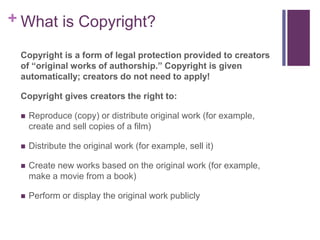
Copyright gives creators the right to:
 Reproduce (copy) or distribute original work (for example,
create and sell copies of a film)
 Distribute the original work (for example, sell it)
 Create new works based on the original work (for example,
make a movie from a book)
 Perform or display the original work publicly
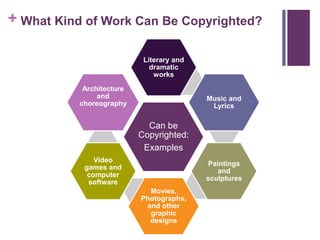
+ What Kind of Work Can Be Copyrighted?
Can be
Copyrighted:
Examples
Literary and
dramatic
works
Music and
Lyrics
Paintings
and
sculptures
Movies,
Photographs,
and other
graphic
designs
Video
games and
computer
software
Architecture
and
choreography
+ Did You Know . . .
Copyright is not unlimited!
 Copyright is given for a limited amount of time.
After it expires, a formerly copyrighted work
moves into the public domain, and it may be
used by anyone.
 Even before copyright expires, the public is free
to make FAIR USE of the copyrighted works.
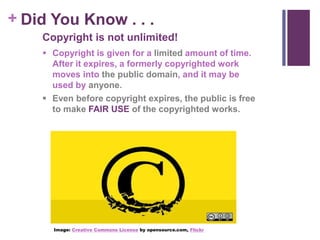
Image: Creative Commons License by opensource.com, Flickr
+ What is Fair Use?
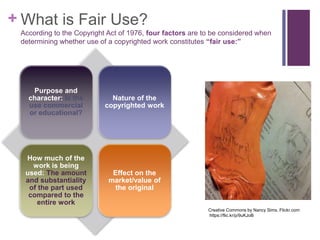
According to the Copyright Act of 1976, four factors are to be considered when
determining whether use of a copyrighted work constitutes “fair use:”
Purpose and
character: Is the
use commercial
or educational?
Nature of the
copyrighted work
How much of the
work is being
used: The amount
and substantiality
of the part used
compared to the
entire work
Effect on the
market/value of
the original
Creative Commons by Nancy Sims, Flickr.com
https://flic.kr/p/9uKJoB
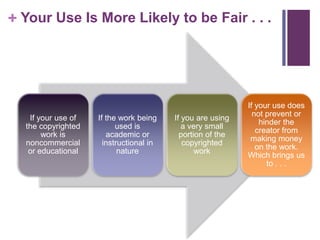
+ Your Use Is More Likely to be Fair . . .
If your use of
the copyrighted
work is
noncommercial
or educational
If the work being
used is
academic or
instructional in
nature
If you are using
a very small
portion of the
copyrighted
work
If your use does
not prevent or
hinder the
creator from
making money
on the work.
Which brings us
to . . .
+ Transformativeness:
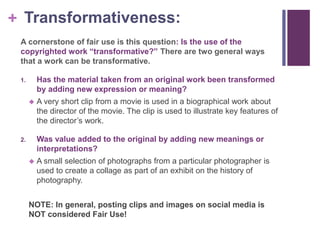
A cornerstone of fair use is this question: Is the use of the
copyrighted work “transformative?” There are two general ways
that a work can be transformative.
1. Has the material taken from an original work been transformed
by adding new expression or meaning?
 A very short clip from a movie is used in a biographical work about
the director of the movie. The clip is used to illustrate key features of
the director’s work.
2. Was value added to the original by adding new meanings or
interpretations?
 A small selection of photographs from a particular photographer is
used to create a collage as part of an exhibit on the history of
photography.
NOTE: In general, posting clips and images on social media is
NOT considered Fair Use!
+
Simple Attribution Guide
Your instructor(s) may provide specific guidelines for correctly
attributing the copyrighted, fair use, or creative commons text and
images you use in your work. You may also use this simple
template for attribution:
 Name of work
 Author of Work
 Source or Web Site Name
 Date of Work or Date Web site was Accessed
 URL (if applicable)
Example:
“Guide to preventing plagiarism.” Accredited Schools Online.
Accredited Schools Online (Web). December 2015.
http://www.accreditedschoolsonline.org/resources/preventing-
plagiarism/
+ Selected Resources for Images
Creative Commons Search -
http://search.creativecommons.org/
FindIcons.com – http://findicons.com/
Flickr Advanced Search – Use advanced
search filters to show only CC licensed
images: https://www.flickr.com/
+
Resources
 "Fair Use: Remix Culture, Mashups, and Copyright.
Teachingcopyright.org Creative Commons,
https://www.teachingcopyright.org/curriculum/hs/3.
 "Fair Use: What is Transformative?" Nolo.com,
http://www.nolo.com/legal-encyclopedia/fair-use-what-
transformative.html
 "Lesson Plan: Understanding Copyright." Media Education Lab,
University of Rhode Island. http://mediaeducationlab.com/section-
1-understanding-copyright

Copyright and fair use lesson

  • 1.
    + Using Others’ Workin Your Research Understanding Copyright and Fair Use Lisa Rathert
  • 2.
    + What isCopyright? Copyright is a form of legal protection provided to creators of “original works of authorship.” Copyright is given automatically; creators do not need to apply! Copyright gives creators the right to:  Reproduce (copy) or distribute original work (for example, create and sell copies of a film)  Distribute the original work (for example, sell it)  Create new works based on the original work (for example, make a movie from a book)  Perform or display the original work publicly
  • 3.
    + What Kindof Work Can Be Copyrighted? Can be Copyrighted: Examples Literary and dramatic works Music and Lyrics Paintings and sculptures Movies, Photographs, and other graphic designs Video games and computer software Architecture and choreography
  • 4.
    + Did YouKnow . . . Copyright is not unlimited!  Copyright is given for a limited amount of time. After it expires, a formerly copyrighted work moves into the public domain, and it may be used by anyone.  Even before copyright expires, the public is free to make FAIR USE of the copyrighted works. Image: Creative Commons License by opensource.com, Flickr
  • 5.
    + What isFair Use? According to the Copyright Act of 1976, four factors are to be considered when determining whether use of a copyrighted work constitutes “fair use:” Purpose and character: Is the use commercial or educational? Nature of the copyrighted work How much of the work is being used: The amount and substantiality of the part used compared to the entire work Effect on the market/value of the original Creative Commons by Nancy Sims, Flickr.com https://flic.kr/p/9uKJoB
  • 6.
    + Your UseIs More Likely to be Fair . . . If your use of the copyrighted work is noncommercial or educational If the work being used is academic or instructional in nature If you are using a very small portion of the copyrighted work If your use does not prevent or hinder the creator from making money on the work. Which brings us to . . .
  • 7.
    + Transformativeness: A cornerstoneof fair use is this question: Is the use of the copyrighted work “transformative?” There are two general ways that a work can be transformative. 1. Has the material taken from an original work been transformed by adding new expression or meaning?  A very short clip from a movie is used in a biographical work about the director of the movie. The clip is used to illustrate key features of the director’s work. 2. Was value added to the original by adding new meanings or interpretations?  A small selection of photographs from a particular photographer is used to create a collage as part of an exhibit on the history of photography. NOTE: In general, posting clips and images on social media is NOT considered Fair Use!
  • 8.
    + Simple Attribution Guide Yourinstructor(s) may provide specific guidelines for correctly attributing the copyrighted, fair use, or creative commons text and images you use in your work. You may also use this simple template for attribution:  Name of work  Author of Work  Source or Web Site Name  Date of Work or Date Web site was Accessed  URL (if applicable) Example: “Guide to preventing plagiarism.” Accredited Schools Online. Accredited Schools Online (Web). December 2015. http://www.accreditedschoolsonline.org/resources/preventing- plagiarism/
  • 9.
    + Selected Resourcesfor Images Creative Commons Search - http://search.creativecommons.org/ FindIcons.com – http://findicons.com/ Flickr Advanced Search – Use advanced search filters to show only CC licensed images: https://www.flickr.com/
  • 10.
    + Resources  "Fair Use:Remix Culture, Mashups, and Copyright. Teachingcopyright.org Creative Commons, https://www.teachingcopyright.org/curriculum/hs/3.  "Fair Use: What is Transformative?" Nolo.com, http://www.nolo.com/legal-encyclopedia/fair-use-what- transformative.html  "Lesson Plan: Understanding Copyright." Media Education Lab, University of Rhode Island. http://mediaeducationlab.com/section- 1-understanding-copyright