• Understand the visual-verbal relationship
illustrated in graphs found in expository text,
• Distinguish the different types of graphs,
• Create and interpret the types of graphs.
are considered to be things
that can be seen, visible
things other than printed
words that are used in a
communication process.
the term verbal applies to
written or spoken words. It
use words to express and
communicate our thoughts
in two ways.
are designed to explain,
inform, and present facts of
specific topics. These texts
can be accompanied by visual
cues to provide or further
highlight information.
News Article, Magazine Article, Instruction
Manuals, Recipes, Textbooks and Modules
• Refers to a text that does not need to be read from
beginning to the end.
• There are multiple reading paths. They are
determined by the reader.
• Typically include digital texts.
Non-linear Text:
• Graphs
• Tables
• Maps
• Captioned
Graphics
• Flowcharts
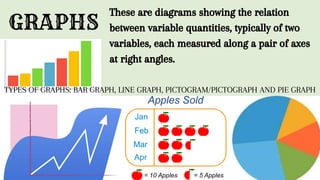
GRAPHS
These are diagrams showing the relation
between variable quantities, typically of two
variables, each measured along a pair of axes
at right angles.
TYPES OF GRAPHS: BAR GRAPH, LINE GRAPH, PICTOGRAM/PICTOGRAPH AND PIE GRAPH
BAR GRAPH IT SHOWS THE NUMBERS THAT
ARE INDEPENDENT OF EACH
OTHER.
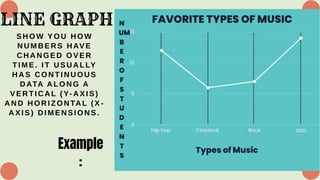
LINE GRAPH
SHO W YO U HO W
NUM BERS HAVE
CHANGED OVER
TI M E. I T USUALLY
HAS CO NTI NUO US
DATA ALO NG A
VERTICAL ( Y- AXIS)
AND HO RI ZO NTAL ( X -
AXI S) DI M ENSI O NS.
Example
:
Study and interpret the infographic
representation of proposed budget for
2022 posted by PhilStar. The last
person to hold the ball will given 5
seconds before to answer.
THANK YOU
FOR
LISTENING!🙂
Pictogram/Pictograp
h
and
Pie graph
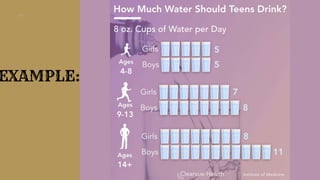
Pictograph/Pictogram
EXAMPLE:
Pie Graph
Pie Graph
EXAMPLE
:
PASS THE
BALL!
Study and
interpret the pie
chart
representation of
top 10
richest/wealtiest
provinces in
Philippines
posted by
PhilStar. The
person to hold
the ball will given
5 seconds before
to answer the
question.
ANSWER KEY:
Copy-of-Visual-Verbal-Relationship (2).pptx

Copy-of-Visual-Verbal-Relationship (2).pptx

  • 11.
    • Understand thevisual-verbal relationship illustrated in graphs found in expository text, • Distinguish the different types of graphs, • Create and interpret the types of graphs.
  • 13.
    are considered tobe things that can be seen, visible things other than printed words that are used in a communication process. the term verbal applies to written or spoken words. It use words to express and communicate our thoughts in two ways.
  • 14.
    are designed toexplain, inform, and present facts of specific topics. These texts can be accompanied by visual cues to provide or further highlight information. News Article, Magazine Article, Instruction Manuals, Recipes, Textbooks and Modules
  • 15.
    • Refers toa text that does not need to be read from beginning to the end. • There are multiple reading paths. They are determined by the reader. • Typically include digital texts.
  • 16.
    Non-linear Text: • Graphs •Tables • Maps • Captioned Graphics • Flowcharts
  • 17.
    GRAPHS These are diagramsshowing the relation between variable quantities, typically of two variables, each measured along a pair of axes at right angles. TYPES OF GRAPHS: BAR GRAPH, LINE GRAPH, PICTOGRAM/PICTOGRAPH AND PIE GRAPH
  • 18.
    BAR GRAPH ITSHOWS THE NUMBERS THAT ARE INDEPENDENT OF EACH OTHER.
  • 19.
    LINE GRAPH SHO WYO U HO W NUM BERS HAVE CHANGED OVER TI M E. I T USUALLY HAS CO NTI NUO US DATA ALO NG A VERTICAL ( Y- AXIS) AND HO RI ZO NTAL ( X - AXI S) DI M ENSI O NS. Example :
  • 21.
    Study and interpretthe infographic representation of proposed budget for 2022 posted by PhilStar. The last person to hold the ball will given 5 seconds before to answer.
  • 25.
  • 26.
  • 27.
  • 28.
  • 29.
  • 30.
  • 31.
  • 32.
    Study and interpret thepie chart representation of top 10 richest/wealtiest provinces in Philippines posted by PhilStar. The person to hold the ball will given 5 seconds before to answer the question.
  • 36.