Learning Objectives:
• Recognize signal words and expressions used to
convey positive and negative messages;
• Identify whether the message in a sentence level
or paragraph level is positive or negative;
• Classify statements whether the positive or
negative messages are literally or figuratively
expressed;
Messages can either be
heard or read.
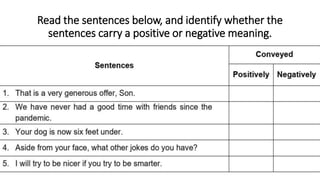
Read the sentences below, and identify whether the
sentences carry a positive or negative meaning.
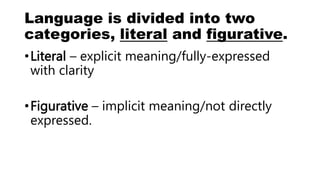
Language is divided into two
categories, literal and figurative.
•Literal – explicit meaning/fully-expressed
with clarity
•Figurative – implicit meaning/not directly
expressed.
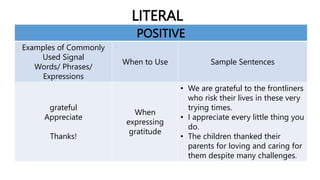
LITERAL
POSITIVE
Examples of Commonly
Used Signal
Words/ Phrases/
Expressions
When to Use Sample Sentences
grateful
Appreciate
Thanks!
When
expressing
gratitude
• We are grateful to the frontliners
who risk their lives in these very
trying times.
• I appreciate every little thing you
do.
• The children thanked their
parents for loving and caring for
them despite many challenges.
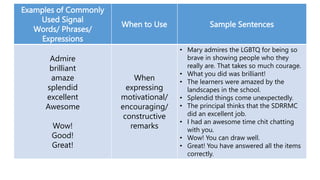
Examples of Commonly
Used Signal
Words/ Phrases/
Expressions
When to Use Sample Sentences
Admire
brilliant
amaze
splendid
excellent
Awesome
Wow!
Good!
Great!
When
expressing
motivational/
encouraging/
constructive
remarks
• Mary admires the LGBTQ for being so
brave in showing people who they
really are. That takes so much courage.
• What you did was brilliant!
• The learners were amazed by the
landscapes in the school.
• Splendid things come unexpectedly.
• The principal thinks that the SDRRMC
did an excellent job.
• I had an awesome time chit chatting
with you.
• Wow! You can draw well.
• Great! You have answered all the items
correctly.
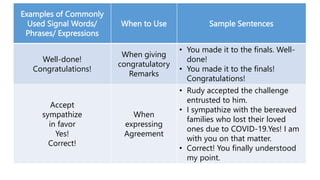
Examples of Commonly
Used Signal Words/
Phrases/ Expressions
When to Use Sample Sentences
Well-done!
Congratulations!
When giving
congratulatory
Remarks
• You made it to the finals. Well-
done!
• You made it to the finals!
Congratulations!
Accept
sympathize
in favor
Yes!
Correct!
When
expressing
Agreement
• Rudy accepted the challenge
entrusted to him.
• I sympathize with the bereaved
families who lost their loved
ones due to COVID-19.Yes! I am
with you on that matter.
• Correct! You finally understood
my point.
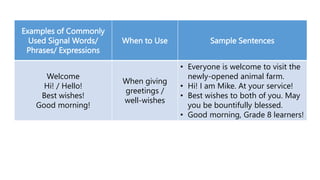
Examples of Commonly
Used Signal Words/
Phrases/ Expressions
When to Use Sample Sentences
Welcome
Hi! / Hello!
Best wishes!
Good morning!
When giving
greetings /
well-wishes
• Everyone is welcome to visit the
newly-opened animal farm.
• Hi! I am Mike. At your service!
• Best wishes to both of you. May
you be bountifully blessed.
• Good morning, Grade 8 learners!
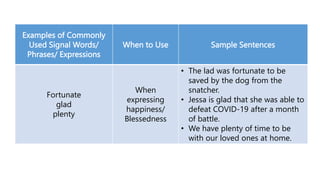
Examples of Commonly
Used Signal Words/
Phrases/ Expressions
When to Use Sample Sentences
Fortunate
glad
plenty
When
expressing
happiness/
Blessedness
• The lad was fortunate to be
saved by the dog from the
snatcher.
• Jessa is glad that she was able to
defeat COVID-19 after a month
of battle.
• We have plenty of time to be
with our loved ones at home.
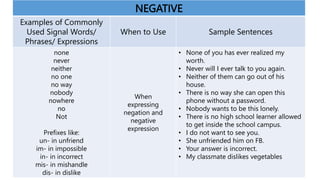
NEGATIVE
Examples of Commonly
Used Signal Words/
Phrases/ Expressions
When to Use Sample Sentences
none
never
neither
no one
no way
nobody
nowhere
no
Not
Prefixes like:
un- in unfriend
im- in impossible
in- in incorrect
mis- in mishandle
dis- in dislike
When
expressing
negation and
negative
expression
• None of you has ever realized my
worth.
• Never will I ever talk to you again.
• Neither of them can go out of his
house.
• There is no way she can open this
phone without a password.
• Nobody wants to be this lonely.
• There is no high school learner allowed
to get inside the school campus.
• I do not want to see you.
• She unfriended him on FB.
• Your answer is incorrect.
• My classmate dislikes vegetables
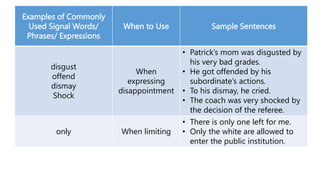
Examples of Commonly
Used Signal Words/
Phrases/ Expressions
When to Use Sample Sentences
disgust
offend
dismay
Shock
When
expressing
disappointment
• Patrick’s mom was disgusted by
his very bad grades.
• He got offended by his
subordinate’s actions.
• To his dismay, he cried.
• The coach was very shocked by
the decision of the referee.
only When limiting
• There is only one left for me.
• Only the white are allowed to
enter the public institution.
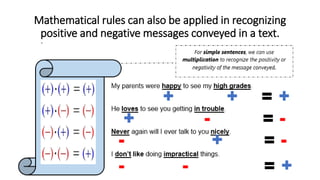
Mathematical rules can also be applied in recognizing
positive and negative messages conveyed in a text.
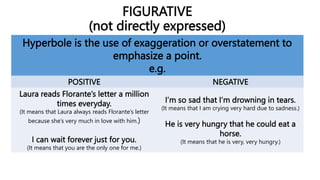
FIGURATIVE
(not directly expressed)
Hyperbole is the use of exaggeration or overstatement to
emphasize a point.
e.g.
POSITIVE NEGATIVE
Laura reads Florante’s letter a million
times everyday.
(It means that Laura always reads Florante’s letter
because she’s very much in love with him.)
I can wait forever just for you.
(It means that you are the only one for me.)
I’m so sad that I’m drowning in tears.
(It means that I am crying very hard due to sadness.)
He is very hungry that he could eat a
horse.
(It means that he is very, very hungry.)
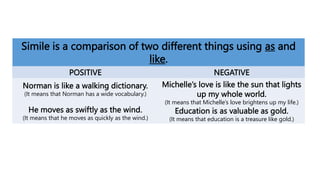
Simile is a comparison of two different things using as and
like.
POSITIVE NEGATIVE
Norman is like a walking dictionary.
(It means that Norman has a wide vocabulary.)
He moves as swiftly as the wind.
(It means that he moves as quickly as the wind.)
Michelle’s love is like the sun that lights
up my whole world.
(It means that Michelle’s love brightens up my life.)
Education is as valuable as gold.
(It means that education is a treasure like gold.)
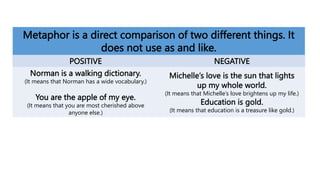
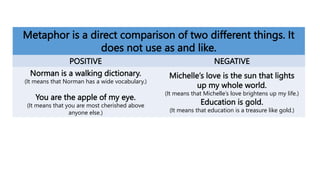
Metaphor is a direct comparison of two different things. It
does not use as and like.
POSITIVE NEGATIVE
Norman is a walking dictionary.
(It means that Norman has a wide vocabulary.)
You are the apple of my eye.
(It means that you are most cherished above
anyone else.)
Michelle’s love is the sun that lights
up my whole world.
(It means that Michelle’s love brightens up my life.)
Education is gold.
(It means that education is a treasure like gold.)
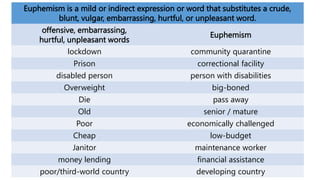
Euphemism is a mild or indirect expression or word that substitutes a crude,
blunt, vulgar, embarrassing, hurtful, or unpleasant word.
offensive, embarrassing,
hurtful, unpleasant words
Euphemism
lockdown community quarantine
Prison correctional facility
disabled person person with disabilities
Overweight big-boned
Die pass away
Old senior / mature
Poor economically challenged
Cheap low-budget
Janitor maintenance worker
money lending financial assistance
poor/third-world country developing country
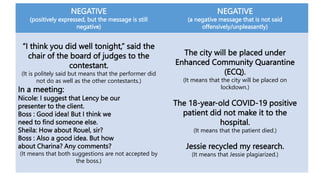
NEGATIVE
(positively expressed, but the message is still
negative)
NEGATIVE
(a negative message that is not said
offensively/unpleasantly)
“I think you did well tonight,” said the
chair of the board of judges to the
contestant.
(It is politely said but means that the performer did
not do as well as the other contestants.)
In a meeting:
Nicole: I suggest that Lency be our
presenter to the client.
Boss : Good idea! But I think we
need to find someone else.
Sheila: How about Rouel, sir?
Boss : Also a good idea. But how
about Charina? Any comments?
(It means that both suggestions are not accepted by
the boss.)
The city will be placed under
Enhanced Community Quarantine
(ECQ).
(It means that the city will be placed on
lockdown.)
The 18-year-old COVID-19 positive
patient did not make it to the
hospital.
(It means that the patient died.)
Jessie recycled my research.
(It means that Jessie plagiarized.)
Metaphor is a direct comparison of two different things. It
does not use as and like.
POSITIVE NEGATIVE
Norman is a walking dictionary.
(It means that Norman has a wide vocabulary.)
You are the apple of my eye.
(It means that you are most cherished above
anyone else.)
Michelle’s love is the sun that lights
up my whole world.
(It means that Michelle’s love brightens up my life.)
Education is gold.
(It means that education is a treasure like gold.)
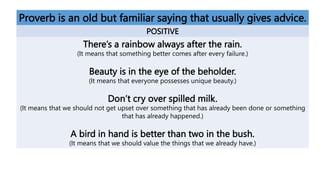
Proverb is an old but familiar saying that usually gives advice.
POSITIVE
There’s a rainbow always after the rain.
(It means that something better comes after every failure.)
Beauty is in the eye of the beholder.
(It means that everyone possesses unique beauty.)
Don’t cry over spilled milk.
(It means that we should not get upset over something that has already been done or something
that has already happened.)
A bird in hand is better than two in the bush.
(It means that we should value the things that we already have.)
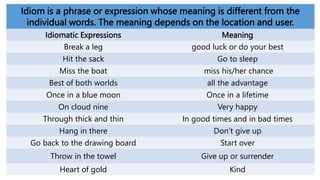
Idiom is a phrase or expression whose meaning is different from the
individual words. The meaning depends on the location and user.
Idiomatic Expressions Meaning
Break a leg good luck or do your best
Hit the sack Go to sleep
Miss the boat miss his/her chance
Best of both worlds all the advantage
Once in a blue moon Once in a lifetime
On cloud nine Very happy
Through thick and thin In good times and in bad times
Hang in there Don’t give up
Go back to the drawing board Start over
Throw in the towel Give up or surrender
Heart of gold Kind
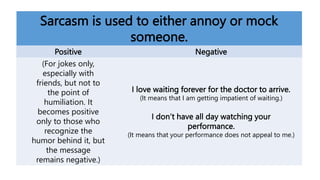
Sarcasm is used to either annoy or mock
someone.
Positive Negative
(For jokes only,
especially with
friends, but not to
the point of
humiliation. It
becomes positive
only to those who
recognize the
humor behind it, but
the message
remains negative.)
I love waiting forever for the doctor to arrive.
(It means that I am getting impatient of waiting.)
I don’t have all day watching your
performance.
(It means that your performance does not appeal to me.)

Analyzing Message Conveyed in a Text.pptx

  • 2.
    Learning Objectives: • Recognizesignal words and expressions used to convey positive and negative messages; • Identify whether the message in a sentence level or paragraph level is positive or negative; • Classify statements whether the positive or negative messages are literally or figuratively expressed;
  • 3.
    Messages can eitherbe heard or read.
  • 6.
    Read the sentencesbelow, and identify whether the sentences carry a positive or negative meaning.
  • 7.
    Language is dividedinto two categories, literal and figurative. •Literal – explicit meaning/fully-expressed with clarity •Figurative – implicit meaning/not directly expressed.
  • 8.
    LITERAL POSITIVE Examples of Commonly UsedSignal Words/ Phrases/ Expressions When to Use Sample Sentences grateful Appreciate Thanks! When expressing gratitude • We are grateful to the frontliners who risk their lives in these very trying times. • I appreciate every little thing you do. • The children thanked their parents for loving and caring for them despite many challenges.
  • 9.
    Examples of Commonly UsedSignal Words/ Phrases/ Expressions When to Use Sample Sentences Admire brilliant amaze splendid excellent Awesome Wow! Good! Great! When expressing motivational/ encouraging/ constructive remarks • Mary admires the LGBTQ for being so brave in showing people who they really are. That takes so much courage. • What you did was brilliant! • The learners were amazed by the landscapes in the school. • Splendid things come unexpectedly. • The principal thinks that the SDRRMC did an excellent job. • I had an awesome time chit chatting with you. • Wow! You can draw well. • Great! You have answered all the items correctly.
  • 10.
    Examples of Commonly UsedSignal Words/ Phrases/ Expressions When to Use Sample Sentences Well-done! Congratulations! When giving congratulatory Remarks • You made it to the finals. Well- done! • You made it to the finals! Congratulations! Accept sympathize in favor Yes! Correct! When expressing Agreement • Rudy accepted the challenge entrusted to him. • I sympathize with the bereaved families who lost their loved ones due to COVID-19.Yes! I am with you on that matter. • Correct! You finally understood my point.
  • 11.
    Examples of Commonly UsedSignal Words/ Phrases/ Expressions When to Use Sample Sentences Welcome Hi! / Hello! Best wishes! Good morning! When giving greetings / well-wishes • Everyone is welcome to visit the newly-opened animal farm. • Hi! I am Mike. At your service! • Best wishes to both of you. May you be bountifully blessed. • Good morning, Grade 8 learners!
  • 12.
    Examples of Commonly UsedSignal Words/ Phrases/ Expressions When to Use Sample Sentences Fortunate glad plenty When expressing happiness/ Blessedness • The lad was fortunate to be saved by the dog from the snatcher. • Jessa is glad that she was able to defeat COVID-19 after a month of battle. • We have plenty of time to be with our loved ones at home.
  • 13.
    NEGATIVE Examples of Commonly UsedSignal Words/ Phrases/ Expressions When to Use Sample Sentences none never neither no one no way nobody nowhere no Not Prefixes like: un- in unfriend im- in impossible in- in incorrect mis- in mishandle dis- in dislike When expressing negation and negative expression • None of you has ever realized my worth. • Never will I ever talk to you again. • Neither of them can go out of his house. • There is no way she can open this phone without a password. • Nobody wants to be this lonely. • There is no high school learner allowed to get inside the school campus. • I do not want to see you. • She unfriended him on FB. • Your answer is incorrect. • My classmate dislikes vegetables
  • 14.
    Examples of Commonly UsedSignal Words/ Phrases/ Expressions When to Use Sample Sentences disgust offend dismay Shock When expressing disappointment • Patrick’s mom was disgusted by his very bad grades. • He got offended by his subordinate’s actions. • To his dismay, he cried. • The coach was very shocked by the decision of the referee. only When limiting • There is only one left for me. • Only the white are allowed to enter the public institution.
  • 15.
    Mathematical rules canalso be applied in recognizing positive and negative messages conveyed in a text.
  • 16.
    FIGURATIVE (not directly expressed) Hyperboleis the use of exaggeration or overstatement to emphasize a point. e.g. POSITIVE NEGATIVE Laura reads Florante’s letter a million times everyday. (It means that Laura always reads Florante’s letter because she’s very much in love with him.) I can wait forever just for you. (It means that you are the only one for me.) I’m so sad that I’m drowning in tears. (It means that I am crying very hard due to sadness.) He is very hungry that he could eat a horse. (It means that he is very, very hungry.)
  • 17.
    Simile is acomparison of two different things using as and like. POSITIVE NEGATIVE Norman is like a walking dictionary. (It means that Norman has a wide vocabulary.) He moves as swiftly as the wind. (It means that he moves as quickly as the wind.) Michelle’s love is like the sun that lights up my whole world. (It means that Michelle’s love brightens up my life.) Education is as valuable as gold. (It means that education is a treasure like gold.)
  • 18.
    Metaphor is adirect comparison of two different things. It does not use as and like. POSITIVE NEGATIVE Norman is a walking dictionary. (It means that Norman has a wide vocabulary.) You are the apple of my eye. (It means that you are most cherished above anyone else.) Michelle’s love is the sun that lights up my whole world. (It means that Michelle’s love brightens up my life.) Education is gold. (It means that education is a treasure like gold.)
  • 19.
    Euphemism is amild or indirect expression or word that substitutes a crude, blunt, vulgar, embarrassing, hurtful, or unpleasant word. offensive, embarrassing, hurtful, unpleasant words Euphemism lockdown community quarantine Prison correctional facility disabled person person with disabilities Overweight big-boned Die pass away Old senior / mature Poor economically challenged Cheap low-budget Janitor maintenance worker money lending financial assistance poor/third-world country developing country
  • 20.
    NEGATIVE (positively expressed, butthe message is still negative) NEGATIVE (a negative message that is not said offensively/unpleasantly) “I think you did well tonight,” said the chair of the board of judges to the contestant. (It is politely said but means that the performer did not do as well as the other contestants.) In a meeting: Nicole: I suggest that Lency be our presenter to the client. Boss : Good idea! But I think we need to find someone else. Sheila: How about Rouel, sir? Boss : Also a good idea. But how about Charina? Any comments? (It means that both suggestions are not accepted by the boss.) The city will be placed under Enhanced Community Quarantine (ECQ). (It means that the city will be placed on lockdown.) The 18-year-old COVID-19 positive patient did not make it to the hospital. (It means that the patient died.) Jessie recycled my research. (It means that Jessie plagiarized.)
  • 21.
    Metaphor is adirect comparison of two different things. It does not use as and like. POSITIVE NEGATIVE Norman is a walking dictionary. (It means that Norman has a wide vocabulary.) You are the apple of my eye. (It means that you are most cherished above anyone else.) Michelle’s love is the sun that lights up my whole world. (It means that Michelle’s love brightens up my life.) Education is gold. (It means that education is a treasure like gold.)
  • 22.
    Proverb is anold but familiar saying that usually gives advice. POSITIVE There’s a rainbow always after the rain. (It means that something better comes after every failure.) Beauty is in the eye of the beholder. (It means that everyone possesses unique beauty.) Don’t cry over spilled milk. (It means that we should not get upset over something that has already been done or something that has already happened.) A bird in hand is better than two in the bush. (It means that we should value the things that we already have.)
  • 23.
    Idiom is aphrase or expression whose meaning is different from the individual words. The meaning depends on the location and user. Idiomatic Expressions Meaning Break a leg good luck or do your best Hit the sack Go to sleep Miss the boat miss his/her chance Best of both worlds all the advantage Once in a blue moon Once in a lifetime On cloud nine Very happy Through thick and thin In good times and in bad times Hang in there Don’t give up Go back to the drawing board Start over Throw in the towel Give up or surrender Heart of gold Kind
  • 24.
    Sarcasm is usedto either annoy or mock someone. Positive Negative (For jokes only, especially with friends, but not to the point of humiliation. It becomes positive only to those who recognize the humor behind it, but the message remains negative.) I love waiting forever for the doctor to arrive. (It means that I am getting impatient of waiting.) I don’t have all day watching your performance. (It means that your performance does not appeal to me.)