SURVEY MAPS
• Topographical maps are Large scale maps show detailed study
of a small area that combine natural and man-made features.
They show relationship between physical features & man made
features.
• Topographical maps are also known as Ordnance Survey Maps
and are similar to the Physical maps as it shows different
landscape features.
• It is an important tool for geographers who intend to make an
in-depth study of a region.These maps are crucial for the army
and defense services as the type of terrain will determine their
strategies. A.Sharma.
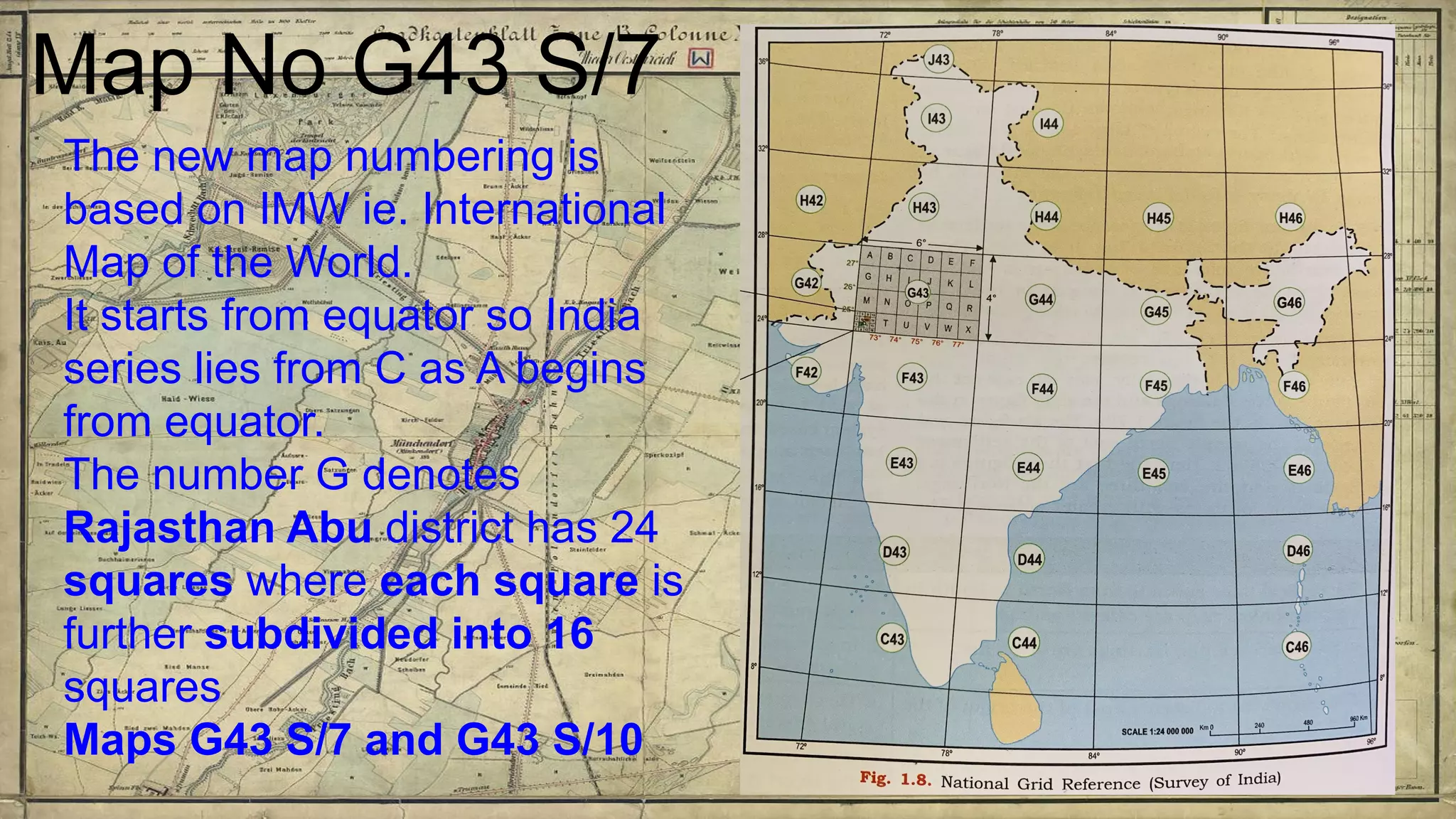
Map No G43 S/7
The new map numbering is
based on IMW ie. International
Map of the World.
It starts from equator so India
series lies from C as A begins
from equator.
The number G denotes
Rajasthan Abu district has 24
squares where each square is
further subdivided into 16
squares
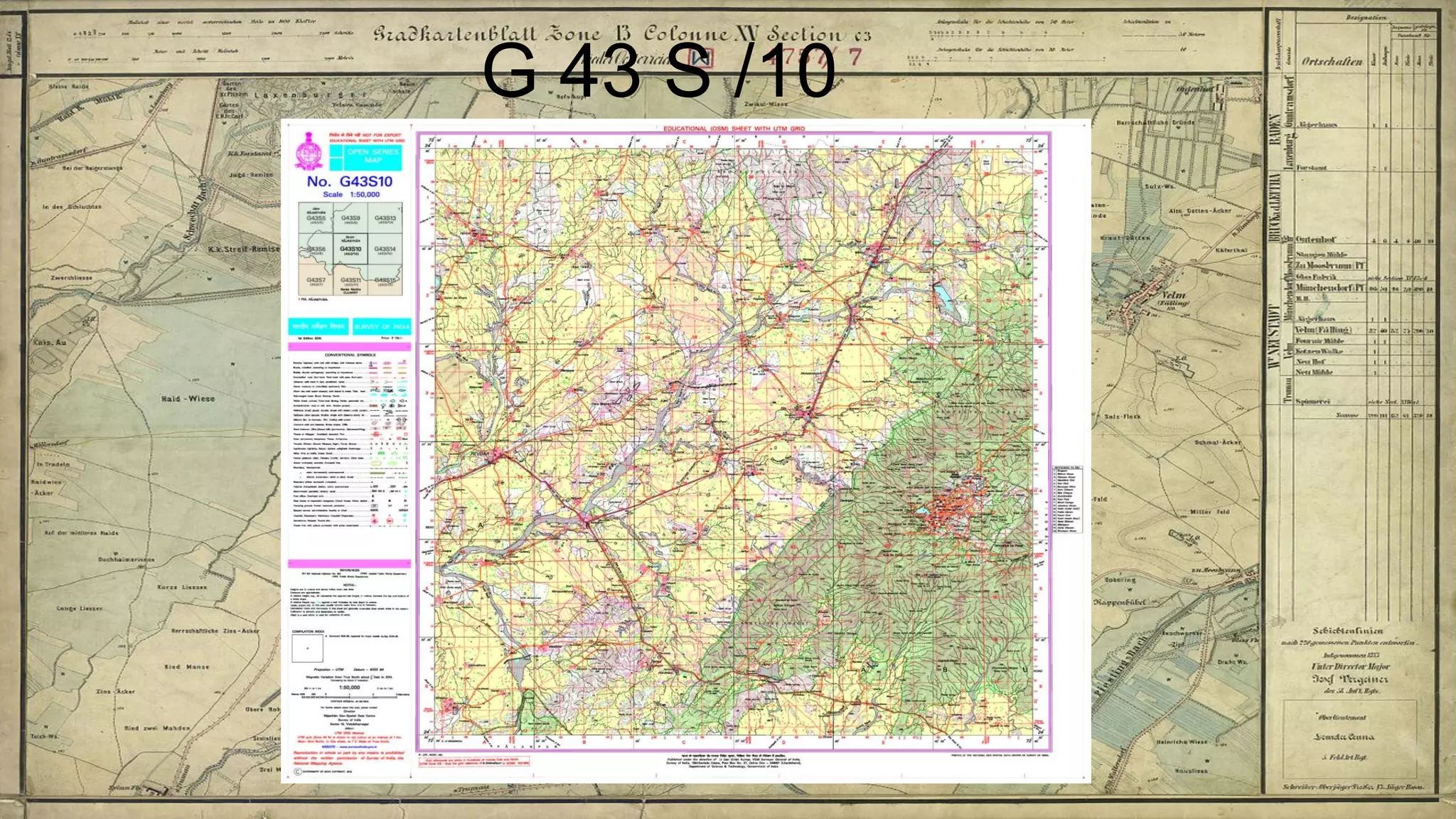
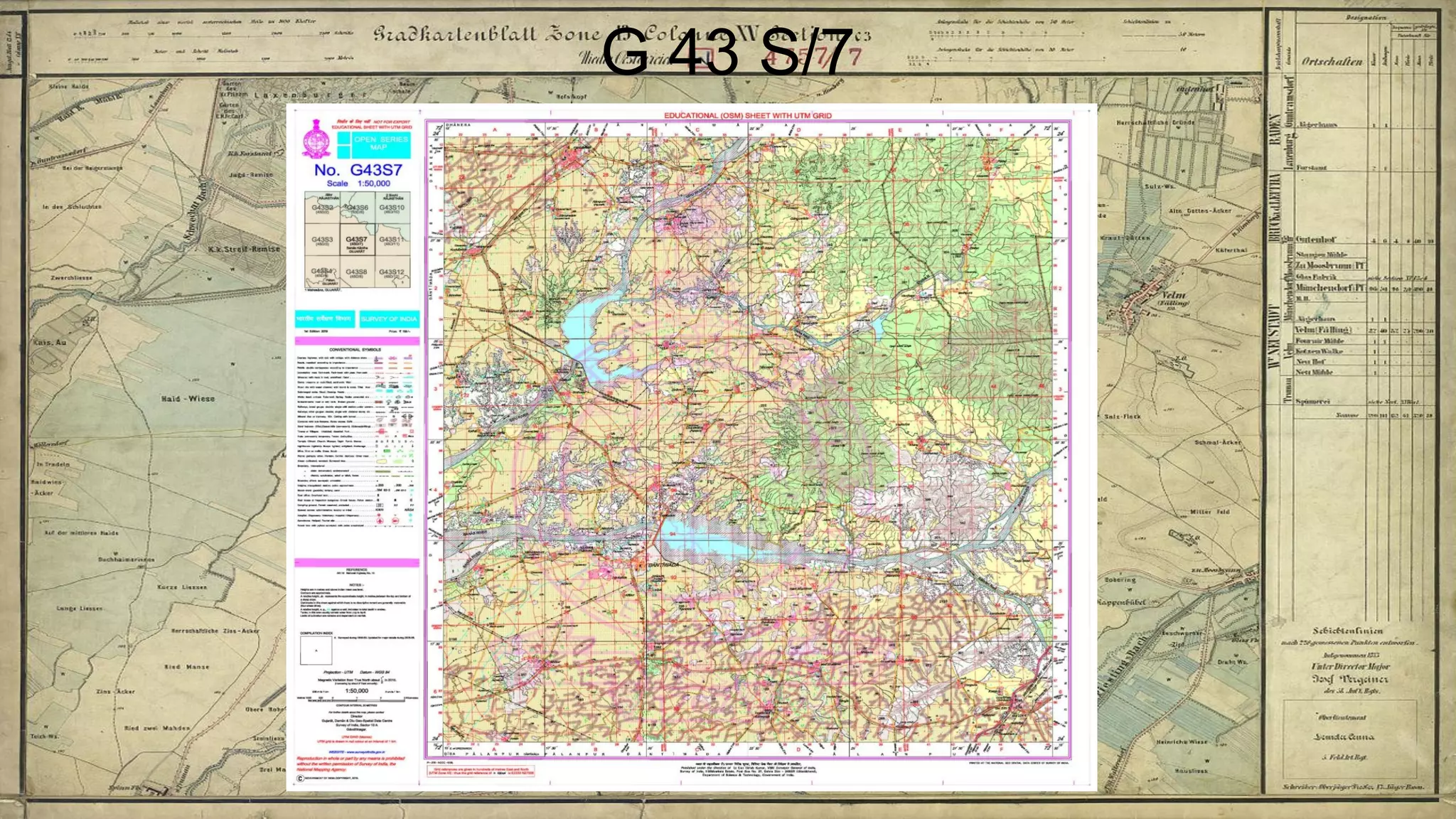
Maps G43 S/7 and G43 S/10
G 43 S /10
G 43 S/7
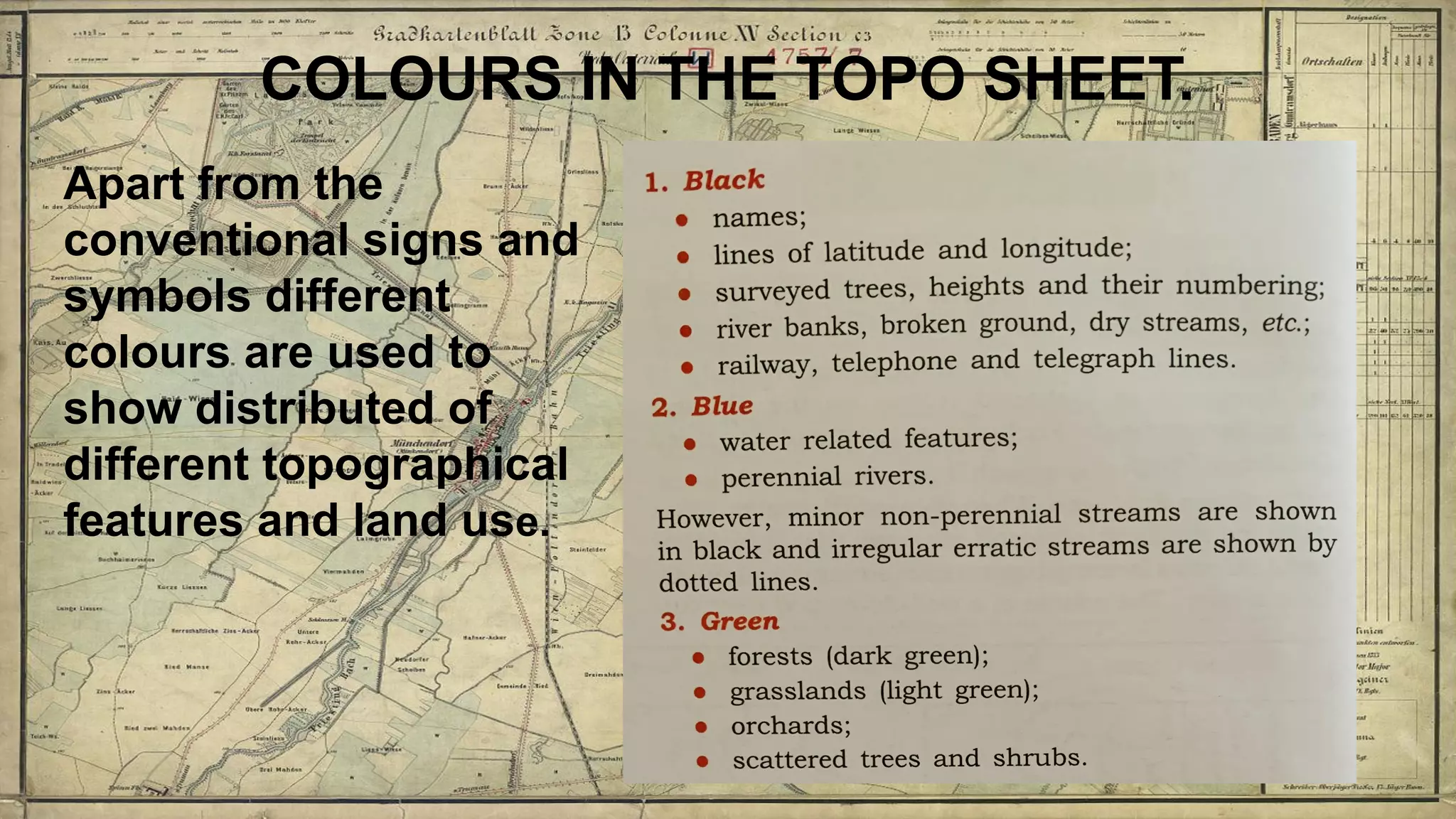
COLOURS IN THE TOPO SHEET.
Apart from the
conventional signs and
symbols different
colours are used to
show distributed of
different topographical
features and land use.
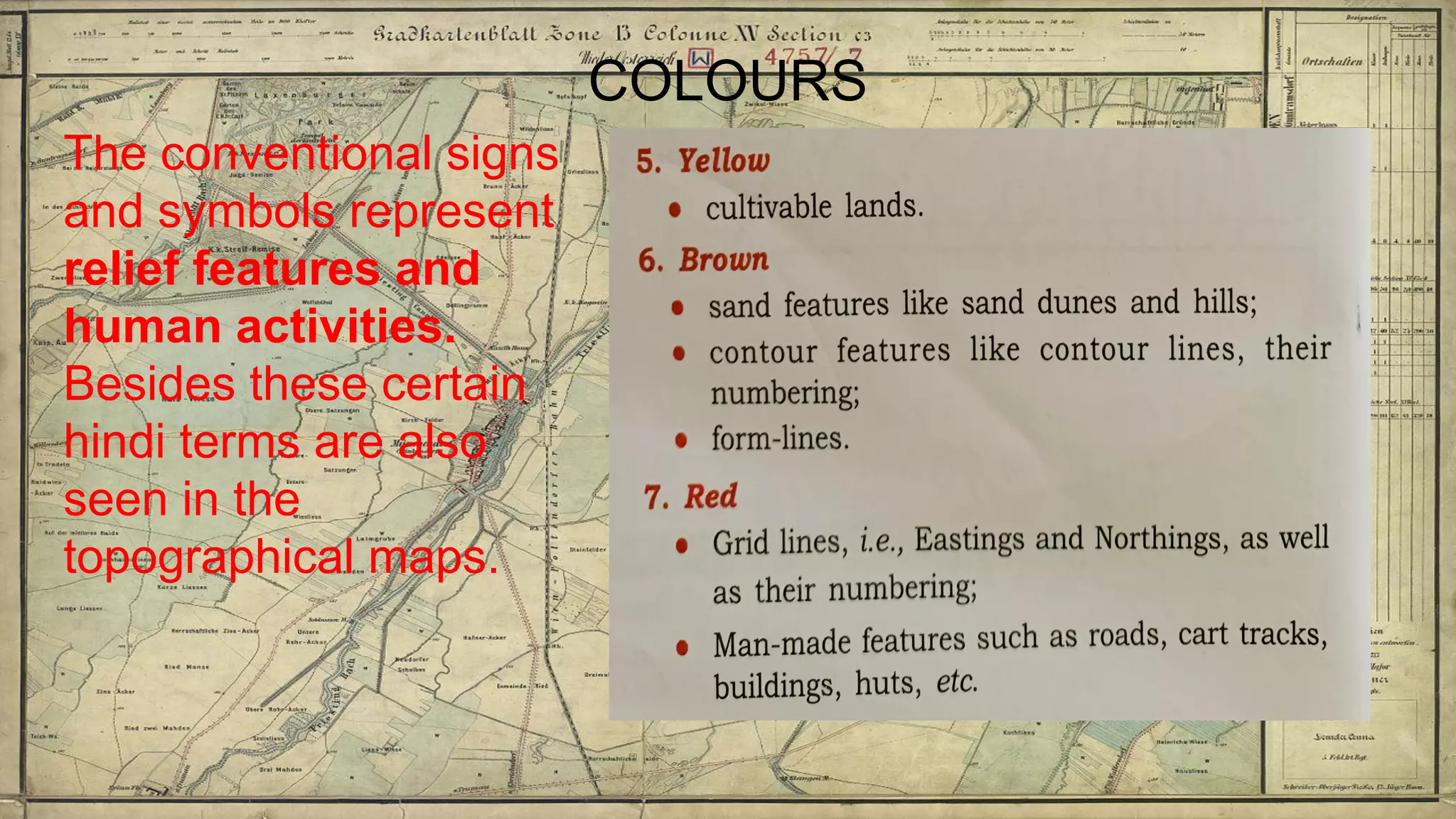
COLOURS
The conventional signs
and symbols represent
relief features and
human activities.
Besides these certain
hindi terms are also
seen in the
topographical maps.
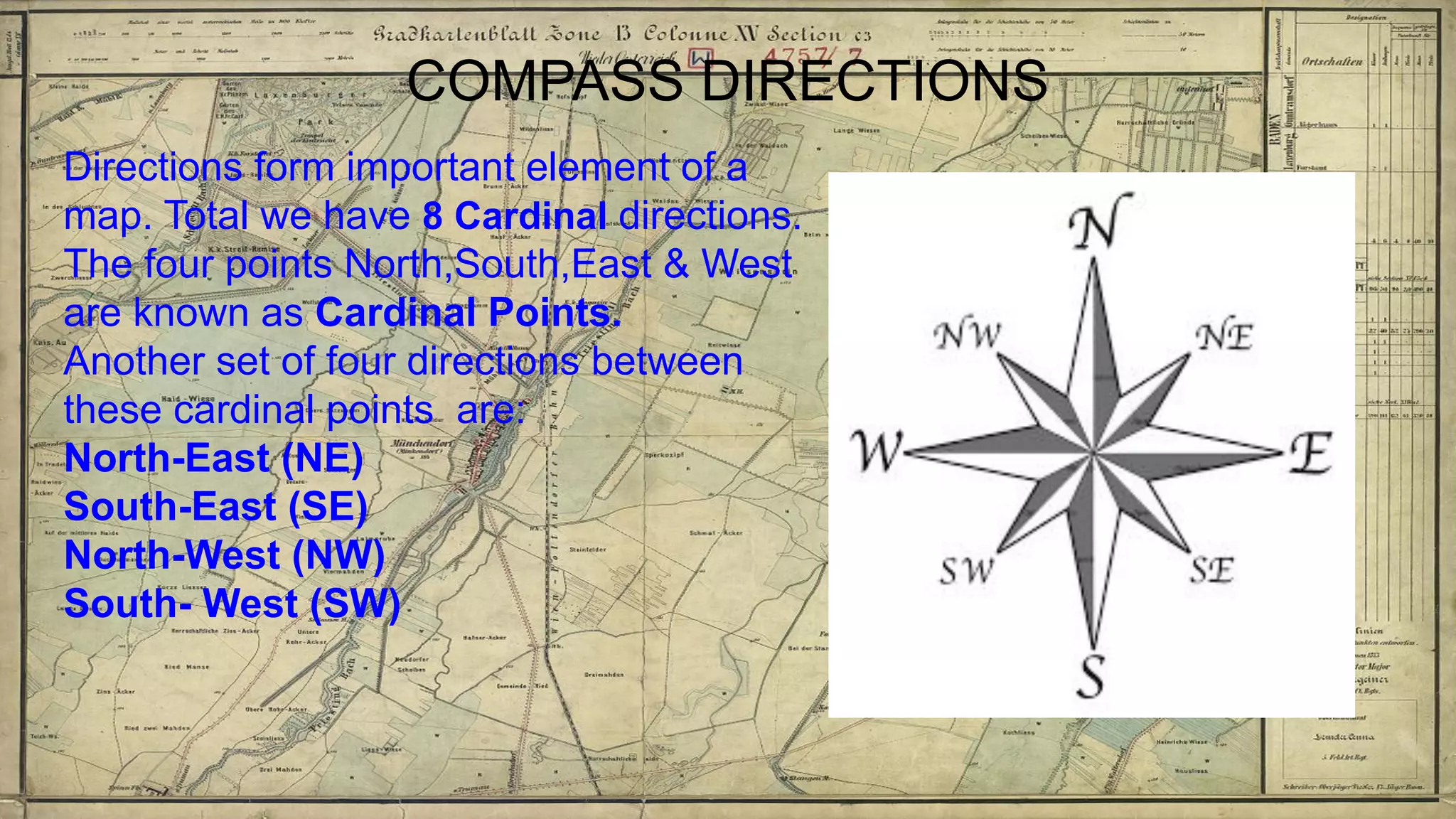
COMPASS DIRECTIONS
Directions form important element of a
map. Total we have 8 Cardinal directions.
The four points North,South,East & West
are known as Cardinal Points.
Another set of four directions between
these cardinal points are:
North-East (NE)
South-East (SE)
North-West (NW)
South- West (SW)
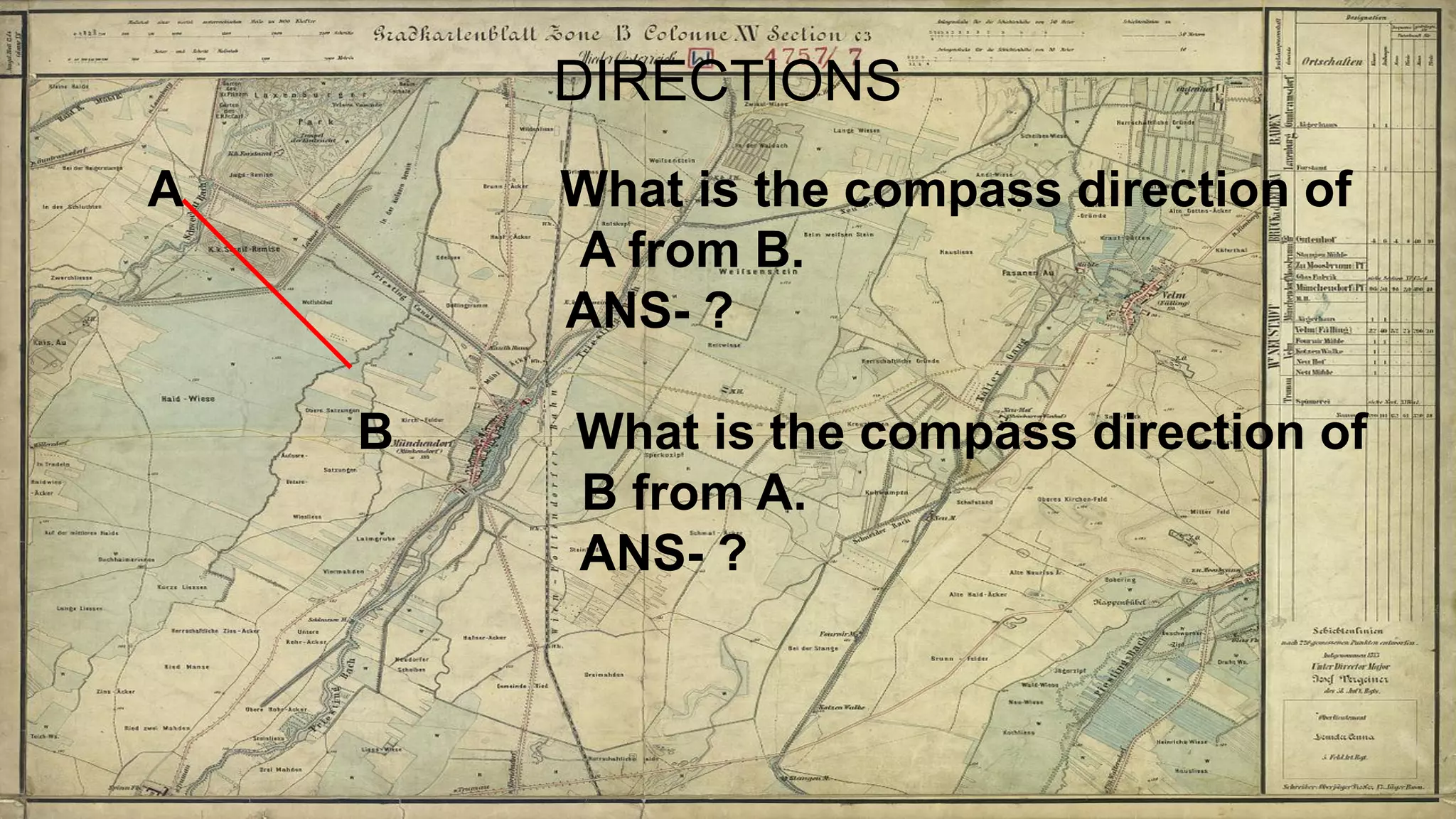
DIRECTIONS
A What is the compass direction of
A from B.
ANS- ?
B What is the compass direction of
B from A.
ANS- ?
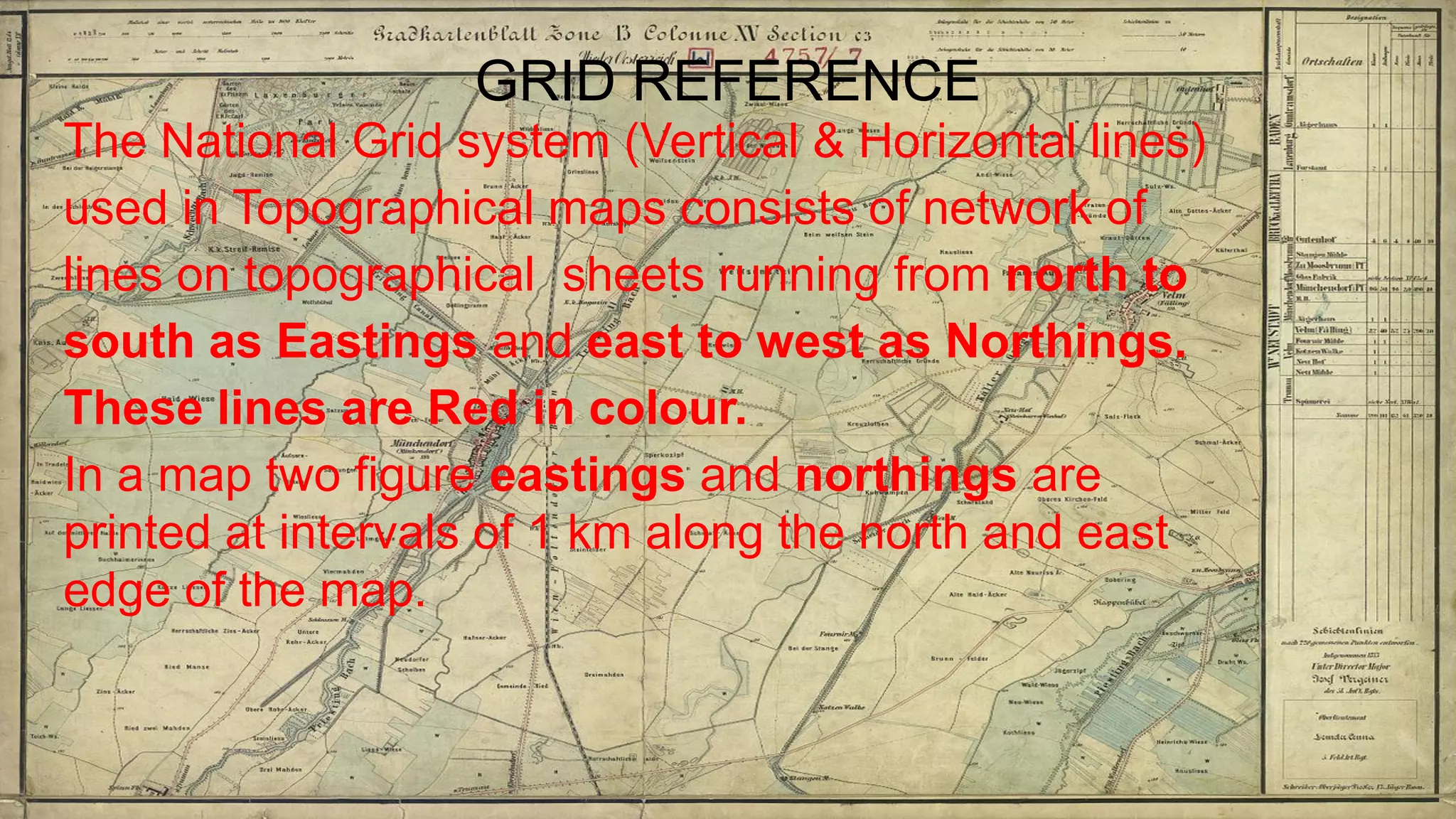
GRID REFERENCE
The National Grid system (Vertical & Horizontal lines)
used in Topographical maps consists of network of
lines on topographical sheets running from north to
south as Eastings and east to west as Northings.
These lines are Red in colour.
In a map two figure eastings and northings are
printed at intervals of 1 km along the north and east
edge of the map.
GRID REFERENCE
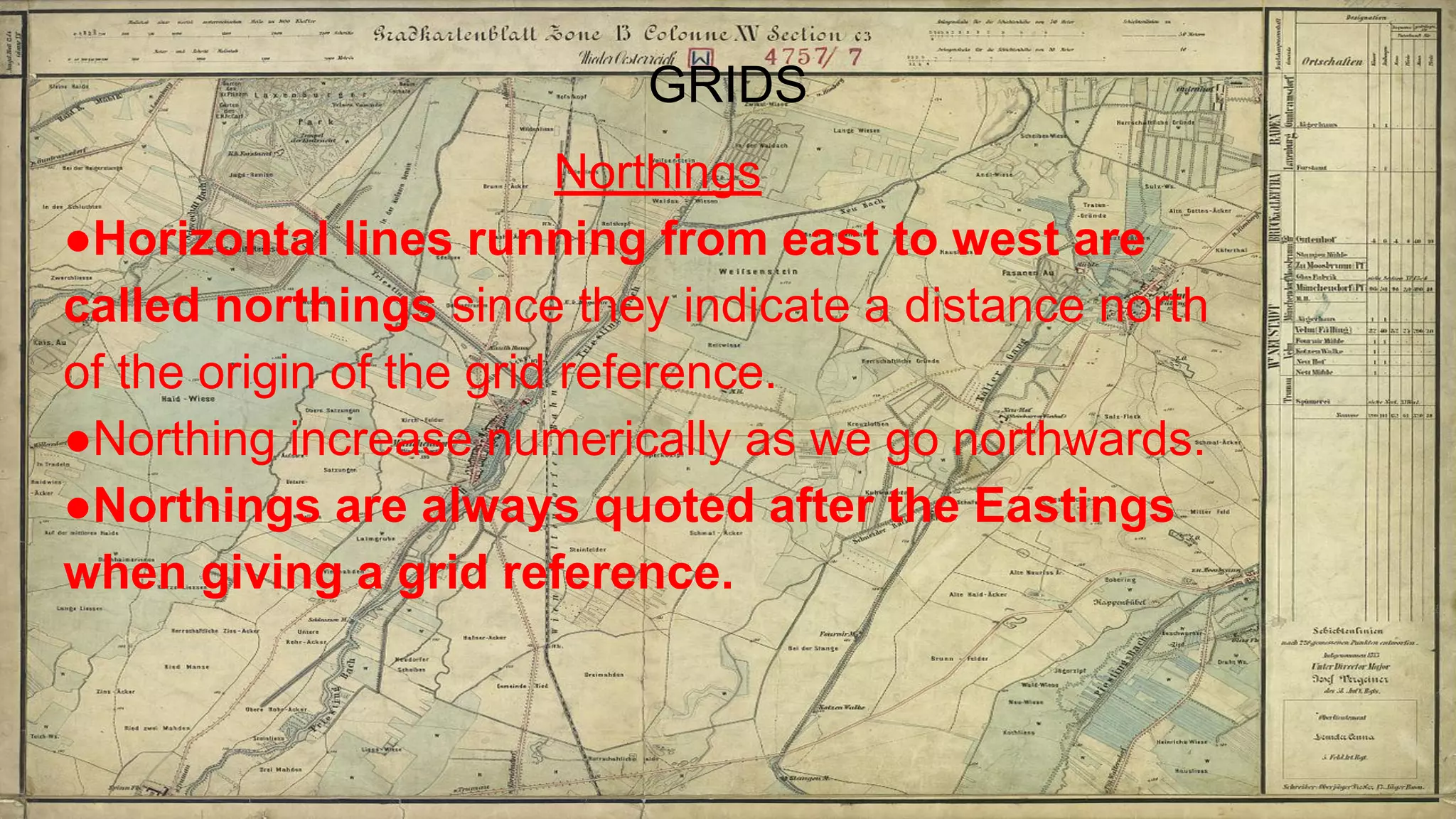
GRIDS
Northings
●Horizontal lines running from east to west are
called northings since they indicate a distance north
of the origin of the grid reference.
●Northing increase numerically as we go northwards.
●Northings are always quoted after the Eastings
when giving a grid reference.
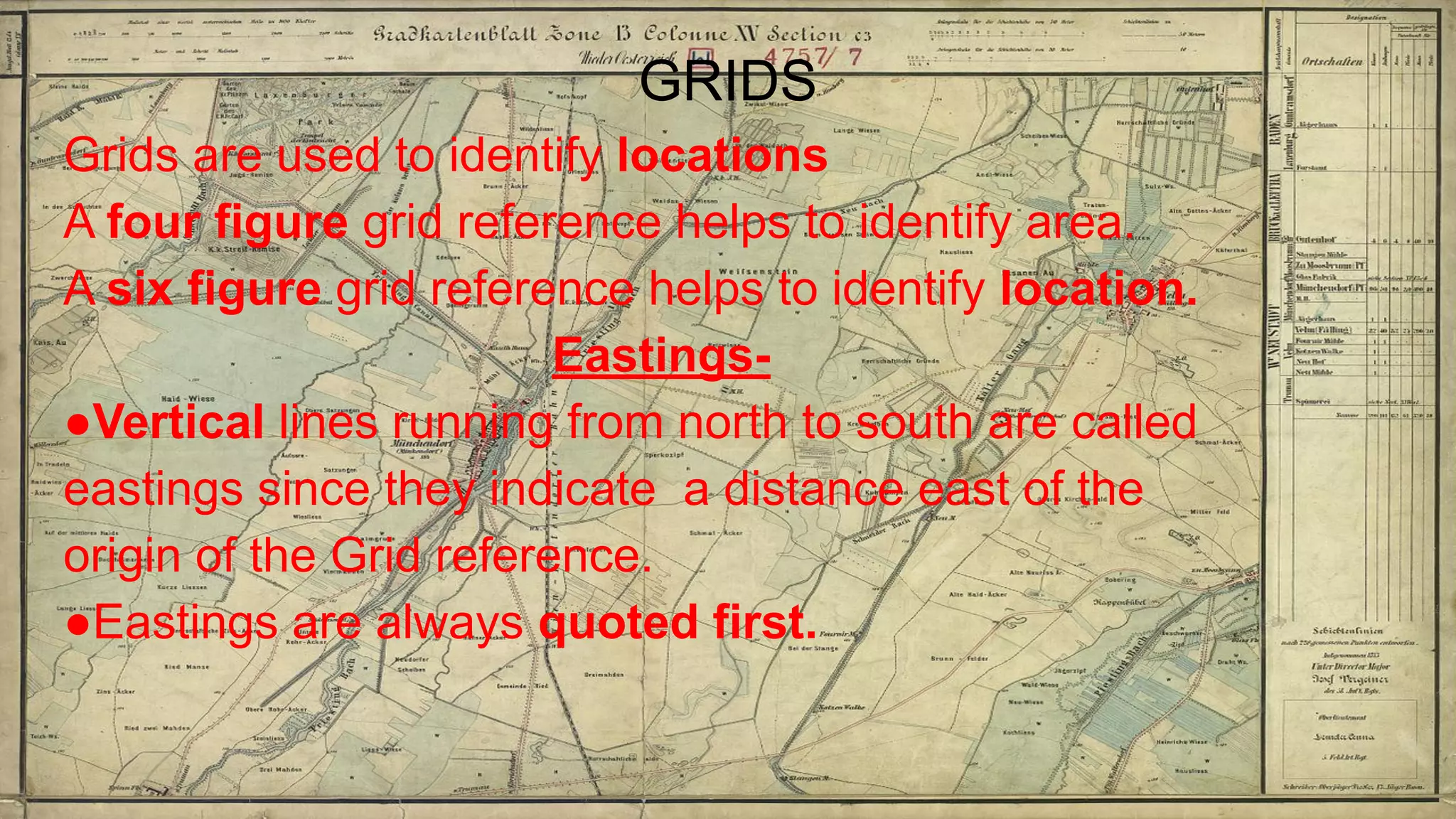
GRIDS
Grids are used to identify locations
A four figure grid reference helps to identify area.
A six figure grid reference helps to identify location.
Eastings-
●Vertical lines running from north to south are called
eastings since they indicate a distance east of the
origin of the Grid reference.
●Eastings are always quoted first.
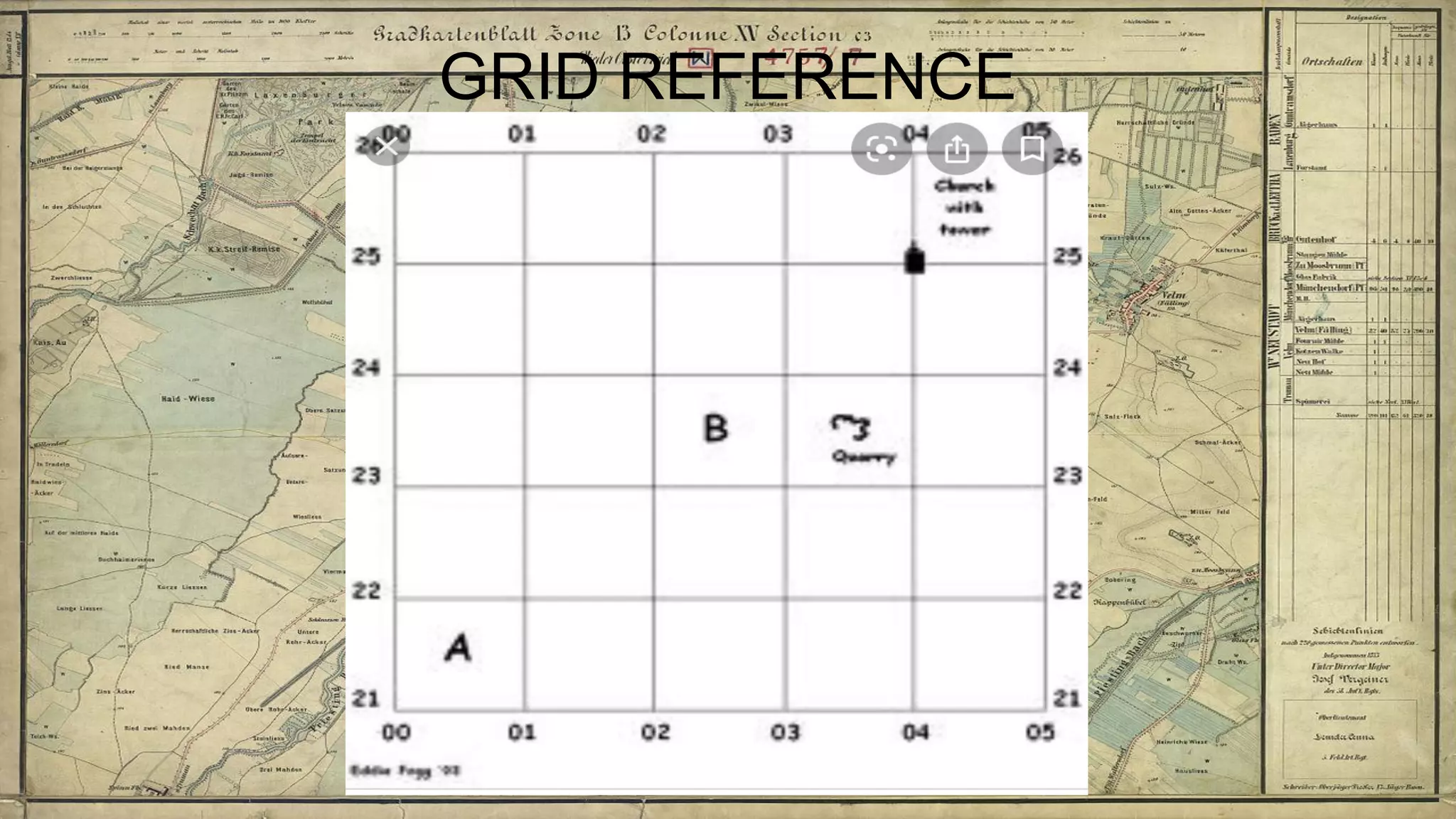
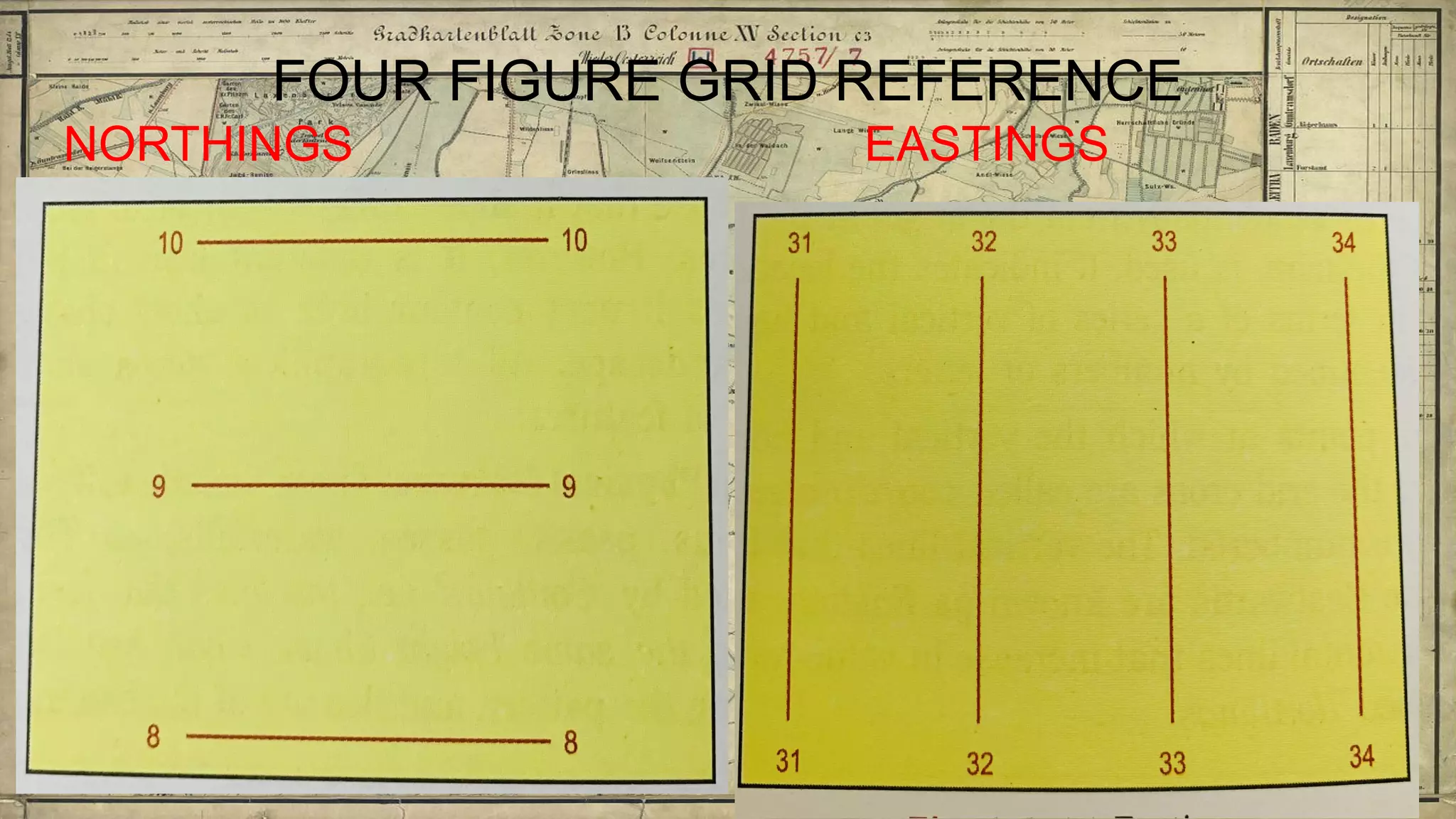
FOUR FIGURE GRID REFERENCE
NORTHINGS EASTINGS
GRIDS
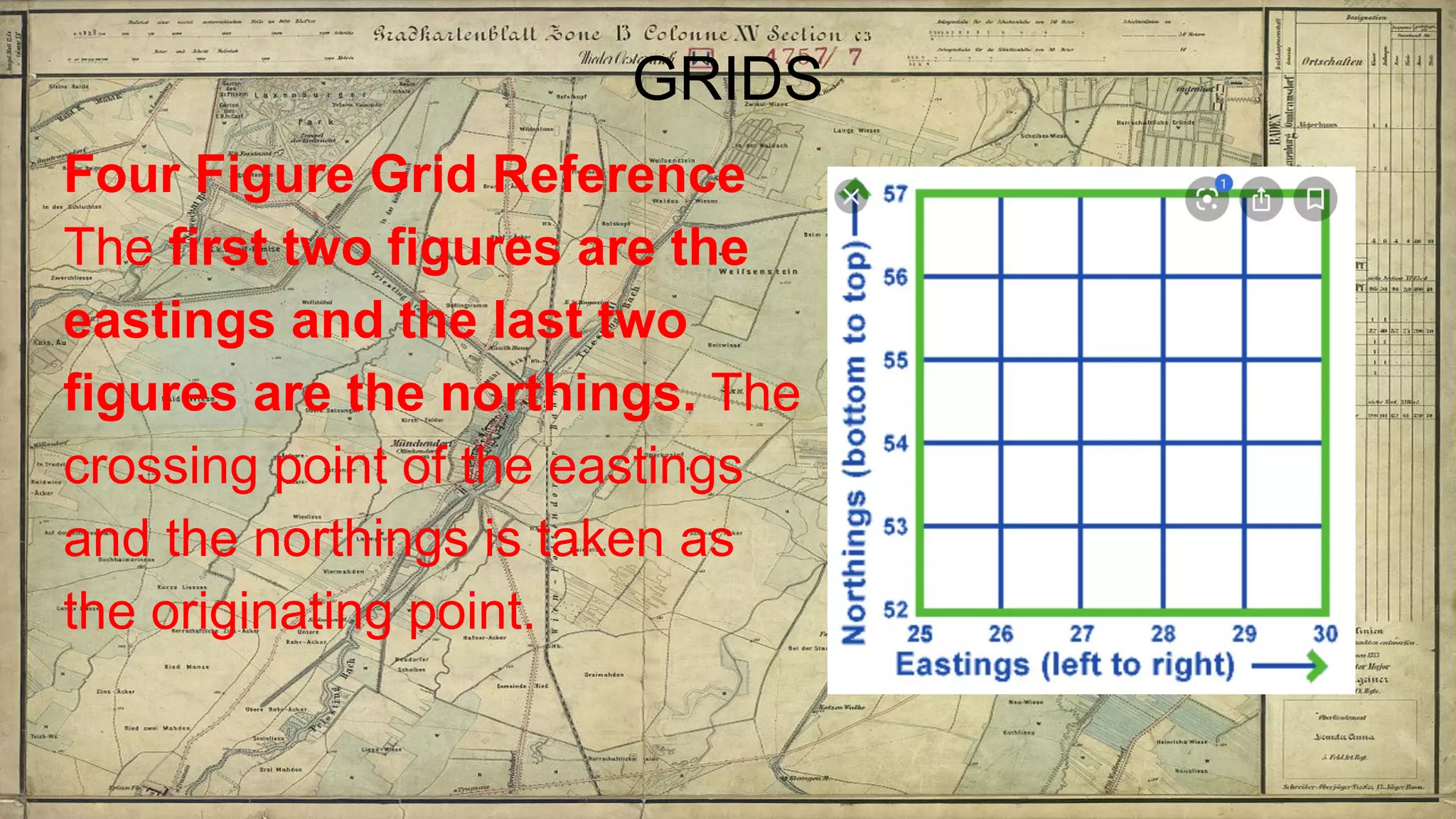
Four Figure Grid Reference
The first two figures are the
eastings and the last two
figures are the northings. The
crossing point of the eastings
and the northings is taken as
the originating point.
DRAINAGE PATTERN
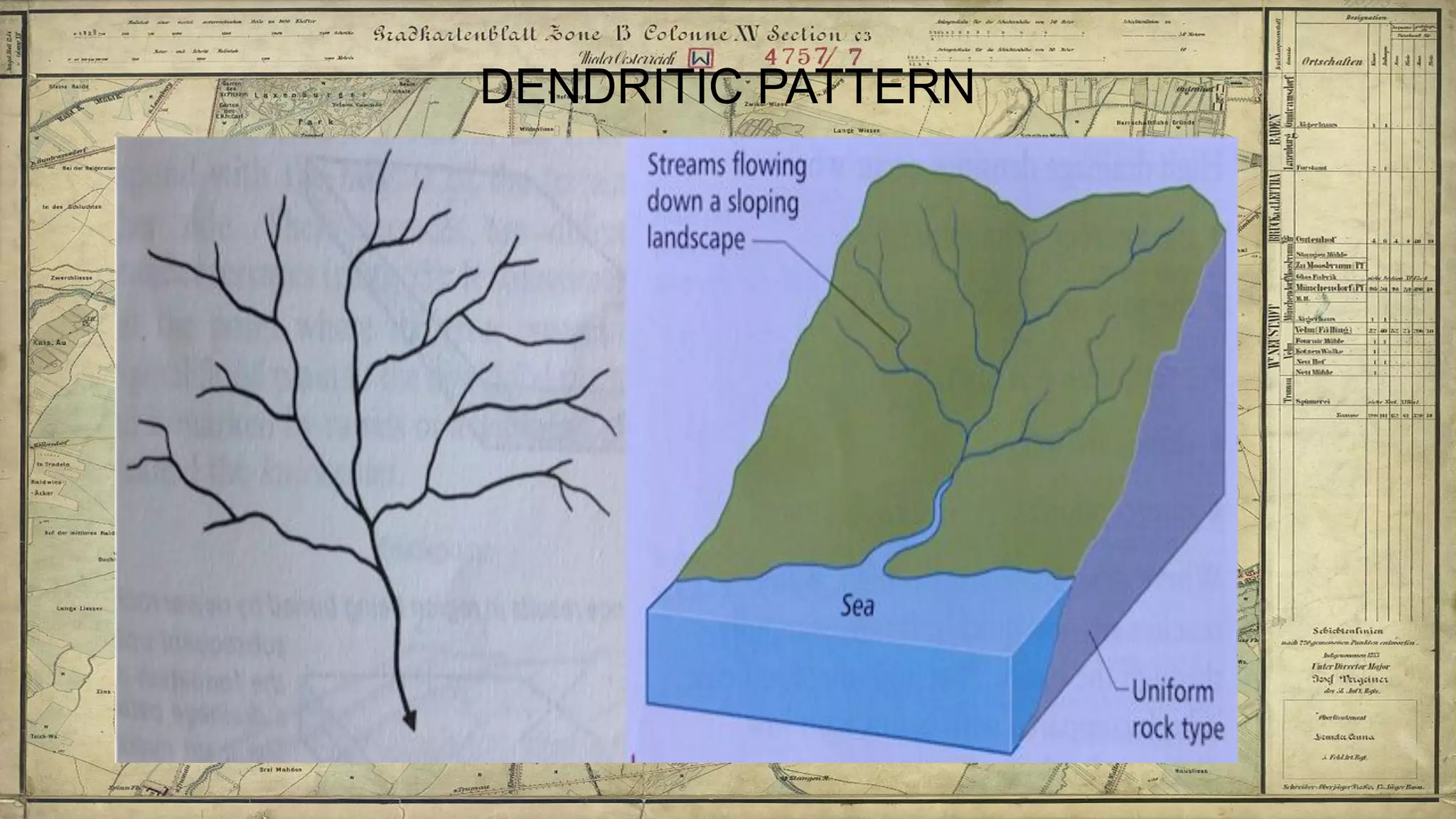
• Dendritic pattern -The tributaries join the main river to form a pattern
like a tree with branches.
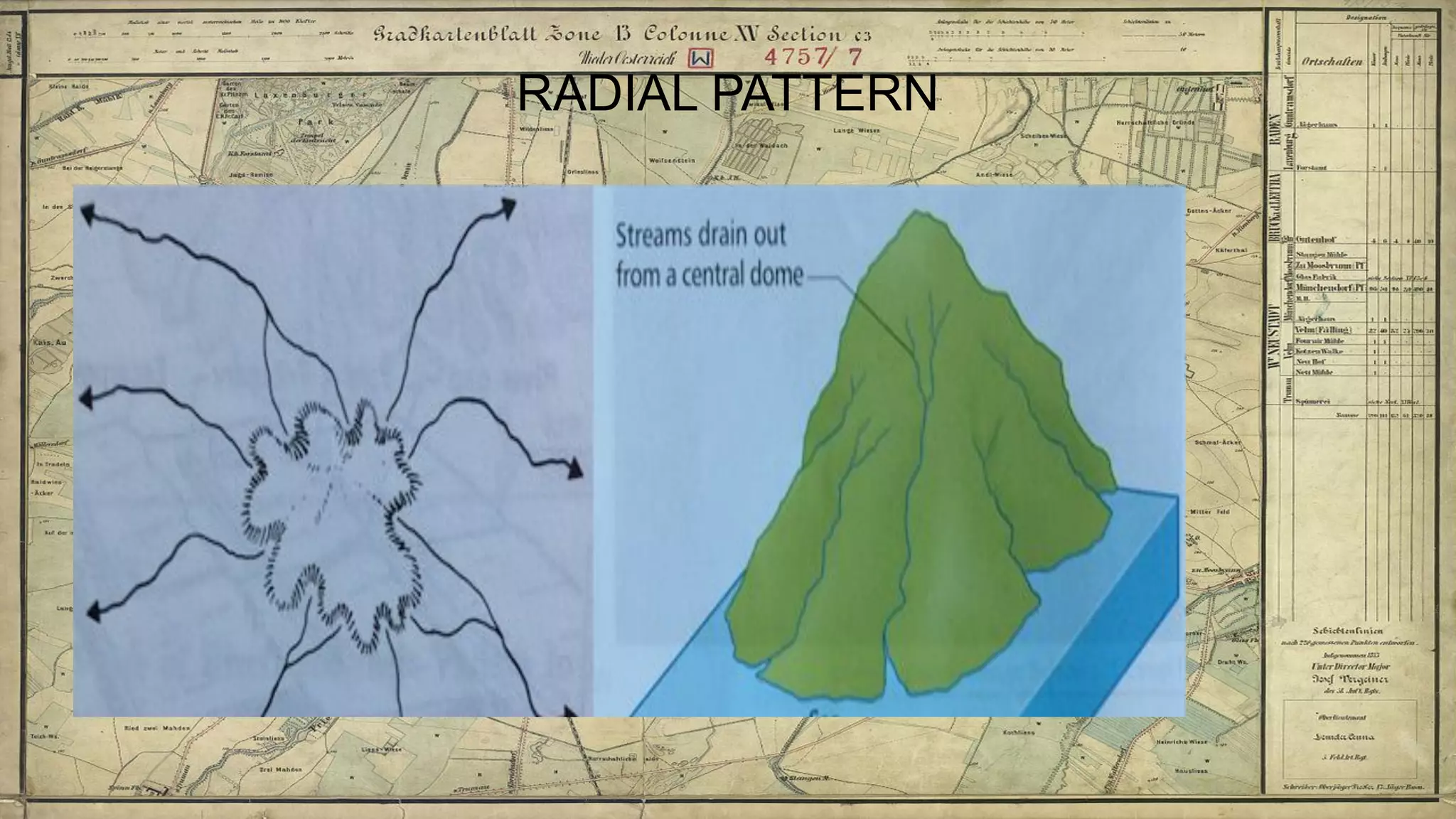
• Radial pattern- It is seen in highland region where rivers radiate from
the central point in all directions.
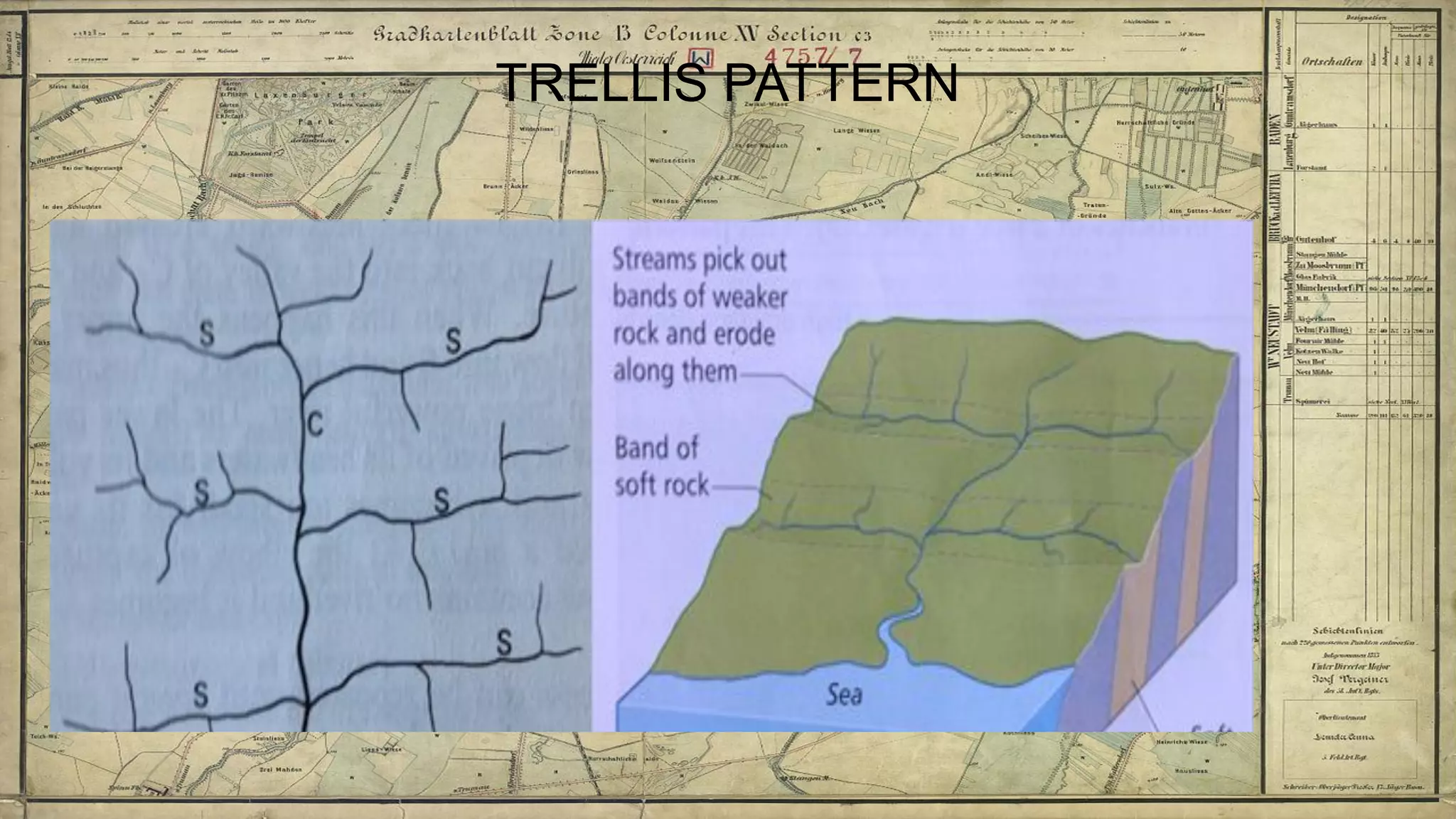
• Trellis pattern- In this pattern the stream flows parallel to each other
and then join the main river at right angles.
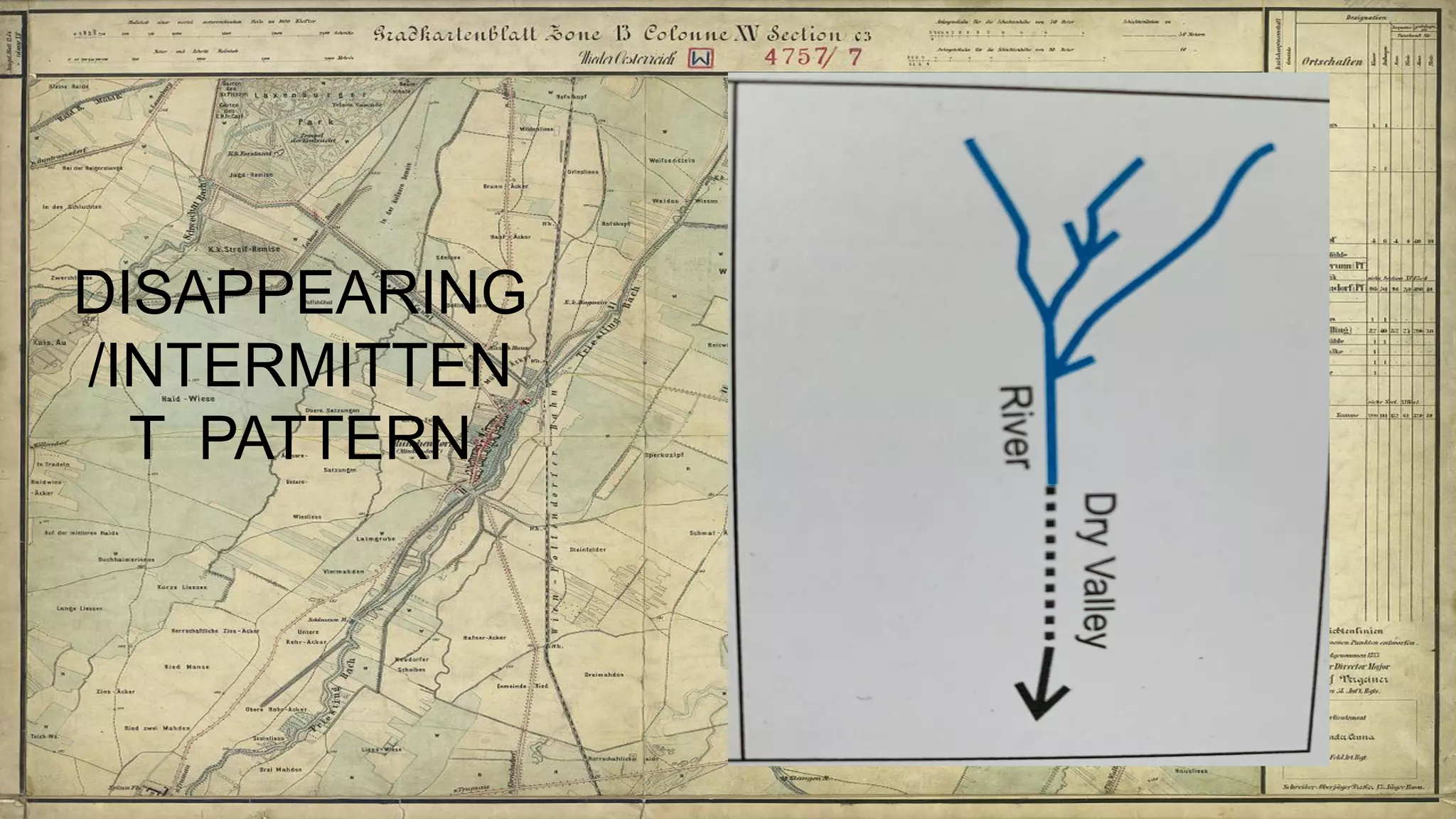
• Disappearing pattern- This indicates dry conditions , the streams flow
over sandy soil and suddenly disappear underground. Intermittent
• Intermittent pattern- The streams in sandy area disappear and again
reappear shown as dash lines
DENDRITIC PATTERN
RADIAL PATTERN
TRELLIS PATTERN
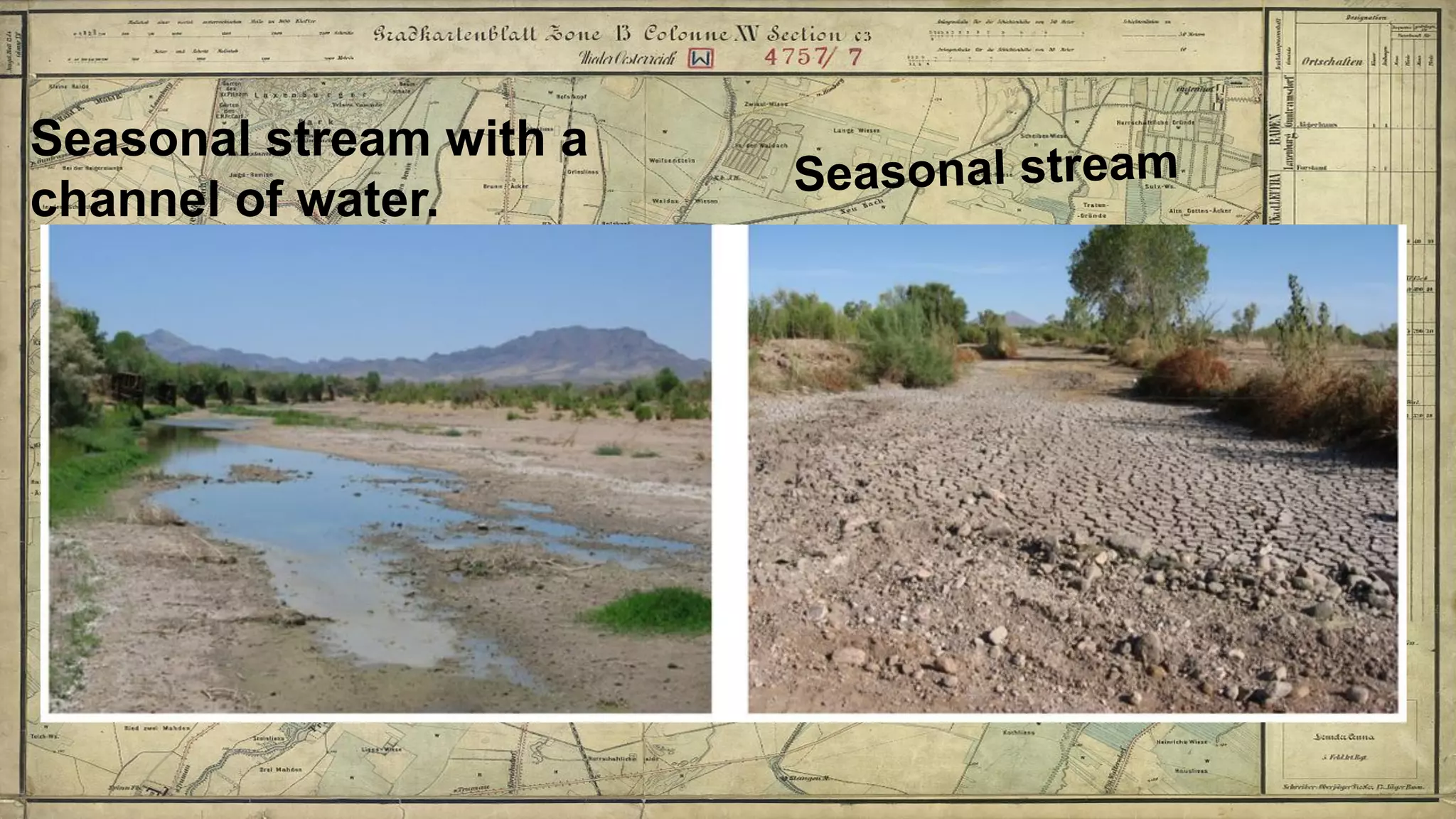
Seasonal stream with a
channel of water. Seasonal stream
DISAPPEARING
/INTERMITTEN
T PATTERN
Scales
• R.F= Distance on the Map_______________
Distance on the ground in the same unit
• Graphical/ linear scale- A straight line is divided into equal parts
(primary and secondary divisions) to show the marking represents
on the actual ground.
SCALES
• Scale= ratio of map distance of any two points to the
corresponding ground distance of these two points.
• Types of scale:
• Verbal/ statement scale- 2cm to 1 kms in this, the Scale is
expressed in words as a statement.
• Representative fraction- R.F -1: 50,000 so 1 unit map distance is
equivalent to 50,000 units on the ground.
SETTLEMENT PATTERN
Settlement pattern refers to the arrangement of
houses and other buildings in an area as seen
from above.
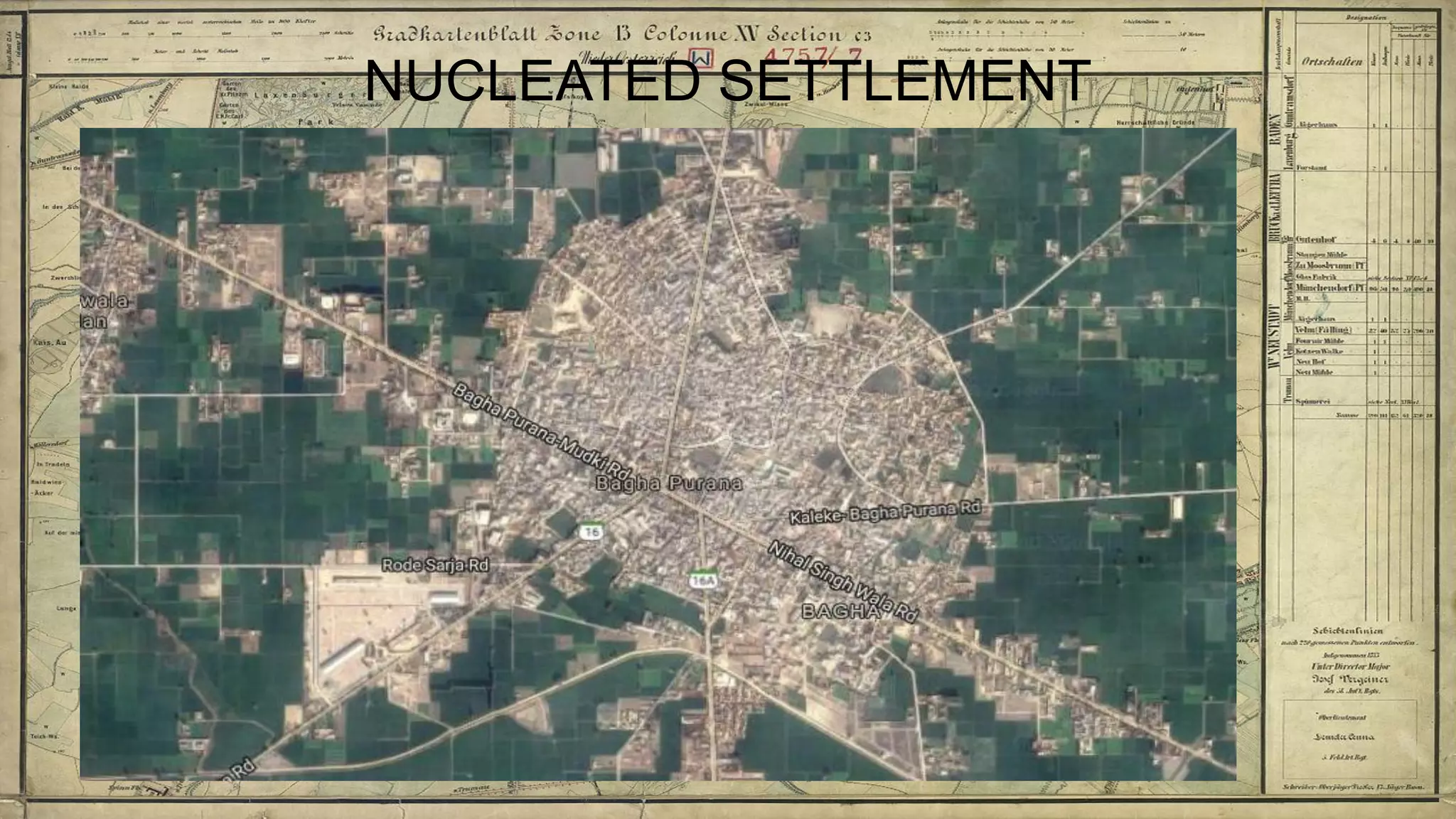
• Nucleated settlement- The houses are closely
spaced or clustered together.It can be called
compact too.
NUCLEATED SETTLEMENT
SETTLEMENT PATTERN
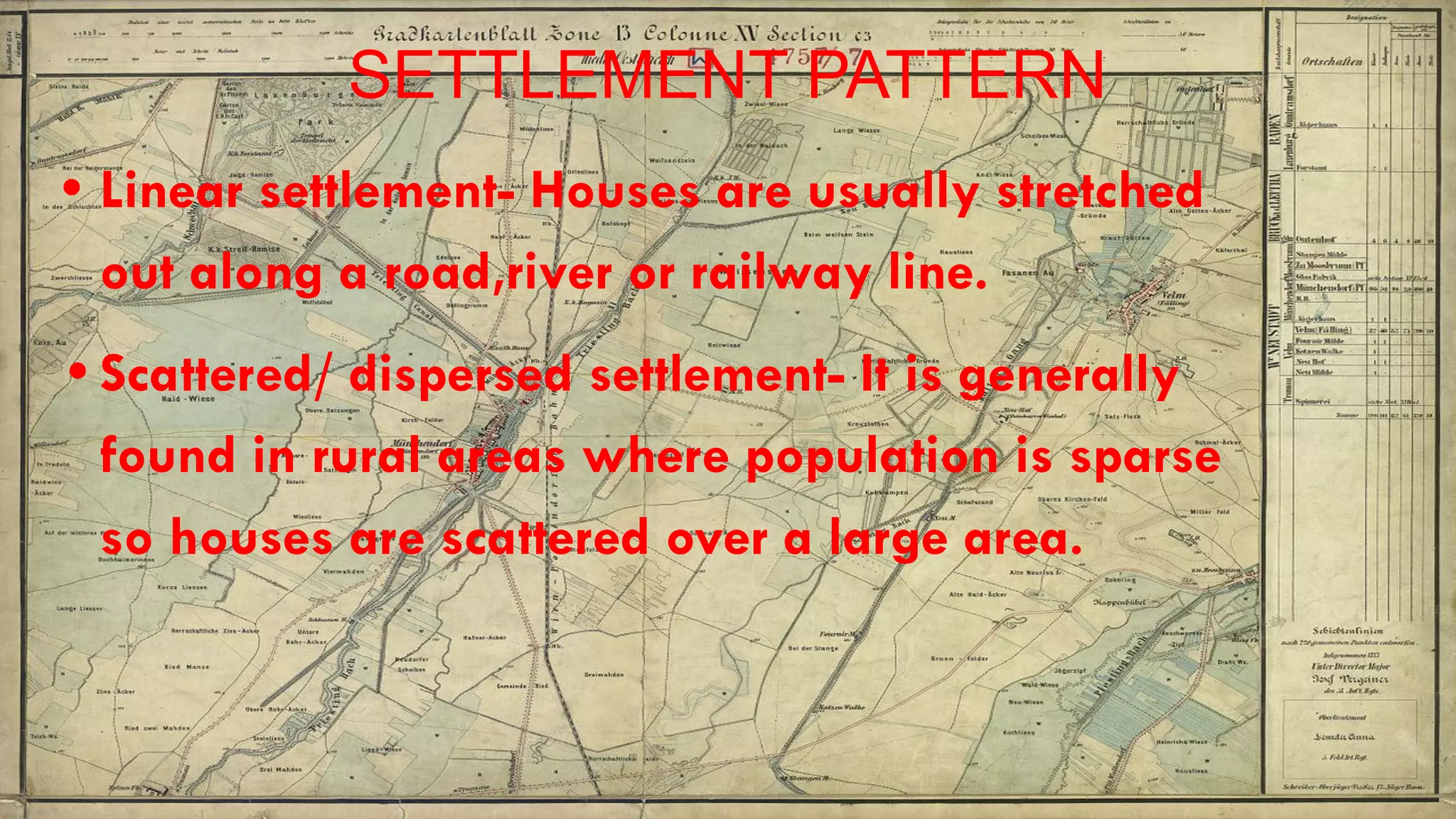
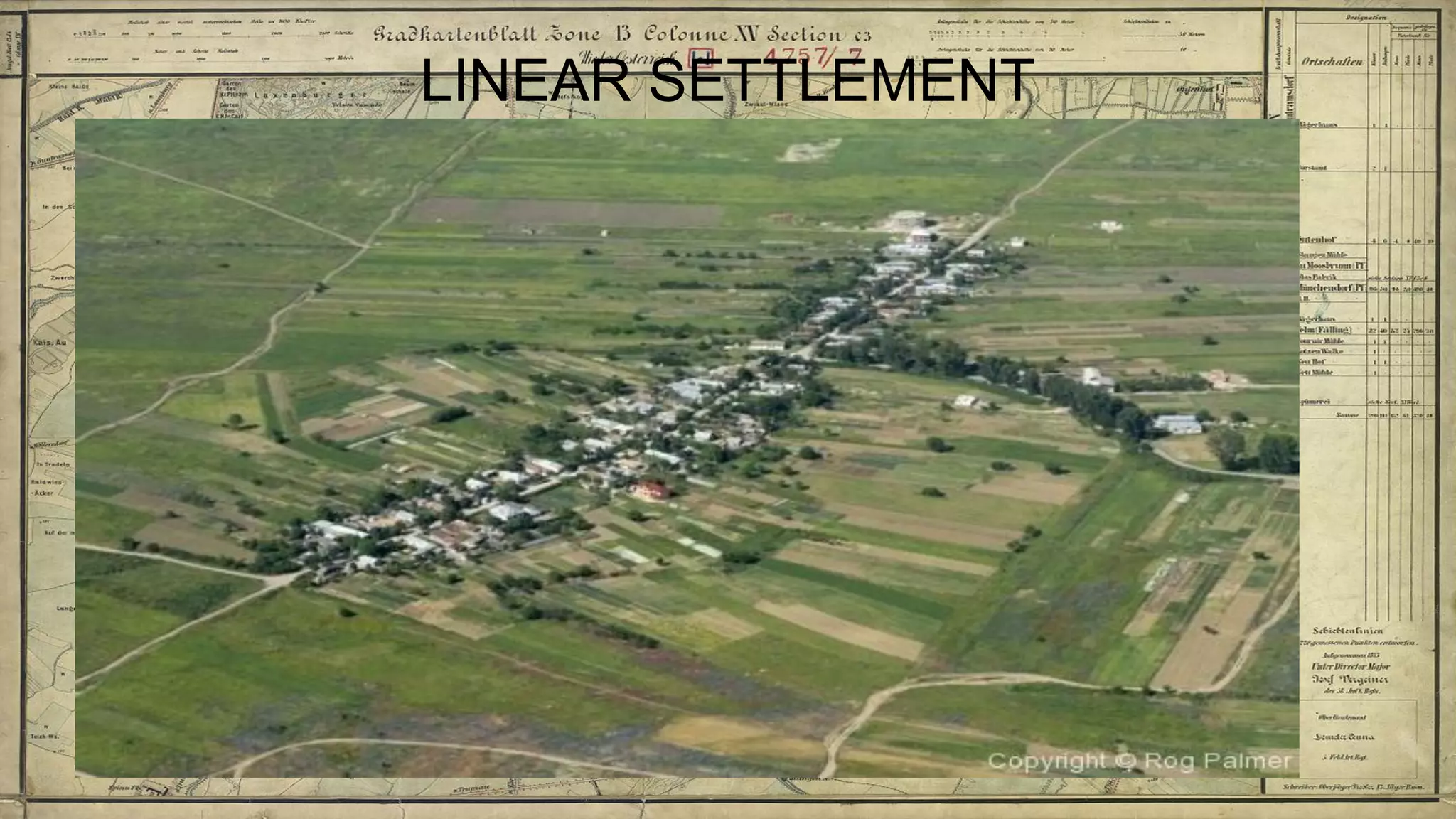
• Linear settlement- Houses are usually stretched
out along a road,river or railway line.
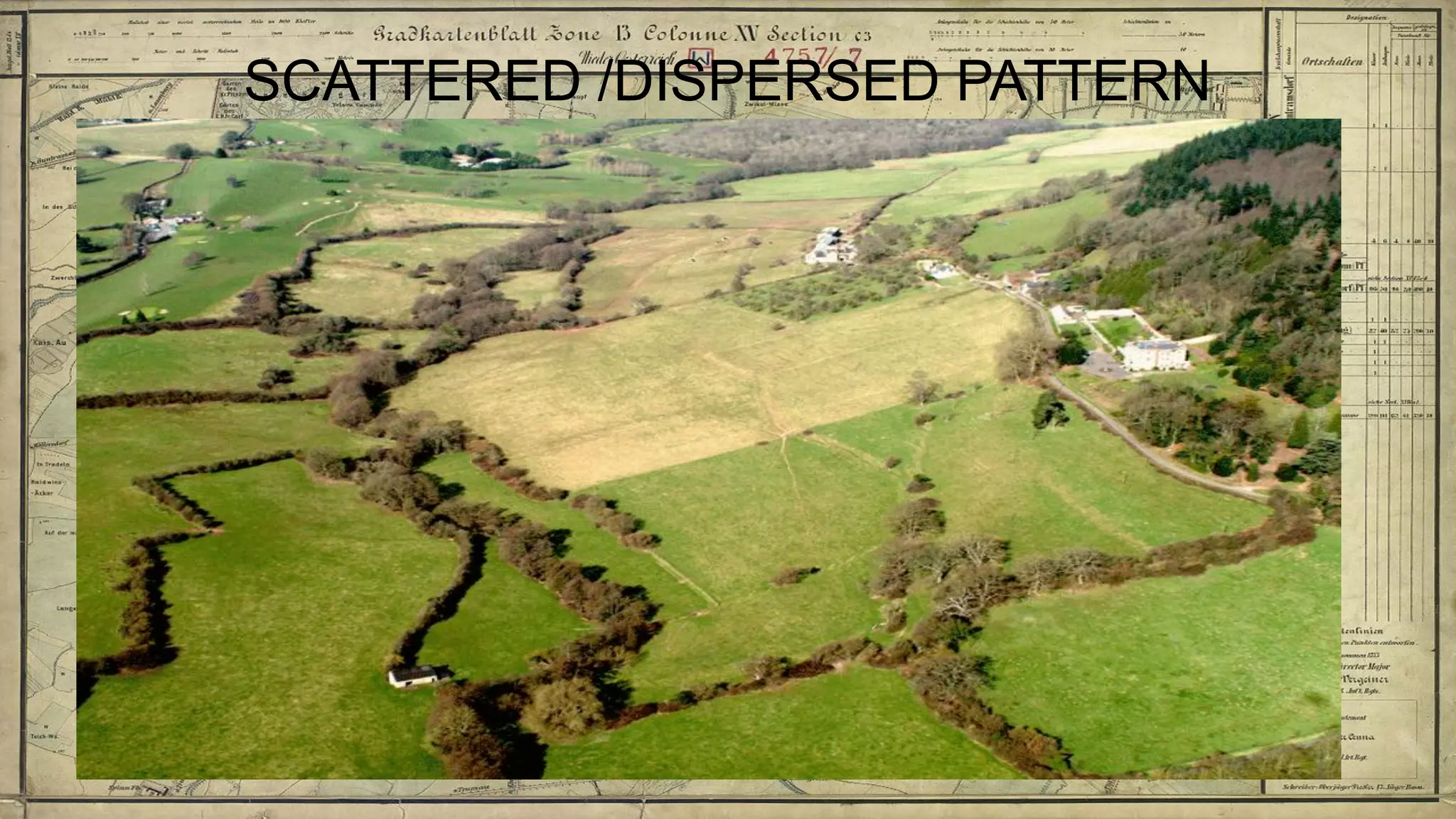
• Scattered/ dispersed settlement- It is generally
found in rural areas where population is sparse
so houses are scattered over a large area.
SCATTERED /DISPERSED PATTERN
LINEAR SETTLEMENT
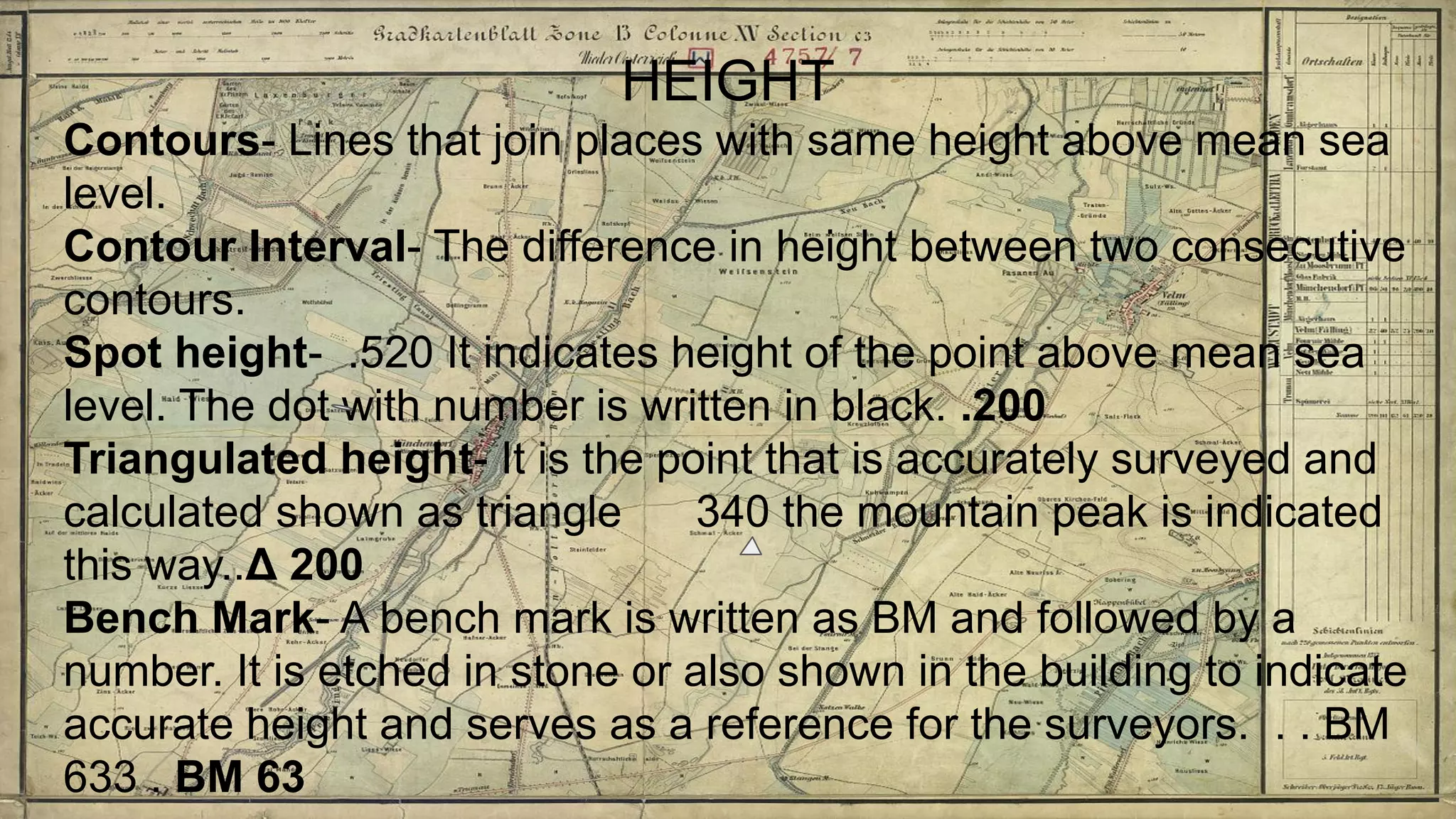
HEIGHT
Contours- Lines that join places with same height above mean sea
level.
Contour Interval- The difference in height between two consecutive
contours.
Spot height- .520 It indicates height of the point above mean sea
level. The dot with number is written in black. .200
Triangulated height- It is the point that is accurately surveyed and
calculated shown as triangle 340 the mountain peak is indicated
this way..Δ 200
Bench Mark- A bench mark is written as BM and followed by a
number. It is etched in stone or also shown in the building to indicate
accurate height and serves as a reference for the surveyors. . . BM
633 . BM 63
Height
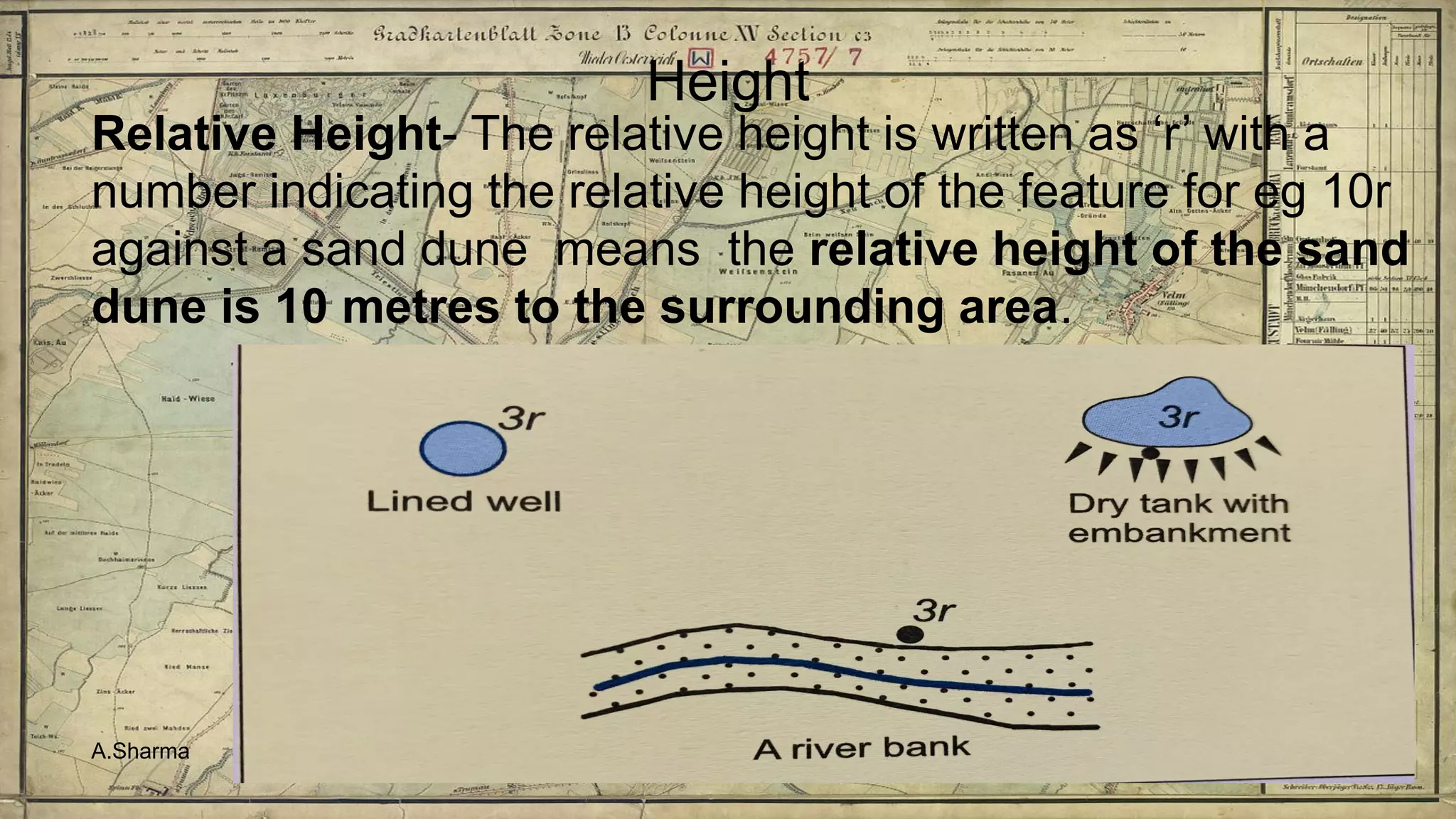
Relative Height- The relative height is written as ‘r’ with a
number indicating the relative height of the feature for eg 10r
against a sand dune means the relative height of the sand
dune is 10 metres to the surrounding area.
A.Sharma
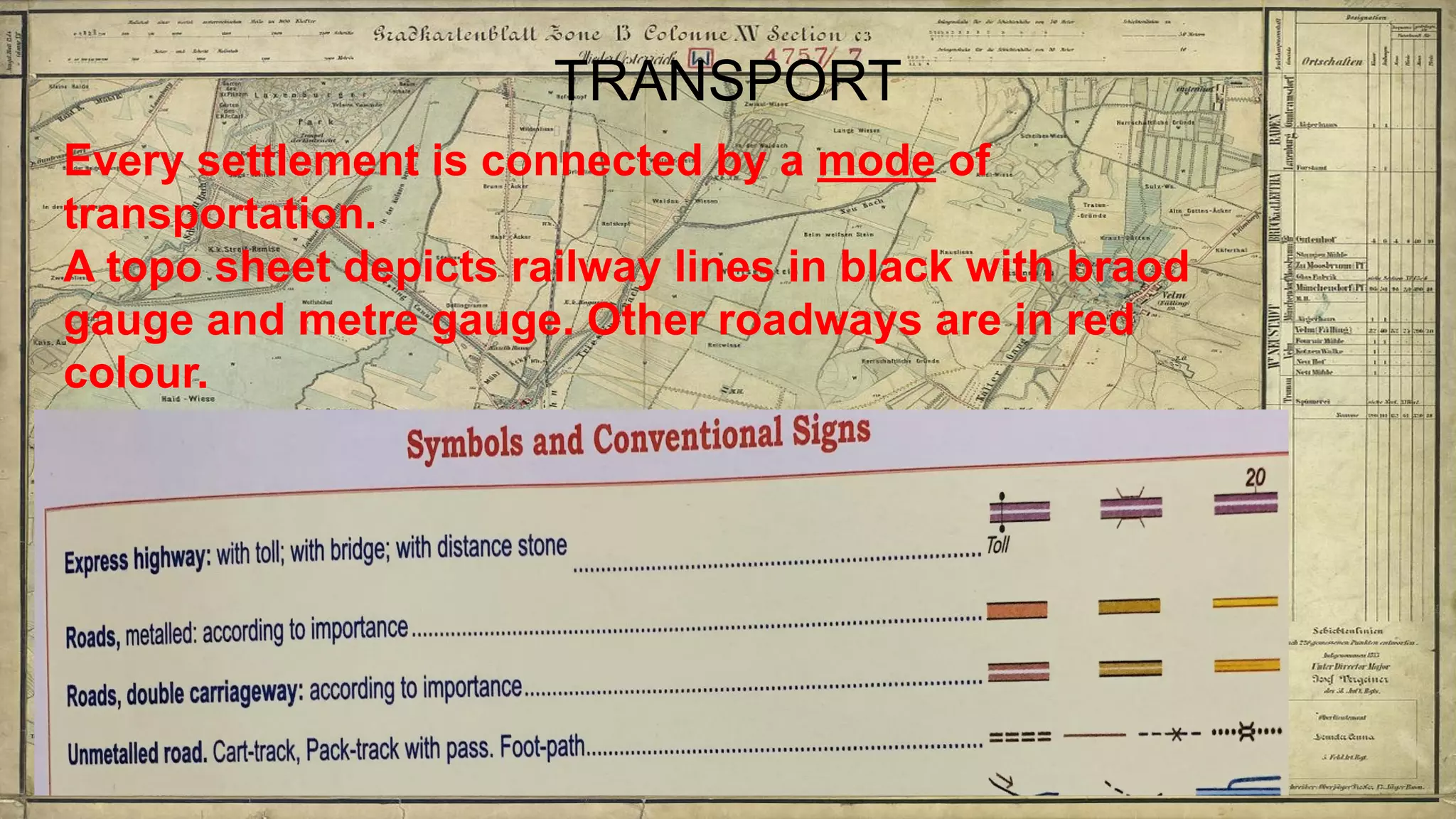
TRANSPORT
Every settlement is connected by a mode of
transportation.
A topo sheet depicts railway lines in black with braod
gauge and metre gauge. Other roadways are in red
colour.
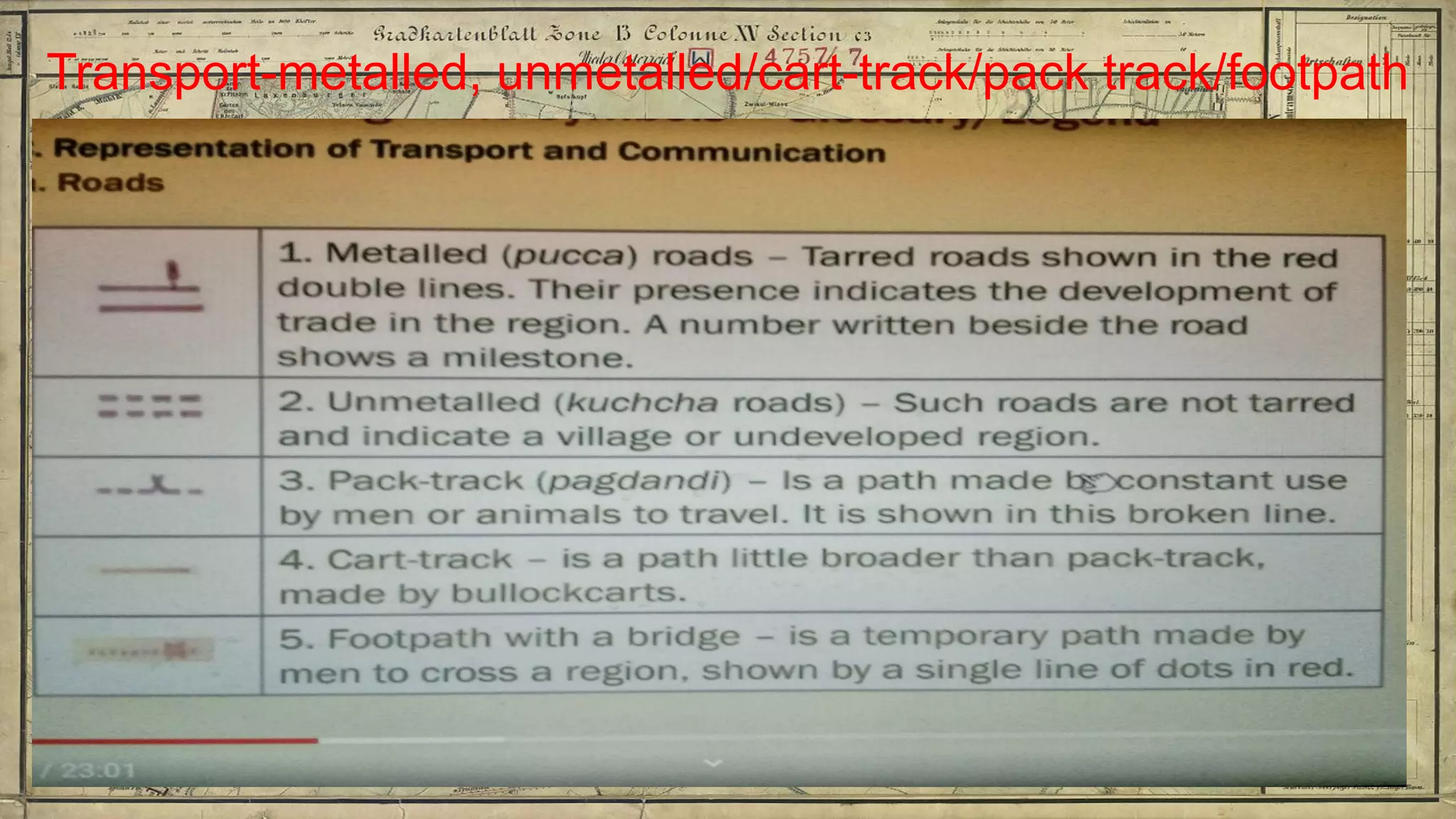
Transport-metalled, unmetalled/cart-track/pack track/footpath

_Copy of Survey Maps New G43 S_7, S_10.pdf

  • 1.
    SURVEY MAPS • Topographicalmaps are Large scale maps show detailed study of a small area that combine natural and man-made features. They show relationship between physical features & man made features. • Topographical maps are also known as Ordnance Survey Maps and are similar to the Physical maps as it shows different landscape features. • It is an important tool for geographers who intend to make an in-depth study of a region.These maps are crucial for the army and defense services as the type of terrain will determine their strategies. A.Sharma.
  • 2.
    Map No G43S/7 The new map numbering is based on IMW ie. International Map of the World. It starts from equator so India series lies from C as A begins from equator. The number G denotes Rajasthan Abu district has 24 squares where each square is further subdivided into 16 squares Maps G43 S/7 and G43 S/10
  • 3.
    G 43 S/10
  • 4.
  • 5.
    COLOURS IN THETOPO SHEET. Apart from the conventional signs and symbols different colours are used to show distributed of different topographical features and land use.
  • 6.
    COLOURS The conventional signs andsymbols represent relief features and human activities. Besides these certain hindi terms are also seen in the topographical maps.
  • 7.
    COMPASS DIRECTIONS Directions formimportant element of a map. Total we have 8 Cardinal directions. The four points North,South,East & West are known as Cardinal Points. Another set of four directions between these cardinal points are: North-East (NE) South-East (SE) North-West (NW) South- West (SW)
  • 8.
    DIRECTIONS A What isthe compass direction of A from B. ANS- ? B What is the compass direction of B from A. ANS- ?
  • 9.
    GRID REFERENCE The NationalGrid system (Vertical & Horizontal lines) used in Topographical maps consists of network of lines on topographical sheets running from north to south as Eastings and east to west as Northings. These lines are Red in colour. In a map two figure eastings and northings are printed at intervals of 1 km along the north and east edge of the map.
  • 10.
  • 11.
    GRIDS Northings ●Horizontal lines runningfrom east to west are called northings since they indicate a distance north of the origin of the grid reference. ●Northing increase numerically as we go northwards. ●Northings are always quoted after the Eastings when giving a grid reference.
  • 12.
    GRIDS Grids are usedto identify locations A four figure grid reference helps to identify area. A six figure grid reference helps to identify location. Eastings- ●Vertical lines running from north to south are called eastings since they indicate a distance east of the origin of the Grid reference. ●Eastings are always quoted first.
  • 13.
    FOUR FIGURE GRIDREFERENCE NORTHINGS EASTINGS
  • 14.
    GRIDS Four Figure GridReference The first two figures are the eastings and the last two figures are the northings. The crossing point of the eastings and the northings is taken as the originating point.
  • 15.
    DRAINAGE PATTERN • Dendriticpattern -The tributaries join the main river to form a pattern like a tree with branches. • Radial pattern- It is seen in highland region where rivers radiate from the central point in all directions. • Trellis pattern- In this pattern the stream flows parallel to each other and then join the main river at right angles. • Disappearing pattern- This indicates dry conditions , the streams flow over sandy soil and suddenly disappear underground. Intermittent • Intermittent pattern- The streams in sandy area disappear and again reappear shown as dash lines
  • 16.
  • 17.
  • 18.
  • 19.
    Seasonal stream witha channel of water. Seasonal stream
  • 20.
  • 21.
    Scales • R.F= Distanceon the Map_______________ Distance on the ground in the same unit • Graphical/ linear scale- A straight line is divided into equal parts (primary and secondary divisions) to show the marking represents on the actual ground.
  • 22.
    SCALES • Scale= ratioof map distance of any two points to the corresponding ground distance of these two points. • Types of scale: • Verbal/ statement scale- 2cm to 1 kms in this, the Scale is expressed in words as a statement. • Representative fraction- R.F -1: 50,000 so 1 unit map distance is equivalent to 50,000 units on the ground.
  • 23.
    SETTLEMENT PATTERN Settlement patternrefers to the arrangement of houses and other buildings in an area as seen from above. • Nucleated settlement- The houses are closely spaced or clustered together.It can be called compact too.
  • 24.
  • 25.
    SETTLEMENT PATTERN • Linearsettlement- Houses are usually stretched out along a road,river or railway line. • Scattered/ dispersed settlement- It is generally found in rural areas where population is sparse so houses are scattered over a large area.
  • 26.
  • 27.
  • 28.
    HEIGHT Contours- Lines thatjoin places with same height above mean sea level. Contour Interval- The difference in height between two consecutive contours. Spot height- .520 It indicates height of the point above mean sea level. The dot with number is written in black. .200 Triangulated height- It is the point that is accurately surveyed and calculated shown as triangle 340 the mountain peak is indicated this way..Δ 200 Bench Mark- A bench mark is written as BM and followed by a number. It is etched in stone or also shown in the building to indicate accurate height and serves as a reference for the surveyors. . . BM 633 . BM 63
  • 29.
    Height Relative Height- Therelative height is written as ‘r’ with a number indicating the relative height of the feature for eg 10r against a sand dune means the relative height of the sand dune is 10 metres to the surrounding area. A.Sharma
  • 30.
    TRANSPORT Every settlement isconnected by a mode of transportation. A topo sheet depicts railway lines in black with braod gauge and metre gauge. Other roadways are in red colour.
  • 31.