
“COPPER AND COPPER
ALLOYS”
( PROPERTIES, EXTRACTION,
PRODUCTION, USES AND
APPLICATIONS)
GROUP MEMBERS
Zaid Khizar Bajwa
BSME 01143071
H Salman Yousaf
BSME 01143072
Hamza Saleem
BSME 01143075
AREAS OF DISCUSSION:
 INTRODUCTION TO COPPER (PHYSICAL PROPERTIES,
OCCURRENCE, DEPOSITS, ORES, PRODUCTION)
 INTRODUCTION TO COPPER ALLOYS (CLASSIFICATION,
PROPERTIES)
 IMPORTANT CLASSES OF COPPER ALLOYS (BRASSES,
BRONZES, SPECIAL ALLOYS)
 USES AND APPLICATIONS OF PURE COPPER AND COPPER
ALLOYS.
COPPER:
Copper (Cu)
atomic weight 63.546.
Its soft , malleable and ductile metal with very high
thermal and electrical conductivity.
There are 29 isotopes of copper.
 63Cu and 65Cu are stable & The other isotopes are
radioactive.
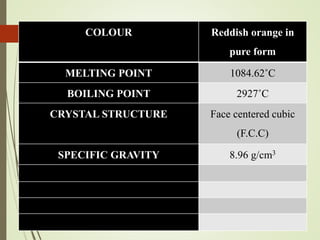
COLOUR Reddish orange in
pure form
MELTING POINT 1084.62˚C
BOILING POINT 2927˚C
CRYSTAL STRUCTURE Face centered cubic
(F.C.C)
SPECIFIC GRAVITY 8.96 g/cm3
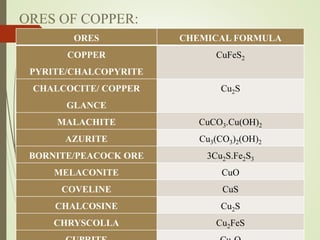
ORES OF COPPER:
ORES CHEMICAL FORMULA
COPPER
PYRITE/CHALCOPYRITE
CuFeS2
CHALCOCITE/ COPPER
GLANCE
Cu2S
MALACHITE CuCO3.Cu(OH)2
AZURITE Cu3(CO3)2(OH)2
BORNITE/PEACOCK ORE 3Cu2S.Fe2S3
MELACONITE CuO
COVELINE CuS
CHALCOSINE Cu2S
CHRYSCOLLA Cu2FeS
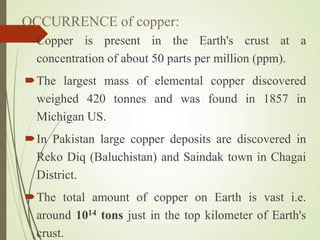
OCCURRENCE of copper:
Copper is present in the Earth's crust at a
concentration of about 50 parts per million (ppm).
The largest mass of elemental copper discovered
weighed 420 tonnes and was found in 1857 in
Michigan US.
In Pakistan large copper deposits are discovered in
Reko Diq (Baluchistan) and Saindak town in Chagai
District.
The total amount of copper on Earth is vast i.e.
around 1014 tons just in the top kilometer of Earth's
crust.
WORLDWIDE PRODUCTION OF COPPER
EXTRACTION TECHNIQUES FOR COPPER
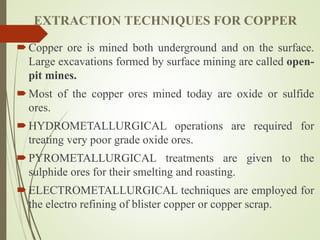
Copper ore is mined both underground and on the surface.
Large excavations formed by surface mining are called open-
pit mines.
Most of the copper ores mined today are oxide or sulfide
ores.
HYDROMETALLURGICAL operations are required for
treating very poor grade oxide ores.
PYROMETALLURGICAL treatments are given to the
sulphide ores for their smelting and roasting.
ELECTROMETALLURGICAL techniques are employed for
the electro refining of blister copper or copper scrap.
EXTRACTION OF COPPER
FROM SULPHIDE ORES
Copper is extracted usually from the sulphide ore
chalcopyrite (CuFeS2) by smelting process.
There are following steps for the Pyrometallurgical
extraction of copper.
1. CONCENTRATION
2. ROASTING
3. SMELTING
4. BESSEMERIZATION
CONCENTRATION BY FROTH FLOTATION
“Crushed ore is suspended in water containing pine
oil. The pine oil binds to the copper compounds, but
not to the unwanted rocky material. A blast of air is
passed through the suspension. The particles of ore
get wetted by oil and floats as a froth which is
skimmed. The gangue sinks to the bottom.”
ROASTING
The concentrated ore is roasted in the furnace in the
presence of oxygen. Sulphur is oxidized to SO2 and
impurities of arsenic and antimony are removed as
volatile oxides. The following reactions take place:
2CuFeS2 + O2 Cu2S + 2FeS + SO2
S + O2 SO2
4As + 3O2 2As2O3
4Sb + 3O2 2Sb2O3
Cu2S + O2 Cu2O + SO2
FeS + O2 FeO + SO2
SMELTING
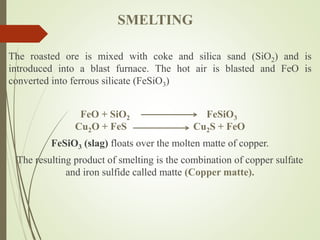
The roasted ore is mixed with coke and silica sand (SiO2) and is
introduced into a blast furnace. The hot air is blasted and FeO is
converted into ferrous silicate (FeSiO3)
FeO + SiO2 FeSiO3
Cu2O + FeS Cu2S + FeO
FeSiO3 (slag) floats over the molten matte of copper.
The resulting product of smelting is the combination of copper sulfate
and iron sulfide called matte (Copper matte).
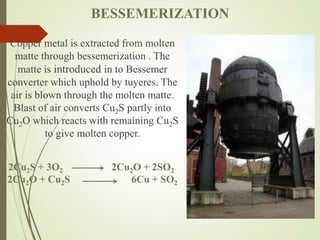
BESSEMERIZATION
Copper metal is extracted from molten
matte through bessemerization . The
matte is introduced in to Bessemer
converter which uphold by tuyeres. The
air is blown through the molten matte.
Blast of air converts Cu2S partly into
Cu2O which reacts with remaining Cu2S
to give molten copper.
2Cu2S + 3O2 2Cu2O + 2SO2
2Cu2O + Cu2S 6Cu + SO2
Alloys of Copper
CLASSIFICATION OF
COPPER AND
COPPER ALLOYS
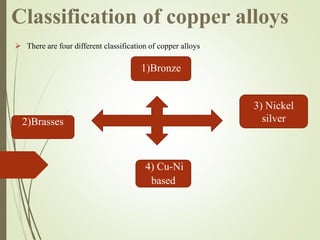
Classification of copper alloys
 There are four different classification of copper alloys
2)Brasses
1)Bronze
4) Cu-Ni
based
3) Nickel
silver
1) Brass:
There are two Class of brass
 The alpha alloys
with less than 37% Zinc. These alloys are ductile and can
be cold worked.
 The alpha/beta or duplex alloys
with 37-45% Zinc. These alloys have limited cold ductility
and are typically harder and stronger.
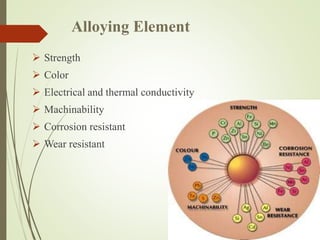
Alloying Element
 Strength
 Color
 Electrical and thermal conductivity
 Machinability
 Corrosion resistant
 Wear resistant
Classification
1. Brasses
2. Bronzes
3. Cupronickels (Alloys of Copper &
Nickel)
4. Nickel silver (Alloys of copper, Zinc &
Nickel)
Brasses-General
Alpha Brasses (Alloys containing 36 %
Zinc)
• Yellow Alpha Brasses
• Red Alpha Brasses
Alpha + Beta Brasses (54-62% copper).
Bronzes
Tin Bronzes
Al Bronzes
Silicon Bronzes
Beryllium Bronzes
Cupro Nickels
Alloys of Cu & Ni , contains upto 30 % Ni
It’s a single phase alloys
No heat treatment is required
It’s high corrosion under sea water.
These are widely used in condenser , heat exchanger tubes ,
coastal power plants
Nickel Silver
Alloys of Cu-Ni-Zn.
If copper is more than 60 % these are single phased ,ductile &
easily workable at room temp.
These are used For Rivets, screws, Costume jewelry , name
plates.
Copper AND copper alloys applications
ELECTRICAL APPLICATIONS
 Approximately 65% of copper produced is used for electrical applications.
 Power generation and transmission
generators, transformers, motors, busbars and cables provide and efficiently
to homes and businesses.
 Electrical equipment - providing circuitry, wiring and contacts for PCs, TVs
and mobile phones.
 In a microchip because of its good conductivity. These are the wires
that connect different sections of the chip together.
 Cu-Ni 70-30 alloy is used in steam generators, heat exchangers,
coolers, condensers, tanks, pipework, valves and fittings.
CONSTRUCTION APPLICATIONS
 25% of all the copper produced is used in
buildings.
 The skin of STATUE Of LIBERTY is made of
81.3 tones Cu.
 Cu is used in roofs, flashings, gutters, building &
expansion joints.
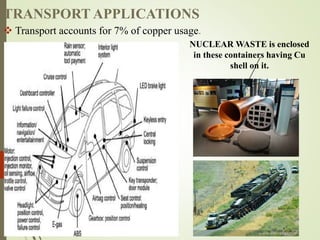
TRANSPORT APPLICATIONS
 Transport accounts for 7% of copper usage.
NUCLEAR WASTE is enclosed
in these containers having Cu
shell on it.
MEDICALAPPLICATIONS
 Bacteria will not grow on cu surface.
 Cu doorknobs are used by hospitals to reduce the transfer of diseases.
 Copper's naturally antimicrobial properties can be exploited in
hygienic surfaces for hospitals and healthcare facilities.
 CuSO4 is used as a fungicides and as algae control in domestic lakes
and ponds.
KITCHENWARE APPLICATIONS
 The burnished glow of copper radiates beauty and warmth the
kitchen.
COMMON applications
 The remaining 3% is used for coins, sculptures, musical instruments
and cookware.
 Cu-alloy is used in Bullets making.
One eurocent coin:
94.35% steel
5.65% copper
10 eurocent coin:
89% copper
5% aluminium
5% zinc
1% tin
PKR 5:
Cupro Nikle alloys
HEAT EXCHANGERS/RADIATORS:
INNER GROOVED COPPER TECHNOLOGY
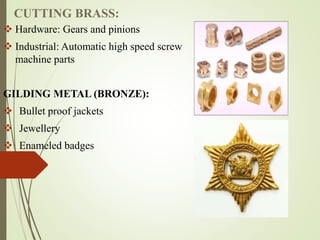
CUTTING BRASS:
 Hardware: Gears and pinions
 Industrial: Automatic high speed screw
machine parts
GILDING METAL (BRONZE):
 Bullet proof jackets
 Jewellery
 Enameled badges
THANK YOU FOR PAYING
ATTENTION!

Copper & its properties

  • 2.
    “COPPER AND COPPER ALLOYS” (PROPERTIES, EXTRACTION, PRODUCTION, USES AND APPLICATIONS)
  • 3.
    GROUP MEMBERS Zaid KhizarBajwa BSME 01143071 H Salman Yousaf BSME 01143072 Hamza Saleem BSME 01143075
  • 5.
    AREAS OF DISCUSSION: INTRODUCTION TO COPPER (PHYSICAL PROPERTIES, OCCURRENCE, DEPOSITS, ORES, PRODUCTION)  INTRODUCTION TO COPPER ALLOYS (CLASSIFICATION, PROPERTIES)  IMPORTANT CLASSES OF COPPER ALLOYS (BRASSES, BRONZES, SPECIAL ALLOYS)  USES AND APPLICATIONS OF PURE COPPER AND COPPER ALLOYS.
  • 6.
    COPPER: Copper (Cu) atomic weight63.546. Its soft , malleable and ductile metal with very high thermal and electrical conductivity. There are 29 isotopes of copper.  63Cu and 65Cu are stable & The other isotopes are radioactive.
  • 7.
    COLOUR Reddish orangein pure form MELTING POINT 1084.62˚C BOILING POINT 2927˚C CRYSTAL STRUCTURE Face centered cubic (F.C.C) SPECIFIC GRAVITY 8.96 g/cm3
  • 8.
    ORES OF COPPER: ORESCHEMICAL FORMULA COPPER PYRITE/CHALCOPYRITE CuFeS2 CHALCOCITE/ COPPER GLANCE Cu2S MALACHITE CuCO3.Cu(OH)2 AZURITE Cu3(CO3)2(OH)2 BORNITE/PEACOCK ORE 3Cu2S.Fe2S3 MELACONITE CuO COVELINE CuS CHALCOSINE Cu2S CHRYSCOLLA Cu2FeS
  • 10.
    OCCURRENCE of copper: Copperis present in the Earth's crust at a concentration of about 50 parts per million (ppm). The largest mass of elemental copper discovered weighed 420 tonnes and was found in 1857 in Michigan US. In Pakistan large copper deposits are discovered in Reko Diq (Baluchistan) and Saindak town in Chagai District. The total amount of copper on Earth is vast i.e. around 1014 tons just in the top kilometer of Earth's crust.
  • 11.
  • 12.
    EXTRACTION TECHNIQUES FORCOPPER Copper ore is mined both underground and on the surface. Large excavations formed by surface mining are called open- pit mines. Most of the copper ores mined today are oxide or sulfide ores. HYDROMETALLURGICAL operations are required for treating very poor grade oxide ores. PYROMETALLURGICAL treatments are given to the sulphide ores for their smelting and roasting. ELECTROMETALLURGICAL techniques are employed for the electro refining of blister copper or copper scrap.
  • 13.
    EXTRACTION OF COPPER FROMSULPHIDE ORES Copper is extracted usually from the sulphide ore chalcopyrite (CuFeS2) by smelting process. There are following steps for the Pyrometallurgical extraction of copper. 1. CONCENTRATION 2. ROASTING 3. SMELTING 4. BESSEMERIZATION
  • 15.
    CONCENTRATION BY FROTHFLOTATION “Crushed ore is suspended in water containing pine oil. The pine oil binds to the copper compounds, but not to the unwanted rocky material. A blast of air is passed through the suspension. The particles of ore get wetted by oil and floats as a froth which is skimmed. The gangue sinks to the bottom.”
  • 16.
    ROASTING The concentrated oreis roasted in the furnace in the presence of oxygen. Sulphur is oxidized to SO2 and impurities of arsenic and antimony are removed as volatile oxides. The following reactions take place: 2CuFeS2 + O2 Cu2S + 2FeS + SO2 S + O2 SO2 4As + 3O2 2As2O3 4Sb + 3O2 2Sb2O3 Cu2S + O2 Cu2O + SO2 FeS + O2 FeO + SO2
  • 17.
    SMELTING The roasted oreis mixed with coke and silica sand (SiO2) and is introduced into a blast furnace. The hot air is blasted and FeO is converted into ferrous silicate (FeSiO3) FeO + SiO2 FeSiO3 Cu2O + FeS Cu2S + FeO FeSiO3 (slag) floats over the molten matte of copper. The resulting product of smelting is the combination of copper sulfate and iron sulfide called matte (Copper matte).
  • 18.
    BESSEMERIZATION Copper metal isextracted from molten matte through bessemerization . The matte is introduced in to Bessemer converter which uphold by tuyeres. The air is blown through the molten matte. Blast of air converts Cu2S partly into Cu2O which reacts with remaining Cu2S to give molten copper. 2Cu2S + 3O2 2Cu2O + 2SO2 2Cu2O + Cu2S 6Cu + SO2
  • 19.
  • 20.
  • 21.
    Classification of copperalloys  There are four different classification of copper alloys 2)Brasses 1)Bronze 4) Cu-Ni based 3) Nickel silver
  • 22.
    1) Brass: There aretwo Class of brass  The alpha alloys with less than 37% Zinc. These alloys are ductile and can be cold worked.  The alpha/beta or duplex alloys with 37-45% Zinc. These alloys have limited cold ductility and are typically harder and stronger.
  • 23.
    Alloying Element  Strength Color  Electrical and thermal conductivity  Machinability  Corrosion resistant  Wear resistant
  • 24.
    Classification 1. Brasses 2. Bronzes 3.Cupronickels (Alloys of Copper & Nickel) 4. Nickel silver (Alloys of copper, Zinc & Nickel)
  • 25.
    Brasses-General Alpha Brasses (Alloyscontaining 36 % Zinc) • Yellow Alpha Brasses • Red Alpha Brasses Alpha + Beta Brasses (54-62% copper).
  • 26.
  • 27.
    Cupro Nickels Alloys ofCu & Ni , contains upto 30 % Ni It’s a single phase alloys No heat treatment is required It’s high corrosion under sea water. These are widely used in condenser , heat exchanger tubes , coastal power plants Nickel Silver Alloys of Cu-Ni-Zn. If copper is more than 60 % these are single phased ,ductile & easily workable at room temp. These are used For Rivets, screws, Costume jewelry , name plates.
  • 29.
    Copper AND copperalloys applications ELECTRICAL APPLICATIONS  Approximately 65% of copper produced is used for electrical applications.  Power generation and transmission generators, transformers, motors, busbars and cables provide and efficiently to homes and businesses.  Electrical equipment - providing circuitry, wiring and contacts for PCs, TVs and mobile phones.
  • 30.
     In amicrochip because of its good conductivity. These are the wires that connect different sections of the chip together.  Cu-Ni 70-30 alloy is used in steam generators, heat exchangers, coolers, condensers, tanks, pipework, valves and fittings.
  • 31.
    CONSTRUCTION APPLICATIONS  25%of all the copper produced is used in buildings.  The skin of STATUE Of LIBERTY is made of 81.3 tones Cu.  Cu is used in roofs, flashings, gutters, building & expansion joints.
  • 32.
    TRANSPORT APPLICATIONS  Transportaccounts for 7% of copper usage. NUCLEAR WASTE is enclosed in these containers having Cu shell on it.
  • 33.
    MEDICALAPPLICATIONS  Bacteria willnot grow on cu surface.  Cu doorknobs are used by hospitals to reduce the transfer of diseases.  Copper's naturally antimicrobial properties can be exploited in hygienic surfaces for hospitals and healthcare facilities.  CuSO4 is used as a fungicides and as algae control in domestic lakes and ponds.
  • 34.
    KITCHENWARE APPLICATIONS  Theburnished glow of copper radiates beauty and warmth the kitchen.
  • 35.
    COMMON applications  Theremaining 3% is used for coins, sculptures, musical instruments and cookware.  Cu-alloy is used in Bullets making. One eurocent coin: 94.35% steel 5.65% copper 10 eurocent coin: 89% copper 5% aluminium 5% zinc 1% tin PKR 5: Cupro Nikle alloys
  • 36.
  • 37.
    CUTTING BRASS:  Hardware:Gears and pinions  Industrial: Automatic high speed screw machine parts GILDING METAL (BRONZE):  Bullet proof jackets  Jewellery  Enameled badges
  • 38.
    THANK YOU FORPAYING ATTENTION!