Presentation Industrial
Material-I
Presented by: Muhammad Usama Haroon
Regd No: 2015-BET-CHEM-20
Presented to: Sir. Sulaiman
Aluminum ( Al )
Introduction
 It occurs primarily as
alumino-silicate
minerals found in the
rocks of outer portion of
the earth.
Aluminum ( Al )
Chemical Properties
• It is amphoteric. It dissolve in both
acids & bases with the liberation of
H2 gas
• It reacts slowly with dilute acid &
more rapidly with concentrated
HCl to displace Hydrogen
Physical Properties
• It is a dull grey metal
• It has low density
• It is malleable & ductile
• It is a good conductor of heat and
electricity
• It is used in flash lights
photography
Aluminum ( Al )
• Fast Facts
• Atomic number: 13
• Atomic mass: 26.98154 g/mol
• Electronegativity: 1.5 (according to pulling)
• Density: 2.7 g. cm−3
• Melting Point: 660.4 °C
• Boiling Point: 2467 °C
• Ionic Radius: 0.05 nm
• Isotopes: 3
• Standard Potential: -1.67 V
Aluminum ( Al )
• Ores
• Aluminum is the third most abundant element in the earth’s curst it’s ores are
following:
• Cryolite ( Na3AlF6 )
• Bauxite ( Al2O3.2H2O )
• Corundum ( Al2O3 )
• Gibbsite ( Al2O3.3H2O )
• Emerald ( Al2F2SiO4 )
Aluminum ( Al )
• Alloying Elements
• Aluminum really comes into its own when you combine it with other metals to make
aluminum alloys (an alloy is a metal mixed together with other elements to make a new
material with improved properties—it might be stronger or it might melt at a higher
temperature). A few of the metals commonly used to make aluminum alloys include
boron, copper, lithium, magnesium, manganese, silicon, tin, and zinc. You mix aluminum
with one or more of these depending on the job you're trying to do.
Copper ( Cu )
Introduction
 Copper is a chemical element
with the symbol Cu and atomic
number 29. It is a ductile, semi-
precious metal with very high
thermal and electrical
conductivity.
 Pure copper is soft and malleable;
an exposed surface has a reddish-
orange tarnish. It is used as a
conductor of heat and electricity,
a building material, and a
constituent of various
metal alloys.
Copper ( Cu )
Physical Properties
• Physically, copper conducts heat and
electricity very well (in other words, it
allows them to flow through it quickly
and easily), it's relatively soft and easy to
shape, and it doesn't go rusty (though its
surface gradually turns a characteristic
blue-green when it oxidizes in air). It can
be made considerably harder by working
it, because that encourages longer crystals
to form inside it, which add strength to its
overall structure—a bit like "rebars"
(reinforcing bars) in reinforced concrete.
Chemical Properties
• Like other metals, copper oxides whenever it is
exposed to the air. That is, the copper reacts to
oxygen in the air, not so much the moisture,
and it creates a verdigris that cakes onto the
copper. This verdigris is not like the rust that
forms on iron or other metals, but actually
layers, covers, and even protects the copper
beneath it.
• Copper also tarnishes when exposed to
different sulfides, and thus creates different
copper sulfides. These are simply different
chemical compounds of sulfur and copper.
Copper ( Cu )
• Fast Facts
• Atomic number: 29
• Atomic mass: 63.546 g/mol
• Electronegativity: 1.9 (according to pulling)
• Density: 8.9 g.cm−3
• Melting Point: 1083 °C
• Boiling Point: 2595 °C
• Ionic Radius: 0.096 nm
• Isotopes: 6
• Standard Potential: +0.522 V ( Cu+/Cu ) ; +0.345 V ( Cu+2/Cu )
Copper ( Cu )
• Ores
• Copper is one of those materials we use all day long in all kinds of ways
without ever really noticing or thinking about it. Copper has following
ores:
• Chalcopyrite ( CuFeS2 )
• Chalcocite ( Cu2S )
• Covellite ( CuS )
• Cuprite ( Cu2O )
• Chrysocolla ( CuO.SiO2.2H2O )
Copper ( Cu )
• Alloying Elements
• Copper alloys are made by mixing copper with one or more other metals to produce a
new material that combines some of their best properties. The best-known copper alloys
are bronze and brass. Bronze is an alloy mostly containing copper and tin, sometimes
with added zinc or lead, and it's harder, stronger, and more resistant to corrosion than
pure copper. Different types of bronze have varying proportions of these ingredients. For
example, the hard bronze used in making statues is typically 78.5 percent copper, 17.2
percent zinc, 2.9 percent tin, and 1.4 percent lead. Brass is an alloy of copper and typically
anything from 10-50 percent zinc, depending on how it will be used.
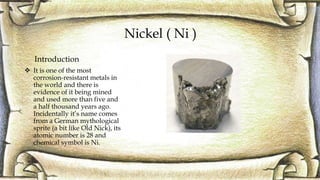
Nickel ( Ni )
Introduction
 It is one of the most
corrosion-resistant metals in
the world and there is
evidence of it being mined
and used more than five and
a half thousand years ago.
Incidentally it’s name comes
from a German mythological
sprite (a bit like Old Nick), its
atomic number is 28 and
chemical symbol is Ni.
Nickel ( Ni )
Physical Properties
• Nickel is a typical metal: solid at everyday
temperatures, reasonably strong and tough,
malleable (easy-to-work), and ductile (capable
of being pulled into wires). It's fairly easy to
polish, a reasonably good conductor
of heat and electricity, and quite magnetic as
well.
• In its strength and toughness, it's similar to
iron (though less magnetic), though it's much
more resistant to corrosion and oxidation
(and, in that respect, more like copper).
Crystals of nickel have a face-centered cubic
(FCC) structure.
Chemical Properties
• Nickel is silvery-white. hard, malleable, and
ductile metal. It is of the iron group and it takes
on a high polish. It is a fairly good conductor of
heat and electricity. In its familiar compounds
nickel is bivalent, although it assumes other
valences. It also forms a number of complex
compounds.
• Most nickel compounds are blue or green.
Nickel dissolves slowly in dilute acids but, like
iron, becomes passive when treated with nitric
acid. Finely divided nickel adsorbs hydrogen.
• By itself, nickel is relatively unreactive. It does
react with strong acids but not alkalis (which is
why it's often used to line containers for alkaline
substances).
Nickel ( Ni ):
• Fast Facts
• Atomic number: 28
• Atomic mass: 58.71 g/mol
• Electronegativity: 1.8 (according to pulling)
• Density: 8.9 g.cm−3 at 20 °C
• Melting Point: 1453 ºC
• Boiling Point: 2913 ºC
• Curie point: 358°C
• Ionic Radius: 0.069 nm
• Isotopes: 10
• Standard Potential: -0.25 V
Nickel ( Ni)
• Ores
• Copper sulfide nickel ore
• Nickel oxide Ore
• Applications
• Nickel ore beneficiation can be applied to process copper nickel ore
accompanied by Pyrite and other gangue or nickel oxide ore.
Nickel ( Ni )
• Alloying Elements
• The vast majority of nickel is used as a constituent of alloys; only a relatively small amount is
used as pure metal in its own right. Worldwide, around two thirds of all nickel is used in
manufacturing stainless steel, while hard and corrosion-resistant nickel steel (steel with
around 3 percent nickel) is important for making a wide range of car parts,
including valves and drive shafts of various kinds.
• Nonferrous alloys are the next most common use for nickel. Cupro-nickel (used to make
coins) is about three quarters copper and one quarter nickel. Turbine blades are typically
coated with nickel to give them greater strength and a protective layer that provides
corrosion resistance.
• Important compounds of nickel include nickel nitrates, chlorides, and sulfates, all of which
are used in electroplating.
Industrial material

Industrial material

  • 1.
    Presentation Industrial Material-I Presented by:Muhammad Usama Haroon Regd No: 2015-BET-CHEM-20 Presented to: Sir. Sulaiman
  • 2.
    Aluminum ( Al) Introduction  It occurs primarily as alumino-silicate minerals found in the rocks of outer portion of the earth.
  • 3.
    Aluminum ( Al) Chemical Properties • It is amphoteric. It dissolve in both acids & bases with the liberation of H2 gas • It reacts slowly with dilute acid & more rapidly with concentrated HCl to displace Hydrogen Physical Properties • It is a dull grey metal • It has low density • It is malleable & ductile • It is a good conductor of heat and electricity • It is used in flash lights photography
  • 4.
    Aluminum ( Al) • Fast Facts • Atomic number: 13 • Atomic mass: 26.98154 g/mol • Electronegativity: 1.5 (according to pulling) • Density: 2.7 g. cm−3 • Melting Point: 660.4 °C • Boiling Point: 2467 °C • Ionic Radius: 0.05 nm • Isotopes: 3 • Standard Potential: -1.67 V
  • 5.
    Aluminum ( Al) • Ores • Aluminum is the third most abundant element in the earth’s curst it’s ores are following: • Cryolite ( Na3AlF6 ) • Bauxite ( Al2O3.2H2O ) • Corundum ( Al2O3 ) • Gibbsite ( Al2O3.3H2O ) • Emerald ( Al2F2SiO4 )
  • 6.
    Aluminum ( Al) • Alloying Elements • Aluminum really comes into its own when you combine it with other metals to make aluminum alloys (an alloy is a metal mixed together with other elements to make a new material with improved properties—it might be stronger or it might melt at a higher temperature). A few of the metals commonly used to make aluminum alloys include boron, copper, lithium, magnesium, manganese, silicon, tin, and zinc. You mix aluminum with one or more of these depending on the job you're trying to do.
  • 7.
    Copper ( Cu) Introduction  Copper is a chemical element with the symbol Cu and atomic number 29. It is a ductile, semi- precious metal with very high thermal and electrical conductivity.  Pure copper is soft and malleable; an exposed surface has a reddish- orange tarnish. It is used as a conductor of heat and electricity, a building material, and a constituent of various metal alloys.
  • 8.
    Copper ( Cu) Physical Properties • Physically, copper conducts heat and electricity very well (in other words, it allows them to flow through it quickly and easily), it's relatively soft and easy to shape, and it doesn't go rusty (though its surface gradually turns a characteristic blue-green when it oxidizes in air). It can be made considerably harder by working it, because that encourages longer crystals to form inside it, which add strength to its overall structure—a bit like "rebars" (reinforcing bars) in reinforced concrete. Chemical Properties • Like other metals, copper oxides whenever it is exposed to the air. That is, the copper reacts to oxygen in the air, not so much the moisture, and it creates a verdigris that cakes onto the copper. This verdigris is not like the rust that forms on iron or other metals, but actually layers, covers, and even protects the copper beneath it. • Copper also tarnishes when exposed to different sulfides, and thus creates different copper sulfides. These are simply different chemical compounds of sulfur and copper.
  • 9.
    Copper ( Cu) • Fast Facts • Atomic number: 29 • Atomic mass: 63.546 g/mol • Electronegativity: 1.9 (according to pulling) • Density: 8.9 g.cm−3 • Melting Point: 1083 °C • Boiling Point: 2595 °C • Ionic Radius: 0.096 nm • Isotopes: 6 • Standard Potential: +0.522 V ( Cu+/Cu ) ; +0.345 V ( Cu+2/Cu )
  • 10.
    Copper ( Cu) • Ores • Copper is one of those materials we use all day long in all kinds of ways without ever really noticing or thinking about it. Copper has following ores: • Chalcopyrite ( CuFeS2 ) • Chalcocite ( Cu2S ) • Covellite ( CuS ) • Cuprite ( Cu2O ) • Chrysocolla ( CuO.SiO2.2H2O )
  • 11.
    Copper ( Cu) • Alloying Elements • Copper alloys are made by mixing copper with one or more other metals to produce a new material that combines some of their best properties. The best-known copper alloys are bronze and brass. Bronze is an alloy mostly containing copper and tin, sometimes with added zinc or lead, and it's harder, stronger, and more resistant to corrosion than pure copper. Different types of bronze have varying proportions of these ingredients. For example, the hard bronze used in making statues is typically 78.5 percent copper, 17.2 percent zinc, 2.9 percent tin, and 1.4 percent lead. Brass is an alloy of copper and typically anything from 10-50 percent zinc, depending on how it will be used.
  • 12.
    Nickel ( Ni) Introduction  It is one of the most corrosion-resistant metals in the world and there is evidence of it being mined and used more than five and a half thousand years ago. Incidentally it’s name comes from a German mythological sprite (a bit like Old Nick), its atomic number is 28 and chemical symbol is Ni.
  • 13.
    Nickel ( Ni) Physical Properties • Nickel is a typical metal: solid at everyday temperatures, reasonably strong and tough, malleable (easy-to-work), and ductile (capable of being pulled into wires). It's fairly easy to polish, a reasonably good conductor of heat and electricity, and quite magnetic as well. • In its strength and toughness, it's similar to iron (though less magnetic), though it's much more resistant to corrosion and oxidation (and, in that respect, more like copper). Crystals of nickel have a face-centered cubic (FCC) structure. Chemical Properties • Nickel is silvery-white. hard, malleable, and ductile metal. It is of the iron group and it takes on a high polish. It is a fairly good conductor of heat and electricity. In its familiar compounds nickel is bivalent, although it assumes other valences. It also forms a number of complex compounds. • Most nickel compounds are blue or green. Nickel dissolves slowly in dilute acids but, like iron, becomes passive when treated with nitric acid. Finely divided nickel adsorbs hydrogen. • By itself, nickel is relatively unreactive. It does react with strong acids but not alkalis (which is why it's often used to line containers for alkaline substances).
  • 14.
    Nickel ( Ni): • Fast Facts • Atomic number: 28 • Atomic mass: 58.71 g/mol • Electronegativity: 1.8 (according to pulling) • Density: 8.9 g.cm−3 at 20 °C • Melting Point: 1453 ºC • Boiling Point: 2913 ºC • Curie point: 358°C • Ionic Radius: 0.069 nm • Isotopes: 10 • Standard Potential: -0.25 V
  • 15.
    Nickel ( Ni) •Ores • Copper sulfide nickel ore • Nickel oxide Ore • Applications • Nickel ore beneficiation can be applied to process copper nickel ore accompanied by Pyrite and other gangue or nickel oxide ore.
  • 16.
    Nickel ( Ni) • Alloying Elements • The vast majority of nickel is used as a constituent of alloys; only a relatively small amount is used as pure metal in its own right. Worldwide, around two thirds of all nickel is used in manufacturing stainless steel, while hard and corrosion-resistant nickel steel (steel with around 3 percent nickel) is important for making a wide range of car parts, including valves and drive shafts of various kinds. • Nonferrous alloys are the next most common use for nickel. Cupro-nickel (used to make coins) is about three quarters copper and one quarter nickel. Turbine blades are typically coated with nickel to give them greater strength and a protective layer that provides corrosion resistance. • Important compounds of nickel include nickel nitrates, chlorides, and sulfates, all of which are used in electroplating.