CLASSIFICATION OF SALTS
•A salt is formed by the neutralization of an
acid by a base.
There are different types of salts. They are:-
a) Simple salt
b) Molecular (or) addition compounds
3.
A)SIMPLE SALT
• Asimple salt is formed by the
neutralization of an acid by a base.
• KOH + HCl → KCl + H2O
• Normally, a simple salt ionizes in water and
produces ions in solution.
• The solution of the simple salt exhibits the
properties of its component ions.
i)Double salts orlattice compounds: These are
molecular compounds which are formed by the
evaporation of solution containing two (or) more salt
in Stoichiometric proportions. The molecular
compounds which dissociate in solution into its
constituent ions are known as double salts. Double
salts retain their properties only in solid state.
Example : K2SO4 . Al2(SO4)3 . 24H2O - Potash alum
FeSO4 . (NH4)2 SO4. 6H2O - Mohr’s salt
K2SO4 . Al2(SO4)3 . 24H2O → 2K+
+ 2Al3+
+ 4SO4
2-
+24H2O
The double salts give the test of all their constituent
ions in solution.
6.
• ii) Coordination(or complex)
compounds : Coordination compound
is a compound formed from a Lewis
acid and a Lewis base. The molecular
compounds, do not dissociate into its
constituent ions in solution are called
coordination compounds.
• Example : Fe(CN)2 + 4KCN → Fe(CN)2 .
4KCN (or) K4[Fe(CN)6] Ferrous cyanide
7.
Coordination (or complex)compounds
• K4[Fe(CN)6] →4K+
+ [Fe(CN)6]4-
Complex anion
• In K4[Fe (CN)6] the individual components
lose their identity.
• The metal of the complex ion is not free in
solution unlike metal in double salt in
solution.
8.
DOUBLE SALTS
They completelyionise in
aqueous solutions and
each ion in the solution
gives the corresponding
confirmatory test.
Example: Potash Alum is
double sulphate
K2SO4.Al2 (SO4)3.24H2O
on Ionization it gives:K+
,
SO4
−2
and Al+3
ions which
response to the
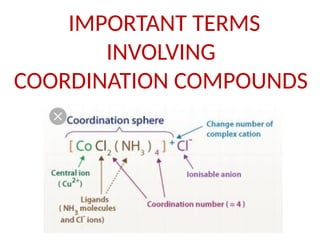
COORDINATION COMPLEX
Co-ordinate complexes ar
incompletely ionizable in
the aqueous solutions.
These give a complexion
which does not show
complete ionization.
• Example: Potassium
Ferrocyanide. [K4Fe(CN)6]
ionizes to give K+
and
[Fe(CN)6]−4
[ferro cyanide
ions]
9.
COORDINATION COMPOUNDS
• Thecompounds in which the
metal atoms are bound to a
number of anions or neutral
molecules are called as complex
compounds or coordination
compounds.
10.
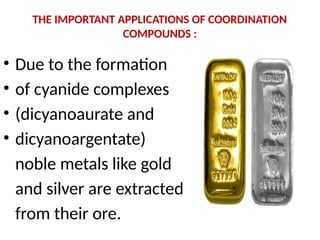
THE IMPORTANT APPLICATIONSOF COORDINATION
COMPOUNDS :
• Due to the formation
• of cyanide complexes
• (dicyanoaurate and
• dicyanoargentate)
noble metals like gold
and silver are extracted
from their ore.
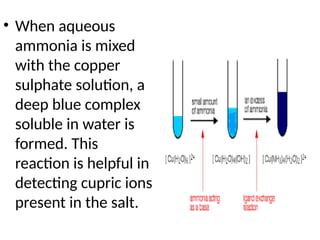
• When aqueous
ammoniais mixed
with the copper
sulphate solution, a
deep blue complex
soluble in water is
formed. This
reaction is helpful in
detecting cupric ions
present in the salt.
15.
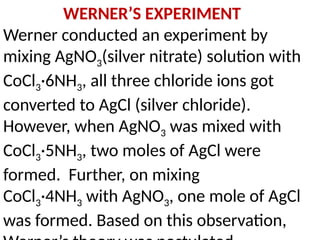
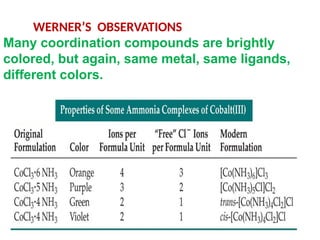
WERNER’S EXPERIMENT
Werner conductedan experiment by
mixing AgNO3(silver nitrate) solution with
CoCl3·6NH3, all three chloride ions got
converted to AgCl (silver chloride).
However, when AgNO3 was mixed with
CoCl3·5NH3, two moles of AgCl were
formed. Further, on mixing
CoCl3·4NH3 with AgNO3, one mole of AgCl
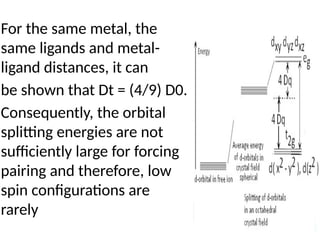
was formed. Based on this observation,
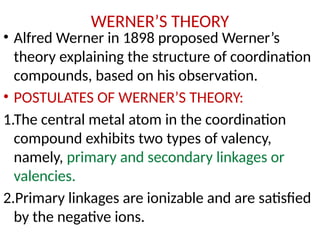
WERNER’S THEORY
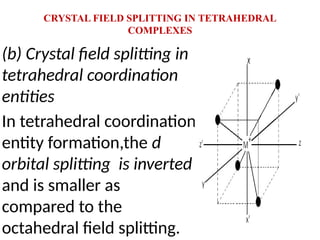
• AlfredWerner in 1898 proposed Werner’s
theory explaining the structure of coordination
compounds, based on his observation.
• POSTULATES OF WERNER’S THEORY:
1.The central metal atom in the coordination
compound exhibits two types of valency,
namely, primary and secondary linkages or
valencies.
2.Primary linkages are ionizable and are satisfied
by the negative ions.
18.
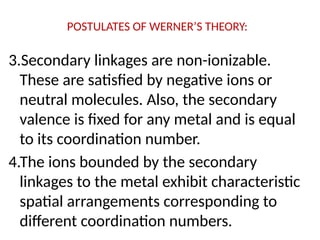
POSTULATES OF WERNER’STHEORY:
3.Secondary linkages are non-ionizable.
These are satisfied by negative ions or
neutral molecules. Also, the secondary
valence is fixed for any metal and is equal
to its coordination number.
4.The ions bounded by the secondary
linkages to the metal exhibit characteristic
spatial arrangements corresponding to
different coordination numbers.
LIMITATIONS OF WERNER’STHEORY
• It fails to explain the magnetic, colour and
optical properties shown by coordination
compounds.
• It failed to explain the reason why all elements
don’t form coordination compounds.
• It failed to explain the directional properties of
bonds in coordination compounds.
• This theory does not explain the stability of the
complex
• This theory could not explain the nature of
COORDINATION ENTITY
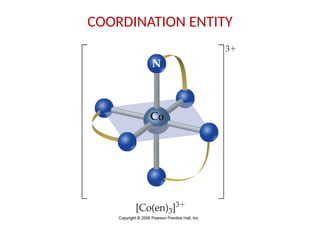
A chemicalcompound in which the
central ion or atom (or the
coordination centre) is bound to a set
number of atoms, molecules, or ions is
called a coordination entity.
Some examples of such coordination
entities include [CoCl3 (NH3)3] and
[Fe(CN)6]4-
.
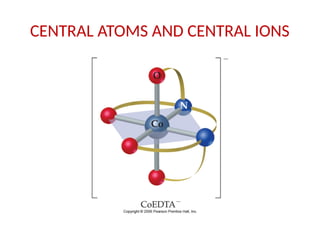
CENTRAL ATOMS ANDCENTRAL IONS
• The atoms and ions to which a set
number of atoms, molecules, or ions
are bound are referred to as
the central atoms and the central ions.
• In coordination compounds, the central
atoms or ions are typically Lewis
Acids and can, therefore, act as
electron-pair acceptors.
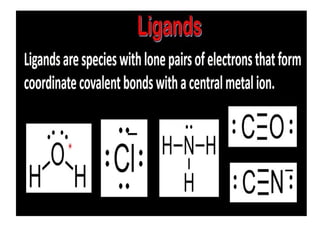
LIGANDS
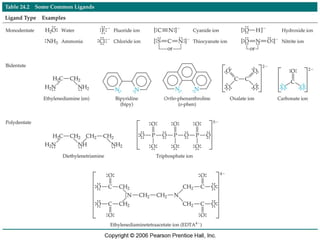
• The atoms,molecules, or ions that are
bound to the coordination centre or the
central atom/ion are referred to
as ligands.
• These ligands can either be a simple ion
or molecule (such as Cl-
or NH3) or in the
form of relatively large molecules, such as
ethane-1,2-diamine (NH2-CH2-CH2-NH2).
28.
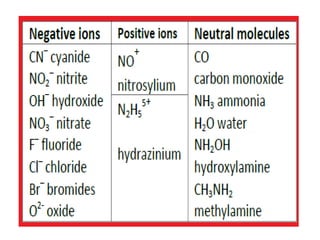
CLASSIFICATION OF LIGANDS
•Based on the nature of the charge on the
ligand and the central atom, ligands are
classified as follows:
• Anionic ligands: CN–
, Br–
, Cl–
• Cationic ligands: NO+
(Nitrosonium ion)
• Neutral ligands: CO, H2O, NH3
30.
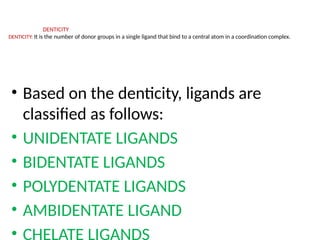
DENTICITY
DENTICITY: It isthe number of donor groups in a single ligand that bind to a central atom in a coordination complex.
• Based on the denticity, ligands are
classified as follows:
• UNIDENTATE LIGANDS
• BIDENTATE LIGANDS
• POLYDENTATE LIGANDS
• AMBIDENTATE LIGAND
• CHELATE LIGANDS
31.
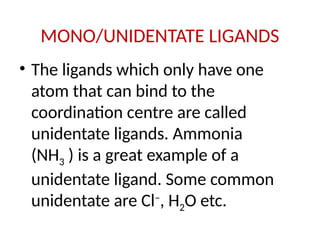
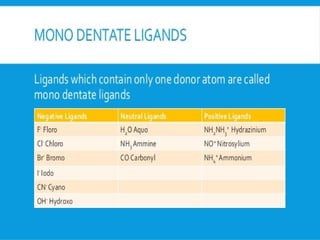
MONO/UNIDENTATE LIGANDS
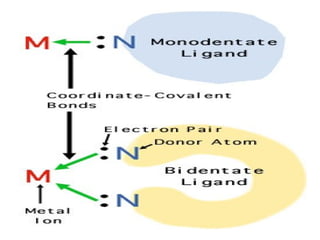
• Theligands which only have one
atom that can bind to the
coordination centre are called
unidentate ligands. Ammonia
(NH3 ) is a great example of a
unidentate ligand. Some common
unidentate are Cl–
, H2O etc.
34.
BIDENTATE LIGANDS
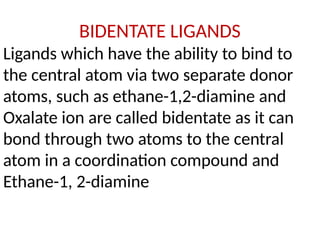
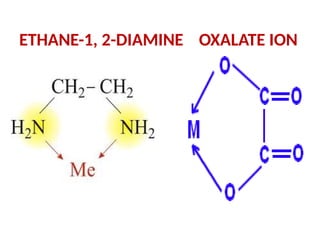
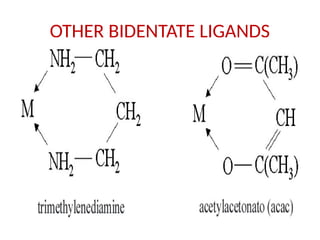
Ligands whichhave the ability to bind to
the central atom via two separate donor
atoms, such as ethane-1,2-diamine and
Oxalate ion are called bidentate as it can
bond through two atoms to the central
atom in a coordination compound and
Ethane-1, 2-diamine
POLYDENTATE LIGANDS
• Someligands have many donor atoms that
can bind to the coordination centre. These
ligands are often referred to as polydentate
ligands.
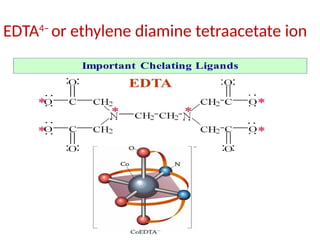
• A great example of a polydentate ligand is
the EDTA4–
ion (ethylene diamine
tetraacetate ion), which can bind to the
coordination centre via its four oxygen
atoms and two nitrogen atoms.
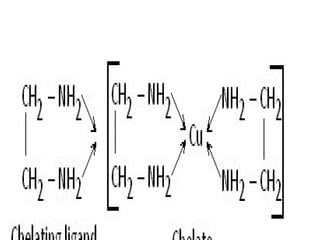
CHELATE LIGANDS
• Whena polydentate ligand attaches
itself to the same central metal atom
through two or more donor atoms, it
is known as a chelate ligand. The
number of atoms that ligate to the
metal ion are termed as the denticity
of such ligands.
42.
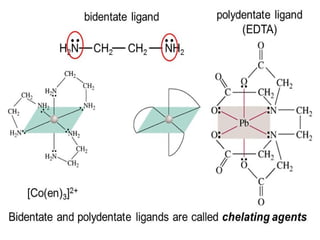
• Di orpolydentate ligands cause cyclisation
around the metal atom which is known as
chelation . Such ligands use two or more
donor atoms to bind a single metal ion and
are known as chelating ligands.
• More the number of chelate rings, more is
the stability of complex.
• The stabilisation of coordination
compounds due to chelation is known as
chelate effect.
43.
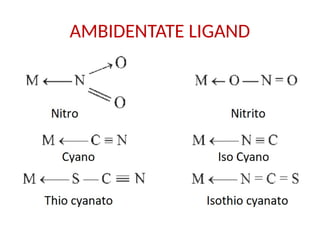
AMBIDENTATE LIGAND
• Someligands have the ability to bind to
the central atom via the atoms of two
different elements.
• For example, the SCN– ion can bind to a
ligand via the nitrogen atom or via the
sulphur atom. Such ligands are known as
ambidentate ligands.
COORDINATION NUMBER
The coordinationnumberof the central
atom in the coordination compound
refers to the total number of bonds
through which the ligands are bound to
the coordination centre.
For example, in the coordination
complex given by [Ni(NH3)4]2+
,
the coordination number of nickel is 4.
47.
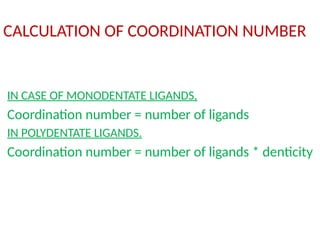
CALCULATION OF COORDINATIONNUMBER
IN CASE OF MONODENTATE LIGANDS,
• Coordination number = number of ligands
IN POLYDENTATE LIGANDS.
• Coordination number = number of ligands * denticity
48.
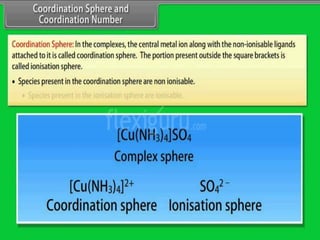
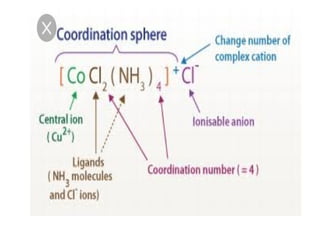
COORDINATION SPHERE
• Thenon-ionizable part of a complex compound which
consists of central transition metal ion surrounded by
neighbouring atoms or groups enclosed in square
bracket.
• The coordination centre, the ligands attached to the
coordination centre, and the net charge of the
chemical compound as a whole, form
the coordination sphere when written together.
• This coordination sphere is usually accompanied by a
counter ion (the ionizable groups that attach to
charged coordination complexes).
• Example: [Co(NH3)6]Cl3
50.
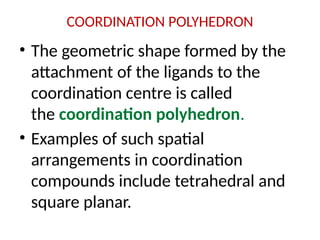
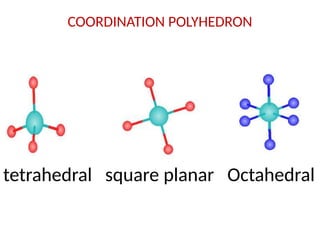
COORDINATION POLYHEDRON
• Thegeometric shape formed by the
attachment of the ligands to the
coordination centre is called
the coordination polyhedron.
• Examples of such spatial
arrangements in coordination
compounds include tetrahedral and
square planar.
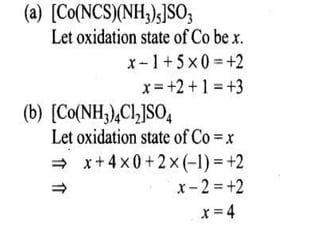
OXIDATION NUMBER
The oxidationnumber of the central
atom can be calculated by finding the
charge associated with it when all the
electron pairs that are donated by the
ligands are removed from it.
For example, the oxidation number of
the platinum atom in the complex
[PtCl6]2-
is +4.
54.
HOMOLEPTIC AND HETEROLEPTICCOMPLEX
When the coordination centre is bound to
only one type of electron pair donating
ligand group, the coordination complex is
called a homoleptic complex, for example:
[Cu(CN)4]3-
.
When the central atom is bound to many
different types of ligands, the coordination
compound in question is called
a heteroleptic complex, an example for
which is [Co(NH3)4Cl2]+
.
56.
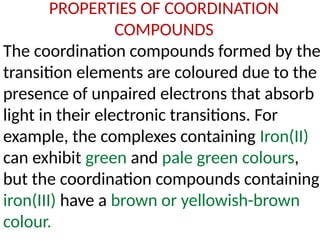
PROPERTIES OF COORDINATION
COMPOUNDS
Thecoordination compounds formed by the
transition elements are coloured due to the
presence of unpaired electrons that absorb
light in their electronic transitions. For
example, the complexes containing Iron(II)
can exhibit green and pale green colours,
but the coordination compounds containing
iron(III) have a brown or yellowish-brown
colour.
57.
• When thecoordination centre is a metal, the
corresponding coordination complexes have a
magnetic nature due to the presence of
unpaired electrons.
• Coordination compounds exhibit a variety
of chemical reactivity. They can be a part of
inner-sphere electron transfer reactions as
well as outer-sphere electron transfers.
• Complex compounds with certain ligands have
the ability to aid in the transformation of
molecules in a catalytic or a stoichiometric
manner.
58.
DOUBLE SALTS
They completelyionise in
aqueous solutions and
each ion in the solution
gives the corresponding
confirmatory test.
Example: Potash Alum is
double sulphate
K2SO4.Al2 (SO4)3.24H2O
on Ionization it gives:K+
,
SO4
−2
and Al+3
ions which
response to the
COORDINATION COMPLEX
Co-ordinate complexes ar
incompletely ionizable in
the aqueous solutions.
These give a complexion
which does not show
complete ionization.
• Example: Potassium
Ferrocyanide. [K4Fe(CN)6]
ionizes to give K+
and
[Fe(CN)6]−4
[ferro cyanide
ions]
59.
TYPES OF COORDINATIONCOMPLEXES
based on whether complex ion is a cation/anion
• 1.Cationic complexes: In this co-ordination
sphere is a cation. Example: [Co(NH3)6]Cl3
• 2.Anionic complexes: In this co-ordination
sphere is Anion. Example: K4[Fe(CH)6]
• 3.Neutral Complexes: In this co-ordination
sphere is neither cation or anion. Example:
[Ni(CO)4]
60.
TYPES OF COORDINATIONCOMPLEXES
based on whether complex ion is a
cation/anion
• Mononuclear complexes: In this co-ordination
sphere has single transition metal ion. Example:
K4[Fe(CN)6]
• Polynuclear complexes:
• More than one transition
• metal ion is present.
• Example:
61.
TYPES OF COORDINATIONCOMPLEXES
based on the types of ligands present
• Homoleptic complex: The complex
consist of a similar type of ligands.
Example: K4[Fe(CN)6]
• Heteroleptic complexes: These
consists of different types of ligands.
Example: [Co(NH3)5Cl]SO4
Rules For NamingCoordination Compound
1.The ligands are always written before the
central metal ion in the naming of
complex coordination complexes.
2.When the coordination centre is bound
to more than one ligand, the names of
the ligands are written in an alphabetical
order which is not affected by the
numerical prefixes that must be applied
to the ligands.
64.
Rules For NamingCoordination Compound
3.When there are many monodentate
ligands present in the coordination
compound, the prefixes that give
insight into the number of ligands are
of the type: di-, tri-, tetra-, and so on.
4.When there are many polydentate
ligands attached to the central metal
ion, the prefixes are of the form bis-,
tris-, etc.
65.
Rules For NamingCoordination Compound
5.The names of the anions present in a
coordination compound must end with the
letter ‘o’, which generally replaces the letter
‘e’. Therefore, the sulphate anion must be
written as ‘sulfato’ and the chloride anion
must be written as ‘chlorido’.
6. The following neutral ligands are assigned
specific names in coordination compounds:
NH3 (ammine), H2O (aqua or aquo), CO
66.
Rules For NamingCoordination Compound
7.After the ligands are named, the name of
the central metal atom is written. If the
complex has an anionic charge associated
with it, the suffix ‘-ate’ is applied.
8.When writing the name of the central
metallic atom in an anionic complex,
priority is given to the Latin name of the
metal if it exists (with the exception of
mercury).
67.
Rules For NamingCoordination Compound
9.The oxidation state of the central metal
atom/ion must be specified with the help
of roman numerals that are enclosed in a
set of parentheses.
10.If the coordination compound is
accompanied by a counter ion, the
cationic entity must be written before the
anionic entity.
68.
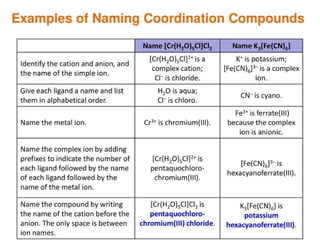
Examples of NamingCoordination Compounds
K4[Fe(CN)6]:Potassium hexacyanidoferrate (II)
[Ni(CN)4]−2
:Tetra cyanidonickelate (II) ion.
[Zn(OH)4]−2
:Tetra hydroxidozincate(II) ion.
[Ni(CO)4]: Tetra carbonyl Nickel (O).
[CO(NH3)4(H2O)2]Cl3:
Tetraamminediaquacobalt(IlI) chloride
[Cr(en)3]Cl3: Tris(ethane-1,2-diamine)
chromium(III) chloride
FORMULAS OF MONONUCLEARCOORDINATION ENTITIES:
• The following rules are applied while
writing the formulas:
• Central atom is listed first.
• Ligands are then listed in alphabetical
order. The placement of a ligand in the
list does not depend on its charge.
73.
• Polydentate ligandsare also listed
alphabetically. In case of abbreviated
ligand, the first letter of the abbreviation is
used to determine the position of the
ligand in the alphabetical order.
• The formula for the entire coordination
entity, whether charged or not, is enclosed
in square brackets. When ligands are
polyatomic, their formulas are enclosed in
parentheses. Ligand abbreviations are also
enclosed in parentheses.
74.
• There shouldbe no space between the ligands
and the metal within a coordination sphere.
• When the formula of a charged coordination
entity is to be written without that of the
counter ion, the charge is indicated outside
the square brackets as a right superscript with
the number before the sign. For example,
[Co(CN)6]3-
, [Cr(H2O)6]3+
, etc.
• The charge of the cation(s) is balanced by the
charge of the anion(s).
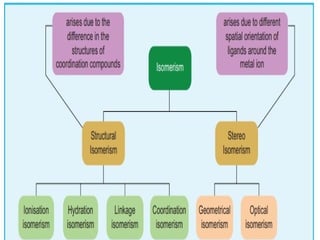
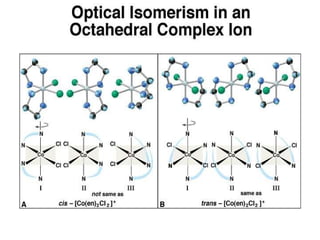
ISOMERISM IN COORDINATIONCOMPOUNDS
• Two or more compounds that have the
same chemical formula but a different
arrangement of atoms are known as
isomers. Due to this difference in the
arrangement of atoms, coordination
compounds pre-dominantly exhibit two
types of isomerism namely, stereo-
isomerism and structural isomerism.
78.
STRUCTURAL ISOMERISM
• Structuralisomerism is exhibited by the
coordination compounds having the
same chemical formula but a different
arrangement of atoms. These are further
divided into four types:
• 1. Linkage Isomerism
• 2. Coordination Isomerism
• 3. Ionisation Isomerism
• 4. Solvate Isomerism
79.
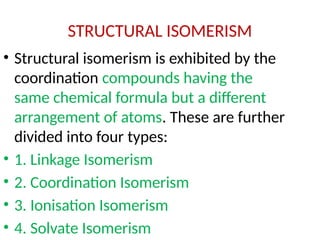
LINKAGE ISOMERISM
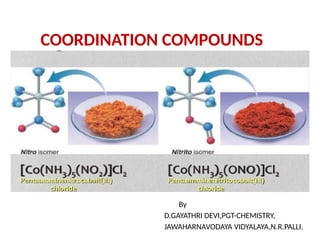
• Linkageisomerism is exhibited by
coordination compounds having
Ambidentate ligands, which may bind to
the central metal atom through different
atoms of the ligand like SCN& NCS, NO2
&ONO,etc.
• For example:[Co(NH3)5NO2]Cl2(RED)and
[Co(NH3)5ONO]Cl2(YELLOW)
81.
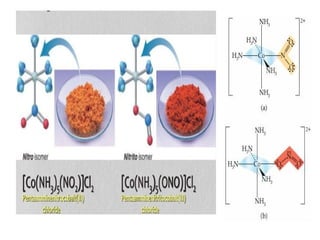
COORDINATION ISOMERISM
• Incoordination isomerism, the
interchange of ligands between
cationic and anionic entities of
different metal ions present in
coordination compounds takes place.
• For example: [Co(NH3)6][Cr(CN)6] and
[Cr(NH3)6][Co(CN)6].
83.
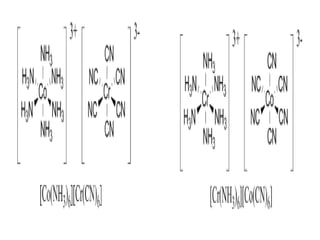
IONISATION ISOMERISM
• Ionisationisomerism arises when
the counter ion in a complex salt
which is a potential ligand replaces
the ligand.
• For example: [Co(NH3)5(SO4)]Br
and [Co(NH3)5Br]SO4.
SOLVATE ISOMERISM
Solvate isomersare a special case of
ionisation isomerism in which compounds
differ depending on the number of the
solvent molecules directly bonded to the
metal ion. If water molecules are the
solvent molecules present, it is called
HYDRATE ISOMERISM.
For example:CrCl3.6H2O
86.
EXAMPLE FOR SOLVATEAND HYDRATE ISOMERISM
• [Cr(H2O)4Cl2]Cl.2H2O - Bright green
Tetraaquadichlorochromium(III) chloride dihydrate
• [Cr(H2O)5Cl]Cl2.H2O - grey-green
Pentaaquachlorochromium(III) chloride
monohydrate
• [Cr(H2O)6]Cl3 - Violet
Hexaaquachromium(III) chloride
87.
STEREOISOMERISM
Coordination compounds whichhave
the same chemical formula
and chemical bonds but have different
spatial arrangement are known as
stereoisomers. These are further
divided into optical isomerism and
geometrical isomerism.
88.
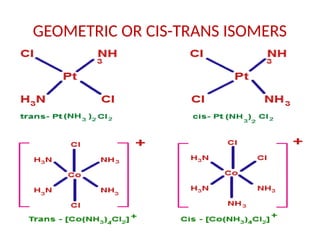
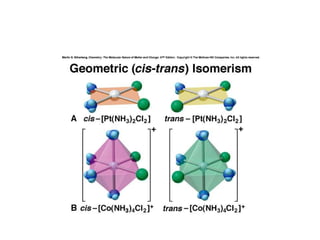
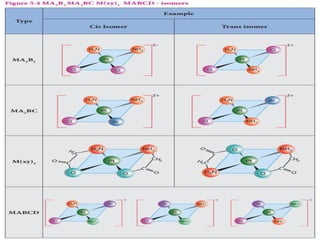
GEOMETRIC OR CIS-TRANSISOMERS
• Geometrical isomerism is observed in
heteroleptic complexes (complexes with
more than one type of ligands) due to
different possible geometric
arrangements of the ligands.
• This behaviour is mainly observed in
coordination compounds having
coordination numbers equal to 4 and 6.
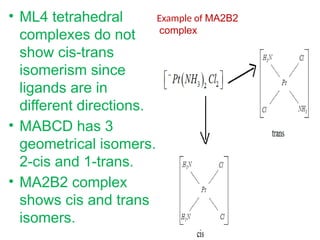
Example of MA2B2
complex
•ML4 tetrahedral
complexes do not
show cis-trans
isomerism since
ligands are in
different directions.
• MABCD has 3
geometrical isomers.
2-cis and 1-trans.
• MA2B2 complex
shows cis and trans
isomers.
93.
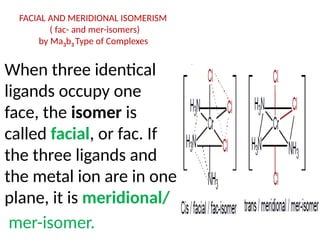
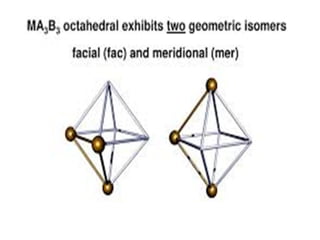
FACIAL AND MERIDIONALISOMERISM
( fac- and mer-isomers)
by Ma3b3 Type of Complexes
When three identical
ligands occupy one
face, the isomer is
called facial, or fac. If
the three ligands and
the metal ion are in one
plane, it is meridional/
mer-isomer.
Chemistry of
Coordination
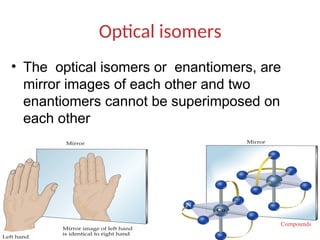
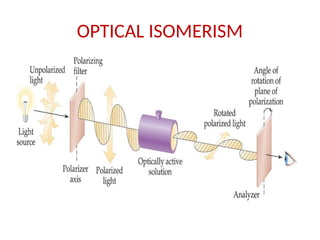
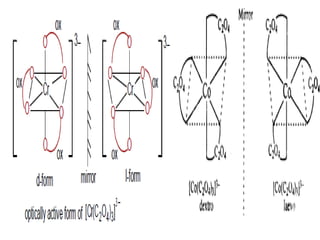
Optical isomers
•The optical isomers or enantiomers, are
mirror images of each other and two
enantiomers cannot be superimposed on
each other
Compounds
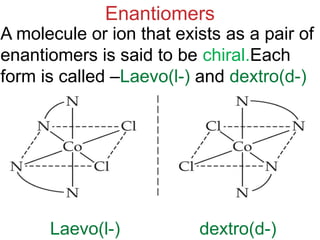
Enantiomers
A molecule orion that exists as a pair of
enantiomers is said to be chiral.Each
form is called –Laevo(l-) and dextro(d-)
Laevo(l-) dextro(d-)
101.
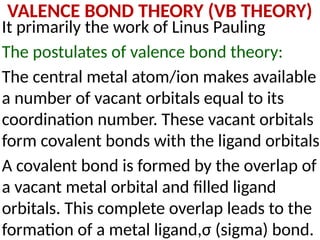
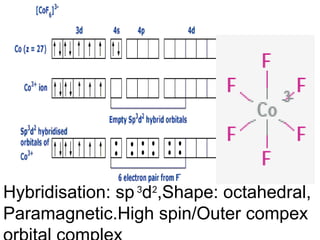
VALENCE BOND THEORY(VB THEORY)
It primarily the work of Linus Pauling
The postulates of valence bond theory:
The central metal atom/ion makes available
a number of vacant orbitals equal to its
coordination number. These vacant orbitals
form covalent bonds with the ligand orbitals.
A covalent bond is formed by the overlap of
a vacant metal orbital and filled ligand
orbitals. This complete overlap leads to the
formation of a metal ligand,σ (sigma) bond.
102.
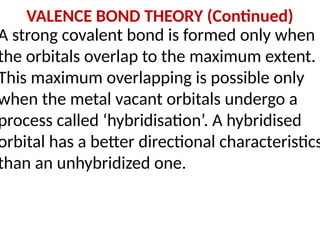
VALENCE BOND THEORY(Continued)
A strong covalent bond is formed only when
the orbitals overlap to the maximum extent.
This maximum overlapping is possible only
when the metal vacant orbitals undergo a
process called ‘hybridisation’. A hybridised
orbital has a better directional characteristics
than an unhybridized one.
103.
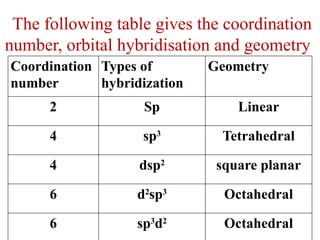
The following tablegives the coordination
number, orbital hybridisation and geometry
Coordination
number
Types of
hybridization
Geometry
2 Sp Linear
4 sp3
Tetrahedral
4 dsp2
square planar
6 d2
sp3
Octahedral
6 sp3
d2
Octahedral
105.
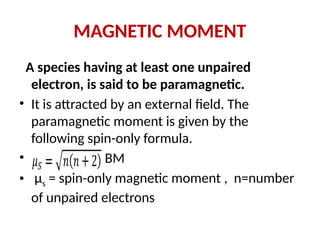
MAGNETIC MOMENT
A specieshaving at least one unpaired
electron, is said to be paramagnetic.
• It is attracted by an external field. The
paramagnetic moment is given by the
following spin-only formula.
• BM
• μs = spin-only magnetic moment , n=number
of unpaired electrons
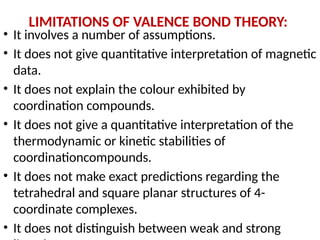
LIMITATIONS OF VALENCEBOND THEORY:
• It involves a number of assumptions.
• It does not give quantitative interpretation of magnetic
data.
• It does not explain the colour exhibited by
coordination compounds.
• It does not give a quantitative interpretation of the
thermodynamic or kinetic stabilities of
coordinationcompounds.
• It does not make exact predictions regarding the
tetrahedral and square planar structures of 4-
coordinate complexes.
• It does not distinguish between weak and strong
114.
CRYSTAL FIELD THEORY(CFT)
Main postulates of crystal field theory are
In a coordination compound there are
electrostatic interaction between metal
atom/ion and ligands. Ligand assumed to be
point charge
In an isolated metal atom or ion all five d-
orbitals have equal energy i.e. they are
degenerate
When metal atom/ion gets surrounded by
115.
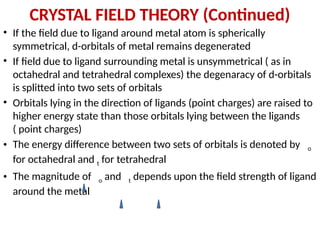
CRYSTAL FIELD THEORY(Continued)
• If the field due to ligand around metal atom is spherically
symmetrical, d-orbitals of metal remains degenerated
• If field due to ligand surrounding metal is unsymmetrical ( as in
octahedral and tetrahedral complexes) the degenaracy of d-orbitals
is splitted into two sets of orbitals
• Orbitals lying in the direction of ligands (point charges) are raised to
higher energy state than those orbitals lying between the ligands
( point charges)
• The energy difference between two sets of orbitals is denoted by o
for octahedral and t for tetrahedral
• The magnitude of o and t depends upon the field strength of ligand
around the metal
116.
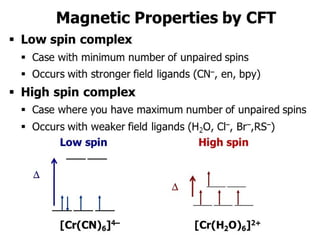
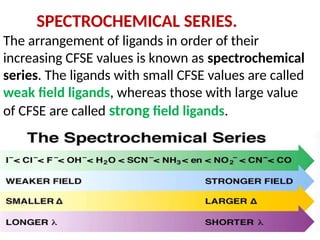
SPECTROCHEMICAL SERIES.
The arrangementof ligands in order of their
increasing CFSE values is known as spectrochemical
series. The ligands with small CFSE values are called
weak field ligands, whereas those with large value
of CFSE are called strong field ligands.
117.
• The spectrochemicalseries is an
experimentally determined series. It is
difficult to explain the order as it
incorporates both the effect of σ and π
bonding.
• A pattern of increasing σ donation is as
follows-
Halides donors < O donors < N donors <
C donors
118.
CRYSTAL FIELD SPLITTINGIN OCTAHEDRAL
COMPLEXES
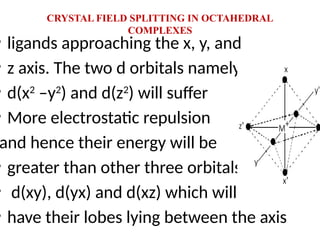
• ligands approaching the x, y, and
• z axis. The two d orbitals namely
• d(x2
–y2
) and d(z2
) will suffer
• More electrostatic repulsion
and hence their energy will be
• greater than other three orbitals
• d(xy), d(yx) and d(xz) which will
• have their lobes lying between the axis
119.
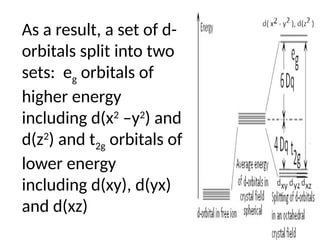
As a result,a set of d-
orbitals split into two
sets: eg orbitals of
higher energy
including d(x2
–y2
) and
d(z2
) and t2g orbitals of
lower energy
including d(xy), d(yx)
and d(xz)
120.
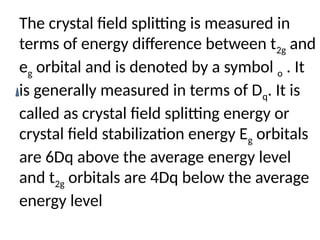
The crystal fieldsplitting is measured in
terms of energy difference between t2g and
eg orbital and is denoted by a symbol o . It
is generally measured in terms of Dq. It is
called as crystal field splitting energy or
crystal field stabilization energy Eg orbitals
are 6Dq above the average energy level
and t2g orbitals are 4Dq below the average
energy level
121.
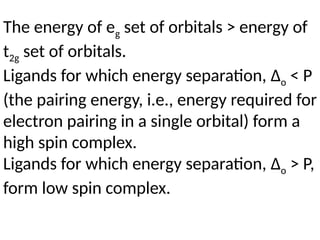
The energy ofeg set of orbitals > energy of
t2g set of orbitals.
Ligands for which energy separation, Δo < P
(the pairing energy, i.e., energy required for
electron pairing in a single orbital) form a
high spin complex.
Ligands for which energy separation, Δo > P,
form low spin complex.
122.
CRYSTAL FIELD SPLITTINGIN TETRAHEDRAL
COMPLEXES
(b) Crystal field splitting in
tetrahedral coordination
entities
In tetrahedral coordination
entity formation,the d
orbital splitting is inverted
and is smaller as
compared to the
octahedral field splitting.
123.
For the samemetal, the
same ligands and metal-
ligand distances, it can
be shown that Dt = (4/9) D0.
Consequently, the orbital
splitting energies are not
sufficiently large for forcing
pairing and therefore, low
spin configurations are
rarely
124.
• The energyof t2g set of orbitals >
Energy of eg set of orbitals.
• In such complexes d-orbital splitting is
inverted and is smaller as compared to
the octahedral field splitting.
No pairing of electrons is possible due
to the lowest splitting energies which
leads to high spin complexes.
125.
COLOUR IN COORDINATIONCOMPOUNDS
• Complexes in which central transition metal ion contains
unpaired electrons shows colour. It is ‘d – d’ transition.
• In coordination complexes energy difference (∆) between
two d-sets of d-orbitals is small. Radiations of appropriate
frequency absorbed from visible region can cause excitation
of d-electron from lower energy orbital to higher energy
orbital. Remaining light is transmitted and compound
appears coloured
• This frequency generally lies in the visible region. The colour
observed corresponds to the complementary colour of the
light absorbed. The frequency of the light absorbed is
determined by the nature of the ligand.
126.
THE FACTORS AFFECTINGTHE COLOUR OF COMPLEXES
Number of unpaired electrons in transition
metal ion
Nature of ligands
The oxidation state of central metal ion
The wavelength of light absorbed and emitted
The proportion of ligands in the coordination
sphere
Ex: [Ni(H2O)6]+2+en(aq)→[Ni(H2O)4en]+2
Green Pale blue
127.
• It isimportant to note that in the absence of
ligand, crystal field splitting does not occur
and hence the substance is colourless. For
e.g. removal of water from [Ti (H2O)6] Cl3 on
heating renders it colourless. Similarly,
anhydrous copper sulphate is white, but
copper sulphate pentahydrate is blue in
colour.
128.
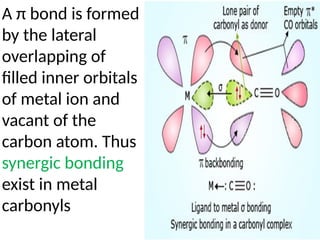
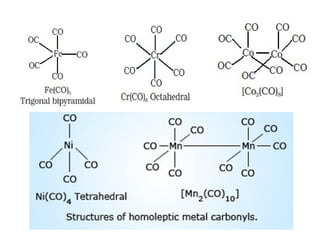
BONDING IN METALCOMPLEXES [METAL CARBONYLS]
• Complexes in which carbon monoxide
acts as ligands are metal carbonyls
• Example: [Ni(CO)4] Tetracarbonyl Nickel
(0) and [Fe(CO)5] Penta Carbonyl Iron (0)
In these complexes, complexes, a σ‘ bond
′
is formed by the overlapping of vacant ‘d’
orbital of metal ion and filled orbital of C-
atom (carbon).
129.
A π bondis formed
by the lateral
overlapping of
filled inner orbitals
of metal ion and
vacant of the
carbon atom. Thus
synergic bonding
exist in metal
carbonyls
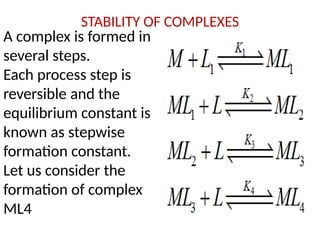
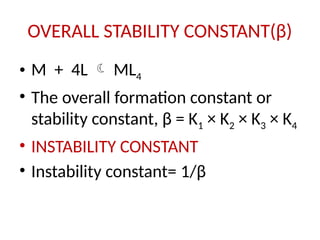
131.
STABILITY OF COMPLEXES
Acomplex is formed in
several steps.
Each process step is
reversible and the
equilibrium constant is
known as stepwise
formation constant.
Let us consider the
formation of complex
ML4
The factors onwhich stability of the
complex depends :
(i) Charge on the central metal atom As
the magnitude of charge on metal atom
increases, stability of the complex
increases.
(ii) Nature of metal ion The stability order
is 3d < 4d < 5d series.
(iii) Basic nature of ligands Strong field
ligands form stable complex.
134.
APPLICATIONS OF COORDINATIONCOMPOUNDS
• The colour of the coordination compounds
containing transition metals causes them to
be extensively used in industries for the
colouration of materials. They find
applications in the dye and pigment
industries.
135.
• Some complexcompounds containing
cyanide as a ligand are used in the
process of electroplating. These
compounds are also very useful in
photography.
• Coordination complexes are very useful
in the extraction of many metals from
their ores. For example, nickel and cobalt
can be extracted from their ores via
hydro- metallurgical processes involving
ions of coordination compounds.
136.
APPLICATIONS IN BIOLOGY
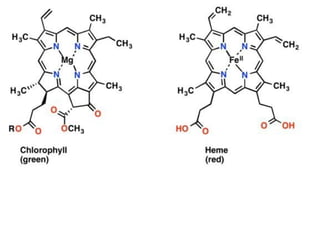
•Haemoglobin consists of Haeme complex-
ion which has tetrapyrrole Porphyrin ring
structure with central Fe2+
ion.
• Vitamin B12 consists of tetrapyrrole
porphyrin ring complex with central
Co+3
ion and its coordination number is 6.
137.
APPLICATIONS IN LABORATORY
•Ni+2
is estimated using a complexing agent
Dimethylglyoxime (DMG). The hardness of
water is estimated using complexes of Ca++
, Mg+
+
with ED↑A
• In Medicine: Cisplatin is used in the treatment
of cancer.
• In Photography: Developing of the film involves
complex formation.
• In Metallurgy: In the extraction of gold, silver
by Mac Arthur Forest Process involves a
complex of cyanide ions.
138.
BEYOND THE TEXTBOOK
• EFFECTIVE ATOMIC NUMBER (EAN)
• The sum of the number of electrons, donated by all ligands and those present
on the central metal ion or atom in complex is called as effective atomic number
(EAN).
• • Generally EAN of central metal ion will be equal to the number of electrons in
the nearest noble gas.
• • If the EAN of the central metal is equal to the number of electrons in the nearest
noble gas then the complex possess greater stability.
• EAN = [(atomic number of central metal) – (the oxidation state of the metal) + (the
number of electrons gained by the metal from the ligands through co-ordination)]
• EAN= [Z metal – (ox.state of the metal) + 2(coordination number of the metal)].
• for example.
[Co(NH3)6]3+ →EAN = [27 – 3 + 2(6)] = 36
![• ii) Coordination (or complex)
compounds : Coordination compound
is a compound formed from a Lewis
acid and a Lewis base. The molecular
compounds, do not dissociate into its
constituent ions in solution are called
coordination compounds.
• Example : Fe(CN)2 + 4KCN → Fe(CN)2 .
4KCN (or) K4[Fe(CN)6] Ferrous cyanide](https://image.slidesharecdn.com/bynvsteachercoordinationcompounds-251224123806-aa6f2ec0/85/by-nvs-teacher-COORDINATION-COMPOUNDS-pptx-6-320.jpg)
![Coordination (or complex) compounds
• K4[Fe(CN)6] →4K+
+ [Fe(CN)6]4-
Complex anion
• In K4[Fe (CN)6] the individual components
lose their identity.
• The metal of the complex ion is not free in
solution unlike metal in double salt in
solution.](https://image.slidesharecdn.com/bynvsteachercoordinationcompounds-251224123806-aa6f2ec0/85/by-nvs-teacher-COORDINATION-COMPOUNDS-pptx-7-320.jpg)
![DOUBLE SALTS
They completely ionise in
aqueous solutions and
each ion in the solution
gives the corresponding
confirmatory test.
Example: Potash Alum is
double sulphate
K2SO4.Al2 (SO4)3.24H2O
on Ionization it gives:K+
,
SO4
−2
and Al+3
ions which
response to the
COORDINATION COMPLEX
Co-ordinate complexes ar
incompletely ionizable in
the aqueous solutions.
These give a complexion
which does not show
complete ionization.
• Example: Potassium
Ferrocyanide. [K4Fe(CN)6]
ionizes to give K+
and
[Fe(CN)6]−4
[ferro cyanide
ions]](https://image.slidesharecdn.com/bynvsteachercoordinationcompounds-251224123806-aa6f2ec0/85/by-nvs-teacher-COORDINATION-COMPOUNDS-pptx-8-320.jpg)
![COORDINATION ENTITY
A chemical compound in which the
central ion or atom (or the
coordination centre) is bound to a set
number of atoms, molecules, or ions is
called a coordination entity.
Some examples of such coordination
entities include [CoCl3 (NH3)3] and
[Fe(CN)6]4-
.](https://image.slidesharecdn.com/bynvsteachercoordinationcompounds-251224123806-aa6f2ec0/85/by-nvs-teacher-COORDINATION-COMPOUNDS-pptx-22-320.jpg)
![COORDINATION NUMBER
The coordination numberof the central
atom in the coordination compound
refers to the total number of bonds
through which the ligands are bound to
the coordination centre.
For example, in the coordination
complex given by [Ni(NH3)4]2+
,
the coordination number of nickel is 4.](https://image.slidesharecdn.com/bynvsteachercoordinationcompounds-251224123806-aa6f2ec0/85/by-nvs-teacher-COORDINATION-COMPOUNDS-pptx-46-320.jpg)
![COORDINATION SPHERE
• The non-ionizable part of a complex compound which
consists of central transition metal ion surrounded by
neighbouring atoms or groups enclosed in square
bracket.
• The coordination centre, the ligands attached to the
coordination centre, and the net charge of the
chemical compound as a whole, form
the coordination sphere when written together.
• This coordination sphere is usually accompanied by a
counter ion (the ionizable groups that attach to
charged coordination complexes).
• Example: [Co(NH3)6]Cl3](https://image.slidesharecdn.com/bynvsteachercoordinationcompounds-251224123806-aa6f2ec0/85/by-nvs-teacher-COORDINATION-COMPOUNDS-pptx-48-320.jpg)
![OXIDATION NUMBER
The oxidation number of the central
atom can be calculated by finding the
charge associated with it when all the
electron pairs that are donated by the
ligands are removed from it.
For example, the oxidation number of
the platinum atom in the complex
[PtCl6]2-
is +4.](https://image.slidesharecdn.com/bynvsteachercoordinationcompounds-251224123806-aa6f2ec0/85/by-nvs-teacher-COORDINATION-COMPOUNDS-pptx-52-320.jpg)
![HOMOLEPTIC AND HETEROLEPTIC COMPLEX
When the coordination centre is bound to
only one type of electron pair donating
ligand group, the coordination complex is
called a homoleptic complex, for example:
[Cu(CN)4]3-
.
When the central atom is bound to many
different types of ligands, the coordination
compound in question is called
a heteroleptic complex, an example for
which is [Co(NH3)4Cl2]+
.](https://image.slidesharecdn.com/bynvsteachercoordinationcompounds-251224123806-aa6f2ec0/85/by-nvs-teacher-COORDINATION-COMPOUNDS-pptx-54-320.jpg)
![DOUBLE SALTS
They completely ionise in
aqueous solutions and
each ion in the solution
gives the corresponding
confirmatory test.
Example: Potash Alum is
double sulphate
K2SO4.Al2 (SO4)3.24H2O
on Ionization it gives:K+
,
SO4
−2
and Al+3
ions which
response to the
COORDINATION COMPLEX
Co-ordinate complexes ar
incompletely ionizable in
the aqueous solutions.
These give a complexion
which does not show
complete ionization.
• Example: Potassium
Ferrocyanide. [K4Fe(CN)6]
ionizes to give K+
and
[Fe(CN)6]−4
[ferro cyanide
ions]](https://image.slidesharecdn.com/bynvsteachercoordinationcompounds-251224123806-aa6f2ec0/85/by-nvs-teacher-COORDINATION-COMPOUNDS-pptx-58-320.jpg)
![TYPES OF COORDINATION COMPLEXES
based on whether complex ion is a cation/anion
• 1.Cationic complexes: In this co-ordination
sphere is a cation. Example: [Co(NH3)6]Cl3
• 2.Anionic complexes: In this co-ordination
sphere is Anion. Example: K4[Fe(CH)6]
• 3.Neutral Complexes: In this co-ordination
sphere is neither cation or anion. Example:
[Ni(CO)4]](https://image.slidesharecdn.com/bynvsteachercoordinationcompounds-251224123806-aa6f2ec0/85/by-nvs-teacher-COORDINATION-COMPOUNDS-pptx-59-320.jpg)
![TYPES OF COORDINATION COMPLEXES
based on whether complex ion is a
cation/anion
• Mononuclear complexes: In this co-ordination
sphere has single transition metal ion. Example:
K4[Fe(CN)6]
• Polynuclear complexes:
• More than one transition
• metal ion is present.
• Example:](https://image.slidesharecdn.com/bynvsteachercoordinationcompounds-251224123806-aa6f2ec0/85/by-nvs-teacher-COORDINATION-COMPOUNDS-pptx-60-320.jpg)
![TYPES OF COORDINATION COMPLEXES
based on the types of ligands present
• Homoleptic complex: The complex
consist of a similar type of ligands.
Example: K4[Fe(CN)6]
• Heteroleptic complexes: These
consists of different types of ligands.
Example: [Co(NH3)5Cl]SO4](https://image.slidesharecdn.com/bynvsteachercoordinationcompounds-251224123806-aa6f2ec0/85/by-nvs-teacher-COORDINATION-COMPOUNDS-pptx-61-320.jpg)
![Examples of Naming Coordination Compounds
K4[Fe(CN)6]:Potassium hexacyanidoferrate (II)
[Ni(CN)4]−2
:Tetra cyanidonickelate (II) ion.
[Zn(OH)4]−2
:Tetra hydroxidozincate(II) ion.
[Ni(CO)4]: Tetra carbonyl Nickel (O).
[CO(NH3)4(H2O)2]Cl3:
Tetraamminediaquacobalt(IlI) chloride
[Cr(en)3]Cl3: Tris(ethane-1,2-diamine)
chromium(III) chloride](https://image.slidesharecdn.com/bynvsteachercoordinationcompounds-251224123806-aa6f2ec0/85/by-nvs-teacher-COORDINATION-COMPOUNDS-pptx-68-320.jpg)
![IUPAC NAMES OF SOME COORDINATION COMPOUNDS
[Co (NH3)4(H2O)2] Cl3 = Tetraamminediaquacobalt(III) chloride
[Cr(en)3] Cl3 = Tris(ethane-1,2-diamine)chromium(III) chloride
[Pt(NH3)BrCl(NO2)]-
= Amminebromidochloridonitrito-N-platinate(II)
[PtCl2(en)2](NO3)2 = Dichloridobis(ethane-1,2-diamine)platinum(IV) nitrate
(NH4)3[Cr(SCN)6] = Ammonium hexathiocyanato-S-chromate(III)
Na2[Cr(CH3COO)4(en)] = Sodium ethylenediaminetetraacetatochromate(II)
[Co(NH3)5(CO3)]Cl = Pentaamminecarbonatocobalt(III) chloride
[Pt(py)4][PtCl4] = Tetrapyridineplatinum(II)tetrachloridoplatinate(II)
(NH4)3[Cr(SCN)6] = Ammonium hexathiocyanato-S-chromate(III)
Na2[Cr(CH3COO)4(en)] = Sodium ethylenediaminetetraacetatochromate(II)
[Co(NH3)5(CO3)]Cl = Pentaamminecarbonatocobalt(III) chloride
[Pt(py)4][PtCl4] = Tetrapyridineplatinum(II)tetrachloridoplatinate(II)
•](https://image.slidesharecdn.com/bynvsteachercoordinationcompounds-251224123806-aa6f2ec0/85/by-nvs-teacher-COORDINATION-COMPOUNDS-pptx-70-320.jpg)
![[Co(NH3)4Cl2]3[Cr(CN)6] =
Tetraamminedichloridocobalt(III)hexacyanochromate(III)
Na2[Fe(CN)5NO] = Sodium pentacyanonitrosoniumferrate(II)
K3[Co(CN)5NO] = Potassium pentacyanonitrosylcobaltate(II)
Na2[CrF4O] = Sodium tetrafluoridooxochromate(IV)
[Cr(H2O)4Cl2]NO3 = Tetraaquadichloridochromium(III) nitrate
(NH4)3[Cr(SCN)6] = Ammonium hexathiocyanato-S-chromate(III)
Na2[Cr(CH3COO)4(en)] =
Sodium ethylenediaminetetraacetatochromate(II)
[Co(NH3)5(CO3)]Cl = Pentaamminecarbonatocobalt(III) chloride
[Pt(py)4][PtCl4] =
Tetrapyridineplatinum(II)tetrachloridoplatinate(II)](https://image.slidesharecdn.com/bynvsteachercoordinationcompounds-251224123806-aa6f2ec0/85/by-nvs-teacher-COORDINATION-COMPOUNDS-pptx-71-320.jpg)
![• There should be no space between the ligands
and the metal within a coordination sphere.
• When the formula of a charged coordination
entity is to be written without that of the
counter ion, the charge is indicated outside
the square brackets as a right superscript with
the number before the sign. For example,
[Co(CN)6]3-
, [Cr(H2O)6]3+
, etc.
• The charge of the cation(s) is balanced by the
charge of the anion(s).](https://image.slidesharecdn.com/bynvsteachercoordinationcompounds-251224123806-aa6f2ec0/85/by-nvs-teacher-COORDINATION-COMPOUNDS-pptx-74-320.jpg)
![ISOMERISM
IN
COORDINATION COMPOUNDS
[Co(H2O)4Cl2]+](https://image.slidesharecdn.com/bynvsteachercoordinationcompounds-251224123806-aa6f2ec0/85/by-nvs-teacher-COORDINATION-COMPOUNDS-pptx-75-320.jpg)
![LINKAGE ISOMERISM
• Linkage isomerism is exhibited by
coordination compounds having
Ambidentate ligands, which may bind to
the central metal atom through different
atoms of the ligand like SCN& NCS, NO2
&ONO,etc.
• For example:[Co(NH3)5NO2]Cl2(RED)and
[Co(NH3)5ONO]Cl2(YELLOW)](https://image.slidesharecdn.com/bynvsteachercoordinationcompounds-251224123806-aa6f2ec0/85/by-nvs-teacher-COORDINATION-COMPOUNDS-pptx-79-320.jpg)
![COORDINATION ISOMERISM
• In coordination isomerism, the
interchange of ligands between
cationic and anionic entities of
different metal ions present in
coordination compounds takes place.
• For example: [Co(NH3)6][Cr(CN)6] and
[Cr(NH3)6][Co(CN)6].](https://image.slidesharecdn.com/bynvsteachercoordinationcompounds-251224123806-aa6f2ec0/85/by-nvs-teacher-COORDINATION-COMPOUNDS-pptx-81-320.jpg)
![IONISATION ISOMERISM
• Ionisation isomerism arises when
the counter ion in a complex salt
which is a potential ligand replaces
the ligand.
• For example: [Co(NH3)5(SO4)]Br
and [Co(NH3)5Br]SO4.](https://image.slidesharecdn.com/bynvsteachercoordinationcompounds-251224123806-aa6f2ec0/85/by-nvs-teacher-COORDINATION-COMPOUNDS-pptx-83-320.jpg)
![EXAMPLE FOR SOLVATE AND HYDRATE ISOMERISM
• [Cr(H2O)4Cl2]Cl.2H2O - Bright green
Tetraaquadichlorochromium(III) chloride dihydrate
• [Cr(H2O)5Cl]Cl2.H2O - grey-green
Pentaaquachlorochromium(III) chloride
monohydrate
• [Cr(H2O)6]Cl3 - Violet
Hexaaquachromium(III) chloride](https://image.slidesharecdn.com/bynvsteachercoordinationcompounds-251224123806-aa6f2ec0/85/by-nvs-teacher-COORDINATION-COMPOUNDS-pptx-86-320.jpg)
![[Co(NH3)3 (NO2)3] [CoCl3(CN)3]](https://image.slidesharecdn.com/bynvsteachercoordinationcompounds-251224123806-aa6f2ec0/85/by-nvs-teacher-COORDINATION-COMPOUNDS-pptx-95-320.jpg)
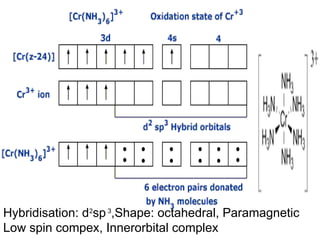
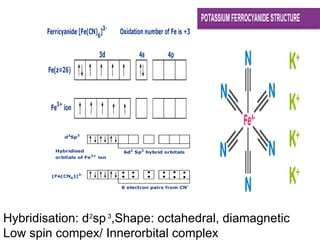
![[Co(NH3)6]3+
Hybridisation: d2
sp3
,Shape: octahedral,
Diamagnetic,Low spin compex,
Innerorbital complex](https://image.slidesharecdn.com/bynvsteachercoordinationcompounds-251224123806-aa6f2ec0/85/by-nvs-teacher-COORDINATION-COMPOUNDS-pptx-107-320.jpg)
![Hybridisation: sp3
,Shape: tetrahedral,
Paramagnetic,Low spin compex,
Innerorbital complex
[Ni(Cl4]2-](https://image.slidesharecdn.com/bynvsteachercoordinationcompounds-251224123806-aa6f2ec0/85/by-nvs-teacher-COORDINATION-COMPOUNDS-pptx-109-320.jpg)
![Hybridisation: dsp2
,Shape: Square
planar, Diamagnetic,Low spin compex,
Innerorbital complex
[Ni(CN4]2-](https://image.slidesharecdn.com/bynvsteachercoordinationcompounds-251224123806-aa6f2ec0/85/by-nvs-teacher-COORDINATION-COMPOUNDS-pptx-110-320.jpg)
![THE FACTORS AFFECTING THE COLOUR OF COMPLEXES
Number of unpaired electrons in transition
metal ion
Nature of ligands
The oxidation state of central metal ion
The wavelength of light absorbed and emitted
The proportion of ligands in the coordination
sphere
Ex: [Ni(H2O)6]+2+en(aq)→[Ni(H2O)4en]+2
Green Pale blue](https://image.slidesharecdn.com/bynvsteachercoordinationcompounds-251224123806-aa6f2ec0/85/by-nvs-teacher-COORDINATION-COMPOUNDS-pptx-126-320.jpg)
![• It is important to note that in the absence of
ligand, crystal field splitting does not occur
and hence the substance is colourless. For
e.g. removal of water from [Ti (H2O)6] Cl3 on
heating renders it colourless. Similarly,
anhydrous copper sulphate is white, but
copper sulphate pentahydrate is blue in
colour.](https://image.slidesharecdn.com/bynvsteachercoordinationcompounds-251224123806-aa6f2ec0/85/by-nvs-teacher-COORDINATION-COMPOUNDS-pptx-127-320.jpg)
![BONDING IN METAL COMPLEXES [METAL CARBONYLS]
• Complexes in which carbon monoxide
acts as ligands are metal carbonyls
• Example: [Ni(CO)4] Tetracarbonyl Nickel
(0) and [Fe(CO)5] Penta Carbonyl Iron (0)
In these complexes, complexes, a σ‘ bond
′
is formed by the overlapping of vacant ‘d’
orbital of metal ion and filled orbital of C-
atom (carbon).](https://image.slidesharecdn.com/bynvsteachercoordinationcompounds-251224123806-aa6f2ec0/85/by-nvs-teacher-COORDINATION-COMPOUNDS-pptx-128-320.jpg)
![BEYOND THE TEXT BOOK
• EFFECTIVE ATOMIC NUMBER (EAN)
• The sum of the number of electrons, donated by all ligands and those present
on the central metal ion or atom in complex is called as effective atomic number
(EAN).
• • Generally EAN of central metal ion will be equal to the number of electrons in
the nearest noble gas.
• • If the EAN of the central metal is equal to the number of electrons in the nearest
noble gas then the complex possess greater stability.
• EAN = [(atomic number of central metal) – (the oxidation state of the metal) + (the
number of electrons gained by the metal from the ligands through co-ordination)]
• EAN= [Z metal – (ox.state of the metal) + 2(coordination number of the metal)].
• for example.
[Co(NH3)6]3+ →EAN = [27 – 3 + 2(6)] = 36](https://image.slidesharecdn.com/bynvsteachercoordinationcompounds-251224123806-aa6f2ec0/85/by-nvs-teacher-COORDINATION-COMPOUNDS-pptx-138-320.jpg)


![Theory of coordination_compounds[1]](https://cdn.slidesharecdn.com/ss_thumbnails/theoryofcoordinationcompounds1-171130080838-thumbnail.jpg?width=640&height=640&fit=bounds)


