Objective
s:
Participants will:
learn the elements of
cooperative learning
Learn what is takes for
students to work successfully
in cooperative groups
Identify ways to implement
Cooperative Learning
strategies into the classroom
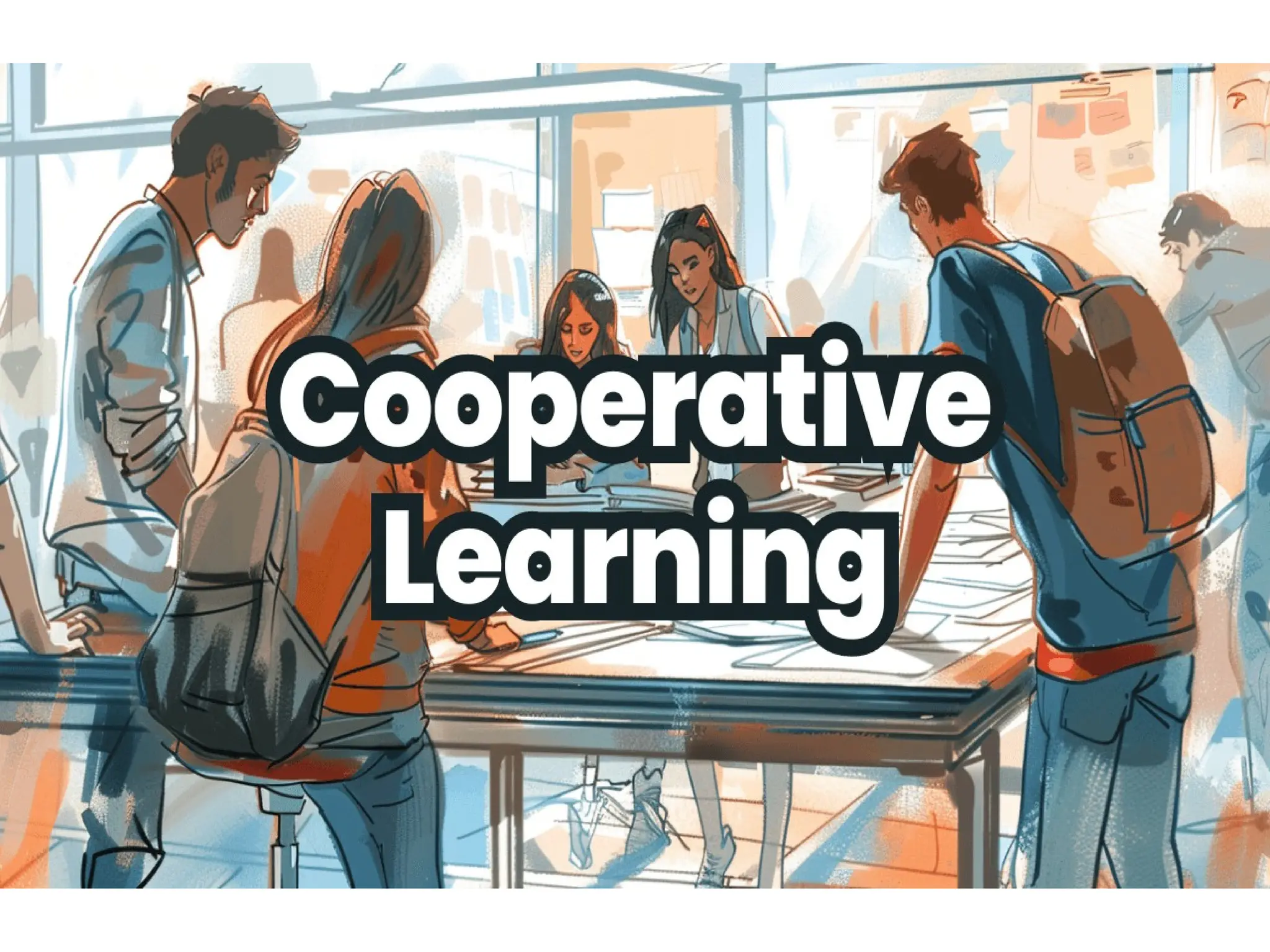
Cooperativ
e Learning
Working together
towards a common
goal
Discussi
on
Questio
n
Table Talk
Activity:
Think about your own
experiences with cooperative
learning as both a learner and
as a teacher.
What is
Cooperativ
e
Learning?
Cooperative Learning refers
to a set of instructional
methods in which students
work in small, mixed-ability
learning teams.
The students in each team
are responsible not only for
learning the material being
taught, but also for helping
their teammates learn.
What is
Cooperativ
e
Learning?
 Cooperative learning is the
instructional use of small
groups so that students work
together to maximize their own
and each other's learning
(Johnson, Johnson, & Holubec,
1993).
 Within cooperative learning
groups students discuss the
material to be learned with each
other, help and assist each other
to understand it, and encourage
each other to work hard.
What is
Cooperativ
e
Learning?
Cooperative learning
groups may be used:
Formal cooperative learning groups
– to teach specific content:
Informal cooperative learning groups
- to ensure active cognitive
processing of information
during a lecture or demonstration
Cooperative base groups
- to provide long-term
support and assistance for
academic progress
Benefits of
Cooperativ
e Learning
•promotes student
achievement
•Increases retention of
knowledge
•Student happiness increased
for learning experience
•develops oral communication
•deepens students' social skills
•promote student self-esteem
FORMAL COOPERATIVE
LEARNING
Basic Components of
Cooperative Learning
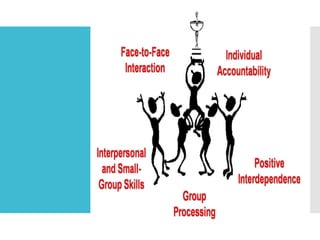
1. Positive Interdependence
(Sense of “sink or swim” together)
2. Face-to-Face Promotive interaction (Helping
each other learn, applauding efforts and success)
3. Individual and group accountability (Each of
us has to contribute to the group achieving its
goal)
4. Interpersonal and small group skills
(Communication, trust, leadership, decision
making, conflict resolution)
5. Group processing (Reflecting on how well the
team is functioning and how to function even
better)
Positive
Inter -
dependenc
e
Face-to-
Face
Promotive
interaction
Individual
and group
accountabili
ty
Interperson
al and small
group skills
Group
processing
Key
Point
# 1
Cooperative Learning is a
flexible and powerful
instructional strategy that
should be used consistently
and systematically, but is
should not be overused.
Key
Point
# 2
Teachers should ensure that the
tasks they assign to formal
cooperative learning groups
address the five components of
cooperative learning:
1. Positive interdependence
2. Face-to-face promotive interaction
3. Individual and group accountability
4. Interpersonal and small group skills
5. Group Processing
Key
Point
# 3
Teachers should use a
variety of criteria for
grouping students and
a variety of grouping
structures (i.e.,
informal, formal and
base groups).
Key
Point
# 4
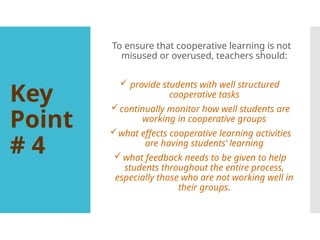
To ensure that cooperative learning is not
misused or overused, teachers should:
 provide students with well structured
cooperative tasks
continually monitor how well students are
working in cooperative groups
what effects cooperative learning activities
are having students’ learning
 what feedback needs to be given to help
students throughout the entire process,
especially those who are not working well in
their groups.
Cooperative_Learn2ing.pp3242342t23423423

Cooperative_Learn2ing.pp3242342t23423423

  • 2.
    Objective s: Participants will: learn theelements of cooperative learning Learn what is takes for students to work successfully in cooperative groups Identify ways to implement Cooperative Learning strategies into the classroom
  • 3.
  • 4.
    Discussi on Questio n Table Talk Activity: Think aboutyour own experiences with cooperative learning as both a learner and as a teacher.
  • 5.
    What is Cooperativ e Learning? Cooperative Learningrefers to a set of instructional methods in which students work in small, mixed-ability learning teams. The students in each team are responsible not only for learning the material being taught, but also for helping their teammates learn.
  • 6.
    What is Cooperativ e Learning?  Cooperativelearning is the instructional use of small groups so that students work together to maximize their own and each other's learning (Johnson, Johnson, & Holubec, 1993).  Within cooperative learning groups students discuss the material to be learned with each other, help and assist each other to understand it, and encourage each other to work hard.
  • 7.
    What is Cooperativ e Learning? Cooperative learning groupsmay be used: Formal cooperative learning groups – to teach specific content: Informal cooperative learning groups - to ensure active cognitive processing of information during a lecture or demonstration Cooperative base groups - to provide long-term support and assistance for academic progress
  • 8.
    Benefits of Cooperativ e Learning •promotesstudent achievement •Increases retention of knowledge •Student happiness increased for learning experience •develops oral communication •deepens students' social skills •promote student self-esteem
  • 9.
    FORMAL COOPERATIVE LEARNING Basic Componentsof Cooperative Learning 1. Positive Interdependence (Sense of “sink or swim” together) 2. Face-to-Face Promotive interaction (Helping each other learn, applauding efforts and success) 3. Individual and group accountability (Each of us has to contribute to the group achieving its goal) 4. Interpersonal and small group skills (Communication, trust, leadership, decision making, conflict resolution) 5. Group processing (Reflecting on how well the team is functioning and how to function even better)
  • 10.
  • 11.
  • 12.
  • 13.
  • 14.
  • 16.
    Key Point # 1 Cooperative Learningis a flexible and powerful instructional strategy that should be used consistently and systematically, but is should not be overused.
  • 17.
    Key Point # 2 Teachers shouldensure that the tasks they assign to formal cooperative learning groups address the five components of cooperative learning: 1. Positive interdependence 2. Face-to-face promotive interaction 3. Individual and group accountability 4. Interpersonal and small group skills 5. Group Processing
  • 18.
    Key Point # 3 Teachers shoulduse a variety of criteria for grouping students and a variety of grouping structures (i.e., informal, formal and base groups).
  • 19.
    Key Point # 4 To ensurethat cooperative learning is not misused or overused, teachers should:  provide students with well structured cooperative tasks continually monitor how well students are working in cooperative groups what effects cooperative learning activities are having students’ learning  what feedback needs to be given to help students throughout the entire process, especially those who are not working well in their groups.

Editor's Notes

  • #2 Review slide
  • #4 Group Activity
  • #7 EXPLAIN: It is based on the information from the research that varying the grouping patterns within a classroom provide students with opportunities to interact with more of their classmates. This can have a number of benefits, including providing students with different perspectives and appreciation for the variety of talents in the room. Informal groups: pair-share, turn to your neighbor, are groups that last a short period of time – few minutes to a full class period. Use informal groups to: Clarify expectations for a task To focus students’ attention To allow students time to process information Or to provide time for closure FORMAL GROUPS: Generally last for an extended period of time, such as several days or even weeks. Formal groups ensure that students have enough time to thoroughly complete an academic assignment. When using formal groups, include the 5 basic components of cooperative learning. We will learn more about those 5 components in the upcoming slides. BASE GROUPS: These groups are long-term groups that provide students with support throughout a semester or an academic year. Base groups help to build camaraderie and create a sense of teamwork and trust. Useful for carrying out routine tasks, (making sure homework assignments have been recorded or signing up for lunch choices as well as planning and participating in activities and practicing complicated multi-step processes such as writing.
  • #9 Review the components one at a time May be necessary to teach students about each of these components. Teachers can design activities to emphasize each element as it is introduced. Providing rubrics are one way to help students develop these skills.
  • #10 Each group member depends on each other to accomplish a shared goal or task. Without the help of on members, the group is not able to reach desired goal. Students must feel they need each other in order to complete the group’s task Mutual Goals Joint Rewards Shared Materials and Information Assigned Roles
  • #11 Orally explaining how to solve problems Teaching one’s knowledge to others Checking for understanding Discussing concepts being learned Connecting present with past learning Discussing Summarizing Explaining Elaborating Receiving Feedback
  • #12 Keeping the size of the group small. The smaller the size of the group, the greater the individual accountability may be. Randomly examining student orally by calling on one student to present his or her group’s work To the teacher or to the entire class Observing each group and recording the frequency with which each member – contributes to The group’s activity Teams succeed when: Every member has learned the material Every member has helped complete tasks Frequently teachers assess individual learning
  • #13 Social Skills must be taught… We are all participating Some are listening, and some are speaking Some get to recite, others get to coach Sometimes, we all are doing part of an activity at the same time Communication Leadership Decision-making Conflict Management Active Listening Challenging Ideas Not People Compromising
  • #14 Group members discuss how well they are achieving their goals and maintaining effective working relationships Describe what member actions are helpful and not helpful Make decisions about what behaviors to continue or change Giving students the time and the procedures to analyze how well their teams are functioning with: Learning tasks Social skills Self-assessment
  • #16 Review slide
  • #17 Review Slide
  • #18 Review slide
  • #19 Review slide