*
*
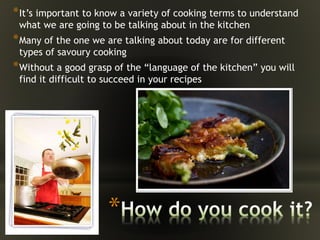
*It’s important to know a variety of cooking terms to understand
what we are going to be talking about in the kitchen
*Many of the one we are talking about today are for different
types of savoury cooking
*Without a good grasp of the “language of the kitchen” you will
find it difficult to succeed in your recipes
*
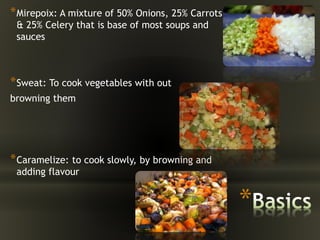
*Mirepoix: A mixture of 50% Onions, 25% Carrots
& 25% Celery that is base of most soups and
sauces
*Sweat: To cook vegetables with out
browning them
*Caramelize: to cook slowly, by browning and
adding flavour
*
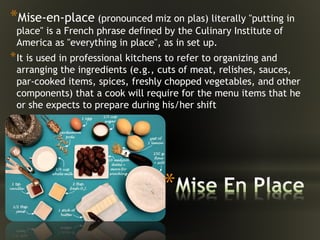
*Mise-en-place (pronounced miz on plas) literally "putting in
place" is a French phrase defined by the Culinary Institute of
America as "everything in place", as in set up.
*It is used in professional kitchens to refer to organizing and
arranging the ingredients (e.g., cuts of meat, relishes, sauces,
par-cooked items, spices, freshly chopped vegetables, and other
components) that a cook will require for the menu items that he
or she expects to prepare during his/her shift
*
*Typically the parts of an animal that move more are tougher and
require more cooking time at a low temperature. Parts that
move less are cooked quickly at a high heat
*
*
*Meat always need to be season prior to roasting, get all sides
*Trim excess fat away, so that just a thin layer remains
*Excessively try meat can be moistened by “barding”
*Sometime a large roast is cooked on a bed of mirepoix, to add
flavour and to provide a platform to keep it out of roasting
juices
*Larger roasts are started at high temps and finished at a lower
temps (typically 275-300ºF) for a long cooking time, usually 15-
20 minutes/ pound
*Thermometers are used to determine doneness, but be aware
of carry over cooking once out of the oven
*Always rest the meat before slicing
*Almost all vegetables can be roasted,
but tougher root vegetables are best
*
*Only super tender cuts should be used for grilling or
broiling due to the high heat that quickly chars the
outside. Cuts like tenderloin, loin, chops, any part of
poultry
*Seasoning should be done as close to cooking time a
possible
*Your meat or vegetables should be free of any moisture
Smoking, which is classic
BBQ technique can be used
for tougher cuts like shoulder
and ribs, but is done a around
200F and for several hours
*
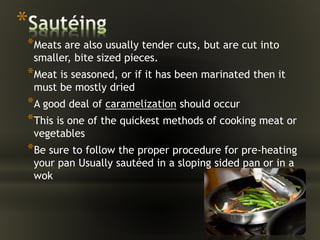
*Meats are also usually tender cuts, but are cut into
smaller, bite sized pieces.
*Meat is seasoned, or if it has been marinated then it
must be mostly dried
*A good deal of caramelization should occur
*This is one of the quickest methods of cooking meat or
vegetables
*Be sure to follow the proper procedure for pre-heating
your pan Usually sautéed in a sloping sided pan or in a
wok
*
*Tender meat are chosen due to the dry heat cooking
methods quick time frame
*Meats are often pounded to get a thinner faster cooking
portion.
*If a larger piece of meat is used it is often seared on one
side, flipped and then finished in a hot oven
*Meat to pan fried is also sometimes breaded. Basically
the steps are flour, egg wash, bread crumbs. Ensure that
the meat is seasoned prior to breading and that it is fried
quickly after to ensure a crispy crust
*Oil is a better conductor of heat than both air and water
*Great for starchy vegetables, or vegetables that require long
cooking times, like potatoes or yams
*Other tender veggies can be coated in a batter and then
deep fried, thereby steaming them on the inside of the
batter
*Many things are happening, the outside is crisping, the
interior is steaming, and all the moisture is being forced out
of the product. This is till considered a dry heat method
however
*
*
*
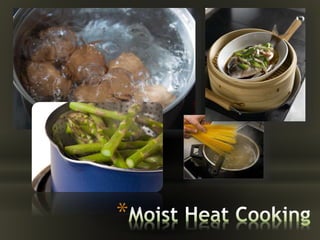
*The most healthy way of preparing vegetables and also
the quickest and easiest. Great for a wide variety of
vegetables
*Since water is a good conductor of heat, steaming cooks
fast
*The nature of the cooking leaves it plain, seasoning will
be needed to bring out the flavours
*Especially good for harder vegetables like
beets, potatoes and carrots
*
*Poaching means cooking in liquid with a temperature ranging
from 140°F to 180°F; typically reserved for cooking very
delicate items like eggs and fish.
*Blanching is a process to slightly cook vegetables in
simmering water, and then “shock” them into a bath of ice
water to immediately stop the cooking. This is done to
brighten colours, and to tenderize. Useful for things like
broccoli and green beans
*Parboiling is similar but the vegetables are cooked for a
longer time, NOT cooled down and then cooked by a
different method. This mostly done to tenderize. Good for
things like beets or carrots
*Boiling is cooking in water until finished
*
*
http://rouxbe.com/cooking-
school/lessons/210-combination-cooking-
fundamentals
*
* Combination cooking method, stewing involves smaller pieces of
meat
* Brown stews involve brown the meat in fat before adding the liquid.
White stews the meat is either cooked in fat prior without browning
or blanched, and rinsed and then added to the cooking liquid. It
should be ivory in colour at the end of cooking
* Meat choice should be tougher with connective tissue
* Meats are always seasoned before hand, but since the cooking liquid
is often also consumed it should have added herbs for flavour
* Meat should be cooked until “fork tender”
* Vegetables may be added half way through the cooking process for
the finished product
*
* Combination cooking method, braising is reserved for larger pieces
of meat
* Meats are first browed and slowly cooked in a small amount of
liquid that will be reduced later and used as a sauce or gravy
* Almost all types of meat can be braised, but tougher cuts are best.
Commonly, chuck, outside round and shank are used
* Must be seasoned beforehand, used of liquid can also add flavour
* Meat can also be tossed in starch beforehand to increase the
amount of caramelization and to help the sauce thicken
* Lower temperatures are best, braising in a covered vessel in the
oven is usually done
* Even vegetables can be “braised”
*
*JULIENNE
Thin strips - 3mm
*BATON
Thicker strips - 6mm
Used for harder types of vegetables
French fry shape
Used in many salads and garnishes
*
DICE ~ Large & small
square shapes - 6mm²
the smallest are also called
brunoise - 3mm²
Good for hard vegetables like
potatoes and carrots
Used for fancy soups and
garnishes
*
*MINCE
*Quickly rocking the knife
back and forth in the same
place to finely chop an
ingredient
*
*CHIFFONADE
*Used for leafy vegetables and
some herbs
Excellent for garnishes for soup
and for salads

Cooking Terms

  • 1.
  • 2.
    * *It’s important toknow a variety of cooking terms to understand what we are going to be talking about in the kitchen *Many of the one we are talking about today are for different types of savoury cooking *Without a good grasp of the “language of the kitchen” you will find it difficult to succeed in your recipes
  • 3.
    * *Mirepoix: A mixtureof 50% Onions, 25% Carrots & 25% Celery that is base of most soups and sauces *Sweat: To cook vegetables with out browning them *Caramelize: to cook slowly, by browning and adding flavour
  • 4.
    * *Mise-en-place (pronounced mizon plas) literally "putting in place" is a French phrase defined by the Culinary Institute of America as "everything in place", as in set up. *It is used in professional kitchens to refer to organizing and arranging the ingredients (e.g., cuts of meat, relishes, sauces, par-cooked items, spices, freshly chopped vegetables, and other components) that a cook will require for the menu items that he or she expects to prepare during his/her shift
  • 5.
    * *Typically the partsof an animal that move more are tougher and require more cooking time at a low temperature. Parts that move less are cooked quickly at a high heat
  • 6.
  • 7.
    * *Meat always needto be season prior to roasting, get all sides *Trim excess fat away, so that just a thin layer remains *Excessively try meat can be moistened by “barding” *Sometime a large roast is cooked on a bed of mirepoix, to add flavour and to provide a platform to keep it out of roasting juices *Larger roasts are started at high temps and finished at a lower temps (typically 275-300ºF) for a long cooking time, usually 15- 20 minutes/ pound *Thermometers are used to determine doneness, but be aware of carry over cooking once out of the oven *Always rest the meat before slicing *Almost all vegetables can be roasted, but tougher root vegetables are best
  • 8.
    * *Only super tendercuts should be used for grilling or broiling due to the high heat that quickly chars the outside. Cuts like tenderloin, loin, chops, any part of poultry *Seasoning should be done as close to cooking time a possible *Your meat or vegetables should be free of any moisture Smoking, which is classic BBQ technique can be used for tougher cuts like shoulder and ribs, but is done a around 200F and for several hours
  • 9.
    * *Meats are alsousually tender cuts, but are cut into smaller, bite sized pieces. *Meat is seasoned, or if it has been marinated then it must be mostly dried *A good deal of caramelization should occur *This is one of the quickest methods of cooking meat or vegetables *Be sure to follow the proper procedure for pre-heating your pan Usually sautéed in a sloping sided pan or in a wok
  • 10.
    * *Tender meat arechosen due to the dry heat cooking methods quick time frame *Meats are often pounded to get a thinner faster cooking portion. *If a larger piece of meat is used it is often seared on one side, flipped and then finished in a hot oven *Meat to pan fried is also sometimes breaded. Basically the steps are flour, egg wash, bread crumbs. Ensure that the meat is seasoned prior to breading and that it is fried quickly after to ensure a crispy crust
  • 11.
    *Oil is abetter conductor of heat than both air and water *Great for starchy vegetables, or vegetables that require long cooking times, like potatoes or yams *Other tender veggies can be coated in a batter and then deep fried, thereby steaming them on the inside of the batter *Many things are happening, the outside is crisping, the interior is steaming, and all the moisture is being forced out of the product. This is till considered a dry heat method however *
  • 12.
  • 13.
  • 14.
    *The most healthyway of preparing vegetables and also the quickest and easiest. Great for a wide variety of vegetables *Since water is a good conductor of heat, steaming cooks fast *The nature of the cooking leaves it plain, seasoning will be needed to bring out the flavours *Especially good for harder vegetables like beets, potatoes and carrots *
  • 15.
    *Poaching means cookingin liquid with a temperature ranging from 140°F to 180°F; typically reserved for cooking very delicate items like eggs and fish. *Blanching is a process to slightly cook vegetables in simmering water, and then “shock” them into a bath of ice water to immediately stop the cooking. This is done to brighten colours, and to tenderize. Useful for things like broccoli and green beans *Parboiling is similar but the vegetables are cooked for a longer time, NOT cooled down and then cooked by a different method. This mostly done to tenderize. Good for things like beets or carrots *Boiling is cooking in water until finished *
  • 16.
  • 17.
    * * Combination cookingmethod, stewing involves smaller pieces of meat * Brown stews involve brown the meat in fat before adding the liquid. White stews the meat is either cooked in fat prior without browning or blanched, and rinsed and then added to the cooking liquid. It should be ivory in colour at the end of cooking * Meat choice should be tougher with connective tissue * Meats are always seasoned before hand, but since the cooking liquid is often also consumed it should have added herbs for flavour * Meat should be cooked until “fork tender” * Vegetables may be added half way through the cooking process for the finished product
  • 18.
    * * Combination cookingmethod, braising is reserved for larger pieces of meat * Meats are first browed and slowly cooked in a small amount of liquid that will be reduced later and used as a sauce or gravy * Almost all types of meat can be braised, but tougher cuts are best. Commonly, chuck, outside round and shank are used * Must be seasoned beforehand, used of liquid can also add flavour * Meat can also be tossed in starch beforehand to increase the amount of caramelization and to help the sauce thicken * Lower temperatures are best, braising in a covered vessel in the oven is usually done * Even vegetables can be “braised”
  • 19.
    * *JULIENNE Thin strips -3mm *BATON Thicker strips - 6mm Used for harder types of vegetables French fry shape Used in many salads and garnishes
  • 20.
    * DICE ~ Large& small square shapes - 6mm² the smallest are also called brunoise - 3mm² Good for hard vegetables like potatoes and carrots Used for fancy soups and garnishes
  • 21.
    * *MINCE *Quickly rocking theknife back and forth in the same place to finely chop an ingredient
  • 22.
    * *CHIFFONADE *Used for leafyvegetables and some herbs Excellent for garnishes for soup and for salads