









Associate Prof Imran Sayyed
HOD IQAC Coordinator
 1.1 Origin of modern cookery practices
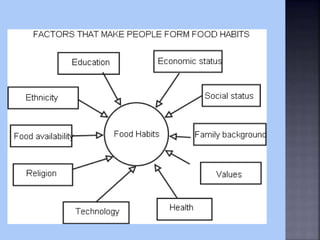
 1.2 Factors influencing eating habits,
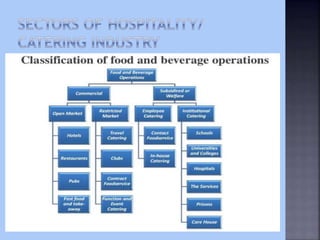
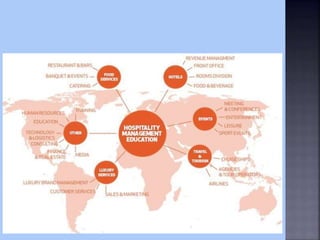
 1.3 Sectors of hospitality/ Catering industry.
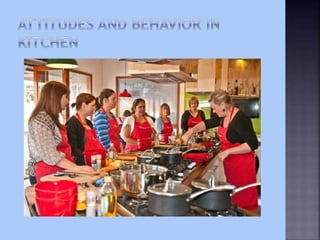
 1.4 Attitudes and behavior in kitchen
 1.5 Personal hygiene & food safety
 1.6 Kitchen uniform – importance
 1.7 Aims & objective of cooking
Louise XIV Boufet service
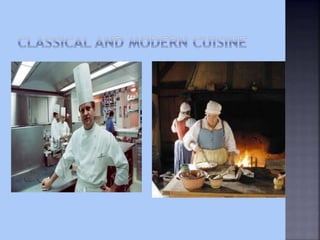
 A HISTORY OF MODERN FOOD SERVICE
An important lesson of history is that the way
we cook now is the result of the work done by
countless chefs over hundreds of years.Cooking
is as much science as it is art. Cooking
techniques are not based on arbitrary rules
that some chefs made up long ago. Rather,they
are based on an understanding of how
different foods react when heated in various
ways, when combined in various proportions,
and so on
 Quantity cookery has existed for thousands
of years, as long as there have been large
groups of people to feed,such as armies.But
modern food service is said to have begun
shortly after the middle of the eighteenth
century. At this time, food production in
France was controlled by guilds
 Georges-Auguste Escoffier (1847–1935), the
greatest chef of his time, is still today
revered by chefs and gourmets as the father
of twentieth-century cookery.His two main
contributions were (1) the simplification of
classical cuisine and the classical menu, and
the reorganization of the kitchen
 Today’s kitchens look much different from
those of Escoffier’s day,even though our basic
cooking principles are the same. Also,the
dishes we eat have gradually changed due to
the innovations and creativity of modern
chefs. The process of simplification and
refinement, to which Carême and Escoffier
made monumental contributions, is still
ongoing, adapting classical cooking to
modern conditions and tastes.
 We take for granted such basic equipment as
gas and electric ranges and ovens and
electric refrigerators. But even these
essential tools did not exist until fairly
recently . The easily controlled heat of
modern cooking equipment , as well as
motorized food cutters, mixers ,and other
processing equipment, has greatly simplified
food production. Research and technology
continue to produce sophisticated tools for
the kitchen.
 All these developments have helped change
cooking styles, menus, and eating habits. The
evolution of cuisine that has been going on
for hundreds of years continues. Changes
occur not only because of technological
developments, such as those just described,
but also because of our reactions to culinary
traditions. Two opposing forces can be seen
at work throughout the history of cooking.
 Advances in agriculture and food
preservation have had disadvantages as well
as advantages. Everyone is familiar with
hard, tasteless fruits and vegetables that
were developed to ship well and last long,
without regard for eating quality. Many
people, including chefs, began to question
not only the flavor but also the health value
and the environmental effects of genetically
engineered foods , of produce raised with
chemical pesticides and fertilizers, and of
animals raised with antibiotics and other
drugs and hormones.
 After the middle of the twentieth century, as
travel became easier and as immigrants
arrived in Europe and North America from
around the world, awareness of and taste for
regional dishes grew . Chefs became more
knowledgeable not only about the traditional
cuisines of other parts of Europe but about
those of Asia, Latin America, and elsewhere.
How do you choose the food you eat?
 In today’s era, we are bombarded with so many
information, including about the food we eat. Some
health experts suggest that certain foods are healthy,
others say that they are not. Which makes it very
confusing and overwhelming for the average person
when it comes to deciding which food to include in
their nutritional plan. Whose advice should you take?
 When choosing what to eat we are influenced by
many internal and external factors, which rarely have
much to do with the food itself. Whether we make
those choices consciously or unconsciously, here are a
few of the factors which have major impact on the
decisions we make when choosing our food:
 A positive attitude towards the job is
expected from the kitchen personnel as the
job requires a lot of hard work and patience.
To become a successful chef, zeal to learn,
creative nature and strong sense of
responsibility is desired.
 While working in the kitchen, a person is
dealing with the sharp tools, electric
machines with blades, gas, fires which all are
very dangerous if treated without
carefulness, therefore a presence of mind is
a must.
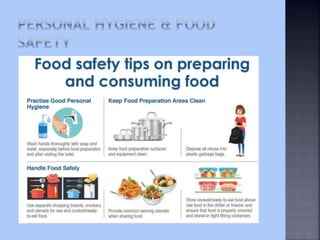
 Good personal hygiene is essential for any
food handler and minimises the risk of food
contamination. Most people carry harmful
bacteria on their bodies and can unwittingly
transport them to food. Touching your
mouth, nose, hair or even your clothing can
spread bacteria and cause contamination.
 Personal hygiene is important to prevent
food poisoning. When handling food, wash
your hands thoroughly and often. If you are
sick, do not go to work, because you can
contaminate food more easily. Food handlers
should be properly trained in safe food
handling
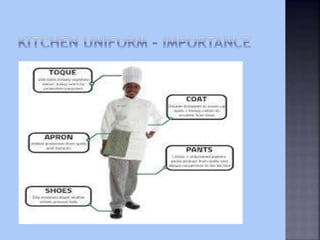
 Wearing the appropriate uniform is just one
positive step you can take towards ensuring food
safety. Chefs must wear the correct protective
clothing in food areas at all times, as this will
help to ensure that any contaminants carried on
normal clothing, such as pet hairs or dirt, do not
contaminate the food.
 We all know how messy the whole process of
cooking can get. Food color, soup, cooking oil,
vegetable juices, and spices are examples of
substances that can severely stain our clothes.
Wearing an apron when cooking will protect your
clothes from stains that would otherwise make
you look untidy
 1) Cooking increases palatability. Cooking pleases the
eye and is receptive to the palate and helps to stimulate
the digestive juices, thereby creating an appetite.
 2) Cooking helps to provide a balanced meal. The
different ingredients combined together in one dish make
it easier to provide a balanced meal.
 3) Cooking sterilizes the food partially. Cooked food can
be stored for a longer time and it prevents food poisoning
and diseases when stored properly. Some of the disease
producing germs is killed by cooking. They are killed
because of high temperature during the cooking process. A
temperature of 600°C applied over 30 or more minutes,
kills most of the pathogenic germs.
 4) Cooking retains, as far as possible, the nutritive and
flavouring ingredients. The flavour depends upon the amount and
kind of extractive present, and the acids developed. Nutritive
value is enhanced if the fat proportion in the meat is more.
While cooking, the nutrition could be preserved by using the
cooking liquor.
 5) Cooking gives a variety to the menu, as one food item could
be cooked in various ways and given different textures, e.g.
mutton in a soup, roast joint, croquettes, stews, keema, sookha
meat, boti kababs, etc. Different methods of cooking when used
make the menu interesting and enhance variety. It is, therefore,
easier to plan a balanced diet.
 6) Cooking preserves food for a longer time. The high
temperature destroys bacteria and limits spoilage. It is
economical as the cooked leftovers could be utilized and new
dishes could be prepared.
Introduction to cookery

Introduction to cookery

  • 1.
    Associate Prof ImranSayyed HOD IQAC Coordinator
  • 2.
     1.1 Originof modern cookery practices  1.2 Factors influencing eating habits,  1.3 Sectors of hospitality/ Catering industry.  1.4 Attitudes and behavior in kitchen  1.5 Personal hygiene & food safety  1.6 Kitchen uniform – importance  1.7 Aims & objective of cooking
  • 3.
  • 4.
     A HISTORYOF MODERN FOOD SERVICE An important lesson of history is that the way we cook now is the result of the work done by countless chefs over hundreds of years.Cooking is as much science as it is art. Cooking techniques are not based on arbitrary rules that some chefs made up long ago. Rather,they are based on an understanding of how different foods react when heated in various ways, when combined in various proportions, and so on
  • 6.
     Quantity cookeryhas existed for thousands of years, as long as there have been large groups of people to feed,such as armies.But modern food service is said to have begun shortly after the middle of the eighteenth century. At this time, food production in France was controlled by guilds
  • 8.
     Georges-Auguste Escoffier(1847–1935), the greatest chef of his time, is still today revered by chefs and gourmets as the father of twentieth-century cookery.His two main contributions were (1) the simplification of classical cuisine and the classical menu, and the reorganization of the kitchen
  • 9.
     Today’s kitchenslook much different from those of Escoffier’s day,even though our basic cooking principles are the same. Also,the dishes we eat have gradually changed due to the innovations and creativity of modern chefs. The process of simplification and refinement, to which Carême and Escoffier made monumental contributions, is still ongoing, adapting classical cooking to modern conditions and tastes.
  • 10.
     We takefor granted such basic equipment as gas and electric ranges and ovens and electric refrigerators. But even these essential tools did not exist until fairly recently . The easily controlled heat of modern cooking equipment , as well as motorized food cutters, mixers ,and other processing equipment, has greatly simplified food production. Research and technology continue to produce sophisticated tools for the kitchen.
  • 11.
     All thesedevelopments have helped change cooking styles, menus, and eating habits. The evolution of cuisine that has been going on for hundreds of years continues. Changes occur not only because of technological developments, such as those just described, but also because of our reactions to culinary traditions. Two opposing forces can be seen at work throughout the history of cooking.
  • 12.
     Advances inagriculture and food preservation have had disadvantages as well as advantages. Everyone is familiar with hard, tasteless fruits and vegetables that were developed to ship well and last long, without regard for eating quality. Many people, including chefs, began to question not only the flavor but also the health value and the environmental effects of genetically engineered foods , of produce raised with chemical pesticides and fertilizers, and of animals raised with antibiotics and other drugs and hormones.
  • 13.
     After themiddle of the twentieth century, as travel became easier and as immigrants arrived in Europe and North America from around the world, awareness of and taste for regional dishes grew . Chefs became more knowledgeable not only about the traditional cuisines of other parts of Europe but about those of Asia, Latin America, and elsewhere.
  • 14.
    How do youchoose the food you eat?  In today’s era, we are bombarded with so many information, including about the food we eat. Some health experts suggest that certain foods are healthy, others say that they are not. Which makes it very confusing and overwhelming for the average person when it comes to deciding which food to include in their nutritional plan. Whose advice should you take?  When choosing what to eat we are influenced by many internal and external factors, which rarely have much to do with the food itself. Whether we make those choices consciously or unconsciously, here are a few of the factors which have major impact on the decisions we make when choosing our food:
  • 20.
     A positiveattitude towards the job is expected from the kitchen personnel as the job requires a lot of hard work and patience. To become a successful chef, zeal to learn, creative nature and strong sense of responsibility is desired.  While working in the kitchen, a person is dealing with the sharp tools, electric machines with blades, gas, fires which all are very dangerous if treated without carefulness, therefore a presence of mind is a must.
  • 21.
     Good personalhygiene is essential for any food handler and minimises the risk of food contamination. Most people carry harmful bacteria on their bodies and can unwittingly transport them to food. Touching your mouth, nose, hair or even your clothing can spread bacteria and cause contamination.
  • 22.
     Personal hygieneis important to prevent food poisoning. When handling food, wash your hands thoroughly and often. If you are sick, do not go to work, because you can contaminate food more easily. Food handlers should be properly trained in safe food handling
  • 26.
     Wearing theappropriate uniform is just one positive step you can take towards ensuring food safety. Chefs must wear the correct protective clothing in food areas at all times, as this will help to ensure that any contaminants carried on normal clothing, such as pet hairs or dirt, do not contaminate the food.  We all know how messy the whole process of cooking can get. Food color, soup, cooking oil, vegetable juices, and spices are examples of substances that can severely stain our clothes. Wearing an apron when cooking will protect your clothes from stains that would otherwise make you look untidy
  • 28.
     1) Cookingincreases palatability. Cooking pleases the eye and is receptive to the palate and helps to stimulate the digestive juices, thereby creating an appetite.  2) Cooking helps to provide a balanced meal. The different ingredients combined together in one dish make it easier to provide a balanced meal.  3) Cooking sterilizes the food partially. Cooked food can be stored for a longer time and it prevents food poisoning and diseases when stored properly. Some of the disease producing germs is killed by cooking. They are killed because of high temperature during the cooking process. A temperature of 600°C applied over 30 or more minutes, kills most of the pathogenic germs.
  • 29.
     4) Cookingretains, as far as possible, the nutritive and flavouring ingredients. The flavour depends upon the amount and kind of extractive present, and the acids developed. Nutritive value is enhanced if the fat proportion in the meat is more. While cooking, the nutrition could be preserved by using the cooking liquor.  5) Cooking gives a variety to the menu, as one food item could be cooked in various ways and given different textures, e.g. mutton in a soup, roast joint, croquettes, stews, keema, sookha meat, boti kababs, etc. Different methods of cooking when used make the menu interesting and enhance variety. It is, therefore, easier to plan a balanced diet.  6) Cooking preserves food for a longer time. The high temperature destroys bacteria and limits spoilage. It is economical as the cooked leftovers could be utilized and new dishes could be prepared.