BASIC TERMINOLOGIES
USED IN FOOD PREPARATION
(UNIT IV)
(Paper – 101 Food and Nutrition)
A PRESENTATION BY:
DR. KUMKUM PANDEY
ASSISTANT PROFESSOR
DEPARTMENT OF HOME SCIENCE
DDM PG COLLEGE, FIROZABAD, U.P.
Mail id: kumkum.pandey.unique@gmail.com
Al dente: Italian term used to cook food until just firm, usually to pasta, but can include
vegetables.
Bake: To cook food in an oven using dry heat.
Barbecue: To cook on a rack or spit over hot coals or some other source of direct heat like open
charcoal or wood fire.
Baste: To spoon pan juices, melted fat, or another liquid over the surface of food during cooking to
keep the food moist and add flavour.
Batter: A mixture containing flour and liquid, thin enough to pour.
Beat: To mix ingredients together with a rapidly circular up and down motion using a spoon,
whisk, or beater to incorporating air.
Bind: To thicken or smooth out the consistency of a locked.
Blanch: To immerse in rapidly boiling water upto 1 minute and allow to cook slightly eg. chips.
Blend: To incorporate two or more ingredients thoroughly.
Boil: To cook in liquid at 100 degrees C or until bubbles break continually on the surface.
Bone: To remove bones from fowl or meat.
Braise: Simmer in a small amount of liquid over low heat for a long period of time in a covered pan
until tender.
Bread: To coat with dry bread or cracker crumbs.
Brown: To cook over high heat (usually on the stove-top) to brown food.
Broil: To expose food to direct heat on a rack or spit, often used for melting food like cheese.
Brush: To apply sauce, melted fat, or other liquid with a basing or pastry brush.
Candy: To cook in a sugar syrup until coated or crystallized.
Caramelize: To heat sugar until a brown colour and characteristic flavour develop.
Chill: To make a food cold by placing it in a refrigerator or in a bowl over crushed ice.
Chop: To cut into small pieces.
Clarify: To make a liquid clear by removing solid particles.
Chop: To cut vegetables into large squares, usually specified by the recipe.
Clarify: To separate and remove solids from a liquid, thus making it clear.
Coat: To thoroughly cover a food with a liquid or dry mixture.
Combine: To mix or blend two or more ingredients together.
Cool: To let a food stand until it no longer feels warm to the touch.
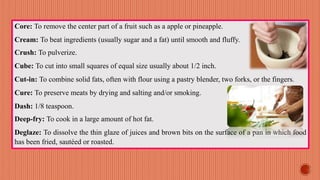
Core: To remove the center part of a fruit such as a apple or pineapple.
Cream: To beat ingredients (usually sugar and a fat) until smooth and fluffy.
Crush: To pulverize.
Cube: To cut into small squares of equal size usually about 1/2 inch.
Cut-in: To combine solid fats, often with flour using a pastry blender, two forks, or the fingers.
Cure: To preserve meats by drying and salting and/or smoking.
Dash: 1/8 teaspoon.
Deep-fry: To cook in a large amount of hot fat.
Deglaze: To dissolve the thin glaze of juices and brown bits on the surface of a pan in which food
has been fried, sautéed or roasted.
Degrease: To remove fat from the surface of stews, soups, or stock. Usually cooled in the
refrigerator so that fat hardens and is easily removed.
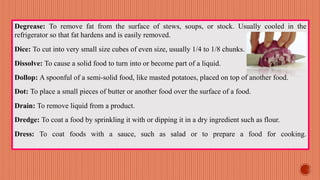
Dice: To cut into very small size cubes of even size, usually 1/4 to 1/8 chunks.
Dissolve: To cause a solid food to turn into or become part of a liquid.
Dollop: A spoonful of a semi-solid food, like masted potatoes, placed on top of another food.
Dot: To place a small pieces of butter or another food over the surface of a food.
Drain: To remove liquid from a product.
Dredge: To coat a food by sprinkling it with or dipping it in a dry ingredient such as flour.
Dress: To coat foods with a sauce, such as salad or to prepare a food for cooking.
Dust: To lightly sprinkle the surface of a food with sugar, flour, or crumbs.
Drizzle: To pour liquid back and forth over a dish in a fine stream.
Flake: To break lightly into small pieces.
Flour: To sprinkle or coat with flour.
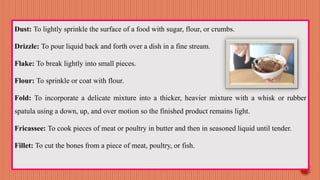
Fold: To incorporate a delicate mixture into a thicker, heavier mixture with a whisk or rubber
spatula using a down, up, and over motion so the finished product remains light.
Fricassee: To cook pieces of meat or poultry in butter and then in seasoned liquid until tender.
Fillet: To cut the bones from a piece of meat, poultry, or fish.
Flambé: To drizzle a flammable spirit over a food while its cooking, to ignite the just before
serving.
Fold: To combine light ingredients, such as whipped cream or beaten eggs whites, with a heavier
mixture, using a over-and-under motion.
Fricassee: To cook by braising; usually applied to fowl or rabbit.
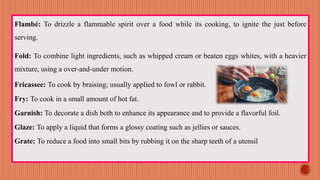
Fry: To cook in a small amount of hot fat.
Garnish: To decorate a dish both to enhance its appearance and to provide a flavorful foil.
Glaze: To apply a liquid that forms a glossy coating such as jellies or sauces.
Grate: To reduce a food into small bits by rubbing it on the sharp teeth of a utensil
Grease: To rub fat on the surface of a cooking utensil or on a food itself.
Grill: To broil over hot coals or to fry on a griddle.
Grind: To mechanically break down a food into a finer texture.
Hull: To remove the outer covering of a fruit or vegetable.
Julienne: Cutting vegetables until long, thin stripes, approximately 1/4 inch thick and 1 inch long.
Knead: The process of mixing dough with the hands or a mixer
Lukewarm: Neither cool nor warm; approximately body temperature.
Marinate: To soak in a sauce or flavoured liquid for a long period of time, usually a meat, poultry.
Meuniere: Dredged with flour and sauteed in butter.
Mince: To cut as small as possible, most commonly used with garlic.
Mix: To combine ingredients usually by stirring.
Pan-broil: To cook uncovered in a hot fry pan, pouring off fat as it accumulates.
Pan-fry: To cook in small amounts of fat.
Parboil: To partially cook by boiling, usually to prepare the food for cooking by another method.
Pare: To remove the outermost skin of a fruit or vegetable.
Peel: To remove the peels from vegetables or fruits.
Pickle: To preserve meats, vegetables, and fruits in brine.
Pinch: trifling amount you can hold between your thumb and forefinger i.e. 1/16 teaspoon.
Pit: To remove pits from fruits.
Plump: To soak dried fruits in liquid until they swell.
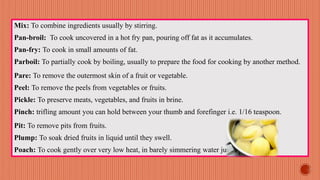
Poach: To cook gently over very low heat, in barely simmering water just to cover.
Puree: To mash foods until perfectly smooth by hand, by rubbing through a sieve or food
mill, or by whirling in a blender or food processor.
Reduce: To boil down to reduce the volume.
Refresh: To run cold water over food that has been parboiled, to stop the cooking process.
Render: To make solid fat into liquid by melting it slowly.
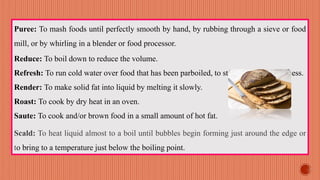
Roast: To cook by dry heat in an oven.
Saute: To cook and/or brown food in a small amount of hot fat.
Scald: To heat liquid almost to a boil until bubbles begin forming just around the edge or
to bring to a temperature just below the boiling point.
Scallop: To bake a food, usually in a casserole, with sauce or other liquid. Crumbs often
are sprinkled over.
Score: To cut narrow grooves or gashes partway through the outer surface of food.
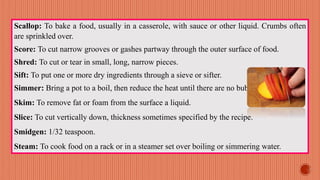
Shred: To cut or tear in small, long, narrow pieces.
Sift: To put one or more dry ingredients through a sieve or sifter.
Simmer: Bring a pot to a boil, then reduce the heat until there are no bubbles.
Skim: To remove fat or foam from the surface a liquid.
Slice: To cut vertically down, thickness sometimes specified by the recipe.
Smidgen: 1/32 teaspoon.
Steam: To cook food on a rack or in a steamer set over boiling or simmering water.
Steep: To soak a dry ingredient in a liquid just under the boiling point to extract the flavour,
such as with tea.
Sterilize: To destroy micro organisms by boiling, dry heat, or steam.
Stew: To cook covered over low heat in a liquid for a substantial period of time.
Stir: To mix ingredients with a circular motion until well blended or of uniform
consistency.
Toss: To combine ingredients with a lifting motion.
Truss: To secure poultry with string or skewers, to hold its shape while cooking.
Whip: To beat food with a whisk or mixer to incorporate air and increase volume.
Zest: The outer, coloured peel of a citrus fruit.
Basic terminologies used in food preperation (unit iv)

Basic terminologies used in food preperation (unit iv)

  • 1.
    BASIC TERMINOLOGIES USED INFOOD PREPARATION (UNIT IV) (Paper – 101 Food and Nutrition) A PRESENTATION BY: DR. KUMKUM PANDEY ASSISTANT PROFESSOR DEPARTMENT OF HOME SCIENCE DDM PG COLLEGE, FIROZABAD, U.P. Mail id: kumkum.pandey.unique@gmail.com
  • 2.
    Al dente: Italianterm used to cook food until just firm, usually to pasta, but can include vegetables. Bake: To cook food in an oven using dry heat. Barbecue: To cook on a rack or spit over hot coals or some other source of direct heat like open charcoal or wood fire. Baste: To spoon pan juices, melted fat, or another liquid over the surface of food during cooking to keep the food moist and add flavour. Batter: A mixture containing flour and liquid, thin enough to pour. Beat: To mix ingredients together with a rapidly circular up and down motion using a spoon, whisk, or beater to incorporating air.
  • 3.
    Bind: To thickenor smooth out the consistency of a locked. Blanch: To immerse in rapidly boiling water upto 1 minute and allow to cook slightly eg. chips. Blend: To incorporate two or more ingredients thoroughly. Boil: To cook in liquid at 100 degrees C or until bubbles break continually on the surface. Bone: To remove bones from fowl or meat. Braise: Simmer in a small amount of liquid over low heat for a long period of time in a covered pan until tender. Bread: To coat with dry bread or cracker crumbs. Brown: To cook over high heat (usually on the stove-top) to brown food. Broil: To expose food to direct heat on a rack or spit, often used for melting food like cheese. Brush: To apply sauce, melted fat, or other liquid with a basing or pastry brush.
  • 4.
    Candy: To cookin a sugar syrup until coated or crystallized. Caramelize: To heat sugar until a brown colour and characteristic flavour develop. Chill: To make a food cold by placing it in a refrigerator or in a bowl over crushed ice. Chop: To cut into small pieces. Clarify: To make a liquid clear by removing solid particles. Chop: To cut vegetables into large squares, usually specified by the recipe. Clarify: To separate and remove solids from a liquid, thus making it clear. Coat: To thoroughly cover a food with a liquid or dry mixture. Combine: To mix or blend two or more ingredients together. Cool: To let a food stand until it no longer feels warm to the touch.
  • 5.
    Core: To removethe center part of a fruit such as a apple or pineapple. Cream: To beat ingredients (usually sugar and a fat) until smooth and fluffy. Crush: To pulverize. Cube: To cut into small squares of equal size usually about 1/2 inch. Cut-in: To combine solid fats, often with flour using a pastry blender, two forks, or the fingers. Cure: To preserve meats by drying and salting and/or smoking. Dash: 1/8 teaspoon. Deep-fry: To cook in a large amount of hot fat. Deglaze: To dissolve the thin glaze of juices and brown bits on the surface of a pan in which food has been fried, sautéed or roasted.
  • 6.
    Degrease: To removefat from the surface of stews, soups, or stock. Usually cooled in the refrigerator so that fat hardens and is easily removed. Dice: To cut into very small size cubes of even size, usually 1/4 to 1/8 chunks. Dissolve: To cause a solid food to turn into or become part of a liquid. Dollop: A spoonful of a semi-solid food, like masted potatoes, placed on top of another food. Dot: To place a small pieces of butter or another food over the surface of a food. Drain: To remove liquid from a product. Dredge: To coat a food by sprinkling it with or dipping it in a dry ingredient such as flour. Dress: To coat foods with a sauce, such as salad or to prepare a food for cooking.
  • 7.
    Dust: To lightlysprinkle the surface of a food with sugar, flour, or crumbs. Drizzle: To pour liquid back and forth over a dish in a fine stream. Flake: To break lightly into small pieces. Flour: To sprinkle or coat with flour. Fold: To incorporate a delicate mixture into a thicker, heavier mixture with a whisk or rubber spatula using a down, up, and over motion so the finished product remains light. Fricassee: To cook pieces of meat or poultry in butter and then in seasoned liquid until tender. Fillet: To cut the bones from a piece of meat, poultry, or fish.
  • 8.
    Flambé: To drizzlea flammable spirit over a food while its cooking, to ignite the just before serving. Fold: To combine light ingredients, such as whipped cream or beaten eggs whites, with a heavier mixture, using a over-and-under motion. Fricassee: To cook by braising; usually applied to fowl or rabbit. Fry: To cook in a small amount of hot fat. Garnish: To decorate a dish both to enhance its appearance and to provide a flavorful foil. Glaze: To apply a liquid that forms a glossy coating such as jellies or sauces. Grate: To reduce a food into small bits by rubbing it on the sharp teeth of a utensil
  • 9.
    Grease: To rubfat on the surface of a cooking utensil or on a food itself. Grill: To broil over hot coals or to fry on a griddle. Grind: To mechanically break down a food into a finer texture. Hull: To remove the outer covering of a fruit or vegetable. Julienne: Cutting vegetables until long, thin stripes, approximately 1/4 inch thick and 1 inch long. Knead: The process of mixing dough with the hands or a mixer Lukewarm: Neither cool nor warm; approximately body temperature. Marinate: To soak in a sauce or flavoured liquid for a long period of time, usually a meat, poultry. Meuniere: Dredged with flour and sauteed in butter. Mince: To cut as small as possible, most commonly used with garlic.
  • 10.
    Mix: To combineingredients usually by stirring. Pan-broil: To cook uncovered in a hot fry pan, pouring off fat as it accumulates. Pan-fry: To cook in small amounts of fat. Parboil: To partially cook by boiling, usually to prepare the food for cooking by another method. Pare: To remove the outermost skin of a fruit or vegetable. Peel: To remove the peels from vegetables or fruits. Pickle: To preserve meats, vegetables, and fruits in brine. Pinch: trifling amount you can hold between your thumb and forefinger i.e. 1/16 teaspoon. Pit: To remove pits from fruits. Plump: To soak dried fruits in liquid until they swell. Poach: To cook gently over very low heat, in barely simmering water just to cover.
  • 11.
    Puree: To mashfoods until perfectly smooth by hand, by rubbing through a sieve or food mill, or by whirling in a blender or food processor. Reduce: To boil down to reduce the volume. Refresh: To run cold water over food that has been parboiled, to stop the cooking process. Render: To make solid fat into liquid by melting it slowly. Roast: To cook by dry heat in an oven. Saute: To cook and/or brown food in a small amount of hot fat. Scald: To heat liquid almost to a boil until bubbles begin forming just around the edge or to bring to a temperature just below the boiling point.
  • 12.
    Scallop: To bakea food, usually in a casserole, with sauce or other liquid. Crumbs often are sprinkled over. Score: To cut narrow grooves or gashes partway through the outer surface of food. Shred: To cut or tear in small, long, narrow pieces. Sift: To put one or more dry ingredients through a sieve or sifter. Simmer: Bring a pot to a boil, then reduce the heat until there are no bubbles. Skim: To remove fat or foam from the surface a liquid. Slice: To cut vertically down, thickness sometimes specified by the recipe. Smidgen: 1/32 teaspoon. Steam: To cook food on a rack or in a steamer set over boiling or simmering water.
  • 13.
    Steep: To soaka dry ingredient in a liquid just under the boiling point to extract the flavour, such as with tea. Sterilize: To destroy micro organisms by boiling, dry heat, or steam. Stew: To cook covered over low heat in a liquid for a substantial period of time. Stir: To mix ingredients with a circular motion until well blended or of uniform consistency. Toss: To combine ingredients with a lifting motion. Truss: To secure poultry with string or skewers, to hold its shape while cooking. Whip: To beat food with a whisk or mixer to incorporate air and increase volume. Zest: The outer, coloured peel of a citrus fruit.