By
Pranith Vontela
rpranith.reddy10@gmail.com
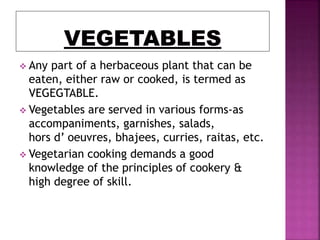
 Any part of a herbaceous plant that can be
eaten, either raw or cooked, is termed as
VEGEGTABLE.
 Vegetables are served in various forms-as
accompaniments, garnishes, salads,
hors d’ oeuvres, bhajees, curries, raitas, etc.
 Vegetarian cooking demands a good
knowledge of the principles of cookery &
high degree of skill.
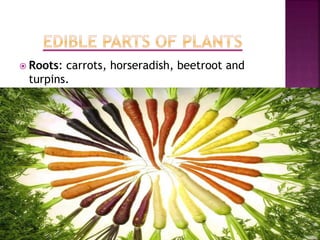
 Roots: carrots, horseradish, beetroot and
turpins.
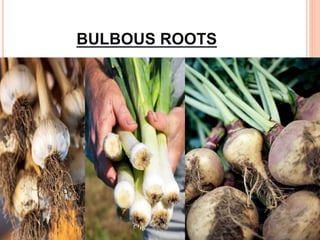
BULBOUS ROOTS
TUBERS
ARTICHOKES POTATOES
FLOWERS
CAULIFLOWER BROCCOLI
LEAVES
CABBAGE SPINACH
FRUITS
WINTER SQUASH PUMPKIN
STEMS
CELERY CORN SALAD
 Vegetables are cooked for various reasons
such as improving their palatability &
digestibility.
 Certain changes occur during cooking:
Cellulose
Flavour
pigments
 FLAVONES: Pigment present in white
vegetables, like potato, onion, cauliflower,
white cabbage, cucumber, etc.
 Pigment stays white in an acid medium and
turns yellow in an alkaline medium.
 TIP-cover the white vegetable while cooking
 Use short cooking time & add small amount
of lemon juice, or vinegar. To create slightly
acidic medium.
 Present in red vegetables & it gives them
their colour.
 Present in very few vegetables in red
cabbage, purple peppers, purple potatoes.
 Affected by acid & alkali mediums.
 Using excessive amount of water while
cooking will leach the colour out of the
vegetable.
 TIP: Cook the red cabbage with small amount
of an acid.
 Green colour in green vegetables due to the
presence of a pigment known as chlorophyll.
 Which is affected by pH.
 In an acid medium the colour of a green
vegetable changes to olive green & in
alkaline medium it changes to bright green.
 The plant’s natural acid is leached into the
cooking liquid & is trapped there creating an
acidic cooking medium.
 This, combined with the heat present,
destroys the pigment.
 Cook vegetables uncovered to allow the
volatile acids to escape.
 Cook them quickly until just al dente.
 After boiling, plunge the vegetables into cold
water to arrest cooking, is known as shocking
or refreshing.
 steam the green vegetables whenever
possible. This shortens the cooking time,
allows far less acid build up, & retains more
colors.
 This pigment gives color to yellow & orange
vegetables such as carrot, corn, winter
squash, sweet potato, tomato, & red pepper.
 It is only slightly affected by acid or alkalis.
 Short cooking times help retain the flavor &
vitamins of most vegetables.
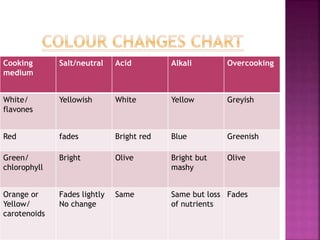
Cooking
medium
Salt/neutral Acid Alkali Overcooking
White/
flavones
Yellowish White Yellow Greyish
Red fades Bright red Blue Greenish
Green/
chlorophyll
Bright Olive Bright but
mashy
Olive
Orange or
Yellow/
carotenoids
Fades lightly
No change
Same Same but loss
of nutrients
Fades
 Vegetables & other food are composed of
proteins, fats, carbohydrates, water,& also
small amounts of minerals, vitamins,
pigments.
 CARBOHYDRATES:- Fruits, grains, beans, &
nuts.
 Vegetables in terms of caramelization &
gelatinization. Caramelization is browning
sugars. Browning of sauteed vegetables is a
form of caramelization.
 when starch absorbs water & swells, the
process is known as gelatinization.
 PROTEINS:- present in Smaller extent in
vegetables are compared to meat, fish &
poultry.
 When heat is applied to proteins they
become firm or they start to coagulate.
 increase in temperature, proteins become
even firmer & start shrinking, exposed to
very high heat, proteins become tough & dry.
 Acids present in lemon juice, vinegar, &
tomato products help in speeding up
coagulation & dissolving few connective
tissues.
 Factors responsible for nutrient loss are:-
 High heat or temperature.
 Too much of liquid that causes leaching &
 Uses of alkalis {baking soda, hard water}
 Tips-some nutrient loss in vegetables is
inevitable.
 use of pressure steam reduces cooking time.
 Boiling is faster than simmering.
 Cut in various sizes & shapes for various
cooking purposes, creating different
textures, tastes, & mouth feel.
 Eg- shredded cabbage will taste different
from diced cabbage in a salad.
 Know one’s vegetables.
 Know your equipments.
 Know the purpose.
 Know the effect of heat.
WHY EAT FRUITS ?
 Very positive effect on the brain.
 80% of water & natural sugars.
 Does not contain any bad amount of
cholesterol.
 Fruits are rich in vitamins, fiber, etc
INTRODUCTION
 Fruits are rich source of vitamins & minerals &
give necessary nutrition to body.
 Fruits are generally eaten raw, but many of them
cooked to serve as accompaniments, sauces,
some fruits are used to prepare jams &
marmalades.
 Fruits are paired with food like Apple with Pork,
Orange with Duck, etc.
CLASSIFICATION OF FRUITS
 Fruits are classified on the basis of their
appearance & another way of segregating them is
on the basis of their texture & flavour.
ON THE BASIS OF TEXTURE & FLAVOUR.
 Soft fruits: papaya, banana, melons.
 Stone fruits: peaches, mango, etc.
 Apple & Pear family
 Citrus fruits: Oranges, sweet, lime, etc.
SOFT FRUITS
BANANA MELON
STONE FRUITS
APPLE & PEAR FAMILY
APPLE PEAR
CITRUS FRUITS
ORANGE LEMON
FRUITS IN COOKING
 The use of fruits in cooking dates back
hundreds of years.
 Fruits are also found in such as cookies,
muffins, yoghurt, ice cream , & cakes.
 Not only used in preparing various dishes but
also used to keep certain foods fresh and help
preserve their colour.
 Gentle simmering preserves the texture &
shape of fruits.
 Barbecuing & grilling fruit leads to very sweet,
strong flavours; this is due to the intense heat
which caramelizes the sugars.
 Grilled or barbecued fruits make fantastic
desserts, side dishes or appetizers.
 Such as apples & pears can be grilled easily.
 Fruits can be made into jellies, jams, pickles, &
chutneys or can be bottled whole.
 Most suitable method of preserving depends on
the type of fruit & its quality & ripeness.
 Under ripe fruit is fine for chutneys, jams, jellies
but over ripe fruit is only good for chutneys, not
good for making jam.
 Drying is also a good way of preserving fruits &
intensifies their flavor.
 Most of fruits can be dried effectively.
THANK YOU
HAVE NICE
DAY.

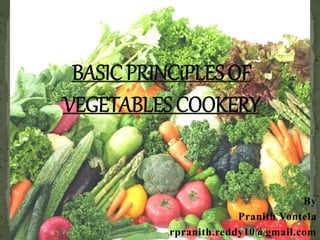
Basic principles of vegetables cookery

  • 1.
  • 2.
     Any partof a herbaceous plant that can be eaten, either raw or cooked, is termed as VEGEGTABLE.  Vegetables are served in various forms-as accompaniments, garnishes, salads, hors d’ oeuvres, bhajees, curries, raitas, etc.  Vegetarian cooking demands a good knowledge of the principles of cookery & high degree of skill.
  • 3.
     Roots: carrots,horseradish, beetroot and turpins.
  • 4.
  • 5.
  • 6.
  • 7.
  • 8.
  • 9.
  • 10.
     Vegetables arecooked for various reasons such as improving their palatability & digestibility.  Certain changes occur during cooking: Cellulose Flavour pigments
  • 11.
     FLAVONES: Pigmentpresent in white vegetables, like potato, onion, cauliflower, white cabbage, cucumber, etc.  Pigment stays white in an acid medium and turns yellow in an alkaline medium.  TIP-cover the white vegetable while cooking  Use short cooking time & add small amount of lemon juice, or vinegar. To create slightly acidic medium.
  • 12.
     Present inred vegetables & it gives them their colour.  Present in very few vegetables in red cabbage, purple peppers, purple potatoes.  Affected by acid & alkali mediums.  Using excessive amount of water while cooking will leach the colour out of the vegetable.  TIP: Cook the red cabbage with small amount of an acid.
  • 13.
     Green colourin green vegetables due to the presence of a pigment known as chlorophyll.  Which is affected by pH.  In an acid medium the colour of a green vegetable changes to olive green & in alkaline medium it changes to bright green.  The plant’s natural acid is leached into the cooking liquid & is trapped there creating an acidic cooking medium.  This, combined with the heat present, destroys the pigment.
  • 14.
     Cook vegetablesuncovered to allow the volatile acids to escape.  Cook them quickly until just al dente.  After boiling, plunge the vegetables into cold water to arrest cooking, is known as shocking or refreshing.  steam the green vegetables whenever possible. This shortens the cooking time, allows far less acid build up, & retains more colors.
  • 15.
     This pigmentgives color to yellow & orange vegetables such as carrot, corn, winter squash, sweet potato, tomato, & red pepper.  It is only slightly affected by acid or alkalis.  Short cooking times help retain the flavor & vitamins of most vegetables.
  • 16.
    Cooking medium Salt/neutral Acid AlkaliOvercooking White/ flavones Yellowish White Yellow Greyish Red fades Bright red Blue Greenish Green/ chlorophyll Bright Olive Bright but mashy Olive Orange or Yellow/ carotenoids Fades lightly No change Same Same but loss of nutrients Fades
  • 17.
     Vegetables &other food are composed of proteins, fats, carbohydrates, water,& also small amounts of minerals, vitamins, pigments.  CARBOHYDRATES:- Fruits, grains, beans, & nuts.  Vegetables in terms of caramelization & gelatinization. Caramelization is browning sugars. Browning of sauteed vegetables is a form of caramelization.  when starch absorbs water & swells, the process is known as gelatinization.
  • 18.
     PROTEINS:- presentin Smaller extent in vegetables are compared to meat, fish & poultry.  When heat is applied to proteins they become firm or they start to coagulate.  increase in temperature, proteins become even firmer & start shrinking, exposed to very high heat, proteins become tough & dry.  Acids present in lemon juice, vinegar, & tomato products help in speeding up coagulation & dissolving few connective tissues.
  • 19.
     Factors responsiblefor nutrient loss are:-  High heat or temperature.  Too much of liquid that causes leaching &  Uses of alkalis {baking soda, hard water}  Tips-some nutrient loss in vegetables is inevitable.  use of pressure steam reduces cooking time.  Boiling is faster than simmering.
  • 20.
     Cut invarious sizes & shapes for various cooking purposes, creating different textures, tastes, & mouth feel.  Eg- shredded cabbage will taste different from diced cabbage in a salad.  Know one’s vegetables.  Know your equipments.  Know the purpose.  Know the effect of heat.
  • 22.
    WHY EAT FRUITS?  Very positive effect on the brain.  80% of water & natural sugars.  Does not contain any bad amount of cholesterol.  Fruits are rich in vitamins, fiber, etc
  • 23.
    INTRODUCTION  Fruits arerich source of vitamins & minerals & give necessary nutrition to body.  Fruits are generally eaten raw, but many of them cooked to serve as accompaniments, sauces, some fruits are used to prepare jams & marmalades.  Fruits are paired with food like Apple with Pork, Orange with Duck, etc.
  • 24.
    CLASSIFICATION OF FRUITS Fruits are classified on the basis of their appearance & another way of segregating them is on the basis of their texture & flavour. ON THE BASIS OF TEXTURE & FLAVOUR.  Soft fruits: papaya, banana, melons.  Stone fruits: peaches, mango, etc.  Apple & Pear family  Citrus fruits: Oranges, sweet, lime, etc.
  • 25.
  • 26.
  • 27.
    APPLE & PEARFAMILY APPLE PEAR
  • 28.
  • 29.
    FRUITS IN COOKING The use of fruits in cooking dates back hundreds of years.  Fruits are also found in such as cookies, muffins, yoghurt, ice cream , & cakes.  Not only used in preparing various dishes but also used to keep certain foods fresh and help preserve their colour.  Gentle simmering preserves the texture & shape of fruits.  Barbecuing & grilling fruit leads to very sweet, strong flavours; this is due to the intense heat which caramelizes the sugars.
  • 30.
     Grilled orbarbecued fruits make fantastic desserts, side dishes or appetizers.  Such as apples & pears can be grilled easily.  Fruits can be made into jellies, jams, pickles, & chutneys or can be bottled whole.  Most suitable method of preserving depends on the type of fruit & its quality & ripeness.  Under ripe fruit is fine for chutneys, jams, jellies but over ripe fruit is only good for chutneys, not good for making jam.
  • 31.
     Drying isalso a good way of preserving fruits & intensifies their flavor.  Most of fruits can be dried effectively.
  • 32.