TLE 10 - COOKERY
Quarter 1 Week 3: Prepare
Egg Dishes: Perform Mise en Place
(TLE_HECK10ED-Ia-1)
INTRODUCTION
◦➢ Mise en Place is a French word which means “setting
everything in place” or “preparing everything in place”.
In cooking any dish, it is a must that everything is ready
before one can start cooking. It includes tools, utensils
and equipment as well as all the ingredients needed.
TOOLS AND EQUIPMENT NEEDED IN EGG
PREPARATION (Kitchen Tools)
1. Channel Knife- a
small hand tool used
generally in
decorative works
such as making
garnishes.
TOOLS AND EQUIPMENT NEEDED IN EGG
PREPARATION
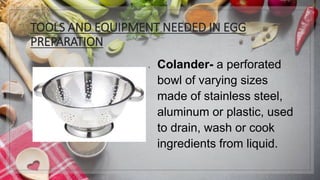
1. Colander- a perforated
bowl of varying sizes
made of stainless steel,
aluminum or plastic, used
to drain, wash or cook
ingredients from liquid.
TOOLS AND EQUIPMENT NEEDED IN EGG
PREPARATION
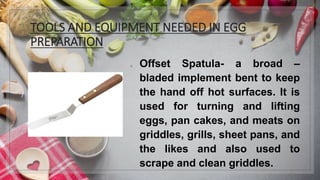
1. Offset Spatula- a broad –
bladed implement bent to keep
the hand off hot surfaces. It is
used for turning and lifting
eggs, pan cakes, and meats on
griddles, grills, sheet pans, and
the likes and also used to
scrape and clean griddles.
TOOLS AND EQUIPMENT NEEDED IN EGG
PREPARATION
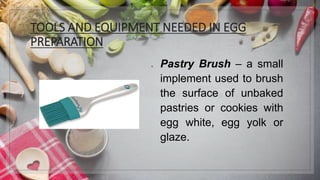
1. Pastry Brush – a small
implement used to brush
the surface of unbaked
pastries or cookies with
egg white, egg yolk or
glaze.
TOOLS AND EQUIPMENT NEEDED IN EGG
PREPARATION
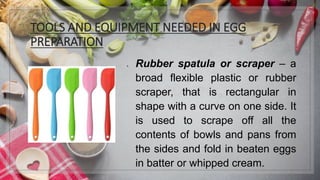
1. Rubber spatula or scraper – a
broad flexible plastic or rubber
scraper, that is rectangular in
shape with a curve on one side. It
is used to scrape off all the
contents of bowls and pans from
the sides and fold in beaten eggs
in batter or whipped cream.
TOOLS AND EQUIPMENT NEEDED IN EGG
PREPARATION
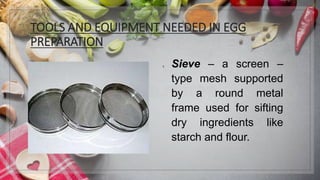
1. Sieve – a screen –
type mesh supported
by a round metal
frame used for sifting
dry ingredients like
starch and flour.
TOOLS AND EQUIPMENT NEEDED IN EGG
PREPARATION
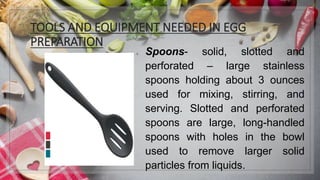
1. Spoons- solid, slotted and
perforated – large stainless
spoons holding about 3 ounces
used for mixing, stirring, and
serving. Slotted and perforated
spoons are large, long-handled
spoons with holes in the bowl
used to remove larger solid
particles from liquids.
TOOLS AND EQUIPMENT NEEDED IN EGG
PREPARATION
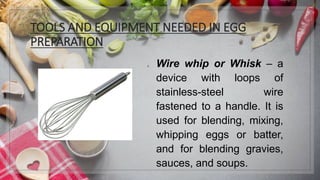
1. Wire whip or Whisk – a
device with loops of
stainless-steel wire
fastened to a handle. It is
used for blending, mixing,
whipping eggs or batter,
and for blending gravies,
sauces, and soups.
TOOLS AND EQUIPMENT NEEDED IN EGG
PREPARATION (Kitchen Utensils)
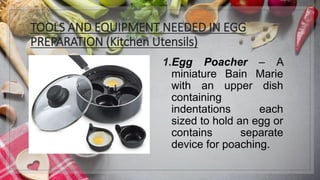
1.Egg Poacher – A
miniature Bain Marie
with an upper dish
containing
indentations each
sized to hold an egg or
contains separate
device for poaching.
TOOLS AND EQUIPMENT NEEDED IN EGG
PREPARATION (Kitchen Utensils)
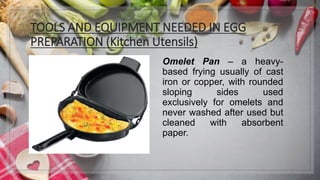
Omelet Pan – a heavy-
based frying usually of cast
iron or copper, with rounded
sloping sides used
exclusively for omelets and
never washed after used but
cleaned with absorbent
paper.
TOOLS AND EQUIPMENT NEEDED IN EGG
PREPARATION (Kitchen Utensils)
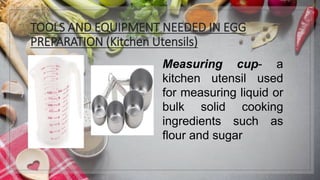
Measuring cup- a
kitchen utensil used
for measuring liquid or
bulk solid cooking
ingredients such as
flour and sugar
TOOLS AND EQUIPMENT NEEDED IN EGG
PREPARATION (Kitchen Utensils)
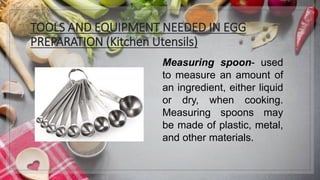
Measuring spoon- used
to measure an amount of
an ingredient, either liquid
or dry, when cooking.
Measuring spoons may
be made of plastic, metal,
and other materials.
TOOLS AND EQUIPMENT NEEDED IN EGG
PREPARATION (Kitchen Utensils)
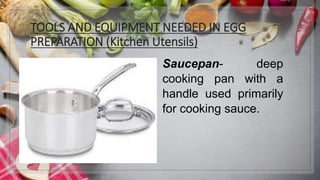
Saucepan- deep
cooking pan with a
handle used primarily
for cooking sauce.
TOOLS AND EQUIPMENT NEEDED IN EGG
PREPARATION (Kitchen Utensils)
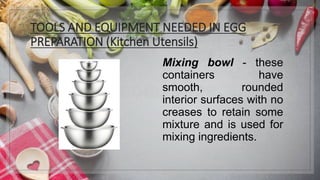
Mixing bowl - these
containers have
smooth, rounded
interior surfaces with no
creases to retain some
mixture and is used for
mixing ingredients.
TOOLS AND EQUIPMENT NEEDED IN EGG
PREPARATION (Kitchen Equipment)
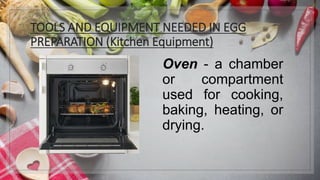
Oven - a chamber
or compartment
used for cooking,
baking, heating, or
drying.
TOOLS AND EQUIPMENT NEEDED IN EGG
PREPARATION (Kitchen Utensils)
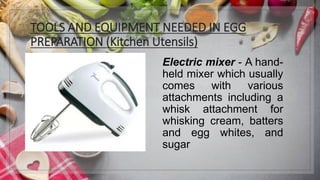
Electric mixer - A hand-
held mixer which usually
comes with various
attachments including a
whisk attachment for
whisking cream, batters
and egg whites, and
sugar
TOOLS AND EQUIPMENT NEEDED IN EGG
PREPARATION (Kitchen Utensils)
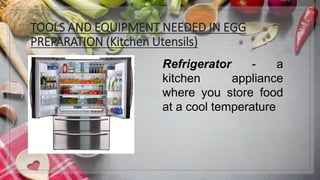
Refrigerator - a
kitchen appliance
where you store food
at a cool temperature
CLEANING AND SANITIZING TOOLS
AND EQUIPMENT
◦ ▪ Cleaning is the removal of visible dirt using soap and water while sanitizing
is the removal of invisible dirt such as bacteria using hot water and chemical
sanitizer.
◦ ▪ Cleaning and sanitizing have 5 steps: scrape, rinse, wash, sanitize, and air
dry.
◦ Cleaning the tools and utensils can be done in two ways. These are the manual
dishwashing and the so-called mechanical dish washing.
Manual Dishwashing Procedure
Scrape and pre-rinse. The purpose of this step is to keep the wash
water cleaner longer.
Wash. Use warm water at 1100F to 1200F and a good detergent.
Scrub well with a brush to remove all traces of leftover and grease.
Rinse. Use clean warm water to rinse off detergent. Change the
water frequently, or use running water with an overflow.
Sanitize. Place utensils in rack and immerse in hot water at 1700F
for thirty seconds. (A gas or electric heating element is needed to hold
water at this temperature.)
Drain and air-dry. Do not towel-dry. This may contaminate
utensils.
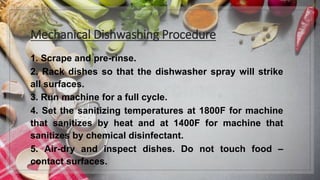
Mechanical Dishwashing Procedure
1. Scrape and pre-rinse.
2. Rack dishes so that the dishwasher spray will strike
all surfaces.
3. Run machine for a full cycle.
4. Set the sanitizing temperatures at 1800F for machine
that sanitizes by heat and at 1400F for machine that
sanitizes by chemical disinfectant.
5. Air-dry and inspect dishes. Do not touch food –
contact surfaces.
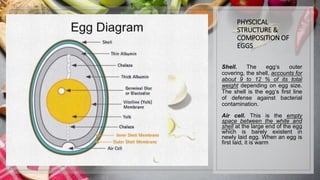
PHYSCICAL
STRUCTURE &
COMPOSITION OF
EGGS
Shell. The egg‘s outer
covering, the shell, accounts for
about 9 to 12 % of its total
weight depending on egg size.
The shell is the egg‘s first line
of defense against bacterial
contamination.
Air cell. This is the empty
space between the white and
shell at the large end of the egg
which is barely existent in
newly laid egg. When an egg is
first laid, it is warm
PHYSCICAL
STRUCTURE &
COMPOSITION OF
EGGS
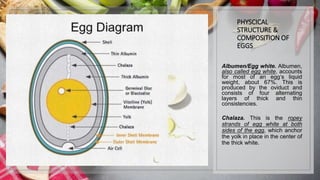
Albumen/Egg white. Albumen,
also called egg white, accounts
for most of an egg‘s liquid
weight, about 67%. This is
produced by the oviduct and
consists of four alternating
layers of thick and thin
consistencies.
Chalaza. This is the ropey
strands of egg white at both
sides of the egg, which anchor
the yolk in place in the center of
the thick white.
PHYSCICAL
STRUCTURE &
COMPOSITION OF
EGGS
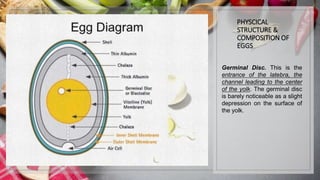
Germinal Disc. This is the
entrance of the latebra, the
channel leading to the center
of the yolk. The germinal disc
is barely noticeable as a slight
depression on the surface of
the yolk.
PHYSCICAL
STRUCTURE &
COMPOSITION OF
EGGS
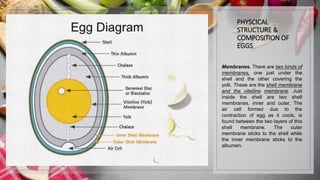
Membranes. There are two kinds of
membranes, one just under the
shell and the other covering the
yolk. These are the shell membrane
and the vitelline membrane. Just
inside the shell are two shell
membranes, inner and outer. The
air cell formed due to the
contraction of egg as it cools, is
found between the two layers of this
shell membrane. The outer
membrane sticks to the shell while
the inner membrane sticks to the
albumen.
PHYSCICAL
STRUCTURE &
COMPOSITION OF
EGGS
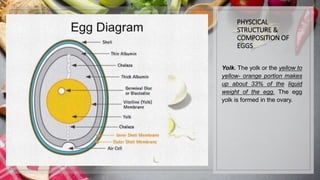
Yolk. The yolk or the yellow to
yellow- orange portion makes
up about 33% of the liquid
weight of the egg. The egg
yolk is formed in the ovary.
DEVELOPMENT
ENGAGEMENT
ASSIMILATION

Cookery week 3 quarter 1

  • 1.
    TLE 10 -COOKERY Quarter 1 Week 3: Prepare Egg Dishes: Perform Mise en Place (TLE_HECK10ED-Ia-1)
  • 2.
    INTRODUCTION ◦➢ Mise enPlace is a French word which means “setting everything in place” or “preparing everything in place”. In cooking any dish, it is a must that everything is ready before one can start cooking. It includes tools, utensils and equipment as well as all the ingredients needed.
  • 3.
    TOOLS AND EQUIPMENTNEEDED IN EGG PREPARATION (Kitchen Tools) 1. Channel Knife- a small hand tool used generally in decorative works such as making garnishes.
  • 4.
    TOOLS AND EQUIPMENTNEEDED IN EGG PREPARATION 1. Colander- a perforated bowl of varying sizes made of stainless steel, aluminum or plastic, used to drain, wash or cook ingredients from liquid.
  • 5.
    TOOLS AND EQUIPMENTNEEDED IN EGG PREPARATION 1. Offset Spatula- a broad – bladed implement bent to keep the hand off hot surfaces. It is used for turning and lifting eggs, pan cakes, and meats on griddles, grills, sheet pans, and the likes and also used to scrape and clean griddles.
  • 6.
    TOOLS AND EQUIPMENTNEEDED IN EGG PREPARATION 1. Pastry Brush – a small implement used to brush the surface of unbaked pastries or cookies with egg white, egg yolk or glaze.
  • 7.
    TOOLS AND EQUIPMENTNEEDED IN EGG PREPARATION 1. Rubber spatula or scraper – a broad flexible plastic or rubber scraper, that is rectangular in shape with a curve on one side. It is used to scrape off all the contents of bowls and pans from the sides and fold in beaten eggs in batter or whipped cream.
  • 8.
    TOOLS AND EQUIPMENTNEEDED IN EGG PREPARATION 1. Sieve – a screen – type mesh supported by a round metal frame used for sifting dry ingredients like starch and flour.
  • 9.
    TOOLS AND EQUIPMENTNEEDED IN EGG PREPARATION 1. Spoons- solid, slotted and perforated – large stainless spoons holding about 3 ounces used for mixing, stirring, and serving. Slotted and perforated spoons are large, long-handled spoons with holes in the bowl used to remove larger solid particles from liquids.
  • 10.
    TOOLS AND EQUIPMENTNEEDED IN EGG PREPARATION 1. Wire whip or Whisk – a device with loops of stainless-steel wire fastened to a handle. It is used for blending, mixing, whipping eggs or batter, and for blending gravies, sauces, and soups.
  • 11.
    TOOLS AND EQUIPMENTNEEDED IN EGG PREPARATION (Kitchen Utensils) 1.Egg Poacher – A miniature Bain Marie with an upper dish containing indentations each sized to hold an egg or contains separate device for poaching.
  • 12.
    TOOLS AND EQUIPMENTNEEDED IN EGG PREPARATION (Kitchen Utensils) Omelet Pan – a heavy- based frying usually of cast iron or copper, with rounded sloping sides used exclusively for omelets and never washed after used but cleaned with absorbent paper.
  • 13.
    TOOLS AND EQUIPMENTNEEDED IN EGG PREPARATION (Kitchen Utensils) Measuring cup- a kitchen utensil used for measuring liquid or bulk solid cooking ingredients such as flour and sugar
  • 14.
    TOOLS AND EQUIPMENTNEEDED IN EGG PREPARATION (Kitchen Utensils) Measuring spoon- used to measure an amount of an ingredient, either liquid or dry, when cooking. Measuring spoons may be made of plastic, metal, and other materials.
  • 15.
    TOOLS AND EQUIPMENTNEEDED IN EGG PREPARATION (Kitchen Utensils) Saucepan- deep cooking pan with a handle used primarily for cooking sauce.
  • 16.
    TOOLS AND EQUIPMENTNEEDED IN EGG PREPARATION (Kitchen Utensils) Mixing bowl - these containers have smooth, rounded interior surfaces with no creases to retain some mixture and is used for mixing ingredients.
  • 17.
    TOOLS AND EQUIPMENTNEEDED IN EGG PREPARATION (Kitchen Equipment) Oven - a chamber or compartment used for cooking, baking, heating, or drying.
  • 18.
    TOOLS AND EQUIPMENTNEEDED IN EGG PREPARATION (Kitchen Utensils) Electric mixer - A hand- held mixer which usually comes with various attachments including a whisk attachment for whisking cream, batters and egg whites, and sugar
  • 19.
    TOOLS AND EQUIPMENTNEEDED IN EGG PREPARATION (Kitchen Utensils) Refrigerator - a kitchen appliance where you store food at a cool temperature
  • 20.
    CLEANING AND SANITIZINGTOOLS AND EQUIPMENT ◦ ▪ Cleaning is the removal of visible dirt using soap and water while sanitizing is the removal of invisible dirt such as bacteria using hot water and chemical sanitizer. ◦ ▪ Cleaning and sanitizing have 5 steps: scrape, rinse, wash, sanitize, and air dry. ◦ Cleaning the tools and utensils can be done in two ways. These are the manual dishwashing and the so-called mechanical dish washing.
  • 21.
    Manual Dishwashing Procedure Scrapeand pre-rinse. The purpose of this step is to keep the wash water cleaner longer. Wash. Use warm water at 1100F to 1200F and a good detergent. Scrub well with a brush to remove all traces of leftover and grease. Rinse. Use clean warm water to rinse off detergent. Change the water frequently, or use running water with an overflow. Sanitize. Place utensils in rack and immerse in hot water at 1700F for thirty seconds. (A gas or electric heating element is needed to hold water at this temperature.) Drain and air-dry. Do not towel-dry. This may contaminate utensils.
  • 22.
    Mechanical Dishwashing Procedure 1.Scrape and pre-rinse. 2. Rack dishes so that the dishwasher spray will strike all surfaces. 3. Run machine for a full cycle. 4. Set the sanitizing temperatures at 1800F for machine that sanitizes by heat and at 1400F for machine that sanitizes by chemical disinfectant. 5. Air-dry and inspect dishes. Do not touch food – contact surfaces.
  • 23.
    PHYSCICAL STRUCTURE & COMPOSITION OF EGGS Shell.The egg‘s outer covering, the shell, accounts for about 9 to 12 % of its total weight depending on egg size. The shell is the egg‘s first line of defense against bacterial contamination. Air cell. This is the empty space between the white and shell at the large end of the egg which is barely existent in newly laid egg. When an egg is first laid, it is warm
  • 24.
    PHYSCICAL STRUCTURE & COMPOSITION OF EGGS Albumen/Eggwhite. Albumen, also called egg white, accounts for most of an egg‘s liquid weight, about 67%. This is produced by the oviduct and consists of four alternating layers of thick and thin consistencies. Chalaza. This is the ropey strands of egg white at both sides of the egg, which anchor the yolk in place in the center of the thick white.
  • 25.
    PHYSCICAL STRUCTURE & COMPOSITION OF EGGS GerminalDisc. This is the entrance of the latebra, the channel leading to the center of the yolk. The germinal disc is barely noticeable as a slight depression on the surface of the yolk.
  • 26.
    PHYSCICAL STRUCTURE & COMPOSITION OF EGGS Membranes.There are two kinds of membranes, one just under the shell and the other covering the yolk. These are the shell membrane and the vitelline membrane. Just inside the shell are two shell membranes, inner and outer. The air cell formed due to the contraction of egg as it cools, is found between the two layers of this shell membrane. The outer membrane sticks to the shell while the inner membrane sticks to the albumen.
  • 27.
    PHYSCICAL STRUCTURE & COMPOSITION OF EGGS Yolk.The yolk or the yellow to yellow- orange portion makes up about 33% of the liquid weight of the egg. The egg yolk is formed in the ovary.
  • 28.
  • 29.
  • 30.