Pasta

cooked until
just firm. From the
Italian “to the tooth.”
To cook food in an
oven, surrounded with
dry heat; called
roasting when applied
to meat or poultry.


A combination of baking soda,
an acid such as cream of tartar,
and a starch or flour (moisture
absorber). Most common type is
double-acting baking powder,
which acts when mixed with
liquid and again when heated.


The main ingredient in baking
powder, baking soda is also used
when there is acid (buttermilk or
sour cream, for example) in a
recipe. Always mix with other dry
ingredients before adding any
liquid, since leavening begins as
soon as soda comes in contact with
liquid.
To

cook foods
on a rack or a
spit over coals.
To

moisten food
for added flavor
and to prevent
drying out while
cooking.
An

uncooked
pourable mixture
usually made up of
flour, a liquid, and
other ingredients.
To

stir rapidly to
make a mixture
smooth, using a
whisk, spoon, or
mixer.
 To

cook briefly in boiling
water to seal in flavor and
color; usually used for
vegetables or fruit, to
prepare for freezing, and to
ease skin removal.
 To

thoroughly combine
2 or more
ingredients, either by
hand with a whisk or
spoon, or with a mixer.
To

cook in
bubbling water that
has reached 212
degrees F.
To

remove
bones from
poultry, meat, o
r fish.
A

tied bundle of herbs,
usually parsley, thyme,
and bay leaves, that is
added to flavor soups,
stews, and sauces but
removed before serving.
 To

cook first by
browning, then gently
simmering in a small
amount of liquid over
low heat in a covered
pan until tender.
To

coat with
crumbs or
cornmeal
before cooking.
To

cook on a rack
or spit under or
over direct
heat, usually in an
oven.
To

cook over high
heat, usually on
top of the stove, to
brown food.
 To

heat sugar until it
liquefies and becomes
a syrup ranging in color
from golden to dark
brown.
To

remove the
seeds or tough
woody centers
from fruits and
vegetables.
 The

butterfat portion of
milk. Also, to beat
ingredients, usually
sugar and a fat, until
smooth and fluffy.
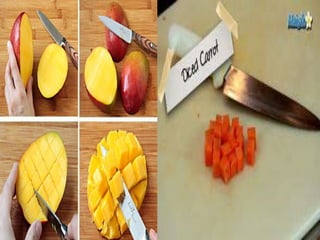
To

cut food
into small
(about 1/2inch) cubes.
 To

distribute a solid fat in
flour using a cutting
motion, with 2 knives used
scissors-fashion or a pastry
blender, until divided evenly
into tiny pieces. Usually
refers to making pastry.
To

cook by
completely
immersing food
in hot fat.
 To

loosen brown bits
from a pan by adding a
liquid, then heating
while stirring and
scraping the pan.
To

cut food
into very small
(1/8-to 1/4-inch)
cubes.
A

spoonful of soft
food such as
whipped cream or
mashed potatoes.
To

scatter
butter in bits
over food.
To

cover or coat
uncooked
food, usually with a
flour, cornmeal
mixture or bread
To

coat foods such
as salad with a
sauce. Also, to clean
fish, poultry, or
game for cooking.
Juices

and fats
rendered by meat
or poultry during
cooking.
 To

pour melted
butter, oil, syrup, melte
d chocolate, or other
liquid back and forth
over food in a fine
stream.
 To

coat lightly with
confectioners’ sugar or
cocoa (cakes and
pastries) or another
powdery ingredient.
A

flat piece of
boneless meat,
poultry, or fish. Also,
to cut the bones from a
piece of meat, poultry,
or fish.
A

mixture of herbs
traditionally
parsley, chervil, chives,
and tarragon, used to
flavor
fish, chicken, and eggs
 To

drizzle liquor over a
food while it is
cooking, then when the
alcohol has warmed,
ignite the food just
before serving.
To

make
decorative
grooves. Usually
refers to pastry.
 To

combine light ingredients
such as whipped cream or
beaten egg whites with a
heavier mixture, using a
gentle over-and-under
motion, usually with a
rubber spatula.
To

coat foods
with glossy
mixtures such as
jellies or sauces.
To

rub foods
against a serrated
surface to produce
shredded or fine
bits.
 To

rub the interior
surface of a cooking
dish or pan with
shortening, oil, or
butter to prevent food
from sticking to it.
To

reduce food to
tiny particles
using a grinder or
a food processor.
To

cut into
long, thin
strips, Matchstic
k like in shape.
To

blend dough
together with
hands or in a mixer
to form a pliable
mass.
To

soak in a
flavored liquid;
usually refers to
fruit.
To

soak in a
flavored liquid;
usually refers to
meat, poultry, or
fish.
To

cut into
tiny
pieces, usuall
y with a knife.
To

partially cook by
boiling. Usually
done to prepare food
for final cooking by
another method.
To

cook gently
over very low heat
in barely
simmering liquid
just to cover.
To

mash or grind food
until completely
smooth, usually in a
food processor,
blender, sieve, or food
mill.
To

thicken a
liquid and
concentrate its
flavor by boiling.
To

cook fatty meat or
poultry—such as
bacon or goose—over
low heat to obtain
drippings.
To

cook a large
piece of meat or
poultry uncovered
with dry heat in an
oven.
To

cook food in a
small amount of
fat over relatively
high heat.
To

heat liquid
almost to a boil until
bubbles begin to
form around the
edge.
To

brown the surface
of meat by quickcooking over high
heat in order to seal
in the meat’s juices.
To

cut food into
narrow strips
with a knife or a
grater.
 To

cook in liquid just
below the boiling
point; bubbles form
but do not burst on the
surface of the liquid.
To

remove
surface foam or
fat from a
liquid.
To

soak in a liquid
just under the
boiling point to
extract the
essence—e.g., tea.
To

quickly cook
small pieces of
food over high
heat, stirring
constantly.
To

tie whole poultry
with string or
skewers so it will
hold its shape during
cooking.
To

beat food with
a whisk or mixer to
incorporate air and
produce volume.
 To

beat ingredients (such
as heavy or whipping
cream, eggs, salad
dressings, or sauces) with
a fork or whisk to
mix, blend, or incorporate
air.
The

outer, colored
part of the peel
of citrus fruit.
Cooking terms

Cooking terms