Hors d’
oeuvres
Chapter 6
•Hors d’oeuvres may be served before a
meal or may be the only food provided.
They should be small (one or two bites),
flavorful, and attractive.
Two ways of serving
hors d’ oeuvres
•butler-style
•buffet-style
Two ways of
serving hors
d’ oeuvres
•Butler-style
•The hors d’oeuvre
selections are offered to
guests by service staff
carrying small trays as they
pass among the assembled
group.
Points to
keep in
mind
•Each item should be small
enough to be eaten in one or
two bites.
•Each item should be easily
handled by the guest.
Points to
keep in
mind
•Strive for simple, attractive
arrangements on the tray.
•Ideally, each tray should
hold only one food
selection.
Points to
keep in
mind
•Avoid presenting hot and cold
items on the same tray.
•For items to be offered with dips,
a small bowl of the dip can be
presented on the same tray as
the individual hors d’oeuvres.
Two types of hors d’ oeuvres
•Cold Hors d’ oeuvres
•Hot Hors d’ oeuvres
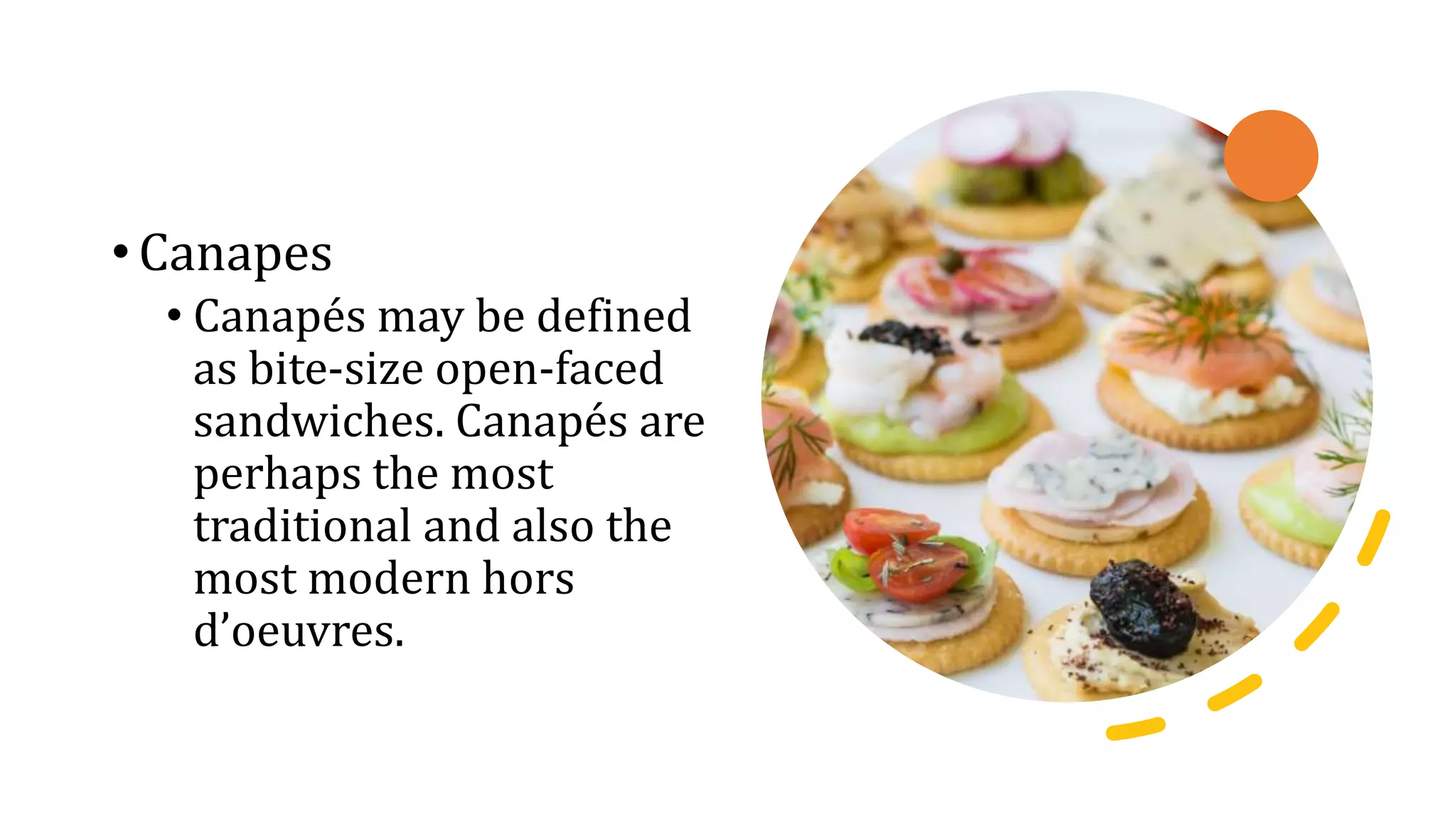
• Canapes
• Canapés may be defined
as bite-size open-faced
sandwiches. Canapés are
perhaps the most
traditional and also the
most modern hors
d’oeuvres.
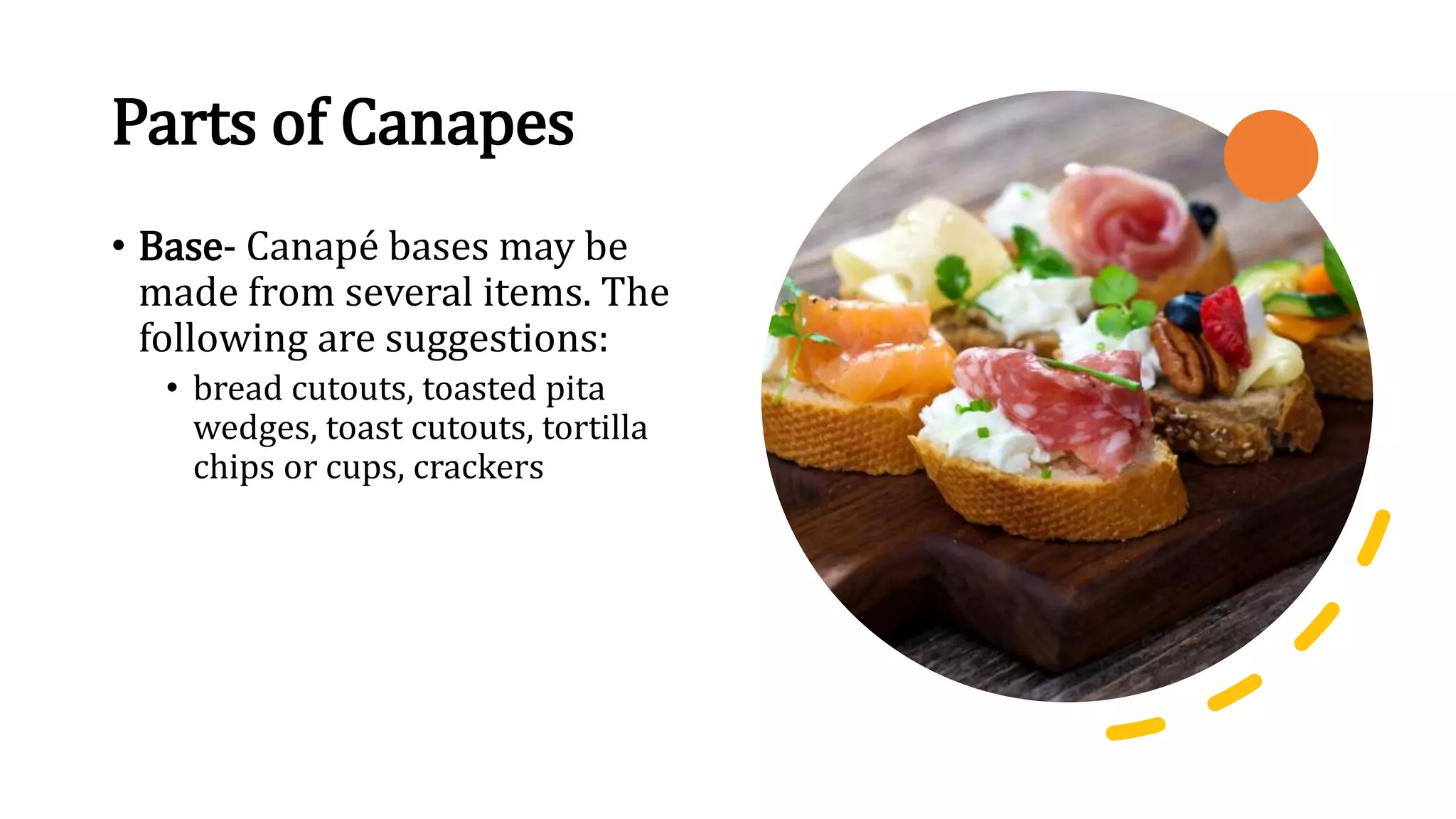
Parts of Canapes
• Base- Canapé bases may be
made from several items. The
following are suggestions:
• bread cutouts, toasted pita
wedges, toast cutouts, tortilla
chips or cups, crackers
Parts of Canapes
• Spread- Canapé spreads may be
as simple as butter or softened
cream cheese.
• The spread should be thick
enough to cling well to the base
and so the garnish sticks to it
without falling off.
• Flavored Butter- Most flavored butters are made
simply by blending the flavoring ingredients with
the softened butter until completely mixed.
• Flavored Cream cheese-Flavored cream cheese
spreads are made like flavored butters, except
cream cheese is substituted for the butter.
• Meat or Fish salad spreads- You can use many cold meat or
fish mixtures, such as cooked salads, to make canapé
spreads.
Parts of Canapes
Garnish- The garnish of a canapé
is any food item or combination of
items placed on top of the spread.
• It may be a major part of the
canapé, such as a slice of ham or
cheese, or it may be a small
tidbit selected for color, design,
texture, or flavor accent.
• Cocktails
• The term cocktail is used not
only for alcoholic beverages
and vegetable and fruit juices
but also for a group of
appetizers made of seafood or
fruit, usually with a tart or
tangy sauce.
• Such cocktails are always
served well chilled, often on a
bed of crushed ice.
Cold Hors d’ oeuvres
• Relishes
• The term relish covers
two categories of foods:
raw vegetables and
pickled items.
Cold Hors d’ oeuvres
• Dips
• Savory dips are popular
accompaniments to
potato chips, crackers,
and raw vegetables.
Miscellaneous Hors
D’ Oeuvres
• Antipasto
• Italian cuisine is
particularly rich in hors
d’oeuvres, or antipasti, as
they are called (singular
form: antipasto).
Miscellaneous Hors D’ Oeuvres
• Bruschetta
• Bruschetta, in its most basic
form, is a slice of Italian bread
that is toasted, rubbed with
crushed garlic, and drizzled with
olive oil.
Miscellaneous Hors D’ Oeuvres
• Tapas
• The Spanish term literally means
“lid,” and the original tapa is thought
to be a small bit of food, perhaps a
slice of cured ham, placed on top of a
glass of sherry.
Miscellaneous Hors D’ Oeuvres
• Caviar
• Caviar is the salted roe, or eggs, of the
sturgeon. Roe from any other fish must be
labeled as such (for example, whitefish
caviar).
• Caviar made with a relatively low proportion of
salt is labeled malassol, which means “little salt.”
Miscellaneous
Hors D’ Oeuvres
• Caviar
• The best caviar should be served ice-
cold and as simply as possible. The
traditional caviar accompaniments of
chopped onion, lemon, chopped egg,
and sour cream may be all right for
inexpensive roes,
Miscellaneous Hors D’ Oeuvres
• Amuse Bouche
• An amuse bouche(ah mews boosh)
is a tiny appetizer or hors d’oeuvre
offered, compliments of the chef
and usually in more expensive
restaurants, to guests seated at their
tables, either before or after they
have ordered from the menu.

Chapter 5 Hors d’ oeuvres.pptx

  • 1.
  • 2.
    •Hors d’oeuvres maybe served before a meal or may be the only food provided. They should be small (one or two bites), flavorful, and attractive.
  • 3.
    Two ways ofserving hors d’ oeuvres •butler-style •buffet-style
  • 4.
    Two ways of servinghors d’ oeuvres •Butler-style •The hors d’oeuvre selections are offered to guests by service staff carrying small trays as they pass among the assembled group.
  • 5.
    Points to keep in mind •Eachitem should be small enough to be eaten in one or two bites. •Each item should be easily handled by the guest.
  • 6.
    Points to keep in mind •Strivefor simple, attractive arrangements on the tray. •Ideally, each tray should hold only one food selection.
  • 7.
    Points to keep in mind •Avoidpresenting hot and cold items on the same tray. •For items to be offered with dips, a small bowl of the dip can be presented on the same tray as the individual hors d’oeuvres.
  • 8.
    Two types ofhors d’ oeuvres •Cold Hors d’ oeuvres •Hot Hors d’ oeuvres
  • 9.
    • Canapes • Canapésmay be defined as bite-size open-faced sandwiches. Canapés are perhaps the most traditional and also the most modern hors d’oeuvres.
  • 10.
    Parts of Canapes •Base- Canapé bases may be made from several items. The following are suggestions: • bread cutouts, toasted pita wedges, toast cutouts, tortilla chips or cups, crackers
  • 11.
    Parts of Canapes •Spread- Canapé spreads may be as simple as butter or softened cream cheese. • The spread should be thick enough to cling well to the base and so the garnish sticks to it without falling off.
  • 12.
    • Flavored Butter-Most flavored butters are made simply by blending the flavoring ingredients with the softened butter until completely mixed. • Flavored Cream cheese-Flavored cream cheese spreads are made like flavored butters, except cream cheese is substituted for the butter. • Meat or Fish salad spreads- You can use many cold meat or fish mixtures, such as cooked salads, to make canapé spreads.
  • 13.
    Parts of Canapes Garnish-The garnish of a canapé is any food item or combination of items placed on top of the spread. • It may be a major part of the canapé, such as a slice of ham or cheese, or it may be a small tidbit selected for color, design, texture, or flavor accent.
  • 14.
    • Cocktails • Theterm cocktail is used not only for alcoholic beverages and vegetable and fruit juices but also for a group of appetizers made of seafood or fruit, usually with a tart or tangy sauce. • Such cocktails are always served well chilled, often on a bed of crushed ice.
  • 15.
    Cold Hors d’oeuvres • Relishes • The term relish covers two categories of foods: raw vegetables and pickled items.
  • 16.
    Cold Hors d’oeuvres • Dips • Savory dips are popular accompaniments to potato chips, crackers, and raw vegetables.
  • 17.
    Miscellaneous Hors D’ Oeuvres •Antipasto • Italian cuisine is particularly rich in hors d’oeuvres, or antipasti, as they are called (singular form: antipasto).
  • 18.
    Miscellaneous Hors D’Oeuvres • Bruschetta • Bruschetta, in its most basic form, is a slice of Italian bread that is toasted, rubbed with crushed garlic, and drizzled with olive oil.
  • 19.
    Miscellaneous Hors D’Oeuvres • Tapas • The Spanish term literally means “lid,” and the original tapa is thought to be a small bit of food, perhaps a slice of cured ham, placed on top of a glass of sherry.
  • 20.
    Miscellaneous Hors D’Oeuvres • Caviar • Caviar is the salted roe, or eggs, of the sturgeon. Roe from any other fish must be labeled as such (for example, whitefish caviar). • Caviar made with a relatively low proportion of salt is labeled malassol, which means “little salt.”
  • 21.
    Miscellaneous Hors D’ Oeuvres •Caviar • The best caviar should be served ice- cold and as simply as possible. The traditional caviar accompaniments of chopped onion, lemon, chopped egg, and sour cream may be all right for inexpensive roes,
  • 22.
    Miscellaneous Hors D’Oeuvres • Amuse Bouche • An amuse bouche(ah mews boosh) is a tiny appetizer or hors d’oeuvre offered, compliments of the chef and usually in more expensive restaurants, to guests seated at their tables, either before or after they have ordered from the menu.