GarnishesGarnishes
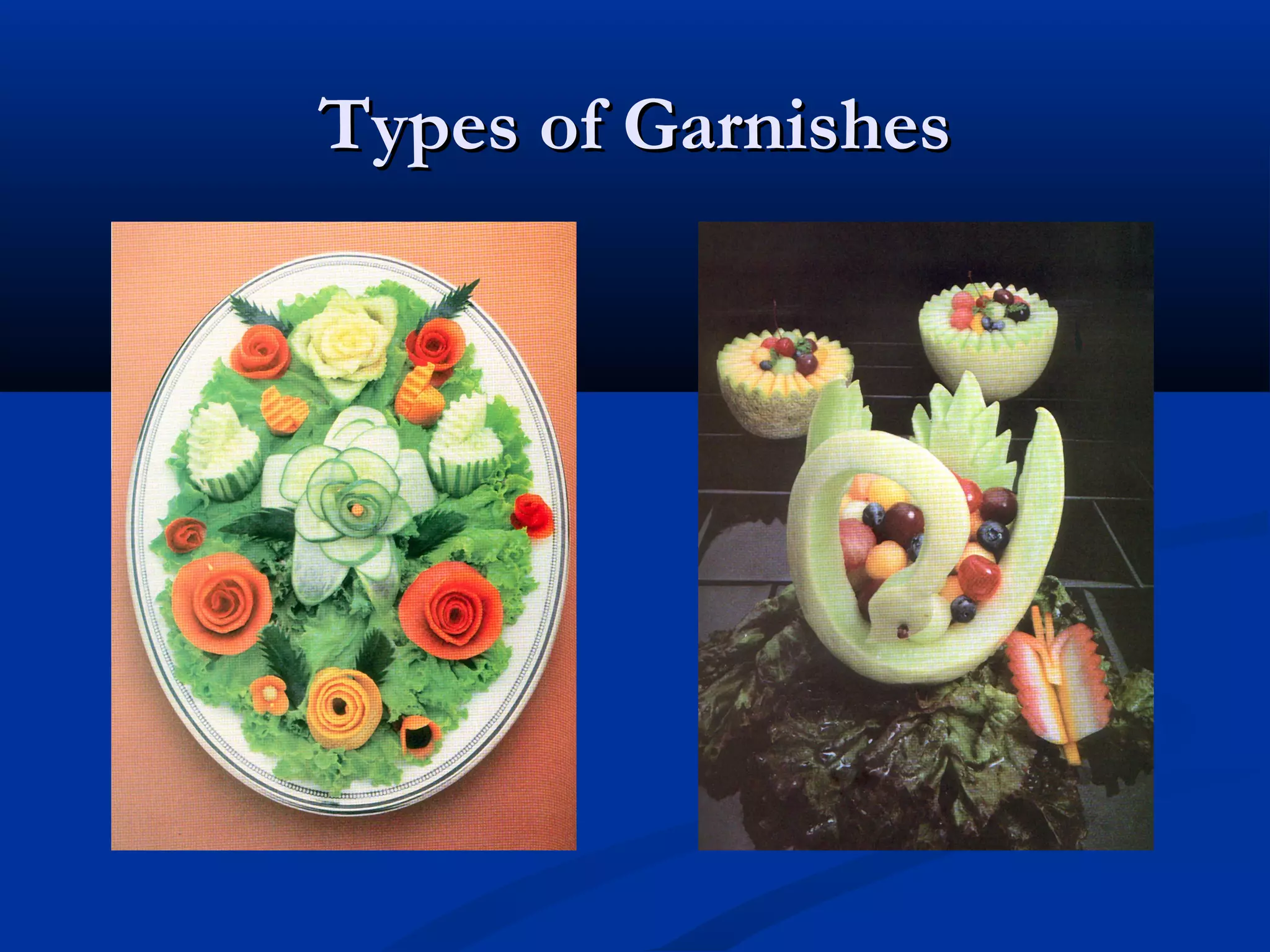
What is a garnish?What is a garnish?
 The wordThe word garnishgarnish comes from the French wordcomes from the French word
“garnir” which means “to decorate or furnish”.“garnir” which means “to decorate or furnish”.
 In the culinary world, it means to use food as anIn the culinary world, it means to use food as an
attractive decoration.attractive decoration.
 It is something that should add real value to theIt is something that should add real value to the
dish by increasing its nutritional value and visualdish by increasing its nutritional value and visual
appeal.appeal.
Garnishing ToolsGarnishing Tools
 Vegetable PeelerVegetable Peeler
 Use to make decorativeUse to make decorative
carrot curls and chocolatecarrot curls and chocolate
curls.curls.
Garnishing ToolsGarnishing Tools
 Butter CutterButter Cutter
 Has four sides that can beHas four sides that can be
used to make a range ofused to make a range of
garnishes from curls togarnishes from curls to
grooves to marble-sizegrooves to marble-size
balls.balls.
 For best results, use ice-For best results, use ice-
cold butter and a buttercold butter and a butter
cutter that has beencutter that has been
warmed in hot water.warmed in hot water.
Garnishing ToolsGarnishing Tools
 ZesterZester
 Use to remove smallUse to remove small
strips of the colored partstrips of the colored part
of citrus peels. You canof citrus peels. You can
also use this tool to shavealso use this tool to shave
pieces from colorfulpieces from colorful
vegetables, such as carrotsvegetables, such as carrots
and radishes.and radishes.
Garnishing ToolsGarnishing Tools
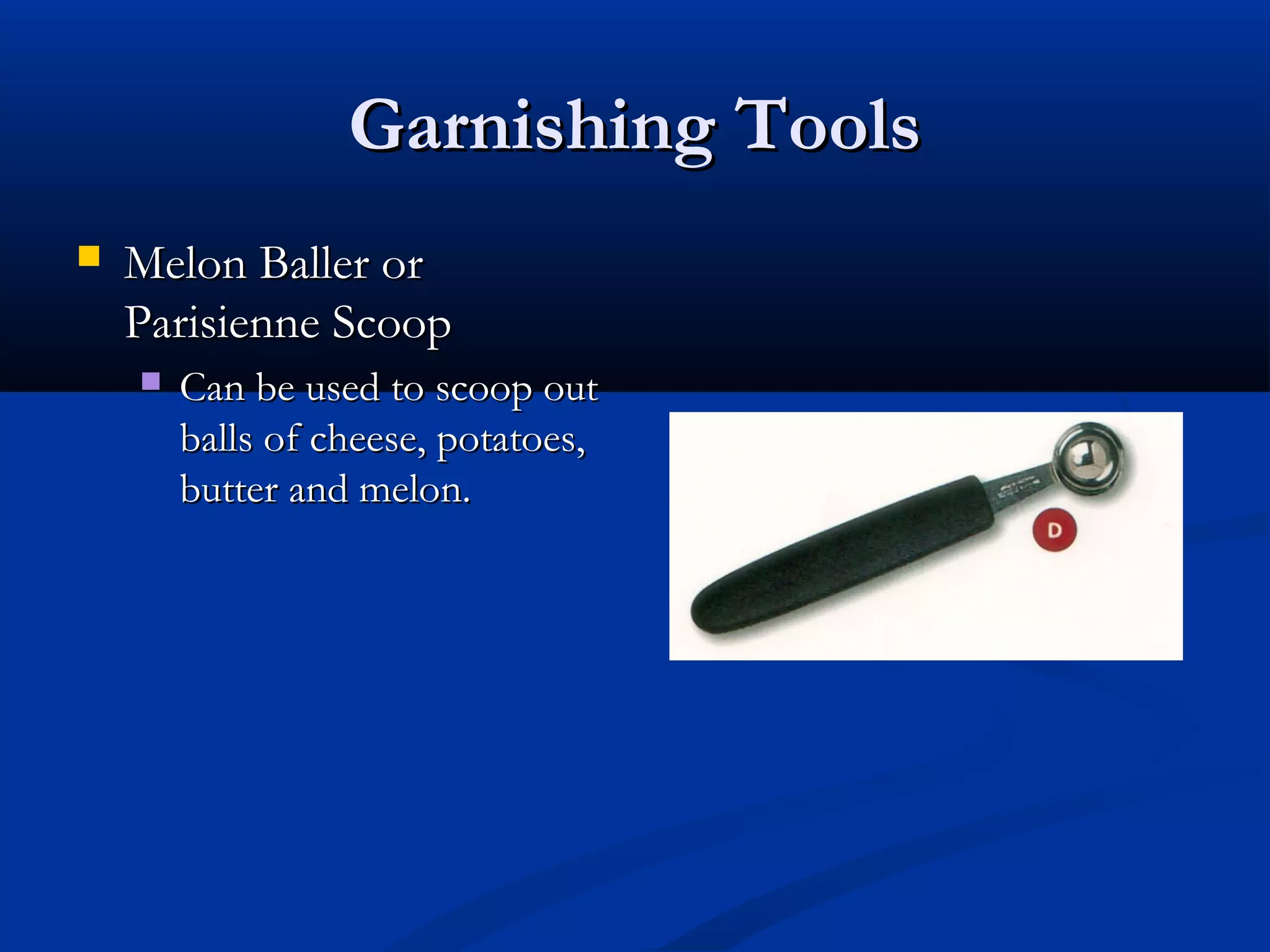
 Melon Baller orMelon Baller or
Parisienne ScoopParisienne Scoop
 Can be used to scoop outCan be used to scoop out
balls of cheese, potatoes,balls of cheese, potatoes,
butter and melon.butter and melon.
Garnishing ToolsGarnishing Tools
 TournTournée Knifeée Knife
 Use to make tournUse to make tournéed, oréed, or
turned, vegetables thatturned, vegetables that
have an oblong shapehave an oblong shape
with seven equal sides andwith seven equal sides and
blunt ends.blunt ends.
Garnishing ToolsGarnishing Tools
 Channel KnifeChannel Knife
 Use to pare strips of peelUse to pare strips of peel
from citrus fruits and thinfrom citrus fruits and thin
grooves from carrots andgrooves from carrots and
cucumbers.cucumbers.
Garnishing ToolsGarnishing Tools
 Decorating SpatulaDecorating Spatula
 Has a flat blade that isHas a flat blade that is
used to create attractiveused to create attractive
designs on soft foods,designs on soft foods,
such as cream cheese,such as cream cheese,
butter and frosting.butter and frosting.
Garnishing ToolsGarnishing Tools
 Pastry Bag and TipsPastry Bag and Tips
 Pastry tips fit into pastryPastry tips fit into pastry
bags and shape the flowbags and shape the flow
of food as it is squeezedof food as it is squeezed
out of the bag.out of the bag.
Garnishing ToolsGarnishing Tools
 Paring KnifeParing Knife
 Has a sharp, V-shapedHas a sharp, V-shaped
blade. Use this tool toblade. Use this tool to
carve fruits andcarve fruits and
vegetables.vegetables.
Garnishing ToolsGarnishing Tools
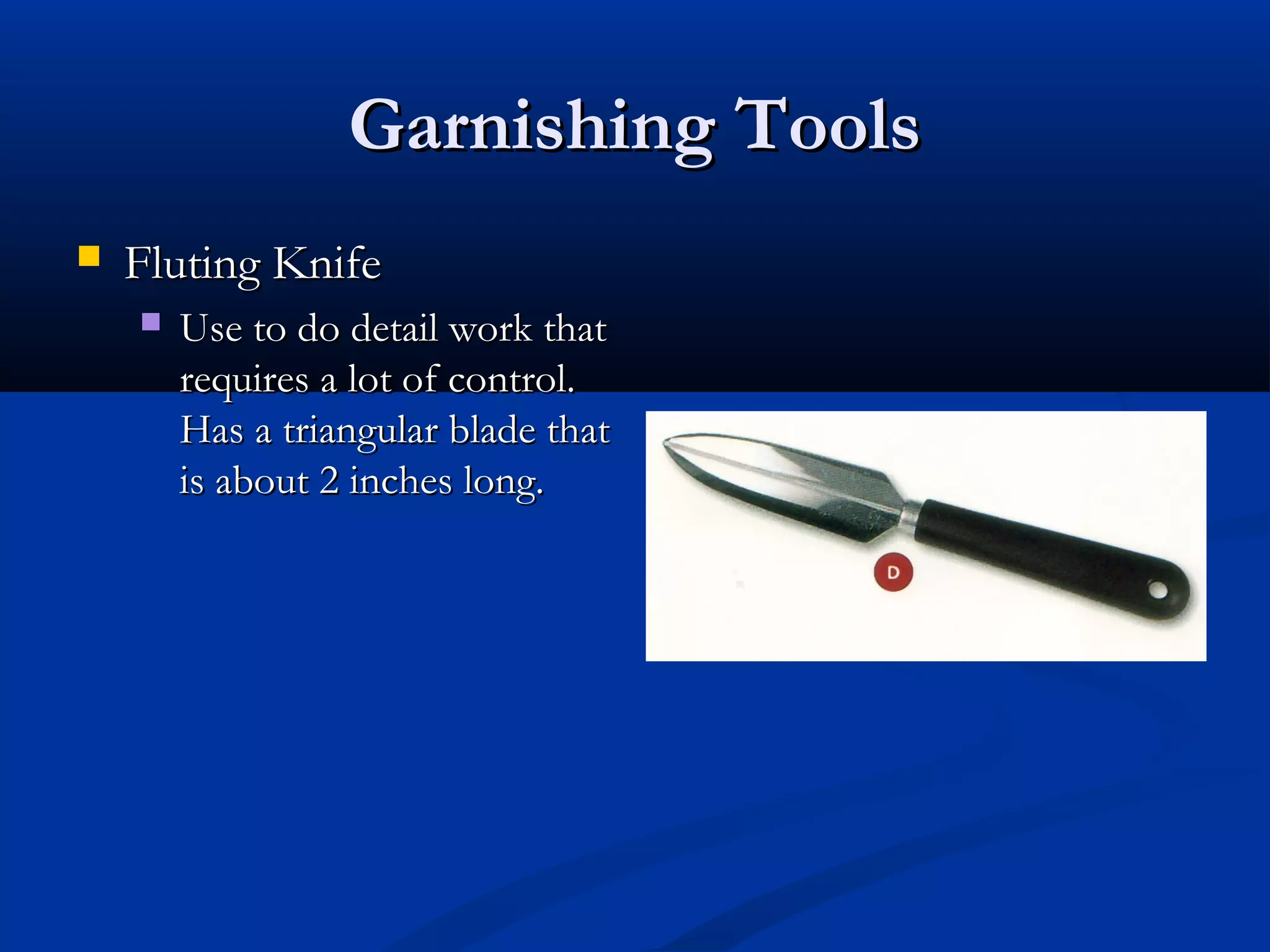
 Fluting KnifeFluting Knife
 Use to do detail work thatUse to do detail work that
requires a lot of control.requires a lot of control.
Has a triangular blade thatHas a triangular blade that
is about 2 inches long.is about 2 inches long.
Garnishing GuidelinesGarnishing Guidelines
 Be sure the flavor is compatible with the food on whichBe sure the flavor is compatible with the food on which
it is served.it is served.
 Keep color in mind. The color should complement theKeep color in mind. The color should complement the
food.food.
 Consider the size of the garnish in relation to the sizeConsider the size of the garnish in relation to the size
of the food and the container. If it’s too large it mayof the food and the container. If it’s too large it may
overpower the food.overpower the food.
 Do not over-garnish foodDo not over-garnish food
 Keep in mind the cost when working in a food serviceKeep in mind the cost when working in a food service
operation. The cost of the garnish should not add toooperation. The cost of the garnish should not add too
much to the cost of the item.much to the cost of the item.
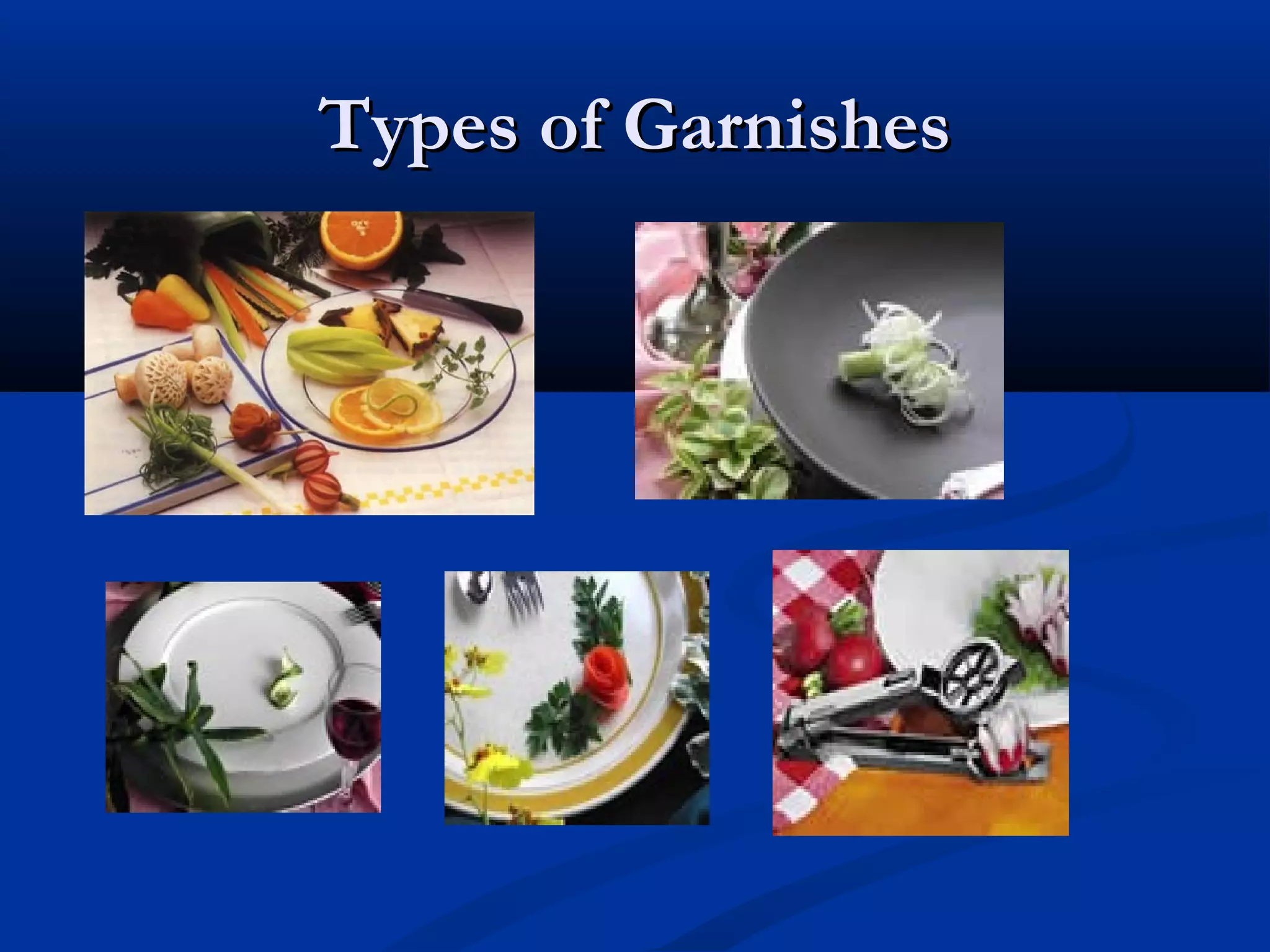
Types of GarnishesTypes of Garnishes
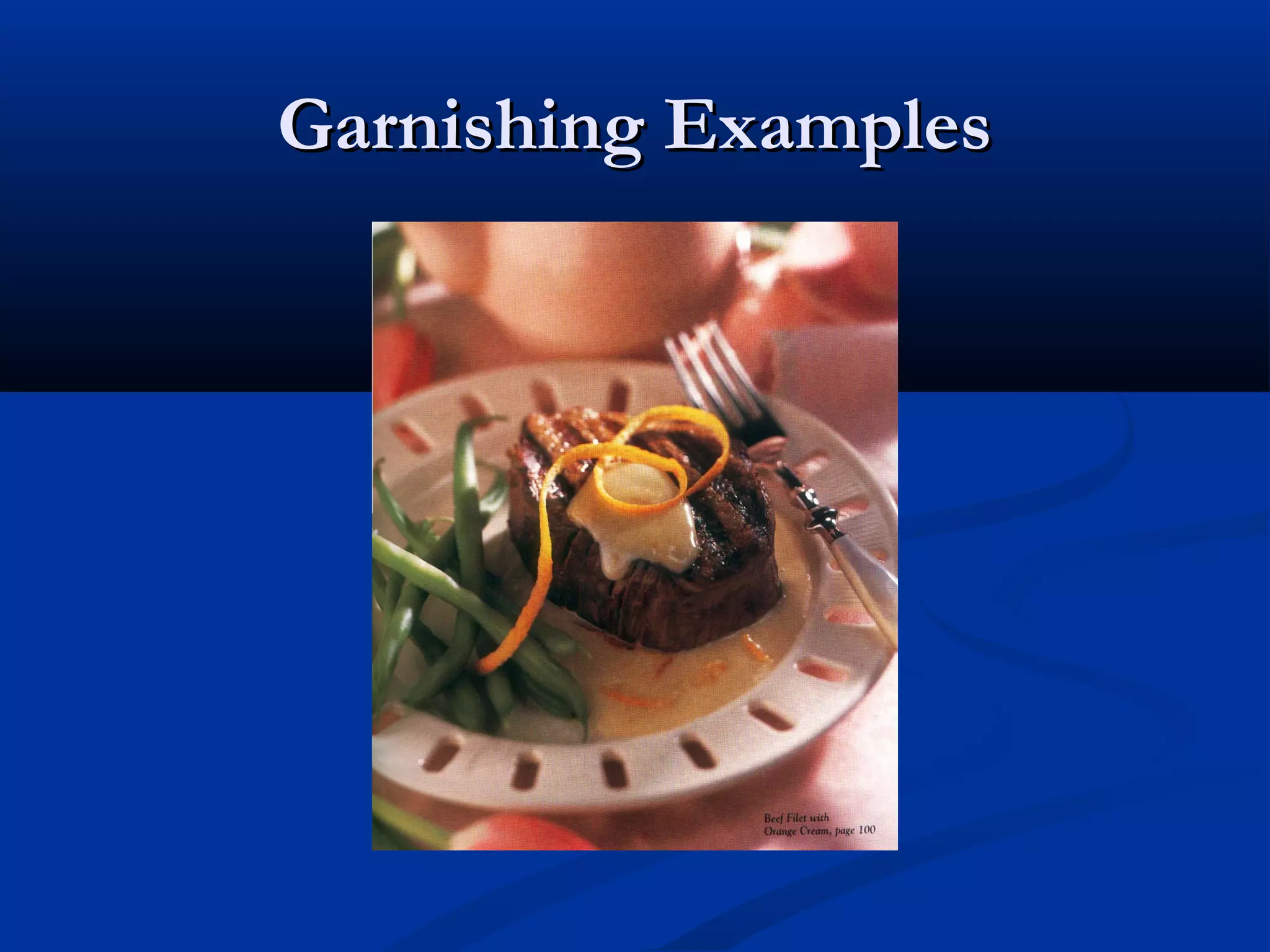
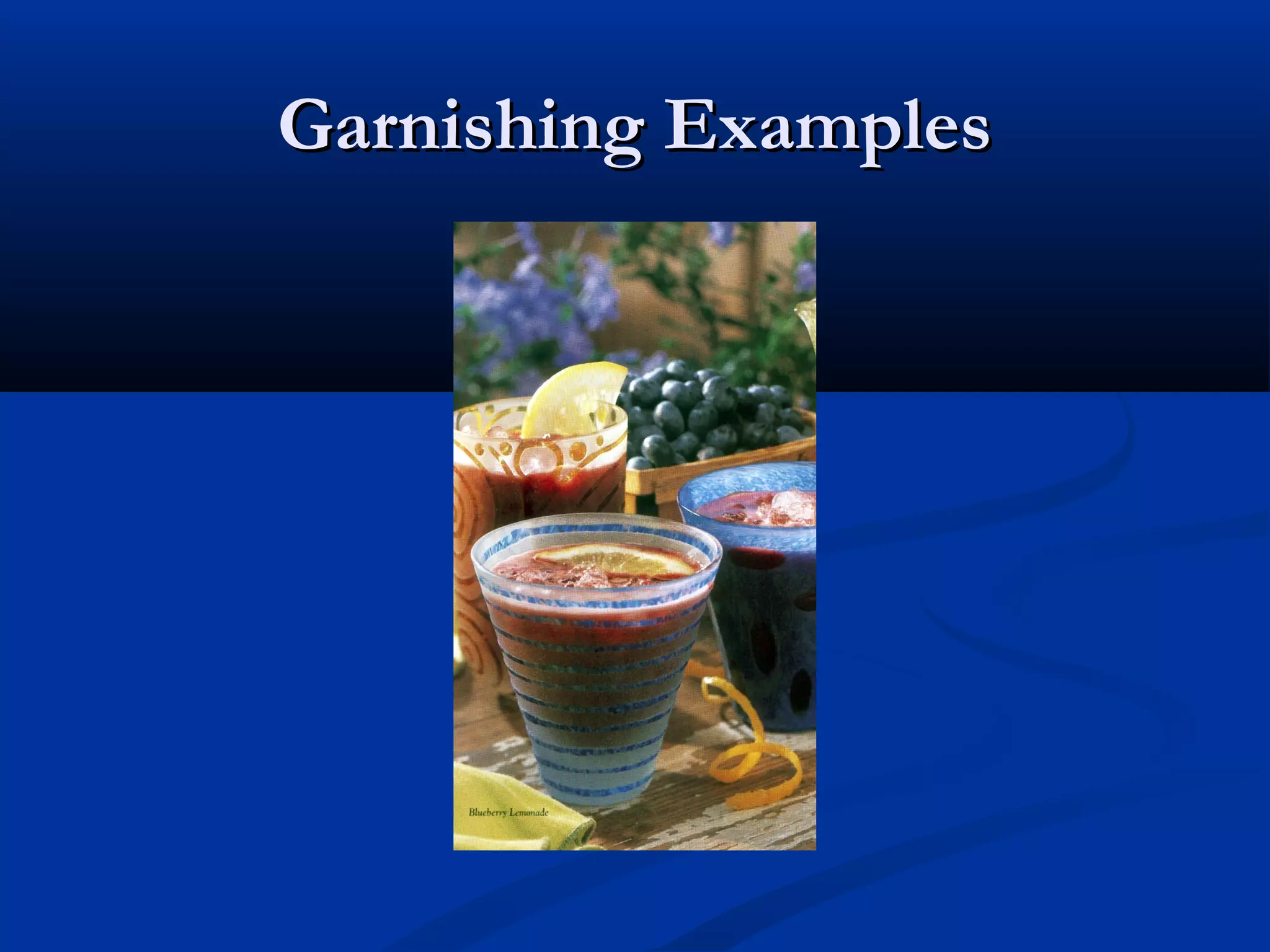
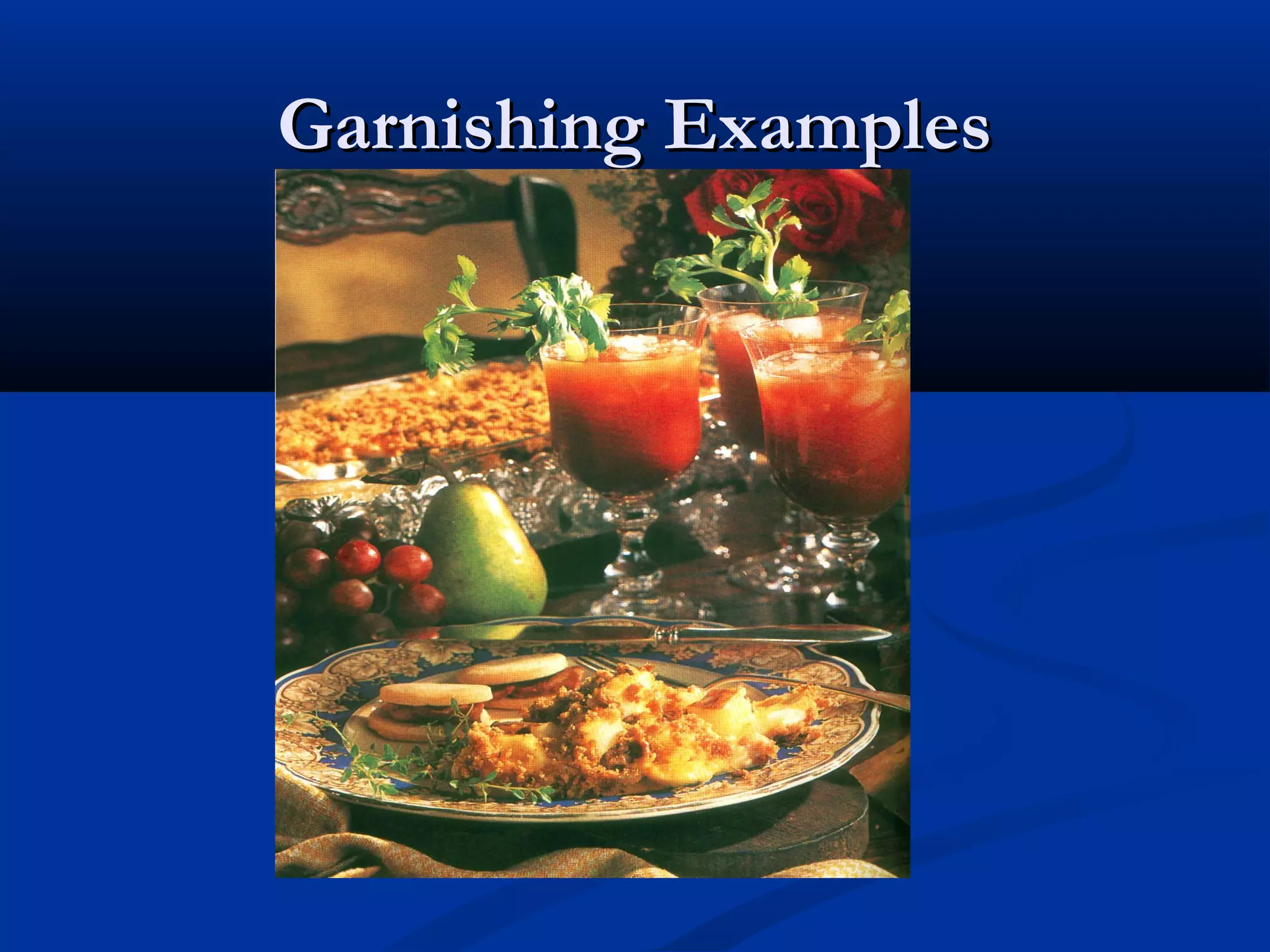
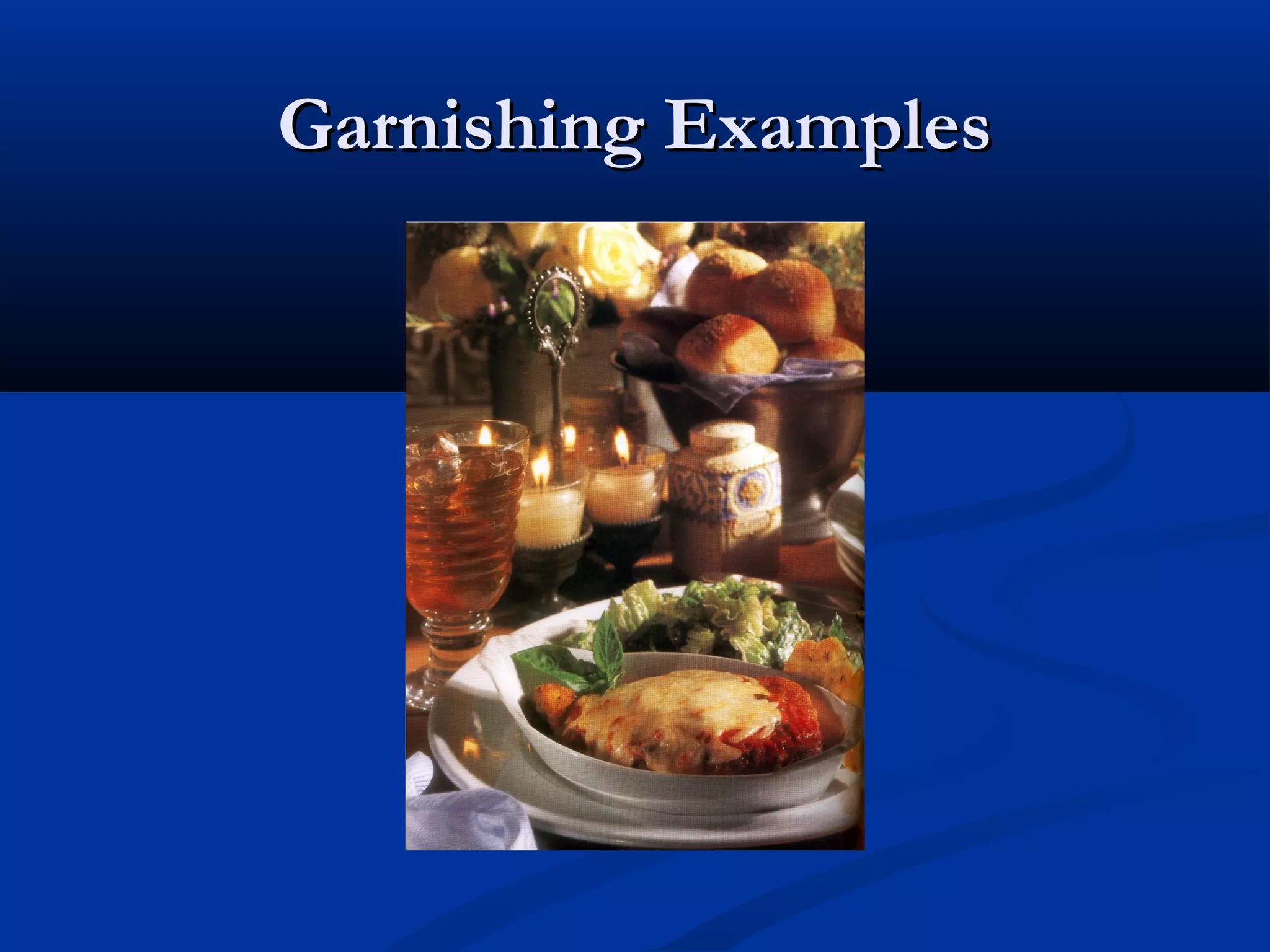
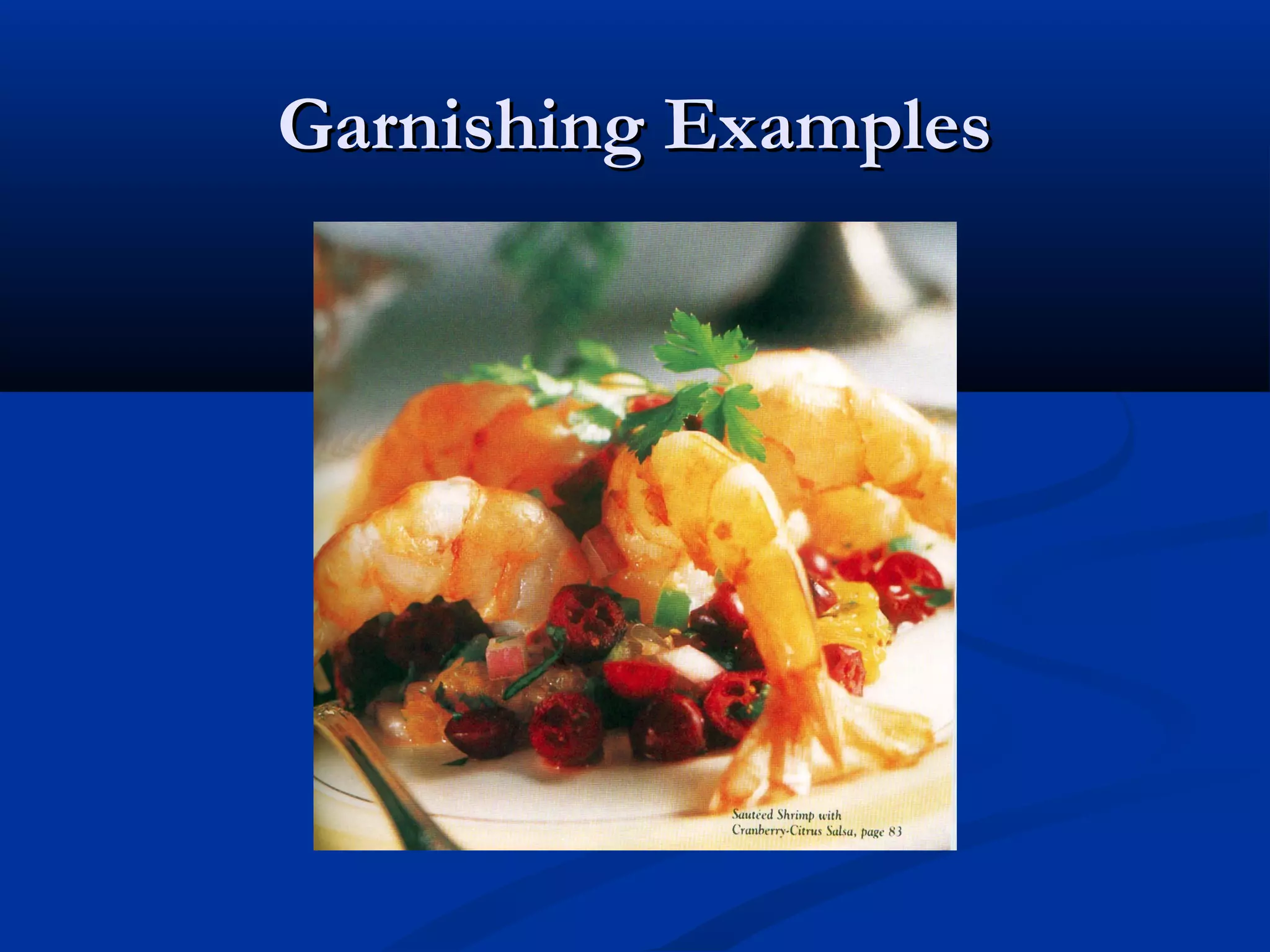
Garnishing ExamplesGarnishing Examples
Plate CompositionPlate Composition
 Presentation is the process of offering thePresentation is the process of offering the
selected foods to diners in a fashion that isselected foods to diners in a fashion that is
visually pleasing.visually pleasing.
 Remember- We eat with our eyes and then withRemember- We eat with our eyes and then with
our mouths!our mouths!
 The colors, textures, shapes and arrangements ofThe colors, textures, shapes and arrangements of
all foods must work together to form a pleasingall foods must work together to form a pleasing
composition on the plate.composition on the plate.
Plate CompositionPlate Composition
 Plates should be neat and clean.Plates should be neat and clean.
 Inspect all plates before they leave the kitchen;Inspect all plates before they leave the kitchen;
wipe fingerprints, drops of sauce or specks ofwipe fingerprints, drops of sauce or specks of
food from their rims with a clean towel.food from their rims with a clean towel.
 When serving food remember :“Hot foodWhen serving food remember :“Hot food
should be placed on a hot plate, cold foodshould be placed on a hot plate, cold food
should be placed on a cold plate”should be placed on a cold plate”
Plate CompositionPlate Composition
 Everything on the plate should be deliberatelyEverything on the plate should be deliberately
placed that way. Choose and position the foodplaced that way. Choose and position the food
carefully to achieve a plate presentation with acarefully to achieve a plate presentation with a
balanced, harmonious composition.balanced, harmonious composition.
 Avoid the “smiley-face” plate.Avoid the “smiley-face” plate.
Meat
Starch
Vegetable
Plate CompositionPlate Composition
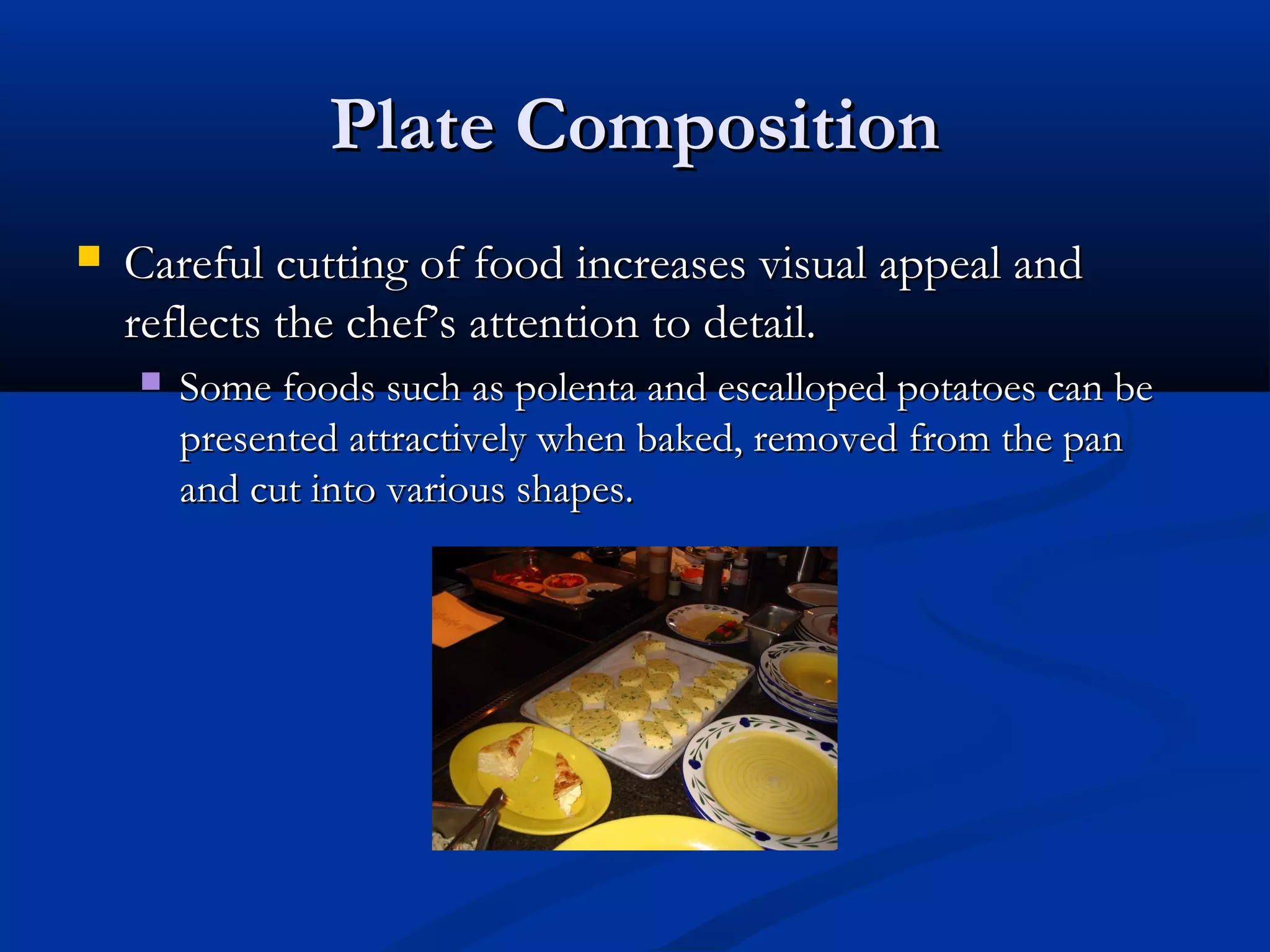
 Careful cutting of food increases visual appeal andCareful cutting of food increases visual appeal and
reflects the chef’s attention to detail.reflects the chef’s attention to detail.
 Some foods such as polenta and escalloped potatoes can beSome foods such as polenta and escalloped potatoes can be
presented attractively when baked, removed from the panpresented attractively when baked, removed from the pan
and cut into various shapes.and cut into various shapes.
Plate CompositionPlate Composition
 Some foods such asSome foods such as
grains or vegetables cangrains or vegetables can
be molded into attractivebe molded into attractive
shapes by using metalshapes by using metal
rings, circular cutters, orrings, circular cutters, or
other forms. Thisother forms. This
creates height and keepscreates height and keeps
the plate neat and clean.the plate neat and clean.
Guidelines for Arranging Foods on a PlateGuidelines for Arranging Foods on a Plate
 Strike a balance between overcrowding the plate andStrike a balance between overcrowding the plate and
leaving large gaps of space. Foods should not touchleaving large gaps of space. Foods should not touch
the plate rim.the plate rim.
 Choose a focal point for the plate. Design the plateChoose a focal point for the plate. Design the plate
with the highest point to the rear or center. Avoidwith the highest point to the rear or center. Avoid
placing foods of equal heights around the edge of theplacing foods of equal heights around the edge of the
plate-leaving a hole in the center- the eye will naturallyplate-leaving a hole in the center- the eye will naturally
be drawn to the gap.be drawn to the gap.
 The plates composition should flow naturally. ForThe plates composition should flow naturally. For
example, make the highest point at the back of the plateexample, make the highest point at the back of the plate
and have the rest of the food become gradually shorterand have the rest of the food become gradually shorter
toward the front of the plate.toward the front of the plate.
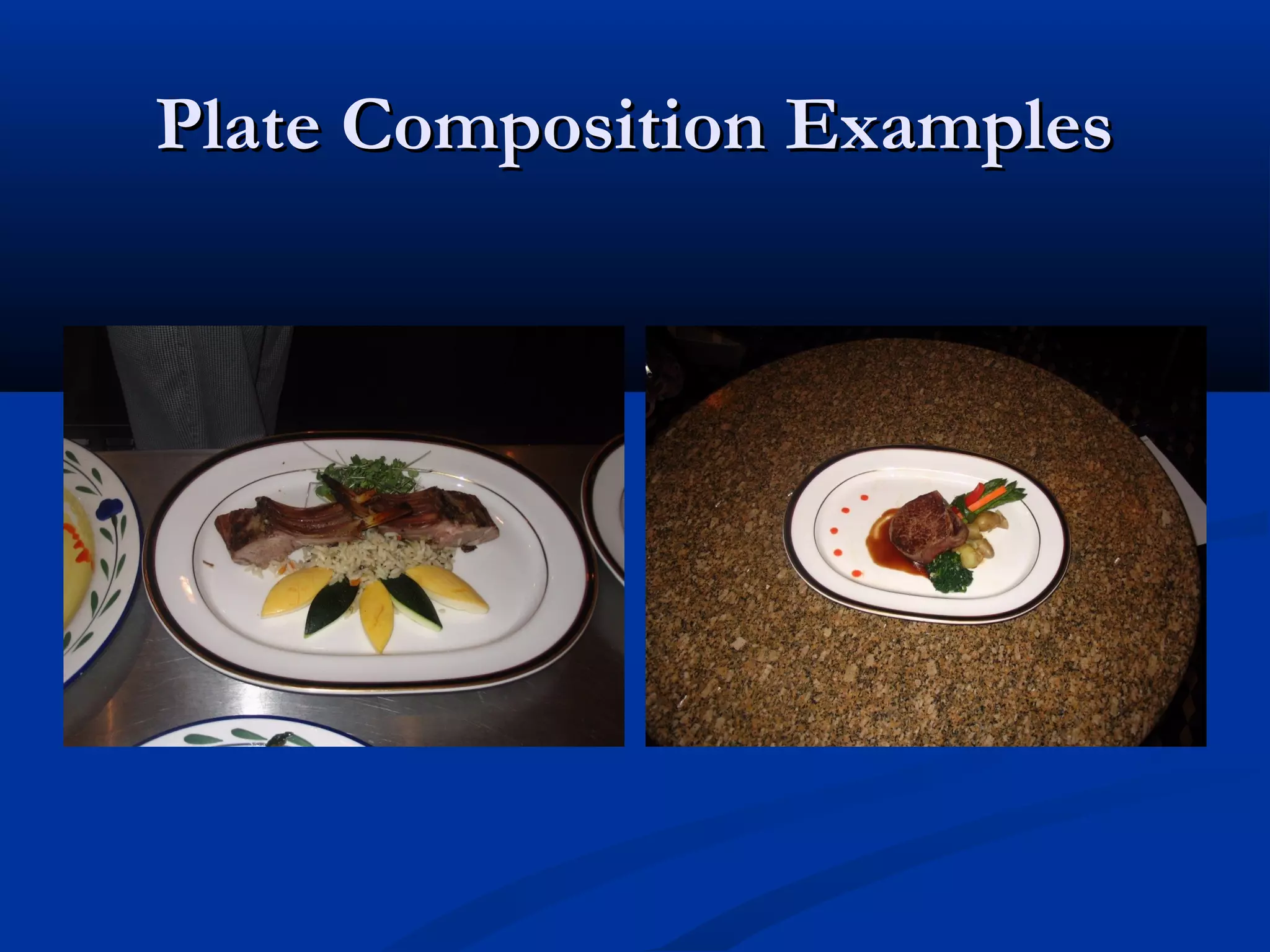
Plate Composition ExamplesPlate Composition Examples
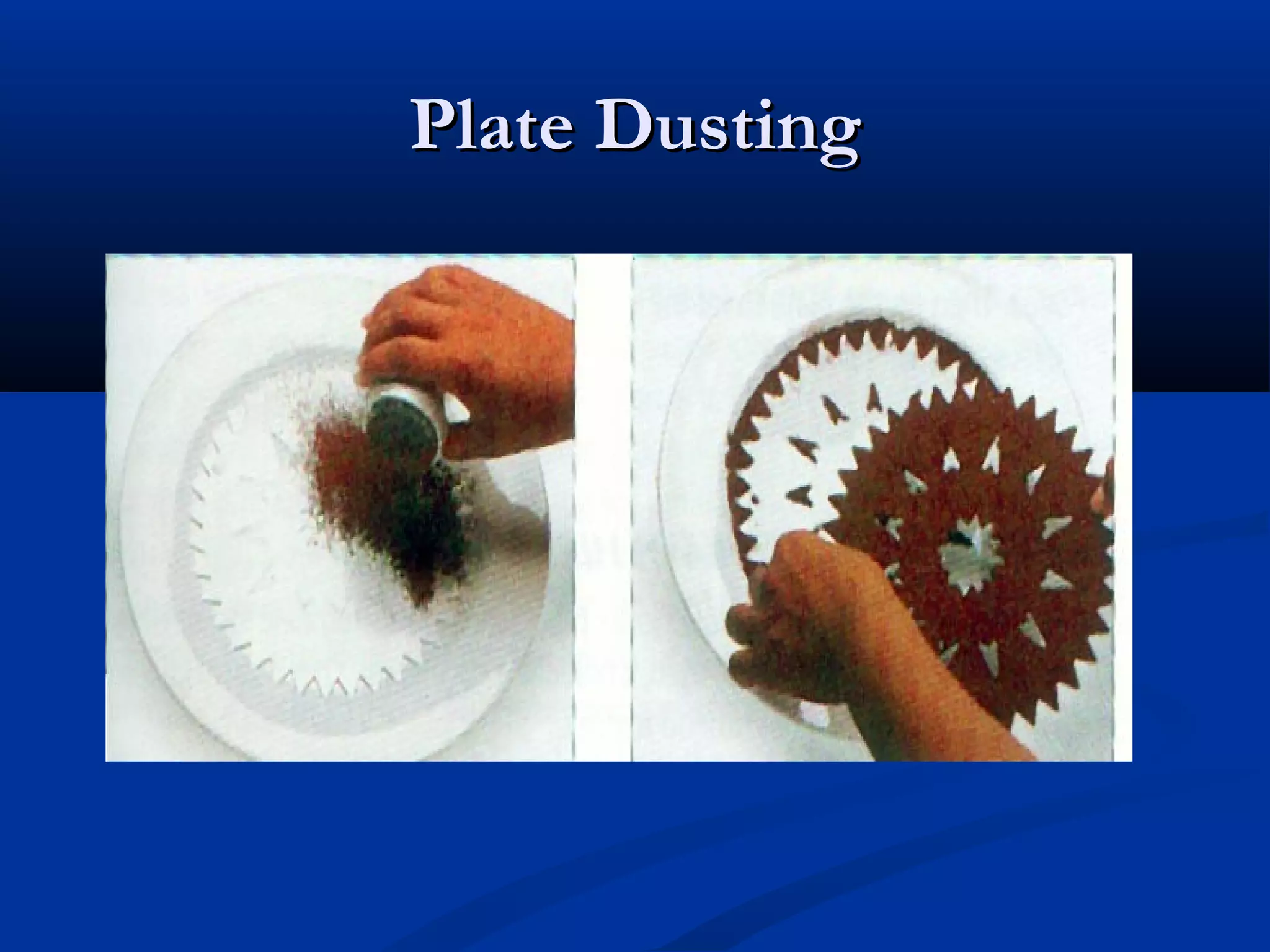
Plate DustingPlate Dusting
 Cover the entire plate with a dusting ofCover the entire plate with a dusting of
powdered sugar, cocoa powder or both beforepowdered sugar, cocoa powder or both before
placing the dessert on the plate.placing the dessert on the plate.
 Can be dusted on with a shaker can or a sifter.Can be dusted on with a shaker can or a sifter.
 Can be dusted on free-form or use a templateCan be dusted on free-form or use a template
such as a doily or stencil.such as a doily or stencil.
Plate DustingPlate Dusting
Garnishing Plates with HerbsGarnishing Plates with Herbs
 Use fresh herbs that complement the dish to add color,Use fresh herbs that complement the dish to add color,
texture and flow to a plate.texture and flow to a plate.
 Can also use finely chopped herbs or nuts or whole orCan also use finely chopped herbs or nuts or whole or
ground spices to decorate plate rims.ground spices to decorate plate rims.
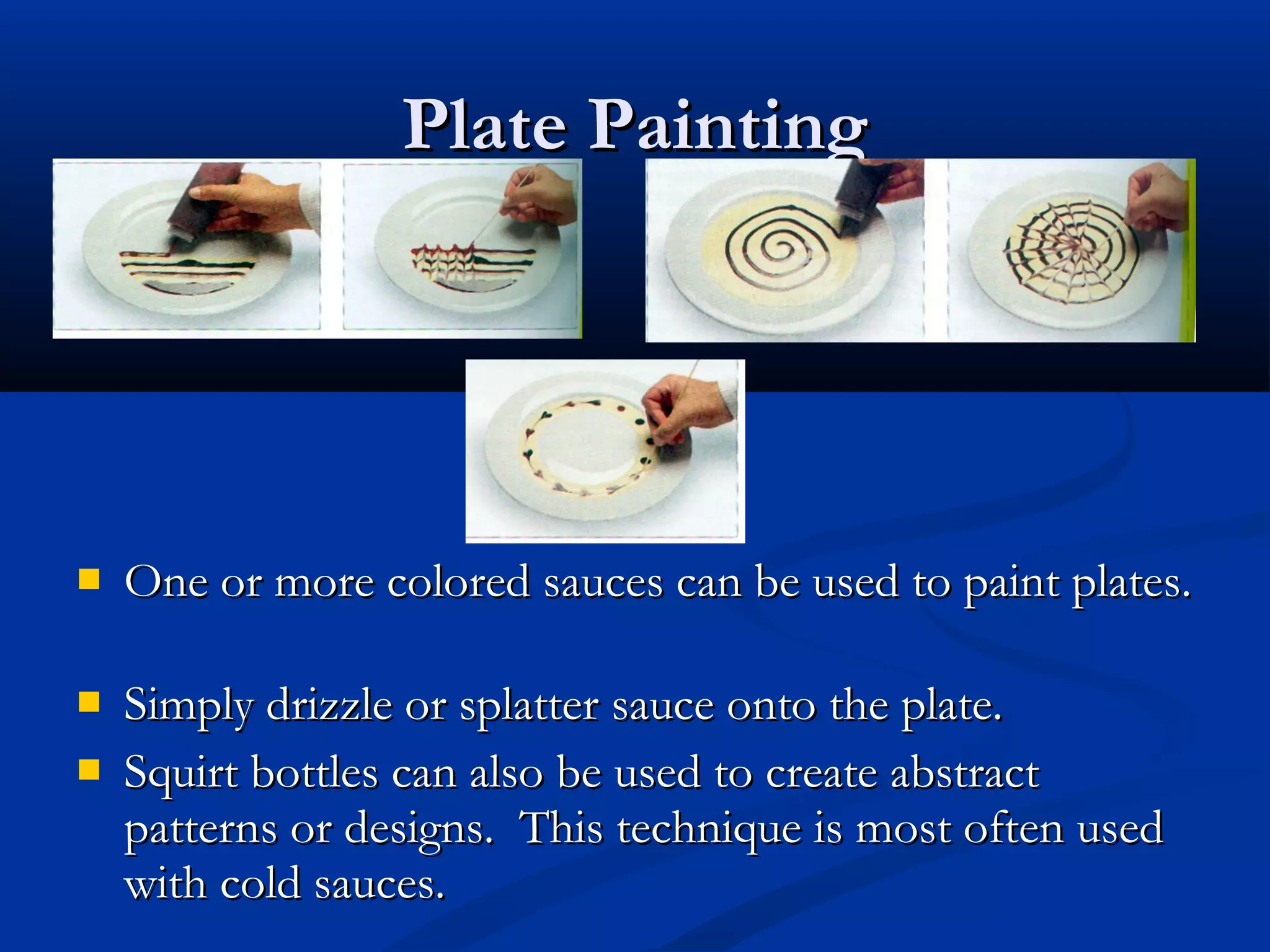
Plate PaintingPlate Painting
 One or more colored sauces can be used to paint plates.One or more colored sauces can be used to paint plates.
 Simply drizzle or splatter sauce onto the plate.Simply drizzle or splatter sauce onto the plate.
 Squirt bottles can also be used to create abstractSquirt bottles can also be used to create abstract
patterns or designs. This technique is most often usedpatterns or designs. This technique is most often used
with cold sauces.with cold sauces.

Garnishes ppt 1

  • 1.
  • 2.
    What is agarnish?What is a garnish?  The wordThe word garnishgarnish comes from the French wordcomes from the French word “garnir” which means “to decorate or furnish”.“garnir” which means “to decorate or furnish”.  In the culinary world, it means to use food as anIn the culinary world, it means to use food as an attractive decoration.attractive decoration.  It is something that should add real value to theIt is something that should add real value to the dish by increasing its nutritional value and visualdish by increasing its nutritional value and visual appeal.appeal.
  • 3.
    Garnishing ToolsGarnishing Tools Vegetable PeelerVegetable Peeler  Use to make decorativeUse to make decorative carrot curls and chocolatecarrot curls and chocolate curls.curls.
  • 4.
    Garnishing ToolsGarnishing Tools Butter CutterButter Cutter  Has four sides that can beHas four sides that can be used to make a range ofused to make a range of garnishes from curls togarnishes from curls to grooves to marble-sizegrooves to marble-size balls.balls.  For best results, use ice-For best results, use ice- cold butter and a buttercold butter and a butter cutter that has beencutter that has been warmed in hot water.warmed in hot water.
  • 5.
    Garnishing ToolsGarnishing Tools ZesterZester  Use to remove smallUse to remove small strips of the colored partstrips of the colored part of citrus peels. You canof citrus peels. You can also use this tool to shavealso use this tool to shave pieces from colorfulpieces from colorful vegetables, such as carrotsvegetables, such as carrots and radishes.and radishes.
  • 6.
    Garnishing ToolsGarnishing Tools Melon Baller orMelon Baller or Parisienne ScoopParisienne Scoop  Can be used to scoop outCan be used to scoop out balls of cheese, potatoes,balls of cheese, potatoes, butter and melon.butter and melon.
  • 7.
    Garnishing ToolsGarnishing Tools TournTournée Knifeée Knife  Use to make tournUse to make tournéed, oréed, or turned, vegetables thatturned, vegetables that have an oblong shapehave an oblong shape with seven equal sides andwith seven equal sides and blunt ends.blunt ends.
  • 8.
    Garnishing ToolsGarnishing Tools Channel KnifeChannel Knife  Use to pare strips of peelUse to pare strips of peel from citrus fruits and thinfrom citrus fruits and thin grooves from carrots andgrooves from carrots and cucumbers.cucumbers.
  • 9.
    Garnishing ToolsGarnishing Tools Decorating SpatulaDecorating Spatula  Has a flat blade that isHas a flat blade that is used to create attractiveused to create attractive designs on soft foods,designs on soft foods, such as cream cheese,such as cream cheese, butter and frosting.butter and frosting.
  • 10.
    Garnishing ToolsGarnishing Tools Pastry Bag and TipsPastry Bag and Tips  Pastry tips fit into pastryPastry tips fit into pastry bags and shape the flowbags and shape the flow of food as it is squeezedof food as it is squeezed out of the bag.out of the bag.
  • 11.
    Garnishing ToolsGarnishing Tools Paring KnifeParing Knife  Has a sharp, V-shapedHas a sharp, V-shaped blade. Use this tool toblade. Use this tool to carve fruits andcarve fruits and vegetables.vegetables.
  • 12.
    Garnishing ToolsGarnishing Tools Fluting KnifeFluting Knife  Use to do detail work thatUse to do detail work that requires a lot of control.requires a lot of control. Has a triangular blade thatHas a triangular blade that is about 2 inches long.is about 2 inches long.
  • 13.
    Garnishing GuidelinesGarnishing Guidelines Be sure the flavor is compatible with the food on whichBe sure the flavor is compatible with the food on which it is served.it is served.  Keep color in mind. The color should complement theKeep color in mind. The color should complement the food.food.  Consider the size of the garnish in relation to the sizeConsider the size of the garnish in relation to the size of the food and the container. If it’s too large it mayof the food and the container. If it’s too large it may overpower the food.overpower the food.  Do not over-garnish foodDo not over-garnish food  Keep in mind the cost when working in a food serviceKeep in mind the cost when working in a food service operation. The cost of the garnish should not add toooperation. The cost of the garnish should not add too much to the cost of the item.much to the cost of the item.
  • 14.
  • 15.
  • 16.
  • 17.
  • 18.
  • 19.
  • 20.
  • 21.
  • 22.
  • 23.
  • 24.
  • 25.
    Plate CompositionPlate Composition Presentation is the process of offering thePresentation is the process of offering the selected foods to diners in a fashion that isselected foods to diners in a fashion that is visually pleasing.visually pleasing.  Remember- We eat with our eyes and then withRemember- We eat with our eyes and then with our mouths!our mouths!  The colors, textures, shapes and arrangements ofThe colors, textures, shapes and arrangements of all foods must work together to form a pleasingall foods must work together to form a pleasing composition on the plate.composition on the plate.
  • 26.
    Plate CompositionPlate Composition Plates should be neat and clean.Plates should be neat and clean.  Inspect all plates before they leave the kitchen;Inspect all plates before they leave the kitchen; wipe fingerprints, drops of sauce or specks ofwipe fingerprints, drops of sauce or specks of food from their rims with a clean towel.food from their rims with a clean towel.  When serving food remember :“Hot foodWhen serving food remember :“Hot food should be placed on a hot plate, cold foodshould be placed on a hot plate, cold food should be placed on a cold plate”should be placed on a cold plate”
  • 27.
    Plate CompositionPlate Composition Everything on the plate should be deliberatelyEverything on the plate should be deliberately placed that way. Choose and position the foodplaced that way. Choose and position the food carefully to achieve a plate presentation with acarefully to achieve a plate presentation with a balanced, harmonious composition.balanced, harmonious composition.  Avoid the “smiley-face” plate.Avoid the “smiley-face” plate. Meat Starch Vegetable
  • 28.
    Plate CompositionPlate Composition Careful cutting of food increases visual appeal andCareful cutting of food increases visual appeal and reflects the chef’s attention to detail.reflects the chef’s attention to detail.  Some foods such as polenta and escalloped potatoes can beSome foods such as polenta and escalloped potatoes can be presented attractively when baked, removed from the panpresented attractively when baked, removed from the pan and cut into various shapes.and cut into various shapes.
  • 29.
    Plate CompositionPlate Composition Some foods such asSome foods such as grains or vegetables cangrains or vegetables can be molded into attractivebe molded into attractive shapes by using metalshapes by using metal rings, circular cutters, orrings, circular cutters, or other forms. Thisother forms. This creates height and keepscreates height and keeps the plate neat and clean.the plate neat and clean.
  • 30.
    Guidelines for ArrangingFoods on a PlateGuidelines for Arranging Foods on a Plate  Strike a balance between overcrowding the plate andStrike a balance between overcrowding the plate and leaving large gaps of space. Foods should not touchleaving large gaps of space. Foods should not touch the plate rim.the plate rim.  Choose a focal point for the plate. Design the plateChoose a focal point for the plate. Design the plate with the highest point to the rear or center. Avoidwith the highest point to the rear or center. Avoid placing foods of equal heights around the edge of theplacing foods of equal heights around the edge of the plate-leaving a hole in the center- the eye will naturallyplate-leaving a hole in the center- the eye will naturally be drawn to the gap.be drawn to the gap.  The plates composition should flow naturally. ForThe plates composition should flow naturally. For example, make the highest point at the back of the plateexample, make the highest point at the back of the plate and have the rest of the food become gradually shorterand have the rest of the food become gradually shorter toward the front of the plate.toward the front of the plate.
  • 31.
    Plate Composition ExamplesPlateComposition Examples
  • 32.
    Plate Composition ExamplesPlateComposition Examples
  • 33.
    Plate DustingPlate Dusting Cover the entire plate with a dusting ofCover the entire plate with a dusting of powdered sugar, cocoa powder or both beforepowdered sugar, cocoa powder or both before placing the dessert on the plate.placing the dessert on the plate.  Can be dusted on with a shaker can or a sifter.Can be dusted on with a shaker can or a sifter.  Can be dusted on free-form or use a templateCan be dusted on free-form or use a template such as a doily or stencil.such as a doily or stencil.
  • 34.
  • 35.
    Garnishing Plates withHerbsGarnishing Plates with Herbs  Use fresh herbs that complement the dish to add color,Use fresh herbs that complement the dish to add color, texture and flow to a plate.texture and flow to a plate.  Can also use finely chopped herbs or nuts or whole orCan also use finely chopped herbs or nuts or whole or ground spices to decorate plate rims.ground spices to decorate plate rims.
  • 36.
    Plate PaintingPlate Painting One or more colored sauces can be used to paint plates.One or more colored sauces can be used to paint plates.  Simply drizzle or splatter sauce onto the plate.Simply drizzle or splatter sauce onto the plate.  Squirt bottles can also be used to create abstractSquirt bottles can also be used to create abstract patterns or designs. This technique is most often usedpatterns or designs. This technique is most often used with cold sauces.with cold sauces.