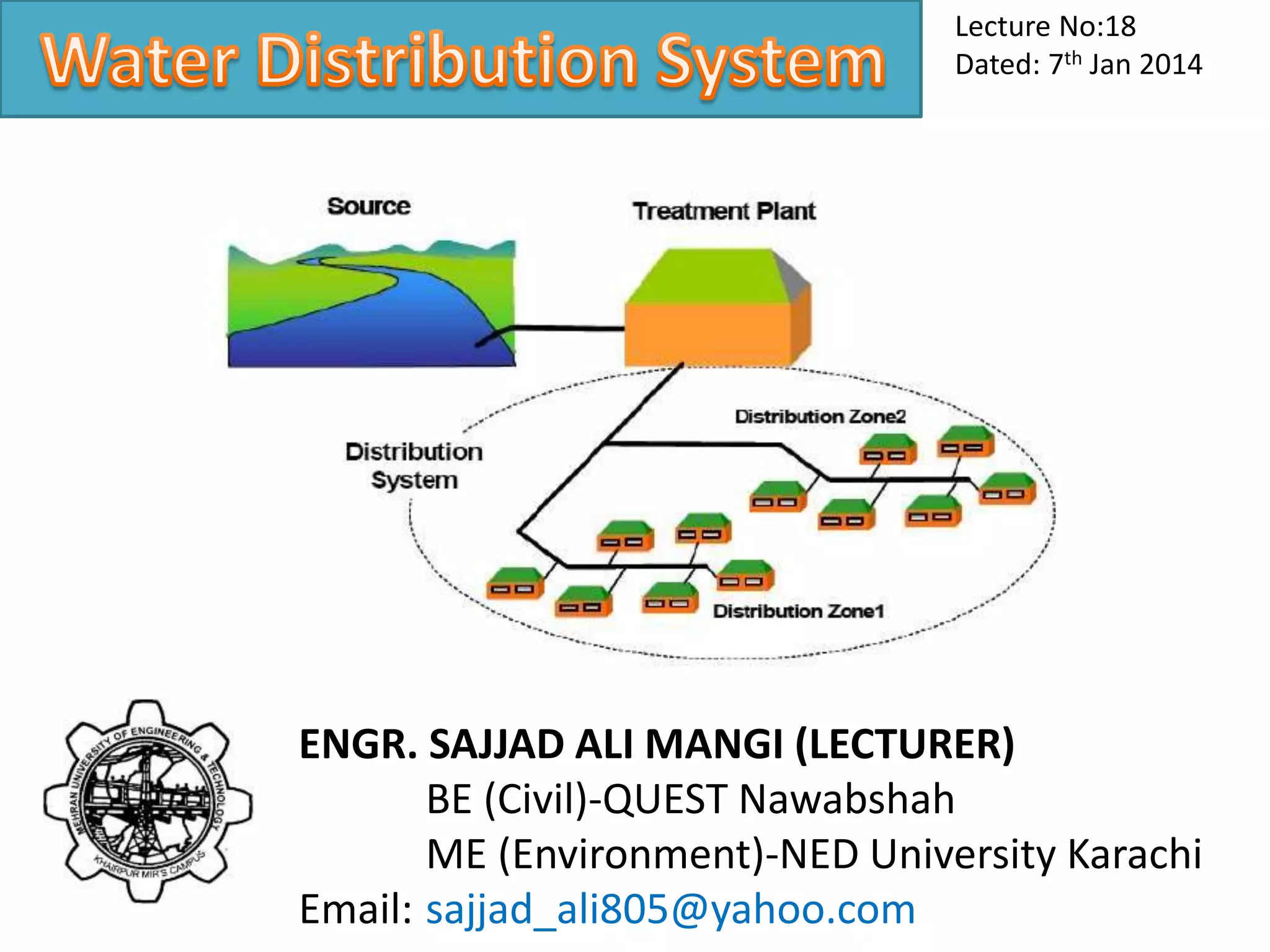
ENGR. SAJJAD ALI MANGI (LECTURER)
BE (Civil)-QUEST Nawabshah
ME (Environment)-NED University Karachi
Email: sajjad_ali805@yahoo.com
Lecture No:18
Dated: 7th Jan 2014
General Consideration for Water Distribution System
Lecture No:18
Dated: 7th Feb 2014
The water, as it leaves the treatment plant, is of desired quality. But the
standard of this quality is to be maintained when the treated water if flowing
through the network of distribution system.
The water should also be supplied in a way useful to the consumers. For
these reasons, the following general considerations of the planning of
distribution system should be observed in its design:
1. Circulation of water
2. Construction and design
3. Contamination by sewage
4. Earth cushioning (laid under road)
5. Economy
6. Fire demand
7. Gradients
8. Leakages
9. Repairs
10. Safety from Pollution
11. Sanitation
12. Unsafe cross connection.
General Consideration for Water Distribution System
Lecture No:18
Dated: 7th Feb 2014
1. Circulation of water: The layout of distribution system should be such that
there is free circulation of water and the number of dead ends should be very
few. Where dead ends are unavoidable, hydrants will be provided to act as
washouts.
2. Construction and design: The construction and design of water distribution
system should be such that sufficient water is available at all times at desired
pressure in all portions of the distribution system.
3. Contamination by sewage: The water pipe should be laid above the sewers at
a vertical distance of about 2 meters and the horizontal distance between the
water pipes and sewer should be at least 3meters .
4. Earth cushioning: The mains which are laid under roads should be provided
with a minimum earth cushioning of 75 to 90 cm height from the top of mains.
5. Economy : The layout and Design of distribution system should be
economical. The cost of distribution system forms a substantial part to the
extent of about 90% of the total cost of the water supply project. Hence water
distribution system should be carefully designed by taking into various factors
such as pumping head, type of pipes, storage requirement, pipe diameters etc
General Consideration for Water Distribution System
Lecture No:18
Dated: 7th Feb 2014
6. Fire demand: The distribution system should be so laid that water for fire
demand is available in required quantity at desired pressure at number of
points along it.
7. Gradients: It is not necessary to lay main at constant gradients. But the
gradients of mains should be in general follow the natural contours of ground.
The gradient line should not rise above the hydraulic gradient line which
means that at every point along the mains, there should be a positive pressure
greater than atmospheric pressure.
8. Leakages: The distribution system should be fairly watertight and the loss of
water due to leakages should be brought down to the minimum possible
extent.
9. Repairs: The distribution system should be so laid as to permit easy repairs.
The broken or worn out parts of the equipments for various operations should
be properly replaced.
10. Safety from Pollution: The layout of Distribution system should be such that it
does not contribute to the pollution of water flowing in it.
General Consideration for Water Distribution System
Lecture No:18
Dated: 7th Feb 2014
11. Sanitation: The sanitation of area through which the distribution system is
passing should be good that there are no chances for water to be polluted
during repair or replaced of pipe lines.
12. Unsafe cross connection: The distribution system should not have any unsafe
cross connections from which there are chances for contaminated water to
enter it.
Methods of Water Distribution System
Lecture No:19
Dated: 10th Feb 2014
Depending upon the topography of the area /country, the following three may be
adopted for distribution of water.
1) Gravity System, 2) Gravity and Pumping System combined, 3) Pumping System
1. Gravity System: In this method, water is conveyed through pipes by gravity
only. The gravity system is the most reliable method of distribution. But it is
useful only when the source of water supply is situated at a higher level than
that of distribution area. As shown in figure A the gravity system with
hydraulic gradient during max. and min. demands. In this case fire, motor
pump may be used to develop high pressure for the fire fighting purpose.
2. Gravity and Pumping System combined: In this system, the treated water is
pumped and stored in an elevated distribution reservoir. The excess water
during low consumption remain in the elevated reservoir and it is supplied
during the peak period. The pumps are usually worked at constant rate and
this rate of pumping is so adjusted that the excess quantity of water stored in
reservoir during low consumption is nearly equal to the extra demand of
water during peak period. As shown figure B it shows the combined gravity
and pumping system with hydraulic gradient during max. and min. demands.
Methods of Water Distribution System
Lecture No:19
Dated: 10th Feb 2014
This method of distribution is usually applicable in most of the cases and it has the
following advantages;
i) in case of a fire, motor pumps can be used to develop high pressure or fire
demand can directly be satisfied from pump house after closing the inlet valve
for elevated reservoir.
ii) In this method, the pumps are generally worked at uniform rate.
iii) This method is economical
iv) This method is fairly reliable in the sense that some quantity of water is
available from elevated reservoir even during breakdown of pumps.
3. Pumping System: In this system, water is directly pumped into the mains
leading to the consumers. The number of pumps required in this system will
depend on the demand of water. As figure shows C the pumping system with
hydraulic gradients during max. and min. demands.
Service Reservoir
Lecture No:20
Dated: 11th Feb 2014
The service or distribution reservoir are generally provided in the distribution
system to store clear treated water before it is dispatched to the consumers.
These may be constructed of brick masonry, Stone masonry, Reinforced
cement concrete (RCC), etc
Purposes:
Following are the purposes served by the service or distribution reservoir:
1. If pumps are used, the provision of these reservoir make it possible to run
pumps at uniform rate.
2. In case of gravity system of supply, the provision of these reservoirs will result
in main of smaller diameters.
3. They furnish the facility of storage of water for meeting fluctuating hourly
demand of water.
4. They maintain constant pressure in the mains. The pressure in mains, without
service reservoirs, will fall as the demand of water will increase.
5. They make the design and construction of treatment units and distribution
system economical.
6. They serve as storage for emergencies such as breakdown of pumps, bursting
of mains, heavy fire demand, interruption in power supply, temporary floods,
etc.
Classification of Service Reservoir
Lecture No:21
Dated: 12th Feb 2014
According to situation with respect to ground, the service reservoirs are
classified in the following three types,
(1) Surface Reservoir,
(2) Elevated Reservoir,
(3) Stand Pipes,
Surface Reservoir: These are also known as ground or non-elevated reservoir.
They are constructed at ground level and are mainly used to store water. It is
usual practice to construct a surface reservoir in two compartments so that
one can be used while the other is being cleaned or repaired.
The two compartments are connected with each other by control valves.
Due to storage of water, silting will take place to some extent and it can be
removed by occasional cleaning through the washout pipes which are placed
at the bottom of the reservoir.
The surface reservoir are usually located at high points in the distribution
system. In the gravity system of supply, water can directly be sent to the
distribution system from the surface reservoir. In the combined gravity and
pumping system, filtered water is first stored in the surface reservoir and it is
then pumped to the elevated reservoir.
Classification of Service Reservoir
Lecture No:21
Dated: 12th Feb 2014
Elevated Reservoir: These are also known as overhead tanks and they are
constructed at an elevation from ground level. They may be of any shape
rectangular, circular or elliptical. With the development of science of
structural analysis, it is possible to construct the elevated reservoir in any
shape to suit the architectural requirement of the structure.
The elevated reservoirs are constructed in distributing areas which are not
controlled by gravity system of distribution.
Stand Piped: A stand pipe is a vertical cylindrical tank resting just above the
ground to develop the necessary pressure. The diameter of stand pipe varies
from 10m to 15m and its height varies from 15m to 30m. The stand pipes are
made of RCC, Steel etc.
The stand pipes are usually located on a hill or high ground so as to
successfully utilize its entire capacity.
The stand pipes, like elevated reservoir, are to be provided with inlet pipe,
outlet pipe, overflow pipe, washout pipe and various other accessories for
their efficient working, inspection and maintenance.
System of Supply of water
Lecture No:21
Dated: 12th Feb 2014
based on the duration of supply, the following are the two systems of supply
of water.
(1)Continues System, (2) Intermittent System
(1) Continues System: In this system of supply, the water is supplied to the
consumers for 24 hours of the day. This is most ideal system of supply and it
should be adopted as for as possible. The only disadvantage of this system is
that considerable wastage of water occurs if consumers do not possess civic
sense regarding the importance of treated water.
(2) Intermittent System: In this system of supply, the water is supplied during
certain fixed hours of the day only. The usual period is about one to four hours
in the morning and about the same period in the afternoon. The timings of
supply of water may be changed according to the seasons of the year. This
system of supply of water proves to be useful for the following two conditions:
(i) the available pressure is poor and (ii) the quantity of water available is not
sufficient to meet with the various demands of water.
The working of this system is very simple. The distribution area is divided into
several zones and the timings of each zone are so adjusted that good working
pressures are maintained in each zone.
Methods of Layout of distribution pipes
Lecture No:22
Dated: 13th Feb 2014
following are the four main methods of laying distribution pipes.
(1) Dead-end Method,
(2) Grid Iron Method,
(3) Circular Method,
(4) Radial Method,
Hydraulics of Closed Conduit Flow
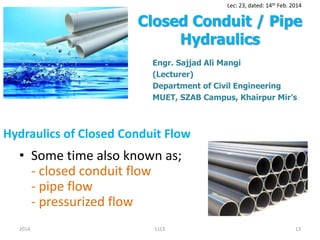
• Some time also known as;
- closed conduit flow
- pipe flow
- pressurized flow
2014 11CE 13
Lec: 23, dated: 14th Feb. 2014
Closed Conduit / Pipe
Hydraulics
Engr. Sajjad Ali Mangi
(Lecturer)
Department of Civil Engineering
MUET, SZAB Campus, Khairpur Mir’s
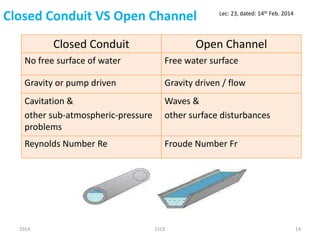
Closed Conduit VS Open Channel
Closed Conduit Open Channel
No free surface of water Free water surface
Gravity or pump driven Gravity driven / flow
Cavitation &
other sub-atmospheric-pressure
problems
Waves &
other surface disturbances
Reynolds Number Re Froude Number Fr
2014 11CE 14
Lec: 23, dated: 14th Feb. 2014
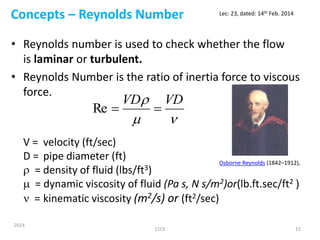
Concepts – Reynolds Number
• Reynolds number is used to check whether the flow
is laminar or turbulent.
• Reynolds Number is the ratio of inertia force to viscous
force.
V = velocity (ft/sec)
D = pipe diameter (ft)
 = density of fluid (lbs/ft3)
 = dynamic viscosity of fluid (Pa s, N s/m2)or(lb.ft.sec/ft2 )
 = kinematic viscosity (m2/s) or (ft2/sec)

 VDVD
Re
2014
11CE 15
Lec: 23, dated: 14th Feb. 2014
Osborne Reynolds (1842–1912),
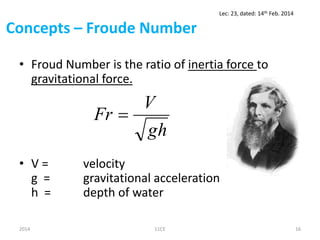
Concepts – Froude Number
• Froud Number is the ratio of inertia force to
gravitational force.
• V = velocity
g = gravitational acceleration
h = depth of water
gh
V
Fr 
2014 11CE 16
Lec: 23, dated: 14th Feb. 2014
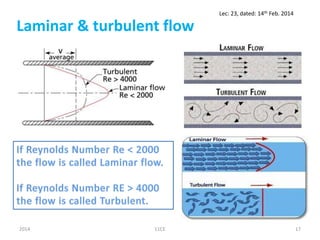
Laminar & turbulent flow
2014 11CE 17
Lec: 23, dated: 14th Feb. 2014
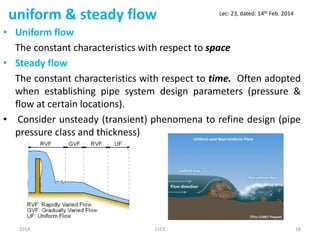
uniform & steady flow
• Uniform flow
The constant characteristics with respect to space
• Steady flow
The constant characteristics with respect to time. Often adopted
when establishing pipe system design parameters (pressure &
flow at certain locations).
• Consider unsteady (transient) phenomena to refine design (pipe
pressure class and thickness)
2014 11CE 18
Lec: 23, dated: 14th Feb. 2014
Conservation of Energy
• In pipeline design, most often consider steady
state – flow not varying with time - first
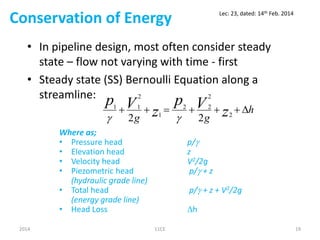
• Steady state (SS) Bernoulli Equation along a
streamline:
h
gg z
Vp
z
Vp  2
2
22
1
2
11
22 
2014 11CE 19
Lec: 23, dated: 14th Feb. 2014
Where as;
• Pressure head p/
• Elevation head z
• Velocity head V2/2g
• Piezometric head p/ + z
(hydraulic grade line)
• Total head p/ + z + V2/2g
(energy grade line)
• Head Loss h
Head Losses
• There are two types of losses:
1. Friction Loss
Resulting from friction between the fluid and pipe wall
2. Minor Loss
Resulting from pipe entrance, transition, exit, valve and
other in-line structures
2014 11CE 20
Lec: 23, dated: 14th Feb. 2014
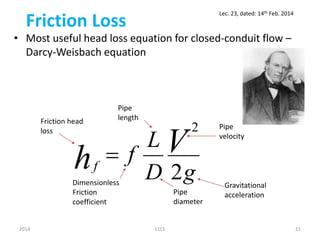
Friction Loss
• Most useful head loss equation for closed-conduit flow –
Darcy-Weisbach equation
gD
L
f Vhf
2
2

2014 11CE 21
Dimensionless
Friction
coefficient
Pipe
diameter
Pipe
length
Pipe
velocity
Friction head
loss
Gravitational
acceleration
Lec: 23, dated: 14th Feb. 2014
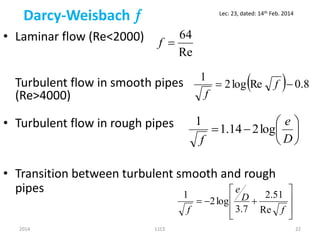
Darcy-Weisbach 
• Laminar flow (Re<2000)
Turbulent flow in smooth pipes
(Re>4000)
  8.0Relog2
1
 f
f
Re
64
f
2014 11CE 22
Lec: 23, dated: 14th Feb. 2014
• Turbulent flow in rough pipes
• Transition between turbulent smooth and rough
pipes







D
e
f
log214.1
1









f
D
e
f Re
51.2
7.3
log2
1
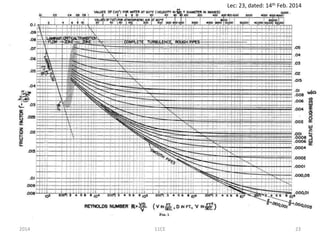
Friction Loss
2014 11CE 23
Lec: 23, dated: 14th Feb. 2014
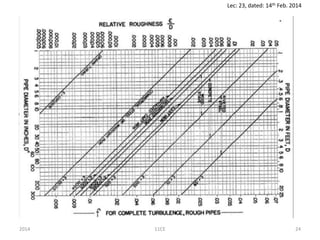
2014 11CE 24
Lec: 23, dated: 14th Feb. 2014
Darcy-Weisbach 
• Most recent development of Darcy Weisbach coefficient -
Explicit equation [Swamee and Jain, 1976] applicable to
entire turbulent flow regime (smooth, transition and rough
pipes):
2
9.0
Re
74.5
7.3
log
25.0


















D
e
f
2014 11CE 25
Lec: 23, dated: 14th Feb. 2014
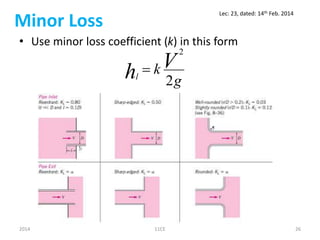
Minor Loss
• Use minor loss coefficient (k) in this form
g
kVhl
2
2

2014 11CE 26
Lec: 23, dated: 14th Feb. 2014
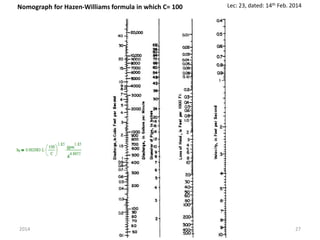
Nomograph for Hazen-Williams formula in which C= 100
2014 11CE 27
Lec: 23, dated: 14th Feb. 2014
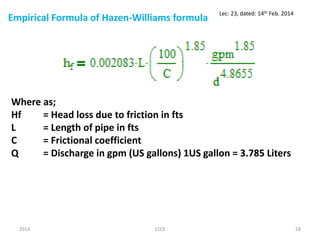
Empirical Formula of Hazen-Williams formula
2014 11CE 28
Lec: 23, dated: 14th Feb. 2014
Where as;
Hf = Head loss due to friction in fts
L = Length of pipe in fts
C = Frictional coefficient
Q = Discharge in gpm (US gallons) 1US gallon = 3.785 Liters

Environment i lecs 18 to 23 wbb34

  • 1.
    ENGR. SAJJAD ALIMANGI (LECTURER) BE (Civil)-QUEST Nawabshah ME (Environment)-NED University Karachi Email: sajjad_ali805@yahoo.com Lecture No:18 Dated: 7th Jan 2014
  • 2.
    General Consideration forWater Distribution System Lecture No:18 Dated: 7th Feb 2014 The water, as it leaves the treatment plant, is of desired quality. But the standard of this quality is to be maintained when the treated water if flowing through the network of distribution system. The water should also be supplied in a way useful to the consumers. For these reasons, the following general considerations of the planning of distribution system should be observed in its design: 1. Circulation of water 2. Construction and design 3. Contamination by sewage 4. Earth cushioning (laid under road) 5. Economy 6. Fire demand 7. Gradients 8. Leakages 9. Repairs 10. Safety from Pollution 11. Sanitation 12. Unsafe cross connection.
  • 3.
    General Consideration forWater Distribution System Lecture No:18 Dated: 7th Feb 2014 1. Circulation of water: The layout of distribution system should be such that there is free circulation of water and the number of dead ends should be very few. Where dead ends are unavoidable, hydrants will be provided to act as washouts. 2. Construction and design: The construction and design of water distribution system should be such that sufficient water is available at all times at desired pressure in all portions of the distribution system. 3. Contamination by sewage: The water pipe should be laid above the sewers at a vertical distance of about 2 meters and the horizontal distance between the water pipes and sewer should be at least 3meters . 4. Earth cushioning: The mains which are laid under roads should be provided with a minimum earth cushioning of 75 to 90 cm height from the top of mains. 5. Economy : The layout and Design of distribution system should be economical. The cost of distribution system forms a substantial part to the extent of about 90% of the total cost of the water supply project. Hence water distribution system should be carefully designed by taking into various factors such as pumping head, type of pipes, storage requirement, pipe diameters etc
  • 4.
    General Consideration forWater Distribution System Lecture No:18 Dated: 7th Feb 2014 6. Fire demand: The distribution system should be so laid that water for fire demand is available in required quantity at desired pressure at number of points along it. 7. Gradients: It is not necessary to lay main at constant gradients. But the gradients of mains should be in general follow the natural contours of ground. The gradient line should not rise above the hydraulic gradient line which means that at every point along the mains, there should be a positive pressure greater than atmospheric pressure. 8. Leakages: The distribution system should be fairly watertight and the loss of water due to leakages should be brought down to the minimum possible extent. 9. Repairs: The distribution system should be so laid as to permit easy repairs. The broken or worn out parts of the equipments for various operations should be properly replaced. 10. Safety from Pollution: The layout of Distribution system should be such that it does not contribute to the pollution of water flowing in it.
  • 5.
    General Consideration forWater Distribution System Lecture No:18 Dated: 7th Feb 2014 11. Sanitation: The sanitation of area through which the distribution system is passing should be good that there are no chances for water to be polluted during repair or replaced of pipe lines. 12. Unsafe cross connection: The distribution system should not have any unsafe cross connections from which there are chances for contaminated water to enter it.
  • 6.
    Methods of WaterDistribution System Lecture No:19 Dated: 10th Feb 2014 Depending upon the topography of the area /country, the following three may be adopted for distribution of water. 1) Gravity System, 2) Gravity and Pumping System combined, 3) Pumping System 1. Gravity System: In this method, water is conveyed through pipes by gravity only. The gravity system is the most reliable method of distribution. But it is useful only when the source of water supply is situated at a higher level than that of distribution area. As shown in figure A the gravity system with hydraulic gradient during max. and min. demands. In this case fire, motor pump may be used to develop high pressure for the fire fighting purpose. 2. Gravity and Pumping System combined: In this system, the treated water is pumped and stored in an elevated distribution reservoir. The excess water during low consumption remain in the elevated reservoir and it is supplied during the peak period. The pumps are usually worked at constant rate and this rate of pumping is so adjusted that the excess quantity of water stored in reservoir during low consumption is nearly equal to the extra demand of water during peak period. As shown figure B it shows the combined gravity and pumping system with hydraulic gradient during max. and min. demands.
  • 7.
    Methods of WaterDistribution System Lecture No:19 Dated: 10th Feb 2014 This method of distribution is usually applicable in most of the cases and it has the following advantages; i) in case of a fire, motor pumps can be used to develop high pressure or fire demand can directly be satisfied from pump house after closing the inlet valve for elevated reservoir. ii) In this method, the pumps are generally worked at uniform rate. iii) This method is economical iv) This method is fairly reliable in the sense that some quantity of water is available from elevated reservoir even during breakdown of pumps. 3. Pumping System: In this system, water is directly pumped into the mains leading to the consumers. The number of pumps required in this system will depend on the demand of water. As figure shows C the pumping system with hydraulic gradients during max. and min. demands.
  • 8.
    Service Reservoir Lecture No:20 Dated:11th Feb 2014 The service or distribution reservoir are generally provided in the distribution system to store clear treated water before it is dispatched to the consumers. These may be constructed of brick masonry, Stone masonry, Reinforced cement concrete (RCC), etc Purposes: Following are the purposes served by the service or distribution reservoir: 1. If pumps are used, the provision of these reservoir make it possible to run pumps at uniform rate. 2. In case of gravity system of supply, the provision of these reservoirs will result in main of smaller diameters. 3. They furnish the facility of storage of water for meeting fluctuating hourly demand of water. 4. They maintain constant pressure in the mains. The pressure in mains, without service reservoirs, will fall as the demand of water will increase. 5. They make the design and construction of treatment units and distribution system economical. 6. They serve as storage for emergencies such as breakdown of pumps, bursting of mains, heavy fire demand, interruption in power supply, temporary floods, etc.
  • 9.
    Classification of ServiceReservoir Lecture No:21 Dated: 12th Feb 2014 According to situation with respect to ground, the service reservoirs are classified in the following three types, (1) Surface Reservoir, (2) Elevated Reservoir, (3) Stand Pipes, Surface Reservoir: These are also known as ground or non-elevated reservoir. They are constructed at ground level and are mainly used to store water. It is usual practice to construct a surface reservoir in two compartments so that one can be used while the other is being cleaned or repaired. The two compartments are connected with each other by control valves. Due to storage of water, silting will take place to some extent and it can be removed by occasional cleaning through the washout pipes which are placed at the bottom of the reservoir. The surface reservoir are usually located at high points in the distribution system. In the gravity system of supply, water can directly be sent to the distribution system from the surface reservoir. In the combined gravity and pumping system, filtered water is first stored in the surface reservoir and it is then pumped to the elevated reservoir.
  • 10.
    Classification of ServiceReservoir Lecture No:21 Dated: 12th Feb 2014 Elevated Reservoir: These are also known as overhead tanks and they are constructed at an elevation from ground level. They may be of any shape rectangular, circular or elliptical. With the development of science of structural analysis, it is possible to construct the elevated reservoir in any shape to suit the architectural requirement of the structure. The elevated reservoirs are constructed in distributing areas which are not controlled by gravity system of distribution. Stand Piped: A stand pipe is a vertical cylindrical tank resting just above the ground to develop the necessary pressure. The diameter of stand pipe varies from 10m to 15m and its height varies from 15m to 30m. The stand pipes are made of RCC, Steel etc. The stand pipes are usually located on a hill or high ground so as to successfully utilize its entire capacity. The stand pipes, like elevated reservoir, are to be provided with inlet pipe, outlet pipe, overflow pipe, washout pipe and various other accessories for their efficient working, inspection and maintenance.
  • 11.
    System of Supplyof water Lecture No:21 Dated: 12th Feb 2014 based on the duration of supply, the following are the two systems of supply of water. (1)Continues System, (2) Intermittent System (1) Continues System: In this system of supply, the water is supplied to the consumers for 24 hours of the day. This is most ideal system of supply and it should be adopted as for as possible. The only disadvantage of this system is that considerable wastage of water occurs if consumers do not possess civic sense regarding the importance of treated water. (2) Intermittent System: In this system of supply, the water is supplied during certain fixed hours of the day only. The usual period is about one to four hours in the morning and about the same period in the afternoon. The timings of supply of water may be changed according to the seasons of the year. This system of supply of water proves to be useful for the following two conditions: (i) the available pressure is poor and (ii) the quantity of water available is not sufficient to meet with the various demands of water. The working of this system is very simple. The distribution area is divided into several zones and the timings of each zone are so adjusted that good working pressures are maintained in each zone.
  • 12.
    Methods of Layoutof distribution pipes Lecture No:22 Dated: 13th Feb 2014 following are the four main methods of laying distribution pipes. (1) Dead-end Method, (2) Grid Iron Method, (3) Circular Method, (4) Radial Method,
  • 13.
    Hydraulics of ClosedConduit Flow • Some time also known as; - closed conduit flow - pipe flow - pressurized flow 2014 11CE 13 Lec: 23, dated: 14th Feb. 2014 Closed Conduit / Pipe Hydraulics Engr. Sajjad Ali Mangi (Lecturer) Department of Civil Engineering MUET, SZAB Campus, Khairpur Mir’s
  • 14.
    Closed Conduit VSOpen Channel Closed Conduit Open Channel No free surface of water Free water surface Gravity or pump driven Gravity driven / flow Cavitation & other sub-atmospheric-pressure problems Waves & other surface disturbances Reynolds Number Re Froude Number Fr 2014 11CE 14 Lec: 23, dated: 14th Feb. 2014
  • 15.
    Concepts – ReynoldsNumber • Reynolds number is used to check whether the flow is laminar or turbulent. • Reynolds Number is the ratio of inertia force to viscous force. V = velocity (ft/sec) D = pipe diameter (ft)  = density of fluid (lbs/ft3)  = dynamic viscosity of fluid (Pa s, N s/m2)or(lb.ft.sec/ft2 )  = kinematic viscosity (m2/s) or (ft2/sec)   VDVD Re 2014 11CE 15 Lec: 23, dated: 14th Feb. 2014 Osborne Reynolds (1842–1912),
  • 16.
    Concepts – FroudeNumber • Froud Number is the ratio of inertia force to gravitational force. • V = velocity g = gravitational acceleration h = depth of water gh V Fr  2014 11CE 16 Lec: 23, dated: 14th Feb. 2014
  • 17.
    Laminar & turbulentflow 2014 11CE 17 Lec: 23, dated: 14th Feb. 2014
  • 18.
    uniform & steadyflow • Uniform flow The constant characteristics with respect to space • Steady flow The constant characteristics with respect to time. Often adopted when establishing pipe system design parameters (pressure & flow at certain locations). • Consider unsteady (transient) phenomena to refine design (pipe pressure class and thickness) 2014 11CE 18 Lec: 23, dated: 14th Feb. 2014
  • 19.
    Conservation of Energy •In pipeline design, most often consider steady state – flow not varying with time - first • Steady state (SS) Bernoulli Equation along a streamline: h gg z Vp z Vp  2 2 22 1 2 11 22  2014 11CE 19 Lec: 23, dated: 14th Feb. 2014 Where as; • Pressure head p/ • Elevation head z • Velocity head V2/2g • Piezometric head p/ + z (hydraulic grade line) • Total head p/ + z + V2/2g (energy grade line) • Head Loss h
  • 20.
    Head Losses • Thereare two types of losses: 1. Friction Loss Resulting from friction between the fluid and pipe wall 2. Minor Loss Resulting from pipe entrance, transition, exit, valve and other in-line structures 2014 11CE 20 Lec: 23, dated: 14th Feb. 2014
  • 21.
    Friction Loss • Mostuseful head loss equation for closed-conduit flow – Darcy-Weisbach equation gD L f Vhf 2 2  2014 11CE 21 Dimensionless Friction coefficient Pipe diameter Pipe length Pipe velocity Friction head loss Gravitational acceleration Lec: 23, dated: 14th Feb. 2014
  • 22.
    Darcy-Weisbach  • Laminarflow (Re<2000) Turbulent flow in smooth pipes (Re>4000)   8.0Relog2 1  f f Re 64 f 2014 11CE 22 Lec: 23, dated: 14th Feb. 2014 • Turbulent flow in rough pipes • Transition between turbulent smooth and rough pipes        D e f log214.1 1          f D e f Re 51.2 7.3 log2 1
  • 23.
    Friction Loss 2014 11CE23 Lec: 23, dated: 14th Feb. 2014
  • 24.
    2014 11CE 24 Lec:23, dated: 14th Feb. 2014
  • 25.
    Darcy-Weisbach  • Mostrecent development of Darcy Weisbach coefficient - Explicit equation [Swamee and Jain, 1976] applicable to entire turbulent flow regime (smooth, transition and rough pipes): 2 9.0 Re 74.5 7.3 log 25.0                   D e f 2014 11CE 25 Lec: 23, dated: 14th Feb. 2014
  • 26.
    Minor Loss • Useminor loss coefficient (k) in this form g kVhl 2 2  2014 11CE 26 Lec: 23, dated: 14th Feb. 2014
  • 27.
    Nomograph for Hazen-Williamsformula in which C= 100 2014 11CE 27 Lec: 23, dated: 14th Feb. 2014
  • 28.
    Empirical Formula ofHazen-Williams formula 2014 11CE 28 Lec: 23, dated: 14th Feb. 2014 Where as; Hf = Head loss due to friction in fts L = Length of pipe in fts C = Frictional coefficient Q = Discharge in gpm (US gallons) 1US gallon = 3.785 Liters