Conversation analysis for geeks
Saul Albert
02/07/13
People seem complex and erratic
Conversation analysis is a systematic method for
explaining our practical reasoning and actions.
People seem complex and erratic
Conversation analysis is a systematic method for
explaining our practical reasoning and actions.
●
Everyday chat is a unique empirical resource
People seem complex and erratic
Conversation analysis is a systematic method for
explaining our practical reasoning and actions.
●
Everyday chat is a unique empirical resource
●
How interaction gives us proof procedures
People seem complex and erratic
Conversation analysis is a systematic method for
explaining our practical reasoning and actions.
●
Everyday chat is a unique empirical resource
●
How interaction gives us proof procedures
●
Why CA should be easy and useful for geeks
Conversation as evidence is:
●
A naturally occuring empirical resource
Conversation as evidence is:
●
A naturally occuring empirical resource
●
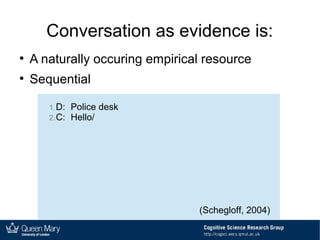
Sequential
Conversation as evidence is:
●
A naturally occuring empirical resource
●
Sequential
1.D: Police desk
2.C: Hello/
(Schegloff, 2004)
Conversation as evidence is:
●
A naturally occuring empirical resource
●
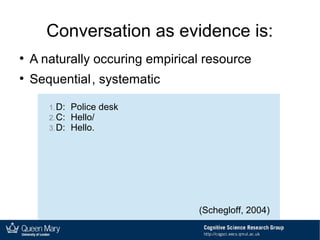
Sequential, systematic
1.D: Police desk
2.C: Hello/
3.D: Hello.
(Schegloff, 2004)
Conversation as evidence is:
●
A naturally occuring empirical resource
●
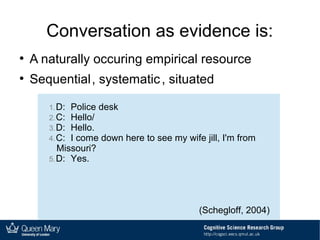
Sequential, systematic, situated
1.D: Police desk
2.C: Hello/
3.D: Hello.
4.C: I come down here to see my wife jill, I'm from
Missouri?
5.D: Yes.
(Schegloff, 2004)
Conversation as evidence is:
●
A naturally occuring empirical resource
●
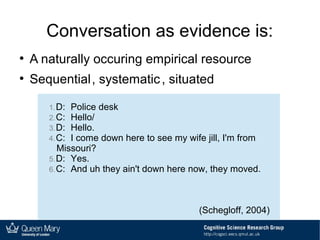
Sequential, systematic, situated
1.D: Police desk
2.C: Hello/
3.D: Hello.
4.C: I come down here to see my wife jill, I'm from
Missouri?
5.D: Yes.
6.C: And uh they ain't down here now, they moved.
(Schegloff, 2004)
Conversation as evidence is:
●
A naturally occuring empirical resource
●
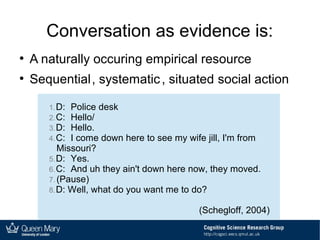
Sequential, systematic, situated social action
1.D: Police desk
2.C: Hello/
3.D: Hello.
4.C: I come down here to see my wife jill, I'm from
Missouri?
5.D: Yes.
6.C: And uh they ain't down here now, they moved.
7. (Pause)
8.D: Well, what do you want me to do?
(Schegloff, 2004)
Conversation as evidence is:
●
A naturally occuring empirical resource
●
Sequential
●
Very different from other kinds of evidence
, systematic, situated social action
Talk-in-interaction's proof practices:
●
Enlist participants' own methods of reasoning
Talk-in-interaction's proof practices:
●
Enlist participants' own methods of reasoning
●
In revealing and resolving problems in talk
1. Fda: =This is nice did you make this?
2. Kat: No Samu made that
3. Fda: Who?
4. Kat: Samu
5. (0.1)
6. Kat: (Sh) You remember my [aunt? ]
7. Dav: [Aunt S ]amu
8. Kat: [From Czechoslovakia?
9. Fda: [Yyeeah
10.Fda: Oh she’s really something
11.Kat: Yeah
(Schegloff & Lerner, 2009)
Talk-in-interaction's proof practices:
●
Enlist participants' own methods of reasoning
●
In revealing and resolving problems in talk
1. Fda: =This is nice did you make this?
2. Kat: No Samu made that
3. Fda: Who?
4. Kat: Samu
5. (0.1)
6. Kat: (Sh) You remember my [aunt? ]
7. Dav: [Aunt S ]amu
8. Kat: [From Czechoslovakia?
9. Fda: [Yyeeah
10.Fda: Oh she’s really something
11.Kat: Yeah
(Schegloff & Lerner, 2009)
1. Fda: =This is nice did you make this?
2. Kat: No Samu made that
3. Fda: Who?
4. Kat: Samu
5. (0.1)
6. Kat: (Sh) You remember my [aunt? ]
7. Dav: [Aunt S ]amu
8. Kat: [From Czechoslovakia?
9. Fda: [Yyeeah
10.Fda: Oh she’s really something
11.Kat: Yeah
(Schegloff & Lerner, 2009)
Talk-in-interaction's proof practices:
●
Enlist participants' own methods of reasoning
●
In revealing and resolving problems in talk
1. Fda: =This is nice did you make this?
2. Kat: No Samu made that
3. Fda: Who?
4. Kat: Samu
5. (0.1)
6. Kat: (Sh) You remember my [aunt? ]
7. Dav: [Aunt S ]amu
8. Kat: [From Czechoslovakia?
9. Fda: [Yyeeah
10.Fda: Oh she’s really something
11.Kat: Yeah
(Schegloff & Lerner, 2009)
1. Fda: =This is nice did you make this?
2. Kat: No Samu made that
3. Fda: Who?
4. Kat: Samu
5. (0.1)
6. Kat: (Sh) You remember my [aunt? ]
7. Dav: [Aunt S ]amu
8. Kat: [From Czechoslovakia?
9. Fda: [Yyeeah
10.Fda: Oh she’s really something
11.Kat: Yeah
(Schegloff & Lerner, 2009)
1. Fda: =This is nice did you make this?
2. Kat: No Samu made that
3. Fda: Who?
4. Kat: Samu
5. (0.1)
6. Kat: (Sh) You remember my [aunt? ]
7. Dav: [Aunt S ]amu
8. Kat: [From Czechoslovakia?
9. Fda: [Yyeeah
10.Fda: Oh she’s really something
11.Kat: Yeah
(Schegloff & Lerner, 2009)
Talk-in-interaction's proof practices:
●
Enlist participants' own methods of reasoning
●
In revealing and resolving problems in talk
1. Fda: =This is nice did you make this?
2. Kat: No Samu made that
3. Fda: Who?
4. Kat: Samu
5. (0.1)
6. Kat: (Sh) You remember my [aunt? ]
7. Dav: [Aunt S ]amu
8. Kat: [From Czechoslovakia?
9. Fda: [Yyeeah
10.Fda: Oh she’s really something
11.Kat: Yeah
(Schegloff & Lerner, 2009)
1. Fda: =This is nice did you make this?
2. Kat: No Samu made that
3. Fda: Who?
4. Kat: Samu
5. (0.1)
6. Kat: (Sh) You remember my [aunt? ]
7. Dav: [Aunt S ]amu
8. Kat: [From Czechoslovakia?
9. Fda: [Yyeeah
10.Fda: Oh she’s really something
11.Kat: Yeah
(Schegloff & Lerner, 2009)
1. Fda: =This is nice did you make this?
2. Kat: No Samu made that
3. Fda: Who?
4. Kat: Samu
5. (0.1)
6. Kat: (Sh) You remember my [aunt? ]
7. Dav: [Aunt S ]amu
8. Kat: [From Czechoslovakia?
9. Fda: [Yyeeah
10.Fda: Oh she’s really something
11.Kat: Yeah
(Schegloff & Lerner, 2009)
1. Fda: =This is nice did you make this?
2. Kat: No Samu made that
3. Fda: Who?
4. Kat: Samu
5. (0.1)
6. Kat: (Sh) You remember my [aunt? ]
7. Dav: [Aunt S ]amu
8. Kat: [From Czechoslovakia?
9. Fda: [Yyeeah
10.Fda: Oh she’s really something
11.Kat: Yeah
(Schegloff & Lerner, 2009)
Talk-in-interaction's proof practices:
●
Enlist participants' own methods of reasoning
●
In revealing and resolving problems in talk
●
Can show us when our theories are wrong
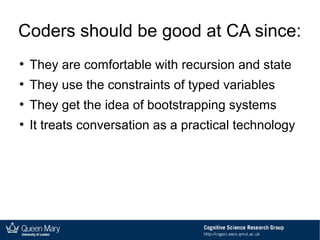
Coders should be good at CA since:
●
They are comfortable with recursion and state
Coders should be good at CA since:
●
They are comfortable with recursion and state
●
They use the constraints of typed variables
Coders should be good at CA since:
●
They are comfortable with recursion and state
●
They use the constraints of typed variables
●
They get the idea of bootstrapping systems
Coders should be good at CA since:
●
They are comfortable with recursion and state
●
They use the constraints of typed variables
●
They get the idea of bootstrapping systems
●
It treats conversation as a practical technology
Thank you for any questions/comments
saul.albert@eecs.qmul.ac.uk
References:
Schegloff, E. (2004). Answering the Phone. In G. H. Lerner (Ed.),
Conversation Analysis: Studies from the First Generation (pp. 63–109).
Amsterdam: John Benjamins Publishing Company.
Schegloff, E. a., & Lerner, G. H. (2009). Beginning to Respond: Well
-Prefaced Responses to Wh -Questions. Research on Language & Social
Interaction, 42(2), 91–115.

Conversation analysis for geeks

  • 1.
    Conversation analysis forgeeks Saul Albert 02/07/13
  • 2.
  • 3.
    People seem complexand erratic Conversation analysis is a systematic method for explaining our practical reasoning and actions.
  • 4.
    People seem complexand erratic Conversation analysis is a systematic method for explaining our practical reasoning and actions. ● Everyday chat is a unique empirical resource
  • 5.
    People seem complexand erratic Conversation analysis is a systematic method for explaining our practical reasoning and actions. ● Everyday chat is a unique empirical resource ● How interaction gives us proof procedures
  • 6.
    People seem complexand erratic Conversation analysis is a systematic method for explaining our practical reasoning and actions. ● Everyday chat is a unique empirical resource ● How interaction gives us proof procedures ● Why CA should be easy and useful for geeks
  • 7.
  • 8.
    Conversation as evidenceis: ● A naturally occuring empirical resource
  • 9.
    Conversation as evidenceis: ● A naturally occuring empirical resource ● Sequential
  • 10.
    Conversation as evidenceis: ● A naturally occuring empirical resource ● Sequential 1.D: Police desk 2.C: Hello/ (Schegloff, 2004)
  • 11.
    Conversation as evidenceis: ● A naturally occuring empirical resource ● Sequential, systematic 1.D: Police desk 2.C: Hello/ 3.D: Hello. (Schegloff, 2004)
  • 12.
    Conversation as evidenceis: ● A naturally occuring empirical resource ● Sequential, systematic, situated 1.D: Police desk 2.C: Hello/ 3.D: Hello. 4.C: I come down here to see my wife jill, I'm from Missouri? 5.D: Yes. (Schegloff, 2004)
  • 13.
    Conversation as evidenceis: ● A naturally occuring empirical resource ● Sequential, systematic, situated 1.D: Police desk 2.C: Hello/ 3.D: Hello. 4.C: I come down here to see my wife jill, I'm from Missouri? 5.D: Yes. 6.C: And uh they ain't down here now, they moved. (Schegloff, 2004)
  • 14.
    Conversation as evidenceis: ● A naturally occuring empirical resource ● Sequential, systematic, situated social action 1.D: Police desk 2.C: Hello/ 3.D: Hello. 4.C: I come down here to see my wife jill, I'm from Missouri? 5.D: Yes. 6.C: And uh they ain't down here now, they moved. 7. (Pause) 8.D: Well, what do you want me to do? (Schegloff, 2004)
  • 15.
    Conversation as evidenceis: ● A naturally occuring empirical resource ● Sequential ● Very different from other kinds of evidence , systematic, situated social action
  • 16.
  • 17.
    Talk-in-interaction's proof practices: ● Enlistparticipants' own methods of reasoning
  • 18.
    Talk-in-interaction's proof practices: ● Enlistparticipants' own methods of reasoning ● In revealing and resolving problems in talk 1. Fda: =This is nice did you make this? 2. Kat: No Samu made that 3. Fda: Who? 4. Kat: Samu 5. (0.1) 6. Kat: (Sh) You remember my [aunt? ] 7. Dav: [Aunt S ]amu 8. Kat: [From Czechoslovakia? 9. Fda: [Yyeeah 10.Fda: Oh she’s really something 11.Kat: Yeah (Schegloff & Lerner, 2009)
  • 19.
    Talk-in-interaction's proof practices: ● Enlistparticipants' own methods of reasoning ● In revealing and resolving problems in talk 1. Fda: =This is nice did you make this? 2. Kat: No Samu made that 3. Fda: Who? 4. Kat: Samu 5. (0.1) 6. Kat: (Sh) You remember my [aunt? ] 7. Dav: [Aunt S ]amu 8. Kat: [From Czechoslovakia? 9. Fda: [Yyeeah 10.Fda: Oh she’s really something 11.Kat: Yeah (Schegloff & Lerner, 2009) 1. Fda: =This is nice did you make this? 2. Kat: No Samu made that 3. Fda: Who? 4. Kat: Samu 5. (0.1) 6. Kat: (Sh) You remember my [aunt? ] 7. Dav: [Aunt S ]amu 8. Kat: [From Czechoslovakia? 9. Fda: [Yyeeah 10.Fda: Oh she’s really something 11.Kat: Yeah (Schegloff & Lerner, 2009)
  • 20.
    Talk-in-interaction's proof practices: ● Enlistparticipants' own methods of reasoning ● In revealing and resolving problems in talk 1. Fda: =This is nice did you make this? 2. Kat: No Samu made that 3. Fda: Who? 4. Kat: Samu 5. (0.1) 6. Kat: (Sh) You remember my [aunt? ] 7. Dav: [Aunt S ]amu 8. Kat: [From Czechoslovakia? 9. Fda: [Yyeeah 10.Fda: Oh she’s really something 11.Kat: Yeah (Schegloff & Lerner, 2009) 1. Fda: =This is nice did you make this? 2. Kat: No Samu made that 3. Fda: Who? 4. Kat: Samu 5. (0.1) 6. Kat: (Sh) You remember my [aunt? ] 7. Dav: [Aunt S ]amu 8. Kat: [From Czechoslovakia? 9. Fda: [Yyeeah 10.Fda: Oh she’s really something 11.Kat: Yeah (Schegloff & Lerner, 2009) 1. Fda: =This is nice did you make this? 2. Kat: No Samu made that 3. Fda: Who? 4. Kat: Samu 5. (0.1) 6. Kat: (Sh) You remember my [aunt? ] 7. Dav: [Aunt S ]amu 8. Kat: [From Czechoslovakia? 9. Fda: [Yyeeah 10.Fda: Oh she’s really something 11.Kat: Yeah (Schegloff & Lerner, 2009)
  • 21.
    Talk-in-interaction's proof practices: ● Enlistparticipants' own methods of reasoning ● In revealing and resolving problems in talk 1. Fda: =This is nice did you make this? 2. Kat: No Samu made that 3. Fda: Who? 4. Kat: Samu 5. (0.1) 6. Kat: (Sh) You remember my [aunt? ] 7. Dav: [Aunt S ]amu 8. Kat: [From Czechoslovakia? 9. Fda: [Yyeeah 10.Fda: Oh she’s really something 11.Kat: Yeah (Schegloff & Lerner, 2009) 1. Fda: =This is nice did you make this? 2. Kat: No Samu made that 3. Fda: Who? 4. Kat: Samu 5. (0.1) 6. Kat: (Sh) You remember my [aunt? ] 7. Dav: [Aunt S ]amu 8. Kat: [From Czechoslovakia? 9. Fda: [Yyeeah 10.Fda: Oh she’s really something 11.Kat: Yeah (Schegloff & Lerner, 2009) 1. Fda: =This is nice did you make this? 2. Kat: No Samu made that 3. Fda: Who? 4. Kat: Samu 5. (0.1) 6. Kat: (Sh) You remember my [aunt? ] 7. Dav: [Aunt S ]amu 8. Kat: [From Czechoslovakia? 9. Fda: [Yyeeah 10.Fda: Oh she’s really something 11.Kat: Yeah (Schegloff & Lerner, 2009) 1. Fda: =This is nice did you make this? 2. Kat: No Samu made that 3. Fda: Who? 4. Kat: Samu 5. (0.1) 6. Kat: (Sh) You remember my [aunt? ] 7. Dav: [Aunt S ]amu 8. Kat: [From Czechoslovakia? 9. Fda: [Yyeeah 10.Fda: Oh she’s really something 11.Kat: Yeah (Schegloff & Lerner, 2009)
  • 22.
    Talk-in-interaction's proof practices: ● Enlistparticipants' own methods of reasoning ● In revealing and resolving problems in talk ● Can show us when our theories are wrong
  • 23.
    Coders should begood at CA since: ● They are comfortable with recursion and state
  • 24.
    Coders should begood at CA since: ● They are comfortable with recursion and state ● They use the constraints of typed variables
  • 25.
    Coders should begood at CA since: ● They are comfortable with recursion and state ● They use the constraints of typed variables ● They get the idea of bootstrapping systems
  • 26.
    Coders should begood at CA since: ● They are comfortable with recursion and state ● They use the constraints of typed variables ● They get the idea of bootstrapping systems ● It treats conversation as a practical technology
  • 27.
    Thank you forany questions/comments saul.albert@eecs.qmul.ac.uk References: Schegloff, E. (2004). Answering the Phone. In G. H. Lerner (Ed.), Conversation Analysis: Studies from the First Generation (pp. 63–109). Amsterdam: John Benjamins Publishing Company. Schegloff, E. a., & Lerner, G. H. (2009). Beginning to Respond: Well -Prefaced Responses to Wh -Questions. Research on Language & Social Interaction, 42(2), 91–115.

Editor's Notes

  • #2 1. Introduction 2. conversation important / unique / effective in any research area 3. honne my method preamble down to a few minutes 4. help me sharpen it up 5. promote conversational data enough that you'll join a data session
  • #3 Everyday talk provides researchers of human cognition and action with naturally occuring data and methods for analysing it in participants own terms. Recordings of conversation can be recorded treated as a natural resource, like a wild plant for a botanist or weather data for a meteorologogist. By analysing people’s conversational interactions, we can harness the same mechanisms of reasoning that they are using to make themselves understood to one another. Why this is unique to conversation, and why it's especially easy & relevant for EECS people.
  • #4 Everyday talk provides researchers of human cognition and action with naturally occuring data and methods for analysing it in participants own terms. Recordings of conversation can be recorded treated as a natural resource, like a wild plant for a botanist or weather data for a meteorologogist. By analysing people’s conversational interactions, we can harness the same mechanisms of reasoning that they are using to make themselves understood to one another. Why this is unique to conversation, and why it's especially easy & relevant for EECS people.
  • #5 Everyday talk provides researchers of human cognition and action with naturally occuring data and methods for analysing it in participants own terms. Recordings of conversation can be recorded treated as a natural resource, like a wild plant for a botanist or weather data for a meteorologogist. By analysing people’s conversational interactions, we can harness the same mechanisms of reasoning that they are using to make themselves understood to one another. Why this is unique to conversation, and why it's especially easy & relevant for EECS people.
  • #6 Everyday talk provides researchers of human cognition and action with naturally occuring data and methods for analysing it in participants own terms. Recordings of conversation can be recorded treated as a natural resource, like a wild plant for a botanist or weather data for a meteorologogist. By analysing people’s conversational interactions, we can harness the same mechanisms of reasoning that they are using to make themselves understood to one another. Why this is unique to conversation, and why it's especially easy & relevant for EECS people.
  • #7 Everyday talk provides researchers of human cognition and action with naturally occuring data and methods for analysing it in participants own terms. Recordings of conversation can be recorded treated as a natural resource, like a wild plant for a botanist or weather data for a meteorologogist. By analysing people’s conversational interactions, we can harness the same mechanisms of reasoning that they are using to make themselves understood to one another. Why this is unique to conversation, and why it's especially easy & relevant for EECS people.
  • #8 0. Conversation is often seen as messy – fragmentary, fleeting, not useful because it's difficult to use in a controlled study. 1. However, whereas in an interview environment or experimental scenario it's didfficult to maneuver people around context, conversation is pervasive – you'll find your phenomenon in the wild. 2. It's messy, not grammatically consistent, fragmentary, incomplete. But that means that participants solve that problem themselves in specific ways that make conversation particularly useful. I will present these as the 3 ses of conversational evidence: 2.1: Seqentially organised: layed out turn-by-turn “why that now?” 2.2: Eg: this initial opening from Schegloff is simple. Given available evidence, what can we say about how and where this takes place? 2.3: Right: we can tell so much: that there's a missing phone ring. What happens next? 2.4: Right: So D's and C's (and our) analysis is systematic enough to tell us that following call/identification/greeting, a greeting is relevant. NB: this is normative, not deterministic. D could say other things (like what? What analysis would that entail for D and us? This is subtle). mention transcription: punctuation use. So if C's hello is analysed by D and by us as a greeting, what kind of thing is D's hello – what's it hearable as – what comes next? 2.5: Situated: right. An explanation for the call – not because D's “hello” asked a question as such, but because of it's local situation with a sequence. Similarly – the 'Yes'. Is hearable as a request for more information. There are two senses in which conversational evidence is 'sitauted' here: a). the position or 'slot' in which the talk appears is evidence for the recipient to monitor what kind of thing is relevant next. b). it mobilises various aspects of its local context: it's phone call-ness, place, time, relationships are “talked into being” (Heritage) 2.6. One more S: Social Action: D's pause first resists then explicitly acknowledges that C's last turn is hearable as a request for D to do something. 3. This aspect of social action makes conversation very different from perfectly valid statistical distributions or rigorously coded interview data. Only by observing how the saying and doing of participants is produced, analysed and responded to turn-by-turn sequence can we gain access to and harness the participants own methods of reasoning.
  • #9 0. Conversation is often seen as messy – fragmentary, fleeting, not useful because it's difficult to use in a controlled study. 1. However, whereas in an interview environment or experimental scenario it's didfficult to maneuver people around context, conversation is pervasive – you'll find your phenomenon in the wild. 2. It's messy, not grammatically consistent, fragmentary, incomplete. But that means that participants solve that problem themselves in specific ways that make conversation particularly useful. I will present these as the 3 ses of conversational evidence: 2.1: Seqentially organised: layed out turn-by-turn “why that now?” 2.2: Eg: this initial opening from Schegloff is simple. Given available evidence, what can we say about how and where this takes place? 2.3: Right: we can tell so much: that there's a missing phone ring. What happens next? 2.4: Right: So D's and C's (and our) analysis is systematic enough to tell us that following call/identification/greeting, a greeting is relevant. NB: this is normative, not deterministic. D could say other things (like what? What analysis would that entail for D and us? This is subtle). mention transcription: punctuation use. So if C's hello is analysed by D and by us as a greeting, what kind of thing is D's hello – what's it hearable as – what comes next? 2.5: Situated: right. An explanation for the call – not because D's “hello” asked a question as such, but because of it's local situation with a sequence. Similarly – the 'Yes'. Is hearable as a request for more information. There are two senses in which conversational evidence is 'sitauted' here: a). the position or 'slot' in which the talk appears is evidence for the recipient to monitor what kind of thing is relevant next. b). it mobilises various aspects of its local context: it's phone call-ness, place, time, relationships are “talked into being” (Heritage) 2.6. One more S: Social Action: D's pause first resists then explicitly acknowledges that C's last turn is hearable as a request for D to do something. 3. This aspect of social action makes conversation very different from perfectly valid statistical distributions or rigorously coded interview data. Only by observing how the saying and doing of participants is produced, analysed and responded to turn-by-turn sequence can we gain access to and harness the participants own methods of reasoning.
  • #10 0. Conversation is often seen as messy – fragmentary, fleeting, not useful because it's difficult to use in a controlled study. 1. However, whereas in an interview environment or experimental scenario it's didfficult to maneuver people around context, conversation is pervasive – you'll find your phenomenon in the wild. 2. It's messy, not grammatically consistent, fragmentary, incomplete. But that means that participants solve that problem themselves in specific ways that make conversation particularly useful. I will present these as the 3 ses of conversational evidence: 2.1: Seqentially organised: layed out turn-by-turn “why that now?” 2.2: Eg: this initial opening from Schegloff is simple. Given available evidence, what can we say about how and where this takes place? 2.3: Right: we can tell so much: that there's a missing phone ring. What happens next? 2.4: Right: So D's and C's (and our) analysis is systematic enough to tell us that following call/identification/greeting, a greeting is relevant. NB: this is normative, not deterministic. D could say other things (like what? What analysis would that entail for D and us? This is subtle). mention transcription: punctuation use. So if C's hello is analysed by D and by us as a greeting, what kind of thing is D's hello – what's it hearable as – what comes next? 2.5: Situated: right. An explanation for the call – not because D's “hello” asked a question as such, but because of it's local situation with a sequence. Similarly – the 'Yes'. Is hearable as a request for more information. There are two senses in which conversational evidence is 'sitauted' here: a). the position or 'slot' in which the talk appears is evidence for the recipient to monitor what kind of thing is relevant next. b). it mobilises various aspects of its local context: it's phone call-ness, place, time, relationships are “talked into being” (Heritage) 2.6. One more S: Social Action: D's pause first resists then explicitly acknowledges that C's last turn is hearable as a request for D to do something. 3. This aspect of social action makes conversation very different from perfectly valid statistical distributions or rigorously coded interview data. Only by observing how the saying and doing of participants is produced, analysed and responded to turn-by-turn sequence can we gain access to and harness the participants own methods of reasoning.
  • #11 0. Conversation is often seen as messy – fragmentary, fleeting, not useful because it's difficult to use in a controlled study. 1. However, whereas in an interview environment or experimental scenario it's didfficult to maneuver people around context, conversation is pervasive – you'll find your phenomenon in the wild. 2. It's messy, not grammatically consistent, fragmentary, incomplete. But that means that participants solve that problem themselves in specific ways that make conversation particularly useful. I will present these as the 3 ses of conversational evidence: 2.1: Seqentially organised: layed out turn-by-turn “why that now?” 2.2: Eg: this initial opening from Schegloff is simple. Given available evidence, what can we say about how and where this takes place? 2.3: Right: we can tell so much: that there's a missing phone ring. What happens next? 2.4: Right: So D's and C's (and our) analysis is systematic enough to tell us that following call/identification/greeting, a greeting is relevant. NB: this is normative, not deterministic. D could say other things (like what? What analysis would that entail for D and us? This is subtle). mention transcription: punctuation use. So if C's hello is analysed by D and by us as a greeting, what kind of thing is D's hello – what's it hearable as – what comes next? 2.5: Situated: right. An explanation for the call – not because D's “hello” asked a question as such, but because of it's local situation with a sequence. Similarly – the 'Yes'. Is hearable as a request for more information. There are two senses in which conversational evidence is 'sitauted' here: a). the position or 'slot' in which the talk appears is evidence for the recipient to monitor what kind of thing is relevant next. b). it mobilises various aspects of its local context: it's phone call-ness, place, time, relationships are “talked into being” (Heritage) 2.6. One more S: Social Action: D's pause first resists then explicitly acknowledges that C's last turn is hearable as a request for D to do something. 3. This aspect of social action makes conversation very different from perfectly valid statistical distributions or rigorously coded interview data. Only by observing how the saying and doing of participants is produced, analysed and responded to turn-by-turn sequence can we gain access to and harness the participants own methods of reasoning.
  • #12 0. Conversation is often seen as messy – fragmentary, fleeting, not useful because it's difficult to use in a controlled study. 1. However, whereas in an interview environment or experimental scenario it's didfficult to maneuver people around context, conversation is pervasive – you'll find your phenomenon in the wild. 2. It's messy, not grammatically consistent, fragmentary, incomplete. But that means that participants solve that problem themselves in specific ways that make conversation particularly useful. I will present these as the 3 ses of conversational evidence: 2.1: Seqentially organised: layed out turn-by-turn “why that now?” 2.2: Eg: this initial opening from Schegloff is simple. Given available evidence, what can we say about how and where this takes place? 2.3: Right: we can tell so much: that there's a missing phone ring. What happens next? 2.4: Right: So D's and C's (and our) analysis is systematic enough to tell us that following call/identification/greeting, a greeting is relevant. NB: this is normative, not deterministic. D could say other things (like what? What analysis would that entail for D and us? This is subtle). mention transcription: punctuation use. So if C's hello is analysed by D and by us as a greeting, what kind of thing is D's hello – what's it hearable as – what comes next? 2.5: Situated: right. An explanation for the call – not because D's “hello” asked a question as such, but because of it's local situation with a sequence. Similarly – the 'Yes'. Is hearable as a request for more information. There are two senses in which conversational evidence is 'sitauted' here: a). the position or 'slot' in which the talk appears is evidence for the recipient to monitor what kind of thing is relevant next. b). it mobilises various aspects of its local context: it's phone call-ness, place, time, relationships are “talked into being” (Heritage) 2.6. One more S: Social Action: D's pause first resists then explicitly acknowledges that C's last turn is hearable as a request for D to do something. 3. This aspect of social action makes conversation very different from perfectly valid statistical distributions or rigorously coded interview data. Only by observing how the saying and doing of participants is produced, analysed and responded to turn-by-turn sequence can we gain access to and harness the participants own methods of reasoning.
  • #13 0. Conversation is often seen as messy – fragmentary, fleeting, not useful because it's difficult to use in a controlled study. 1. However, whereas in an interview environment or experimental scenario it's didfficult to maneuver people around context, conversation is pervasive – you'll find your phenomenon in the wild. 2. It's messy, not grammatically consistent, fragmentary, incomplete. But that means that participants solve that problem themselves in specific ways that make conversation particularly useful. I will present these as the 3 ses of conversational evidence: 2.1: Seqentially organised: layed out turn-by-turn “why that now?” 2.2: Eg: this initial opening from Schegloff is simple. Given available evidence, what can we say about how and where this takes place? 2.3: Right: we can tell so much: that there's a missing phone ring. What happens next? 2.4: Right: So D's and C's (and our) analysis is systematic enough to tell us that following call/identification/greeting, a greeting is relevant. NB: this is normative, not deterministic. D could say other things (like what? What analysis would that entail for D and us? This is subtle). mention transcription: punctuation use. So if C's hello is analysed by D and by us as a greeting, what kind of thing is D's hello – what's it hearable as – what comes next? 2.5: Situated: right. An explanation for the call – not because D's “hello” asked a question as such, but because of it's local situation with a sequence. Similarly – the 'Yes'. Is hearable as a request for more information. There are two senses in which conversational evidence is 'sitauted' here: a). the position or 'slot' in which the talk appears is evidence for the recipient to monitor what kind of thing is relevant next. b). it mobilises various aspects of its local context: it's phone call-ness, place, time, relationships are “talked into being” (Heritage) 2.6. One more S: Social Action: D's pause first resists then explicitly acknowledges that C's last turn is hearable as a request for D to do something. 3. This aspect of social action makes conversation very different from perfectly valid statistical distributions or rigorously coded interview data. Only by observing how the saying and doing of participants is produced, analysed and responded to turn-by-turn sequence can we gain access to and harness the participants own methods of reasoning.
  • #14 0. Conversation is often seen as messy – fragmentary, fleeting, not useful because it's difficult to use in a controlled study. 1. However, whereas in an interview environment or experimental scenario it's didfficult to maneuver people around context, conversation is pervasive – you'll find your phenomenon in the wild. 2. It's messy, not grammatically consistent, fragmentary, incomplete. But that means that participants solve that problem themselves in specific ways that make conversation particularly useful. I will present these as the 3 ses of conversational evidence: 2.1: Seqentially organised: layed out turn-by-turn “why that now?” 2.2: Eg: this initial opening from Schegloff is simple. Given available evidence, what can we say about how and where this takes place? 2.3: Right: we can tell so much: that there's a missing phone ring. What happens next? 2.4: Right: So D's and C's (and our) analysis is systematic enough to tell us that following call/identification/greeting, a greeting is relevant. NB: this is normative, not deterministic. D could say other things (like what? What analysis would that entail for D and us? This is subtle). mention transcription: punctuation use. So if C's hello is analysed by D and by us as a greeting, what kind of thing is D's hello – what's it hearable as – what comes next? 2.5: Situated: right. An explanation for the call – not because D's “hello” asked a question as such, but because of it's local situation with a sequence. Similarly – the 'Yes'. Is hearable as a request for more information. There are two senses in which conversational evidence is 'sitauted' here: a). the position or 'slot' in which the talk appears is evidence for the recipient to monitor what kind of thing is relevant next. b). it mobilises various aspects of its local context: it's phone call-ness, place, time, relationships are “talked into being” (Heritage) 2.6. One more S: Social Action: D's pause first resists then explicitly acknowledges that C's last turn is hearable as a request for D to do something. 3. This aspect of social action makes conversation very different from perfectly valid statistical distributions or rigorously coded interview data. Only by observing how the saying and doing of participants is produced, analysed and responded to turn-by-turn sequence can we gain access to and harness the participants own methods of reasoning.
  • #15 0. Conversation is often seen as messy – fragmentary, fleeting, not useful because it's difficult to use in a controlled study. 1. However, whereas in an interview environment or experimental scenario it's didfficult to maneuver people around context, conversation is pervasive – you'll find your phenomenon in the wild. 2. It's messy, not grammatically consistent, fragmentary, incomplete. But that means that participants solve that problem themselves in specific ways that make conversation particularly useful. I will present these as the 3 ses of conversational evidence: 2.1: Seqentially organised: layed out turn-by-turn “why that now?” 2.2: Eg: this initial opening from Schegloff is simple. Given available evidence, what can we say about how and where this takes place? 2.3: Right: we can tell so much: that there's a missing phone ring. What happens next? 2.4: Right: So D's and C's (and our) analysis is systematic enough to tell us that following call/identification/greeting, a greeting is relevant. NB: this is normative, not deterministic. D could say other things (like what? What analysis would that entail for D and us? This is subtle). mention transcription: punctuation use. So if C's hello is analysed by D and by us as a greeting, what kind of thing is D's hello – what's it hearable as – what comes next? 2.5: Situated: right. An explanation for the call – not because D's “hello” asked a question as such, but because of it's local situation with a sequence. Similarly – the 'Yes'. Is hearable as a request for more information. There are two senses in which conversational evidence is 'sitauted' here: a). the position or 'slot' in which the talk appears is evidence for the recipient to monitor what kind of thing is relevant next. b). it mobilises various aspects of its local context: it's phone call-ness, place, time, relationships are “talked into being” (Heritage) 2.6. One more S: Social Action: D's pause first resists then explicitly acknowledges that C's last turn is hearable as a request for D to do something. 3. This aspect of social action makes conversation very different from perfectly valid statistical distributions or rigorously coded interview data. Only by observing how the saying and doing of participants is produced, analysed and responded to turn-by-turn sequence can we gain access to and harness the participants own methods of reasoning.
  • #16 0. Conversation is often seen as messy – fragmentary, fleeting, not useful because it's difficult to use in a controlled study. 1. However, whereas in an interview environment or experimental scenario it's didfficult to maneuver people around context, conversation is pervasive – you'll find your phenomenon in the wild. 2. It's messy, not grammatically consistent, fragmentary, incomplete. But that means that participants solve that problem themselves in specific ways that make conversation particularly useful. I will present these as the 3 ses of conversational evidence: 2.1: Seqentially organised: layed out turn-by-turn “why that now?” 2.2: Eg: this initial opening from Schegloff is simple. Given available evidence, what can we say about how and where this takes place? 2.3: Right: we can tell so much: that there's a missing phone ring. What happens next? 2.4: Right: So D's and C's (and our) analysis is systematic enough to tell us that following call/identification/greeting, a greeting is relevant. NB: this is normative, not deterministic. D could say other things (like what? What analysis would that entail for D and us? This is subtle). mention transcription: punctuation use. So if C's hello is analysed by D and by us as a greeting, what kind of thing is D's hello – what's it hearable as – what comes next? 2.5: Situated: right. An explanation for the call – not because D's “hello” asked a question as such, but because of it's local situation with a sequence. Similarly – the 'Yes'. Is hearable as a request for more information. There are two senses in which conversational evidence is 'sitauted' here: a). the position or 'slot' in which the talk appears is evidence for the recipient to monitor what kind of thing is relevant next. b). it mobilises various aspects of its local context: it's phone call-ness, place, time, relationships are “talked into being” (Heritage) 2.6. One more S: Social Action: D's pause first resists then explicitly acknowledges that C's last turn is hearable as a request for D to do something. 3. This aspect of social action makes conversation very different from perfectly valid statistical distributions or rigorously coded interview data. Only by observing how the saying and doing of participants is produced, analysed and responded to turn-by-turn sequence can we gain access to and harness the participants own methods of reasoning.
  • #17 By 'proof practices' I'm caricaturing conversation as on-the-fly analysis, but that's what CA does tries to 1. Enlist participants own methods. Recording technologies slow it down, lay it out turn-by-turn, we can see the ways participants check and cross-check for mutual comprehension. In order to understand and be understood they must shape their utterances to accommodate each other's comprehension needs. This is RECIPIENT DESIGN and it's really cool. EG: there are many ways we can refer to people in conversation: 'you', 'that man', 'my supervisor' – these choices are highly consequential for both speaker and recipient – and for overhearing analysts who get to listen in on their reasoning as they solve problems step-by-step. 2. DO ANALYSIS 2.1 mishearing 2.2: simultaneous response renders pause as fda's non-recognition 2.3: fda's overlap and assessment deal with awkwardness of b). Not only do we see what is invoked and MADE RELEVANT – we also get a turn-by-turn cross check of each stage of reasoning. When I talked about testing abstractions rigorously, empirically and systematically – it was the participants own methods and materials of reasoning that I was talking about. Finding talk that implicates your research abstractions and phenomena is a rigorous test because... 3. It can prove you wrong: very useful in the study of human cognition and action. If you can come up with creative ways or contexts – you get to see everday collission testing of interactional relevance Can be high level: how they might themselves use words like 'incentive' or 'background', or more low-level formulation of their activity: you get to see how they make your abstractions concrete by designing talk and action for each other's understanding. If your phenomena don't show up at all, or show up in ways that show you that your abstractions are based on false assumptions, you save yourself pain and toil.
  • #18 By 'proof practices' I'm caricaturing conversation as on-the-fly analysis, but that's what CA does tries to 1. Enlist participants own methods. Recording technologies slow it down, lay it out turn-by-turn, we can see the ways participants check and cross-check for mutual comprehension. In order to understand and be understood they must shape their utterances to accommodate each other's comprehension needs. This is RECIPIENT DESIGN and it's really cool. EG: there are many ways we can refer to people in conversation: 'you', 'that man', 'my supervisor' – these choices are highly consequential for both speaker and recipient – and for overhearing analysts who get to listen in on their reasoning as they solve problems step-by-step. 2. DO ANALYSIS 2.1 mishearing 2.2: simultaneous response renders pause as fda's non-recognition 2.3: fda's overlap and assessment deal with awkwardness of b). Not only do we see what is invoked and MADE RELEVANT – we also get a turn-by-turn cross check of each stage of reasoning. When I talked about testing abstractions rigorously, empirically and systematically – it was the participants own methods and materials of reasoning that I was talking about. Finding talk that implicates your research abstractions and phenomena is a rigorous test because... 3. It can prove you wrong: very useful in the study of human cognition and action. If you can come up with creative ways or contexts – you get to see everday collission testing of interactional relevance Can be high level: how they might themselves use words like 'incentive' or 'background', or more low-level formulation of their activity: you get to see how they make your abstractions concrete by designing talk and action for each other's understanding. If your phenomena don't show up at all, or show up in ways that show you that your abstractions are based on false assumptions, you save yourself pain and toil.
  • #19 By 'proof practices' I'm caricaturing conversation as on-the-fly analysis, but that's what CA does tries to 1. Enlist participants own methods. Recording technologies slow it down, lay it out turn-by-turn, we can see the ways participants check and cross-check for mutual comprehension. In order to understand and be understood they must shape their utterances to accommodate each other's comprehension needs. This is RECIPIENT DESIGN and it's really cool. EG: there are many ways we can refer to people in conversation: 'you', 'that man', 'my supervisor' – these choices are highly consequential for both speaker and recipient – and for overhearing analysts who get to listen in on their reasoning as they solve problems step-by-step. 2. DO ANALYSIS 2.1 mishearing 2.2: simultaneous response renders pause as fda's non-recognition 2.3: fda's overlap and assessment deal with awkwardness of b). Not only do we see what is invoked and MADE RELEVANT – we also get a turn-by-turn cross check of each stage of reasoning. When I talked about testing abstractions rigorously, empirically and systematically – it was the participants own methods and materials of reasoning that I was talking about. Finding talk that implicates your research abstractions and phenomena is a rigorous test because... 3. It can prove you wrong: very useful in the study of human cognition and action. If you can come up with creative ways or contexts – you get to see everday collission testing of interactional relevance Can be high level: how they might themselves use words like 'incentive' or 'background', or more low-level formulation of their activity: you get to see how they make your abstractions concrete by designing talk and action for each other's understanding. If your phenomena don't show up at all, or show up in ways that show you that your abstractions are based on false assumptions, you save yourself pain and toil.
  • #20 By 'proof practices' I'm caricaturing conversation as on-the-fly analysis, but that's what CA does tries to 1. Enlist participants own methods. Recording technologies slow it down, lay it out turn-by-turn, we can see the ways participants check and cross-check for mutual comprehension. In order to understand and be understood they must shape their utterances to accommodate each other's comprehension needs. This is RECIPIENT DESIGN and it's really cool. EG: there are many ways we can refer to people in conversation: 'you', 'that man', 'my supervisor' – these choices are highly consequential for both speaker and recipient – and for overhearing analysts who get to listen in on their reasoning as they solve problems step-by-step. 2. DO ANALYSIS 2.1 mishearing 2.2: simultaneous response renders pause as fda's non-recognition 2.3: fda's overlap and assessment deal with awkwardness of b). Not only do we see what is invoked and MADE RELEVANT – we also get a turn-by-turn cross check of each stage of reasoning. When I talked about testing abstractions rigorously, empirically and systematically – it was the participants own methods and materials of reasoning that I was talking about. Finding talk that implicates your research abstractions and phenomena is a rigorous test because... 3. It can prove you wrong: very useful in the study of human cognition and action. If you can come up with creative ways or contexts – you get to see everday collission testing of interactional relevance Can be high level: how they might themselves use words like 'incentive' or 'background', or more low-level formulation of their activity: you get to see how they make your abstractions concrete by designing talk and action for each other's understanding. If your phenomena don't show up at all, or show up in ways that show you that your abstractions are based on false assumptions, you save yourself pain and toil.
  • #21 By 'proof practices' I'm caricaturing conversation as on-the-fly analysis, but that's what CA does tries to 1. Enlist participants own methods. Recording technologies slow it down, lay it out turn-by-turn, we can see the ways participants check and cross-check for mutual comprehension. In order to understand and be understood they must shape their utterances to accommodate each other's comprehension needs. This is RECIPIENT DESIGN and it's really cool. EG: there are many ways we can refer to people in conversation: 'you', 'that man', 'my supervisor' – these choices are highly consequential for both speaker and recipient – and for overhearing analysts who get to listen in on their reasoning as they solve problems step-by-step. 2. DO ANALYSIS 2.1 mishearing 2.2: simultaneous response renders pause as fda's non-recognition 2.3: fda's overlap and assessment deal with awkwardness of b). Not only do we see what is invoked and MADE RELEVANT – we also get a turn-by-turn cross check of each stage of reasoning. When I talked about testing abstractions rigorously, empirically and systematically – it was the participants own methods and materials of reasoning that I was talking about. Finding talk that implicates your research abstractions and phenomena is a rigorous test because... 3. It can prove you wrong: very useful in the study of human cognition and action. If you can come up with creative ways or contexts – you get to see everday collission testing of interactional relevance Can be high level: how they might themselves use words like 'incentive' or 'background', or more low-level formulation of their activity: you get to see how they make your abstractions concrete by designing talk and action for each other's understanding. If your phenomena don't show up at all, or show up in ways that show you that your abstractions are based on false assumptions, you save yourself pain and toil.
  • #22 By 'proof practices' I'm caricaturing conversation as on-the-fly analysis, but that's what CA does tries to 1. Enlist participants own methods. Recording technologies slow it down, lay it out turn-by-turn, we can see the ways participants check and cross-check for mutual comprehension. In order to understand and be understood they must shape their utterances to accommodate each other's comprehension needs. This is RECIPIENT DESIGN and it's really cool. EG: there are many ways we can refer to people in conversation: 'you', 'that man', 'my supervisor' – these choices are highly consequential for both speaker and recipient – and for overhearing analysts who get to listen in on their reasoning as they solve problems step-by-step. 2. DO ANALYSIS 2.1 mishearing 2.2: simultaneous response renders pause as fda's non-recognition 2.3: fda's overlap and assessment deal with awkwardness of b). Not only do we see what is invoked and MADE RELEVANT – we also get a turn-by-turn cross check of each stage of reasoning. When I talked about testing abstractions rigorously, empirically and systematically – it was the participants own methods and materials of reasoning that I was talking about. Finding talk that implicates your research abstractions and phenomena is a rigorous test because... 3. It can prove you wrong: very useful in the study of human cognition and action. If you can come up with creative ways or contexts – you get to see everday collission testing of interactional relevance Can be high level: how they might themselves use words like 'incentive' or 'background', or more low-level formulation of their activity: you get to see how they make your abstractions concrete by designing talk and action for each other's understanding. If your phenomena don't show up at all, or show up in ways that show you that your abstractions are based on false assumptions, you save yourself pain and toil.
  • #23 By 'proof practices' I'm caricaturing conversation as on-the-fly analysis, but that's what CA does tries to 1. Enlist participants own methods. Recording technologies slow it down, lay it out turn-by-turn, we can see the ways participants check and cross-check for mutual comprehension. In order to understand and be understood they must shape their utterances to accommodate each other's comprehension needs. This is RECIPIENT DESIGN and it's really cool. EG: there are many ways we can refer to people in conversation: 'you', 'that man', 'my supervisor' – these choices are highly consequential for both speaker and recipient – and for overhearing analysts who get to listen in on their reasoning as they solve problems step-by-step. 2. DO ANALYSIS 2.1 mishearing 2.2: simultaneous response renders pause as fda's non-recognition 2.3: fda's overlap and assessment deal with awkwardness of b). Not only do we see what is invoked and MADE RELEVANT – we also get a turn-by-turn cross check of each stage of reasoning. When I talked about testing abstractions rigorously, empirically and systematically – it was the participants own methods and materials of reasoning that I was talking about. Finding talk that implicates your research abstractions and phenomena is a rigorous test because... 3. It can prove you wrong: very useful in the study of human cognition and action. If you can come up with creative ways or contexts – you get to see everday collission testing of interactional relevance Can be high level: how they might themselves use words like 'incentive' or 'background', or more low-level formulation of their activity: you get to see how they make your abstractions concrete by designing talk and action for each other's understanding. If your phenomena don't show up at all, or show up in ways that show you that your abstractions are based on false assumptions, you save yourself pain and toil.
  • #24 To conclude, I want to suggest several reasons that CA is particularly suited to and easy to understand for CS and EE people: far more so than the sociologists who came up with it: 1. Fundamental principle is that each turn introduces new information which is available for participants to analyse and respond to – so each turn recursively modifies the conversation state. That's curiously hard to explain in non-coder terms. 2. The idea that word, thought of as a variable can not only have changing values, but may also change type from string, to array, to floating point and so constrain subsequent uses and interactions is beautifully simple to explain to coders. 3. Pub conversation starter: If you think of conversation as a technology (seems obvious if you don't have a very limited view), and you read Sacks, Schegloff and Jefferson's rules of conversational turn taking, you get the sense of conversation being a kind of universal set of communicative norms, and everything else that formalises communication, from CB radio to diagnostic consultations, to PMQs, to Foursquare as a set of – often rather awkward constraints on conversation. So if we're going to understand or attempt to build communications technologies, conversation is probably a good place to start and a good place to return to frequently.
  • #25 To conclude, I want to suggest several reasons that CA is particularly suited to and easy to understand for CS and EE people: far more so than the sociologists who came up with it: 1. Fundamental principle is that each turn introduces new information which is available for participants to analyse and respond to – so each turn recursively modifies the conversation state. That's curiously hard to explain in non-coder terms. 2. The idea that word, thought of as a variable can not only have changing values, but may also change type from string, to array, to floating point and so constrain subsequent uses and interactions is beautifully simple to explain to coders. 3. Pub conversation starter: If you think of conversation as a technology (seems obvious if you don't have a very limited view), and you read Sacks, Schegloff and Jefferson's rules of conversational turn taking, you get the sense of conversation being a kind of universal set of communicative norms, and everything else that formalises communication, from CB radio to diagnostic consultations, to PMQs, to Foursquare as a set of – often rather awkward constraints on conversation. So if we're going to understand or attempt to build communications technologies, conversation is probably a good place to start and a good place to return to frequently.
  • #26 To conclude, I want to suggest several reasons that CA is particularly suited to and easy to understand for CS and EE people: far more so than the sociologists who came up with it: 1. Fundamental principle is that each turn introduces new information which is available for participants to analyse and respond to – so each turn recursively modifies the conversation state. That's curiously hard to explain in non-coder terms. 2. The idea that word, thought of as a variable can not only have changing values, but may also change type from string, to array, to floating point and so constrain subsequent uses and interactions is beautifully simple to explain to coders. 3. Pub conversation starter: If you think of conversation as a technology (seems obvious if you don't have a very limited view), and you read Sacks, Schegloff and Jefferson's rules of conversational turn taking, you get the sense of conversation being a kind of universal set of communicative norms, and everything else that formalises communication, from CB radio to diagnostic consultations, to PMQs, to Foursquare as a set of – often rather awkward constraints on conversation. So if we're going to understand or attempt to build communications technologies, conversation is probably a good place to start and a good place to return to frequently.
  • #27 To conclude, I want to suggest several reasons that CA is particularly suited to and easy to understand for CS and EE people: far more so than the sociologists who came up with it: 1. Fundamental principle is that each turn introduces new information which is available for participants to analyse and respond to – so each turn recursively modifies the conversation state. That's curiously hard to explain in non-coder terms. 2. The idea that word, thought of as a variable can not only have changing values, but may also change type from string, to array, to floating point and so constrain subsequent uses and interactions is beautifully simple to explain to coders. 3. Pub conversation starter: If you think of conversation as a technology (seems obvious if you don't have a very limited view), and you read Sacks, Schegloff and Jefferson's rules of conversational turn taking, you get the sense of conversation being a kind of universal set of communicative norms, and everything else that formalises communication, from CB radio to diagnostic consultations, to PMQs, to Foursquare as a set of – often rather awkward constraints on conversation. So if we're going to understand or attempt to build communications technologies, conversation is probably a good place to start and a good place to return to frequently.