CONVENTIONS
Toby Ayres
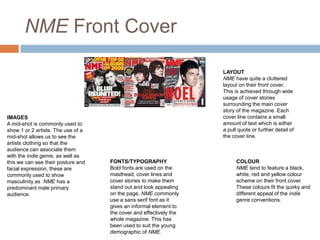
NME Front Cover

IMAGES
A mid-shot is commonly used to
show 1 or 2 artists. The use of a
mid-shot allows us to see the
artists clothing so that the
audience can associate them
with the indie genre, as well as
this we can see their posture and
facial expression, these are
commonly used to show
masculinity as NME has a
predominant male primary
audience.

LAYOUT
NME have quite a cluttered
layout on their front cover.
This is achieved through wide
usage of cover stories
surrounding the main cover
story of the magazine. Each
cover line contains a small
amount of text which is either
a pull quote or further detail of
the cover line.

FONTS/TYPOGRAPHY
Bold fonts are used on the
masthead, cover lines and
cover stories to make them
stand out and look appealing
on the page. NME commonly
use a sans serif font as it
gives an informal element to
the cover and effectively the
whole magazine. This has
been used to suit the young
demographic of NME.

COLOUR
NME tend to feature a black,
white, red and yellow colour
scheme on their front cover.
These colours fit the quirky and
different appeal of the indie
genre conventions.
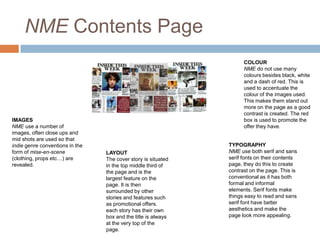
NME Contents Page

IMAGES
NME use a number of
images, often close ups and
mid shots are used so that
indie genre conventions in the
form of mise-en-scene
(clothing, props etc…) are
revealed.

COLOUR
NME do not use many
colours besides black, white
and a dash of red. This is
used to accentuate the
colour of the images used.
This makes them stand out
more on the page as a good
contrast is created. The red
box is used to promote the
offer they have.

LAYOUT
The cover story is situated
in the top middle third of
the page and is the
largest feature on the
page. It is then
surrounded by other
stories and features such
as promotional offers.
each story has their own
box and the title is always
at the very top of the
page.

TYPOGRAPHY
NME use both serif and sans
serif fonts on their contents
page, they do this to create
contrast on the page. This is
conventional as it has both
formal and informal
elements. Serif fonts make
things easy to read and sans
serif font have better
aesthetics and make the
page look more appealing.
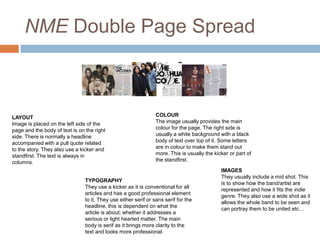
NME Double Page Spread

LAYOUT
Image is placed on the left side of the
page and the body of text is on the right
side. There is normally a headline
accompanied with a pull quote related
to the story. They also use a kicker and
standfirst. The text is always in
columns.

COLOUR
The image usually provides the main
colour for the page. The right side is
usually a white background with a black
body of text over top of it. Some letters
are in colour to make them stand out
more. This is usually the kicker or part of
the standfirst.

TYPOGRAPHY
They use a kicker as it is conventional for all
articles and has a good professional element
to it. They use either serif or sans serif for the
headline, this is dependent on what the
article is about; whether it addresses a
serious or light hearted matter. The main
body is serif as it brings more clarity to the
text and looks more professional.

IMAGES
They usually include a mid shot. This
is to show how the band/artist are
represented and how it fits the indie
genre. They also use a wide shot as it
allows the whole band to be seen and
can portray them to be united etc…
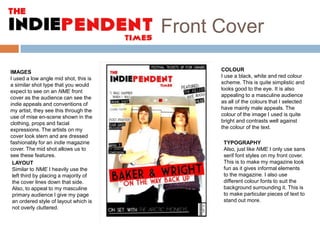
Front Cover
IMAGES
I used a low angle mid shot, this is
a similar shot type that you would
expect to see on an NME front
cover as the audience can see the
indie appeals and conventions of
my artist, they see this through the
use of mise en-scene shown in the
clothing, props and facial
expressions. The artists on my
cover look stern and are dressed
fashionably for an indie magazine
cover. The mid shot allows us to
see these features.
LAYOUT
Similar to NME I heavily use the
left third by placing a majority of
the cover lines down that side.
Also, to appeal to my masculine
primary audience I give my page
an ordered style of layout which is
not overly cluttered.

COLOUR
I use a black, white and red colour
scheme. This is quite simplistic and
looks good to the eye. It is also
appealing to a masculine audience
as all of the colours that I selected
have mainly male appeals. The
colour of the image I used is quite
bright and contrasts well against
the colour of the text.
TYPOGRAPHY
Also, just like NME I only use sans
serif font styles on my front cover.
This is to make my magazine look
fun as it gives informal elements
to the magazine. I also use
different colour fonts to suit the
background surrounding it. This is
to make particular pieces of text to
stand out more.
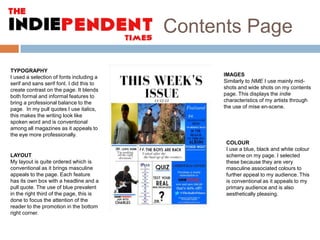
Contents Page
TYPOGRAPHY
I used a selection of fonts including a
serif and sans serif font. I did this to
create contrast on the page. It blends
both formal and informal features to
bring a professional balance to the
page. In my pull quotes I use italics,
this makes the writing look like
spoken word and is conventional
among all magazines as it appeals to
the eye more professionally.

LAYOUT
My layout is quite ordered which is
conventional as it brings masculine
appeals to the page. Each feature
has its own box with a headline and a
pull quote. The use of blue prevalent
in the right third of the page, this is
done to focus the attention of the
reader to the promotion in the bottom
right corner.

IMAGES
Similarly to NME I use mainly midshots and wide shots on my contents
page. This displays the indie
characteristics of my artists through
the use of mise en-scene.

COLOUR
I use a blue, black and white colour
scheme on my page. I selected
these because they are very
masculine associated colours to
further appeal to my audience. This
is conventional as it appeals to my
primary audience and is also
aesthetically pleasing.
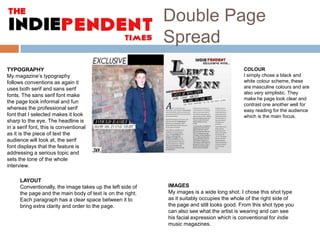
Double Page
Spread
TYPOGRAPHY
My magazine’s typography
follows conventions as again it
uses both serif and sans serif
fonts. The sans serif font make
the page look informal and fun
whereas the professional serif
font that I selected makes it look
sharp to the eye. The headline is
in a serif font, this is conventional
as it is the piece of text the
audience will look at, the serif
font displays that the feature is
addressing a serious topic and
sets the tone of the whole
interview.
LAYOUT
Conventionally, the image takes up the left side of
the page and the main body of text is on the right.
Each paragraph has a clear space between it to
bring extra clarity and order to the page.

COLOUR
I simply chose a black and
white colour scheme, these
are masculine colours and are
also very simplistic. They
make he page look clear and
contrast one another well for
easy reading for the audience
which is the main focus.

IMAGES
My images is a wide long shot. I chose this shot type
as it suitably occupies the whole of the right side of
the page and still looks good. From this shot type you
can also see what the artist is wearing and can see
his facial expression which is conventional for indie
music magazines.

Conventions slide show

  • 1.
  • 2.
    NME Front Cover IMAGES Amid-shot is commonly used to show 1 or 2 artists. The use of a mid-shot allows us to see the artists clothing so that the audience can associate them with the indie genre, as well as this we can see their posture and facial expression, these are commonly used to show masculinity as NME has a predominant male primary audience. LAYOUT NME have quite a cluttered layout on their front cover. This is achieved through wide usage of cover stories surrounding the main cover story of the magazine. Each cover line contains a small amount of text which is either a pull quote or further detail of the cover line. FONTS/TYPOGRAPHY Bold fonts are used on the masthead, cover lines and cover stories to make them stand out and look appealing on the page. NME commonly use a sans serif font as it gives an informal element to the cover and effectively the whole magazine. This has been used to suit the young demographic of NME. COLOUR NME tend to feature a black, white, red and yellow colour scheme on their front cover. These colours fit the quirky and different appeal of the indie genre conventions.
  • 3.
    NME Contents Page IMAGES NMEuse a number of images, often close ups and mid shots are used so that indie genre conventions in the form of mise-en-scene (clothing, props etc…) are revealed. COLOUR NME do not use many colours besides black, white and a dash of red. This is used to accentuate the colour of the images used. This makes them stand out more on the page as a good contrast is created. The red box is used to promote the offer they have. LAYOUT The cover story is situated in the top middle third of the page and is the largest feature on the page. It is then surrounded by other stories and features such as promotional offers. each story has their own box and the title is always at the very top of the page. TYPOGRAPHY NME use both serif and sans serif fonts on their contents page, they do this to create contrast on the page. This is conventional as it has both formal and informal elements. Serif fonts make things easy to read and sans serif font have better aesthetics and make the page look more appealing.
  • 4.
    NME Double PageSpread LAYOUT Image is placed on the left side of the page and the body of text is on the right side. There is normally a headline accompanied with a pull quote related to the story. They also use a kicker and standfirst. The text is always in columns. COLOUR The image usually provides the main colour for the page. The right side is usually a white background with a black body of text over top of it. Some letters are in colour to make them stand out more. This is usually the kicker or part of the standfirst. TYPOGRAPHY They use a kicker as it is conventional for all articles and has a good professional element to it. They use either serif or sans serif for the headline, this is dependent on what the article is about; whether it addresses a serious or light hearted matter. The main body is serif as it brings more clarity to the text and looks more professional. IMAGES They usually include a mid shot. This is to show how the band/artist are represented and how it fits the indie genre. They also use a wide shot as it allows the whole band to be seen and can portray them to be united etc…
  • 5.
    Front Cover IMAGES I useda low angle mid shot, this is a similar shot type that you would expect to see on an NME front cover as the audience can see the indie appeals and conventions of my artist, they see this through the use of mise en-scene shown in the clothing, props and facial expressions. The artists on my cover look stern and are dressed fashionably for an indie magazine cover. The mid shot allows us to see these features. LAYOUT Similar to NME I heavily use the left third by placing a majority of the cover lines down that side. Also, to appeal to my masculine primary audience I give my page an ordered style of layout which is not overly cluttered. COLOUR I use a black, white and red colour scheme. This is quite simplistic and looks good to the eye. It is also appealing to a masculine audience as all of the colours that I selected have mainly male appeals. The colour of the image I used is quite bright and contrasts well against the colour of the text. TYPOGRAPHY Also, just like NME I only use sans serif font styles on my front cover. This is to make my magazine look fun as it gives informal elements to the magazine. I also use different colour fonts to suit the background surrounding it. This is to make particular pieces of text to stand out more.
  • 6.
    Contents Page TYPOGRAPHY I useda selection of fonts including a serif and sans serif font. I did this to create contrast on the page. It blends both formal and informal features to bring a professional balance to the page. In my pull quotes I use italics, this makes the writing look like spoken word and is conventional among all magazines as it appeals to the eye more professionally. LAYOUT My layout is quite ordered which is conventional as it brings masculine appeals to the page. Each feature has its own box with a headline and a pull quote. The use of blue prevalent in the right third of the page, this is done to focus the attention of the reader to the promotion in the bottom right corner. IMAGES Similarly to NME I use mainly midshots and wide shots on my contents page. This displays the indie characteristics of my artists through the use of mise en-scene. COLOUR I use a blue, black and white colour scheme on my page. I selected these because they are very masculine associated colours to further appeal to my audience. This is conventional as it appeals to my primary audience and is also aesthetically pleasing.
  • 7.
    Double Page Spread TYPOGRAPHY My magazine’stypography follows conventions as again it uses both serif and sans serif fonts. The sans serif font make the page look informal and fun whereas the professional serif font that I selected makes it look sharp to the eye. The headline is in a serif font, this is conventional as it is the piece of text the audience will look at, the serif font displays that the feature is addressing a serious topic and sets the tone of the whole interview. LAYOUT Conventionally, the image takes up the left side of the page and the main body of text is on the right. Each paragraph has a clear space between it to bring extra clarity and order to the page. COLOUR I simply chose a black and white colour scheme, these are masculine colours and are also very simplistic. They make he page look clear and contrast one another well for easy reading for the audience which is the main focus. IMAGES My images is a wide long shot. I chose this shot type as it suitably occupies the whole of the right side of the page and still looks good. From this shot type you can also see what the artist is wearing and can see his facial expression which is conventional for indie music magazines.