RESEARCHRESEARCH
TOOLSTOOLS
3 IDENTIFIED
RESEARCH TOOLS
• Library or bibliothecal tools
• Communication or linguistic
tools
• Statistical tools
The Library asThe Library as
a Research Toola Research Tool
Various Sections of
the Library
THE CARD CATALOGUE
SECTION
• This section serves as a guide to all
the holdings of the library. It
contains a drawer type cabinet which
contains 3 x 5 inches index cards.
THE PERIODICAL
SECTION
• The section of the library where you
can find the magazines, journals,
newspapers and other periodicals.
THE BOOK SECTION
• The section of the library where you
can find numbers of books that
contain specific and current overview
of the desired information. This
section holds numbers of fiction and
non-fiction books.
THE COMPUTER
SECTION
• Many libraries have already set up an
electronic database of all the
information found in the card
catalogue. This makes the search for
any of the holdings of a particular
library easier. The database also
contains the specific library in the
university where a particular journal
or book can be found.
THE VERTICAL FILE
SECTION
• In this section, one finds the
library’s collections of clippings from
pamphlets, magazines, newspapers,
brochures, documents, and
summaries of timely topics arranged
by subject matter.
THE GENERAL
REFERENCE SECTION
• Scientific dictionaries, handbooks,
almanacs, atlases, and encyclopedias
are general references classified as
secondary publications.
LIBRARYLIBRARY
CLASSIFICATIONCLASSIFICATION
SYSTEMSSYSTEMS
Two Library
Classification Systems
• The Dewey Decimal Classification
System
• The Library of Congress
Classification System
The Dewey Decimal
Classification System
• It was conceived by Melvil Dewey
(1851-1931) in 1873.
• The system is called “decimal” which
is derived from the Latin word
“decem” meaning ten and the system
contains ten main groupings or
divisions of knowledge.
• It is widely used particularly in small
libraries.
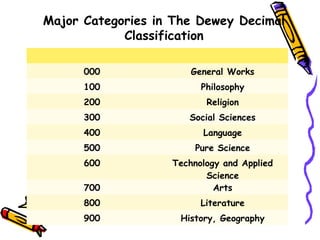
000 General Works
100 Philosophy
200 Religion
300 Social Sciences
400 Language
500 Pure Science
600 Technology and Applied
Science
700 Arts
800 Literature
900 History, Geography
Major Categories in The Dewey Decimal
Classification
The Library of Congress
System
• It is used in libraries which house
large collections.
• The system groups books according
to subject in twenty-one major
classes, each class being represented
by a capital letter of the alphabet.
A- General Works L- Education
B- Philosophy-Religion M- Music
C- History-Auxiliary Sciences N- Fine Arts
D- History and Topography (except
America)
P- Language and Literature
PN – Literary History and
Literature (general)
E- America (general) and United
States (general)
Q- Science
F- United States (local) and
America
R- Medicine
G- Geography-Anthropology S- Agriculture
H- Social Sciences T- Technology
J- Political Science U- Military Science
K- Law V- Naval Science
Z- Bibliography and Library Science

Research tools

  • 1.
  • 2.
    3 IDENTIFIED RESEARCH TOOLS •Library or bibliothecal tools • Communication or linguistic tools • Statistical tools
  • 3.
    The Library asTheLibrary as a Research Toola Research Tool
  • 4.
  • 5.
    THE CARD CATALOGUE SECTION •This section serves as a guide to all the holdings of the library. It contains a drawer type cabinet which contains 3 x 5 inches index cards.
  • 6.
    THE PERIODICAL SECTION • Thesection of the library where you can find the magazines, journals, newspapers and other periodicals.
  • 7.
    THE BOOK SECTION •The section of the library where you can find numbers of books that contain specific and current overview of the desired information. This section holds numbers of fiction and non-fiction books.
  • 8.
    THE COMPUTER SECTION • Manylibraries have already set up an electronic database of all the information found in the card catalogue. This makes the search for any of the holdings of a particular library easier. The database also contains the specific library in the university where a particular journal or book can be found.
  • 9.
    THE VERTICAL FILE SECTION •In this section, one finds the library’s collections of clippings from pamphlets, magazines, newspapers, brochures, documents, and summaries of timely topics arranged by subject matter.
  • 10.
    THE GENERAL REFERENCE SECTION •Scientific dictionaries, handbooks, almanacs, atlases, and encyclopedias are general references classified as secondary publications.
  • 11.
  • 12.
    Two Library Classification Systems •The Dewey Decimal Classification System • The Library of Congress Classification System
  • 13.
    The Dewey Decimal ClassificationSystem • It was conceived by Melvil Dewey (1851-1931) in 1873. • The system is called “decimal” which is derived from the Latin word “decem” meaning ten and the system contains ten main groupings or divisions of knowledge. • It is widely used particularly in small libraries.
  • 14.
    000 General Works 100Philosophy 200 Religion 300 Social Sciences 400 Language 500 Pure Science 600 Technology and Applied Science 700 Arts 800 Literature 900 History, Geography Major Categories in The Dewey Decimal Classification
  • 15.
    The Library ofCongress System • It is used in libraries which house large collections. • The system groups books according to subject in twenty-one major classes, each class being represented by a capital letter of the alphabet.
  • 16.
    A- General WorksL- Education B- Philosophy-Religion M- Music C- History-Auxiliary Sciences N- Fine Arts D- History and Topography (except America) P- Language and Literature PN – Literary History and Literature (general) E- America (general) and United States (general) Q- Science F- United States (local) and America R- Medicine G- Geography-Anthropology S- Agriculture H- Social Sciences T- Technology J- Political Science U- Military Science K- Law V- Naval Science Z- Bibliography and Library Science