#libdata4impact
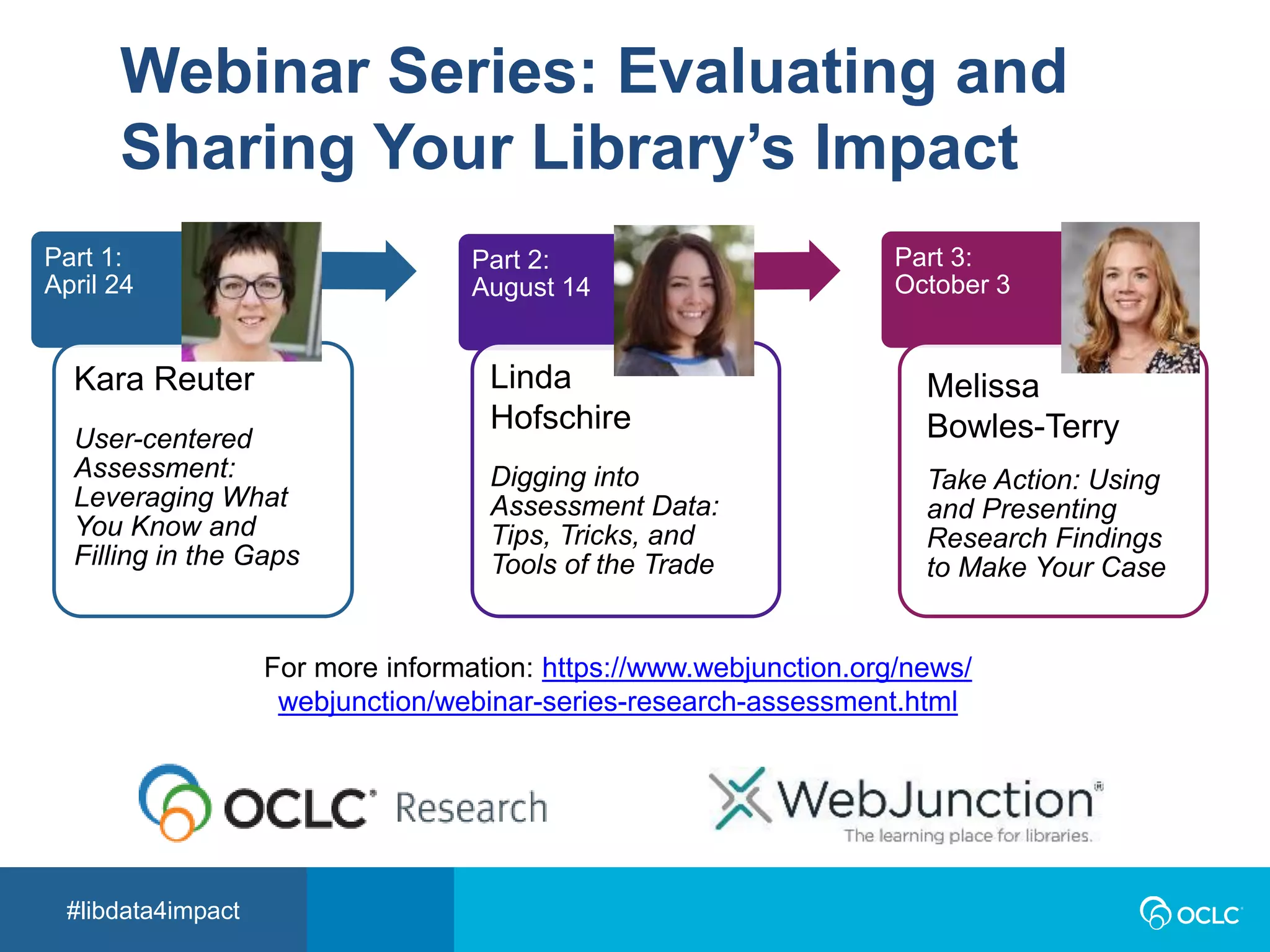
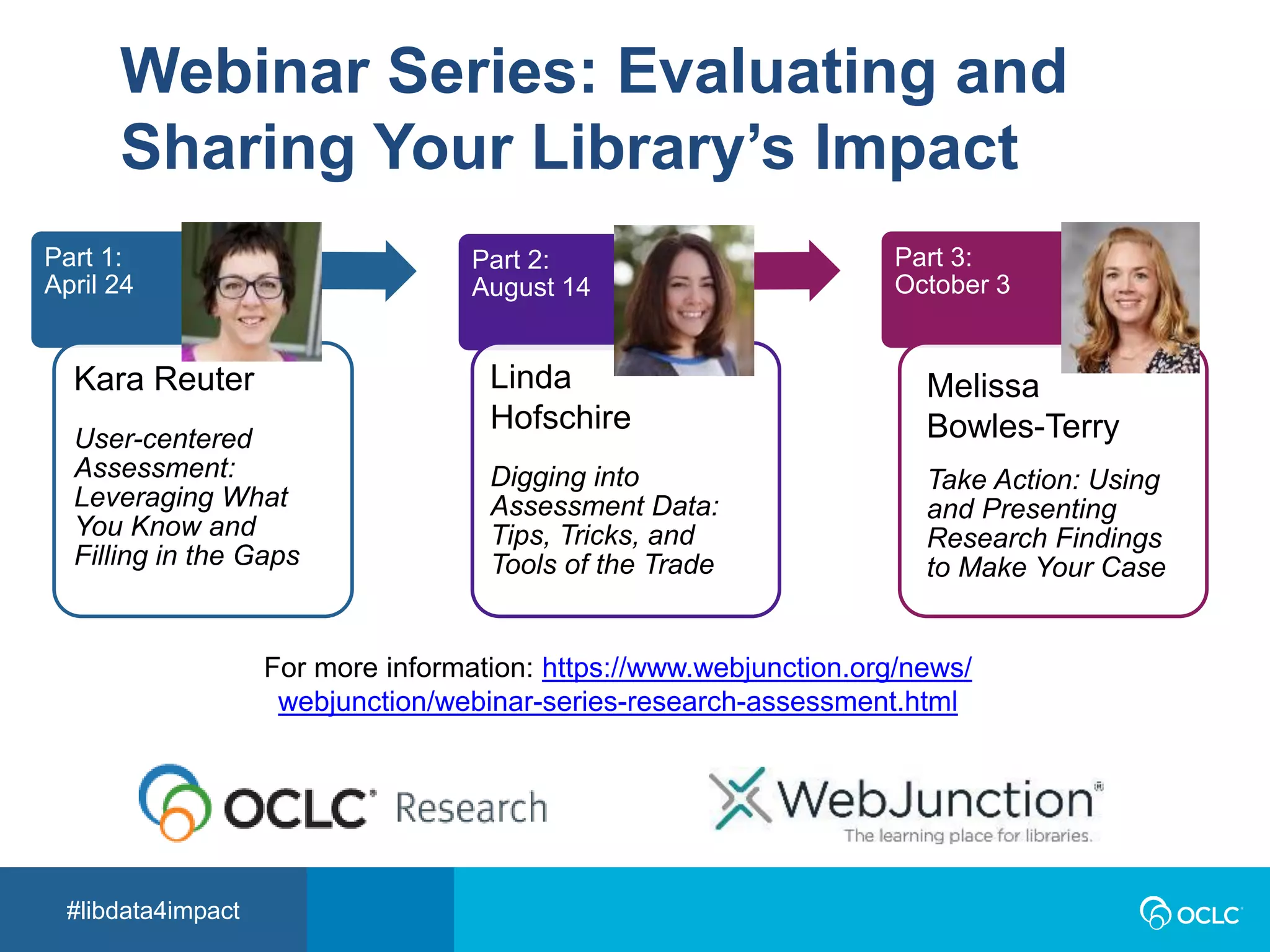
Webinar Series: Evaluating and
Sharing Your Library’s Impact
Part 1:
April 24
Kara Reuter
User-centered
Assessment:
Leveraging What
You Know and
Filling in the Gaps
Part 2:
August 14
Linda
Hofschire
Digging into
Assessment Data:
Tips, Tricks, and
Tools of the Trade
Part 3:
October 3
Melissa
Bowles-Terry
Take Action: Using
and Presenting
Research Findings
to Make Your Case
For more information: https://www.webjunction.org/news/
webjunction/webinar-series-research-assessment.html
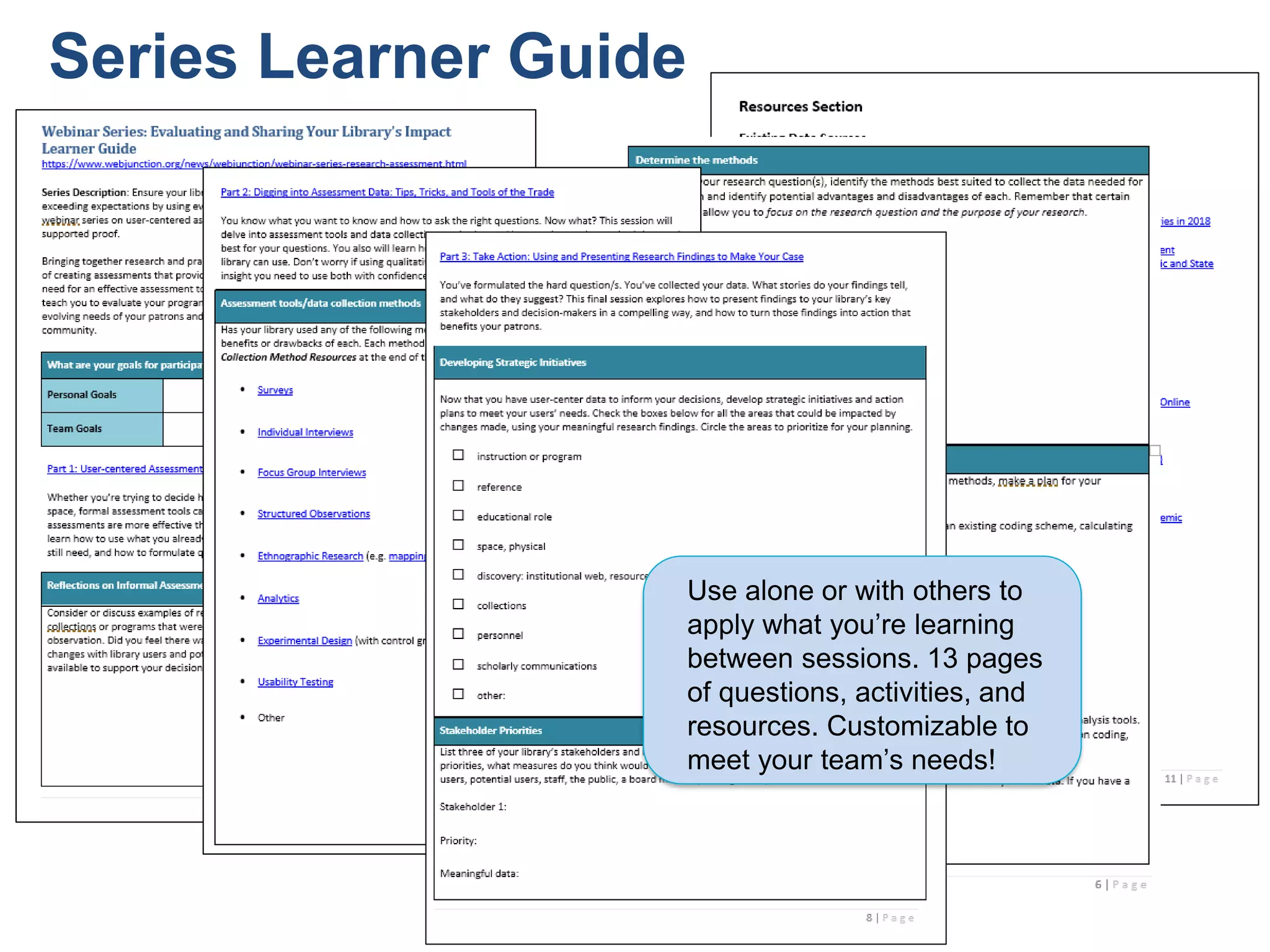
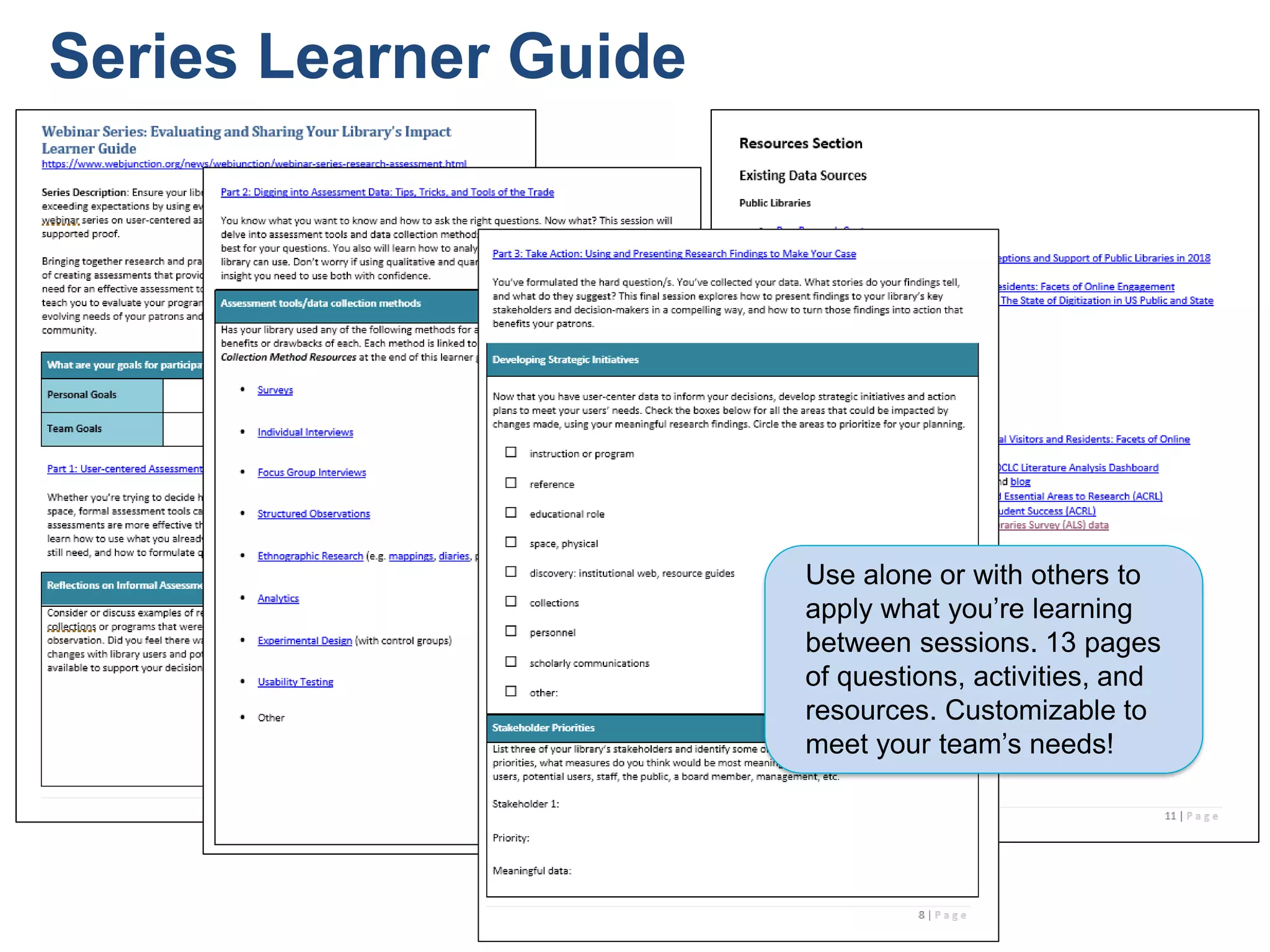
Series Learner Guide
Use alone or with others to
apply what you’re learning
between sessions. 13 pages
of questions, activities, and
resources. Customizable to
meet your team’s needs!
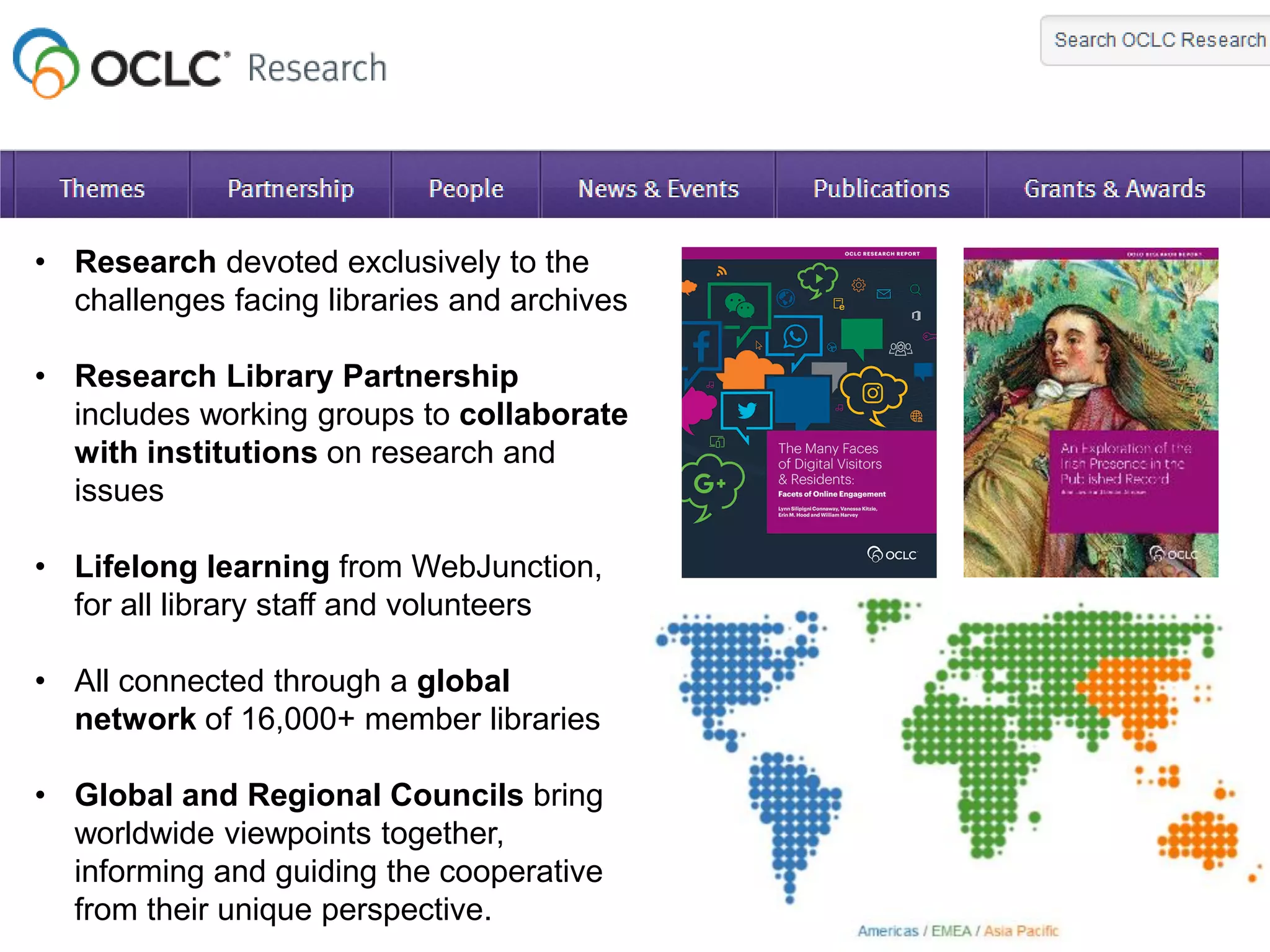
• Research devoted exclusively to the
challenges facing libraries and archives
• Research Library Partnership
includes working groups to collaborate
with institutions on research and
issues
• Lifelong learning from WebJunction,
for all library staff and volunteers
• All connected through a global
network of 16,000+ member libraries
• Global and Regional Councils bring
worldwide viewpoints together,
informing and guiding the cooperative
from their unique perspective.
#libdata4impact
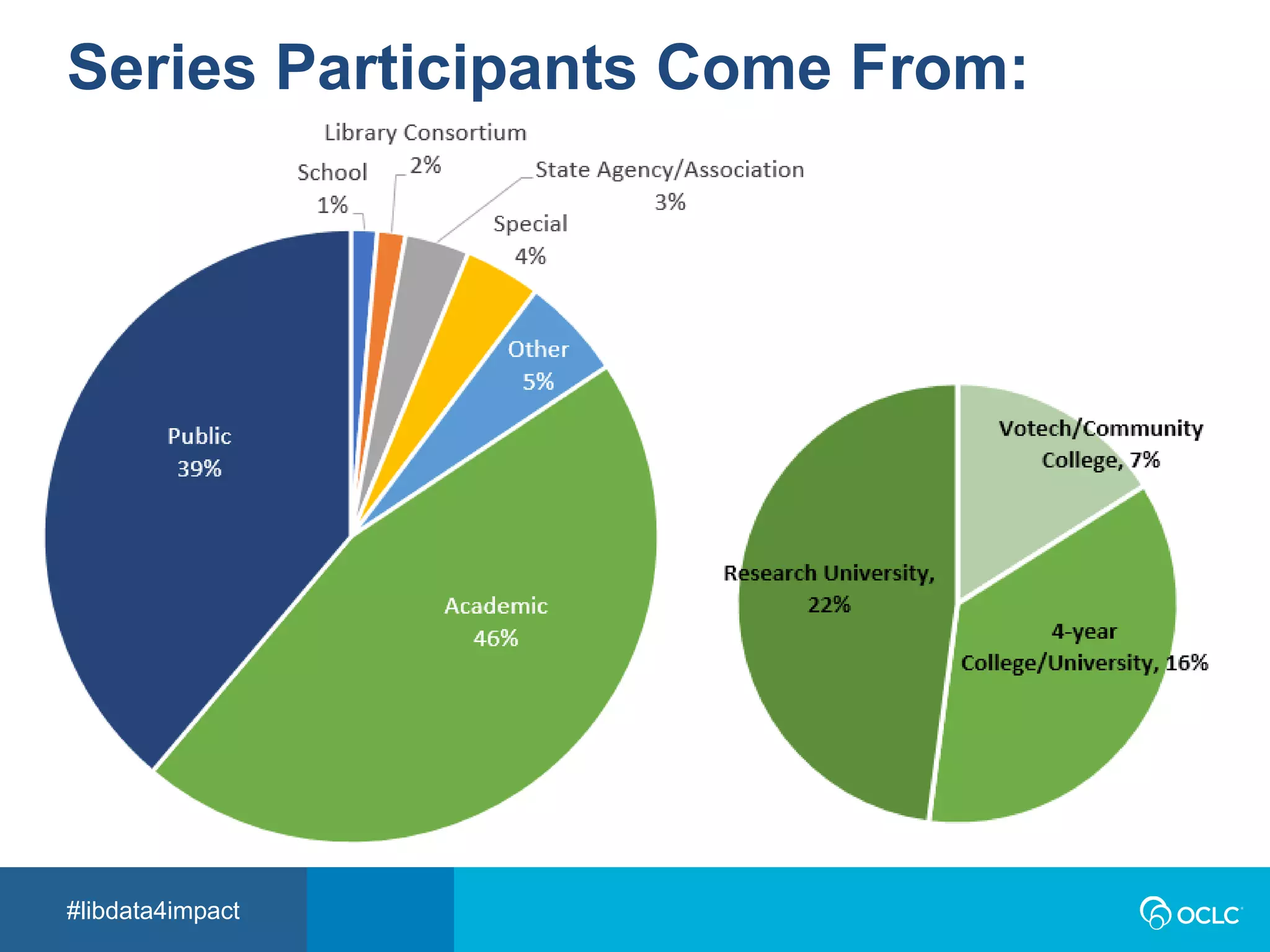
Series Participants Come From:
#libdata4impact
Research Library Partnership:
Library Assessment Interest Group
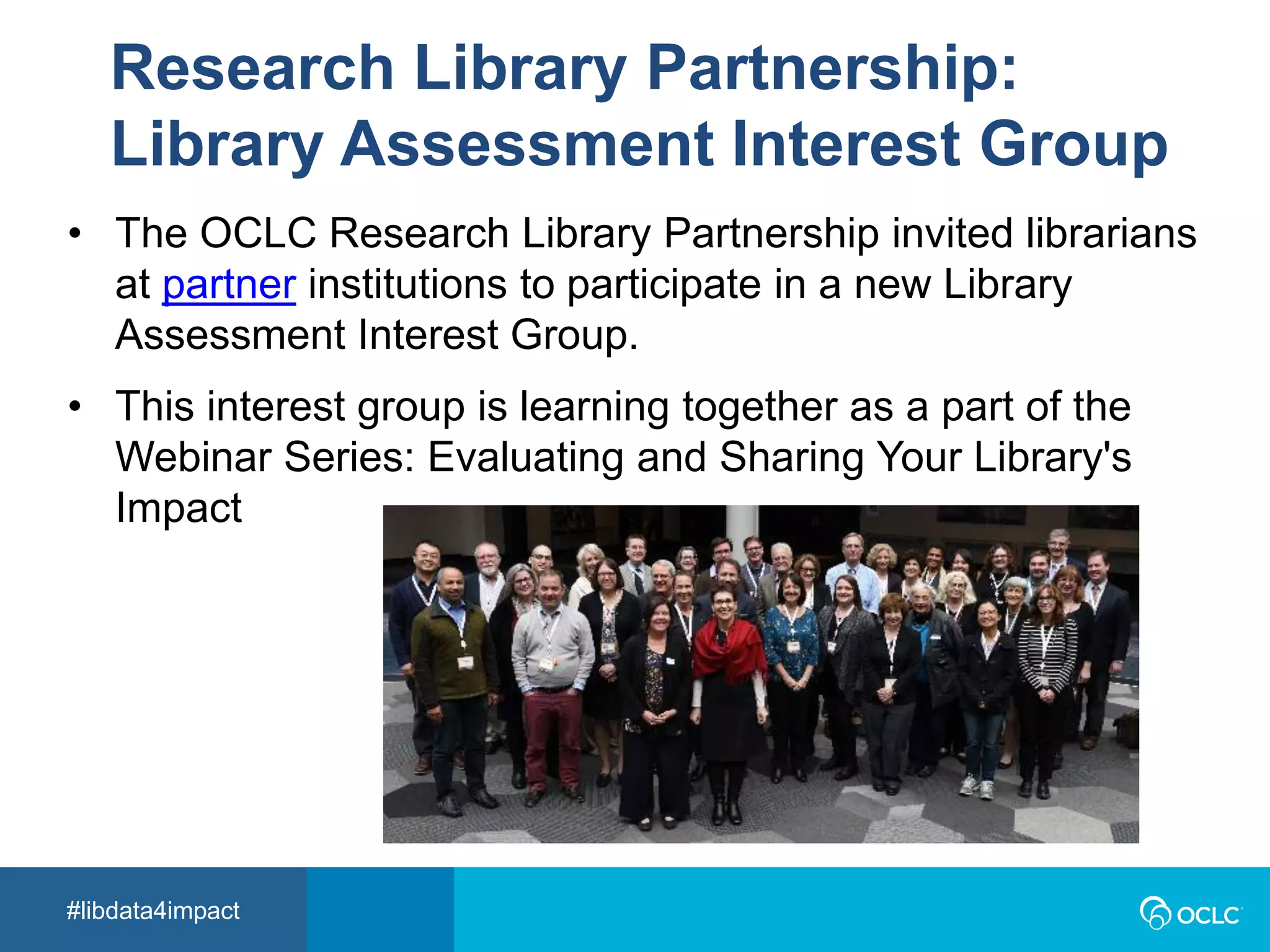
• The OCLC Research Library Partnership invited librarians
at partner institutions to participate in a new Library
Assessment Interest Group.
• This interest group is learning together as a part of the
Webinar Series: Evaluating and Sharing Your Library's
Impact
#libdata4impact
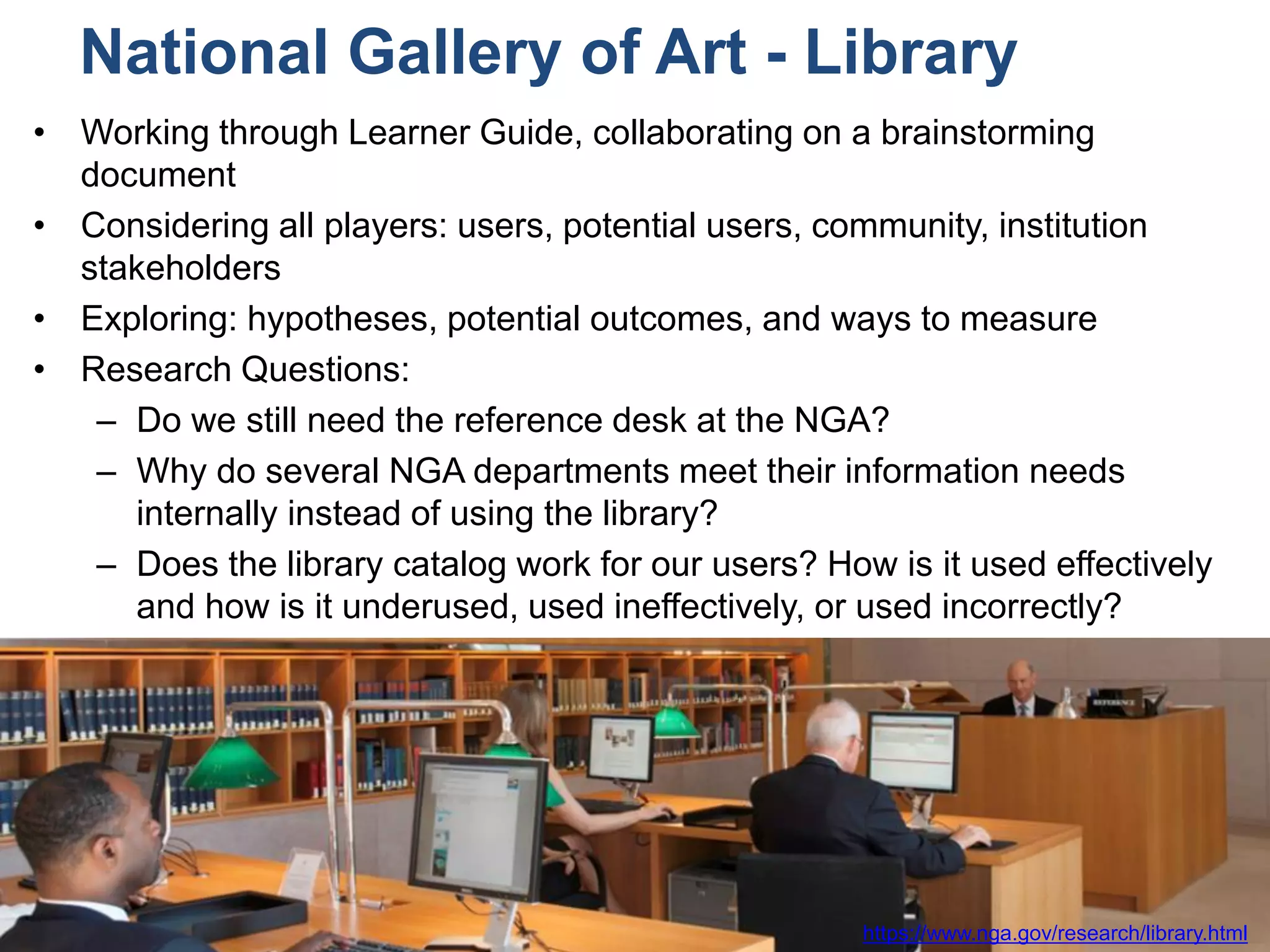
National Gallery of Art - Library
• Working through Learner Guide, collaborating on a brainstorming
document
• Considering all players: users, potential users, community, institution
stakeholders
• Exploring: hypotheses, potential outcomes, and ways to measure
• Research Questions:
– Do we still need the reference desk at the NGA?
– Why do several NGA departments meet their information needs
internally instead of using the library?
– Does the library catalog work for our users? How is it used effectively
and how is it underused, used ineffectively, or used incorrectly?
https://www.nga.gov/research/library.html
Lynn Silipigni Connaway
Director, Library Trends and User Research
OCLC Research
connawal@oclc.org
@LynnConnaway
#libdata4impact
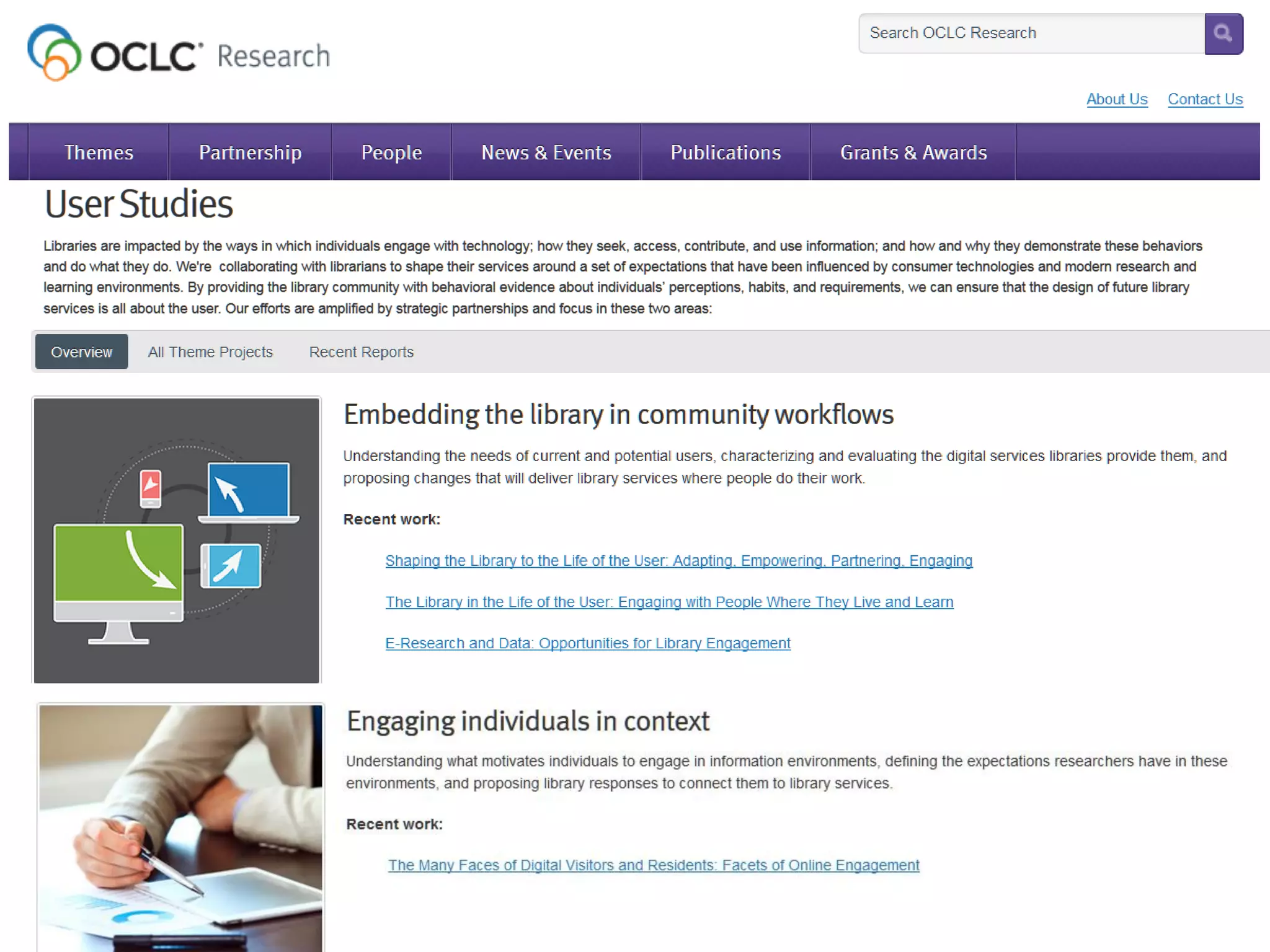
OCLC Research
#libdata4impact
Principles for Assessment
• Center on users
• Assess changes in programming/resource engagement and
other initiatives
• Build on what your library already has done and what you
already know
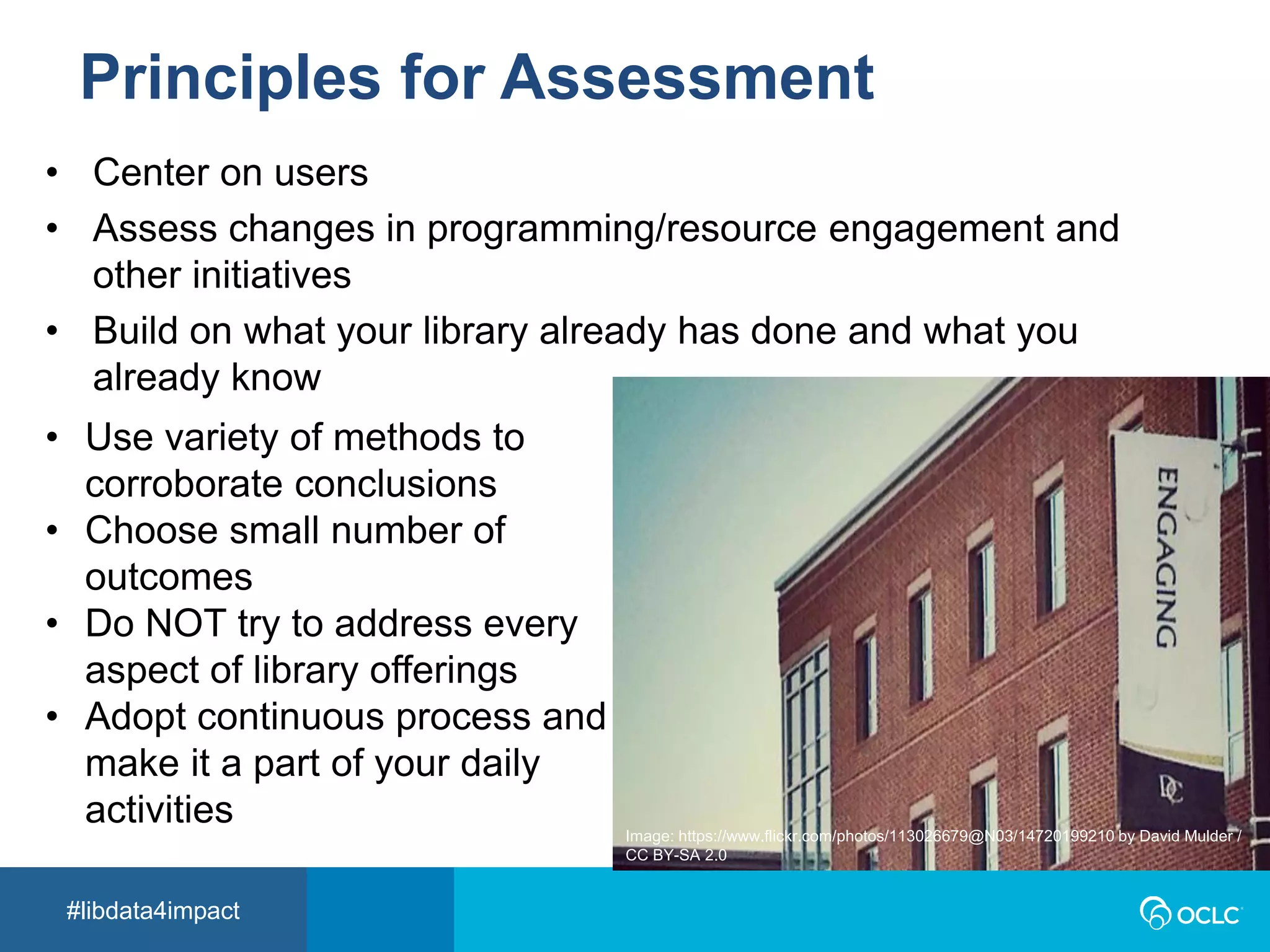
Image: https://www.flickr.com/photos/113026679@N03/14720199210 by David Mulder /
CC BY-SA 2.0
• Use variety of methods to
corroborate conclusions
• Choose small number of
outcomes
• Do NOT try to address every
aspect of library offerings
• Adopt continuous process and
make it a part of your daily
activities
#libdata4impact
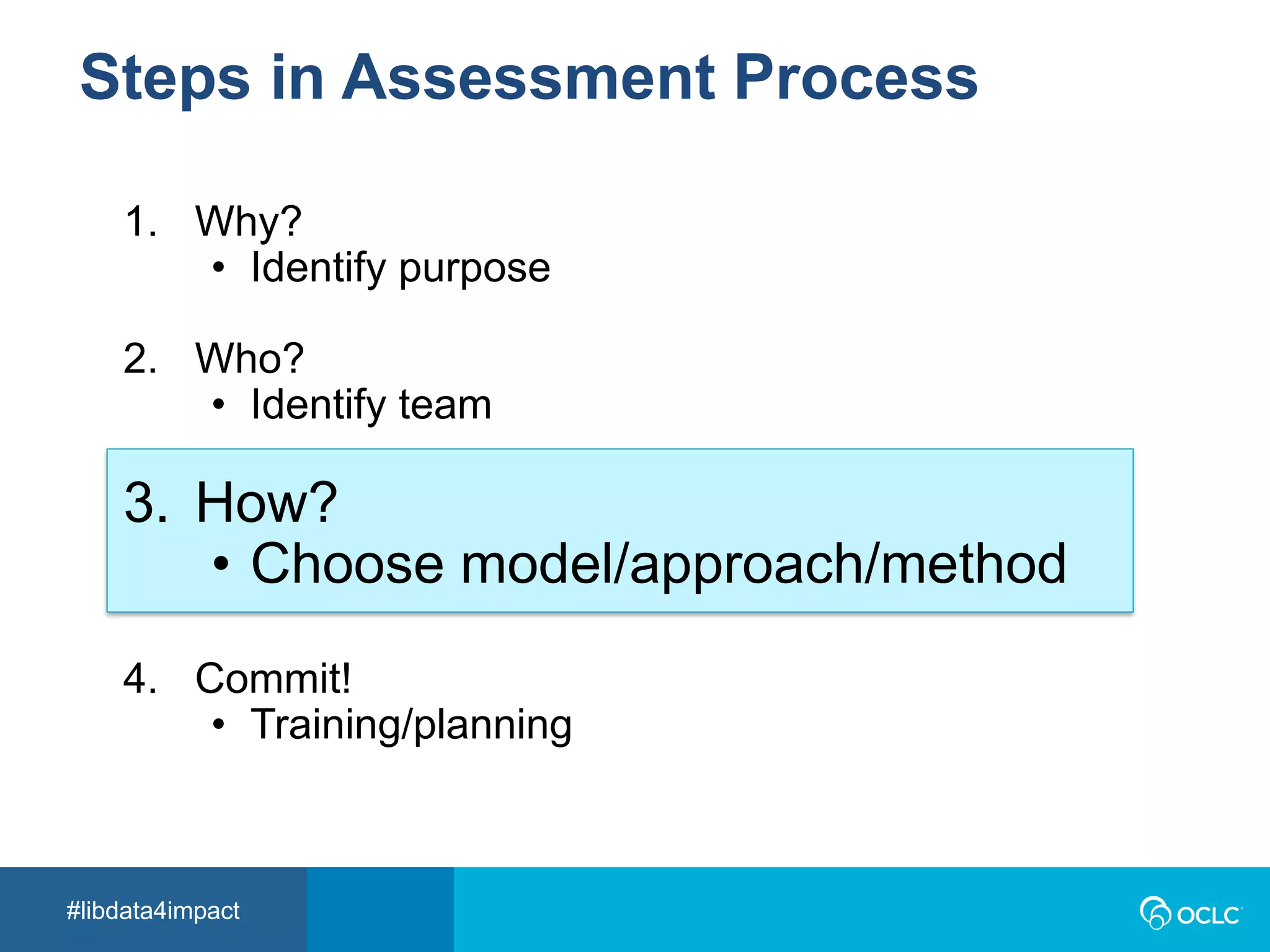
Steps in Assessment Process
Image: https://www.flickr.com/photos/113026679@N03/14720199210 by David
Mulder / CC BY-SA 2.0
1. Why?
• Identify purpose
2. Who?
• Identify team
3. How?
• Choose model/approach/method
4. Commit!
• Training/planning
#libdata4impact
Developing the Question/s
Image: https://www.flickr.com/photos/113026679@N03/14720199210 by David
Mulder / CC BY-SA 2.0
The problem to be resolved by this study is whether
the frequency of library use of first-year undergraduate
students given course-integrated information literacy
instruction is different from the frequency of library use
of first-year undergraduate students not given course-
integrated information literacy instruction.
(Connaway & Radford, 2017, p. 36)
Image: https://www.flickr.com/photos/68532869@N08/17470913285/ by
Japanexperterna.se / CC BY-SA 2.0
Problem statement
#libdata4impact
Developing the Question/s
Subproblems
• What is the frequency of library use of the first-year
undergraduate students who did receive course-
integrated information literacy instruction?
• What is the frequency of library use of the first-year
undergraduate students who did not receive
course-integrated information literacy instruction?
• What is the difference in the frequency of library
use between the two groups of undergraduate
students?
(Connaway & Radford, 2017, p. 36)
Image: https://www.flickr.com/photos/benhosg/32627578042 by Benjamin Ho / CC BY-NC-ND 2.0
#libdata4impact
Advice from the Trenches:
You are NOT Alone
• “Techniques to conduct an effective assessment evaluation
are learnable.”
• Always start with a problem – the question/s.
• “…consult the literature, participate in webinars, attend
conferences, and learn what is already known about the
evaluation problem.
• Take the plunge and just do an assessment evaluation and
learn from the experience – the next one will be easier and
better.
• Make the assessment evaluation a part of your job, not
more work.
• Plan the process…and share your results.”
(Nitecki, 2017, p. 356)
Image: https://www.flickr.com/photos/steve_way/38027571414 by steve_w / CC BY-NC-ND 2.0
http://hangingtogether.org/?p=6790
#libdata4impact
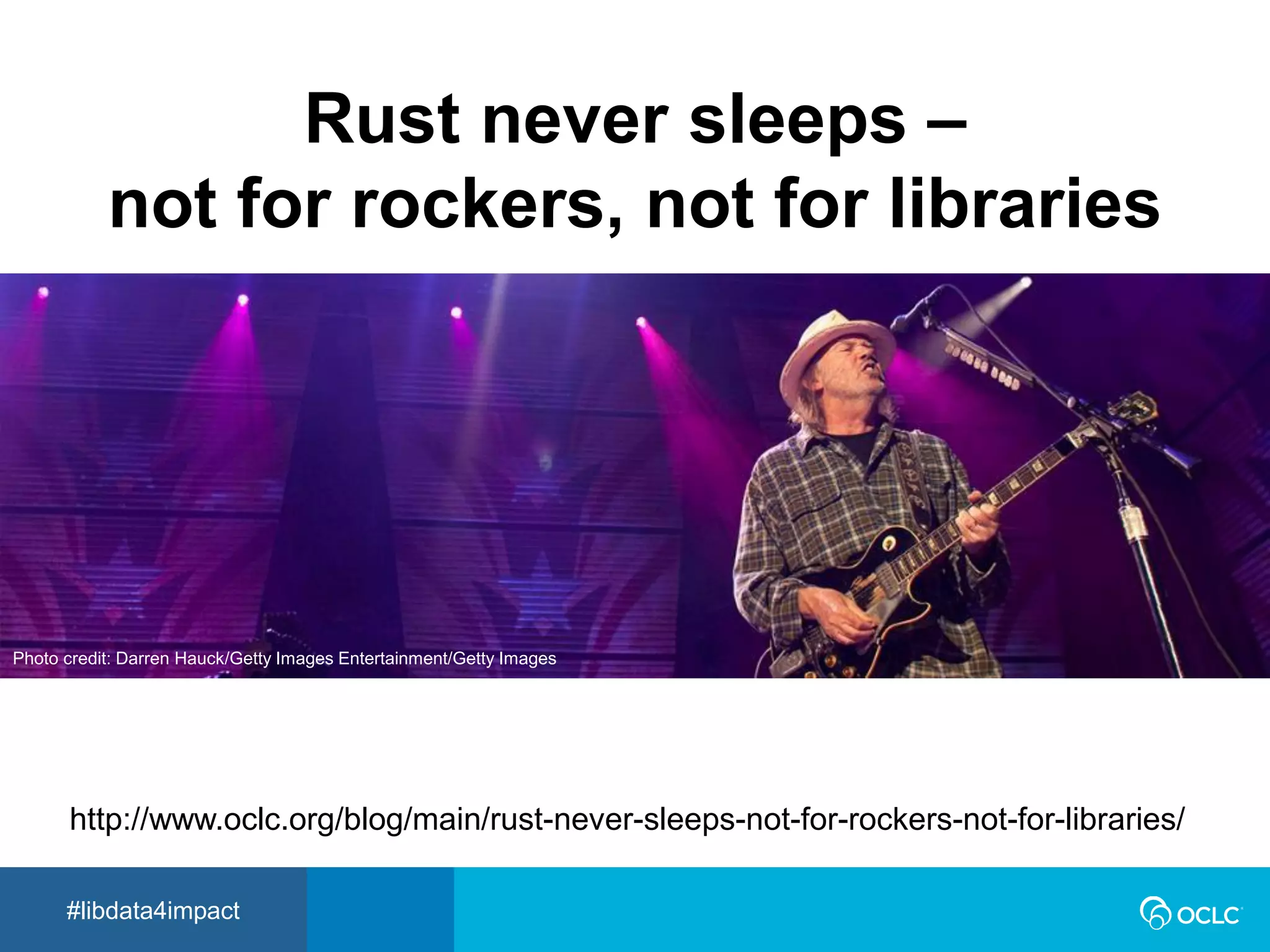
Rust never sleeps –
not for rockers, not for libraries
http://www.oclc.org/blog/main/rust-never-sleeps-not-for-rockers-not-for-libraries/
Photo credit: Darren Hauck/Getty Images Entertainment/Getty Images
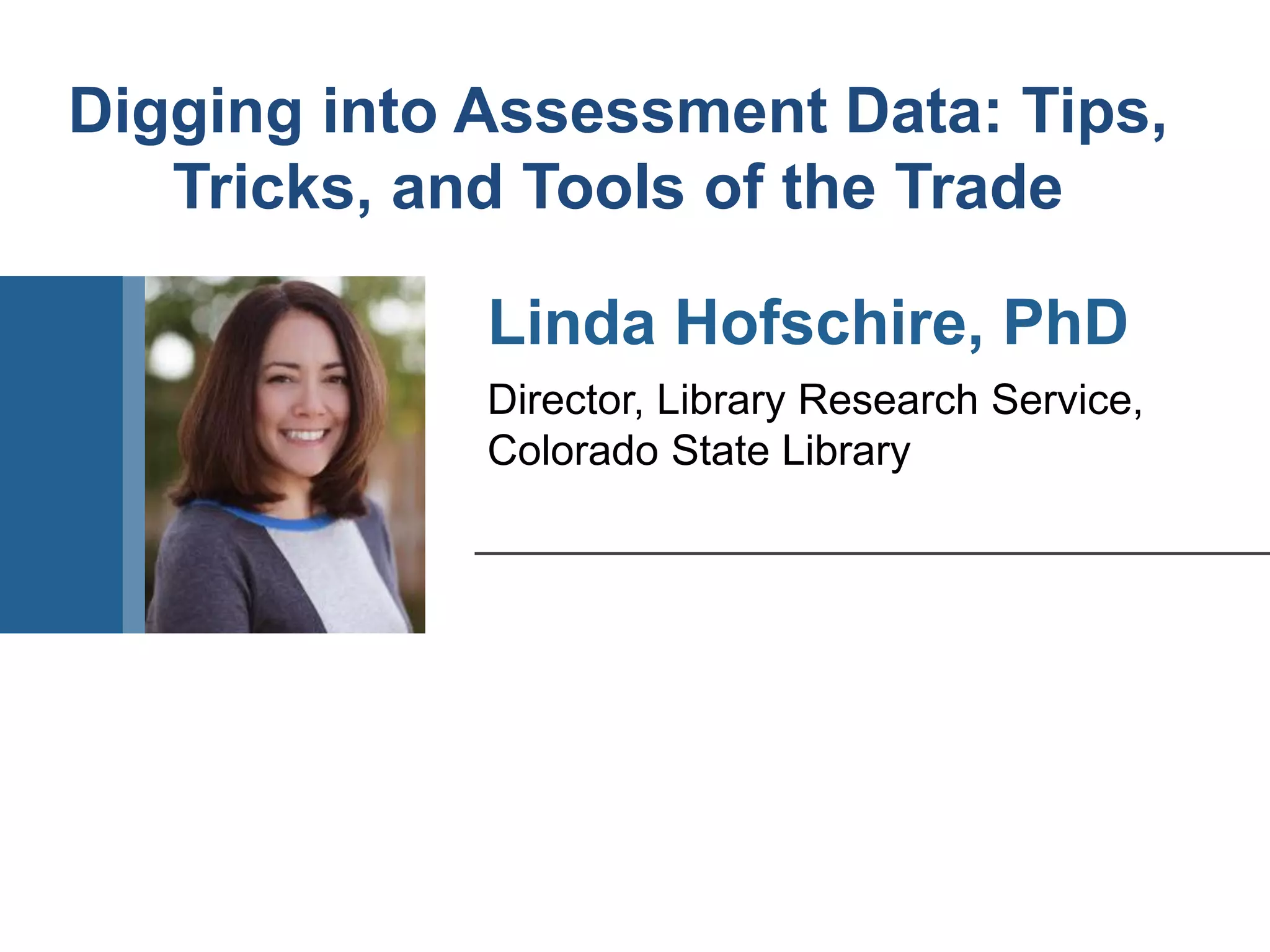
Director, Library Research Service,
Colorado State Library
Linda Hofschire, PhD
Digging into Assessment Data: Tips,
Tricks, and Tools of the Trade
TODAY’S PLAN
•Focus on why vs. how
TODAY’S PLAN
•Focus on why vs. how
•The how includes:
–Research Ethics:
consent, privacy, etc.
–Sampling
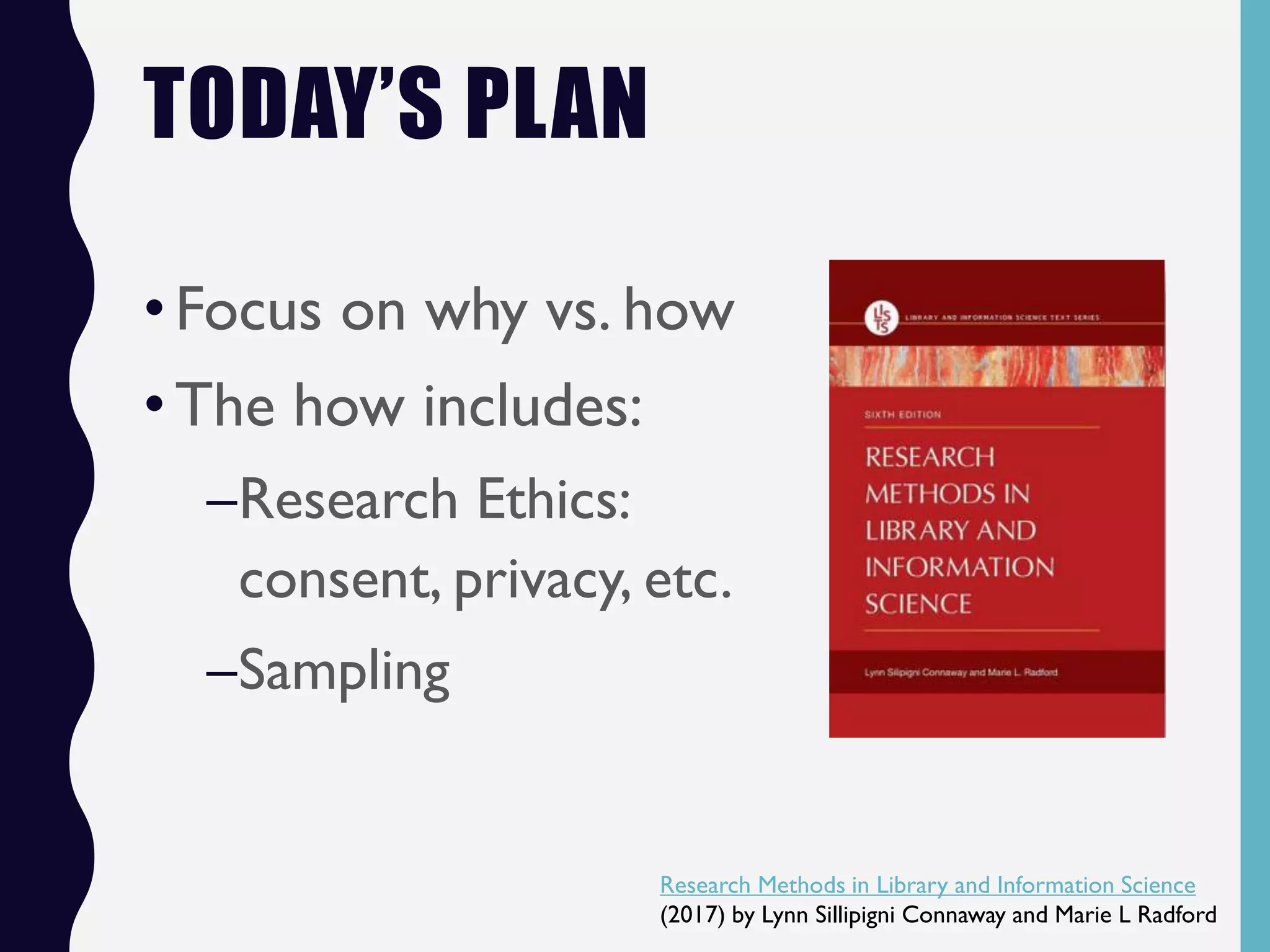
Research Methods in Library and Information Science
(2017) by Lynn Sillipigni Connaway and Marie L Radford
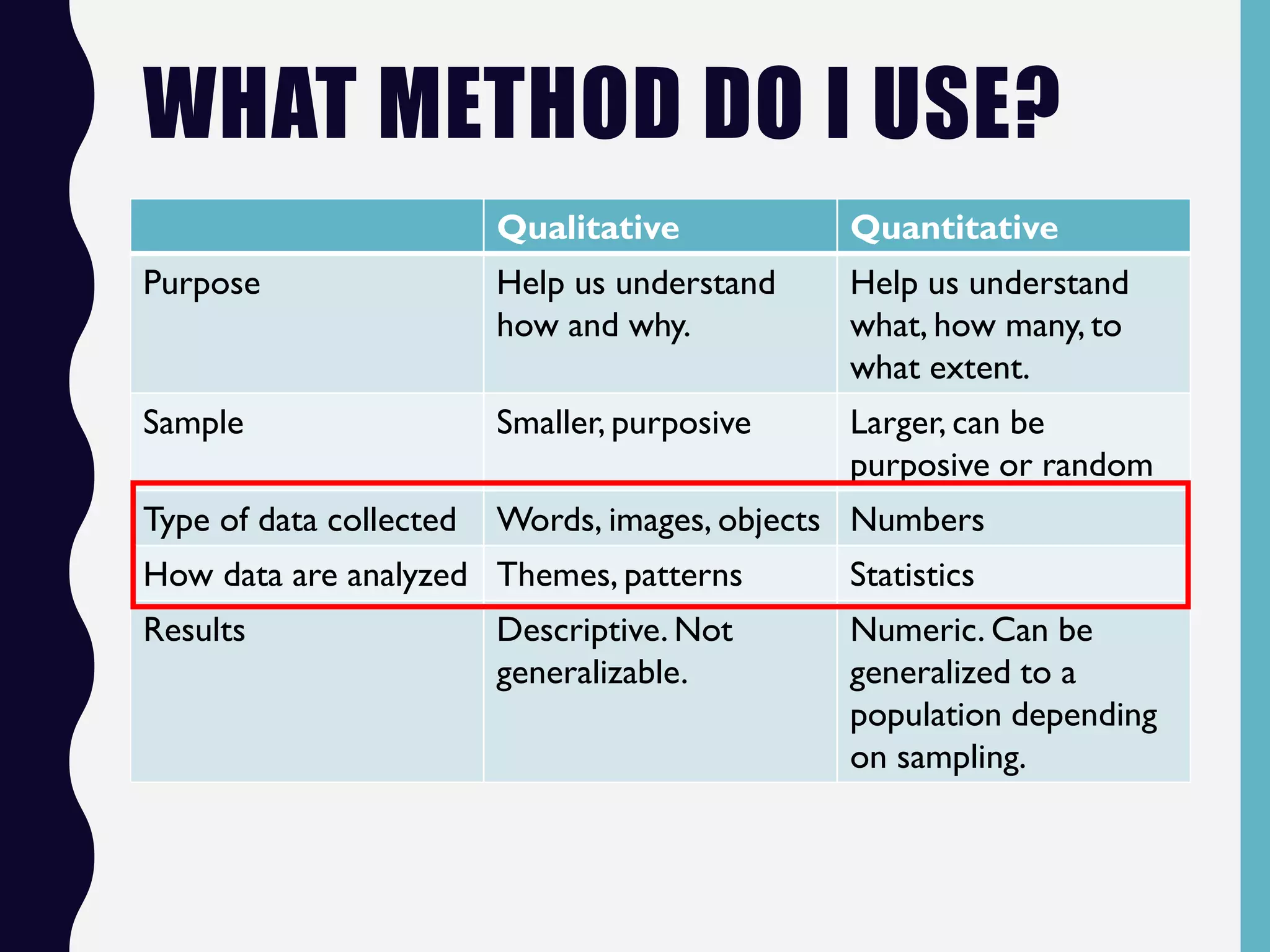
WHAT METHOD DO I USE?
•Quantitative vs. Qualitative
WHAT METHOD DO I USE?
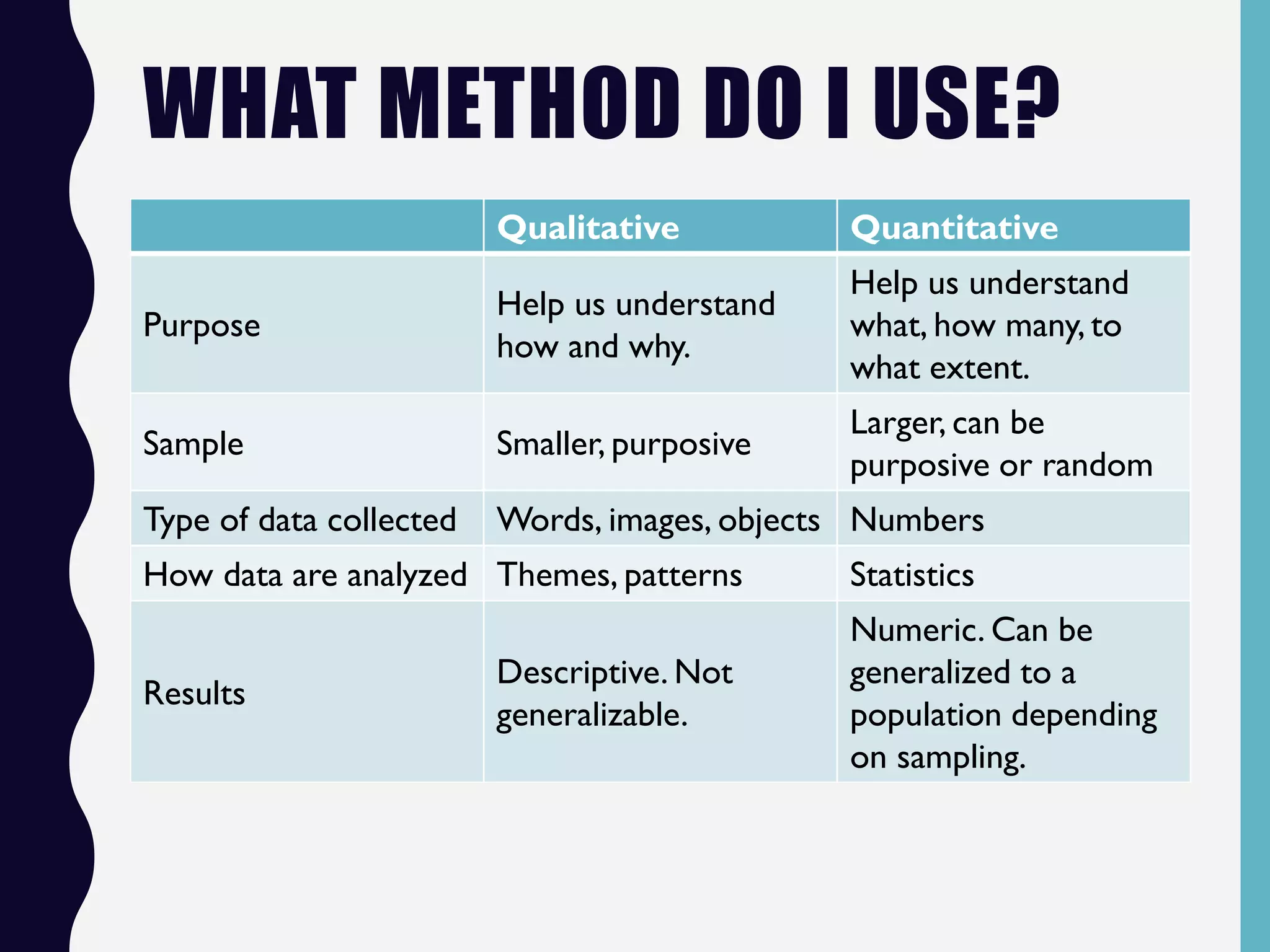
Qualitative Quantitative
Purpose
Help us understand
how and why.
Help us understand
what, how many, to
what extent.
Sample Smaller, purposive
Larger, can be
purposive or random
Type of data collected Words, images, objects Numbers
How data are analyzed Themes, patterns Statistics
Results
Descriptive. Not
generalizable.
Numeric. Can be
generalized to a
population depending
on sampling.
WHAT METHOD DO I USE?
•Quantitative vs. Qualitative
•Self-report vs. direct observation/
demonstration
SELF-REPORT
METHODS
I N T E RV I E W S
F O C U S G R O U P S
S U RV E Y S
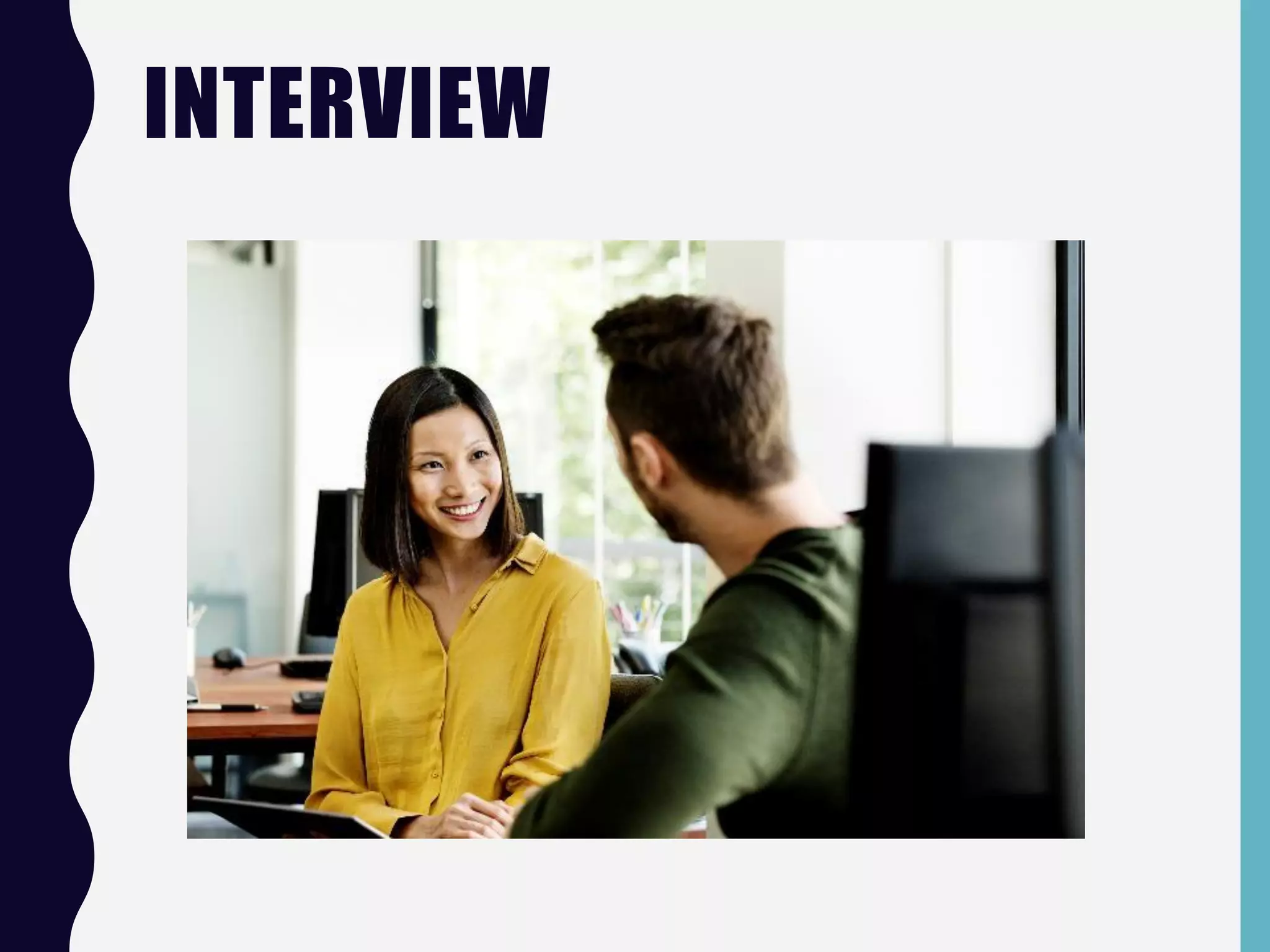
INTERVIEW
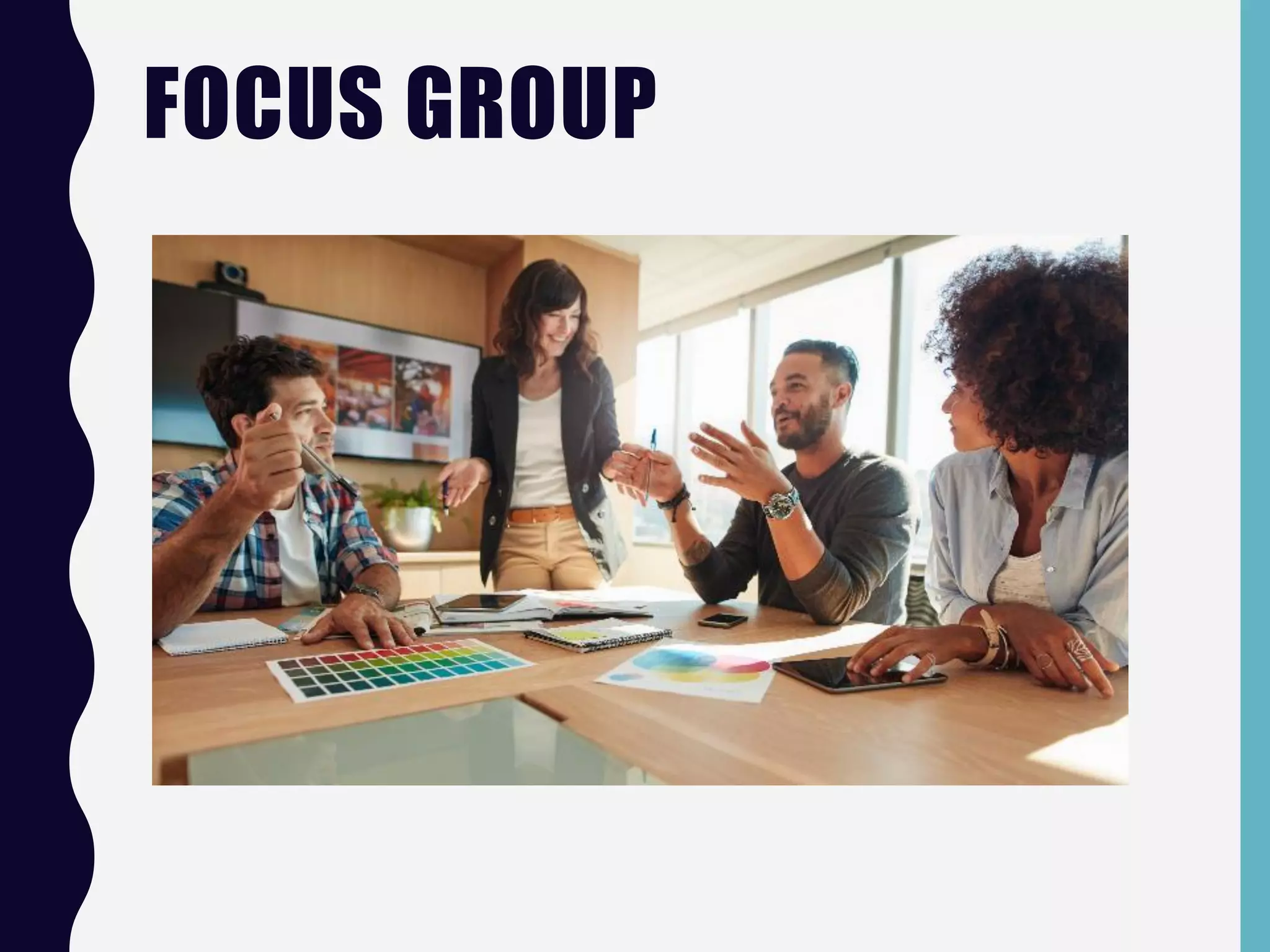
FOCUS GROUP
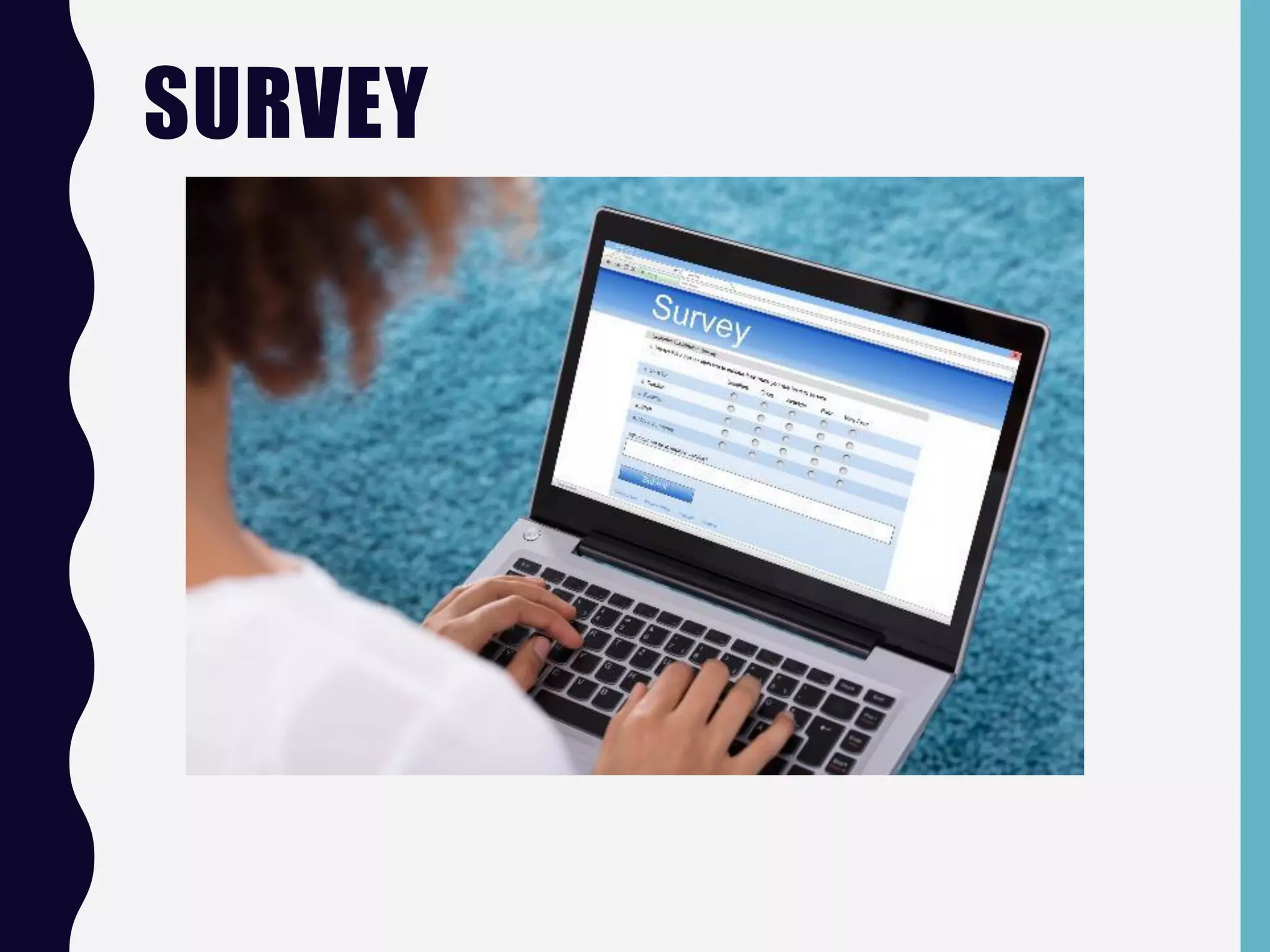
SURVEY
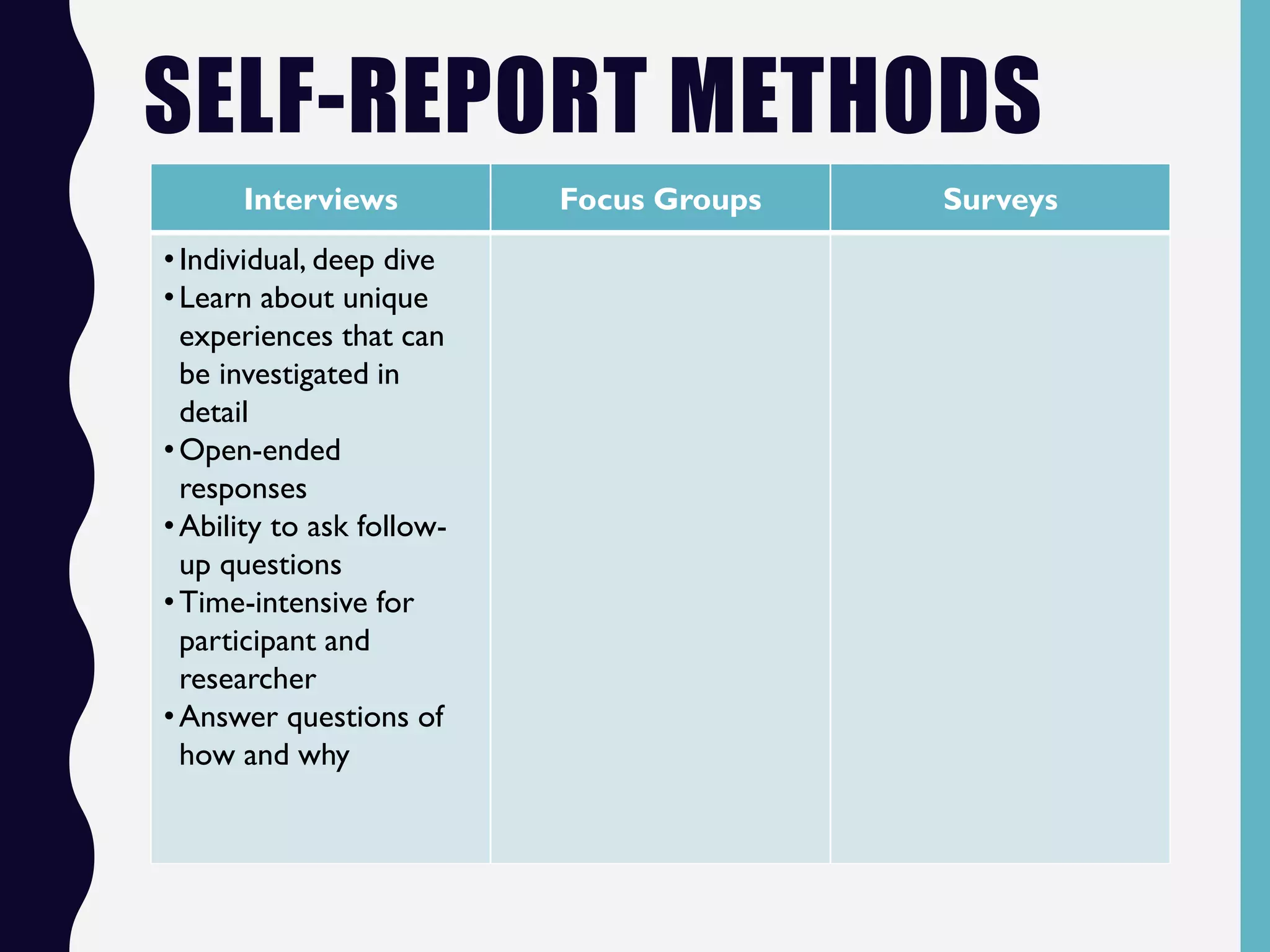
SELF-REPORT METHODS
Interviews Focus Groups Surveys
•Individual, deep dive
•Learn about unique
experiences that can
be investigated in
detail
•Open-ended
responses
•Ability to ask follow-
up questions
•Time-intensive for
participant and
researcher
•Answer questions of
how and why
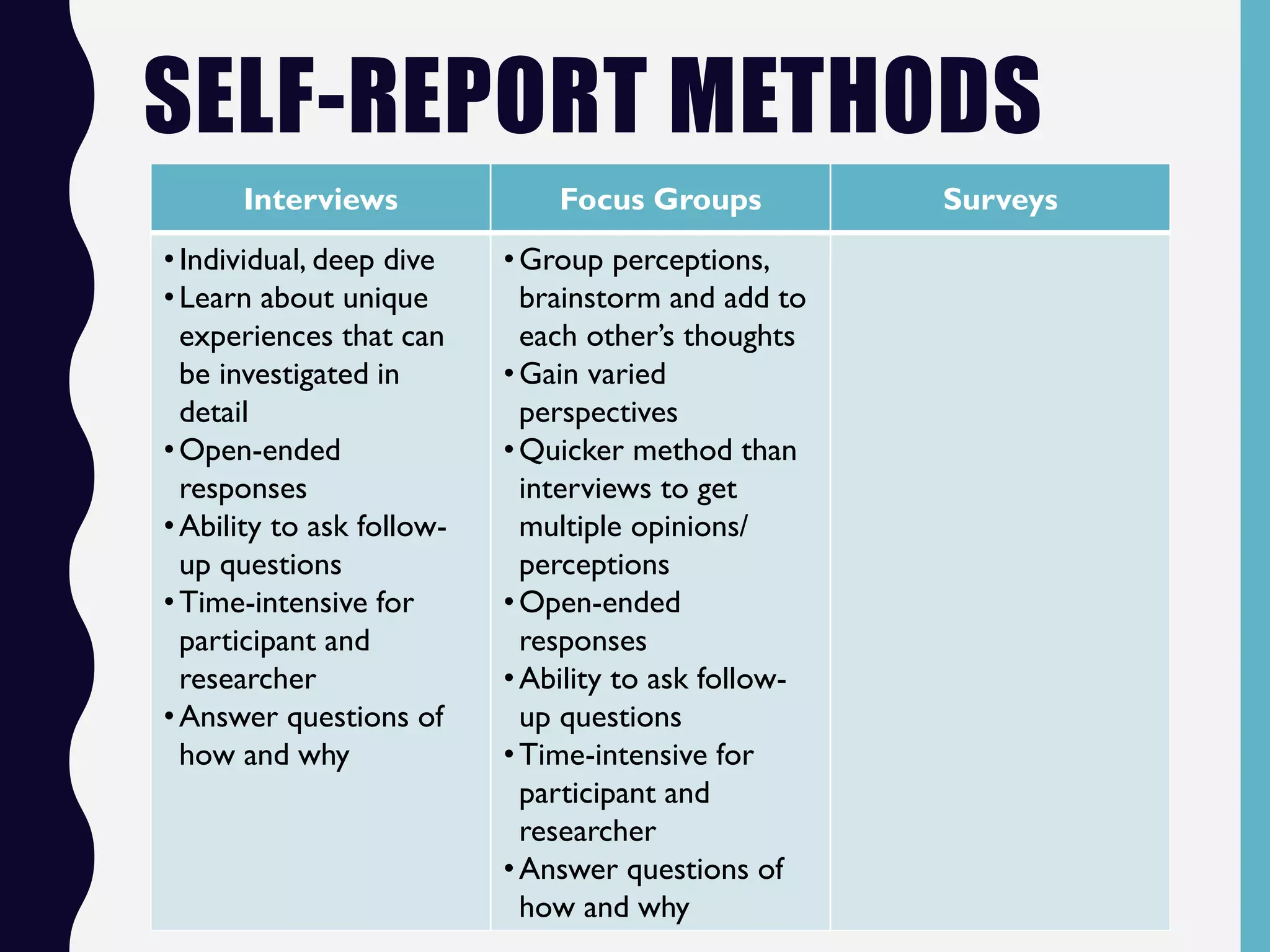
SELF-REPORT METHODS
Interviews Focus Groups Surveys
•Individual, deep dive
•Learn about unique
experiences that can
be investigated in
detail
•Open-ended
responses
•Ability to ask follow-
up questions
•Time-intensive for
participant and
researcher
•Answer questions of
how and why
•Group perceptions,
brainstorm and add to
each other’s thoughts
•Gain varied
perspectives
•Quicker method than
interviews to get
multiple opinions/
perceptions
•Open-ended
responses
•Ability to ask follow-
up questions
•Time-intensive for
participant and
researcher
•Answer questions of
how and why
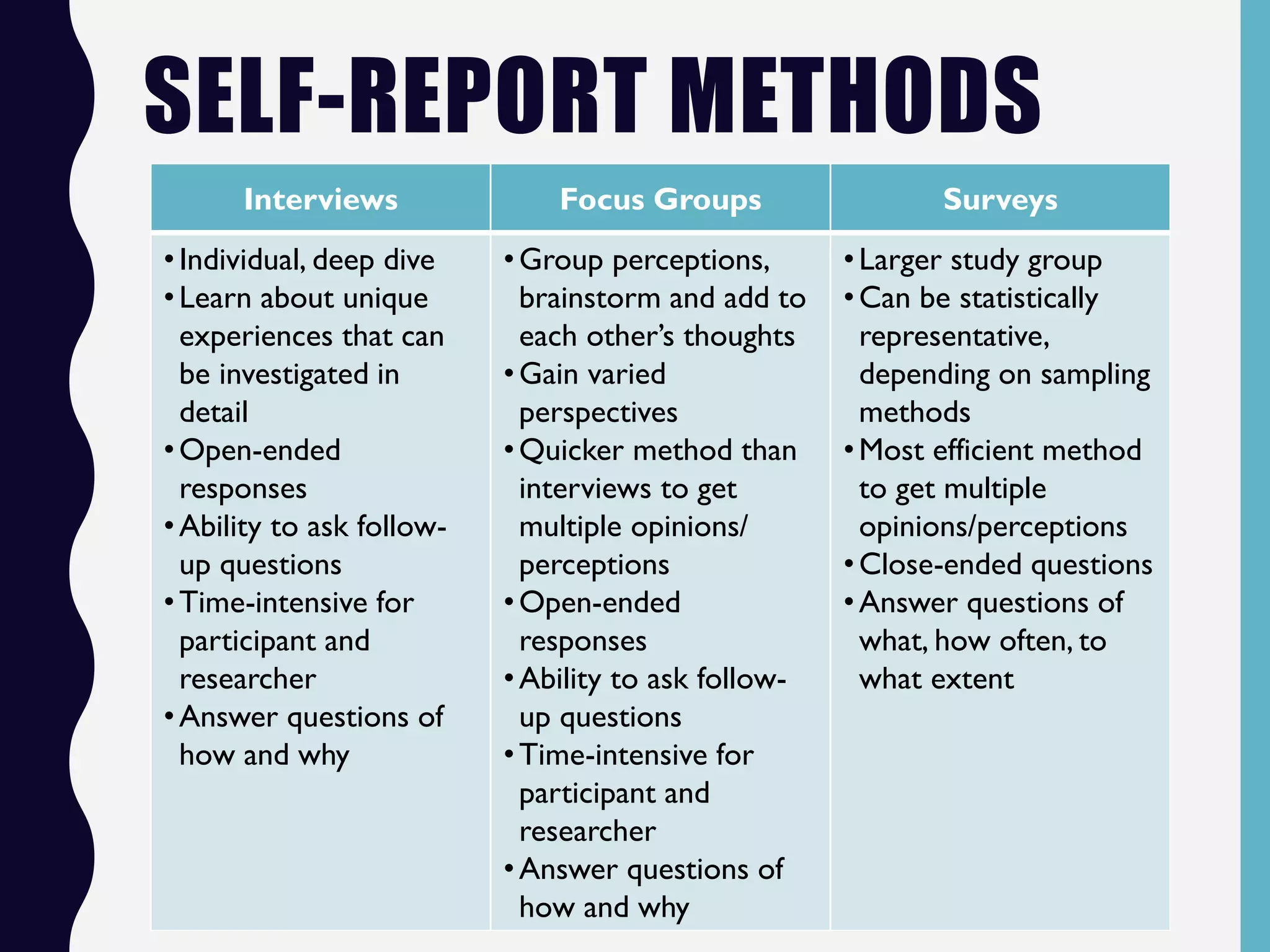
SELF-REPORT METHODS
Interviews Focus Groups Surveys
•Individual, deep dive
•Learn about unique
experiences that can
be investigated in
detail
•Open-ended
responses
•Ability to ask follow-
up questions
•Time-intensive for
participant and
researcher
•Answer questions of
how and why
•Group perceptions,
brainstorm and add to
each other’s thoughts
•Gain varied
perspectives
•Quicker method than
interviews to get
multiple opinions/
perceptions
•Open-ended
responses
•Ability to ask follow-
up questions
•Time-intensive for
participant and
researcher
•Answer questions of
how and why
•Larger study group
•Can be statistically
representative,
depending on sampling
methods
•Most efficient method
to get multiple
opinions/perceptions
•Close-ended questions
•Answer questions of
what, how often, to
what extent
GETTING
BEYOND THE
SELF-REPORT
C O N T E N T A N A LY S I S
O B S E RVAT I O N
D E M O N S T R AT I O N
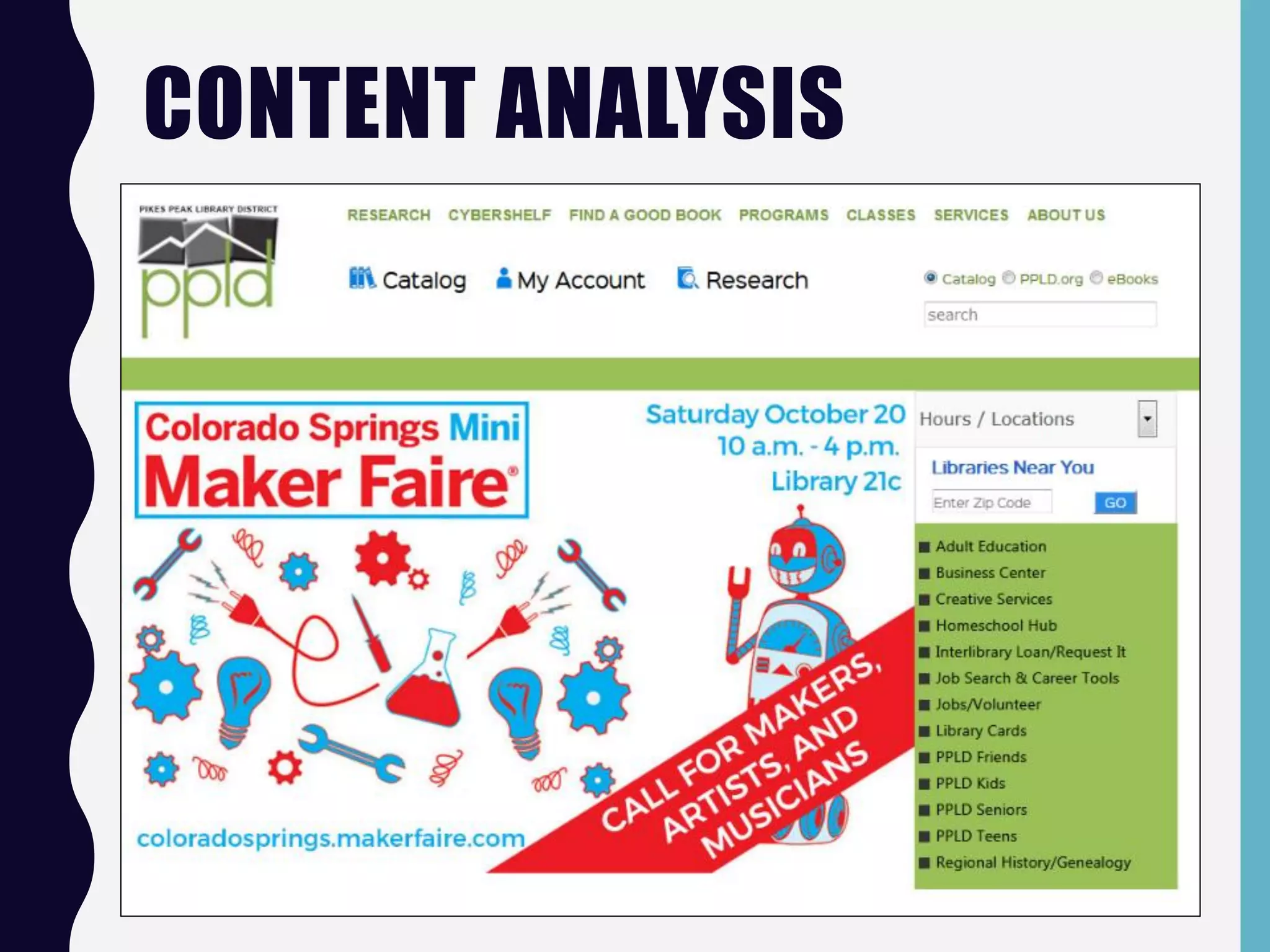
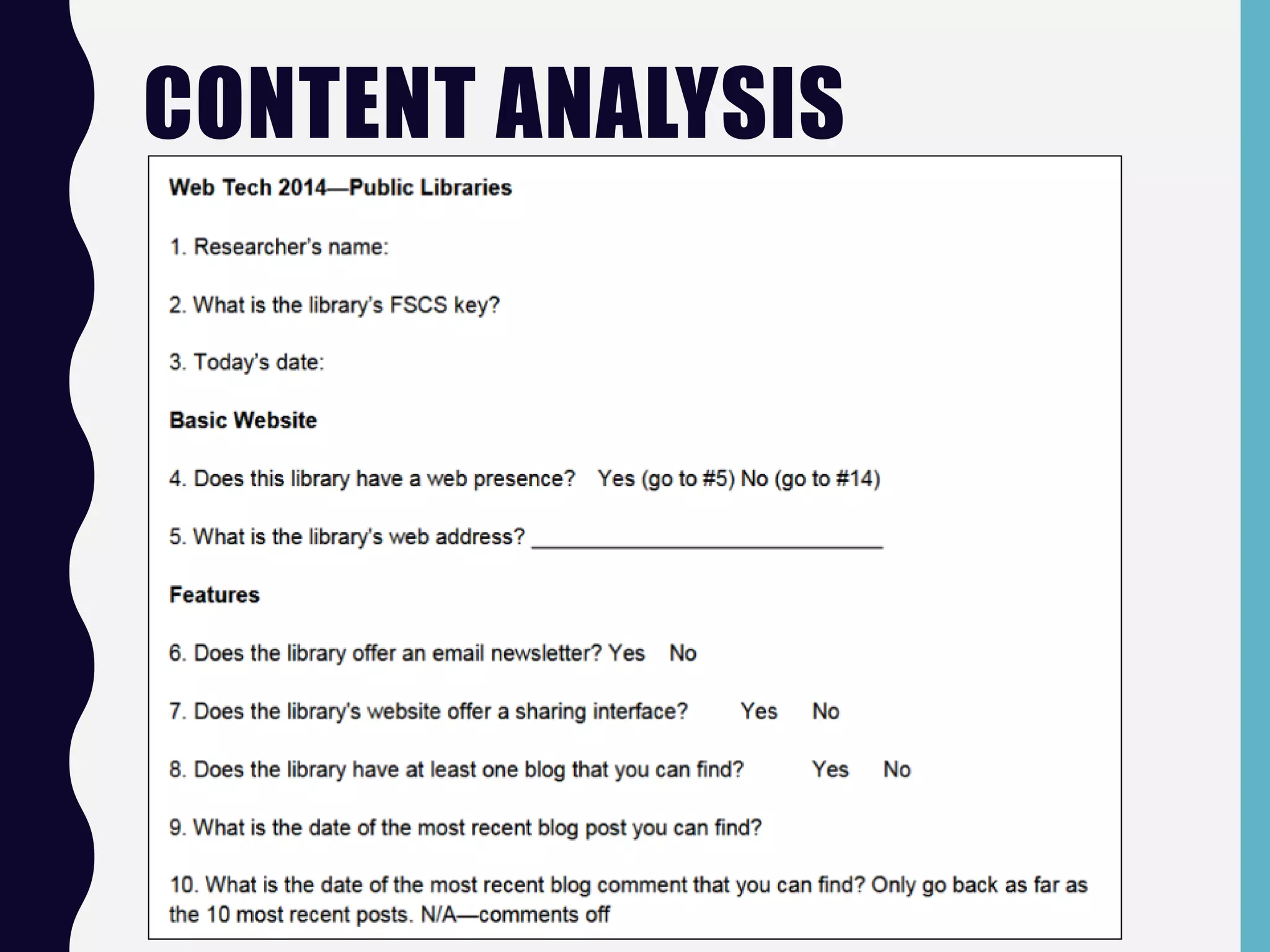
CONTENT ANALYSIS
CONTENT ANALYSIS
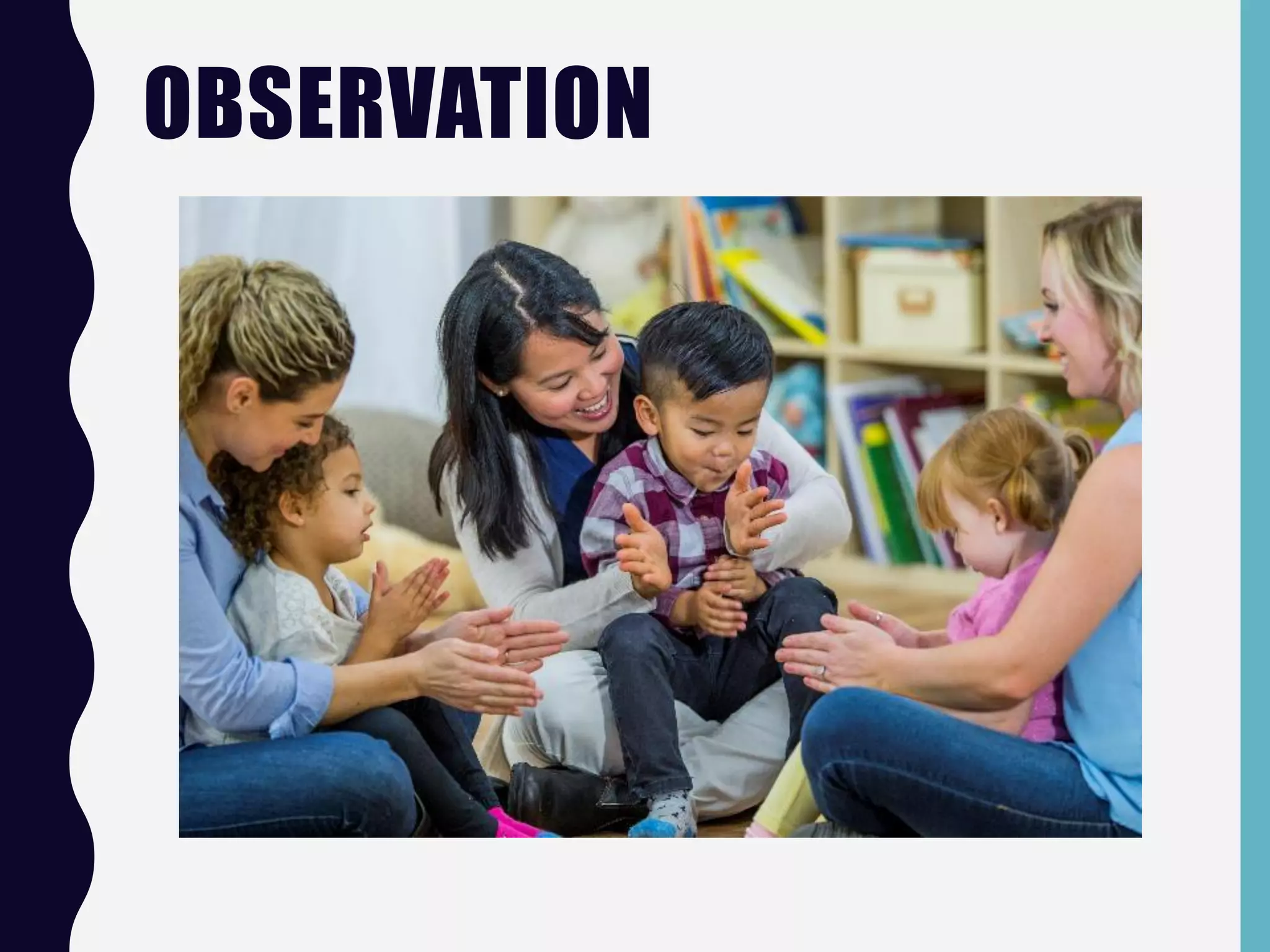
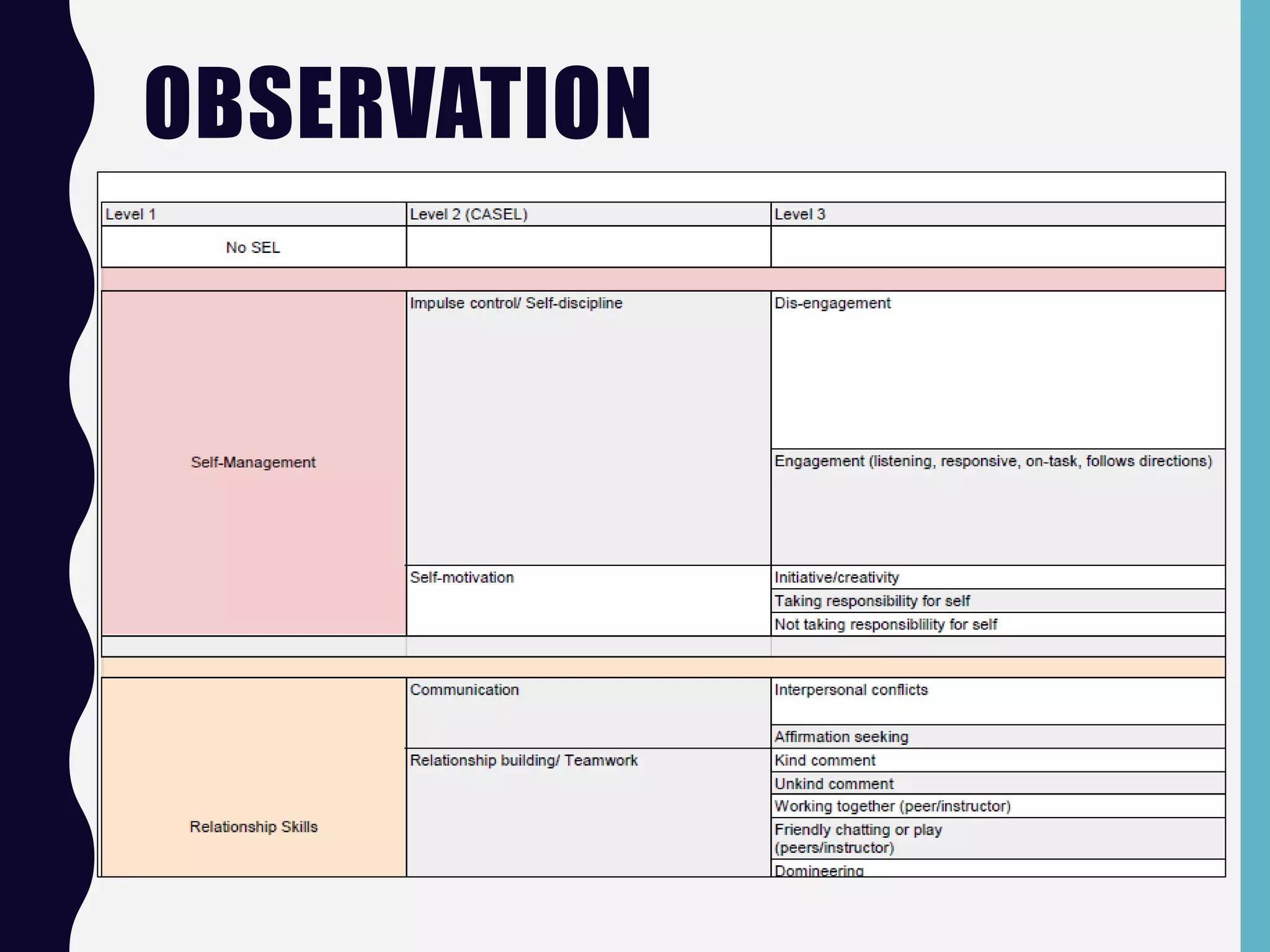
OBSERVATION
OBSERVATION
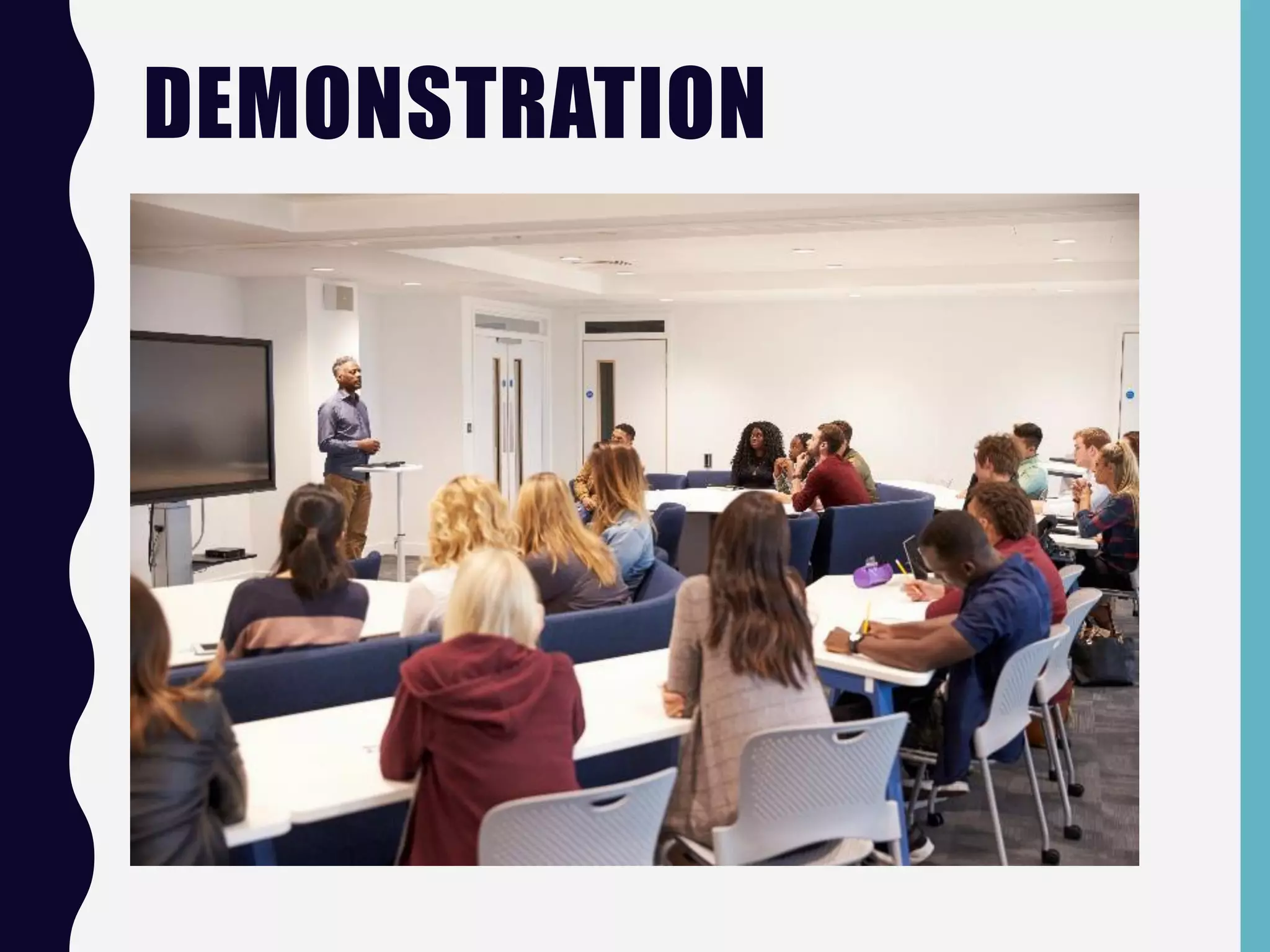
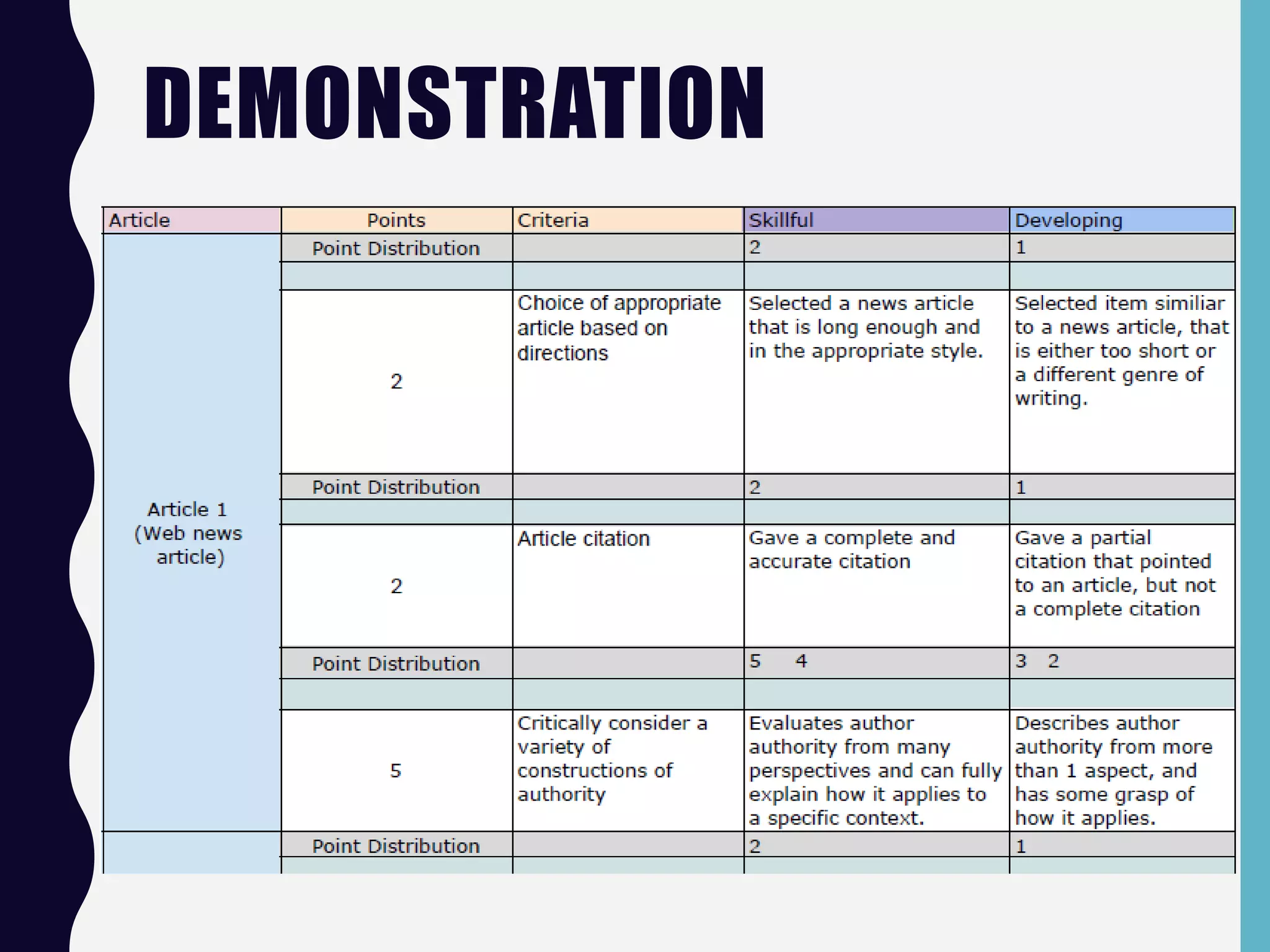
DEMONSTRATION
DEMONSTRATION
DEMONSTRATION
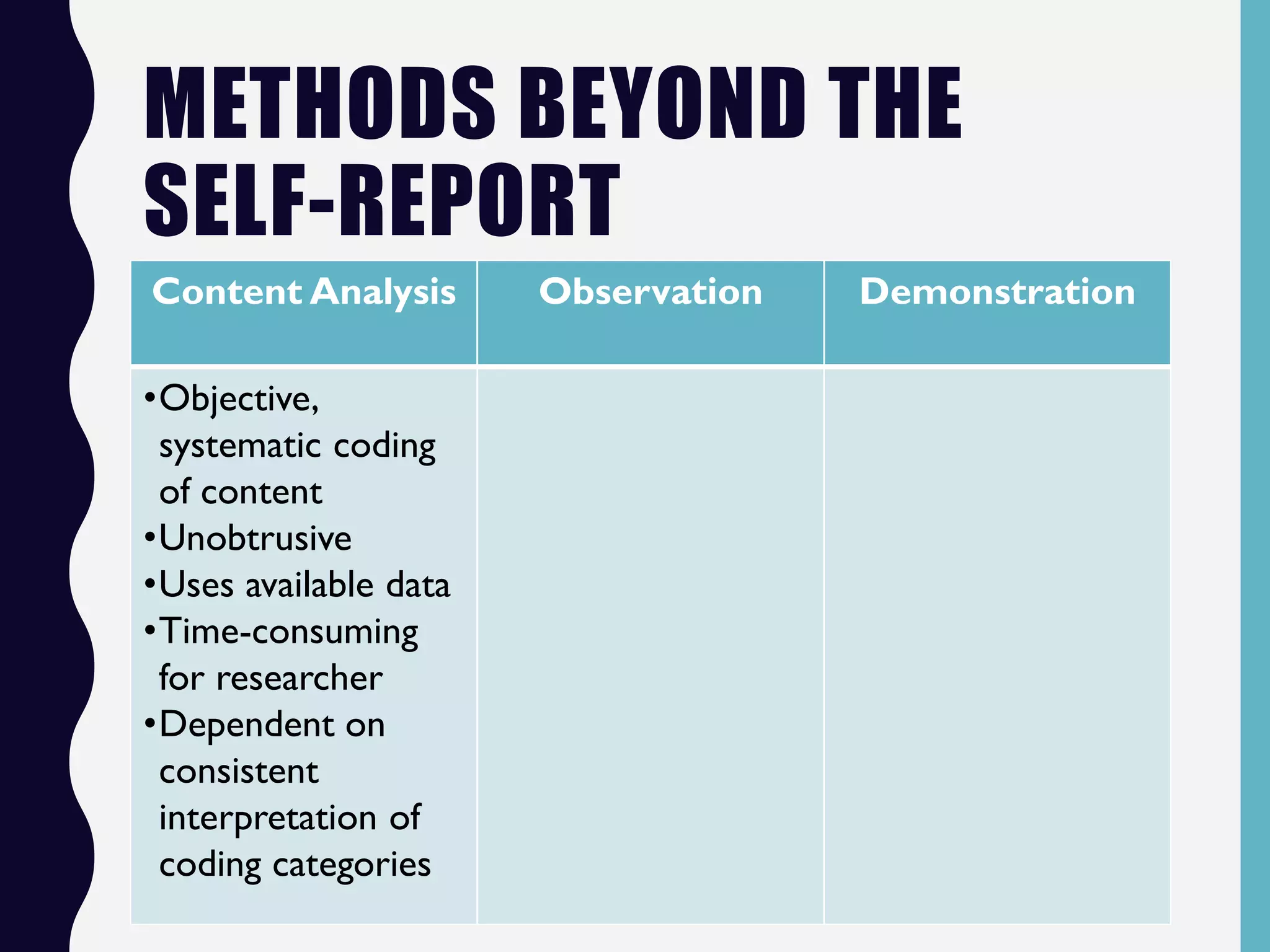
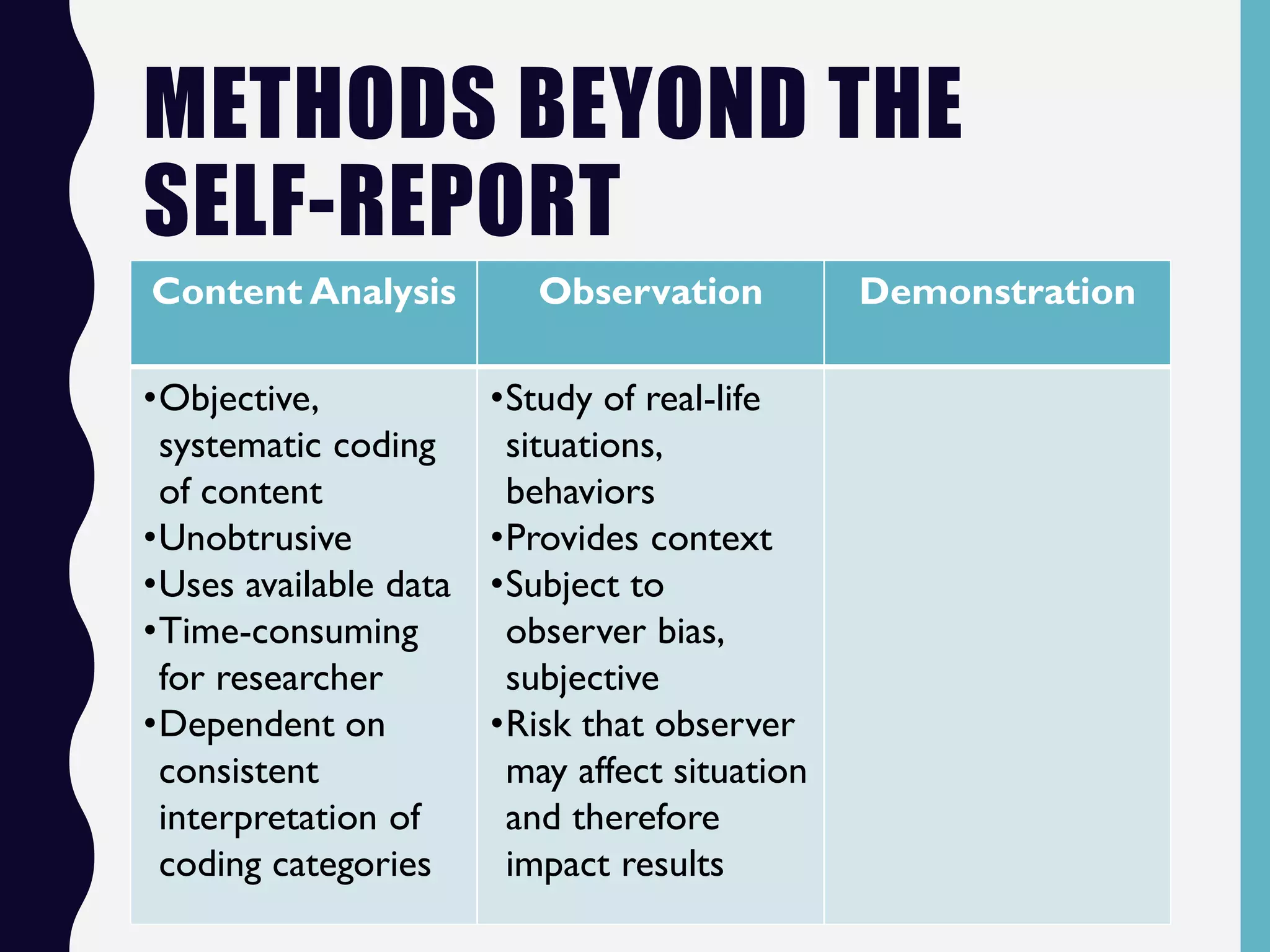
METHODS BEYOND THE
SELF-REPORT
Content Analysis Observation Demonstration
•Objective,
systematic coding
of content
•Unobtrusive
•Uses available data
•Time-consuming
for researcher
•Dependent on
consistent
interpretation of
coding categories
METHODS BEYOND THE
SELF-REPORT
Content Analysis Observation Demonstration
•Objective,
systematic coding
of content
•Unobtrusive
•Uses available data
•Time-consuming
for researcher
•Dependent on
consistent
interpretation of
coding categories
•Study of real-life
situations,
behaviors
•Provides context
•Subject to
observer bias,
subjective
•Risk that observer
may affect situation
and therefore
impact results
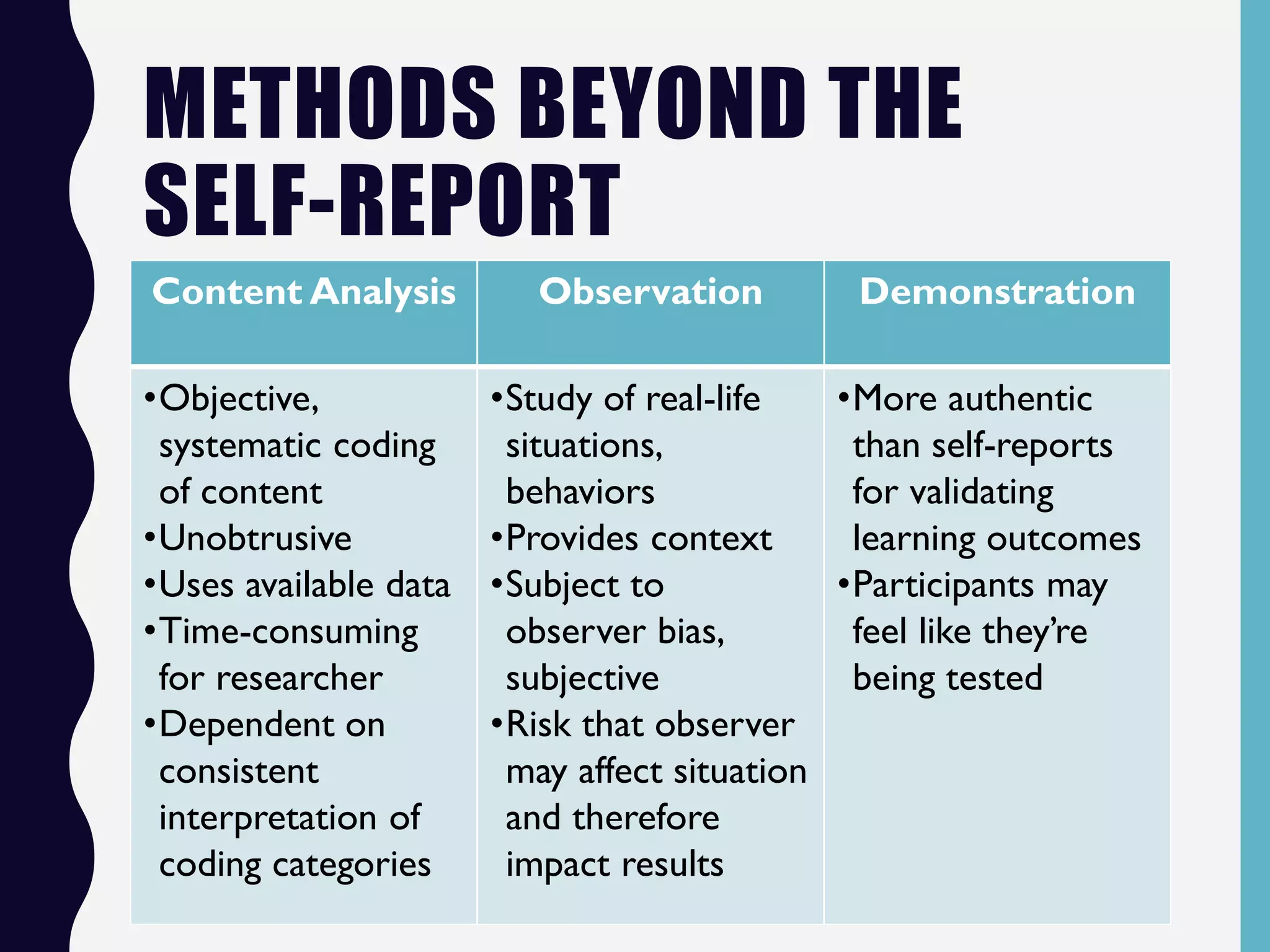
METHODS BEYOND THE
SELF-REPORT
Content Analysis Observation Demonstration
•Objective,
systematic coding
of content
•Unobtrusive
•Uses available data
•Time-consuming
for researcher
•Dependent on
consistent
interpretation of
coding categories
•Study of real-life
situations,
behaviors
•Provides context
•Subject to
observer bias,
subjective
•Risk that observer
may affect situation
and therefore
impact results
•More authentic
than self-reports
for validating
learning outcomes
•Participants may
feel like they’re
being tested
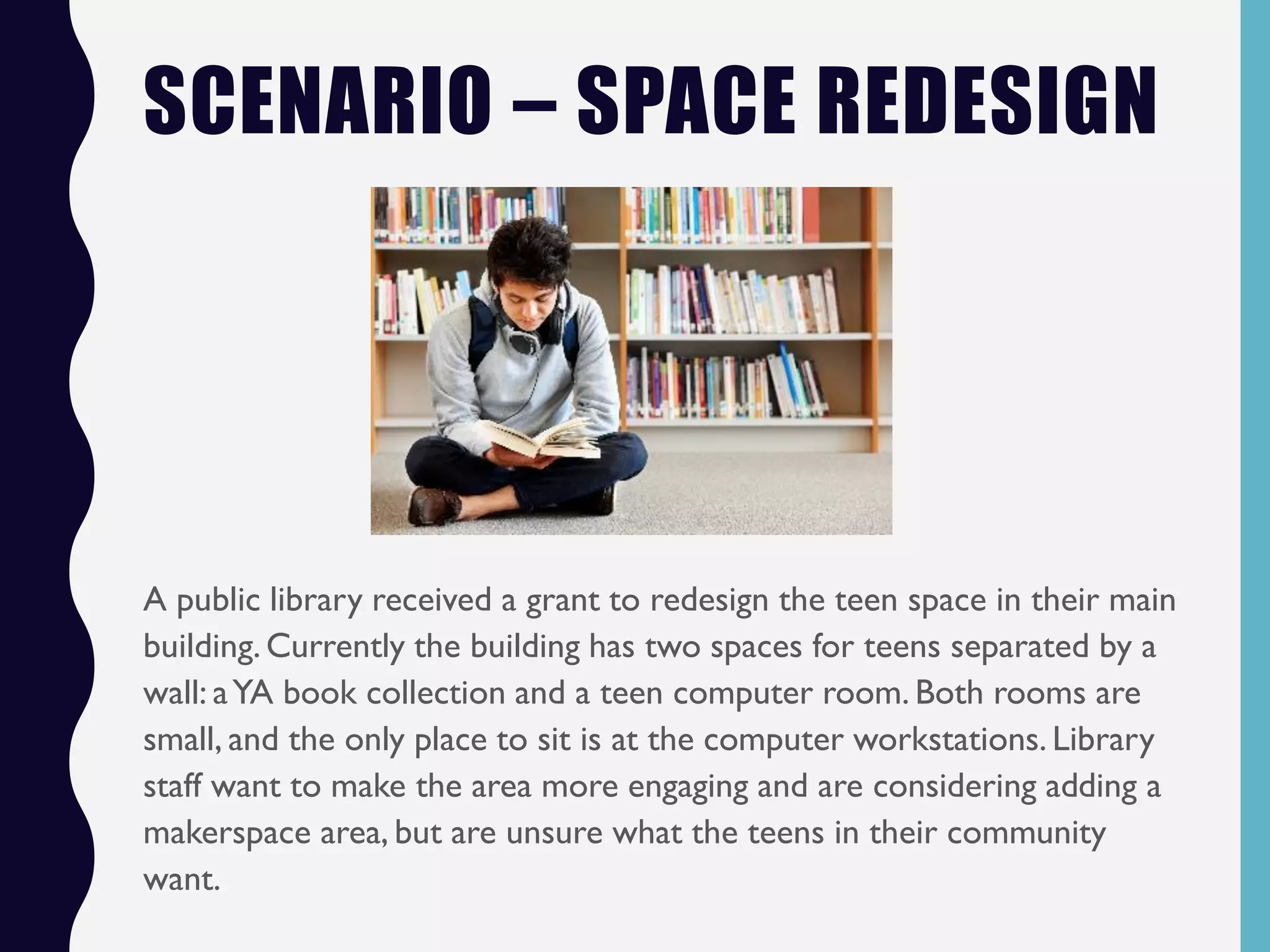
SCENARIO – SPACE REDESIGN
A public library received a grant to redesign the teen space in their main
building.Currently the building has two spaces for teens separated by a
wall: aYA book collection and a teen computer room. Both rooms are
small, and the only place to sit is at the computer workstations. Library
staff want to make the area more engaging and are considering adding a
makerspace area, but are unsure what the teens in their community
want.
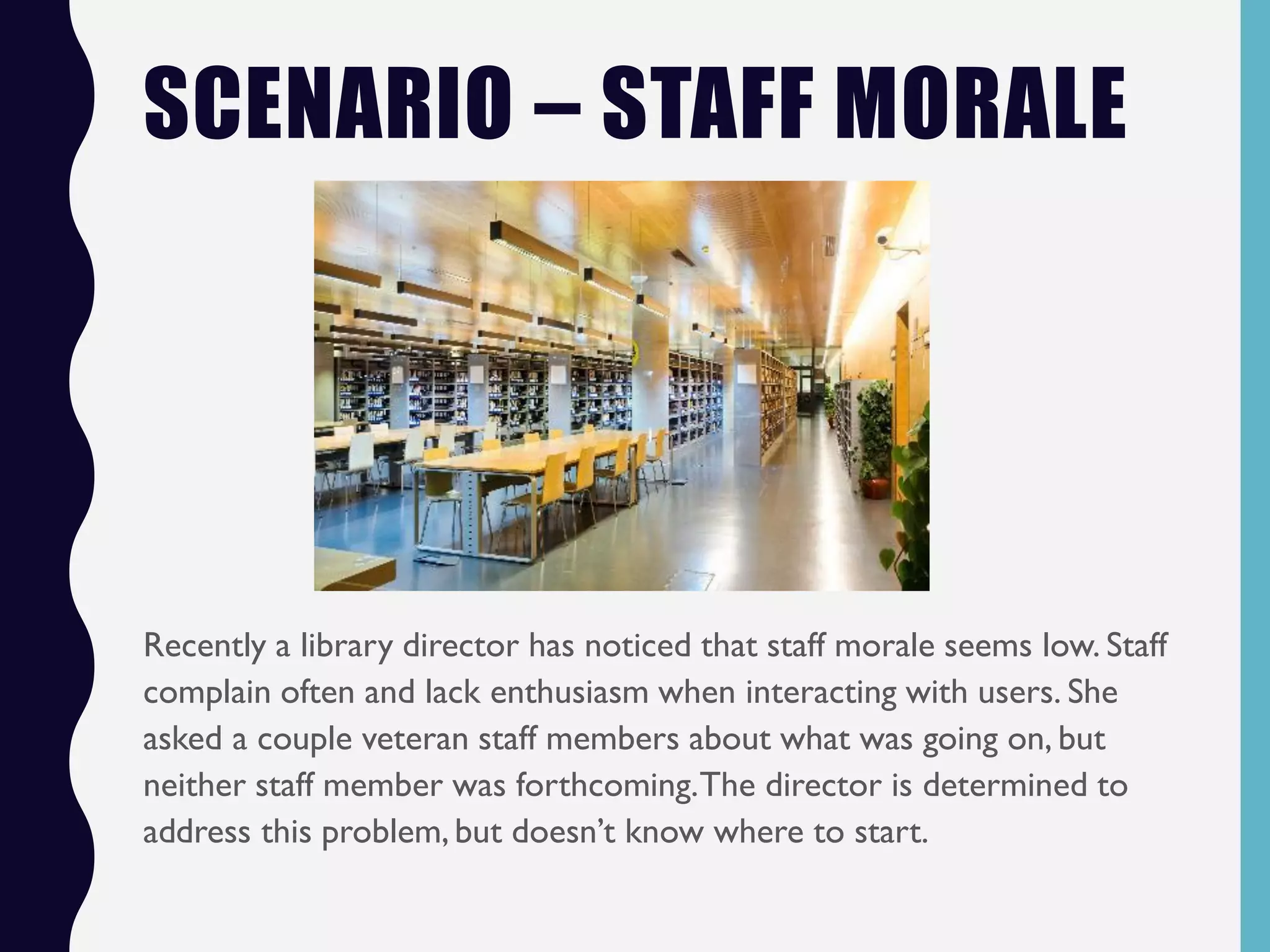
SCENARIO – STAFF MORALE
Recently a library director has noticed that staff morale seems low. Staff
complain often and lack enthusiasm when interacting with users. She
asked a couple veteran staff members about what was going on, but
neither staff member was forthcoming.The director is determined to
address this problem, but doesn’t know where to start.
DATA ANALYSIS
WHAT METHOD DO I USE?
Qualitative Quantitative
Purpose Help us understand
how and why.
Help us understand
what, how many, to
what extent.
Sample Smaller, purposive Larger, can be
purposive or random
Type of data collected Words, images, objects Numbers
How data are analyzed Themes, patterns Statistics
Results Descriptive. Not
generalizable.
Numeric. Can be
generalized to a
population depending
on sampling.
DATA ANALYSIS – 3 TIPS
1. Your data analysis plan should
guide the design of your data
collection instrument.
DATA ANALYSIS – 3 TIPS
2. Clean your data
– Check accuracy of data
entry/transcription
– Examine data for outliers,
consistency with trends
DATA ANALYSIS – 3 TIPS
3. Documentation is critical.
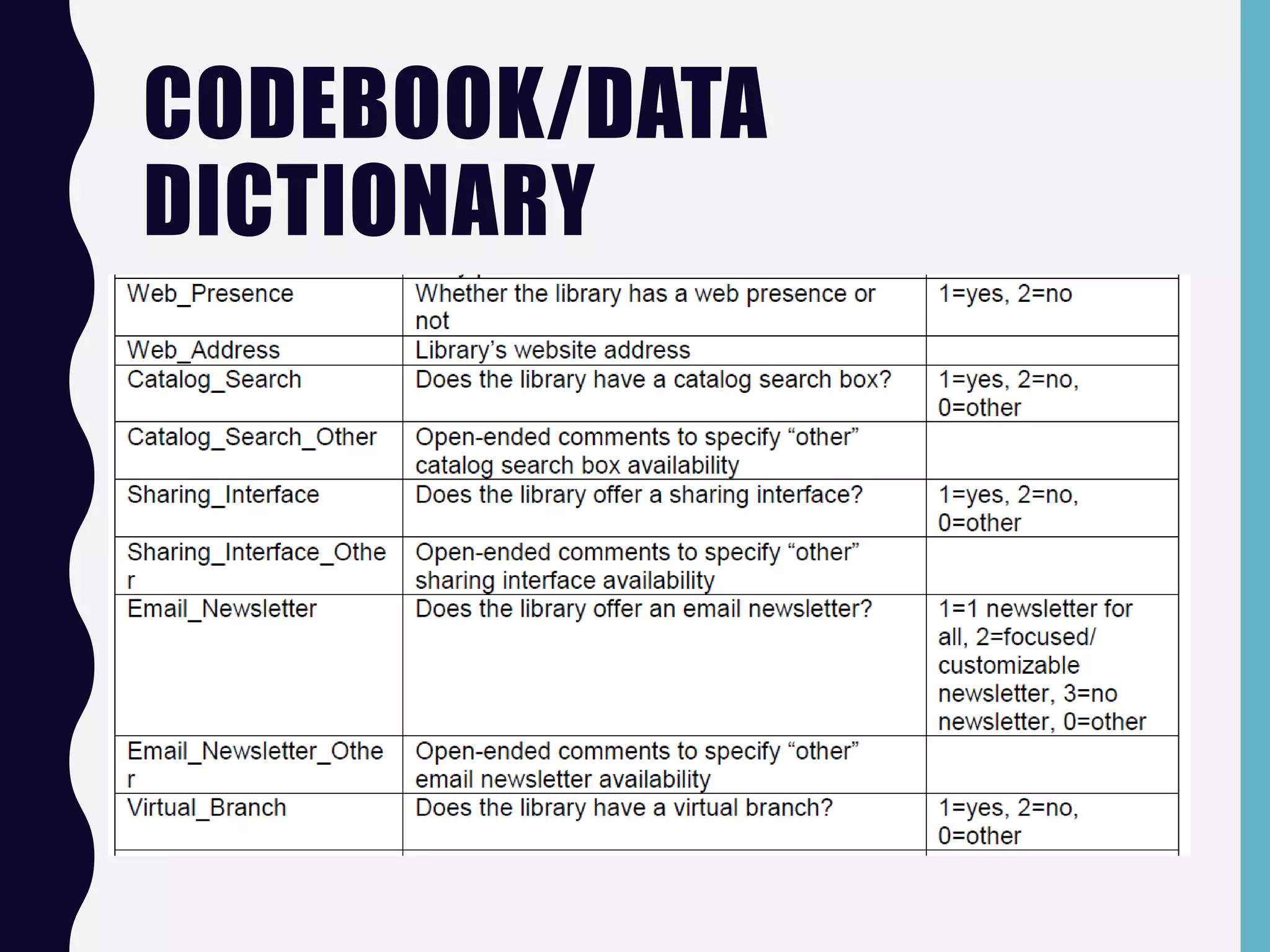
CODEBOOK/DATA
DICTIONARY
QUANTITATIVE DATA
ANALYSIS
•Frequencies
•Descriptives
•Crosstabs
QUANTITATIVE DATA
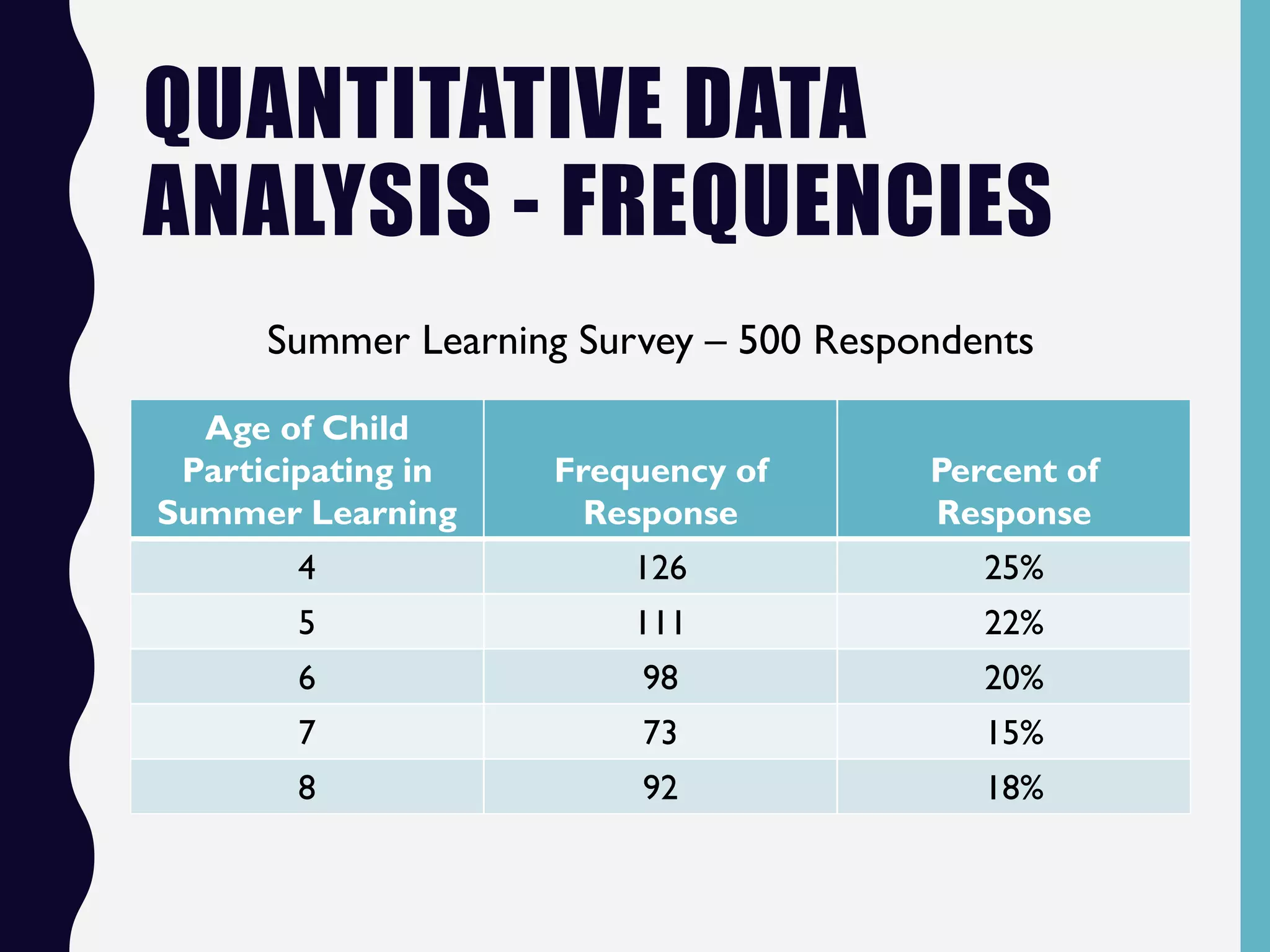
ANALYSIS - FREQUENCIES
Age of Child
Participating in
Summer Learning
Frequency of
Response
Percent of
Response
4 126 25%
5 111 22%
6 98 20%
7 73 15%
8 92 18%
Summer Learning Survey – 500 Respondents
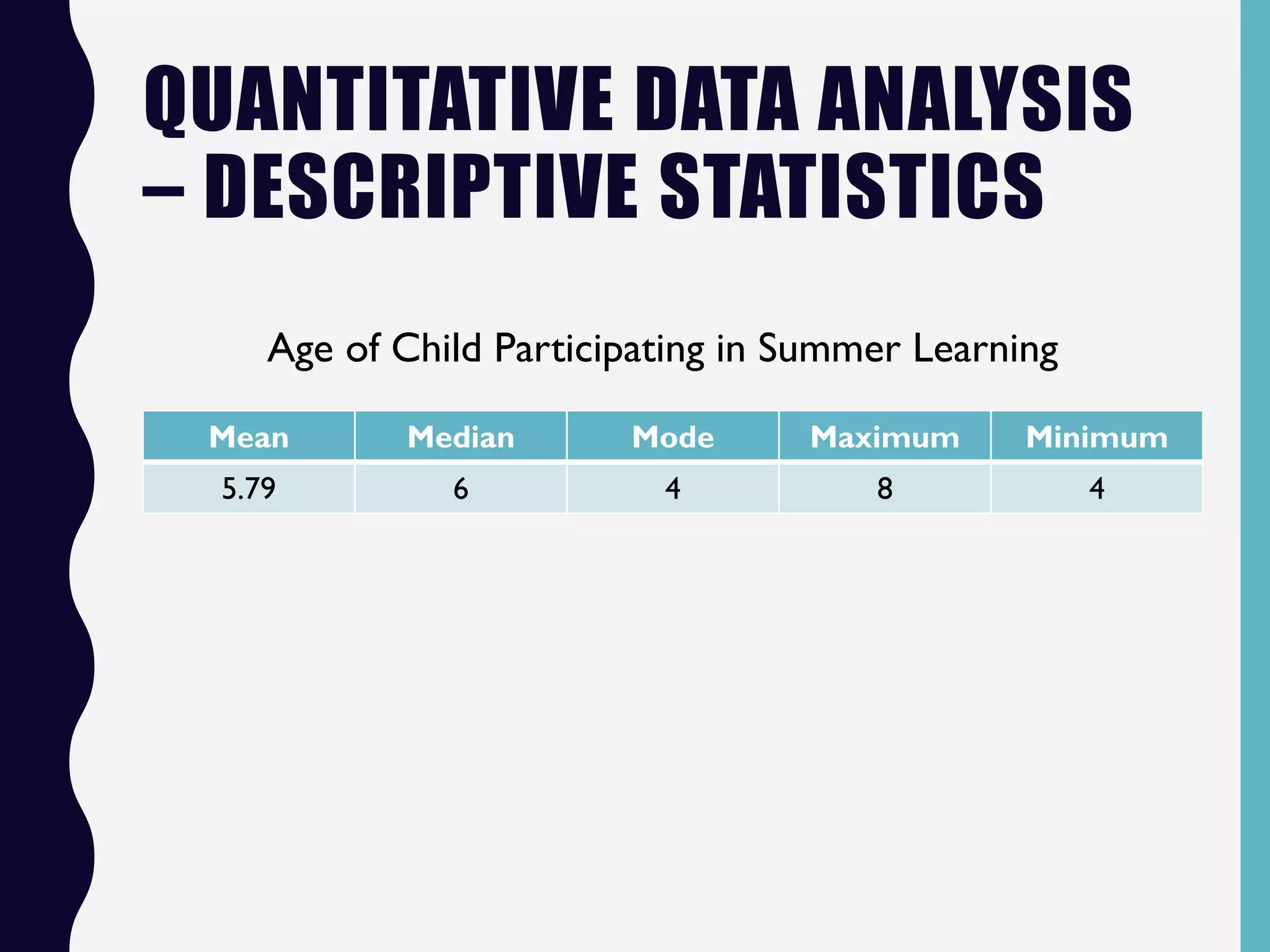
QUANTITATIVE DATA ANALYSIS
– DESCRIPTIVE STATISTICS
Age of Child Participating in Summer Learning
Mean Median Mode Maximum Minimum
5.79 6 4 8 4
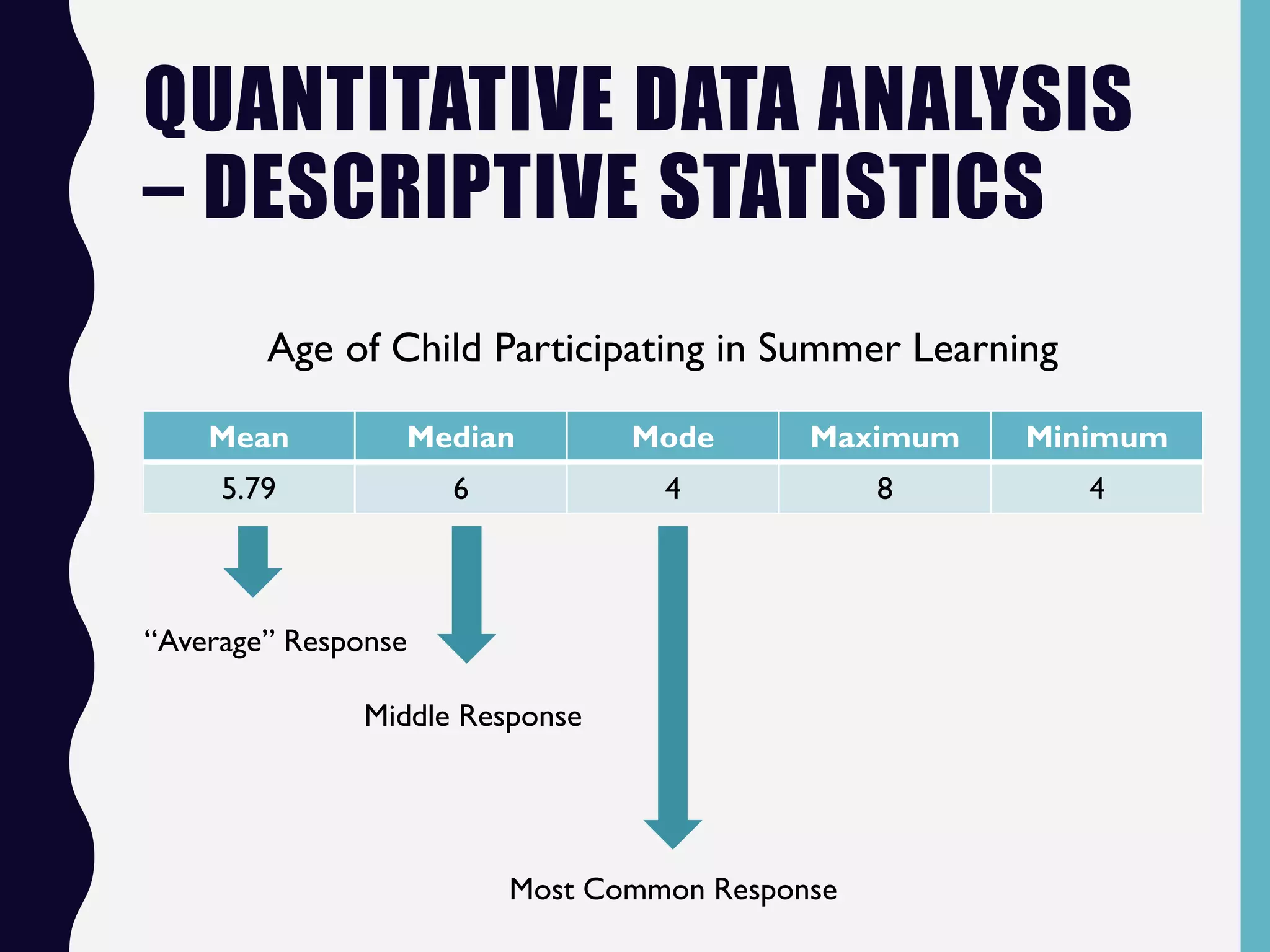
QUANTITATIVE DATA ANALYSIS
– DESCRIPTIVE STATISTICS
Age of Child Participating in Summer Learning
Mean Median Mode Maximum Minimum
5.79 6 4 8 4
Middle Response
Most Common Response
“Average” Response
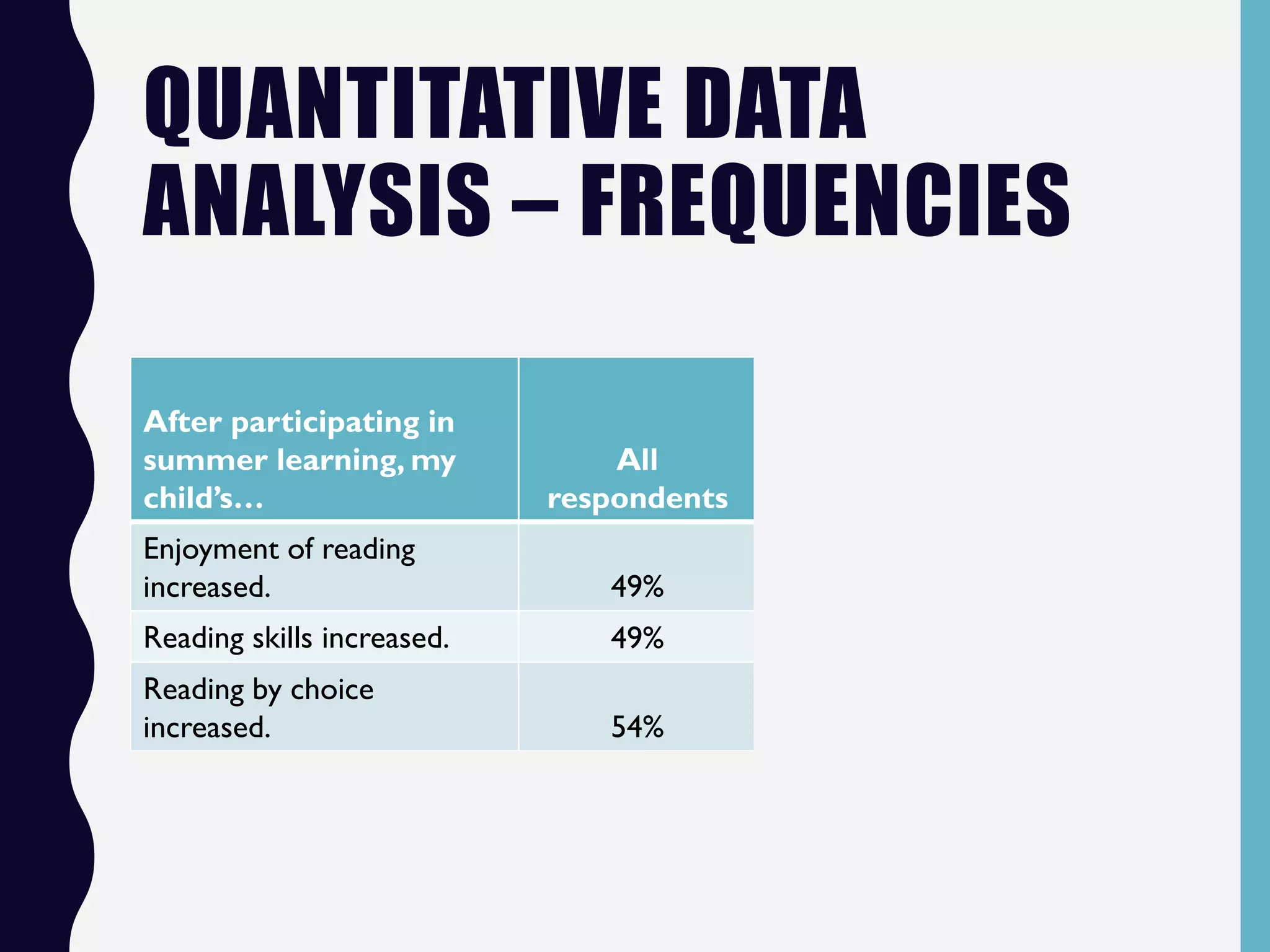
QUANTITATIVE DATA
ANALYSIS – FREQUENCIES
After participating in
summer learning, my
child’s…
All
respondents
Families
participating
in SL for the
first time
Families
with
children
ages 4-6
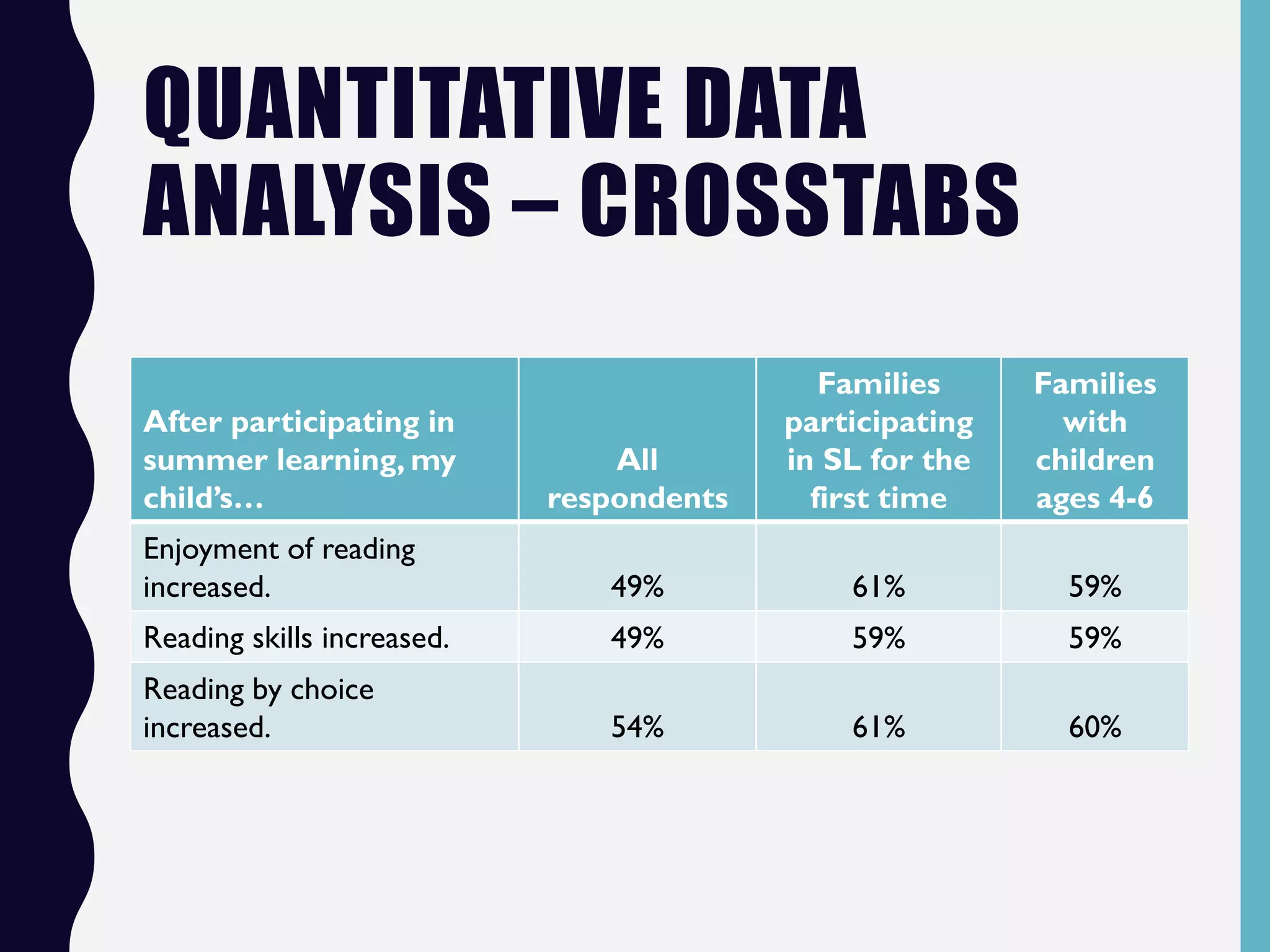
Enjoyment of reading
increased. 49% 61% 59%
Reading skills increased. 49% 59% 59%
Reading by choice
increased. 54% 61% 60%
QUANTITATIVE DATA
ANALYSIS – CROSSTABS
After participating in
summer learning, my
child’s…
All
respondents
Families
participating
in SL for the
first time
Families
with
children
ages 4-6
Enjoyment of reading
increased. 49% 61% 59%
Reading skills increased. 49% 59% 59%
Reading by choice
increased. 54% 61% 60%
QUALITATIVE DATA
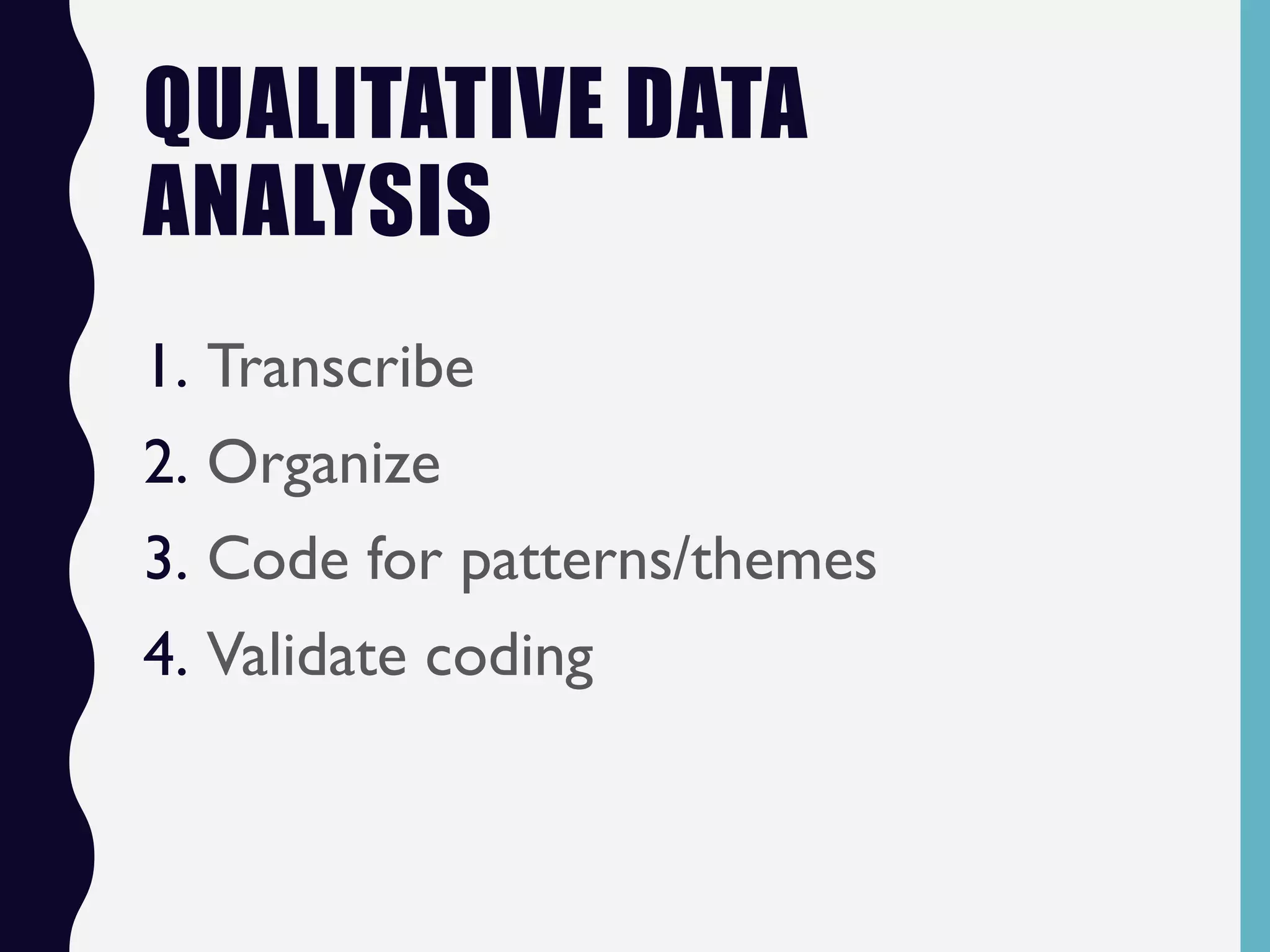
ANALYSIS
1. Transcribe
2. Organize
3. Code for patterns/themes
4. Validate coding
QUALITATIVE DATA
ANALYSIS - EXAMPLE
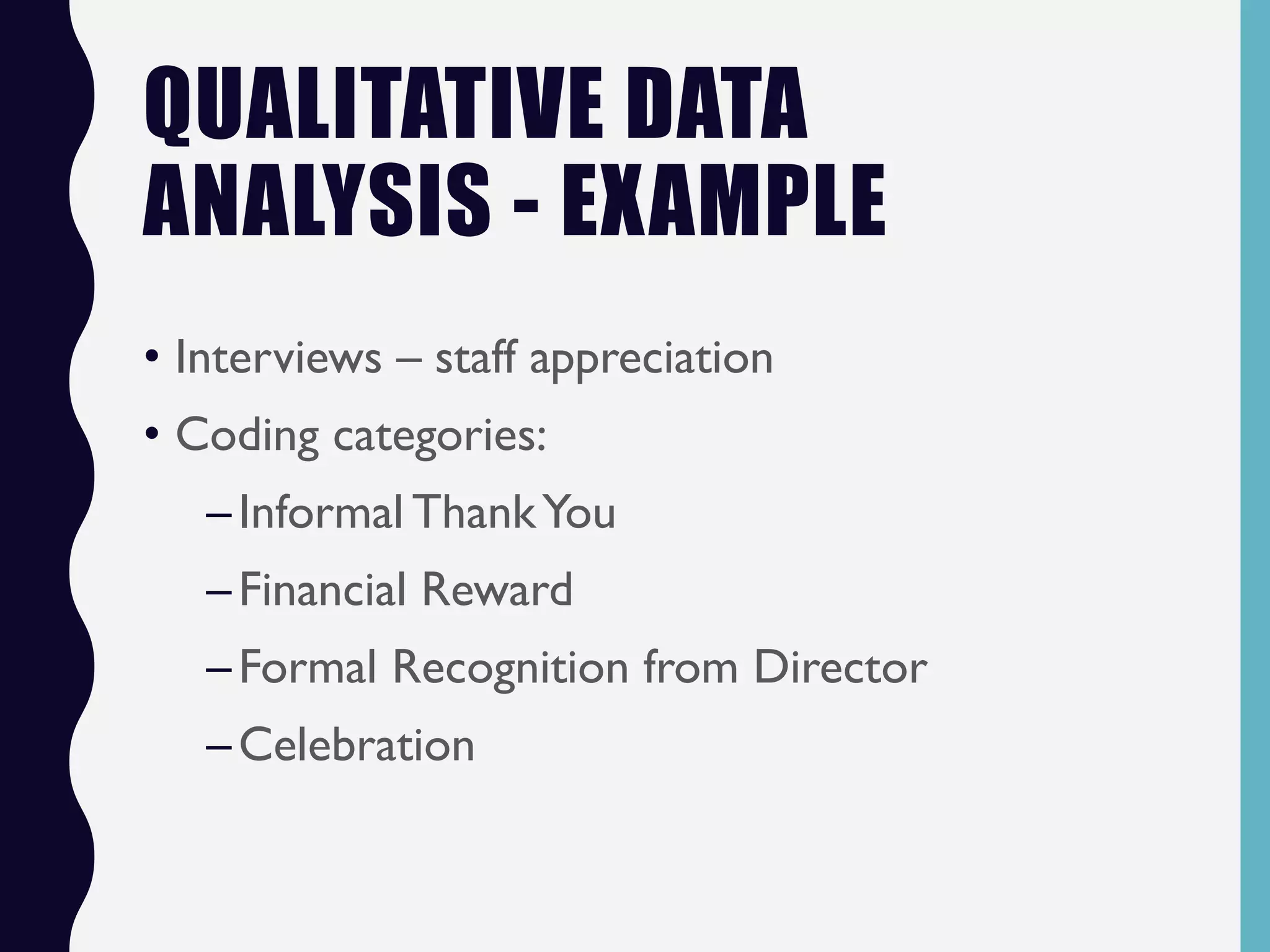
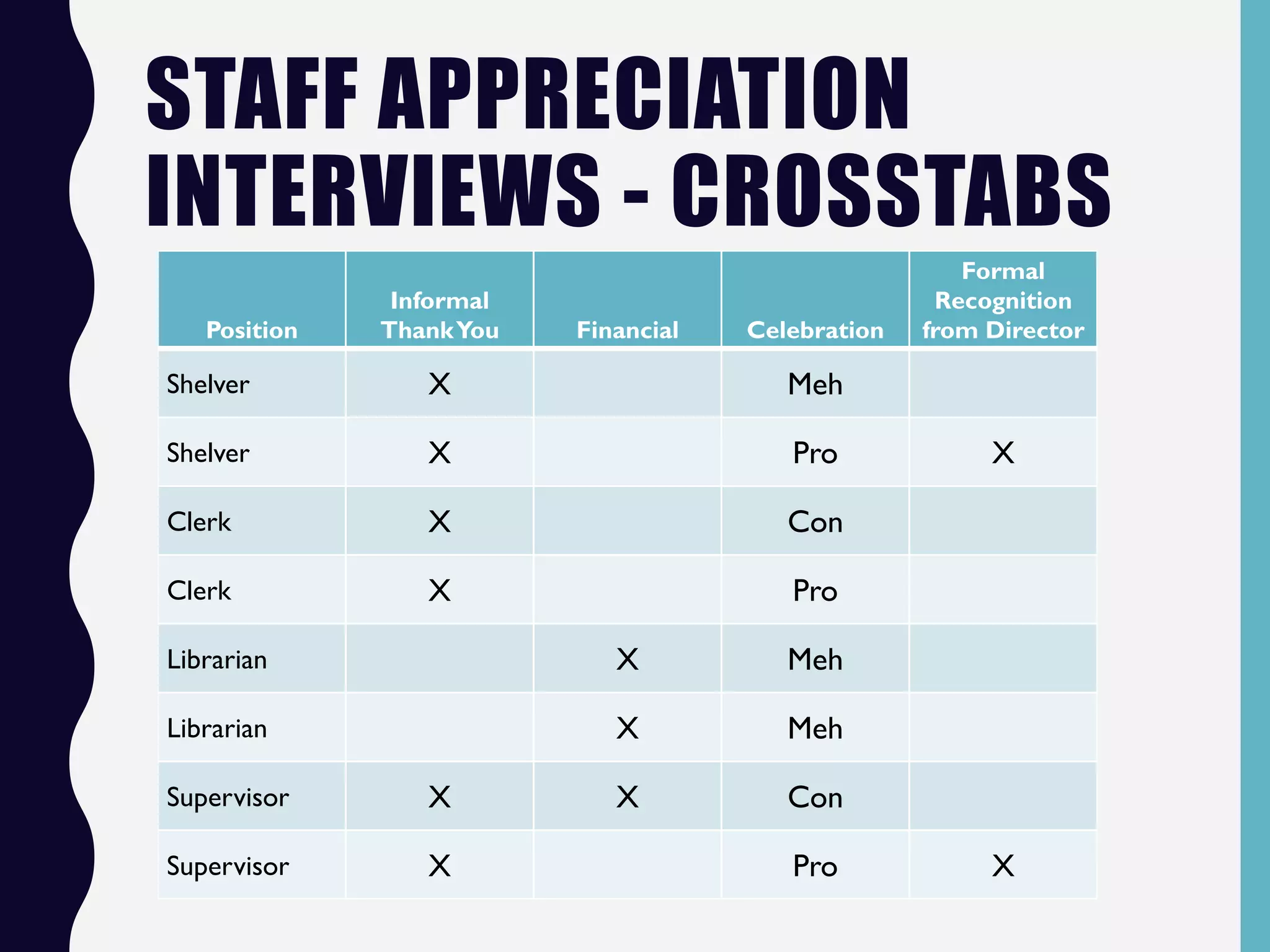
• Interviews – staff appreciation
• Coding categories:
–Informal ThankYou
–Financial Reward
–Formal Recognition from Director
–Celebration
STAFF APPRECIATION
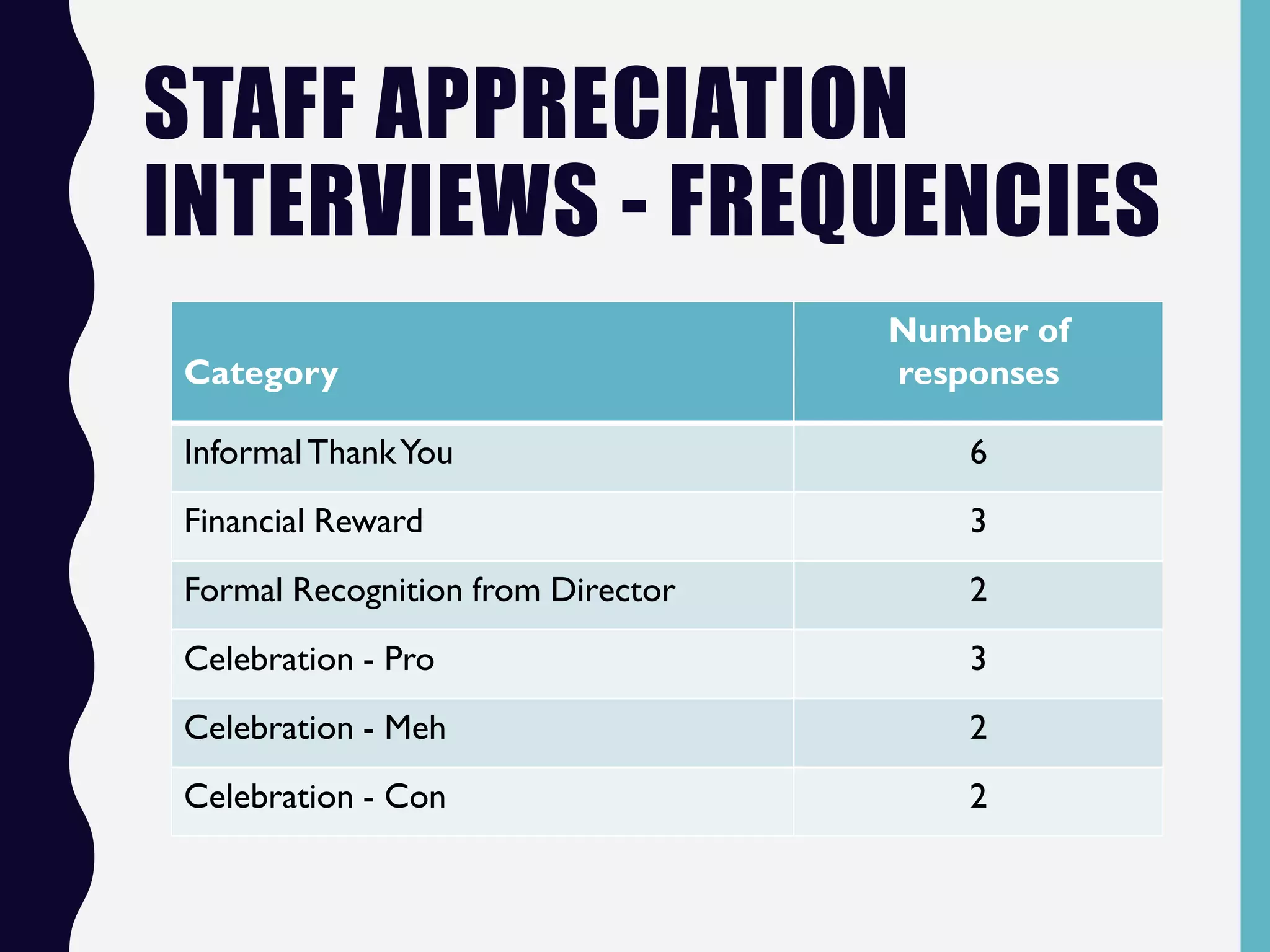
INTERVIEWS - FREQUENCIES
Category
Number of
responses
InformalThankYou 6
Financial Reward 3
Formal Recognition from Director 2
Celebration - Pro 3
Celebration - Meh 2
Celebration - Con 2
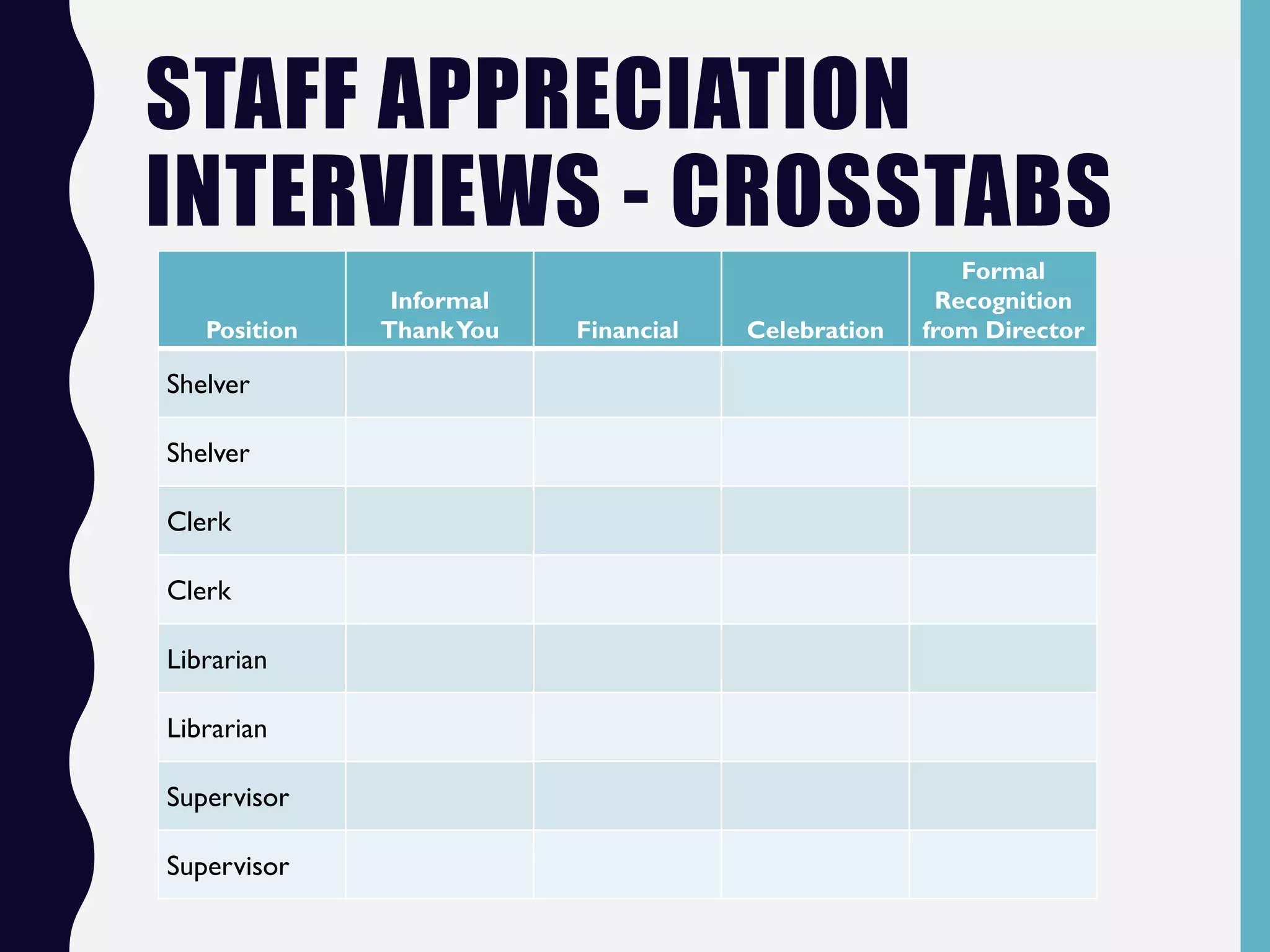
STAFF APPRECIATION
INTERVIEWS - CROSSTABS
Position
Informal
ThankYou Financial Celebration
Formal
Recognition
from Director
Shelver
Shelver
Clerk
Clerk
Librarian
Librarian
Supervisor
Supervisor
Position
Informal
ThankYou Financial Celebration
Formal
Recognition
from Director
Shelver X Meh
Shelver X Pro X
Clerk X Con
Clerk X Pro
Librarian X Meh
Librarian X Meh
Supervisor X X Con
Supervisor X Pro X
STAFF APPRECIATION
INTERVIEWS - CROSSTABS
#libdata4impact
References
Connaway, L. S., & Radford, M. L. (2016).
Research methods in library and information
science (6th ed.). Santa Barbara: Libraries
Unlimited.
Nitecki, D. (2017). Assessment evaluations. In L.
S. Connaway & M. Radford, Research methods
in library and information science (6th ed.).
Santa Barbara: Libraries Unlimited.
Questions and
Discussion
Linda Hofschire
Director, Library Research Service,
Colorado State Library
Hofschire_L@cde.state.co.us
Thank you!
Lynn Silipigni Connaway
Director, Library Trends and User Research
OCLC Research
connawal@oclc.org
@LynnConnaway
#libdata4impact
#libdata4impact
Webinar Series: Evaluating and
Sharing Your Library’s Impact
Part 1:
April 24
Kara Reuter
User-centered
Assessment:
Leveraging What
You Know and
Filling in the Gaps
Part 2:
August 14
Linda
Hofschire
Digging into
Assessment Data:
Tips, Tricks, and
Tools of the Trade
Part 3:
October 3
Melissa
Bowles-Terry
Take Action: Using
and Presenting
Research Findings
to Make Your Case
For more information: https://www.webjunction.org/news/
webjunction/webinar-series-research-assessment.html
Series Learner Guide
Use alone or with others to
apply what you’re learning
between sessions. 13 pages
of questions, activities, and
resources. Customizable to
meet your team’s needs!

Digging into assessment data: Tips, tricks, and tools of the trade.

  • 1.
    #libdata4impact Webinar Series: Evaluatingand Sharing Your Library’s Impact Part 1: April 24 Kara Reuter User-centered Assessment: Leveraging What You Know and Filling in the Gaps Part 2: August 14 Linda Hofschire Digging into Assessment Data: Tips, Tricks, and Tools of the Trade Part 3: October 3 Melissa Bowles-Terry Take Action: Using and Presenting Research Findings to Make Your Case For more information: https://www.webjunction.org/news/ webjunction/webinar-series-research-assessment.html
  • 2.
    Series Learner Guide Usealone or with others to apply what you’re learning between sessions. 13 pages of questions, activities, and resources. Customizable to meet your team’s needs!
  • 3.
    • Research devotedexclusively to the challenges facing libraries and archives • Research Library Partnership includes working groups to collaborate with institutions on research and issues • Lifelong learning from WebJunction, for all library staff and volunteers • All connected through a global network of 16,000+ member libraries • Global and Regional Councils bring worldwide viewpoints together, informing and guiding the cooperative from their unique perspective.
  • 4.
  • 5.
    #libdata4impact Research Library Partnership: LibraryAssessment Interest Group • The OCLC Research Library Partnership invited librarians at partner institutions to participate in a new Library Assessment Interest Group. • This interest group is learning together as a part of the Webinar Series: Evaluating and Sharing Your Library's Impact
  • 6.
    #libdata4impact National Gallery ofArt - Library • Working through Learner Guide, collaborating on a brainstorming document • Considering all players: users, potential users, community, institution stakeholders • Exploring: hypotheses, potential outcomes, and ways to measure • Research Questions: – Do we still need the reference desk at the NGA? – Why do several NGA departments meet their information needs internally instead of using the library? – Does the library catalog work for our users? How is it used effectively and how is it underused, used ineffectively, or used incorrectly? https://www.nga.gov/research/library.html
  • 7.
    Lynn Silipigni Connaway Director,Library Trends and User Research OCLC Research connawal@oclc.org @LynnConnaway
  • 8.
  • 9.
    #libdata4impact Principles for Assessment •Center on users • Assess changes in programming/resource engagement and other initiatives • Build on what your library already has done and what you already know Image: https://www.flickr.com/photos/113026679@N03/14720199210 by David Mulder / CC BY-SA 2.0 • Use variety of methods to corroborate conclusions • Choose small number of outcomes • Do NOT try to address every aspect of library offerings • Adopt continuous process and make it a part of your daily activities
  • 10.
    #libdata4impact Steps in AssessmentProcess Image: https://www.flickr.com/photos/113026679@N03/14720199210 by David Mulder / CC BY-SA 2.0 1. Why? • Identify purpose 2. Who? • Identify team 3. How? • Choose model/approach/method 4. Commit! • Training/planning
  • 11.
    #libdata4impact Developing the Question/s Image:https://www.flickr.com/photos/113026679@N03/14720199210 by David Mulder / CC BY-SA 2.0 The problem to be resolved by this study is whether the frequency of library use of first-year undergraduate students given course-integrated information literacy instruction is different from the frequency of library use of first-year undergraduate students not given course- integrated information literacy instruction. (Connaway & Radford, 2017, p. 36) Image: https://www.flickr.com/photos/68532869@N08/17470913285/ by Japanexperterna.se / CC BY-SA 2.0 Problem statement
  • 12.
    #libdata4impact Developing the Question/s Subproblems •What is the frequency of library use of the first-year undergraduate students who did receive course- integrated information literacy instruction? • What is the frequency of library use of the first-year undergraduate students who did not receive course-integrated information literacy instruction? • What is the difference in the frequency of library use between the two groups of undergraduate students? (Connaway & Radford, 2017, p. 36) Image: https://www.flickr.com/photos/benhosg/32627578042 by Benjamin Ho / CC BY-NC-ND 2.0
  • 13.
    #libdata4impact Advice from theTrenches: You are NOT Alone • “Techniques to conduct an effective assessment evaluation are learnable.” • Always start with a problem – the question/s. • “…consult the literature, participate in webinars, attend conferences, and learn what is already known about the evaluation problem. • Take the plunge and just do an assessment evaluation and learn from the experience – the next one will be easier and better. • Make the assessment evaluation a part of your job, not more work. • Plan the process…and share your results.” (Nitecki, 2017, p. 356) Image: https://www.flickr.com/photos/steve_way/38027571414 by steve_w / CC BY-NC-ND 2.0 http://hangingtogether.org/?p=6790
  • 14.
    #libdata4impact Rust never sleeps– not for rockers, not for libraries http://www.oclc.org/blog/main/rust-never-sleeps-not-for-rockers-not-for-libraries/ Photo credit: Darren Hauck/Getty Images Entertainment/Getty Images
  • 15.
    Director, Library ResearchService, Colorado State Library Linda Hofschire, PhD Digging into Assessment Data: Tips, Tricks, and Tools of the Trade
  • 16.
  • 17.
    TODAY’S PLAN •Focus onwhy vs. how •The how includes: –Research Ethics: consent, privacy, etc. –Sampling Research Methods in Library and Information Science (2017) by Lynn Sillipigni Connaway and Marie L Radford
  • 18.
    WHAT METHOD DOI USE? •Quantitative vs. Qualitative
  • 19.
    WHAT METHOD DOI USE? Qualitative Quantitative Purpose Help us understand how and why. Help us understand what, how many, to what extent. Sample Smaller, purposive Larger, can be purposive or random Type of data collected Words, images, objects Numbers How data are analyzed Themes, patterns Statistics Results Descriptive. Not generalizable. Numeric. Can be generalized to a population depending on sampling.
  • 20.
    WHAT METHOD DOI USE? •Quantitative vs. Qualitative •Self-report vs. direct observation/ demonstration
  • 21.
    SELF-REPORT METHODS I N TE RV I E W S F O C U S G R O U P S S U RV E Y S
  • 22.
  • 23.
  • 24.
  • 25.
    SELF-REPORT METHODS Interviews FocusGroups Surveys •Individual, deep dive •Learn about unique experiences that can be investigated in detail •Open-ended responses •Ability to ask follow- up questions •Time-intensive for participant and researcher •Answer questions of how and why
  • 26.
    SELF-REPORT METHODS Interviews FocusGroups Surveys •Individual, deep dive •Learn about unique experiences that can be investigated in detail •Open-ended responses •Ability to ask follow- up questions •Time-intensive for participant and researcher •Answer questions of how and why •Group perceptions, brainstorm and add to each other’s thoughts •Gain varied perspectives •Quicker method than interviews to get multiple opinions/ perceptions •Open-ended responses •Ability to ask follow- up questions •Time-intensive for participant and researcher •Answer questions of how and why
  • 27.
    SELF-REPORT METHODS Interviews FocusGroups Surveys •Individual, deep dive •Learn about unique experiences that can be investigated in detail •Open-ended responses •Ability to ask follow- up questions •Time-intensive for participant and researcher •Answer questions of how and why •Group perceptions, brainstorm and add to each other’s thoughts •Gain varied perspectives •Quicker method than interviews to get multiple opinions/ perceptions •Open-ended responses •Ability to ask follow- up questions •Time-intensive for participant and researcher •Answer questions of how and why •Larger study group •Can be statistically representative, depending on sampling methods •Most efficient method to get multiple opinions/perceptions •Close-ended questions •Answer questions of what, how often, to what extent
  • 28.
    GETTING BEYOND THE SELF-REPORT C ON T E N T A N A LY S I S O B S E RVAT I O N D E M O N S T R AT I O N
  • 29.
  • 30.
  • 31.
  • 32.
  • 33.
  • 34.
  • 35.
  • 36.
    METHODS BEYOND THE SELF-REPORT ContentAnalysis Observation Demonstration •Objective, systematic coding of content •Unobtrusive •Uses available data •Time-consuming for researcher •Dependent on consistent interpretation of coding categories
  • 37.
    METHODS BEYOND THE SELF-REPORT ContentAnalysis Observation Demonstration •Objective, systematic coding of content •Unobtrusive •Uses available data •Time-consuming for researcher •Dependent on consistent interpretation of coding categories •Study of real-life situations, behaviors •Provides context •Subject to observer bias, subjective •Risk that observer may affect situation and therefore impact results
  • 38.
    METHODS BEYOND THE SELF-REPORT ContentAnalysis Observation Demonstration •Objective, systematic coding of content •Unobtrusive •Uses available data •Time-consuming for researcher •Dependent on consistent interpretation of coding categories •Study of real-life situations, behaviors •Provides context •Subject to observer bias, subjective •Risk that observer may affect situation and therefore impact results •More authentic than self-reports for validating learning outcomes •Participants may feel like they’re being tested
  • 39.
    SCENARIO – SPACEREDESIGN A public library received a grant to redesign the teen space in their main building.Currently the building has two spaces for teens separated by a wall: aYA book collection and a teen computer room. Both rooms are small, and the only place to sit is at the computer workstations. Library staff want to make the area more engaging and are considering adding a makerspace area, but are unsure what the teens in their community want.
  • 40.
    SCENARIO – STAFFMORALE Recently a library director has noticed that staff morale seems low. Staff complain often and lack enthusiasm when interacting with users. She asked a couple veteran staff members about what was going on, but neither staff member was forthcoming.The director is determined to address this problem, but doesn’t know where to start.
  • 41.
  • 42.
    WHAT METHOD DOI USE? Qualitative Quantitative Purpose Help us understand how and why. Help us understand what, how many, to what extent. Sample Smaller, purposive Larger, can be purposive or random Type of data collected Words, images, objects Numbers How data are analyzed Themes, patterns Statistics Results Descriptive. Not generalizable. Numeric. Can be generalized to a population depending on sampling.
  • 43.
    DATA ANALYSIS –3 TIPS 1. Your data analysis plan should guide the design of your data collection instrument.
  • 44.
    DATA ANALYSIS –3 TIPS 2. Clean your data – Check accuracy of data entry/transcription – Examine data for outliers, consistency with trends
  • 45.
    DATA ANALYSIS –3 TIPS 3. Documentation is critical.
  • 46.
  • 47.
  • 48.
    QUANTITATIVE DATA ANALYSIS -FREQUENCIES Age of Child Participating in Summer Learning Frequency of Response Percent of Response 4 126 25% 5 111 22% 6 98 20% 7 73 15% 8 92 18% Summer Learning Survey – 500 Respondents
  • 49.
    QUANTITATIVE DATA ANALYSIS –DESCRIPTIVE STATISTICS Age of Child Participating in Summer Learning Mean Median Mode Maximum Minimum 5.79 6 4 8 4
  • 50.
    QUANTITATIVE DATA ANALYSIS –DESCRIPTIVE STATISTICS Age of Child Participating in Summer Learning Mean Median Mode Maximum Minimum 5.79 6 4 8 4 Middle Response Most Common Response “Average” Response
  • 51.
    QUANTITATIVE DATA ANALYSIS –FREQUENCIES After participating in summer learning, my child’s… All respondents Families participating in SL for the first time Families with children ages 4-6 Enjoyment of reading increased. 49% 61% 59% Reading skills increased. 49% 59% 59% Reading by choice increased. 54% 61% 60%
  • 52.
    QUANTITATIVE DATA ANALYSIS –CROSSTABS After participating in summer learning, my child’s… All respondents Families participating in SL for the first time Families with children ages 4-6 Enjoyment of reading increased. 49% 61% 59% Reading skills increased. 49% 59% 59% Reading by choice increased. 54% 61% 60%
  • 53.
    QUALITATIVE DATA ANALYSIS 1. Transcribe 2.Organize 3. Code for patterns/themes 4. Validate coding
  • 54.
    QUALITATIVE DATA ANALYSIS -EXAMPLE • Interviews – staff appreciation • Coding categories: –Informal ThankYou –Financial Reward –Formal Recognition from Director –Celebration
  • 55.
    STAFF APPRECIATION INTERVIEWS -FREQUENCIES Category Number of responses InformalThankYou 6 Financial Reward 3 Formal Recognition from Director 2 Celebration - Pro 3 Celebration - Meh 2 Celebration - Con 2
  • 56.
    STAFF APPRECIATION INTERVIEWS -CROSSTABS Position Informal ThankYou Financial Celebration Formal Recognition from Director Shelver Shelver Clerk Clerk Librarian Librarian Supervisor Supervisor
  • 57.
    Position Informal ThankYou Financial Celebration Formal Recognition fromDirector Shelver X Meh Shelver X Pro X Clerk X Con Clerk X Pro Librarian X Meh Librarian X Meh Supervisor X X Con Supervisor X Pro X STAFF APPRECIATION INTERVIEWS - CROSSTABS
  • 58.
    #libdata4impact References Connaway, L. S.,& Radford, M. L. (2016). Research methods in library and information science (6th ed.). Santa Barbara: Libraries Unlimited. Nitecki, D. (2017). Assessment evaluations. In L. S. Connaway & M. Radford, Research methods in library and information science (6th ed.). Santa Barbara: Libraries Unlimited.
  • 59.
    Questions and Discussion Linda Hofschire Director,Library Research Service, Colorado State Library Hofschire_L@cde.state.co.us Thank you! Lynn Silipigni Connaway Director, Library Trends and User Research OCLC Research connawal@oclc.org @LynnConnaway #libdata4impact
  • 60.
    #libdata4impact Webinar Series: Evaluatingand Sharing Your Library’s Impact Part 1: April 24 Kara Reuter User-centered Assessment: Leveraging What You Know and Filling in the Gaps Part 2: August 14 Linda Hofschire Digging into Assessment Data: Tips, Tricks, and Tools of the Trade Part 3: October 3 Melissa Bowles-Terry Take Action: Using and Presenting Research Findings to Make Your Case For more information: https://www.webjunction.org/news/ webjunction/webinar-series-research-assessment.html
  • 61.
    Series Learner Guide Usealone or with others to apply what you’re learning between sessions. 13 pages of questions, activities, and resources. Customizable to meet your team’s needs!