CHAPTER – 15
OUR ENVIRONMENT
Introduction
We have the word
environment often being
used on the television, in
newspapers and by people
around us. Environment (F.
environ – about ) is the
sum total of all external
factors, substances, living
beings, and conditions that
surround an organism and
influence the same without
becoming its part. It
consists of both living and
non- living components,
each of which has several
sub-components which are
interlinked and
interdependent on each
other. In this chapter, we
shall be studying how
various factors in the
environment interact with
each other and how we
impact the environment.
Sub-Concept 15.1
What happens when we
add our waste to the
environment?
Effect of adding waste to
the environment
Human activities produce
a lot of waste materials
which are thrown away
into the environment.
These wastes cause
pollution of air, water
and soil. The waste
materials produced are
of two main types. They
are biodegradable
wastes and non
biodegradable wastes.
i)Biodegradable wastes: are
wastes which are
decomposed into harmless
substances by
microorganisms. E. g.
vegetables, fruits, pulses,
cereals, cotton, jute, wool,
wood, leather, paper,
animal dung, animal bones
ii) Non biodegradable
wastes :- are wastes which
are not decomposed by
microorganisms. E. g.
polythene bags, plastics,
synthetic fibres, glass,
metals, synthetic rubber,
insecticides, pesticides
etc.
Sub-Concept 15.2
Eco-system – What
are its components?
Ecosystem : An ecosystem
consists of all the living
organisms in an area along
with the non living
components and their
interaction.
There are different types of
ecosystems. They are :-
i)Natural ecosystems :- like
forests, deserts, grass lands,
mountains, ponds, lakes,
ii) Artificial ecosystems :-
like gardens, parks, crop
fields, aquarium, zoo etc.
Components of an
ecosystem:
An ecosystem consists of
two main components. They
are biotic and abiotic
components.
i) Biotic components :- are
the living components like
plants, animals
and microorganisms. They
consist of producers,
consumers and decomposers.
Producers :- are green
plants which produce food by
photosynthesis.
Consumers :- are
herbivores which get their
food directly from plants,
carnivores which get their
food indirectly from plants
and omnivores which get
their food directly or
indirectly from plants.
Decomposers :- are
microorganisms which
decompose dead plants and
animals. They decompose
complex organic substances
into simple inorganic
substances in the soil which
are again used by plants.
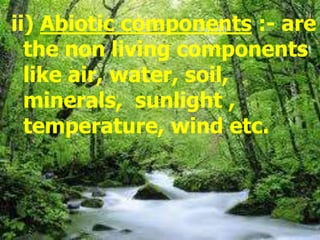
ii) Abiotic components :- are
the non living components
like air, water, soil,
minerals, sunlight ,
temperature, wind etc.
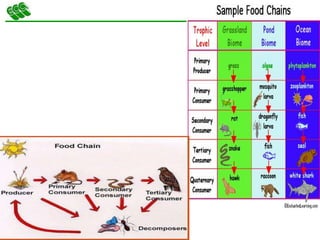
Food chain :
A food chain is the flow of food
energy from one organism to
the next and to the next and so
on. They usually start with a
producer (plants) and end with
a carnivore. In a food chain an
organism gets food from one
group of organisms.
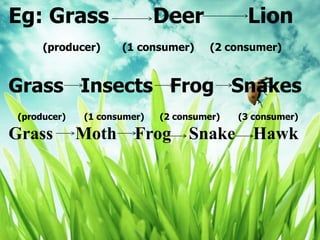
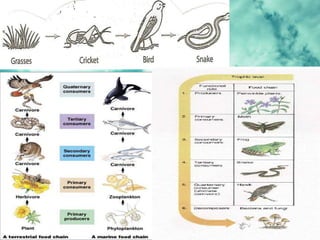
Eg: Grass Deer Lion
(producer) (1 consumer) (2 consumer)
Grass Insects Frog Snakes
(producer) (1 consumer) (2 consumer) (3 consumer)
Grass Moth Frog Snake Hawk
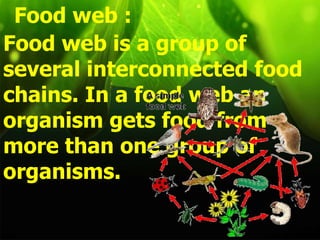
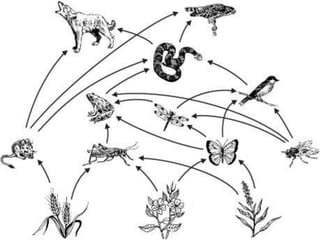
Food web :
Food web is a group of
several interconnected food
chains. In a food web an
organism gets food from
more than one group of
organisms.

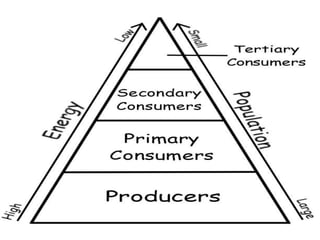
Trophic levels :-
Each step in a food chain
where transfer of food
energy takes place is called
trophic level.
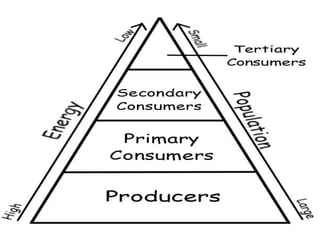
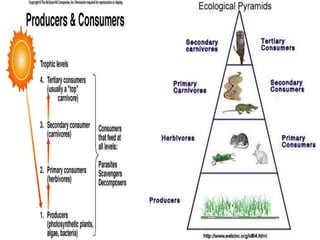
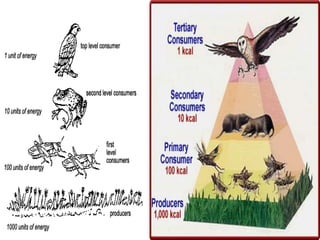
The first trophic level
consists of producers.
 The second trophic level
consists of primary
consumers.
 The third trophic level
consists of secondary
consumers.
The fourth trophic level
consists of tertiary
consumers.
Since the transfer of food
energy decreases at every
trophic level, the number
of trophic levels are limited
and do not exceed four or
five.
Energy flow in trophic
levels
Green plants (producers)
absorb about 1% of solar
energy falling on the
leaves and stores it as
food energy during
photosynthesis.
During the transfer of food
energy from one trophic
level to the next, 90% of the
energy is lost to the
environment and only 10%
is transferred to the next
trophic level.
So there is a decrease in
the amount of food energy
transferred at every trophic
level by 10%. This is
known as the 10% law.
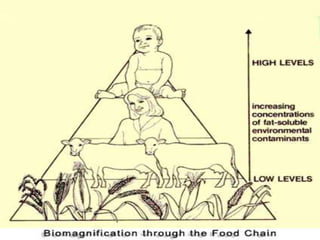
Biological magnification
(Biomagnification)
Harmful chemicals like
insecticides and pesticides
which are used to protect
crops from insects and pests
are absorbed by plants and
enter the food chain. Since
these chemicals are non
biodegradable, they get
accumulated at every
trophic level and their
concentration increases.
Since human beings occupy
the highest trophic level,
the concentration of these
harmful chemicals is
maximum in our bodies.
The increase in
concentration of harmful
chemicals in the bodies of
organisms at higher
trophic levels is called
biological magnification.
Sub-Concept: 15.3
How do our activities
affect the
environment?
Depletion of ozone layer in
the atmosphere:
Ozone molecule contains
three oxygen atoms (O3). At
higher levels in the
atmosphere the UV radiation
splits some oxygen
molecules (O2) into free
oxygen atoms which
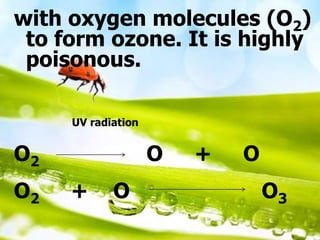
combines
with oxygen molecules (O2)
to form ozone. It is highly
poisonous.
UV radiation
O2 O + O
O2 + O O3
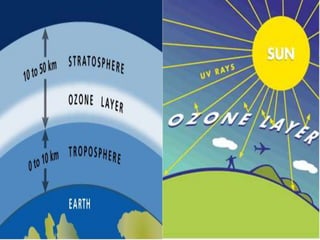
The ozone layer present in
the higher layer of the
atmosphere protects the
earth from the harmful UV
radiation from the sun. UV
radiation causes skin cancer
in humans.
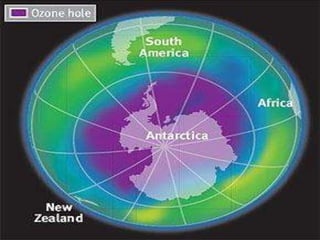
The ozone layer is being
damaged by the use of
chemicals like chloro fluoro
carbons (CFCs) used in
refrigerators and fire
extinguishers. So the use of
CFCs is now being reduced
to protect the ozone layer.
Managing the garbage we
produce :
The household waste is
called garbage. Some of
the garbage is
biodegradable and some
are non biodegradable.
Garbage causes pollution
of air, water and soil. So
it should be disposed
properly.
Some of the methods of
garbage disposal are :-
i) Land fills
ii) Recycling
iii) Production of biogas
and manure
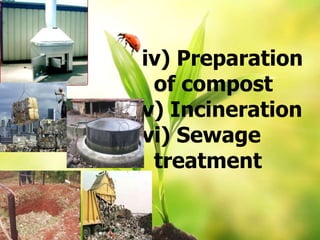
iv) Preparation
of compost
v) Incineration
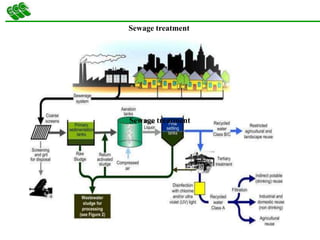
vi) Sewage
treatment
Sewage treatment
Sewage treatment
Summary
The various components
of an ecosystems are
interdependent.
The produces make the
energy from the sunlight
available to rest of the
ecosystem.
There is a loss of energy
as we go from one tropic
level to the next this
limits the number of
tropic levels in a food
chain.
Human actvisists have an
The use of chemicals like
CFCs has endangered the
ozone layer.
The disposal of waste we
generate is causing
serious environmental
problems.

Chapter 15 our environment

  • 1.
    CHAPTER – 15 OURENVIRONMENT
  • 2.
    Introduction We have theword environment often being used on the television, in newspapers and by people around us. Environment (F. environ – about ) is the sum total of all external factors, substances, living
  • 3.
    beings, and conditionsthat surround an organism and influence the same without becoming its part. It consists of both living and non- living components, each of which has several sub-components which are interlinked and
  • 4.
    interdependent on each other.In this chapter, we shall be studying how various factors in the environment interact with each other and how we impact the environment.
  • 5.
    Sub-Concept 15.1 What happenswhen we add our waste to the environment?
  • 6.
    Effect of addingwaste to the environment Human activities produce a lot of waste materials which are thrown away into the environment. These wastes cause
  • 7.
    pollution of air,water and soil. The waste materials produced are of two main types. They are biodegradable wastes and non biodegradable wastes.
  • 8.
    i)Biodegradable wastes: are wasteswhich are decomposed into harmless substances by microorganisms. E. g. vegetables, fruits, pulses, cereals, cotton, jute, wool, wood, leather, paper, animal dung, animal bones
  • 9.
    ii) Non biodegradable wastes:- are wastes which are not decomposed by microorganisms. E. g. polythene bags, plastics, synthetic fibres, glass, metals, synthetic rubber, insecticides, pesticides etc.
  • 10.
    Sub-Concept 15.2 Eco-system –What are its components?
  • 11.
    Ecosystem : Anecosystem consists of all the living organisms in an area along with the non living components and their interaction. There are different types of ecosystems. They are :- i)Natural ecosystems :- like forests, deserts, grass lands, mountains, ponds, lakes,
  • 12.
    ii) Artificial ecosystems:- like gardens, parks, crop fields, aquarium, zoo etc. Components of an ecosystem: An ecosystem consists of two main components. They are biotic and abiotic components.
  • 13.
    i) Biotic components:- are the living components like plants, animals and microorganisms. They consist of producers, consumers and decomposers. Producers :- are green plants which produce food by photosynthesis.
  • 14.
    Consumers :- are herbivoreswhich get their food directly from plants, carnivores which get their food indirectly from plants and omnivores which get their food directly or indirectly from plants.
  • 15.
    Decomposers :- are microorganismswhich decompose dead plants and animals. They decompose complex organic substances into simple inorganic substances in the soil which are again used by plants.
  • 16.
    ii) Abiotic components:- are the non living components like air, water, soil, minerals, sunlight , temperature, wind etc.
  • 17.
    Food chain : Afood chain is the flow of food energy from one organism to the next and to the next and so on. They usually start with a producer (plants) and end with a carnivore. In a food chain an organism gets food from one group of organisms.
  • 18.
    Eg: Grass DeerLion (producer) (1 consumer) (2 consumer) Grass Insects Frog Snakes (producer) (1 consumer) (2 consumer) (3 consumer) Grass Moth Frog Snake Hawk
  • 21.
    Food web : Foodweb is a group of several interconnected food chains. In a food web an organism gets food from more than one group of organisms.
  • 22.
  • 23.
    Trophic levels :- Eachstep in a food chain where transfer of food energy takes place is called trophic level. The first trophic level consists of producers.
  • 24.
     The secondtrophic level consists of primary consumers.  The third trophic level consists of secondary consumers.
  • 25.
    The fourth trophiclevel consists of tertiary consumers. Since the transfer of food energy decreases at every trophic level, the number of trophic levels are limited and do not exceed four or five.
  • 28.
    Energy flow introphic levels Green plants (producers) absorb about 1% of solar energy falling on the leaves and stores it as food energy during photosynthesis.
  • 29.
    During the transferof food energy from one trophic level to the next, 90% of the energy is lost to the environment and only 10% is transferred to the next trophic level.
  • 30.
    So there isa decrease in the amount of food energy transferred at every trophic level by 10%. This is known as the 10% law.
  • 33.
    Biological magnification (Biomagnification) Harmful chemicalslike insecticides and pesticides which are used to protect crops from insects and pests are absorbed by plants and enter the food chain. Since these chemicals are non
  • 34.
    biodegradable, they get accumulatedat every trophic level and their concentration increases. Since human beings occupy the highest trophic level, the concentration of these harmful chemicals is maximum in our bodies.
  • 35.
    The increase in concentrationof harmful chemicals in the bodies of organisms at higher trophic levels is called biological magnification.
  • 37.
    Sub-Concept: 15.3 How doour activities affect the environment?
  • 38.
    Depletion of ozonelayer in the atmosphere: Ozone molecule contains three oxygen atoms (O3). At higher levels in the atmosphere the UV radiation splits some oxygen molecules (O2) into free oxygen atoms which combines
  • 39.
    with oxygen molecules(O2) to form ozone. It is highly poisonous. UV radiation O2 O + O O2 + O O3
  • 40.
    The ozone layerpresent in the higher layer of the atmosphere protects the earth from the harmful UV radiation from the sun. UV radiation causes skin cancer in humans.
  • 41.
    The ozone layeris being damaged by the use of chemicals like chloro fluoro carbons (CFCs) used in refrigerators and fire extinguishers. So the use of CFCs is now being reduced to protect the ozone layer.
  • 45.
    Managing the garbagewe produce : The household waste is called garbage. Some of the garbage is biodegradable and some are non biodegradable. Garbage causes pollution
  • 46.
    of air, waterand soil. So it should be disposed properly. Some of the methods of garbage disposal are :- i) Land fills ii) Recycling iii) Production of biogas and manure
  • 47.
    iv) Preparation of compost v)Incineration vi) Sewage treatment
  • 48.
  • 49.
    Summary The various components ofan ecosystems are interdependent. The produces make the energy from the sunlight available to rest of the ecosystem.
  • 50.
    There is aloss of energy as we go from one tropic level to the next this limits the number of tropic levels in a food chain. Human actvisists have an
  • 51.
    The use ofchemicals like CFCs has endangered the ozone layer. The disposal of waste we generate is causing serious environmental problems.