Contribution of
scientist Louis Pasteur
in the field of
Microbiology.
kirtish Dudwadkar
kirtishdudwadkar@23gmail.com
DIV:-A
COMBINATION :- BOTANY , CHEMISTRY, BIOCHEMISTRY.
MOB:-8104511307.
Abstract
In Louis Pasteur's scientific career it is striking to note the exponential character
of the research he introduced in all the fields he opened up. He offered fabulous
opportunities to stereochemistry. He is acknowledged as one of the founders of
microbiology. He established the possibility of anaerobic life. He pointed the way
to epidemiology, public health, and the bacteriologic fight. He struggled against
the idea of spontaneous generation of life. He irrevocably substantiated the
microbial theory of infectious diseases. He demonstrated that bacterial virulence
could be attenuated, he evidenced immunity and generalised the vaccination
principle. He also was an incomparable experimenter.
S. P. Mandali’s
Ramnarain Ruia Autonomous College
Matunga, Mumbai.
Department of Botany
CERTIFICATE
This is to certify that Mr. KIRTISH RAVINDAR DUDWADKAR of
FY.BSc(Botany,Chemistry,Biochemistry)
has completed an assignment in RUSBOT 101, titled:
“Contribution of scientist Louis Pasture in the field of
Microbiology.” and submitted the same on :-
DATE :- 22/10/2020
Signature of the Teacher :-
Louis Pasteur -(1822 – 1895) :-
Louis Pasteur was a French chemist and a crystallographer. His greatest
contribution to microbiology made him to be the ‘Father of Modern
Microbiology’. ‘Father of immunology’. He was a biologist,
microbiologist and chemist.
Louis Pasteur was born on 27th December,1822 in Dole, French.
His father, Jean-Joseph Pasteur, was tanner and a sergeant major who
received the legion of honour during the Napoleonic wars. Pasteur earned
his BSc. in arts degree (1840) at the Royal college of Besancon and
doctorate (1847) from the Ecole Nonmale in Paris.
In 1848,he became a professor of chemistry at the university of Strasbourg.
During the mid-to late 19th century Pasteur demonstrated that
microorganisms cause disease and discovered how to make vaccines from
weakened, or attenuated microbes. He developed the earliest vaccines
against fowl cholera, anthrax and rabies.
Louis Pasteur (1822–1895) is revered by his successors in the life sciences
as well as by the general public. In fact, his name provided the basis for a
household word—pasteurized.
His research, which showed that microorganisms cause both fermentation
and disease, supported the germ theory of disease at a time when its
validity was still being questioned. In his ongoing quest for disease
treatments he created the first vaccines for fowl cholera; anthrax, a major
livestock disease that in recent times has been used against humans in
germ warfare; and the dreaded rabies.
Contribution to science as a chemist :-
In 1848 pasture observed that,
He was working with tartaric acid and racemic acid found in
sediment of fermenting wine have identical chemical composition.
Upon intense inspection using a microscope, pasture noticed that
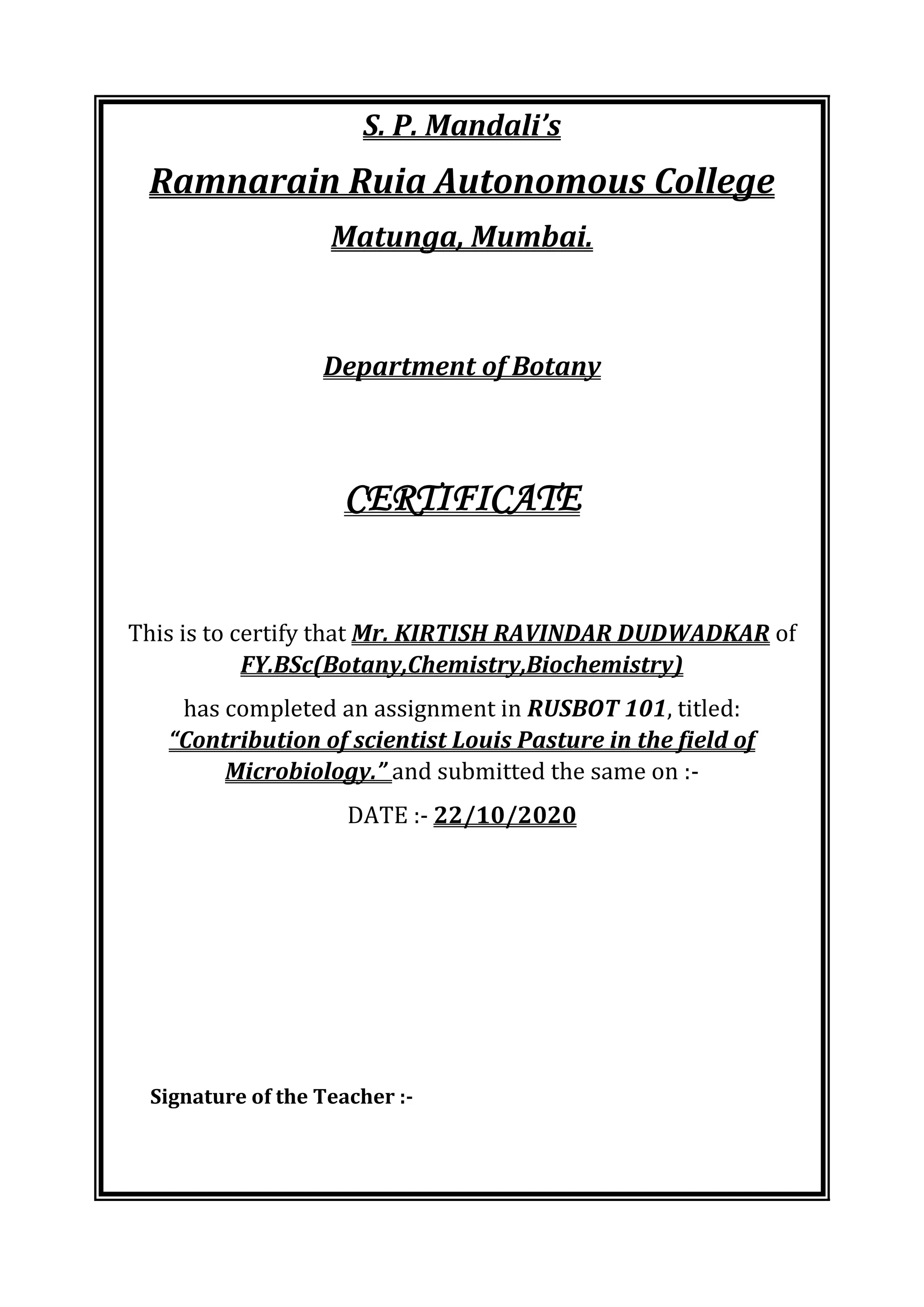
identical molecules have different spatial arrangement. One was the
mirror image of the other.
This discovery led to the branch of science – ‘Stereochemistry’.
This experiment established that to study a chemical behave , along
with its composition , the structure and shape is also important.
Pasteur separated the left and right crystal shapes from each other to form two piles of crystals: in solution
one form rotated light to the left, the other to the right, while an equal mixture of the two forms canceled
each other's effect, and does not rotate the polarized light.
Contribution to science as a microbiologist:-
1. To wine industry
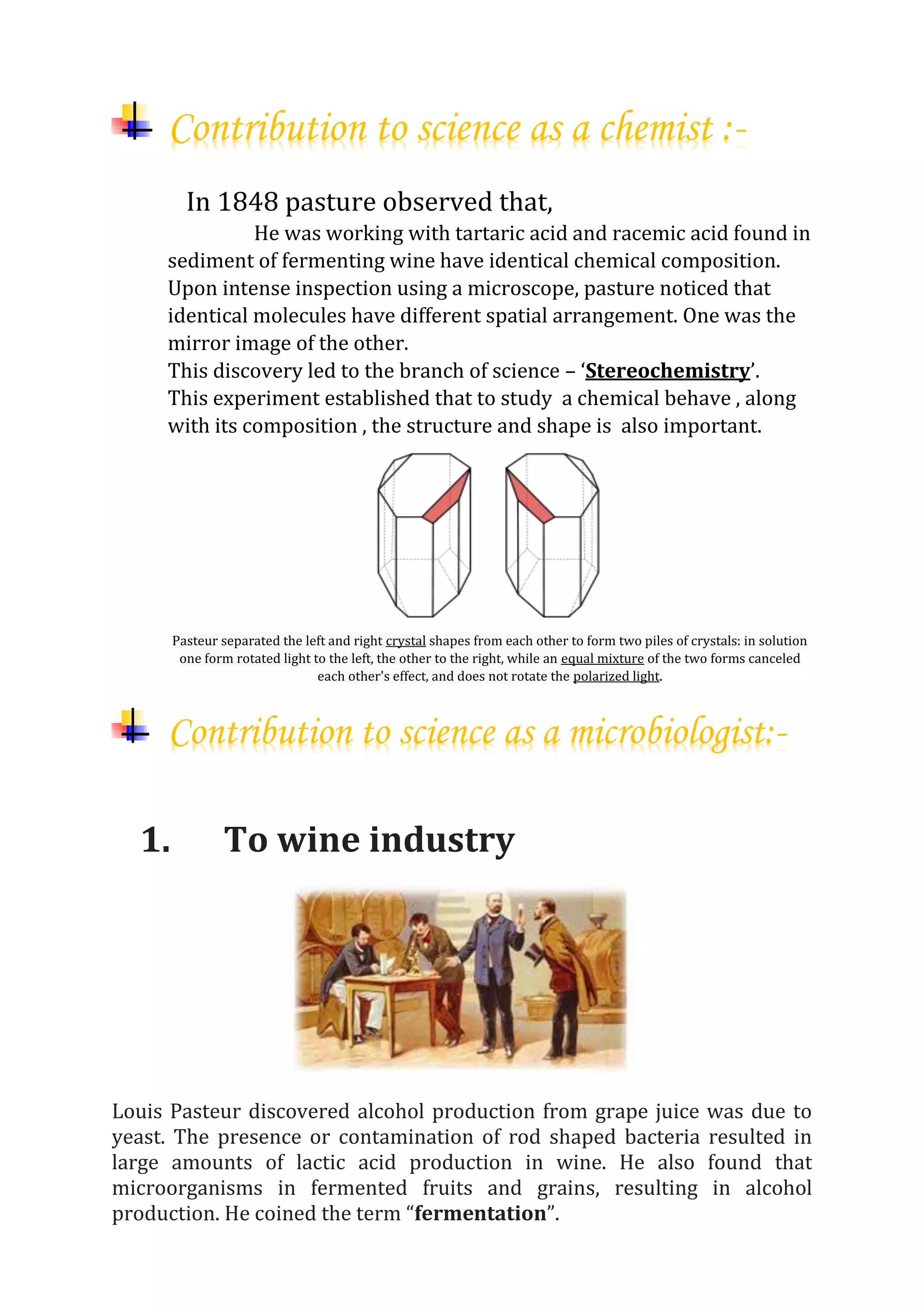
Louis Pasteur discovered alcohol production from grape juice was due to
yeast. The presence or contamination of rod shaped bacteria resulted in
large amounts of lactic acid production in wine. He also found that
microorganisms in fermented fruits and grains, resulting in alcohol
production. He coined the term “fermentation”.
Pasteur disproved spontaneous generation Spontaneous generation
states that life could arisespontaneouslyfrominanimate(non-living)
materials (Abiogenesis). Pasteur disproved the theory of spontaneous
generation. He strongly supported theory of Biogenesis (life orginates from
pre-existing life forms). To prove this he carried out several experiments.
Pasteur poured meat infusions into flasks and then drew the top of each flask
into a long curved neck that would admit air but not dust (Figure 1.4). He
found that if the infusions were heated, they remained sterile (free from any
growth) until they were exposed to dust. After opening them on a dusty road
and resealing them, he demonstrated the growth of microorganisms in all
the flasks. The unopened flasks were sterile. Thus he disproved the theory
of spontaneous generation.
2. Pasteurization
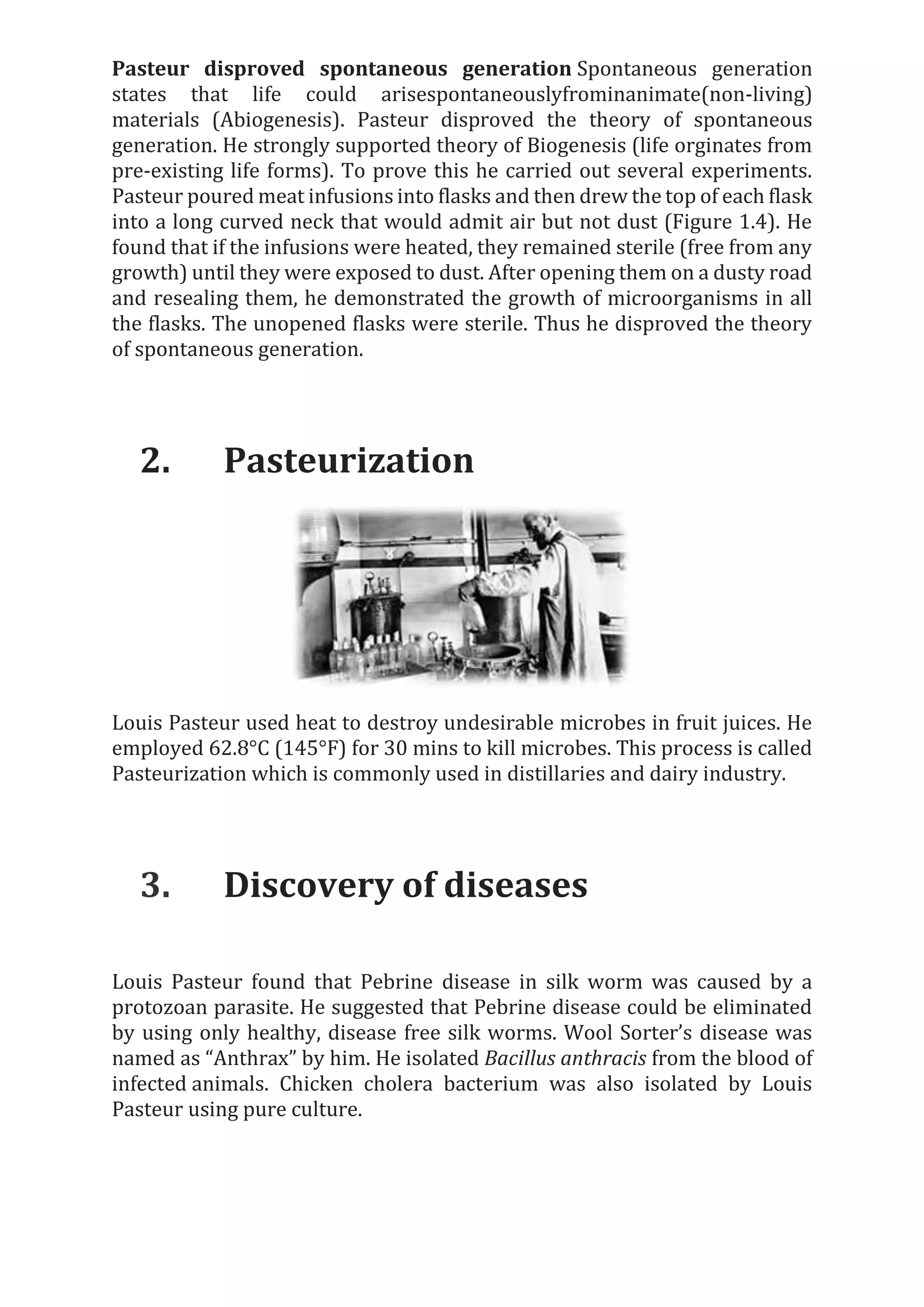
Louis Pasteur used heat to destroy undesirable microbes in fruit juices. He
employed 62.8°C (145°F) for 30 mins to kill microbes. This process is called
Pasteurization which is commonly used in distillaries and dairy industry.
3. Discovery of diseases
Louis Pasteur found that Pebrine disease in silk worm was caused by a
protozoan parasite. He suggested that Pebrine disease could be eliminated
by using only healthy, disease free silk worms. Wool Sorter’s disease was
named as “Anthrax” by him. He isolated Bacillus anthracis from the blood of
infected animals. Chicken cholera bacterium was also isolated by Louis
Pasteur using pure culture.
He proved that many diseases were caused by the presence of foreign
microorganisms (Germ theory of disease). He discovered various infection
causing microorganisms such as Staphylococcus,
Streptococcus and Pneumococcus.
4. Vaccination
Pasteur found out that bacteria could be attenuated by growing them in
unnatural conditions. He coined the term “attenuation”. It is a process
wherein bacteria lose their virulence due to repeated subculturing under
laboratory conditions. He used attenuated cultures as vaccines for
immunizing and protecting an individual against the disease. He developed
vaccines for anthrax and rabies.
Implications of Pasteur’s Work :-
The theoretical implications and practical importance of Pasteur’s work
were immense. Pasteur once said, “There are no such things as pure and
applied science; there are only science and the application of science.”
Thus, once he established the theoretical basis of a given process, he
investigated ways to further develop industrial applications. (As a result,
he deposited a number of patents.)
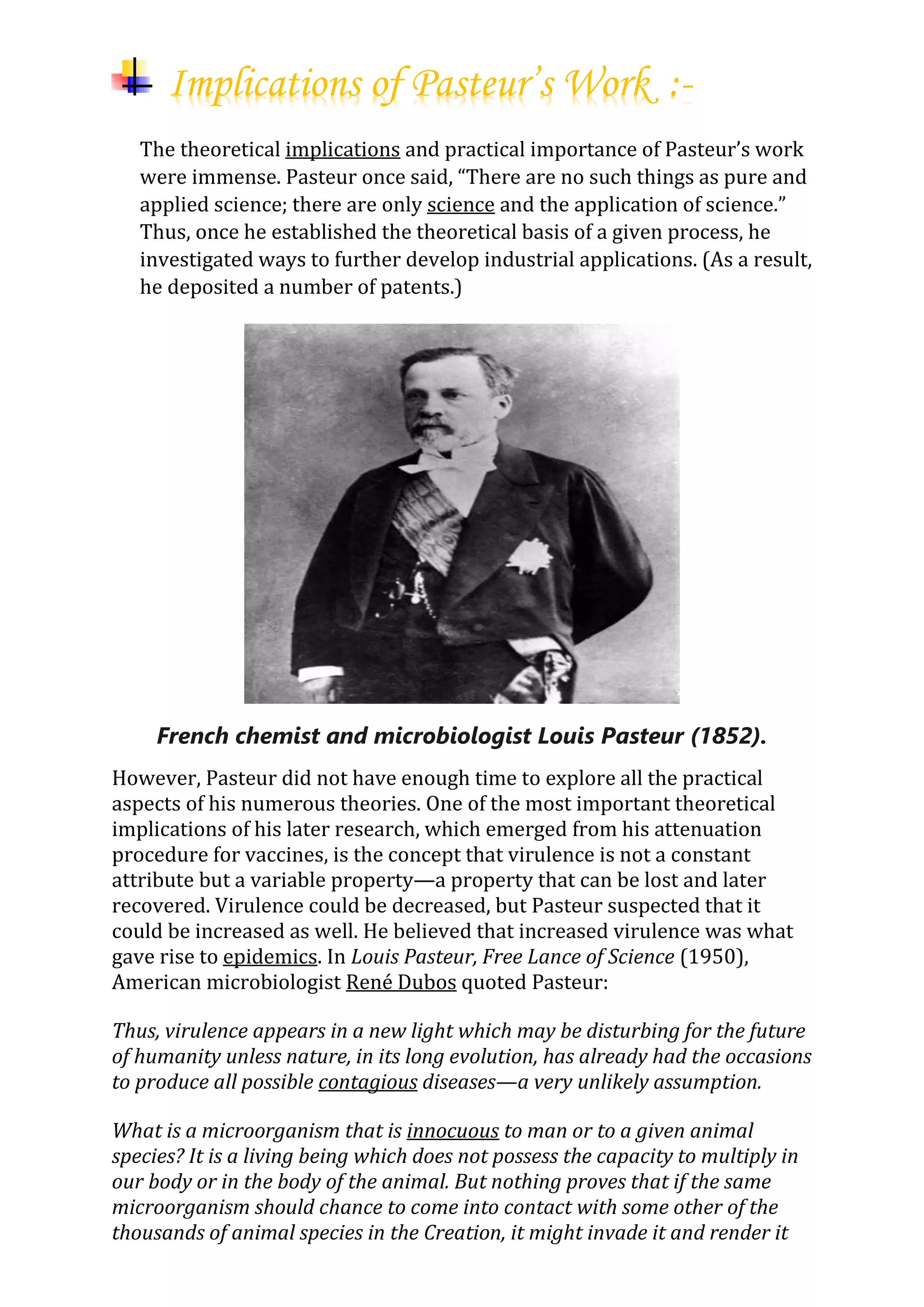
French chemist and microbiologist Louis Pasteur (1852).
However, Pasteur did not have enough time to explore all the practical
aspects of his numerous theories. One of the most important theoretical
implications of his later research, which emerged from his attenuation
procedure for vaccines, is the concept that virulence is not a constant
attribute but a variable property—a property that can be lost and later
recovered. Virulence could be decreased, but Pasteur suspected that it
could be increased as well. He believed that increased virulence was what
gave rise to epidemics. In Louis Pasteur, Free Lance of Science (1950),
American microbiologist René Dubos quoted Pasteur:
Thus, virulence appears in a new light which may be disturbing for the future
of humanity unless nature, in its long evolution, has already had the occasions
to produce all possible contagious diseases—a very unlikely assumption.
What is a microorganism that is innocuous to man or to a given animal
species? It is a living being which does not possess the capacity to multiply in
our body or in the body of the animal. But nothing proves that if the same
microorganism should chance to come into contact with some other of the
thousands of animal species in the Creation, it might invade it and render it
sick. Its virulence might increase by repeated passages through that species,
and might eventually affect man or domesticated animals. Thus might be
brought about a new virulence and new contagions. I am much inclined to
believe that such mechanisms would explain how smallpox, syphilis,
plague, yellow fever, etc. have come about in the course of time, and how
certain great epidemics appear once in a while.
Pasteur was the first to recognize variability in virulence. Today this
concept remains relevant to the study of infectious disease, especially with
regard to understanding the emergence of diseases such as bovine
spongiform encephalopathy (BSE), severe acute respiratory
syndrome (SARS), and acquired immunodeficiency syndrome (AIDS).
After Pasteur’s 70th birthday, which was acknowledged by a large but
solemn celebration at the Sorbonne that was attended by several
prominent scientists, including British surgeon Joseph Lister,
Pasteur’s health continued to deteriorate. His paralysis worsened, and he
died on September 28, 1895. He was buried in the cathedral of Notre-Dame
de Paris, but his remains were transferred to a Neo-Byzantine crypt at the
Pasteur Institute in 1896.
Louis Pasteur all Contribution to
Science :-
References :-
1. https://en.wikipedia.org/wiki/Louis_Pasteur#Resea
rch
2. http://www.brainkart.com/article/Contributors-to-
Microbiology_35211/
3. https://www.sciencehistory.org/historical-
profile/louis-pasteur
4. https://www.britannica.com/biography/Louis-
Pasteur/Vaccine-development
5. https://www.slideshare.net/DhanyaKc/louis-
pasteur-contributions-to-science?
6. All images are from google .com
Contributors to microbiology  by louis pasture

Contributors to microbiology by louis pasture

  • 1.
    Contribution of scientist LouisPasteur in the field of Microbiology. kirtish Dudwadkar kirtishdudwadkar@23gmail.com DIV:-A COMBINATION :- BOTANY , CHEMISTRY, BIOCHEMISTRY. MOB:-8104511307. Abstract In Louis Pasteur's scientific career it is striking to note the exponential character of the research he introduced in all the fields he opened up. He offered fabulous opportunities to stereochemistry. He is acknowledged as one of the founders of microbiology. He established the possibility of anaerobic life. He pointed the way to epidemiology, public health, and the bacteriologic fight. He struggled against the idea of spontaneous generation of life. He irrevocably substantiated the microbial theory of infectious diseases. He demonstrated that bacterial virulence could be attenuated, he evidenced immunity and generalised the vaccination principle. He also was an incomparable experimenter.
  • 2.
    S. P. Mandali’s RamnarainRuia Autonomous College Matunga, Mumbai. Department of Botany CERTIFICATE This is to certify that Mr. KIRTISH RAVINDAR DUDWADKAR of FY.BSc(Botany,Chemistry,Biochemistry) has completed an assignment in RUSBOT 101, titled: “Contribution of scientist Louis Pasture in the field of Microbiology.” and submitted the same on :- DATE :- 22/10/2020 Signature of the Teacher :-
  • 3.
    Louis Pasteur -(1822– 1895) :- Louis Pasteur was a French chemist and a crystallographer. His greatest contribution to microbiology made him to be the ‘Father of Modern Microbiology’. ‘Father of immunology’. He was a biologist, microbiologist and chemist. Louis Pasteur was born on 27th December,1822 in Dole, French. His father, Jean-Joseph Pasteur, was tanner and a sergeant major who received the legion of honour during the Napoleonic wars. Pasteur earned his BSc. in arts degree (1840) at the Royal college of Besancon and doctorate (1847) from the Ecole Nonmale in Paris. In 1848,he became a professor of chemistry at the university of Strasbourg. During the mid-to late 19th century Pasteur demonstrated that microorganisms cause disease and discovered how to make vaccines from weakened, or attenuated microbes. He developed the earliest vaccines against fowl cholera, anthrax and rabies. Louis Pasteur (1822–1895) is revered by his successors in the life sciences as well as by the general public. In fact, his name provided the basis for a household word—pasteurized. His research, which showed that microorganisms cause both fermentation and disease, supported the germ theory of disease at a time when its validity was still being questioned. In his ongoing quest for disease treatments he created the first vaccines for fowl cholera; anthrax, a major livestock disease that in recent times has been used against humans in germ warfare; and the dreaded rabies.
  • 4.
    Contribution to scienceas a chemist :- In 1848 pasture observed that, He was working with tartaric acid and racemic acid found in sediment of fermenting wine have identical chemical composition. Upon intense inspection using a microscope, pasture noticed that identical molecules have different spatial arrangement. One was the mirror image of the other. This discovery led to the branch of science – ‘Stereochemistry’. This experiment established that to study a chemical behave , along with its composition , the structure and shape is also important. Pasteur separated the left and right crystal shapes from each other to form two piles of crystals: in solution one form rotated light to the left, the other to the right, while an equal mixture of the two forms canceled each other's effect, and does not rotate the polarized light. Contribution to science as a microbiologist:- 1. To wine industry Louis Pasteur discovered alcohol production from grape juice was due to yeast. The presence or contamination of rod shaped bacteria resulted in large amounts of lactic acid production in wine. He also found that microorganisms in fermented fruits and grains, resulting in alcohol production. He coined the term “fermentation”.
  • 5.
    Pasteur disproved spontaneousgeneration Spontaneous generation states that life could arisespontaneouslyfrominanimate(non-living) materials (Abiogenesis). Pasteur disproved the theory of spontaneous generation. He strongly supported theory of Biogenesis (life orginates from pre-existing life forms). To prove this he carried out several experiments. Pasteur poured meat infusions into flasks and then drew the top of each flask into a long curved neck that would admit air but not dust (Figure 1.4). He found that if the infusions were heated, they remained sterile (free from any growth) until they were exposed to dust. After opening them on a dusty road and resealing them, he demonstrated the growth of microorganisms in all the flasks. The unopened flasks were sterile. Thus he disproved the theory of spontaneous generation. 2. Pasteurization Louis Pasteur used heat to destroy undesirable microbes in fruit juices. He employed 62.8°C (145°F) for 30 mins to kill microbes. This process is called Pasteurization which is commonly used in distillaries and dairy industry. 3. Discovery of diseases Louis Pasteur found that Pebrine disease in silk worm was caused by a protozoan parasite. He suggested that Pebrine disease could be eliminated by using only healthy, disease free silk worms. Wool Sorter’s disease was named as “Anthrax” by him. He isolated Bacillus anthracis from the blood of infected animals. Chicken cholera bacterium was also isolated by Louis Pasteur using pure culture.
  • 6.
    He proved thatmany diseases were caused by the presence of foreign microorganisms (Germ theory of disease). He discovered various infection causing microorganisms such as Staphylococcus, Streptococcus and Pneumococcus. 4. Vaccination Pasteur found out that bacteria could be attenuated by growing them in unnatural conditions. He coined the term “attenuation”. It is a process wherein bacteria lose their virulence due to repeated subculturing under laboratory conditions. He used attenuated cultures as vaccines for immunizing and protecting an individual against the disease. He developed vaccines for anthrax and rabies.
  • 7.
    Implications of Pasteur’sWork :- The theoretical implications and practical importance of Pasteur’s work were immense. Pasteur once said, “There are no such things as pure and applied science; there are only science and the application of science.” Thus, once he established the theoretical basis of a given process, he investigated ways to further develop industrial applications. (As a result, he deposited a number of patents.) French chemist and microbiologist Louis Pasteur (1852). However, Pasteur did not have enough time to explore all the practical aspects of his numerous theories. One of the most important theoretical implications of his later research, which emerged from his attenuation procedure for vaccines, is the concept that virulence is not a constant attribute but a variable property—a property that can be lost and later recovered. Virulence could be decreased, but Pasteur suspected that it could be increased as well. He believed that increased virulence was what gave rise to epidemics. In Louis Pasteur, Free Lance of Science (1950), American microbiologist René Dubos quoted Pasteur: Thus, virulence appears in a new light which may be disturbing for the future of humanity unless nature, in its long evolution, has already had the occasions to produce all possible contagious diseases—a very unlikely assumption. What is a microorganism that is innocuous to man or to a given animal species? It is a living being which does not possess the capacity to multiply in our body or in the body of the animal. But nothing proves that if the same microorganism should chance to come into contact with some other of the thousands of animal species in the Creation, it might invade it and render it
  • 8.
    sick. Its virulencemight increase by repeated passages through that species, and might eventually affect man or domesticated animals. Thus might be brought about a new virulence and new contagions. I am much inclined to believe that such mechanisms would explain how smallpox, syphilis, plague, yellow fever, etc. have come about in the course of time, and how certain great epidemics appear once in a while. Pasteur was the first to recognize variability in virulence. Today this concept remains relevant to the study of infectious disease, especially with regard to understanding the emergence of diseases such as bovine spongiform encephalopathy (BSE), severe acute respiratory syndrome (SARS), and acquired immunodeficiency syndrome (AIDS). After Pasteur’s 70th birthday, which was acknowledged by a large but solemn celebration at the Sorbonne that was attended by several prominent scientists, including British surgeon Joseph Lister, Pasteur’s health continued to deteriorate. His paralysis worsened, and he died on September 28, 1895. He was buried in the cathedral of Notre-Dame de Paris, but his remains were transferred to a Neo-Byzantine crypt at the Pasteur Institute in 1896. Louis Pasteur all Contribution to Science :-
  • 9.
    References :- 1. https://en.wikipedia.org/wiki/Louis_Pasteur#Resea rch 2.http://www.brainkart.com/article/Contributors-to- Microbiology_35211/ 3. https://www.sciencehistory.org/historical- profile/louis-pasteur 4. https://www.britannica.com/biography/Louis- Pasteur/Vaccine-development 5. https://www.slideshare.net/DhanyaKc/louis- pasteur-contributions-to-science? 6. All images are from google .com