AMI Shishu Mandir
Gwalior
Presented by: Kavya Mane
Swarangi Yadav
Twinkle Chawla
Naina Jain
Class – 9th
B
Presented to: Nagma Mam
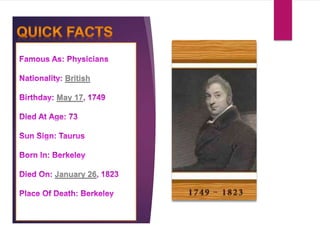
British
May 17
January 26
Childhood & Early Life
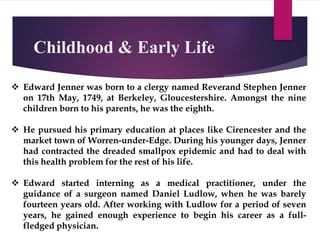
 Edward Jenner was born to a clergy named Reverand Stephen Jenner
on 17th May, 1749, at Berkeley, Gloucestershire. Amongst the nine
children born to his parents, he was the eighth.
 He pursued his primary education at places like Cirencester and the
market town of Worren-under-Edge. During his younger days, Jenner
had contracted the dreaded smallpox epidemic and had to deal with
this health problem for the rest of his life.
 Edward started interning as a medical practitioner, under the
guidance of a surgeon named Daniel Ludlow, when he was barely
fourteen years old. After working with Ludlow for a period of seven
years, he gained enough experience to begin his career as a full-
fledged physician.
Career
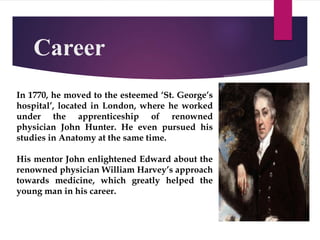
In 1770, he moved to the esteemed ‘St. George’s
hospital’, located in London, where he worked
under the apprenticeship of renowned
physician John Hunter. He even pursued his
studies in Anatomy at the same time.
His mentor John enlightened Edward about the
renowned physician William Harvey’s approach
towards medicine, which greatly helped the
young man in his career.
Career
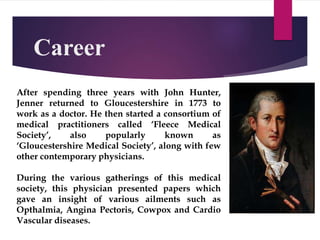
After spending three years with John Hunter,
Jenner returned to Gloucestershire in 1773 to
work as a doctor. He then started a consortium of
medical practitioners called ‘Fleece Medical
Society’, also popularly known as
‘Gloucestershire Medical Society’, along with few
other contemporary physicians.
During the various gatherings of this medical
society, this physician presented papers which
gave an insight of various ailments such as
Opthalmia, Angina Pectoris, Cowpox and Cardio
Vascular diseases.
Career
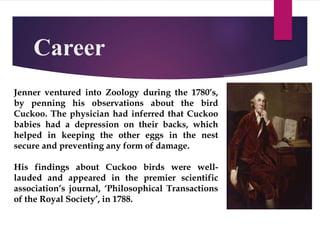
Jenner ventured into Zoology during the 1780’s,
by penning his observations about the bird
Cuckoo. The physician had inferred that Cuckoo
babies had a depression on their backs, which
helped in keeping the other eggs in the nest
secure and preventing any form of damage.
His findings about Cuckoo birds were well-
lauded and appeared in the premier scientific
association’s journal, ‘Philosophical Transactions
of the Royal Society’, in 1788.
Career
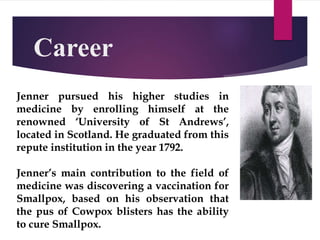
Jenner pursued his higher studies in
medicine by enrolling himself at the
renowned ‘University of St Andrews’,
located in Scotland. He graduated from this
repute institution in the year 1792.
Jenner’s main contribution to the field of
medicine was discovering a vaccination for
Smallpox, based on his observation that
the pus of Cowpox blisters has the ability
to cure Smallpox.
Career
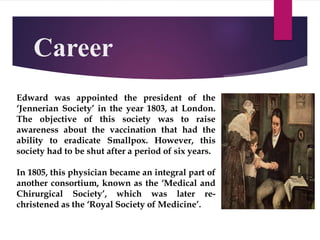
Edward was appointed the president of the
‘Jennerian Society’ in the year 1803, at London.
The objective of this society was to raise
awareness about the vaccination that had the
ability to eradicate Smallpox. However, this
society had to be shut after a period of six years.
In 1805, this physician became an integral part of
another consortium, known as the ‘Medical and
Chirurgical Society’, which was later re-
christened as the ‘Royal Society of Medicine’.
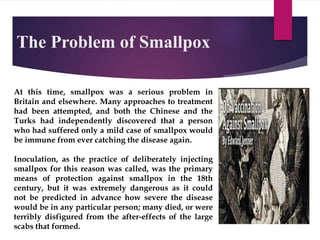
The Problem of Smallpox
At this time, smallpox was a serious problem in
Britain and elsewhere. Many approaches to treatment
had been attempted, and both the Chinese and the
Turks had independently discovered that a person
who had suffered only a mild case of smallpox would
be immune from ever catching the disease again.
Inoculation, as the practice of deliberately injecting
smallpox for this reason was called, was the primary
means of protection against smallpox in the 18th
century, but it was extremely dangerous as it could
not be predicted in advance how severe the disease
would be in any particular person; many died, or were
terribly disfigured from the after-effects of the large
scabs that formed.
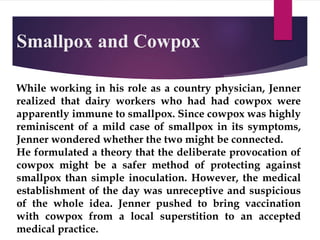
Smallpox and Cowpox
While working in his role as a country physician, Jenner
realized that dairy workers who had had cowpox were
apparently immune to smallpox. Since cowpox was highly
reminiscent of a mild case of smallpox in its symptoms,
Jenner wondered whether the two might be connected.
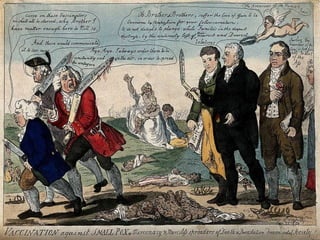
He formulated a theory that the deliberate provocation of
cowpox might be a safer method of protecting against
smallpox than simple inoculation. However, the medical
establishment of the day was unreceptive and suspicious
of the whole idea. Jenner pushed to bring vaccination
with cowpox from a local superstition to an accepted
medical practice.
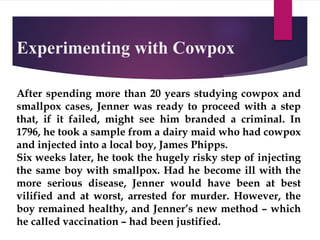
Experimenting with Cowpox
After spending more than 20 years studying cowpox and
smallpox cases, Jenner was ready to proceed with a step
that, if it failed, might see him branded a criminal. In
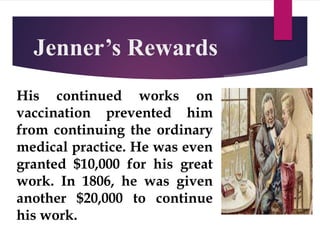
1796, he took a sample from a dairy maid who had cowpox
and injected into a local boy, James Phipps.
Six weeks later, he took the hugely risky step of injecting
the same boy with smallpox. Had he become ill with the
more serious disease, Jenner would have been at best
vilified and at worst, arrested for murder. However, the
boy remained healthy, and Jenner’s new method – which
he called vaccination – had been justified.
Publishing His Findings
Jenner quickly published a paper about his findings,
which became hugely sought after all over Europe. Within
two years, 12,000 people in England had been vaccinated
and smallpox deaths had fallen by two-thirds. Demand
for vaccination grew, and by 1800 more than 100,000
people all over the world had received the new miracle
injection. Jenner realized that it was possible to dry
lymph fluid from a smallpox pustule and keep it in dried
form for several months, allowing for easier
transportation. This in turn allowed patients to be treated
much more easily, even in remote and outlying districts.
Major Works
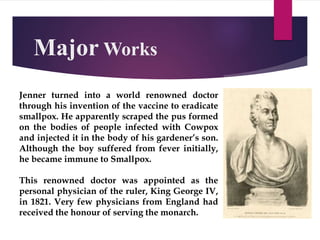
Jenner turned into a world renowned doctor
through his invention of the vaccine to eradicate
smallpox. He apparently scraped the pus formed
on the bodies of people infected with Cowpox
and injected it in the body of his gardener’s son.
Although the boy suffered from fever initially,
he became immune to Smallpox.
This renowned doctor was appointed as the
personal physician of the ruler, King George IV,
in 1821. Very few physicians from England had
received the honour of serving the monarch.
Jenner’s Rewards
In 1798, after several other successful
tests, Jenner finally published his
findings in a publication called An
Inquiry into Causes plus the Effects of
Variolae Vaccine. He called his idea
“vaccination,” from vaccinia, which is a
Latin word for cowpox. After so much
ridicule, other doctors finally found out
that the vaccination really worked and
by 1800, a large number of them were
using it.
Jenner’s Rewards
His continued works on
vaccination prevented him
from continuing the ordinary
medical practice. He was even
granted $10,000 for his great
work. In 1806, he was given
another $20,000 to continue
his work.
Jenner’s Honors and Legacy
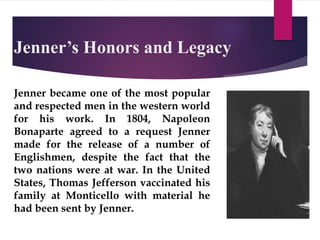
Jenner became one of the most popular
and respected men in the western world
for his work. In 1804, Napoleon
Bonaparte agreed to a request Jenner
made for the release of a number of
Englishmen, despite the fact that the
two nations were at war. In the United
States, Thomas Jefferson vaccinated his
family at Monticello with material he
had been sent by Jenner.
Jenner’s Honors and Legacy
Despite his fame, however, the medical
establishment in Jenner’s home country denied him
entry into London’s College of Physicians unless he
first took an exam on Galenic and Hippocratic theory.
Jenner refused, stating that his work was his
qualification, and he was never elected a college
member.
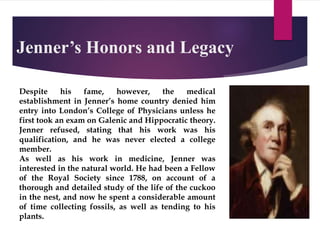
As well as his work in medicine, Jenner was
interested in the natural world. He had been a Fellow
of the Royal Society since 1788, on account of a
thorough and detailed study of the life of the cuckoo
in the nest, and now he spent a considerable amount
of time collecting fossils, as well as tending to his
plants.
Jenner’s Honors and Legacy
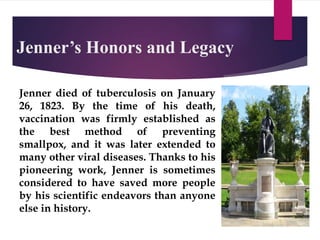
Jenner died of tuberculosis on January
26, 1823. By the time of his death,
vaccination was firmly established as
the best method of preventing
smallpox, and it was later extended to
many other viral diseases. Thanks to his
pioneering work, Jenner is sometimes
considered to have saved more people
by his scientific endeavors than anyone
else in history.
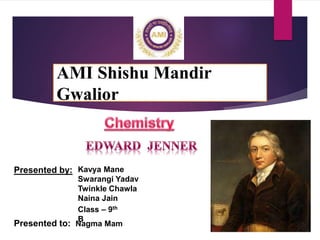
Edward Jenner

Edward Jenner

  • 1.
    AMI Shishu Mandir Gwalior Presentedby: Kavya Mane Swarangi Yadav Twinkle Chawla Naina Jain Class – 9th B Presented to: Nagma Mam
  • 2.
  • 3.
    Childhood & EarlyLife  Edward Jenner was born to a clergy named Reverand Stephen Jenner on 17th May, 1749, at Berkeley, Gloucestershire. Amongst the nine children born to his parents, he was the eighth.  He pursued his primary education at places like Cirencester and the market town of Worren-under-Edge. During his younger days, Jenner had contracted the dreaded smallpox epidemic and had to deal with this health problem for the rest of his life.  Edward started interning as a medical practitioner, under the guidance of a surgeon named Daniel Ludlow, when he was barely fourteen years old. After working with Ludlow for a period of seven years, he gained enough experience to begin his career as a full- fledged physician.
  • 4.
    Career In 1770, hemoved to the esteemed ‘St. George’s hospital’, located in London, where he worked under the apprenticeship of renowned physician John Hunter. He even pursued his studies in Anatomy at the same time. His mentor John enlightened Edward about the renowned physician William Harvey’s approach towards medicine, which greatly helped the young man in his career.
  • 5.
    Career After spending threeyears with John Hunter, Jenner returned to Gloucestershire in 1773 to work as a doctor. He then started a consortium of medical practitioners called ‘Fleece Medical Society’, also popularly known as ‘Gloucestershire Medical Society’, along with few other contemporary physicians. During the various gatherings of this medical society, this physician presented papers which gave an insight of various ailments such as Opthalmia, Angina Pectoris, Cowpox and Cardio Vascular diseases.
  • 6.
    Career Jenner ventured intoZoology during the 1780’s, by penning his observations about the bird Cuckoo. The physician had inferred that Cuckoo babies had a depression on their backs, which helped in keeping the other eggs in the nest secure and preventing any form of damage. His findings about Cuckoo birds were well- lauded and appeared in the premier scientific association’s journal, ‘Philosophical Transactions of the Royal Society’, in 1788.
  • 7.
    Career Jenner pursued hishigher studies in medicine by enrolling himself at the renowned ‘University of St Andrews’, located in Scotland. He graduated from this repute institution in the year 1792. Jenner’s main contribution to the field of medicine was discovering a vaccination for Smallpox, based on his observation that the pus of Cowpox blisters has the ability to cure Smallpox.
  • 8.
    Career Edward was appointedthe president of the ‘Jennerian Society’ in the year 1803, at London. The objective of this society was to raise awareness about the vaccination that had the ability to eradicate Smallpox. However, this society had to be shut after a period of six years. In 1805, this physician became an integral part of another consortium, known as the ‘Medical and Chirurgical Society’, which was later re- christened as the ‘Royal Society of Medicine’.
  • 9.
    The Problem ofSmallpox At this time, smallpox was a serious problem in Britain and elsewhere. Many approaches to treatment had been attempted, and both the Chinese and the Turks had independently discovered that a person who had suffered only a mild case of smallpox would be immune from ever catching the disease again. Inoculation, as the practice of deliberately injecting smallpox for this reason was called, was the primary means of protection against smallpox in the 18th century, but it was extremely dangerous as it could not be predicted in advance how severe the disease would be in any particular person; many died, or were terribly disfigured from the after-effects of the large scabs that formed.
  • 10.
    Smallpox and Cowpox Whileworking in his role as a country physician, Jenner realized that dairy workers who had had cowpox were apparently immune to smallpox. Since cowpox was highly reminiscent of a mild case of smallpox in its symptoms, Jenner wondered whether the two might be connected. He formulated a theory that the deliberate provocation of cowpox might be a safer method of protecting against smallpox than simple inoculation. However, the medical establishment of the day was unreceptive and suspicious of the whole idea. Jenner pushed to bring vaccination with cowpox from a local superstition to an accepted medical practice.
  • 11.
    Experimenting with Cowpox Afterspending more than 20 years studying cowpox and smallpox cases, Jenner was ready to proceed with a step that, if it failed, might see him branded a criminal. In 1796, he took a sample from a dairy maid who had cowpox and injected into a local boy, James Phipps. Six weeks later, he took the hugely risky step of injecting the same boy with smallpox. Had he become ill with the more serious disease, Jenner would have been at best vilified and at worst, arrested for murder. However, the boy remained healthy, and Jenner’s new method – which he called vaccination – had been justified.
  • 12.
    Publishing His Findings Jennerquickly published a paper about his findings, which became hugely sought after all over Europe. Within two years, 12,000 people in England had been vaccinated and smallpox deaths had fallen by two-thirds. Demand for vaccination grew, and by 1800 more than 100,000 people all over the world had received the new miracle injection. Jenner realized that it was possible to dry lymph fluid from a smallpox pustule and keep it in dried form for several months, allowing for easier transportation. This in turn allowed patients to be treated much more easily, even in remote and outlying districts.
  • 13.
    Major Works Jenner turnedinto a world renowned doctor through his invention of the vaccine to eradicate smallpox. He apparently scraped the pus formed on the bodies of people infected with Cowpox and injected it in the body of his gardener’s son. Although the boy suffered from fever initially, he became immune to Smallpox. This renowned doctor was appointed as the personal physician of the ruler, King George IV, in 1821. Very few physicians from England had received the honour of serving the monarch.
  • 15.
    Jenner’s Rewards In 1798,after several other successful tests, Jenner finally published his findings in a publication called An Inquiry into Causes plus the Effects of Variolae Vaccine. He called his idea “vaccination,” from vaccinia, which is a Latin word for cowpox. After so much ridicule, other doctors finally found out that the vaccination really worked and by 1800, a large number of them were using it.
  • 16.
    Jenner’s Rewards His continuedworks on vaccination prevented him from continuing the ordinary medical practice. He was even granted $10,000 for his great work. In 1806, he was given another $20,000 to continue his work.
  • 17.
    Jenner’s Honors andLegacy Jenner became one of the most popular and respected men in the western world for his work. In 1804, Napoleon Bonaparte agreed to a request Jenner made for the release of a number of Englishmen, despite the fact that the two nations were at war. In the United States, Thomas Jefferson vaccinated his family at Monticello with material he had been sent by Jenner.
  • 18.
    Jenner’s Honors andLegacy Despite his fame, however, the medical establishment in Jenner’s home country denied him entry into London’s College of Physicians unless he first took an exam on Galenic and Hippocratic theory. Jenner refused, stating that his work was his qualification, and he was never elected a college member. As well as his work in medicine, Jenner was interested in the natural world. He had been a Fellow of the Royal Society since 1788, on account of a thorough and detailed study of the life of the cuckoo in the nest, and now he spent a considerable amount of time collecting fossils, as well as tending to his plants.
  • 19.
    Jenner’s Honors andLegacy Jenner died of tuberculosis on January 26, 1823. By the time of his death, vaccination was firmly established as the best method of preventing smallpox, and it was later extended to many other viral diseases. Thanks to his pioneering work, Jenner is sometimes considered to have saved more people by his scientific endeavors than anyone else in history.