Continuous deployment with Jenkins and Salt
LinuxCon CloudOpen ContainerCon
North America 2015, Seattle
Anirban Saha
About me
Techie…
Traveller…
Thinker…
Author of ‘Salt Cookbook’
Deployment
Should be…
• Simple
• Stable
• Fast (good to have…)
• Reliable
• One click
Problems faced
• Code distribution
• Additional tasks (commands, migrations)
• Latency
• Parallel execution
• Batch deployments
• Ensuring uptime
Methods available
Deployment
Configuration management tools :
• Puppet, Chef, Ansible, Salt
Remote execution tools:
• SSH, Parallel SSH, Rundeck
Packages:
• Code packaged as RPM or DEB files
Code storage
• GIT server (Github, Gitlab, Bitbucket, etc.)
• Object storage (Amazon S3, Swift, etc.)
• Package repositories (YUM/Debian)
• Configuration management repositories
• File servers managed manually
Problems
Deployment:
• Remote execution tools :
• Time consuming (over SSH)
• Need to maintain inventory of hosts
Code storage:
• GIT repositories:
• Usually centrally located, latency when deployed from GIT
• Package repositories (RPM/DEB):
• Problems in simultaneously updating repo metadata
Rollback:
• Version manipulation is a problem with most configuration
management and remote execution tools
Salt
Provides…
• Agent based communication
• Fast execution
• Orchestration
• Batch execution
• Strong Integration with providers and
services
Salt features
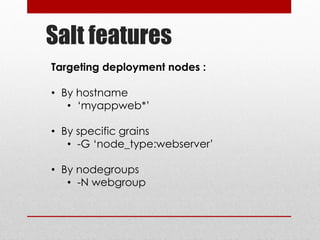
Targeting deployment nodes :
• By hostname
• ‘myappweb*’
• By specific grains
• -G ‘node_type:webserver’
• By nodegroups
• -N webgroup
Salt features
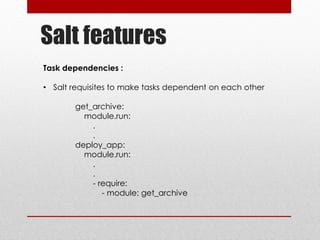
Task dependencies :
• Salt requisites to make tasks dependent on each other
get_archive:
module.run:
.
.
deploy_app:
module.run:
.
.
- require:
- module: get_archive
Salt features
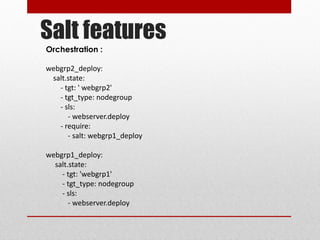
Orchestration :
webgrp2_deploy:
salt.state:
- tgt: ' webgrp2'
- tgt_type: nodegroup
- sls:
- webserver.deploy
- require:
- salt: webgrp1_deploy
webgrp1_deploy:
salt.state:
- tgt: 'webgrp1'
- tgt_type: nodegroup
- sls:
- webserver.deploy
Salt features
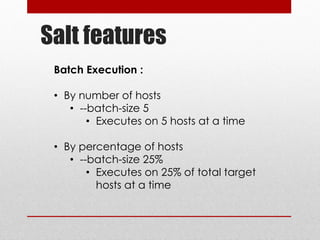
Batch Execution :
• By number of hosts
• --batch-size 5
• Executes on 5 hosts at a time
• By percentage of hosts
• --batch-size 25%
• Executes on 25% of total target
hosts at a time
Salt features
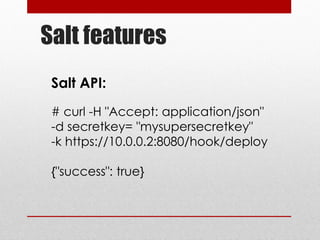
Salt API:
# curl -H "Accept: application/json"
-d secretkey= "mysupersecretkey"
-k https://10.0.0.2:8080/hook/deploy
{"success": true}
Tools
To be used…
• GIT for code repository
• Jenkins for CI
• Ant for build and tasks
• Amazon S3 for code archive storage
• Salt for deployment
• Shell scripts (good old bash) for
additional tasks
Salt deployment methods
• Salt hosted on the Jenkins server.
Jenkins calls Salt binary
• Salt hosted independently.
Jenkins calls Salt via SSH
• Jenkins calls Salt via Salt API
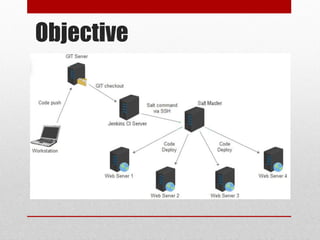
Objective
Steps
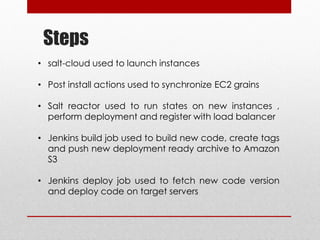
• salt-cloud used to launch instances
• Post install actions used to synchronize EC2 grains
• Salt reactor used to run states on new instances ,
perform deployment and register with load balancer
• Jenkins build job used to build new code, create tags
and push new deployment ready archive to Amazon
S3
• Jenkins deploy job used to fetch new code version
and deploy code on target servers
Steps explained
• Salt cloud is used to spawn instances
• Following parameter is provided in the profile to push custom EC2 grains,
• sync_after_install: grains
• The node is registered and deregistered from the load balancer with the
following module definition,
register:
module.run:
- name: boto_elb.register_instances
- m_name: mywebapp
- instances:
- {{ grains['ec2']['instance_id'] }}
• Here ['ec2']['instance_id'] is one of the custom grains pushed to the node
Steps explained
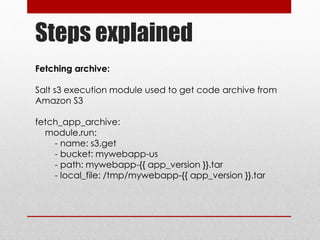
Fetching archive:
Salt s3 execution module used to get code archive from
Amazon S3
fetch_app_archive:
module.run:
- name: s3.get
- bucket: mywebapp-us
- path: mywebapp-{{ app_version }}.tar
- local_file: /tmp/mywebapp-{{ app_version }}.tar
Steps explained
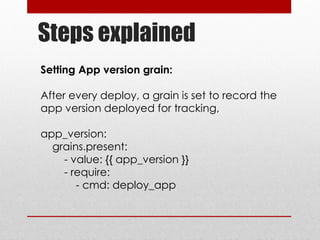
Setting App version grain:
After every deploy, a grain is set to record the
app version deployed for tracking,
app_version:
grains.present:
- value: {{ app_version }}
- require:
- cmd: deploy_app
Steps explained
Deployment based on App version:
At every deploy, it is checked if the version to
be deployed is already on the node using the
app_version grain,
{% if grains['app_version'] != app_version %}
deregister:
fetch_app_archive:
deploy_app:
register:
{% endif %}
Lets do it then !!!
Demo repository
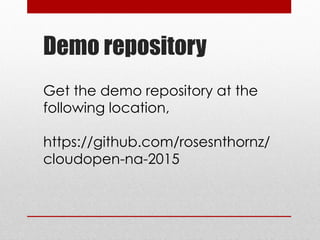
Get the demo repository at the
following location,
https://github.com/rosesnthornz/
cloudopen-na-2015
Questions ?
Contact
Email :
sahaanirban1988@gmail.com
Twitter : @rosesnthornz
Thank You !!!

Continuous Deployment with Jenkins and Salt

  • 1.
    Continuous deployment withJenkins and Salt LinuxCon CloudOpen ContainerCon North America 2015, Seattle Anirban Saha
  • 2.
  • 3.
    Deployment Should be… • Simple •Stable • Fast (good to have…) • Reliable • One click
  • 4.
    Problems faced • Codedistribution • Additional tasks (commands, migrations) • Latency • Parallel execution • Batch deployments • Ensuring uptime
  • 5.
    Methods available Deployment Configuration managementtools : • Puppet, Chef, Ansible, Salt Remote execution tools: • SSH, Parallel SSH, Rundeck Packages: • Code packaged as RPM or DEB files
  • 6.
    Code storage • GITserver (Github, Gitlab, Bitbucket, etc.) • Object storage (Amazon S3, Swift, etc.) • Package repositories (YUM/Debian) • Configuration management repositories • File servers managed manually
  • 7.
    Problems Deployment: • Remote executiontools : • Time consuming (over SSH) • Need to maintain inventory of hosts Code storage: • GIT repositories: • Usually centrally located, latency when deployed from GIT • Package repositories (RPM/DEB): • Problems in simultaneously updating repo metadata Rollback: • Version manipulation is a problem with most configuration management and remote execution tools
  • 8.
    Salt Provides… • Agent basedcommunication • Fast execution • Orchestration • Batch execution • Strong Integration with providers and services
  • 9.
    Salt features Targeting deploymentnodes : • By hostname • ‘myappweb*’ • By specific grains • -G ‘node_type:webserver’ • By nodegroups • -N webgroup
  • 10.
    Salt features Task dependencies: • Salt requisites to make tasks dependent on each other get_archive: module.run: . . deploy_app: module.run: . . - require: - module: get_archive
  • 11.
    Salt features Orchestration : webgrp2_deploy: salt.state: -tgt: ' webgrp2' - tgt_type: nodegroup - sls: - webserver.deploy - require: - salt: webgrp1_deploy webgrp1_deploy: salt.state: - tgt: 'webgrp1' - tgt_type: nodegroup - sls: - webserver.deploy
  • 12.
    Salt features Batch Execution: • By number of hosts • --batch-size 5 • Executes on 5 hosts at a time • By percentage of hosts • --batch-size 25% • Executes on 25% of total target hosts at a time
  • 13.
    Salt features Salt API: #curl -H "Accept: application/json" -d secretkey= "mysupersecretkey" -k https://10.0.0.2:8080/hook/deploy {"success": true}
  • 14.
    Tools To be used… •GIT for code repository • Jenkins for CI • Ant for build and tasks • Amazon S3 for code archive storage • Salt for deployment • Shell scripts (good old bash) for additional tasks
  • 15.
    Salt deployment methods •Salt hosted on the Jenkins server. Jenkins calls Salt binary • Salt hosted independently. Jenkins calls Salt via SSH • Jenkins calls Salt via Salt API
  • 16.
  • 17.
    Steps • salt-cloud usedto launch instances • Post install actions used to synchronize EC2 grains • Salt reactor used to run states on new instances , perform deployment and register with load balancer • Jenkins build job used to build new code, create tags and push new deployment ready archive to Amazon S3 • Jenkins deploy job used to fetch new code version and deploy code on target servers
  • 18.
    Steps explained • Saltcloud is used to spawn instances • Following parameter is provided in the profile to push custom EC2 grains, • sync_after_install: grains • The node is registered and deregistered from the load balancer with the following module definition, register: module.run: - name: boto_elb.register_instances - m_name: mywebapp - instances: - {{ grains['ec2']['instance_id'] }} • Here ['ec2']['instance_id'] is one of the custom grains pushed to the node
  • 19.
    Steps explained Fetching archive: Salts3 execution module used to get code archive from Amazon S3 fetch_app_archive: module.run: - name: s3.get - bucket: mywebapp-us - path: mywebapp-{{ app_version }}.tar - local_file: /tmp/mywebapp-{{ app_version }}.tar
  • 20.
    Steps explained Setting Appversion grain: After every deploy, a grain is set to record the app version deployed for tracking, app_version: grains.present: - value: {{ app_version }} - require: - cmd: deploy_app
  • 21.
    Steps explained Deployment basedon App version: At every deploy, it is checked if the version to be deployed is already on the node using the app_version grain, {% if grains['app_version'] != app_version %} deregister: fetch_app_archive: deploy_app: register: {% endif %}
  • 22.
    Lets do itthen !!!
  • 23.
    Demo repository Get thedemo repository at the following location, https://github.com/rosesnthornz/ cloudopen-na-2015
  • 24.
  • 25.
  • 26.