Independent Research Report
On
“Repowering the Indian Discoms: Impact of Financial Restructuring and Smart
Grid Technology on Business Viability”
Research Guide
Dr. D R Mahapatra
Post Graduate Program in Infrastructure Management (PGPIM)
June 2014
Prepared By
Aditya Parchure
Adani Institute of Infrastructure Management
ACKNOWLEDGEMENT
I would like to express my gratitude towards few key people. Without their support this project
would not have been a success.
First and foremost, I would like to thank my project guide, Prof. D R Mahapatra for providing
me constant support throughout the execution of the project. He gave me guidance,
motivation, sincere knowledge, and helped me channelize my efforts in my endeavor.
I would also like to thank Prof. Pramod Yadav who provided me with valuable insights,
scrutinized and refined my assumptions, and clarified my doubts about the project.
Last but not the least, I am grateful to our institute, The Adani Institute of Infrastructure
Management (AIIM), which provided me with the theoretical knowledge and practical insights
that made me capable of carrying out a project of this vigor.
Executive Summary
Should we rejoice about the recent slew of cleared power generation projects? Not so fast.
The ironic truth about Indian Power Sector : On one hand, the Cabinet Committee on
Investments (CCI) are busy clearing stuck power generation and other infrastructure projects-
over Rs 83,000 Crore. On the other, generation companies are finding it increasingly difficult to
find buyers for their operational plants.
The reason: State DISCOMs are preferring to cut down purchase of power rather than
increasing the cost burden of additional electricity. The State DISCOMs have been in a state of
continued financial distress due to marked difference in the ACS (Average Cost of Sale) and ARR
(Average Revenue Realized). This is mainly due to the AT&C losses suffered by the DISCOMs.
The government announced a 1.9 lakh Crore financial restructuring package in October 2012 as
a financial boost to the power sector which is expected to bring the DISCOMs back to operating
profits.
The objective of this project is to explore whether this is the right solution in the long run for
the power distribution sector. I have explored the economic impact of this FRP on DISCOMs by
developing a robust Financial Model and have also attempted to explore whether integrating
Smart Grids could serve as a sustainable solution for the power distribution sector.
Through this project I would try to answer the following questions:
What factors are actually contributing to current financial state of DISCOMs?
How are DISCOMs treating the FRP on their Balance sheet?
What is the impact of this FRP on future cash flows/valuation of the DISCOMs?
What are Smart Grids? How can they serve as a long term sustainable solution for
profitable operations of DISCOMs?
TABLE OF CONTENTS
LIST OF FIGURES ……………………………………………………………………………………………………………………...1
CHAPTER 1 : DISTRIBUTION SECTOR - OVERVIEW 2-10
 Financial Restructuring Package for State Discoms....................................... ……………….3
 ACS vs ARR Gap……………………………………………………………………………………………………………..3
 Tariff Revision……………………………………………………………………………………………………………….4
 Franchise Model for Discoms………………………………………………………………………………………...4
 RAPDRP initiative…………………………………………………………………………………………………………..5
 Credit Rating for Discoms………………………………………………………………………………………………6
 Power Purchase Cost……………………………………………………………………………………………………..9
 Tariff Renegotiation- CERC Compensatory Tariff……………………………………………………………9
 Smart Grids……………………………………………………………………………………………………………………9
 Twelfth Five Year Plan – Distribution Sector………………………………………………………………..10
CHAPTER 2 : FINANCIAL PERFORMANCE 11-15
 Revenue Growth……………………………………………………………………………...............................11
 Financial Losses……………………………………………………………………………………………………………11
 Subsidy…………………………………………………………………………………………………………………………13
 Capital Employed………………………………………………………………………………………………………….14
 Net Worth…………………………………………………………………………………………………………………….14
 Net Fixed Assets, Capital WIP (CWIP) & Capital Expenditure……………………………………….14
 Receivables for sale of Power……………………………………………………………………………………...15
 Creditors for Purchase of Power…………………………………………………………………………………..15
CHAPTER 3: FINANCIAL RESTRUCTURING PACKAGE 16-19
 Salient Features of FRP…………………………………………………………………………………………………16
 FRP: 1st
Phase of Disbursement…………………………………………………………………………………….18
 Objectives and Expected Outcomes by MoP…………………………………………………………………19
CHAPTER 4: FINANCIAL MODEL 20-30
 Objective…………………………………………………………………………………………………………………….20
 Methodology ………………………………………………………………………………………………………………20
 Key Assumptions………………………………………………………………………………………………………….20
 Schematic of FRP………………………………………………………………………………………………………….21
 Base Case…………………………………………………………………………………………………………………….21
 Impact of FRP on Valuation considering Business as usual…………………………………………..24
o Debt to Equity (D/E) , Debt to Value (D/V) & Equity/ Value………………………………24
o Cost of Equity Calculation…………………………………………………………………………………25
o Cost of Capital Calculation………………………………………………………………………………..26
o Results………………………………………………………………………………………………………………27
o Inference………………………………………………………………………………………………………….28
 Impact of complete first phase of FRP on long term valuation of Discoms with Improved
Operating side……………………………………………....................................................................29
o Assumptions …………………………………………………………………………………………………….29
o Discom Valuation …………………………………………………………………………………………….30
o Monte-carlo Simulation Results………………………………………………………………………..30
CHAPTER 5: SMART GRIDS 32-41
 Smart Grid Drivers………………………………………………………………………………………………………..32
 Smart Grid Technologies………………………………………………………………………………………………33
 Key Characteristics of Smart Grid………………………………………………………………………………….34
 Smart Grid and Integration of Renewable Energy Sources……………………………………………34
 Indian Government Initiatives toward a Smart Grid………………………………………………….....36
 How Does Smart Grid Benefit Different Stakeholders?....................................................38
 Upcoming/Proposed pilot projects……………………………………………………………………………….39
CHAPTER 6: COST BENEFIT ANALYSIS OF PUDUCHERRY PILOT & REVISITING VALUATION 42-45
 Cost Benefit Analysis…………………………………………………………………………………………………….42
 Revisiting the Valuation ……………………………………………………………………………………………….44
 Final Inferences & Recommendations
REFERENCES …………………………………………………………………………....................................................46
1 | P a g e
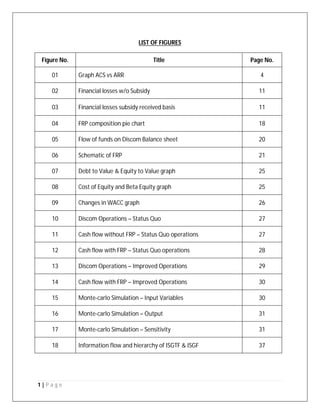
LIST OF FIGURES
Figure No. Title Page No.
01 Graph ACS vs ARR 4
02 Financial losses w/o Subsidy 11
03 Financial losses subsidy received basis 11
04 FRP composition pie chart 18
05 Flow of funds on Discom Balance sheet 20
06 Schematic of FRP 21
07 Debt to Value & Equity to Value graph 25
08 Cost of Equity and Beta Equity graph 25
09 Changes in WACC graph 26
10 Discom Operations – Status Quo 27
11 Cash flow without FRP – Status Quo operations 27
12 Cash flow with FRP – Status Quo operations 28
13 Discom Operations – Improved Operations 29
14 Cash flow with FRP – Improved Operations 30
15 Monte-carlo Simulation – Input Variables 30
16 Monte-carlo Simulation – Output 31
17 Monte-carlo Simulation – Sensitivity 31
18 Information flow and hierarchy of ISGTF & ISGF 37
2 | P a g e
1. Distribution Sector – OVERVIEW
The power sector in India is presently passing through a difficult phase. Generation and
distribution are the two segments that have been impacted the most. While the generation
segment has been plagued with fuel shortages, the distribution segment is suffering from the
financial losses of state distribution utilities, which according to estimates, presently stand at
around Rs 2.5 trillion. These issues have put a question mark on the viability of the sector.
Discoms’ ability to raise financing to purchase power for provision of quality supply and invest
in new assets to meet demand has been falling, and almost all public distribution companies
are in the red. This has been partly due to rising input costs, lack of tariff revisions and failure of
state governments to pay the subsidies due to their discoms. However, over the past years,
almost all states have witnessed a sharp rise in power tariffs and the government has launched
a debt restructuring plan linked to reforms. Aggregate technical and commercial (AT&C) losses
still remain high. This is compounded by poor metering and low levels of energy audits, making
it difficult to dissociate the commercial losses from technical losses.
There is also the issue of a large number of regulators not being effective in ensuring
compliance with regulatory requirements of open access, renewable purchase obligations,
economically sound tariff regulations, and reduction in cross‐subsidies. There is a strong need
for the support and political will of the state governments to allow regulators to act
independently.
The lack of political will to implement open access in true spirit is another challenge being faced
by the sector. A number of states have invoked Section 11 of the Electricity Act, 2003 to
disallow open access to generators within the state. A similar situation persists regarding
bringing reforms in distribution by privatization of discoms.
The distribution network in the country as of March 2012 stood at 8 million ct. km of line length
and around 520,000 MVA of transformer capacity. A total of around 235 million consumers are
served by this distribution network and the total power sold was estimated at 685,000 MUs
3 | P a g e
during 2011‐12. The AT&C losses at the country level were estimated at around 26‐27 per cent
as of March 2012.
This fifth edition of the “Power Distribution in India” report provides a comprehensive analysis
of the Indian distribution business and utility level data of 51 distribution companies, including
their asset base, performance and future plans.
Summarized below are some of the key highlights of the sector along with outstanding
challenges and the way ahead:
 Financial Restructuring Package for State Discoms
The financial restructuring package for state distribution utilities, launched in October
2012, is expected to help the distribution segment in the short term, though structural
changes are needed to turn around the segment. The financial restructuring plan is
expected to significantly ease the liquidity position of distribution utilities. The total
accumulated losses of Discoms were estimated at Rs 1.9 trillion as of March 2011.
About 70 per cent of these losses are accounted for by the Discoms of Rajasthan, Tamil
Nadu, Uttar Pradesh, Haryana, Punjab and Madhya Pradesh. The total accumulated
losses are expected to have risen to Rs 2.5 trillion by March 2012. So far, eight states
including Rajasthan, Haryana, Uttar Pradesh, Bihar, West Bengal, Tamil Nadu, Andhra
Pradesh and Kerala have opted for the restructuring package.
 ACS vs ARR - Gap
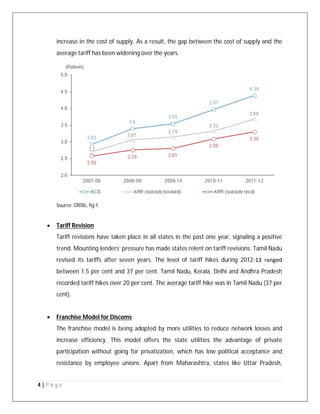
Average costs still remain higher than the average revenue for most utilities. As per the
Planning Commission’s annual report titled “The Working of State Power Utilities and
Electricity Departments”, the gap between average tariff and average cost of supply
(ACS) increased from Rs 0.76 per kWh in 1998‐99 to Rs 0.88 per kWh in 2010‐11. It is
expected to have further increased to Rs 1.07 per kWh in 2011‐12. Though the average
tariff has increased in the past few years, the rise has not been commensurate with the
4 | P a g e
increase in the cost of supply. As a result, the gap between the cost of supply and the
average tariff has been widening over the years.
Source: CRISIL, fig 1
 Tariff Revision
Tariff revisions have taken place in all states in the past one year, signaling a positive
trend. Mounting lenders’ pressure has made states relent on tariff revisions. Tamil Nadu
revised its tariffs after seven years. The level of tariff hikes during 2012‐13 ranged
between 1.5 per cent and 37 per cent. Tamil Nadu, Kerala, Delhi and Andhra Pradesh
recorded tariff hikes over 20 per cent. The average tariff hike was in Tamil Nadu (37 per
cent).
 Franchise Model for Discoms
The franchise model is being adopted by more utilities to reduce network losses and
increase efficiency. This model offers the state utilities the advantage of private
participation without going for privatization, which has low political acceptance and
resistance by employee unions. Apart from Maharashtra, states like Uttar Pradesh,
5 | P a g e
Madhya Pradesh, Odisha and Jharkhand have also appointed franchisees for high loss
circles. The model has seen a good amount of interest from private players, including
large companies such as Torrent Power Limited (TPL), Tata Power, CESC, Crompton
Greaves and Essel, and mid‐sized companies like Spanco, Enzen and GTL.
 RAPDRP initiative
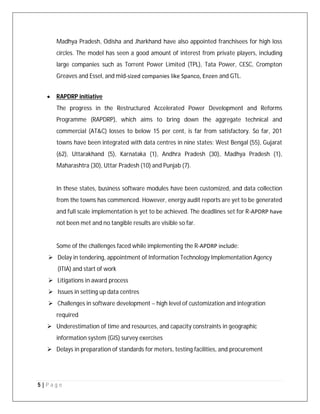
The progress in the Restructured Accelerated Power Development and Reforms
Programme (RAPDRP), which aims to bring down the aggregate technical and
commercial (AT&C) losses to below 15 per cent, is far from satisfactory. So far, 201
towns have been integrated with data centres in nine states: West Bengal (55), Gujarat
(62), Uttarakhand (5), Karnataka (1), Andhra Pradesh (30), Madhya Pradesh (1),
Maharashtra (30), Uttar Pradesh (10) and Punjab (7).
In these states, business software modules have been customized, and data collection
from the towns has commenced. However, energy audit reports are yet to be generated
and full scale implementation is yet to be achieved. The deadlines set for R‐APDRP have
not been met and no tangible results are visible so far.
Some of the challenges faced while implementing the R‐APDRP include:
 Delay in tendering, appointment of Information Technology Implementation Agency
(ITIA) and start of work
 Litigations in award process
 Issues in setting up data centres
 Challenges in software development – high level of customization and integration
required
 Underestimation of time and resources, and capacity constraints in geographic
information system (GIS) survey exercises
 Delays in preparation of standards for meters, testing facilities, and procurement
6 | P a g e
Measures are being undertaken to resolve these issues. A meter testing lab is being set
up in association with the Central Power Research Institute. Utilities have been asked to
jointly execute GIS surveys to ensure faster and smoother data validation. Joint effort
has also been suggested for resolving other issues such as discrepancies in energy
accounting data, errors in indexing of assets, etc. Further, a wider coverage area of R‐
APDRP has been suggested after the existing phase is complete. Most importantly, the
IT backbone being set up under RAPDRP is planned as the base for introducing more
advanced technologies under a smart grid framework.
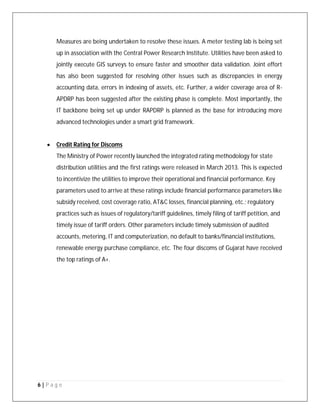
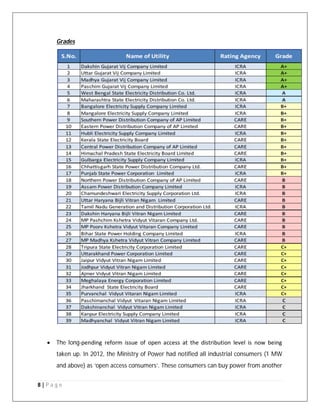
 Credit Rating for Discoms
The Ministry of Power recently launched the integrated rating methodology for state
distribution utilities and the first ratings were released in March 2013. This is expected
to incentivize the utilities to improve their operational and financial performance. Key
parameters used to arrive at these ratings include financial performance parameters like
subsidy received, cost coverage ratio, AT&C losses, financial planning, etc.; regulatory
practices such as issues of regulatory/tariff guidelines, timely filing of tariff petition, and
timely issue of tariff orders. Other parameters include timely submission of audited
accounts, metering, IT and computerization, no default to banks/financial institutions,
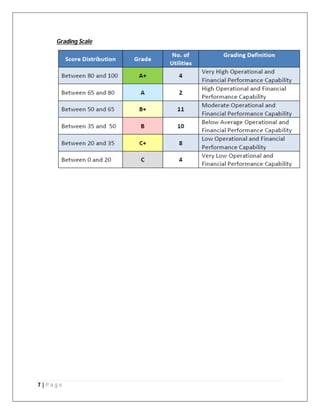
renewable energy purchase compliance, etc. The four discoms of Gujarat have received
the top ratings of A+.
7 | P a g e
Grading Scale
8 | P a g e
Grades
 The long‐pending reform issue of open access at the distribution level is now being
taken up. In 2012, the Ministry of Power had notified all industrial consumers (1 MW
and above) as ‘open access consumers’. These consumers can buy power from another
9 | P a g e
supplier or from the open market by just giving notice to the discom; and the discom is
obligated to provide network access. While this benefits industrial consumers, it has
ramifications on utilities’ business. The risk is in migration of high‐value consumers, i.e.
the industries which often cross‐subsidise other consumer categories. However, a
number of state regulators have contested the ministry’s notification.
 Power Purchase Cost
There is an upward trend in power purchase costs, which have grown at a CAGR of 14.17
per cent between 2005‐06 and 2010‐11. The increase in costs of sourcing imported coal
has been the key factor for the growth in power purchase costs. Majority of coal‐fired
power plants are now exposed to imported coal, which, as per industry sources,
increases the variable costs by about three times. Case I tariffs also show an upward
trend, as developers are trying to build in a fuel risk premium in the costs. Tariff
quotations obtained in the Case I bidding invited by Uttar Pradesh Power Corporation
Limited (UPPCL) show a range of Rs 4.48‐7.10 per unit from various developers. While
power purchase costs are expected to increase in the short‐ to medium‐term, fuel
surcharge adjustments and regular tariff revisions will help the Discoms in passing on
these costs to consumers.
 Tariff Renegotiations – CERC compensatory tariff
A major step towards reviving stalled projects under competitive bidding was taken by
the Central Electricity Regulatory Commission (CERC) in April 2013. In a ruling related to
Adani Power’s petition for renegotiating its power purchase agreements (PPAs) with
Gujarat and Haryana, the regulator allowed a compensatory tariff to offset the rise in
imported coal prices for the project. CERC called for formation of a committee to
determine a package for compensatory tariff. This judgment is likely to set a precedent
for other competitively bid projects facing similar issues.
 Smart Grids
The ongoing revamp of transmission and distribution infrastructure offers the
opportunity for introducing smart grid technologies. A few progressive Discoms
10 | P a g e
including Bangalore Electricity Supply Company (BESCOM) and Mangalore Electricity
Supply Company (MESCOM), have already implemented pilot smart grid projects. The
India Smart Grid Task Force (ISGTF), which is an inter‐ministerial group formed to focus
on activities related to smart grids, has shortlisted 14 pilot smart grid projects. Most of
the shortlisted projects target peak load management and outage management as the
desired functionalities based on advanced metering infrastructure (AMI). Its
implementation will involve varied technology options on residential, industrial,
commercial and agricultural loads. Expected benefits of the pilots include network loss
reduction and improved availability; peak load rationalization or shifting; metering and
billing cost reduction; lowering transformer failure rates; and preventing unforeseen
outages and improving recovery time. An important step towards smart grid technology
adoption has been the development of low-cost smart meters. Under the aegis of the
ISGTF, various utilities, manufacturers and technology providers are in the process of
finalizing specifications for a low‐cost smart meter. The aim is to enable widespread
adoption of smart meters across distribution utilities.
 Twelfth Five Year Plan – Distribution Sector
The total investment required by the distribution segment during the Twelfth Plan
period is estimated at Rs 3.06 trillion. The planned capital expenditure by the utilities
stands at Rs 1.52 trillion. Loss reduction and network upgradation are the key focus
areas. For the most part, utility investments will be directed at revamping the physical
infrastructure for increasing the connectivity reach (especially rural electrification),
reducing network losses (metering, HVDS, energy accounting) and capacity building for
business processes (management information systems and building up technical
manpower).
11 | P a g e
2. Financial Performance
Revenue Growth
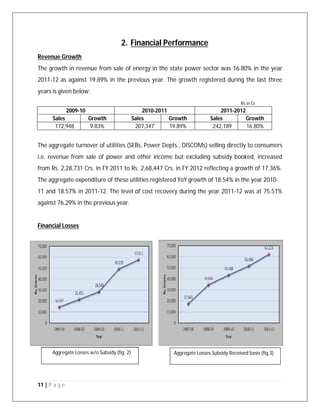
The growth in revenue from sale of energy in the state power sector was 16.80% in the year
2011-12 as against 19.89% in the previous year. The growth registered during the last three
years is given below:
Rs in Cr.
2009-10 2010-2011 2011-2012
Sales Growth Sales Growth Sales Growth
172,948 9.83% 207,347 19.89% 242,189 16.80%
The aggregate turnover of utilities (SEBs, Power Depts., DISCOMs) selling directly to consumers
i.e. revenue from sale of power and other income but excluding subsidy booked, increased
from Rs. 2,28,731 Crs. in FY 2011 to Rs. 2,68,447 Crs. in FY 2012 reflecting a growth of 17.36%.
The aggregate expenditure of these utilities registered YoY growth of 18.54% in the year 2010-
11 and 18.57% in 2011-12. The level of cost recovery during the year 2011-12 was at 75.51%
against 76.29% in the previous year.
Financial Losses
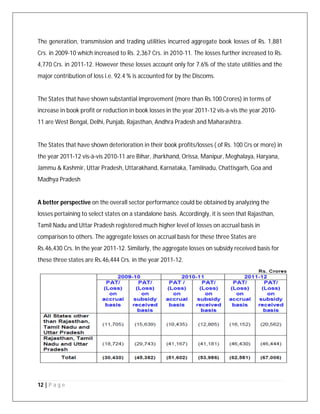
Aggregate Losses w/o Subsidy (fig. 2) Aggregate Losses Subsidy Received basis (fig.3)
12 | P a g e
The generation, transmission and trading utilities incurred aggregate book losses of Rs. 1,881
Crs. in 2009-10 which increased to Rs. 2,367 Crs. in 2010-11. The losses further increased to Rs.
4,770 Crs. in 2011-12. However these losses account only for 7.6% of the state utilities and the
major contribution of loss i.e. 92.4 % is accounted for by the Discoms.
The States that have shown substantial improvement (more than Rs.100 Crores) in terms of
increase in book profit or reduction in book losses in the year 2011-12 vis-à-vis the year 2010-
11 are West Bengal, Delhi, Punjab, Rajasthan, Andhra Pradesh and Maharashtra.
The States that have shown deterioration in their book profits/losses ( of Rs. 100 Crs or more) in
the year 2011-12 vis-à-vis 2010-11 are Bihar, Jharkhand, Orissa, Manipur, Meghalaya, Haryana,
Jammu & Kashmir, Uttar Pradesh, Uttarakhand, Karnataka, Tamilnadu, Chattisgarh, Goa and
Madhya Pradesh
A better perspective on the overall sector performance could be obtained by analyzing the
losses pertaining to select states on a standalone basis. Accordingly, it is seen that Rajasthan,
Tamil Nadu and Uttar Pradesh registered much higher level of losses on accrual basis in
comparison to others. The aggregate losses on accrual basis for these three States are
Rs.46,430 Crs. In the year 2011-12. Similarly, the aggregate losses on subsidy received basis for
these three states are Rs.46,444 Crs. in the year 2011-12.
13 | P a g e
Weakest states account for 30% of total power consumption & about 60% of accumulated
losses
 Tamil Nadu, Rajasthan, Uttar Pradesh, Punjab and Orissa are the weakest Discoms,
accounting for 30 per cent of the country's power consumption and about 60 per cent
of the total accumulated losses. Inadequate and irregular tariff hikes coupled with rising
power purchase cost has led to widening ACS-ARR gap. This has resulted in rising
accumulated losses and thereby restricted the ability of these Discoms to invest
in distribution infrastructure. Consequently, AT&C losses, particularly in UP, Rajasthan
and Odisha, are very high.
 Among these states Rajasthan has the highest state government support through equity
infusions and subsidy payments. On the other hand, state government support in
Odisha is limited due to privatization of Discoms in the state.
 Few states including Tamil Nadu, Uttar Pradesh and Rajasthan have implemented the
financial restructuring of their respective Discoms and also revised tariffs upwards over
the last 2 years. However, significant improvement is unlikely given that AT&C losses are
likely to remain high on account of muted investments and high cumulative regulatory
assets.
Subsidy
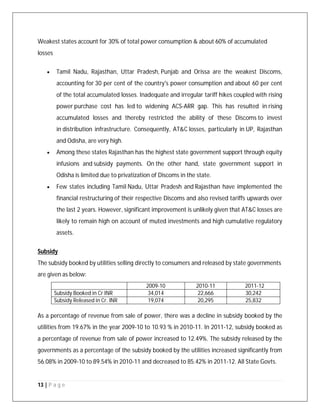
The subsidy booked by utilities selling directly to consumers and released by state governments
are given as below:
2009-10 2010-11 2011-12
Subsidy Booked in Cr INR 34,014 22,666 30,242
Subsidy Released in Cr. INR 19,074 20,295 25,832
As a percentage of revenue from sale of power, there was a decline in subsidy booked by the
utilities from 19.67% in the year 2009-10 to 10.93 % in 2010-11. In 2011-12, subsidy booked as
a percentage of revenue from sale of power increased to 12.49%. The subsidy released by the
governments as a percentage of the subsidy booked by the utilities increased significantly from
56.08% in 2009-10 to 89.54% in 2010-11 and decreased to 85.42% in 2011-12. All State Govts.
14 | P a g e
except Assam (0.00%), Andhra Pradesh (50.03%), Karnataka (88.40%) and Haryana (98.75%)
have released the entire subsidy booked by their respective distribution utilities.
Capital Employed
The total capital employed in the sector increased from Rs.3,72,936 Crs. at the end of FY 2010
to Rs.4,29,784 Crs. at the end of FY 2011 and to Rs. 4,70,792 Crs. at the end of FY 2012. The
borrowings from FIs, Banks and market continue to be the major source of capital employed in
the sector. The share of these borrowings in the total capital employed increased from 71% at
the end of FY 2010 to 76% at end of FY 2011and to 81% at the end of FY 2012. State
Government Loans, which constitute the second largest component in the capital employed,
decreased from 12% as at the end the FY 2010 to 10% as at the end of FY 2011 and increased to
12% as at the end of FY 2012.
Net worth
The net worth decreased from Rs.14,973 Crs. as on 31st March 2010 to Rs.5,314 Crs. as on 31st
March 2011. The net worth turned negative to Rs. 31,812 Crs. as on 31st March 2012. The total
equity investment in the sector went up from Rs. 1,24,258 Crs. in the year 2009-10 to
Rs.1,41,944 Crs. in the year 2010-11 and to Rs. 1,70,451 Crs. in 2011-12 reflecting an increase of
20% in the year 2011-12.
Net Fixed Assets, Capital WIP (CWIP) & Capital Expenditure
The Net Fixed Assets showed an increase from Rs.2,31,812 Crs. as on 31st March, 2010 to
Rs.2,96,179 Crs. as on 31st March, 2011 and to Rs.3,26,549 Crs. as on 31st March, 2012. The
CWIP along with advances to contractors increased from Rs.96,364 Crs. as on 31st March 2010
to Rs.1,07,038 Crs. as on 31st March, 2011 and to Rs.1,30,730 Crs. as on 31st March, 2012.
The capital expenditure during the year 2009-10 was Rs.59,022 Crs., which increased to
Rs.70,147 Crs. in 2010-11. However, in 2011-12 it decreased marginally to Rs.69,868Crs.
15 | P a g e
Receivables for sale of Power
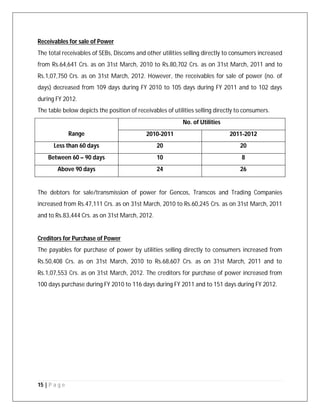
The total receivables of SEBs, Discoms and other utilities selling directly to consumers increased
from Rs.64,641 Crs. as on 31st March, 2010 to Rs.80,702 Crs. as on 31st March, 2011 and to
Rs.1,07,750 Crs. as on 31st March, 2012. However, the receivables for sale of power (no. of
days) decreased from 109 days during FY 2010 to 105 days during FY 2011 and to 102 days
during FY 2012.
The table below depicts the position of receivables of utilities selling directly to consumers.
Range
No. of Utilities
2010-2011 2011-2012
Less than 60 days 20 20
Between 60 – 90 days 10 8
Above 90 days 24 26
The debtors for sale/transmission of power for Gencos, Transcos and Trading Companies
increased from Rs.47,111 Crs. as on 31st March, 2010 to Rs.60,245 Crs. as on 31st March, 2011
and to Rs.83,444 Crs. as on 31st March, 2012.
Creditors for Purchase of Power
The payables for purchase of power by utilities selling directly to consumers increased from
Rs.50,408 Crs. as on 31st March, 2010 to Rs.68,607 Crs. as on 31st March, 2011 and to
Rs.1,07,553 Crs. as on 31st March, 2012. The creditors for purchase of power increased from
100 days purchase during FY 2010 to 116 days during FY 2011 and to 151 days during FY 2012.
16 | P a g e
3. Financial Restructuring Package
A scheme for Financial restructuring of State Owned Discoms has been formulated and
approved by the Government to enable the turnaround of the State Discoms and ensure their
long term viability. The scheme contains measures to be taken by the State Discoms and State
Government for achieving financial turnaround by restructuring their debt with support
through a Transitional Finance Mechanism by Central Government.
The salient features of the Scheme for restructuring are as under:-
A.
1. 50% of the outstanding short term liabilities (STL) as of March 31, 2012 to be taken
over by State Governments. This shall be first converted into bonds to be issued by
Discoms to participating lenders, duly backed by the State Government guarantee. The
State Government will take over the liability during next 2-5 years by issuance of
special securities in favor of participating lenders in a phased manner keeping in view
the fiscal space available till the entire loan (50% of STL) is taken over by the State
Government. The door to door maturity will not be more than 15 years with a
moratorium of 3-5 years on the principal repayment.
2. The State Government would provide full support to the Discoms for repayment of
interest and principal for this portion.
3. State Government would ensure that issuance of Special securities is within the targets
prescribed in FRBM Acts of respective States and even if fiscal space including Debt-
GSDP ratio under the FRBM targets is available, States need to remain with their
respective Net Borrowing Ceilings (of each of the relevant fiscal) fixed annually as per
the formula prescribed by the Thirteenth Finance Commission .
B.
Balance 50% of the STL will be rescheduled by lenders and serviced by the
DISCOMS with moratorium of 3 years on principal. Repayment of Principal and
Interest be fully secured by the State Government Guarantee. The best possible
17 | P a g e
terms are to be extended for the rescheduled loans to improve viability of
Discoms operations.
C.
The restructuring/reschedulement of loan is to be accompanied by concrete and
measurable action by the Discoms/States to improve the operational performance of
the distribution utilities. State Government Discoms have to commit themselves and
carry out certain mandatory and recommendatory conditions as contained in part (C) of
the Scheme.
D.
A Transitional Finance Mechanism (TFM) by the Central Government in support of the
restructuring effort is available, subject to fulfillment of mandatory conditions given in
part C of the scheme. The TFM has the following features :-
(i)
 For providing liquidity support by way of a grant equal to the value of the additional
energy saved by way of accelerated AT&C loss reduction beyond the loss trajectory
specified under RAPDRP (Restructured Accelerated Power Development and Reform
Programme).
• The eligibility of grant would arise only if the gap between ARR and ACS for the year has
been reduced by at least 25% during the year judged against the benchmark for the year
2010-11.
• This scheme would be available only for three years beginning 2012-13.
(ii) Incentive by way of capital reimbursement support of 25% of principal repayment
by the State Government on the liability taken over by the State Government under the
scheme. The amount to be reimbursed only in case the State Government take-over the
entire 50% of the short term liabilities(corresponding to the accumulated losses)
outstanding as on 31 .3.2012.
18 | P a g e
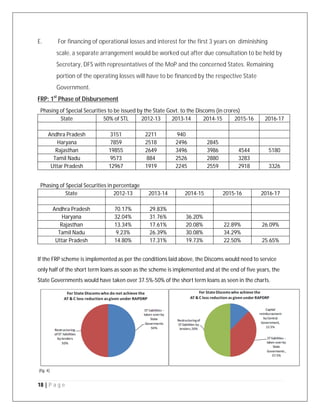
E. For financing of operational losses and interest for the first 3 years on diminishing
scale, a separate arrangement would be worked out after due consultation to be held by
Secretary, DFS with representatives of the MoP and the concerned States. Remaining
portion of the operating losses will have to be financed by the respective State
Government.
FRP: 1st
Phase of Disbursement
Phasing of Special Securities to be issued by the State Govt. to the Discoms (in crores)
State 50% of STL 2012-13 2013-14 2014-15 2015-16 2016-17
Andhra Pradesh 3151 2211 940
Haryana 7859 2518 2496 2845
Rajasthan 19855 2649 3496 3986 4544 5180
Tamil Nadu 9573 884 2526 2880 3283
Uttar Pradesh 12967 1919 2245 2559 2918 3326
Phasing of Special Securities in percentage
State 2012-13 2013-14 2014-15 2015-16 2016-17
Andhra Pradesh 70.17% 29.83%
Haryana 32.04% 31.76% 36.20%
Rajasthan 13.34% 17.61% 20.08% 22.89% 26.09%
Tamil Nadu 9.23% 26.39% 30.08% 34.29%
Uttar Pradesh 14.80% 17.31% 19.73% 22.50% 25.65%
If the FRP scheme is implemented as per the conditions laid above, the Discoms would need to service
only half of the short term loans as soon as the scheme is implemented and at the end of five years, the
State Governments would have taken over 37.5%-50% of the short term loans as seen in the charts.
(fig. 4)
19 | P a g e
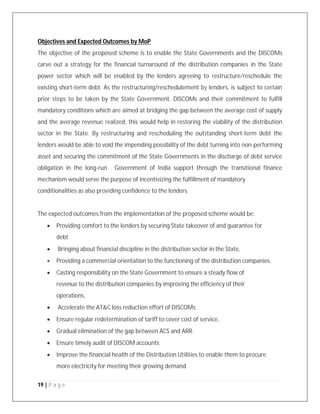
Objectives and Expected Outcomes by MoP
The objective of the proposed scheme is to enable the State Governments and the DISCOMs
carve out a strategy for the financial turnaround of the distribution companies in the State
power sector which will be enabled by the lenders agreeing to restructure/reschedule the
existing short-term debt. As the restructuring/reschedulement by lenders, is subject to certain
prior steps to be taken by the State Government. DISCOMs and their commitment to fulfill
mandatory conditions which are aimed at bridging the gap between the average cost of supply
and the average revenue realized, this would help in restoring the viability of the distribution
sector in the State. By restructuring and rescheduling the outstanding short-term debt the
lenders would be able to void the impending possibility of the debt turning into non-performing
asset and securing the commitment of the State Governments in the discharge of debt service
obligation in the long-run . Government of India support through the transitional finance
mechanism would serve the purpose of incentivizing the fulfillment of mandatory
conditionalities as also providing confidence to the lenders.
The expected outcomes from the implementation of the proposed scheme would be:
 Providing comfort to the lenders by securing State takeover of and guarantee for
debt
 Bringing about financial discipline in the distribution sector in the State,
 Providing a commercial orientation to the functioning of the distribution companies,
 Casting responsibility on the State Government to ensure a steady flow of
revenue to the distribution companies by improving the efficiency of their
operations,
 Accelerate the AT&C loss reduction effort of DISCOMs
 Ensure regular redetermination of tariff to cover cost of service,
 Gradual elimination of the gap between ACS and ARR.
 Ensure timely audit of DISCOM accounts
 Improve the financial health of the Distribution Utilities to enable them to procure
more electricity for meeting their growing demand
20 | P a g e
4. Financial Model
Objective: To generate a spread sheet based financial model which would carry out valuation
for Discoms considering the impact of 1st
phase disbursement on FRP and gain all possible
insights for the purpose of setting parameters for Discom Operation and Policy Regulation.
Methodology Adopted : We have prepared a base case spreadsheet based financial model with
the help of existing financial statements for the fiscal year 2011-2012 of a Discom and
forecasted future cash flows by taking into consideration the historical performance, possible
initiatives from state government and Discom operator and the impact of FRP on the cost of
capital. The basic purpose of this exercise is to create a universal model where the existing
financial and operational data available can be keyed in to obtain relevant insights to move
towards sustainability of bleeding State Discoms.
Key Assumptions:
 Due to absence of adequate clarity on the repayment pattern of the bonds to be issued by the
Discoms, the analysis does not take into account any principal repayment or consequent capital
reimbursement (25%) from GoI to the State Governments.
 Growth in Tariff have been considered as announced in that particular state
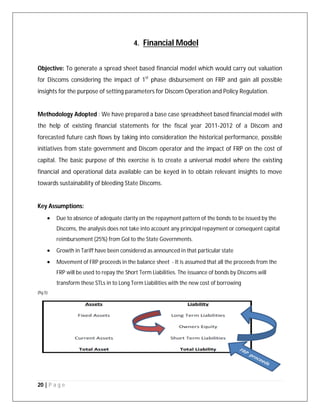
 Movement of FRP proceeds in the balance sheet - It is assumed that all the proceeds from the
FRP will be used to repay the Short Term Liabilities. The issuance of bonds by Discoms will
transform these STLs in to Long Term Liabilities with the new cost of borrowing
(fig.5)
21 | P a g e
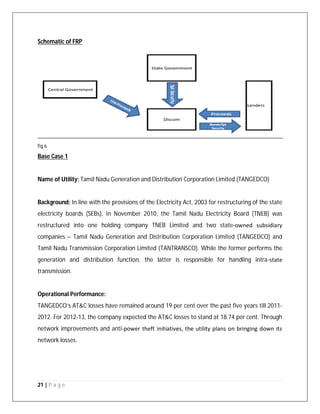
Schematic of FRP
fig 6
Base Case 1
Name of Utility: Tamil Nadu Generation and Distribution Corporation Limited (TANGEDCO)
Background: In line with the provisions of the Electricity Act, 2003 for restructuring of the state
electricity boards (SEBs), in November 2010, the Tamil Nadu Electricity Board (TNEB) was
restructured into one holding company TNEB Limited and two state‐owned subsidiary
companies – Tamil Nadu Generation and Distribution Corporation Limited (TANGEDCO) and
Tamil Nadu Transmission Corporation Limited (TANTRANSCO). While the former performs the
generation and distribution function, the latter is responsible for handling intra‐state
transmission.
Operational Performance:
TANGEDCO’s AT&C losses have remained around 19 per cent over the past five years till 2011-
2012. For 2012‐13, the company expected the AT&C losses to stand at 18.74 per cent. Through
network improvements and anti‐power theft initiatives, the utility plans on bringing down its
network losses.
22 | P a g e
TANGEDCO’s power purchase costs stood at over 21000 Cr INR as of March 2012, registering a
CAGR of 16.25 per cent over the five‐year period under consideration. The O&M expenses, that
takes into account the R&M expenses, A&G expenses and the employee cost, were at 4539 Cr
INR for 2011‐12, reporting an increase of 4 per cent over 2010‐11.
In terms of metering, all consumer categories served by TANGEDCO, with the exception of only
two categories namely agricultural (2.02 million consumers) and hut service consumers (1.46
million consumers), are fully metered. Further, with respect to existing metered consumers,
initiatives are being undertaken to gradually replace the existing electro‐mechanical meters
with static meters. This would help in reduction of tampering, identifying various parameters,
downloading of data, introduction of ToD tariff, etc. besides reducing billing errors. Also, all
new service connections are being provided with static meters. The utility’s collection efficiency
for the year 2011‐12 stands at 98 per cent.
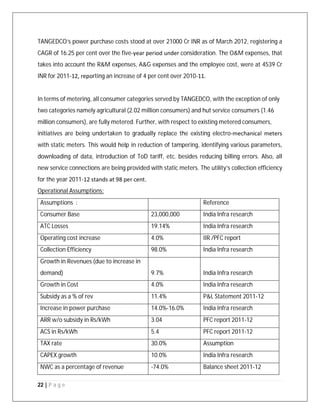
Operational Assumptions:
Assumptions : Reference
Consumer Base 23,000,000 India Infra research
ATC Losses 19.14% India Infra research
Operating cost increase 4.0% IIR /PFC report
Collection Efficiency 98.0% India Infra research
Growth in Revenues (due to increase in
demand) 9.7% India Infra research
Growth in Cost 4.0% India Infra research
Subsidy as a % of rev 11.4% P&L Statement 2011-12
Increase in power purchase 14.0%-16.0% India Infra research
ARR w/o subsidy in Rs/kWh 3.04 PFC report 2011-12
ACS in Rs/kWh 5.4 PFC report 2011-12
TAX rate 30.0% Assumption
CAPEX growth 10.0% India Infra research
NWC as a percentage of revenue -74.0% Balance sheet 2011-12
23 | P a g e
including subsidy
Cost of capital (original) 10.38% Calculated as given
Growth in Tariff in 1st yr and 2nd year 37%, 4% Infraline
ATC Loss:
As the T&D loss was not able to capture all the losses in the net work, concept of Aggregate
Technical and Commercial (AT&C) loss was introduced. AT&C loss captures technical as well as
commercial losses in the network and is a true indicator of total losses in the system.
High technical losses in the system are primarily due to inadequate investments over the years
for system improvement works, which has resulted in unplanned extensions of the distribution
lines, overloading of the system elements like transformers and conductors, and lack of
adequate reactive power support.
The commercial losses are mainly due to low metering efficiency, theft & pilferages. This may
be eliminated by improving metering efficiency, proper energy accounting & auditing and
improved billing & collection efficiency. Fixing of accountability of the personnel / feeder
managers may help considerably in reduction of AT&C loss.
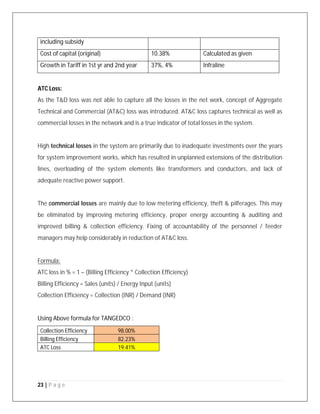
Formula:
ATC loss in % = 1 – (Billing Efficiency * Collection Efficiency)
Billing Efficiency = Sales (units) / Energy Input (units)
Collection Efficiency = Collection (INR) / Demand (INR)
Using Above formula for TANGEDCO :
Collection Efficiency 98.00%
Billing Efficiency 82.23%
ATC Loss 19.41%
24 | P a g e
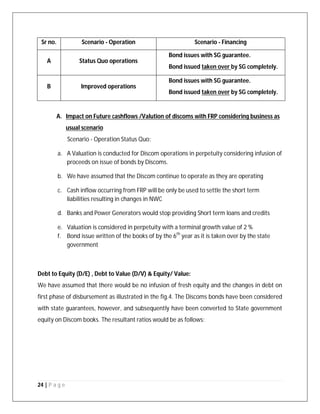
Sr no. Scenario - Operation Scenario - Financing
A Status Quo operations
Bond issues with SG guarantee.
Bond issued taken over by SG completely.
B Improved operations
Bond issues with SG guarantee.
Bond issued taken over by SG completely.
A. Impact on Future cashflows /Valution of discoms with FRP considering business as
usual scenario
Scenario - Operation Status Quo:
a. A Valuation is conducted for Discom operations in perpetuity considering infusion of
proceeds on issue of bonds by Discoms.
b. We have assumed that the Discom continue to operate as they are operating
c. Cash inflow occurring from FRP will be only be used to settle the short term
liabilities resulting in changes in NWC
d. Banks and Power Generators would stop providing Short term loans and credits
e. Valuation is considered in perpetuity with a terminal growth value of 2 %
f. Bond issue written of the books of by the 6th
year as it is taken over by the state
government
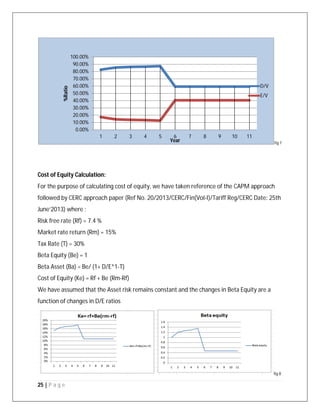
Debt to Equity (D/E) , Debt to Value (D/V) & Equity/ Value:
We have assumed that there would be no infusion of fresh equity and the changes in debt on
first phase of disbursement as illustrated in the fig.4. The Discoms bonds have been considered
with state guarantees, however, and subsequently have been converted to State government
equity on Discom books. The resultant ratios would be as follows:
25 | P a g e
fig 7
Cost of Equity Calculation:
For the purpose of calculating cost of equity, we have taken reference of the CAPM approach
followed by CERC approach paper (Ref No. 20/2013/CERC/Fin(Vol-I)/Tariff Reg/CERC Date: 25th
June’2013) where :
Risk free rate (Rf) = 7.4 %
Market rate return (Rm) = 15%
Tax Rate (T) = 30%
Beta Equity (Be) = 1
Beta Asset (Ba) = Be/ (1+ D/E*1-T)
Cost of Equity (Ke) = Rf + Be (Rm-Rf)
We have assumed that the Asset risk remains constant and the changes in Beta Equity are a
function of changes in D/E ratios
fig.8
0.00%
10.00%
20.00%
30.00%
40.00%
50.00%
60.00%
70.00%
80.00%
90.00%
100.00%
1 2 3 4 5 6 7 8 9 10 11
%Ratio
Year
D/V
E/V
26 | P a g e
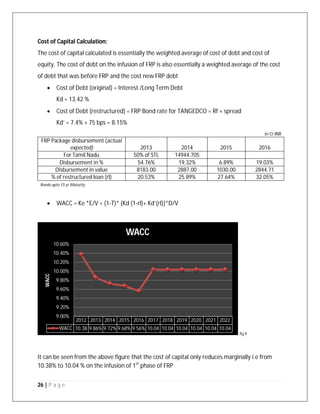
Cost of Capital Calculation:
The cost of capital calculated is essentially the weighted average of cost of debt and cost of
equity. The cost of debt on the infusion of FRP is also essentially a weighted average of the cost
of debt that was before FRP and the cost new FRP debt
 Cost of Debt (original) = Interest /Long Term Debt
Kd = 13.42 %
 Cost of Debt (restructured) = FRP Bond rate for TANGEDCO = Rf + spread
Kd’ = 7.4% + 75 bps = 8.15%
in Cr INR
FRP Package disbursement (actual
expected) 2013 2014 2015 2016
For Tamil Nadu 50% of STL 14944.705
Disbursement in % 54.76% 19.32% 6.89% 19.03%
Disbursement in value 8183.00 2887.00 1030.00 2844.71
% of restructured loan (rl) 20.53% 25.89% 27.64% 32.05%
Bonds upto 15 yr Maturity
 WACC = Ke *E/V + (1-T)* {Kd (1-rl)+ Kd’(rl)}*D/V
fig 9
It can be seen from the above figure that the cost of capital only reduces marginally i.e from
10.38% to 10.04 % on the infusion of 1st
phase of FRP
2012 2013 2014 2015 2016 2017 2018 2019 2020 2021 2022
WACC 10.38 9.86% 9.72% 9.68% 9.56% 10.04 10.04 10.04 10.04 10.04 10.04
9.00%
9.20%
9.40%
9.60%
9.80%
10.00%
10.20%
10.40%
10.60%
WACC
WACC
27 | P a g e
Results:
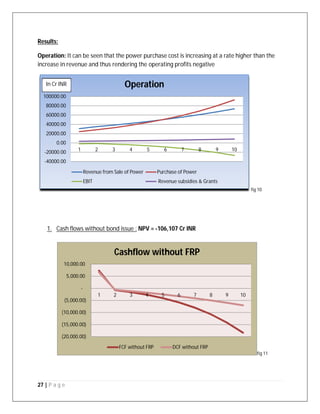
Operation: It can be seen that the power purchase cost is increasing at a rate higher than the
increase in revenue and thus rendering the operating profits negative
fig 10
1. Cash flows without bond issue : NPV = -106,107 Cr INR
fig 11
-40000.00
-20000.00
0.00
20000.00
40000.00
60000.00
80000.00
100000.00
1 2 3 4 5 6 7 8 9 10
Operation
Revenue from Sale of Power Purchase of Power
EBIT Revenue subsidies & Grants
(20,000.00)
(15,000.00)
(10,000.00)
(5,000.00)
-
5,000.00
10,000.00
1 2 3 4 5 6 7 8 9 10
Cashflow without FRP
FCF without FRP DCF without FRP
In Cr INR
28 | P a g e
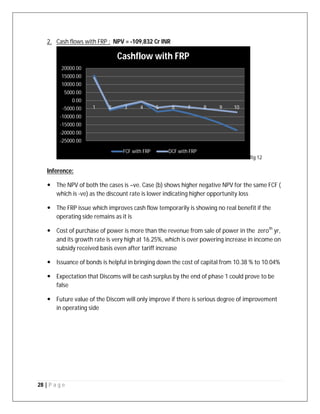
2. Cash flows with FRP : NPV = -109,832 Cr INR
fig 12
Inference:
 The NPV of both the cases is –ve. Case (b) shows higher negative NPV for the same FCF (
which is -ve) as the discount rate is lower indicating higher opportunity loss
 The FRP issue which improves cash flow temporarily is showing no real benefit if the
operating side remains as it is
 Cost of purchase of power is more than the revenue from sale of power in the zeroth
yr,
and its growth rate is very high at 16.25%, which is over powering increase in income on
subsidy received basis even after tariff increase
 Issuance of bonds is helpful in bringing down the cost of capital from 10.38 % to 10.04%
 Expectation that Discoms will be cash surplus by the end of phase 1 could prove to be
false
 Future value of the Discom will only improve if there is serious degree of improvement
in operating side
-25000.00
-20000.00
-15000.00
-10000.00
-5000.00
0.00
5000.00
10000.00
15000.00
20000.00
1 2 3 4 5 6 7 8 9 10
Cashflow with FRP
FCF with FRP DCF with FRP
29 | P a g e
B. Impact of complete first phase of FRP on long term valuation of Discoms with
Improved Operating side
Scenario: Improvement in Operating side of discoms as per the following parameters
 Power purchase cost grow at a lower rate of as compared to all India CAGR i.e @
12% < 15 % as State Generation improves
 ATC loss improvement of 1.5 % per annum to meet the loss reduction trajectory
as specified by the RAPDRP
 Average tariff hike in 8th
year – say @ 12 %
 Cost of restructured loan @ 8.9%
 Operational loss funding as per the scheme from Central government considered
for Tamil Nadu
 Bond issue written of the books of by the 6th
year as it is taken over by the state
government
 Valuation is considered in perpetuity with a terminal growth value of 2 %
Results:
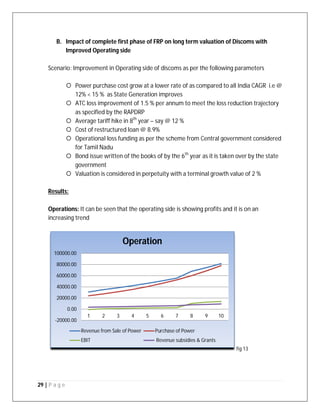
Operations: It can be seen that the operating side is showing profits and it is on an
increasing trend
fig 13
-20000.00
0.00
20000.00
40000.00
60000.00
80000.00
100000.00
1 2 3 4 5 6 7 8 9 10
Operation
Revenue from Sale of Power Purchase of Power
EBIT Revenue subsidies & Grants
30 | P a g e
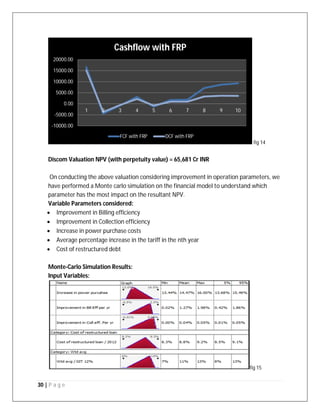
fig 14
Discom Valuation NPV (with perpetuity value) = 65,681 Cr INR
On conducting the above valuation considering improvement in operation parameters, we
have performed a Monte carlo simulation on the financial model to understand which
parameter has the most impact on the resultant NPV.
Variable Parameters considered:
 Improvement in Billing efficiency
 Improvement in Collection efficiency
 Increase in power purchase costs
 Average percentage increase in the tariff in the nth year
 Cost of restructured debt
Monte-Carlo Simulation Results:
Input Variables:
fig 15
-10000.00
-5000.00
0.00
5000.00
10000.00
15000.00
20000.00
1 2 3 4 5 6 7 8 9 10
Cashflow with FRP
FCF with FRP DCF with FRP
31 | P a g e
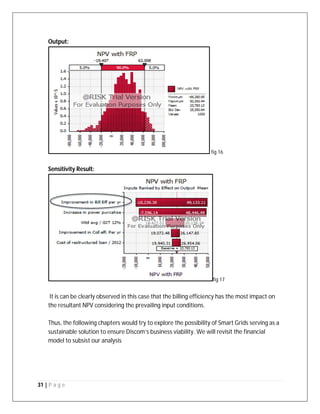
Output:
fig 16
Sensitivity Result:
fig 17
It is can be clearly observed in this case that the billing efficiency has the most impact on
the resultant NPV considering the prevailing input conditions.
Thus, the following chapters would try to explore the possibility of Smart Grids serving as a
sustainable solution to ensure Discom’s business viability. We will revisit the financial
model to subsist our analysis
32 | P a g e
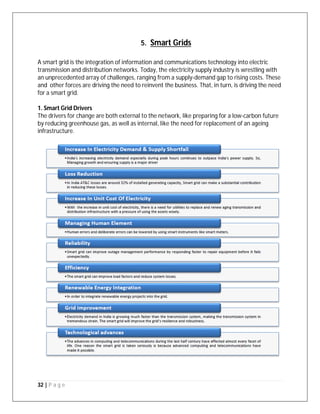
5. Smart Grids
A smart grid is the integration of information and communications technology into electric
transmission and distribution networks. Today, the electricity supply industry is wrestling with
an unprecedented array of challenges, ranging from a supply-demand gap to rising costs. These
and other forces are driving the need to reinvent the business. That, in turn, is driving the need
for a smart grid.
1. Smart Grid Drivers
The drivers for change are both external to the network, like preparing for a low-carbon future
by reducing greenhouse gas, as well as internal, like the need for replacement of an ageing
infrastructure.
33 | P a g e
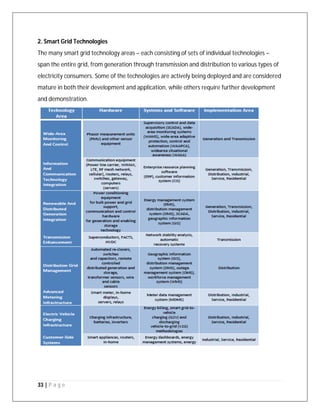
2. Smart Grid Technologies
The many smart grid technology areas – each consisting of sets of individual technologies –
span the entire grid, from generation through transmission and distribution to various types of
electricity consumers. Some of the technologies are actively being deployed and are considered
mature in both their development and application, while others require further development
and demonstration.
34 | P a g e
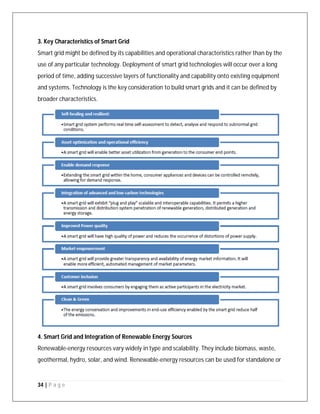
3. Key Characteristics of Smart Grid
Smart grid might be defined by its capabilities and operational characteristics rather than by the
use of any particular technology. Deployment of smart grid technologies will occur over a long
period of time, adding successive layers of functionality and capability onto existing equipment
and systems. Technology is the key consideration to build smart grids and it can be defined by
broader characteristics.
4. Smart Grid and Integration of Renewable Energy Sources
Renewable-energy resources vary widely in type and scalability. They include biomass, waste,
geothermal, hydro, solar, and wind. Renewable-energy resources can be used for standalone or
35 | P a g e
islanded (system isolated) power generation, but their benefits are greatly enhanced when they
are integrated into broader electric power grids. With greater use of smart grid technologies,
higher degrees and rates of penetration can be accommodated. Each resource is different from
the grid’s perspective and some are easier to integrate than others. Variable generation,
provided by many renewable-energy sources, can be a challenge to electric system operations,
but when used in conjunction with smart grid approaches, responsive distributed generation
also can be a benefit to system operations if coordinated to relieve stress in the system.
Key characteristics of renewable resources that impact their integration into power grids are
their size (generation capacity as compared to other sources of power generation on a system),
their location (both geographically and with respect to network topology), and their variability
(minute by- minute, daily, seasonally, and intermittently).
Smart grid technology can control renewable resources to effect changes in the grid’s operating
conditions and can provide additional benefits as distributed generation assets or when
installed at the transmission level. Small, electricity-generating systems located at or near the
place where the energy is used and connected at the distribution level are referred to as
distributed generation. Residential-scale wind and solar energy projects are examples of
distributed generation. Distributed generation assets can support weak grids, adding grid
voltage and improving power quality. Having generation close to load can reduce transmission
losses and infrastructure costs and can support the operation of local islands of electricity to
reduce impacts of wide scale black-outs.
Smart grid technologies and concepts can significantly reduce barriers to the integration of
renewable resources and allow power grids to support a greater percentage of variable
renewable resources. Enabling smart grid technology, such as distributed storage, demand
response, advanced sensing, control software, information infrastructure, and market signals,
increases the ability to influence and balance supply and demand. With smart grid technology,
grid operators can better coordinate and control the system in response to grid conditions, thus
36 | P a g e
allowing integration of increasingly greater levels of renewable resources more effectively and
at lower cost.
5. Indian Government Initiatives toward a Smart Grid
5.1 India Smart Grid Task Force (ISGTF)
The Government of India formed the India Smart Grid Task Force in 2010 as an inter-ministerial
group and will serve as the government focal point. It is a body composed of officials from
different government departments and is primarily meant for understanding and advocating
policies in smart grid technologies.
Major functions of the ISGTF are:
a. Ensure awareness, coordination, and integration of diverse activities related to
smart grid technologies
b. Promote practices and services for R&D of smart grids
c. Coordinate and integrate other relevant intergovernmental activities
d. Collaborate on an interoperability framework
e. Review and validate recommendations from the India Smart Grid Forum.
5.2 India Smart Grid Forum (ISGF)
The Government of India also formulated the India Smart Grid Forum in 2010 as a non-profit,
voluntary consortium of public and private stakeholders with the prime objective of
accelerating development of smart grid technologies in the Indian power sector. The ISGF has
roles and responsibilities complementary to the ISGTF.
The goal of the Forum is to help the Indian power sector to deploy Smart Grid technologies in
an efficient, cost-effective, innovative and scalable manner by bringing together all the key
stakeholders and enabling technologies.
37 | P a g e
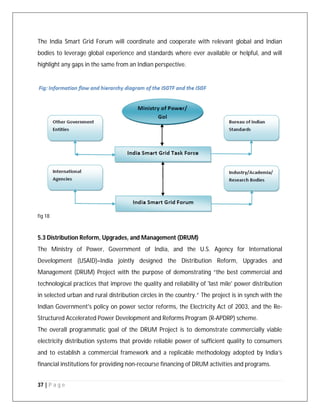
The India Smart Grid Forum will coordinate and cooperate with relevant global and Indian
bodies to leverage global experience and standards where ever available or helpful, and will
highlight any gaps in the same from an Indian perspective.
fig 18
5.3 Distribution Reform, Upgrades, and Management (DRUM)
The Ministry of Power, Government of India, and the U.S. Agency for International
Development (USAID)–India jointly designed the Distribution Reform, Upgrades and
Management (DRUM) Project with the purpose of demonstrating “the best commercial and
technological practices that improve the quality and reliability of 'last mile' power distribution
in selected urban and rural distribution circles in the country.” The project is in synch with the
Indian Government's policy on power sector reforms, the Electricity Act of 2003, and the Re-
Structured Accelerated Power Development and Reforms Program (R-APDRP) scheme.
The overall programmatic goal of the DRUM Project is to demonstrate commercially viable
electricity distribution systems that provide reliable power of sufficient quality to consumers
and to establish a commercial framework and a replicable methodology adopted by India’s
financial institutions for providing non-recourse financing of DRUM activities and programs.
38 | P a g e
5.4 Re-Structured Accelerated Power Development and Reforms Program (R-APDRP)
Ministry of Power, Govt. of India, as a part of Reforms in the Power Sector, has launched the
RAPDRP in the XI Five year Plan. The focus of the program is on the actual demonstrable
performance in terms of AT&C loss reduction, establishment of the reliable and automated
sustainable systems for collection of base line data, adoption of information technology in the
areas of electricity accounting, Consumer care and strengthening of Distribution network of
State Power Utilities.
Projects under the scheme shall be taken up in two parts. Part-A shall include the projects for
establishment of baseline data and IT applications for energy accounting/auditing & IT based
consumer service centres. Part-B shall include regular distribution strengthening projects.
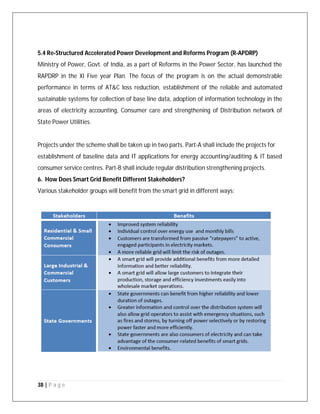
6. How Does Smart Grid Benefit Different Stakeholders?
Various stakeholder groups will benefit from the smart grid in different ways:
39 | P a g e
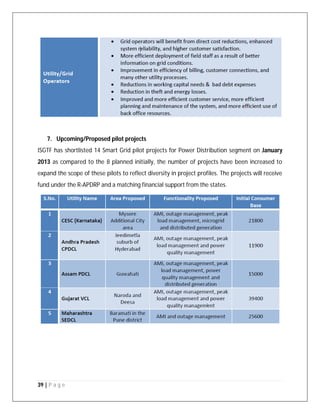
7. Upcoming/Proposed pilot projects
ISGTF has shortlisted 14 Smart Grid pilot projects for Power Distribution segment on January
2013 as compared to the 8 planned initially, the number of projects have been increased to
expand the scope of these pilots to reflect diversity in project profiles. The projects will receive
fund under the R-APDRP and a matching financial support from the states.
40 | P a g e
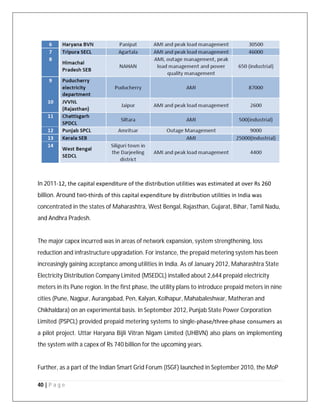
In 2011‐12, the capital expenditure of the distribution utilities was estimated at over Rs 260
billion. Around two‐thirds of this capital expenditure by distribution utilities in India was
concentrated in the states of Maharashtra, West Bengal, Rajasthan, Gujarat, Bihar, Tamil Nadu,
and Andhra Pradesh.
The major capex incurred was in areas of network expansion, system strengthening, loss
reduction and infrastructure upgradation. For instance, the prepaid metering system has been
increasingly gaining acceptance among utilities in India. As of January 2012, Maharashtra State
Electricity Distribution Company Limited (MSEDCL) installed about 2,644 prepaid electricity
meters in its Pune region. In the first phase, the utility plans to introduce prepaid meters in nine
cities (Pune, Nagpur, Aurangabad, Pen, Kalyan, Kolhapur, Mahabaleshwar, Matheran and
Chikhaldara) on an experimental basis. In September 2012, Punjab State Power Corporation
Limited (PSPCL) provided prepaid metering systems to single‐phase/three‐phase consumers as
a pilot project. Uttar Haryana Bijli Vitran Nigam Limited (UHBVN) also plans on implementing
the system with a capex of Rs 740 billion for the upcoming years.
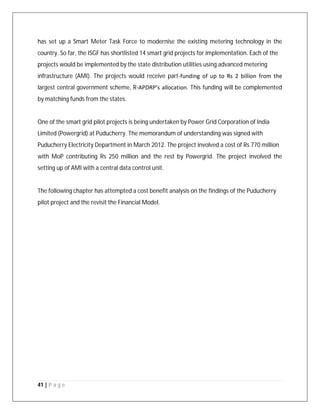
Further, as a part of the Indian Smart Grid Forum (ISGF) launched in September 2010, the MoP
41 | P a g e
has set up a Smart Meter Task Force to modernise the existing metering technology in the
country. So far, the ISGF has shortlisted 14 smart grid projects for implementation. Each of the
projects would be implemented by the state distribution utilities using advanced metering
infrastructure (AMI). The projects would receive part‐funding of up to Rs 2 billion from the
largest central government scheme, R‐APDRP’s allocation. This funding will be complemented
by matching funds from the states.
One of the smart grid pilot projects is being undertaken by Power Grid Corporation of India
Limited (Powergrid) at Puducherry. The memorandum of understanding was signed with
Puducherry Electricity Department in March 2012. The project involved a cost of Rs 770 million
with MoP contributing Rs 250 million and the rest by Powergrid. The project involved the
setting up of AMI with a central data control unit.
The following chapter has attempted a cost benefit analysis on the findings of the Puducherry
pilot project and the revisit the Financial Model.
42 | P a g e
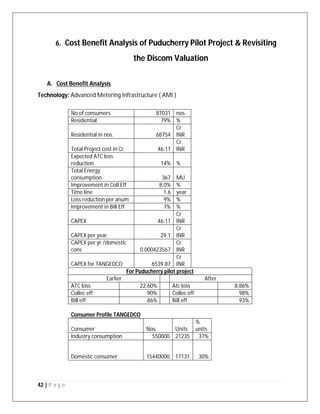
6. Cost Benefit Analysis of Puducherry Pilot Project & Revisiting
the Discom Valuation
A. Cost Benefit Analysis
Technology: Advanced Metering Infrastructure ( AMI )
No of consumers 87031 nos.
Residential 79% %
Residential in nos. 68754
Cr
INR
Total Project cost in Cr 46.11
Cr.
INR
Expected ATC loss
reduction 14% %
Total Energy
consumption 367 MU
Improvement in Coll Eff 8.0% %
Time line 1.6 year
Loss reduction per anum 9% %
Improvement in Bill Eff 7% %
CAPEX 46.11
Cr
INR
CAPEX per year 29.1
Cr
INR
CAPEX per yr /domestic
cons 0.000423567
Cr
INR
CAPEX for TANGEDCO 6539.87
Cr
INR
For Puducherry pilot project
Earlier After
ATC loss 22.60% Atc loss 8.86%
Collec eff 90% Collec eff 98%
Bill eff 86% Bill eff 93%
Consumer Profile TANGEDCO
Consumer Nos. Units
%
units
Industry consumption 550000 21235 37%
Domestic consumer 15440000 17131 30%
43 | P a g e
Commercial consumer 2980000 4755 8%
Agriculture consumer 2020000 10425 18%
Others 2360000 3429 6%
Total 56975 100%
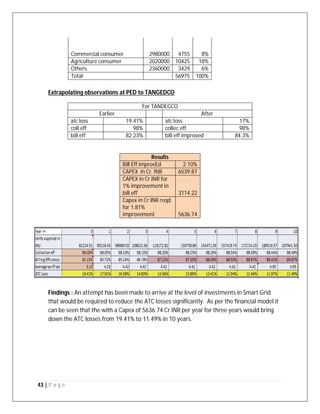
Extrapolating observations at PED to TANGEDCO
For TANDEGCO
Earlier After
atc loss 19.41% atc loss 17%
coll eff 98% collec eff 98%
bill eff 82.23% bill eff improved 84.3%
Results
Bill Eff improvEd 2.10%
CAPEX in Cr. INR 6539.87
CAPEX in Cr.INR for
1% improvement in
bill eff 3114.22
Capex in Cr INR reqd
for 1.81%
improvement 5636.74
Findings : An attempt has been made to arrive at the level of investments in Smart Grid
that would be required to reduce the ATC losses significantly. As per the financial model it
can be seen that the with a Capex of 5636.74 Cr INR per year for three years would bring
down the ATC losses from 19.41% to 11.49% in 10 years.
44 | P a g e
B. Revisiting the Valuation :
 We have re-conducted the valuation of Discoms after considering the required
CAPEX in Smart Grids.
 We have also re-conducted the valuation considering the a financing scenario where
the bonds issued by Discoms are guaranteed for principal repayment by the State
Government but not converted as state government equity on the Discoms books.
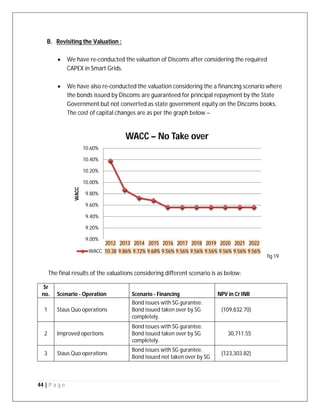
The cost of capital changes are as per the graph below –
fig 19
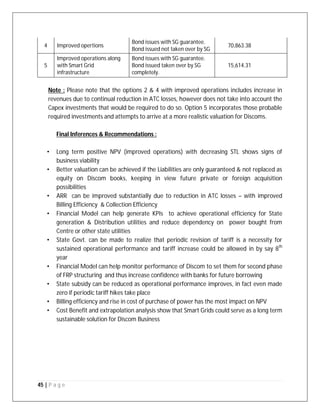
The final results of the valuations considering different scenario is as below:
Sr
no. Scenario - Operation Scenario - Financing NPV in Cr INR
1 Staus Quo operations
Bond issues with SG gurantee.
Bond issued taken over by SG
completely.
(109,832.70)
2 Improved opertions
Bond issues with SG gurantee.
Bond issued taken over by SG
completely.
30,711.55
3 Staus Quo operations
Bond issues with SG gurantee.
Bond issued not taken over by SG
(123,303.82)
2012 2013 2014 2015 2016 2017 2018 2019 2020 2021 2022
WACC 10.38 9.86% 9.72% 9.68% 9.56% 9.56% 9.56% 9.56% 9.56% 9.56% 9.56%
9.00%
9.20%
9.40%
9.60%
9.80%
10.00%
10.20%
10.40%
10.60%
WACC
WACC – No Take over
45 | P a g e
4 Improved opertions
Bond issues with SG guarantee.
Bond issued not taken over by SG
70,863.38
5
Improved operations along
with Smart Grid
infrastructure
Bond issues with SG guarantee.
Bond issued taken over by SG
completely.
15,614.31
Note : Please note that the options 2 & 4 with improved operations includes increase in
revenues due to continual reduction in ATC losses, however does not take into account the
Capex investments that would be required to do so. Option 5 incorporates those probable
required investments and attempts to arrive at a more realistic valuation for Discoms.
Final Inferences & Recommendations :
• Long term positive NPV (improved operations) with decreasing STL shows signs of
business viability
• Better valuation can be achieved if the Liabilities are only guaranteed & not replaced as
equity on Discom books, keeping in view future private or foreign acquisition
possibilities
• ARR can be improved substantially due to reduction in ATC losses – with improved
Billing Efficiency & Collection Efficiency
• Financial Model can help generate KPIs to achieve operational efficiency for State
generation & Distribution utilities and reduce dependency on power bought from
Centre or other state utilities
• State Govt. can be made to realize that periodic revision of tariff is a necessity for
sustained operational performance and tariff increase could be allowed in by say 8th
year
• Financial Model can help monitor performance of Discom to set them for second phase
of FRP structuring and thus increase confidence with banks for future borrowing
• State subsidy can be reduced as operational performance improves, in fact even made
zero if periodic tariff hikes take place
• Billing efficiency and rise in cost of purchase of power has the most impact on NPV
• Cost Benefit and extrapolation analysis show that Smart Grids could serve as a long term
sustainable solution for Discom Business
46 | P a g e
REFERENCES
• Infraline report on FRP status
http://www.infraline.com/details/Overview-State-Wise-Status-Of-Financial-Restructuring-Plan-
For-Discoms-March-2014-228857.htm
• Ministry of Power Guidelines for FRP – October 2012
• CERC approach paper for Cost of Capital Calculation : Ref No. 20/2013/CERC/Fin(Vol-
I)/Tariff Reg/CERC Date: 25th June’2013)
• Business Standard Article June 2013
http://www.business-standard.com/article/economy-policy/discom-debt-restructuring-
takes-off-with-tn-issuing-bonds-113061500837_1.html
• India Infrastructure Report on State Utilities 2012-13
• PFC report on State Utilities 2012-2013
• Smart Grid Task Force publication
http://indiasmartgrid.org/en/Pages/Index.aspx
• CRISIL Report on Power Distribution Sector
• Power Plus Smart Grid Report 2013

Repowering the Indian Discoms

  • 1.
    Independent Research Report On “Repoweringthe Indian Discoms: Impact of Financial Restructuring and Smart Grid Technology on Business Viability” Research Guide Dr. D R Mahapatra Post Graduate Program in Infrastructure Management (PGPIM) June 2014 Prepared By Aditya Parchure Adani Institute of Infrastructure Management
  • 2.
    ACKNOWLEDGEMENT I would liketo express my gratitude towards few key people. Without their support this project would not have been a success. First and foremost, I would like to thank my project guide, Prof. D R Mahapatra for providing me constant support throughout the execution of the project. He gave me guidance, motivation, sincere knowledge, and helped me channelize my efforts in my endeavor. I would also like to thank Prof. Pramod Yadav who provided me with valuable insights, scrutinized and refined my assumptions, and clarified my doubts about the project. Last but not the least, I am grateful to our institute, The Adani Institute of Infrastructure Management (AIIM), which provided me with the theoretical knowledge and practical insights that made me capable of carrying out a project of this vigor.
  • 3.
    Executive Summary Should werejoice about the recent slew of cleared power generation projects? Not so fast. The ironic truth about Indian Power Sector : On one hand, the Cabinet Committee on Investments (CCI) are busy clearing stuck power generation and other infrastructure projects- over Rs 83,000 Crore. On the other, generation companies are finding it increasingly difficult to find buyers for their operational plants. The reason: State DISCOMs are preferring to cut down purchase of power rather than increasing the cost burden of additional electricity. The State DISCOMs have been in a state of continued financial distress due to marked difference in the ACS (Average Cost of Sale) and ARR (Average Revenue Realized). This is mainly due to the AT&C losses suffered by the DISCOMs. The government announced a 1.9 lakh Crore financial restructuring package in October 2012 as a financial boost to the power sector which is expected to bring the DISCOMs back to operating profits. The objective of this project is to explore whether this is the right solution in the long run for the power distribution sector. I have explored the economic impact of this FRP on DISCOMs by developing a robust Financial Model and have also attempted to explore whether integrating Smart Grids could serve as a sustainable solution for the power distribution sector. Through this project I would try to answer the following questions: What factors are actually contributing to current financial state of DISCOMs? How are DISCOMs treating the FRP on their Balance sheet? What is the impact of this FRP on future cash flows/valuation of the DISCOMs? What are Smart Grids? How can they serve as a long term sustainable solution for profitable operations of DISCOMs?
  • 4.
    TABLE OF CONTENTS LISTOF FIGURES ……………………………………………………………………………………………………………………...1 CHAPTER 1 : DISTRIBUTION SECTOR - OVERVIEW 2-10  Financial Restructuring Package for State Discoms....................................... ……………….3  ACS vs ARR Gap……………………………………………………………………………………………………………..3  Tariff Revision……………………………………………………………………………………………………………….4  Franchise Model for Discoms………………………………………………………………………………………...4  RAPDRP initiative…………………………………………………………………………………………………………..5  Credit Rating for Discoms………………………………………………………………………………………………6  Power Purchase Cost……………………………………………………………………………………………………..9  Tariff Renegotiation- CERC Compensatory Tariff……………………………………………………………9  Smart Grids……………………………………………………………………………………………………………………9  Twelfth Five Year Plan – Distribution Sector………………………………………………………………..10 CHAPTER 2 : FINANCIAL PERFORMANCE 11-15  Revenue Growth……………………………………………………………………………...............................11  Financial Losses……………………………………………………………………………………………………………11  Subsidy…………………………………………………………………………………………………………………………13  Capital Employed………………………………………………………………………………………………………….14  Net Worth…………………………………………………………………………………………………………………….14  Net Fixed Assets, Capital WIP (CWIP) & Capital Expenditure……………………………………….14  Receivables for sale of Power……………………………………………………………………………………...15  Creditors for Purchase of Power…………………………………………………………………………………..15 CHAPTER 3: FINANCIAL RESTRUCTURING PACKAGE 16-19  Salient Features of FRP…………………………………………………………………………………………………16  FRP: 1st Phase of Disbursement…………………………………………………………………………………….18  Objectives and Expected Outcomes by MoP…………………………………………………………………19
  • 5.
    CHAPTER 4: FINANCIALMODEL 20-30  Objective…………………………………………………………………………………………………………………….20  Methodology ………………………………………………………………………………………………………………20  Key Assumptions………………………………………………………………………………………………………….20  Schematic of FRP………………………………………………………………………………………………………….21  Base Case…………………………………………………………………………………………………………………….21  Impact of FRP on Valuation considering Business as usual…………………………………………..24 o Debt to Equity (D/E) , Debt to Value (D/V) & Equity/ Value………………………………24 o Cost of Equity Calculation…………………………………………………………………………………25 o Cost of Capital Calculation………………………………………………………………………………..26 o Results………………………………………………………………………………………………………………27 o Inference………………………………………………………………………………………………………….28  Impact of complete first phase of FRP on long term valuation of Discoms with Improved Operating side……………………………………………....................................................................29 o Assumptions …………………………………………………………………………………………………….29 o Discom Valuation …………………………………………………………………………………………….30 o Monte-carlo Simulation Results………………………………………………………………………..30 CHAPTER 5: SMART GRIDS 32-41  Smart Grid Drivers………………………………………………………………………………………………………..32  Smart Grid Technologies………………………………………………………………………………………………33  Key Characteristics of Smart Grid………………………………………………………………………………….34  Smart Grid and Integration of Renewable Energy Sources……………………………………………34  Indian Government Initiatives toward a Smart Grid………………………………………………….....36  How Does Smart Grid Benefit Different Stakeholders?....................................................38  Upcoming/Proposed pilot projects……………………………………………………………………………….39 CHAPTER 6: COST BENEFIT ANALYSIS OF PUDUCHERRY PILOT & REVISITING VALUATION 42-45  Cost Benefit Analysis…………………………………………………………………………………………………….42  Revisiting the Valuation ……………………………………………………………………………………………….44
  • 6.
     Final Inferences& Recommendations REFERENCES …………………………………………………………………………....................................................46
  • 7.
    1 | Pa g e LIST OF FIGURES Figure No. Title Page No. 01 Graph ACS vs ARR 4 02 Financial losses w/o Subsidy 11 03 Financial losses subsidy received basis 11 04 FRP composition pie chart 18 05 Flow of funds on Discom Balance sheet 20 06 Schematic of FRP 21 07 Debt to Value & Equity to Value graph 25 08 Cost of Equity and Beta Equity graph 25 09 Changes in WACC graph 26 10 Discom Operations – Status Quo 27 11 Cash flow without FRP – Status Quo operations 27 12 Cash flow with FRP – Status Quo operations 28 13 Discom Operations – Improved Operations 29 14 Cash flow with FRP – Improved Operations 30 15 Monte-carlo Simulation – Input Variables 30 16 Monte-carlo Simulation – Output 31 17 Monte-carlo Simulation – Sensitivity 31 18 Information flow and hierarchy of ISGTF & ISGF 37
  • 8.
    2 | Pa g e 1. Distribution Sector – OVERVIEW The power sector in India is presently passing through a difficult phase. Generation and distribution are the two segments that have been impacted the most. While the generation segment has been plagued with fuel shortages, the distribution segment is suffering from the financial losses of state distribution utilities, which according to estimates, presently stand at around Rs 2.5 trillion. These issues have put a question mark on the viability of the sector. Discoms’ ability to raise financing to purchase power for provision of quality supply and invest in new assets to meet demand has been falling, and almost all public distribution companies are in the red. This has been partly due to rising input costs, lack of tariff revisions and failure of state governments to pay the subsidies due to their discoms. However, over the past years, almost all states have witnessed a sharp rise in power tariffs and the government has launched a debt restructuring plan linked to reforms. Aggregate technical and commercial (AT&C) losses still remain high. This is compounded by poor metering and low levels of energy audits, making it difficult to dissociate the commercial losses from technical losses. There is also the issue of a large number of regulators not being effective in ensuring compliance with regulatory requirements of open access, renewable purchase obligations, economically sound tariff regulations, and reduction in cross‐subsidies. There is a strong need for the support and political will of the state governments to allow regulators to act independently. The lack of political will to implement open access in true spirit is another challenge being faced by the sector. A number of states have invoked Section 11 of the Electricity Act, 2003 to disallow open access to generators within the state. A similar situation persists regarding bringing reforms in distribution by privatization of discoms. The distribution network in the country as of March 2012 stood at 8 million ct. km of line length and around 520,000 MVA of transformer capacity. A total of around 235 million consumers are served by this distribution network and the total power sold was estimated at 685,000 MUs
  • 9.
    3 | Pa g e during 2011‐12. The AT&C losses at the country level were estimated at around 26‐27 per cent as of March 2012. This fifth edition of the “Power Distribution in India” report provides a comprehensive analysis of the Indian distribution business and utility level data of 51 distribution companies, including their asset base, performance and future plans. Summarized below are some of the key highlights of the sector along with outstanding challenges and the way ahead:  Financial Restructuring Package for State Discoms The financial restructuring package for state distribution utilities, launched in October 2012, is expected to help the distribution segment in the short term, though structural changes are needed to turn around the segment. The financial restructuring plan is expected to significantly ease the liquidity position of distribution utilities. The total accumulated losses of Discoms were estimated at Rs 1.9 trillion as of March 2011. About 70 per cent of these losses are accounted for by the Discoms of Rajasthan, Tamil Nadu, Uttar Pradesh, Haryana, Punjab and Madhya Pradesh. The total accumulated losses are expected to have risen to Rs 2.5 trillion by March 2012. So far, eight states including Rajasthan, Haryana, Uttar Pradesh, Bihar, West Bengal, Tamil Nadu, Andhra Pradesh and Kerala have opted for the restructuring package.  ACS vs ARR - Gap Average costs still remain higher than the average revenue for most utilities. As per the Planning Commission’s annual report titled “The Working of State Power Utilities and Electricity Departments”, the gap between average tariff and average cost of supply (ACS) increased from Rs 0.76 per kWh in 1998‐99 to Rs 0.88 per kWh in 2010‐11. It is expected to have further increased to Rs 1.07 per kWh in 2011‐12. Though the average tariff has increased in the past few years, the rise has not been commensurate with the
  • 10.
    4 | Pa g e increase in the cost of supply. As a result, the gap between the cost of supply and the average tariff has been widening over the years. Source: CRISIL, fig 1  Tariff Revision Tariff revisions have taken place in all states in the past one year, signaling a positive trend. Mounting lenders’ pressure has made states relent on tariff revisions. Tamil Nadu revised its tariffs after seven years. The level of tariff hikes during 2012‐13 ranged between 1.5 per cent and 37 per cent. Tamil Nadu, Kerala, Delhi and Andhra Pradesh recorded tariff hikes over 20 per cent. The average tariff hike was in Tamil Nadu (37 per cent).  Franchise Model for Discoms The franchise model is being adopted by more utilities to reduce network losses and increase efficiency. This model offers the state utilities the advantage of private participation without going for privatization, which has low political acceptance and resistance by employee unions. Apart from Maharashtra, states like Uttar Pradesh,
  • 11.
    5 | Pa g e Madhya Pradesh, Odisha and Jharkhand have also appointed franchisees for high loss circles. The model has seen a good amount of interest from private players, including large companies such as Torrent Power Limited (TPL), Tata Power, CESC, Crompton Greaves and Essel, and mid‐sized companies like Spanco, Enzen and GTL.  RAPDRP initiative The progress in the Restructured Accelerated Power Development and Reforms Programme (RAPDRP), which aims to bring down the aggregate technical and commercial (AT&C) losses to below 15 per cent, is far from satisfactory. So far, 201 towns have been integrated with data centres in nine states: West Bengal (55), Gujarat (62), Uttarakhand (5), Karnataka (1), Andhra Pradesh (30), Madhya Pradesh (1), Maharashtra (30), Uttar Pradesh (10) and Punjab (7). In these states, business software modules have been customized, and data collection from the towns has commenced. However, energy audit reports are yet to be generated and full scale implementation is yet to be achieved. The deadlines set for R‐APDRP have not been met and no tangible results are visible so far. Some of the challenges faced while implementing the R‐APDRP include:  Delay in tendering, appointment of Information Technology Implementation Agency (ITIA) and start of work  Litigations in award process  Issues in setting up data centres  Challenges in software development – high level of customization and integration required  Underestimation of time and resources, and capacity constraints in geographic information system (GIS) survey exercises  Delays in preparation of standards for meters, testing facilities, and procurement
  • 12.
    6 | Pa g e Measures are being undertaken to resolve these issues. A meter testing lab is being set up in association with the Central Power Research Institute. Utilities have been asked to jointly execute GIS surveys to ensure faster and smoother data validation. Joint effort has also been suggested for resolving other issues such as discrepancies in energy accounting data, errors in indexing of assets, etc. Further, a wider coverage area of R‐ APDRP has been suggested after the existing phase is complete. Most importantly, the IT backbone being set up under RAPDRP is planned as the base for introducing more advanced technologies under a smart grid framework.  Credit Rating for Discoms The Ministry of Power recently launched the integrated rating methodology for state distribution utilities and the first ratings were released in March 2013. This is expected to incentivize the utilities to improve their operational and financial performance. Key parameters used to arrive at these ratings include financial performance parameters like subsidy received, cost coverage ratio, AT&C losses, financial planning, etc.; regulatory practices such as issues of regulatory/tariff guidelines, timely filing of tariff petition, and timely issue of tariff orders. Other parameters include timely submission of audited accounts, metering, IT and computerization, no default to banks/financial institutions, renewable energy purchase compliance, etc. The four discoms of Gujarat have received the top ratings of A+.
  • 13.
    7 | Pa g e Grading Scale
  • 14.
    8 | Pa g e Grades  The long‐pending reform issue of open access at the distribution level is now being taken up. In 2012, the Ministry of Power had notified all industrial consumers (1 MW and above) as ‘open access consumers’. These consumers can buy power from another
  • 15.
    9 | Pa g e supplier or from the open market by just giving notice to the discom; and the discom is obligated to provide network access. While this benefits industrial consumers, it has ramifications on utilities’ business. The risk is in migration of high‐value consumers, i.e. the industries which often cross‐subsidise other consumer categories. However, a number of state regulators have contested the ministry’s notification.  Power Purchase Cost There is an upward trend in power purchase costs, which have grown at a CAGR of 14.17 per cent between 2005‐06 and 2010‐11. The increase in costs of sourcing imported coal has been the key factor for the growth in power purchase costs. Majority of coal‐fired power plants are now exposed to imported coal, which, as per industry sources, increases the variable costs by about three times. Case I tariffs also show an upward trend, as developers are trying to build in a fuel risk premium in the costs. Tariff quotations obtained in the Case I bidding invited by Uttar Pradesh Power Corporation Limited (UPPCL) show a range of Rs 4.48‐7.10 per unit from various developers. While power purchase costs are expected to increase in the short‐ to medium‐term, fuel surcharge adjustments and regular tariff revisions will help the Discoms in passing on these costs to consumers.  Tariff Renegotiations – CERC compensatory tariff A major step towards reviving stalled projects under competitive bidding was taken by the Central Electricity Regulatory Commission (CERC) in April 2013. In a ruling related to Adani Power’s petition for renegotiating its power purchase agreements (PPAs) with Gujarat and Haryana, the regulator allowed a compensatory tariff to offset the rise in imported coal prices for the project. CERC called for formation of a committee to determine a package for compensatory tariff. This judgment is likely to set a precedent for other competitively bid projects facing similar issues.  Smart Grids The ongoing revamp of transmission and distribution infrastructure offers the opportunity for introducing smart grid technologies. A few progressive Discoms
  • 16.
    10 | Pa g e including Bangalore Electricity Supply Company (BESCOM) and Mangalore Electricity Supply Company (MESCOM), have already implemented pilot smart grid projects. The India Smart Grid Task Force (ISGTF), which is an inter‐ministerial group formed to focus on activities related to smart grids, has shortlisted 14 pilot smart grid projects. Most of the shortlisted projects target peak load management and outage management as the desired functionalities based on advanced metering infrastructure (AMI). Its implementation will involve varied technology options on residential, industrial, commercial and agricultural loads. Expected benefits of the pilots include network loss reduction and improved availability; peak load rationalization or shifting; metering and billing cost reduction; lowering transformer failure rates; and preventing unforeseen outages and improving recovery time. An important step towards smart grid technology adoption has been the development of low-cost smart meters. Under the aegis of the ISGTF, various utilities, manufacturers and technology providers are in the process of finalizing specifications for a low‐cost smart meter. The aim is to enable widespread adoption of smart meters across distribution utilities.  Twelfth Five Year Plan – Distribution Sector The total investment required by the distribution segment during the Twelfth Plan period is estimated at Rs 3.06 trillion. The planned capital expenditure by the utilities stands at Rs 1.52 trillion. Loss reduction and network upgradation are the key focus areas. For the most part, utility investments will be directed at revamping the physical infrastructure for increasing the connectivity reach (especially rural electrification), reducing network losses (metering, HVDS, energy accounting) and capacity building for business processes (management information systems and building up technical manpower).
  • 17.
    11 | Pa g e 2. Financial Performance Revenue Growth The growth in revenue from sale of energy in the state power sector was 16.80% in the year 2011-12 as against 19.89% in the previous year. The growth registered during the last three years is given below: Rs in Cr. 2009-10 2010-2011 2011-2012 Sales Growth Sales Growth Sales Growth 172,948 9.83% 207,347 19.89% 242,189 16.80% The aggregate turnover of utilities (SEBs, Power Depts., DISCOMs) selling directly to consumers i.e. revenue from sale of power and other income but excluding subsidy booked, increased from Rs. 2,28,731 Crs. in FY 2011 to Rs. 2,68,447 Crs. in FY 2012 reflecting a growth of 17.36%. The aggregate expenditure of these utilities registered YoY growth of 18.54% in the year 2010- 11 and 18.57% in 2011-12. The level of cost recovery during the year 2011-12 was at 75.51% against 76.29% in the previous year. Financial Losses Aggregate Losses w/o Subsidy (fig. 2) Aggregate Losses Subsidy Received basis (fig.3)
  • 18.
    12 | Pa g e The generation, transmission and trading utilities incurred aggregate book losses of Rs. 1,881 Crs. in 2009-10 which increased to Rs. 2,367 Crs. in 2010-11. The losses further increased to Rs. 4,770 Crs. in 2011-12. However these losses account only for 7.6% of the state utilities and the major contribution of loss i.e. 92.4 % is accounted for by the Discoms. The States that have shown substantial improvement (more than Rs.100 Crores) in terms of increase in book profit or reduction in book losses in the year 2011-12 vis-à-vis the year 2010- 11 are West Bengal, Delhi, Punjab, Rajasthan, Andhra Pradesh and Maharashtra. The States that have shown deterioration in their book profits/losses ( of Rs. 100 Crs or more) in the year 2011-12 vis-à-vis 2010-11 are Bihar, Jharkhand, Orissa, Manipur, Meghalaya, Haryana, Jammu & Kashmir, Uttar Pradesh, Uttarakhand, Karnataka, Tamilnadu, Chattisgarh, Goa and Madhya Pradesh A better perspective on the overall sector performance could be obtained by analyzing the losses pertaining to select states on a standalone basis. Accordingly, it is seen that Rajasthan, Tamil Nadu and Uttar Pradesh registered much higher level of losses on accrual basis in comparison to others. The aggregate losses on accrual basis for these three States are Rs.46,430 Crs. In the year 2011-12. Similarly, the aggregate losses on subsidy received basis for these three states are Rs.46,444 Crs. in the year 2011-12.
  • 19.
    13 | Pa g e Weakest states account for 30% of total power consumption & about 60% of accumulated losses  Tamil Nadu, Rajasthan, Uttar Pradesh, Punjab and Orissa are the weakest Discoms, accounting for 30 per cent of the country's power consumption and about 60 per cent of the total accumulated losses. Inadequate and irregular tariff hikes coupled with rising power purchase cost has led to widening ACS-ARR gap. This has resulted in rising accumulated losses and thereby restricted the ability of these Discoms to invest in distribution infrastructure. Consequently, AT&C losses, particularly in UP, Rajasthan and Odisha, are very high.  Among these states Rajasthan has the highest state government support through equity infusions and subsidy payments. On the other hand, state government support in Odisha is limited due to privatization of Discoms in the state.  Few states including Tamil Nadu, Uttar Pradesh and Rajasthan have implemented the financial restructuring of their respective Discoms and also revised tariffs upwards over the last 2 years. However, significant improvement is unlikely given that AT&C losses are likely to remain high on account of muted investments and high cumulative regulatory assets. Subsidy The subsidy booked by utilities selling directly to consumers and released by state governments are given as below: 2009-10 2010-11 2011-12 Subsidy Booked in Cr INR 34,014 22,666 30,242 Subsidy Released in Cr. INR 19,074 20,295 25,832 As a percentage of revenue from sale of power, there was a decline in subsidy booked by the utilities from 19.67% in the year 2009-10 to 10.93 % in 2010-11. In 2011-12, subsidy booked as a percentage of revenue from sale of power increased to 12.49%. The subsidy released by the governments as a percentage of the subsidy booked by the utilities increased significantly from 56.08% in 2009-10 to 89.54% in 2010-11 and decreased to 85.42% in 2011-12. All State Govts.
  • 20.
    14 | Pa g e except Assam (0.00%), Andhra Pradesh (50.03%), Karnataka (88.40%) and Haryana (98.75%) have released the entire subsidy booked by their respective distribution utilities. Capital Employed The total capital employed in the sector increased from Rs.3,72,936 Crs. at the end of FY 2010 to Rs.4,29,784 Crs. at the end of FY 2011 and to Rs. 4,70,792 Crs. at the end of FY 2012. The borrowings from FIs, Banks and market continue to be the major source of capital employed in the sector. The share of these borrowings in the total capital employed increased from 71% at the end of FY 2010 to 76% at end of FY 2011and to 81% at the end of FY 2012. State Government Loans, which constitute the second largest component in the capital employed, decreased from 12% as at the end the FY 2010 to 10% as at the end of FY 2011 and increased to 12% as at the end of FY 2012. Net worth The net worth decreased from Rs.14,973 Crs. as on 31st March 2010 to Rs.5,314 Crs. as on 31st March 2011. The net worth turned negative to Rs. 31,812 Crs. as on 31st March 2012. The total equity investment in the sector went up from Rs. 1,24,258 Crs. in the year 2009-10 to Rs.1,41,944 Crs. in the year 2010-11 and to Rs. 1,70,451 Crs. in 2011-12 reflecting an increase of 20% in the year 2011-12. Net Fixed Assets, Capital WIP (CWIP) & Capital Expenditure The Net Fixed Assets showed an increase from Rs.2,31,812 Crs. as on 31st March, 2010 to Rs.2,96,179 Crs. as on 31st March, 2011 and to Rs.3,26,549 Crs. as on 31st March, 2012. The CWIP along with advances to contractors increased from Rs.96,364 Crs. as on 31st March 2010 to Rs.1,07,038 Crs. as on 31st March, 2011 and to Rs.1,30,730 Crs. as on 31st March, 2012. The capital expenditure during the year 2009-10 was Rs.59,022 Crs., which increased to Rs.70,147 Crs. in 2010-11. However, in 2011-12 it decreased marginally to Rs.69,868Crs.
  • 21.
    15 | Pa g e Receivables for sale of Power The total receivables of SEBs, Discoms and other utilities selling directly to consumers increased from Rs.64,641 Crs. as on 31st March, 2010 to Rs.80,702 Crs. as on 31st March, 2011 and to Rs.1,07,750 Crs. as on 31st March, 2012. However, the receivables for sale of power (no. of days) decreased from 109 days during FY 2010 to 105 days during FY 2011 and to 102 days during FY 2012. The table below depicts the position of receivables of utilities selling directly to consumers. Range No. of Utilities 2010-2011 2011-2012 Less than 60 days 20 20 Between 60 – 90 days 10 8 Above 90 days 24 26 The debtors for sale/transmission of power for Gencos, Transcos and Trading Companies increased from Rs.47,111 Crs. as on 31st March, 2010 to Rs.60,245 Crs. as on 31st March, 2011 and to Rs.83,444 Crs. as on 31st March, 2012. Creditors for Purchase of Power The payables for purchase of power by utilities selling directly to consumers increased from Rs.50,408 Crs. as on 31st March, 2010 to Rs.68,607 Crs. as on 31st March, 2011 and to Rs.1,07,553 Crs. as on 31st March, 2012. The creditors for purchase of power increased from 100 days purchase during FY 2010 to 116 days during FY 2011 and to 151 days during FY 2012.
  • 22.
    16 | Pa g e 3. Financial Restructuring Package A scheme for Financial restructuring of State Owned Discoms has been formulated and approved by the Government to enable the turnaround of the State Discoms and ensure their long term viability. The scheme contains measures to be taken by the State Discoms and State Government for achieving financial turnaround by restructuring their debt with support through a Transitional Finance Mechanism by Central Government. The salient features of the Scheme for restructuring are as under:- A. 1. 50% of the outstanding short term liabilities (STL) as of March 31, 2012 to be taken over by State Governments. This shall be first converted into bonds to be issued by Discoms to participating lenders, duly backed by the State Government guarantee. The State Government will take over the liability during next 2-5 years by issuance of special securities in favor of participating lenders in a phased manner keeping in view the fiscal space available till the entire loan (50% of STL) is taken over by the State Government. The door to door maturity will not be more than 15 years with a moratorium of 3-5 years on the principal repayment. 2. The State Government would provide full support to the Discoms for repayment of interest and principal for this portion. 3. State Government would ensure that issuance of Special securities is within the targets prescribed in FRBM Acts of respective States and even if fiscal space including Debt- GSDP ratio under the FRBM targets is available, States need to remain with their respective Net Borrowing Ceilings (of each of the relevant fiscal) fixed annually as per the formula prescribed by the Thirteenth Finance Commission . B. Balance 50% of the STL will be rescheduled by lenders and serviced by the DISCOMS with moratorium of 3 years on principal. Repayment of Principal and Interest be fully secured by the State Government Guarantee. The best possible
  • 23.
    17 | Pa g e terms are to be extended for the rescheduled loans to improve viability of Discoms operations. C. The restructuring/reschedulement of loan is to be accompanied by concrete and measurable action by the Discoms/States to improve the operational performance of the distribution utilities. State Government Discoms have to commit themselves and carry out certain mandatory and recommendatory conditions as contained in part (C) of the Scheme. D. A Transitional Finance Mechanism (TFM) by the Central Government in support of the restructuring effort is available, subject to fulfillment of mandatory conditions given in part C of the scheme. The TFM has the following features :- (i)  For providing liquidity support by way of a grant equal to the value of the additional energy saved by way of accelerated AT&C loss reduction beyond the loss trajectory specified under RAPDRP (Restructured Accelerated Power Development and Reform Programme). • The eligibility of grant would arise only if the gap between ARR and ACS for the year has been reduced by at least 25% during the year judged against the benchmark for the year 2010-11. • This scheme would be available only for three years beginning 2012-13. (ii) Incentive by way of capital reimbursement support of 25% of principal repayment by the State Government on the liability taken over by the State Government under the scheme. The amount to be reimbursed only in case the State Government take-over the entire 50% of the short term liabilities(corresponding to the accumulated losses) outstanding as on 31 .3.2012.
  • 24.
    18 | Pa g e E. For financing of operational losses and interest for the first 3 years on diminishing scale, a separate arrangement would be worked out after due consultation to be held by Secretary, DFS with representatives of the MoP and the concerned States. Remaining portion of the operating losses will have to be financed by the respective State Government. FRP: 1st Phase of Disbursement Phasing of Special Securities to be issued by the State Govt. to the Discoms (in crores) State 50% of STL 2012-13 2013-14 2014-15 2015-16 2016-17 Andhra Pradesh 3151 2211 940 Haryana 7859 2518 2496 2845 Rajasthan 19855 2649 3496 3986 4544 5180 Tamil Nadu 9573 884 2526 2880 3283 Uttar Pradesh 12967 1919 2245 2559 2918 3326 Phasing of Special Securities in percentage State 2012-13 2013-14 2014-15 2015-16 2016-17 Andhra Pradesh 70.17% 29.83% Haryana 32.04% 31.76% 36.20% Rajasthan 13.34% 17.61% 20.08% 22.89% 26.09% Tamil Nadu 9.23% 26.39% 30.08% 34.29% Uttar Pradesh 14.80% 17.31% 19.73% 22.50% 25.65% If the FRP scheme is implemented as per the conditions laid above, the Discoms would need to service only half of the short term loans as soon as the scheme is implemented and at the end of five years, the State Governments would have taken over 37.5%-50% of the short term loans as seen in the charts. (fig. 4)
  • 25.
    19 | Pa g e Objectives and Expected Outcomes by MoP The objective of the proposed scheme is to enable the State Governments and the DISCOMs carve out a strategy for the financial turnaround of the distribution companies in the State power sector which will be enabled by the lenders agreeing to restructure/reschedule the existing short-term debt. As the restructuring/reschedulement by lenders, is subject to certain prior steps to be taken by the State Government. DISCOMs and their commitment to fulfill mandatory conditions which are aimed at bridging the gap between the average cost of supply and the average revenue realized, this would help in restoring the viability of the distribution sector in the State. By restructuring and rescheduling the outstanding short-term debt the lenders would be able to void the impending possibility of the debt turning into non-performing asset and securing the commitment of the State Governments in the discharge of debt service obligation in the long-run . Government of India support through the transitional finance mechanism would serve the purpose of incentivizing the fulfillment of mandatory conditionalities as also providing confidence to the lenders. The expected outcomes from the implementation of the proposed scheme would be:  Providing comfort to the lenders by securing State takeover of and guarantee for debt  Bringing about financial discipline in the distribution sector in the State,  Providing a commercial orientation to the functioning of the distribution companies,  Casting responsibility on the State Government to ensure a steady flow of revenue to the distribution companies by improving the efficiency of their operations,  Accelerate the AT&C loss reduction effort of DISCOMs  Ensure regular redetermination of tariff to cover cost of service,  Gradual elimination of the gap between ACS and ARR.  Ensure timely audit of DISCOM accounts  Improve the financial health of the Distribution Utilities to enable them to procure more electricity for meeting their growing demand
  • 26.
    20 | Pa g e 4. Financial Model Objective: To generate a spread sheet based financial model which would carry out valuation for Discoms considering the impact of 1st phase disbursement on FRP and gain all possible insights for the purpose of setting parameters for Discom Operation and Policy Regulation. Methodology Adopted : We have prepared a base case spreadsheet based financial model with the help of existing financial statements for the fiscal year 2011-2012 of a Discom and forecasted future cash flows by taking into consideration the historical performance, possible initiatives from state government and Discom operator and the impact of FRP on the cost of capital. The basic purpose of this exercise is to create a universal model where the existing financial and operational data available can be keyed in to obtain relevant insights to move towards sustainability of bleeding State Discoms. Key Assumptions:  Due to absence of adequate clarity on the repayment pattern of the bonds to be issued by the Discoms, the analysis does not take into account any principal repayment or consequent capital reimbursement (25%) from GoI to the State Governments.  Growth in Tariff have been considered as announced in that particular state  Movement of FRP proceeds in the balance sheet - It is assumed that all the proceeds from the FRP will be used to repay the Short Term Liabilities. The issuance of bonds by Discoms will transform these STLs in to Long Term Liabilities with the new cost of borrowing (fig.5)
  • 27.
    21 | Pa g e Schematic of FRP fig 6 Base Case 1 Name of Utility: Tamil Nadu Generation and Distribution Corporation Limited (TANGEDCO) Background: In line with the provisions of the Electricity Act, 2003 for restructuring of the state electricity boards (SEBs), in November 2010, the Tamil Nadu Electricity Board (TNEB) was restructured into one holding company TNEB Limited and two state‐owned subsidiary companies – Tamil Nadu Generation and Distribution Corporation Limited (TANGEDCO) and Tamil Nadu Transmission Corporation Limited (TANTRANSCO). While the former performs the generation and distribution function, the latter is responsible for handling intra‐state transmission. Operational Performance: TANGEDCO’s AT&C losses have remained around 19 per cent over the past five years till 2011- 2012. For 2012‐13, the company expected the AT&C losses to stand at 18.74 per cent. Through network improvements and anti‐power theft initiatives, the utility plans on bringing down its network losses.
  • 28.
    22 | Pa g e TANGEDCO’s power purchase costs stood at over 21000 Cr INR as of March 2012, registering a CAGR of 16.25 per cent over the five‐year period under consideration. The O&M expenses, that takes into account the R&M expenses, A&G expenses and the employee cost, were at 4539 Cr INR for 2011‐12, reporting an increase of 4 per cent over 2010‐11. In terms of metering, all consumer categories served by TANGEDCO, with the exception of only two categories namely agricultural (2.02 million consumers) and hut service consumers (1.46 million consumers), are fully metered. Further, with respect to existing metered consumers, initiatives are being undertaken to gradually replace the existing electro‐mechanical meters with static meters. This would help in reduction of tampering, identifying various parameters, downloading of data, introduction of ToD tariff, etc. besides reducing billing errors. Also, all new service connections are being provided with static meters. The utility’s collection efficiency for the year 2011‐12 stands at 98 per cent. Operational Assumptions: Assumptions : Reference Consumer Base 23,000,000 India Infra research ATC Losses 19.14% India Infra research Operating cost increase 4.0% IIR /PFC report Collection Efficiency 98.0% India Infra research Growth in Revenues (due to increase in demand) 9.7% India Infra research Growth in Cost 4.0% India Infra research Subsidy as a % of rev 11.4% P&L Statement 2011-12 Increase in power purchase 14.0%-16.0% India Infra research ARR w/o subsidy in Rs/kWh 3.04 PFC report 2011-12 ACS in Rs/kWh 5.4 PFC report 2011-12 TAX rate 30.0% Assumption CAPEX growth 10.0% India Infra research NWC as a percentage of revenue -74.0% Balance sheet 2011-12
  • 29.
    23 | Pa g e including subsidy Cost of capital (original) 10.38% Calculated as given Growth in Tariff in 1st yr and 2nd year 37%, 4% Infraline ATC Loss: As the T&D loss was not able to capture all the losses in the net work, concept of Aggregate Technical and Commercial (AT&C) loss was introduced. AT&C loss captures technical as well as commercial losses in the network and is a true indicator of total losses in the system. High technical losses in the system are primarily due to inadequate investments over the years for system improvement works, which has resulted in unplanned extensions of the distribution lines, overloading of the system elements like transformers and conductors, and lack of adequate reactive power support. The commercial losses are mainly due to low metering efficiency, theft & pilferages. This may be eliminated by improving metering efficiency, proper energy accounting & auditing and improved billing & collection efficiency. Fixing of accountability of the personnel / feeder managers may help considerably in reduction of AT&C loss. Formula: ATC loss in % = 1 – (Billing Efficiency * Collection Efficiency) Billing Efficiency = Sales (units) / Energy Input (units) Collection Efficiency = Collection (INR) / Demand (INR) Using Above formula for TANGEDCO : Collection Efficiency 98.00% Billing Efficiency 82.23% ATC Loss 19.41%
  • 30.
    24 | Pa g e Sr no. Scenario - Operation Scenario - Financing A Status Quo operations Bond issues with SG guarantee. Bond issued taken over by SG completely. B Improved operations Bond issues with SG guarantee. Bond issued taken over by SG completely. A. Impact on Future cashflows /Valution of discoms with FRP considering business as usual scenario Scenario - Operation Status Quo: a. A Valuation is conducted for Discom operations in perpetuity considering infusion of proceeds on issue of bonds by Discoms. b. We have assumed that the Discom continue to operate as they are operating c. Cash inflow occurring from FRP will be only be used to settle the short term liabilities resulting in changes in NWC d. Banks and Power Generators would stop providing Short term loans and credits e. Valuation is considered in perpetuity with a terminal growth value of 2 % f. Bond issue written of the books of by the 6th year as it is taken over by the state government Debt to Equity (D/E) , Debt to Value (D/V) & Equity/ Value: We have assumed that there would be no infusion of fresh equity and the changes in debt on first phase of disbursement as illustrated in the fig.4. The Discoms bonds have been considered with state guarantees, however, and subsequently have been converted to State government equity on Discom books. The resultant ratios would be as follows:
  • 31.
    25 | Pa g e fig 7 Cost of Equity Calculation: For the purpose of calculating cost of equity, we have taken reference of the CAPM approach followed by CERC approach paper (Ref No. 20/2013/CERC/Fin(Vol-I)/Tariff Reg/CERC Date: 25th June’2013) where : Risk free rate (Rf) = 7.4 % Market rate return (Rm) = 15% Tax Rate (T) = 30% Beta Equity (Be) = 1 Beta Asset (Ba) = Be/ (1+ D/E*1-T) Cost of Equity (Ke) = Rf + Be (Rm-Rf) We have assumed that the Asset risk remains constant and the changes in Beta Equity are a function of changes in D/E ratios fig.8 0.00% 10.00% 20.00% 30.00% 40.00% 50.00% 60.00% 70.00% 80.00% 90.00% 100.00% 1 2 3 4 5 6 7 8 9 10 11 %Ratio Year D/V E/V
  • 32.
    26 | Pa g e Cost of Capital Calculation: The cost of capital calculated is essentially the weighted average of cost of debt and cost of equity. The cost of debt on the infusion of FRP is also essentially a weighted average of the cost of debt that was before FRP and the cost new FRP debt  Cost of Debt (original) = Interest /Long Term Debt Kd = 13.42 %  Cost of Debt (restructured) = FRP Bond rate for TANGEDCO = Rf + spread Kd’ = 7.4% + 75 bps = 8.15% in Cr INR FRP Package disbursement (actual expected) 2013 2014 2015 2016 For Tamil Nadu 50% of STL 14944.705 Disbursement in % 54.76% 19.32% 6.89% 19.03% Disbursement in value 8183.00 2887.00 1030.00 2844.71 % of restructured loan (rl) 20.53% 25.89% 27.64% 32.05% Bonds upto 15 yr Maturity  WACC = Ke *E/V + (1-T)* {Kd (1-rl)+ Kd’(rl)}*D/V fig 9 It can be seen from the above figure that the cost of capital only reduces marginally i.e from 10.38% to 10.04 % on the infusion of 1st phase of FRP 2012 2013 2014 2015 2016 2017 2018 2019 2020 2021 2022 WACC 10.38 9.86% 9.72% 9.68% 9.56% 10.04 10.04 10.04 10.04 10.04 10.04 9.00% 9.20% 9.40% 9.60% 9.80% 10.00% 10.20% 10.40% 10.60% WACC WACC
  • 33.
    27 | Pa g e Results: Operation: It can be seen that the power purchase cost is increasing at a rate higher than the increase in revenue and thus rendering the operating profits negative fig 10 1. Cash flows without bond issue : NPV = -106,107 Cr INR fig 11 -40000.00 -20000.00 0.00 20000.00 40000.00 60000.00 80000.00 100000.00 1 2 3 4 5 6 7 8 9 10 Operation Revenue from Sale of Power Purchase of Power EBIT Revenue subsidies & Grants (20,000.00) (15,000.00) (10,000.00) (5,000.00) - 5,000.00 10,000.00 1 2 3 4 5 6 7 8 9 10 Cashflow without FRP FCF without FRP DCF without FRP In Cr INR
  • 34.
    28 | Pa g e 2. Cash flows with FRP : NPV = -109,832 Cr INR fig 12 Inference:  The NPV of both the cases is –ve. Case (b) shows higher negative NPV for the same FCF ( which is -ve) as the discount rate is lower indicating higher opportunity loss  The FRP issue which improves cash flow temporarily is showing no real benefit if the operating side remains as it is  Cost of purchase of power is more than the revenue from sale of power in the zeroth yr, and its growth rate is very high at 16.25%, which is over powering increase in income on subsidy received basis even after tariff increase  Issuance of bonds is helpful in bringing down the cost of capital from 10.38 % to 10.04%  Expectation that Discoms will be cash surplus by the end of phase 1 could prove to be false  Future value of the Discom will only improve if there is serious degree of improvement in operating side -25000.00 -20000.00 -15000.00 -10000.00 -5000.00 0.00 5000.00 10000.00 15000.00 20000.00 1 2 3 4 5 6 7 8 9 10 Cashflow with FRP FCF with FRP DCF with FRP
  • 35.
    29 | Pa g e B. Impact of complete first phase of FRP on long term valuation of Discoms with Improved Operating side Scenario: Improvement in Operating side of discoms as per the following parameters  Power purchase cost grow at a lower rate of as compared to all India CAGR i.e @ 12% < 15 % as State Generation improves  ATC loss improvement of 1.5 % per annum to meet the loss reduction trajectory as specified by the RAPDRP  Average tariff hike in 8th year – say @ 12 %  Cost of restructured loan @ 8.9%  Operational loss funding as per the scheme from Central government considered for Tamil Nadu  Bond issue written of the books of by the 6th year as it is taken over by the state government  Valuation is considered in perpetuity with a terminal growth value of 2 % Results: Operations: It can be seen that the operating side is showing profits and it is on an increasing trend fig 13 -20000.00 0.00 20000.00 40000.00 60000.00 80000.00 100000.00 1 2 3 4 5 6 7 8 9 10 Operation Revenue from Sale of Power Purchase of Power EBIT Revenue subsidies & Grants
  • 36.
    30 | Pa g e fig 14 Discom Valuation NPV (with perpetuity value) = 65,681 Cr INR On conducting the above valuation considering improvement in operation parameters, we have performed a Monte carlo simulation on the financial model to understand which parameter has the most impact on the resultant NPV. Variable Parameters considered:  Improvement in Billing efficiency  Improvement in Collection efficiency  Increase in power purchase costs  Average percentage increase in the tariff in the nth year  Cost of restructured debt Monte-Carlo Simulation Results: Input Variables: fig 15 -10000.00 -5000.00 0.00 5000.00 10000.00 15000.00 20000.00 1 2 3 4 5 6 7 8 9 10 Cashflow with FRP FCF with FRP DCF with FRP
  • 37.
    31 | Pa g e Output: fig 16 Sensitivity Result: fig 17 It is can be clearly observed in this case that the billing efficiency has the most impact on the resultant NPV considering the prevailing input conditions. Thus, the following chapters would try to explore the possibility of Smart Grids serving as a sustainable solution to ensure Discom’s business viability. We will revisit the financial model to subsist our analysis
  • 38.
    32 | Pa g e 5. Smart Grids A smart grid is the integration of information and communications technology into electric transmission and distribution networks. Today, the electricity supply industry is wrestling with an unprecedented array of challenges, ranging from a supply-demand gap to rising costs. These and other forces are driving the need to reinvent the business. That, in turn, is driving the need for a smart grid. 1. Smart Grid Drivers The drivers for change are both external to the network, like preparing for a low-carbon future by reducing greenhouse gas, as well as internal, like the need for replacement of an ageing infrastructure.
  • 39.
    33 | Pa g e 2. Smart Grid Technologies The many smart grid technology areas – each consisting of sets of individual technologies – span the entire grid, from generation through transmission and distribution to various types of electricity consumers. Some of the technologies are actively being deployed and are considered mature in both their development and application, while others require further development and demonstration.
  • 40.
    34 | Pa g e 3. Key Characteristics of Smart Grid Smart grid might be defined by its capabilities and operational characteristics rather than by the use of any particular technology. Deployment of smart grid technologies will occur over a long period of time, adding successive layers of functionality and capability onto existing equipment and systems. Technology is the key consideration to build smart grids and it can be defined by broader characteristics. 4. Smart Grid and Integration of Renewable Energy Sources Renewable-energy resources vary widely in type and scalability. They include biomass, waste, geothermal, hydro, solar, and wind. Renewable-energy resources can be used for standalone or
  • 41.
    35 | Pa g e islanded (system isolated) power generation, but their benefits are greatly enhanced when they are integrated into broader electric power grids. With greater use of smart grid technologies, higher degrees and rates of penetration can be accommodated. Each resource is different from the grid’s perspective and some are easier to integrate than others. Variable generation, provided by many renewable-energy sources, can be a challenge to electric system operations, but when used in conjunction with smart grid approaches, responsive distributed generation also can be a benefit to system operations if coordinated to relieve stress in the system. Key characteristics of renewable resources that impact their integration into power grids are their size (generation capacity as compared to other sources of power generation on a system), their location (both geographically and with respect to network topology), and their variability (minute by- minute, daily, seasonally, and intermittently). Smart grid technology can control renewable resources to effect changes in the grid’s operating conditions and can provide additional benefits as distributed generation assets or when installed at the transmission level. Small, electricity-generating systems located at or near the place where the energy is used and connected at the distribution level are referred to as distributed generation. Residential-scale wind and solar energy projects are examples of distributed generation. Distributed generation assets can support weak grids, adding grid voltage and improving power quality. Having generation close to load can reduce transmission losses and infrastructure costs and can support the operation of local islands of electricity to reduce impacts of wide scale black-outs. Smart grid technologies and concepts can significantly reduce barriers to the integration of renewable resources and allow power grids to support a greater percentage of variable renewable resources. Enabling smart grid technology, such as distributed storage, demand response, advanced sensing, control software, information infrastructure, and market signals, increases the ability to influence and balance supply and demand. With smart grid technology, grid operators can better coordinate and control the system in response to grid conditions, thus
  • 42.
    36 | Pa g e allowing integration of increasingly greater levels of renewable resources more effectively and at lower cost. 5. Indian Government Initiatives toward a Smart Grid 5.1 India Smart Grid Task Force (ISGTF) The Government of India formed the India Smart Grid Task Force in 2010 as an inter-ministerial group and will serve as the government focal point. It is a body composed of officials from different government departments and is primarily meant for understanding and advocating policies in smart grid technologies. Major functions of the ISGTF are: a. Ensure awareness, coordination, and integration of diverse activities related to smart grid technologies b. Promote practices and services for R&D of smart grids c. Coordinate and integrate other relevant intergovernmental activities d. Collaborate on an interoperability framework e. Review and validate recommendations from the India Smart Grid Forum. 5.2 India Smart Grid Forum (ISGF) The Government of India also formulated the India Smart Grid Forum in 2010 as a non-profit, voluntary consortium of public and private stakeholders with the prime objective of accelerating development of smart grid technologies in the Indian power sector. The ISGF has roles and responsibilities complementary to the ISGTF. The goal of the Forum is to help the Indian power sector to deploy Smart Grid technologies in an efficient, cost-effective, innovative and scalable manner by bringing together all the key stakeholders and enabling technologies.
  • 43.
    37 | Pa g e The India Smart Grid Forum will coordinate and cooperate with relevant global and Indian bodies to leverage global experience and standards where ever available or helpful, and will highlight any gaps in the same from an Indian perspective. fig 18 5.3 Distribution Reform, Upgrades, and Management (DRUM) The Ministry of Power, Government of India, and the U.S. Agency for International Development (USAID)–India jointly designed the Distribution Reform, Upgrades and Management (DRUM) Project with the purpose of demonstrating “the best commercial and technological practices that improve the quality and reliability of 'last mile' power distribution in selected urban and rural distribution circles in the country.” The project is in synch with the Indian Government's policy on power sector reforms, the Electricity Act of 2003, and the Re- Structured Accelerated Power Development and Reforms Program (R-APDRP) scheme. The overall programmatic goal of the DRUM Project is to demonstrate commercially viable electricity distribution systems that provide reliable power of sufficient quality to consumers and to establish a commercial framework and a replicable methodology adopted by India’s financial institutions for providing non-recourse financing of DRUM activities and programs.
  • 44.
    38 | Pa g e 5.4 Re-Structured Accelerated Power Development and Reforms Program (R-APDRP) Ministry of Power, Govt. of India, as a part of Reforms in the Power Sector, has launched the RAPDRP in the XI Five year Plan. The focus of the program is on the actual demonstrable performance in terms of AT&C loss reduction, establishment of the reliable and automated sustainable systems for collection of base line data, adoption of information technology in the areas of electricity accounting, Consumer care and strengthening of Distribution network of State Power Utilities. Projects under the scheme shall be taken up in two parts. Part-A shall include the projects for establishment of baseline data and IT applications for energy accounting/auditing & IT based consumer service centres. Part-B shall include regular distribution strengthening projects. 6. How Does Smart Grid Benefit Different Stakeholders? Various stakeholder groups will benefit from the smart grid in different ways:
  • 45.
    39 | Pa g e 7. Upcoming/Proposed pilot projects ISGTF has shortlisted 14 Smart Grid pilot projects for Power Distribution segment on January 2013 as compared to the 8 planned initially, the number of projects have been increased to expand the scope of these pilots to reflect diversity in project profiles. The projects will receive fund under the R-APDRP and a matching financial support from the states.
  • 46.
    40 | Pa g e In 2011‐12, the capital expenditure of the distribution utilities was estimated at over Rs 260 billion. Around two‐thirds of this capital expenditure by distribution utilities in India was concentrated in the states of Maharashtra, West Bengal, Rajasthan, Gujarat, Bihar, Tamil Nadu, and Andhra Pradesh. The major capex incurred was in areas of network expansion, system strengthening, loss reduction and infrastructure upgradation. For instance, the prepaid metering system has been increasingly gaining acceptance among utilities in India. As of January 2012, Maharashtra State Electricity Distribution Company Limited (MSEDCL) installed about 2,644 prepaid electricity meters in its Pune region. In the first phase, the utility plans to introduce prepaid meters in nine cities (Pune, Nagpur, Aurangabad, Pen, Kalyan, Kolhapur, Mahabaleshwar, Matheran and Chikhaldara) on an experimental basis. In September 2012, Punjab State Power Corporation Limited (PSPCL) provided prepaid metering systems to single‐phase/three‐phase consumers as a pilot project. Uttar Haryana Bijli Vitran Nigam Limited (UHBVN) also plans on implementing the system with a capex of Rs 740 billion for the upcoming years. Further, as a part of the Indian Smart Grid Forum (ISGF) launched in September 2010, the MoP
  • 47.
    41 | Pa g e has set up a Smart Meter Task Force to modernise the existing metering technology in the country. So far, the ISGF has shortlisted 14 smart grid projects for implementation. Each of the projects would be implemented by the state distribution utilities using advanced metering infrastructure (AMI). The projects would receive part‐funding of up to Rs 2 billion from the largest central government scheme, R‐APDRP’s allocation. This funding will be complemented by matching funds from the states. One of the smart grid pilot projects is being undertaken by Power Grid Corporation of India Limited (Powergrid) at Puducherry. The memorandum of understanding was signed with Puducherry Electricity Department in March 2012. The project involved a cost of Rs 770 million with MoP contributing Rs 250 million and the rest by Powergrid. The project involved the setting up of AMI with a central data control unit. The following chapter has attempted a cost benefit analysis on the findings of the Puducherry pilot project and the revisit the Financial Model.
  • 48.
    42 | Pa g e 6. Cost Benefit Analysis of Puducherry Pilot Project & Revisiting the Discom Valuation A. Cost Benefit Analysis Technology: Advanced Metering Infrastructure ( AMI ) No of consumers 87031 nos. Residential 79% % Residential in nos. 68754 Cr INR Total Project cost in Cr 46.11 Cr. INR Expected ATC loss reduction 14% % Total Energy consumption 367 MU Improvement in Coll Eff 8.0% % Time line 1.6 year Loss reduction per anum 9% % Improvement in Bill Eff 7% % CAPEX 46.11 Cr INR CAPEX per year 29.1 Cr INR CAPEX per yr /domestic cons 0.000423567 Cr INR CAPEX for TANGEDCO 6539.87 Cr INR For Puducherry pilot project Earlier After ATC loss 22.60% Atc loss 8.86% Collec eff 90% Collec eff 98% Bill eff 86% Bill eff 93% Consumer Profile TANGEDCO Consumer Nos. Units % units Industry consumption 550000 21235 37% Domestic consumer 15440000 17131 30%
  • 49.
    43 | Pa g e Commercial consumer 2980000 4755 8% Agriculture consumer 2020000 10425 18% Others 2360000 3429 6% Total 56975 100% Extrapolating observations at PED to TANGEDCO For TANDEGCO Earlier After atc loss 19.41% atc loss 17% coll eff 98% collec eff 98% bill eff 82.23% bill eff improved 84.3% Results Bill Eff improvEd 2.10% CAPEX in Cr. INR 6539.87 CAPEX in Cr.INR for 1% improvement in bill eff 3114.22 Capex in Cr INR reqd for 1.81% improvement 5636.74 Findings : An attempt has been made to arrive at the level of investments in Smart Grid that would be required to reduce the ATC losses significantly. As per the financial model it can be seen that the with a Capex of 5636.74 Cr INR per year for three years would bring down the ATC losses from 19.41% to 11.49% in 10 years.
  • 50.
    44 | Pa g e B. Revisiting the Valuation :  We have re-conducted the valuation of Discoms after considering the required CAPEX in Smart Grids.  We have also re-conducted the valuation considering the a financing scenario where the bonds issued by Discoms are guaranteed for principal repayment by the State Government but not converted as state government equity on the Discoms books. The cost of capital changes are as per the graph below – fig 19 The final results of the valuations considering different scenario is as below: Sr no. Scenario - Operation Scenario - Financing NPV in Cr INR 1 Staus Quo operations Bond issues with SG gurantee. Bond issued taken over by SG completely. (109,832.70) 2 Improved opertions Bond issues with SG gurantee. Bond issued taken over by SG completely. 30,711.55 3 Staus Quo operations Bond issues with SG gurantee. Bond issued not taken over by SG (123,303.82) 2012 2013 2014 2015 2016 2017 2018 2019 2020 2021 2022 WACC 10.38 9.86% 9.72% 9.68% 9.56% 9.56% 9.56% 9.56% 9.56% 9.56% 9.56% 9.00% 9.20% 9.40% 9.60% 9.80% 10.00% 10.20% 10.40% 10.60% WACC WACC – No Take over
  • 51.
    45 | Pa g e 4 Improved opertions Bond issues with SG guarantee. Bond issued not taken over by SG 70,863.38 5 Improved operations along with Smart Grid infrastructure Bond issues with SG guarantee. Bond issued taken over by SG completely. 15,614.31 Note : Please note that the options 2 & 4 with improved operations includes increase in revenues due to continual reduction in ATC losses, however does not take into account the Capex investments that would be required to do so. Option 5 incorporates those probable required investments and attempts to arrive at a more realistic valuation for Discoms. Final Inferences & Recommendations : • Long term positive NPV (improved operations) with decreasing STL shows signs of business viability • Better valuation can be achieved if the Liabilities are only guaranteed & not replaced as equity on Discom books, keeping in view future private or foreign acquisition possibilities • ARR can be improved substantially due to reduction in ATC losses – with improved Billing Efficiency & Collection Efficiency • Financial Model can help generate KPIs to achieve operational efficiency for State generation & Distribution utilities and reduce dependency on power bought from Centre or other state utilities • State Govt. can be made to realize that periodic revision of tariff is a necessity for sustained operational performance and tariff increase could be allowed in by say 8th year • Financial Model can help monitor performance of Discom to set them for second phase of FRP structuring and thus increase confidence with banks for future borrowing • State subsidy can be reduced as operational performance improves, in fact even made zero if periodic tariff hikes take place • Billing efficiency and rise in cost of purchase of power has the most impact on NPV • Cost Benefit and extrapolation analysis show that Smart Grids could serve as a long term sustainable solution for Discom Business
  • 52.
    46 | Pa g e REFERENCES • Infraline report on FRP status http://www.infraline.com/details/Overview-State-Wise-Status-Of-Financial-Restructuring-Plan- For-Discoms-March-2014-228857.htm • Ministry of Power Guidelines for FRP – October 2012 • CERC approach paper for Cost of Capital Calculation : Ref No. 20/2013/CERC/Fin(Vol- I)/Tariff Reg/CERC Date: 25th June’2013) • Business Standard Article June 2013 http://www.business-standard.com/article/economy-policy/discom-debt-restructuring- takes-off-with-tn-issuing-bonds-113061500837_1.html • India Infrastructure Report on State Utilities 2012-13 • PFC report on State Utilities 2012-2013 • Smart Grid Task Force publication http://indiasmartgrid.org/en/Pages/Index.aspx • CRISIL Report on Power Distribution Sector • Power Plus Smart Grid Report 2013