Shakespeare’s Language
The Elizabethans They loved language Even poorly-written plays usually rhymed and alliterated Sound of language was more important than logic of sentence structure E.g. they changed word order or repeated words for emphasis
William Shakespeare Introduced nearly 3,000 words into English His vocabulary is upward of 29,000 words (quadruple that of an average well-educated person!)
So… why is it so hard to understand? Many words have shifted meaning since Shakespeare’s day, or have fallen out of use
Letters, syllables, or whole words were sometimes omitted 'tis: it is o'er: over ne'er: never e'er / ere: ever oft: often e'en: even
Word order was more flexible.  I ate the sandwich. I the sandwich ate. Ate the sandwich I. Ate I the sandwich. The sandwich I ate. The sandwich ate I.
Pronunciation was quite different from ours, so Shakespeare’s perfect rhymes usually are imperfect rhymes to us love / prove
Shakespeare wrote dramatic poetry most of the time, but sometimes included prose Poetry was mostly in blank verse (unrhymed lines of iambic pentametre) Poetry was sometimes in rhyming couplets, sonnet form, etc. Poetry usually used for passages of high feeling and increased intensity Prose often used for wit and play, or lower-status characters
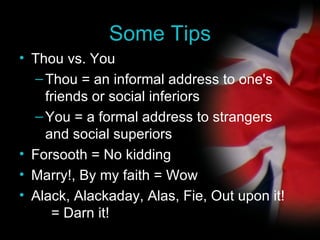
Some Tips Thou vs. You Thou = an informal address to one's friends or social inferiors You = a formal address to strangers and social superiors Forsooth = No kidding Marry!, By my faith = Wow Alack, Alackaday, Alas, Fie, Out upon it!  = Darn it!
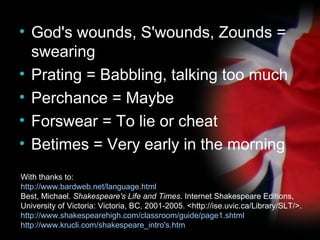
God's wounds, S'wounds, Zounds = swearing Prating = Babbling, talking too much Perchance = Maybe Forswear = To lie or cheat Betimes = Very early in the morning With thanks to: http://www.bardweb.net/language.html Best, Michael.  Shakespeare's Life and Times . Internet Shakespeare Editions, University of Victoria: Victoria, BC, 2001-2005. <http://ise.uvic.ca/Library/SLT/>. http://www.shakespearehigh.com/classroom/guide/page1.shtml http://www.krucli.com/shakespeare_intro's.htm
What do these two passages have in common? Lord Chief Justice: &quot;Your means are very slender and your   waste great.&quot;  Falstaff (an obese and high-living man): &quot;I would that my   means were greater and my waist slenderer.&quot;  Romeo and Juliet:  Mercutio is a young man with wit and little seriousness. As he lies dying: &quot;Ask for me tomorrow and you will find me a grave man.&quot;
They both contains puns. Lord Chief Justice: &quot;Your means are very slender and your   waste  great.&quot;  Falstaff (an obese and high-living man): &quot;I would that my   means were greater and my waist slenderer.&quot;  Romeo and Juliet:  Mercutio is a young man with wit and little seriousness. As he lies dying: &quot;Ask for me tomorrow and you will find me a  grave  man.&quot;
What device is Shakespeare using in these passages? &quot;Death, death, O amiable lovely death.&quot; &quot;Parting is such sweet sorrow.&quot;
They are both oxymorons. &quot; Death , death, O amiable  lovely  death.&quot; &quot;Parting is such  sweet sorrow .&quot;
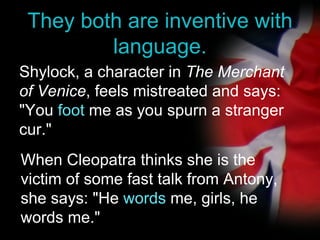
What do these passages illustrate? Shylock, a character in  The Merchant of Venice , feels   mistreated and says: &quot;You foot me as you spurn a stranger cur.&quot; When Cleopatra thinks she is the victim of some fast talk from Antony, she says: &quot;He words me, girls, he words me.&quot;
They both are inventive with language. Shylock, a character in  The Merchant of Venice , feels   mistreated and says: &quot;You  foot  me as you spurn a stranger cur.&quot; When Cleopatra thinks she is the victim of some fast talk from Antony, she says: &quot;He  words  me, girls, he words me.&quot;
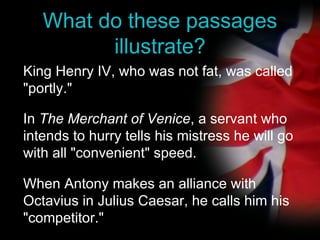
What do these passages illustrate? King Henry IV, who was not fat, was called &quot;portly.&quot; In  The Merchant of Venice , a servant who intends to hurry tells his mistress he will go with all &quot;convenient&quot; speed. When Antony makes an alliance with Octavius in Julius Caesar, he calls him his &quot;competitor.&quot;
They contain words that have shifted meaning. King Henry IV, who was not fat, was called &quot; portly .“  (stately; imposing) In  The Merchant of Venice , a servant who intends to hurry tells his mistress he will go with all &quot; convenient &quot; speed.  (near at hand) When Antony makes an alliance with Octavius in Julius Caesar, he calls him his &quot; competitor .“  (one who strives in common/agrees)
What are these passages examples of? King Henry IV says the soil of England will no longer &quot;daub her lips with her children's blood.&quot; In  A Midsummers' Night Dream , the course of young love is described as &quot;swift as a shadow, short as any dream, brief as lightning.&quot; In  Romeo and Juliet , Romeo says, &quot;But soft, what light through yonder window breaks? It is the east, and Juliet is the sun.&quot;
They all use metaphors. King Henry IV says the soil of England will no longer &quot;daub her lips with her children's blood.&quot; In  A Midsummers' Night Dream , the course of young love is described as &quot;swift as a shadow, short as any dream, brief as lightning.&quot; In  Romeo and Juliet , Romeo says, &quot;But soft, what light through yonder window breaks? It is the east, and Juliet is the sun.&quot;
 

Shakespeare’s language

  • 1.
  • 2.
    The Elizabethans Theyloved language Even poorly-written plays usually rhymed and alliterated Sound of language was more important than logic of sentence structure E.g. they changed word order or repeated words for emphasis
  • 3.
    William Shakespeare Introducednearly 3,000 words into English His vocabulary is upward of 29,000 words (quadruple that of an average well-educated person!)
  • 4.
    So… why isit so hard to understand? Many words have shifted meaning since Shakespeare’s day, or have fallen out of use
  • 5.
    Letters, syllables, orwhole words were sometimes omitted 'tis: it is o'er: over ne'er: never e'er / ere: ever oft: often e'en: even
  • 6.
    Word order wasmore flexible. I ate the sandwich. I the sandwich ate. Ate the sandwich I. Ate I the sandwich. The sandwich I ate. The sandwich ate I.
  • 7.
    Pronunciation was quitedifferent from ours, so Shakespeare’s perfect rhymes usually are imperfect rhymes to us love / prove
  • 8.
    Shakespeare wrote dramaticpoetry most of the time, but sometimes included prose Poetry was mostly in blank verse (unrhymed lines of iambic pentametre) Poetry was sometimes in rhyming couplets, sonnet form, etc. Poetry usually used for passages of high feeling and increased intensity Prose often used for wit and play, or lower-status characters
  • 9.
    Some Tips Thouvs. You Thou = an informal address to one's friends or social inferiors You = a formal address to strangers and social superiors Forsooth = No kidding Marry!, By my faith = Wow Alack, Alackaday, Alas, Fie, Out upon it! = Darn it!
  • 10.
    God's wounds, S'wounds,Zounds = swearing Prating = Babbling, talking too much Perchance = Maybe Forswear = To lie or cheat Betimes = Very early in the morning With thanks to: http://www.bardweb.net/language.html Best, Michael. Shakespeare's Life and Times . Internet Shakespeare Editions, University of Victoria: Victoria, BC, 2001-2005. <http://ise.uvic.ca/Library/SLT/>. http://www.shakespearehigh.com/classroom/guide/page1.shtml http://www.krucli.com/shakespeare_intro's.htm
  • 11.
    What do thesetwo passages have in common? Lord Chief Justice: &quot;Your means are very slender and your waste great.&quot; Falstaff (an obese and high-living man): &quot;I would that my means were greater and my waist slenderer.&quot; Romeo and Juliet: Mercutio is a young man with wit and little seriousness. As he lies dying: &quot;Ask for me tomorrow and you will find me a grave man.&quot;
  • 12.
    They both containspuns. Lord Chief Justice: &quot;Your means are very slender and your waste great.&quot; Falstaff (an obese and high-living man): &quot;I would that my means were greater and my waist slenderer.&quot; Romeo and Juliet: Mercutio is a young man with wit and little seriousness. As he lies dying: &quot;Ask for me tomorrow and you will find me a grave man.&quot;
  • 13.
    What device isShakespeare using in these passages? &quot;Death, death, O amiable lovely death.&quot; &quot;Parting is such sweet sorrow.&quot;
  • 14.
    They are bothoxymorons. &quot; Death , death, O amiable lovely death.&quot; &quot;Parting is such sweet sorrow .&quot;
  • 15.
    What do thesepassages illustrate? Shylock, a character in The Merchant of Venice , feels mistreated and says: &quot;You foot me as you spurn a stranger cur.&quot; When Cleopatra thinks she is the victim of some fast talk from Antony, she says: &quot;He words me, girls, he words me.&quot;
  • 16.
    They both areinventive with language. Shylock, a character in The Merchant of Venice , feels mistreated and says: &quot;You foot me as you spurn a stranger cur.&quot; When Cleopatra thinks she is the victim of some fast talk from Antony, she says: &quot;He words me, girls, he words me.&quot;
  • 17.
    What do thesepassages illustrate? King Henry IV, who was not fat, was called &quot;portly.&quot; In The Merchant of Venice , a servant who intends to hurry tells his mistress he will go with all &quot;convenient&quot; speed. When Antony makes an alliance with Octavius in Julius Caesar, he calls him his &quot;competitor.&quot;
  • 18.
    They contain wordsthat have shifted meaning. King Henry IV, who was not fat, was called &quot; portly .“ (stately; imposing) In The Merchant of Venice , a servant who intends to hurry tells his mistress he will go with all &quot; convenient &quot; speed. (near at hand) When Antony makes an alliance with Octavius in Julius Caesar, he calls him his &quot; competitor .“ (one who strives in common/agrees)
  • 19.
    What are thesepassages examples of? King Henry IV says the soil of England will no longer &quot;daub her lips with her children's blood.&quot; In A Midsummers' Night Dream , the course of young love is described as &quot;swift as a shadow, short as any dream, brief as lightning.&quot; In Romeo and Juliet , Romeo says, &quot;But soft, what light through yonder window breaks? It is the east, and Juliet is the sun.&quot;
  • 20.
    They all usemetaphors. King Henry IV says the soil of England will no longer &quot;daub her lips with her children's blood.&quot; In A Midsummers' Night Dream , the course of young love is described as &quot;swift as a shadow, short as any dream, brief as lightning.&quot; In Romeo and Juliet , Romeo says, &quot;But soft, what light through yonder window breaks? It is the east, and Juliet is the sun.&quot;
  • 21.