SUBJECT : Literature
LECTURE : Miss Rani
ARRANGES BY : 1. Ani Istiana
2. Pipih Yanti
3. Romy Mardian
4. Warsono
GROUP 1
How to Analyze a
Short Story
What is a Short
Story ?
A short story is a work of short,
narrative proses that is usually
centered around one single
event. It is limited in scope and
has an introduction, body and
conclusion.
Although a short story has much in
common with a novel (See How to
Analyze a Novel), it is written with
much greater precision. You will often
be asked to write a literary analysis.
An analysis of a short story requires
basic knowledge of literary elements.
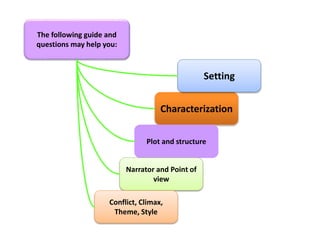
The following guide and
questions may help you:
Characterization
Setting
Plot and structure
Narrator and Point of
view
Conflict, Climax,
Theme, Style
Setting is a description of where and
when the story takes place. In a short story there
are fewer settings compared to a novel. The time
is more limited.
A. What role does setting play in the story? Is it an
important part of the plot or theme? Or is it just a
back drop against which the action takes place?
Study the time period which is also part of the setting :
* When was the story written?
• Does it take place in the present, the past, or the future?
• How does the time period affect the language, atmosphere
or social circumstances of the short story?
B. How is the setting created? Consider
geography, weather, time of day, social
conditions, etc.
Setting
1
2
3
4
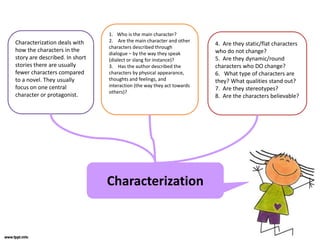
Characterization
Characterization deals with
how the characters in the
story are described. In short
stories there are usually
fewer characters compared
to a novel. They usually
focus on one central
character or protagonist.
1. Who is the main character?
2. Are the main character and other
characters described through
dialogue – by the way they speak
(dialect or slang for instance)?
3. Has the author described the
characters by physical appearance,
thoughts and feelings, and
interaction (the way they act towards
others)?
4. Are they static/flat characters
who do not change?
5. Are they dynamic/round
characters who DO change?
6. What type of characters are
they? What qualities stand out?
7. Are they stereotypes?
8. Are the characters believable?
Plot and structure
The plot is the main sequence
of events that make up the
story. In short stories the plot
is usually centered around one
experience or significant
moment
What is the most
important event?
How is the plot structured? Is it
linear, chronological or does it
move around?
Is the plot believable?
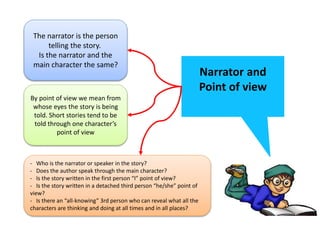
Narrator and
Point of view
The narrator is the person
telling the story.
Is the narrator and the
main character the same?
By point of view we mean from
whose eyes the story is being
told. Short stories tend to be
told through one character’s
point of view
- Who is the narrator or speaker in the story?
- Does the author speak through the main character?
- Is the story written in the first person “I” point of view?
- Is the story written in a detached third person “he/she” point of
view?
- Is there an “all-knowing” 3rd person who can reveal what all the
characters are thinking and doing at all times and in all places?
Conflict
Conflict or tension is usually the
heart of the short story and is
related to the main character. In a
short story there is usually one main
struggle.
Is it an external conflict caused by
the surroundings or environment
the main character finds
himself/herself in?
1. How would you describe the main
conflict?
2. Is it an internal conflict within the
character?
Climax
The climax is the point of greatest tension
or intensity in the short story. It can also
be the turning point where events take a
major turn as the story races towards its
conclusion.
* Is there a turning point in the story?
* When does the climax take place?
Theme
The theme is the main idea, lesson or message in the
short story. It is usually an abstract idea about the
human condition, society or life.
How is the theme expressed?
Are any elements repeated that may suggest a theme?
Is there more than one theme?
Style
The author’s style has to do with the author’s
vocabulary, use of imagery, tone or feeling of the story.
It has to do with his attitude to wards the subject. In
some short stories the tone can be ironic, humorous,
cold or dramatic.
Is his language full of figurative language?
What images does he use?
Your literary analysis of a short story will
often be in the form of an essay where
you may be asked to give your opinions
of the short story at the end.
THANK YOU

How to Analyze a Short Story

  • 1.
    SUBJECT : Literature LECTURE: Miss Rani ARRANGES BY : 1. Ani Istiana 2. Pipih Yanti 3. Romy Mardian 4. Warsono GROUP 1
  • 2.
    How to Analyzea Short Story
  • 3.
    What is aShort Story ? A short story is a work of short, narrative proses that is usually centered around one single event. It is limited in scope and has an introduction, body and conclusion. Although a short story has much in common with a novel (See How to Analyze a Novel), it is written with much greater precision. You will often be asked to write a literary analysis. An analysis of a short story requires basic knowledge of literary elements.
  • 4.
    The following guideand questions may help you: Characterization Setting Plot and structure Narrator and Point of view Conflict, Climax, Theme, Style
  • 5.
    Setting is adescription of where and when the story takes place. In a short story there are fewer settings compared to a novel. The time is more limited. A. What role does setting play in the story? Is it an important part of the plot or theme? Or is it just a back drop against which the action takes place? Study the time period which is also part of the setting : * When was the story written? • Does it take place in the present, the past, or the future? • How does the time period affect the language, atmosphere or social circumstances of the short story? B. How is the setting created? Consider geography, weather, time of day, social conditions, etc. Setting 1 2 3 4
  • 6.
    Characterization Characterization deals with howthe characters in the story are described. In short stories there are usually fewer characters compared to a novel. They usually focus on one central character or protagonist. 1. Who is the main character? 2. Are the main character and other characters described through dialogue – by the way they speak (dialect or slang for instance)? 3. Has the author described the characters by physical appearance, thoughts and feelings, and interaction (the way they act towards others)? 4. Are they static/flat characters who do not change? 5. Are they dynamic/round characters who DO change? 6. What type of characters are they? What qualities stand out? 7. Are they stereotypes? 8. Are the characters believable?
  • 7.
    Plot and structure Theplot is the main sequence of events that make up the story. In short stories the plot is usually centered around one experience or significant moment What is the most important event? How is the plot structured? Is it linear, chronological or does it move around? Is the plot believable?
  • 8.
    Narrator and Point ofview The narrator is the person telling the story. Is the narrator and the main character the same? By point of view we mean from whose eyes the story is being told. Short stories tend to be told through one character’s point of view - Who is the narrator or speaker in the story? - Does the author speak through the main character? - Is the story written in the first person “I” point of view? - Is the story written in a detached third person “he/she” point of view? - Is there an “all-knowing” 3rd person who can reveal what all the characters are thinking and doing at all times and in all places?
  • 9.
    Conflict Conflict or tensionis usually the heart of the short story and is related to the main character. In a short story there is usually one main struggle. Is it an external conflict caused by the surroundings or environment the main character finds himself/herself in? 1. How would you describe the main conflict? 2. Is it an internal conflict within the character?
  • 10.
    Climax The climax isthe point of greatest tension or intensity in the short story. It can also be the turning point where events take a major turn as the story races towards its conclusion. * Is there a turning point in the story? * When does the climax take place? Theme The theme is the main idea, lesson or message in the short story. It is usually an abstract idea about the human condition, society or life. How is the theme expressed? Are any elements repeated that may suggest a theme? Is there more than one theme?
  • 11.
    Style The author’s stylehas to do with the author’s vocabulary, use of imagery, tone or feeling of the story. It has to do with his attitude to wards the subject. In some short stories the tone can be ironic, humorous, cold or dramatic. Is his language full of figurative language? What images does he use? Your literary analysis of a short story will often be in the form of an essay where you may be asked to give your opinions of the short story at the end.
  • 12.