Presented in Ms. Ronila Seva's Class
Group Report
on
SHORT STORY
GLCA Grade 8
English
8
Angel
Erlisha
James
Short Story
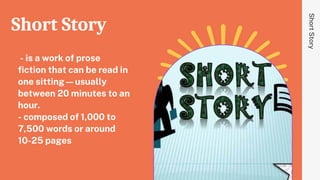
- is a work of prose
fiction that can be read in
one sitting—usually
between 20 minutes to an
hour.
- composed of 1,000 to
7,500 words or around
10-25 pages
Short
Story
History
Origins
The evolution of the short story first began before humans could write. To
aid in constructing and memorizing tales, the early storyteller often
relied on stock phrases, fixed rhythms, and rhyme. Consequently, many
of the oldest narratives in the world, such as the ancient Babylonian tale
the Epic of Gilgamesh, are in verse. Indeed, most major stories from the
ancient Middle East were in verse: “The War of the Gods,” “The Story of
Adapa” (both Babylonian), “The Heavenly Bow,” and “The King Who
Forgot” (both Canaanite). Those tales were inscribed in cuneiform on clay
during the 2nd millennium BCE.
Origins
Short-form stories or story telling can be
traced back to ancient legends,
mythology, folklore, and fables found in
communities all over the world. Some of
these stories existed in written form, but
many were passed down through oral
traditions.
Elements of a Short Story
• Setting
• Characters
• Plot
• Conflict
• Point of View
• Theme
ELEMENTS
Setting • the time/period and location in
which the story takes place
⚬ Where is the geographical location of the
story?
⚬ When is the story taking place (historical
period, time of the day or year)
⚬ What is the weather condition?
⚬ What is the social condition?
Elements
of
a
Short
Story
• the setting of short story is often simplified
(one time and place)
Characters
• persons, animals
or fantasy
characters
involved in the
short story
• characteristics of
a person
1) MAJOR CHARACTER - main characters
PROTAGONIST - central character or the "good guy"
or hero of the story
ANTAGONIST - opposer of the protagonist or the
"bad guy"/villain; usually creates conflict for the
main character
DEUTEROGAMIST - second in importance or the
"second lead"
2) MINOR CHARACTER - have little roles in the story
but are necessary to move the plot along
Kinds of Characters
1) What he/she looks like - physical appearance
2)What he/she thinks, feels or dreams about
3) What he/she does or does not do
4) What others say about him/her or they react to
him/her
Characteristics of a Person
Elements
of
a
Short
Story
Plot
• sequence of events in a story
• how the author arranges the events
to develop his basic idea
• the blueprint or skeleton of the
story
Elements
of
a
Short
Story
Short stories:
• focus on a single plot instead of multiple subplots
• revolve around just one incident that happens
during a brief period of time
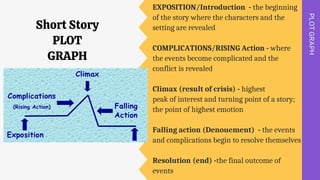
EXPOSITION/Introduction - the beginning
of the story where the characters and the
setting are revealed
COMPLICATIONS/RISING Action - where
the events become complicated and the
conflict is revealed
Climax (result of crisis) - highest
peak of interest and turning point of a story;
the point of highest emotion
Falling action (Denouement) - the events
and complications begin to resolve themselves
Resolution (end) -the final outcome of
events
PLOT
GRAPH
Short Story
PLOT
GRAPH
Conflict
• What prevents
the main
character from
getting what he
wants
• a problem or
goal that the
main character
is faced with
Conflict
A story is told through
the eyes of a character or
narrator, and this is
called the
Point of View
WHO IS THE NARRATOR OF
THE STORY?
.
Point
of
VIew
Who is telling the story?
Point of View
Point
of
View
One of the characters
is telling the story
First Person
Narrator is addressing
the reader
Second Person
The narrator is not part
of the the story
Third Person
Key Words Key Words Key Words
I, Me, Our, We You,
Your
He, She, His, Her Their,
Them, names
Theme
• the central idea
about life that the
story highlights
• the main idea,
universal truths
• Examples: love,
honor, revenge
Tristan
01 has a simple subject/plot,
one that lets the story take
place within a brief period
of time
02 with few characters that
are quickly developed
03 has one point of view
04 has a fast-paced, reader-
grabbing beginning but
proceeds with a direct route
to the end
05 has a strong ending that
completes the story and
provides understanding
and satisfaction
A Short
Story:
The Types of
Short Stories
Anecdote
An anecdote is a short account of something
interesting and amusing, which usually tells a
story about a real person and/or incident. Often,
anecdotes are used to illustrate or support a
point in an essay, article, or chapter. They are
very short, but have no specific limits.
Fable
A fable is a succinct story featuring anthropomorphic
creatures (usually animals, but also mythical creatures,
plants, inanimate objects, or forces of nature) to tell a
story with a moral. Often the moral is explicitly told at
the end. A fable is similar to a parable, but differs most
in the fact that fables use animals to tell a story but
parables do not.
Feghoot
A feghoot is an interesting short story type
also known as a story pun or a poetic story
joke. It is a humorous piece ending in an
atrocious pun. It can be very short, only long
enough to sufficiently illustrate the context of
the piece enough to lead up to the pun.
Flash Fiction
A feghoot is an interesting short story type also known as a story
pun or a poetic story joke. It is a humorous piece ending in an
atrocious pun. It can be very short, only long enough to
sufficiently illustrate the context of the piece enough to lead up to
the pun.
Frame
Story
A frame story is also known as a frame tale
or a nested narrative. It is a literary
technique of placing a story within a story,
for the purpose of introducing or setting
the stage for a main narrative or a series of
short stories.
Mini - Saga
A mini-saga is a short story told in
exactly 50 words. It is a test in brevity
– about saying a lot with a little.
Story Sequence
A story sequence, also called a short story cycle or a composite
novel, is a group of short stories that work together to form a
longer piece, while still functioning as complete short stories on
their own.
Sketch Story
A sketch story is a shorter than average piece containing
little or no plot. It can be merely a description of a
character or a location. Character sketches are common,
and a good way to build a character that will eventually be
part of a longer piece.
Vignette
A vignette is a short, impressionistic piece that focuses on
a single scene, character, idea, setting, or object. There is
little emphasis on adhering to conventional theatrical or
literary structure, or story development. It can be a
stand-alone piece or part of a larger work.
Examples of
Short Stories
Examples
:
-The Tale of Peter Rabbit
-Goldilocks and the Three Bears
-The Night Before Christmas
-Where the Wild things Are
-Little Red Riding Hood
-Peter Pan
-Rip Van Winkle
-The Prince and the
Pauper
-Three Little Pigs
-The Giving Tree
-Green Eggs and Ham
-The Cat in the Hat
-The Princess and the Pea
-The Boy Who Cried Wolf
Thank you for listening to our
presentation!
We hope you all learned something new.

Short Story.pdf

  • 1.
    Presented in Ms.Ronila Seva's Class Group Report on SHORT STORY GLCA Grade 8 English 8 Angel Erlisha James
  • 2.
    Short Story - isa work of prose fiction that can be read in one sitting—usually between 20 minutes to an hour. - composed of 1,000 to 7,500 words or around 10-25 pages Short Story
  • 3.
    History Origins The evolution ofthe short story first began before humans could write. To aid in constructing and memorizing tales, the early storyteller often relied on stock phrases, fixed rhythms, and rhyme. Consequently, many of the oldest narratives in the world, such as the ancient Babylonian tale the Epic of Gilgamesh, are in verse. Indeed, most major stories from the ancient Middle East were in verse: “The War of the Gods,” “The Story of Adapa” (both Babylonian), “The Heavenly Bow,” and “The King Who Forgot” (both Canaanite). Those tales were inscribed in cuneiform on clay during the 2nd millennium BCE.
  • 4.
    Origins Short-form stories orstory telling can be traced back to ancient legends, mythology, folklore, and fables found in communities all over the world. Some of these stories existed in written form, but many were passed down through oral traditions.
  • 5.
    Elements of aShort Story • Setting • Characters • Plot • Conflict • Point of View • Theme ELEMENTS
  • 6.
    Setting • thetime/period and location in which the story takes place ⚬ Where is the geographical location of the story? ⚬ When is the story taking place (historical period, time of the day or year) ⚬ What is the weather condition? ⚬ What is the social condition? Elements of a Short Story • the setting of short story is often simplified (one time and place)
  • 7.
    Characters • persons, animals orfantasy characters involved in the short story • characteristics of a person 1) MAJOR CHARACTER - main characters PROTAGONIST - central character or the "good guy" or hero of the story ANTAGONIST - opposer of the protagonist or the "bad guy"/villain; usually creates conflict for the main character DEUTEROGAMIST - second in importance or the "second lead" 2) MINOR CHARACTER - have little roles in the story but are necessary to move the plot along Kinds of Characters 1) What he/she looks like - physical appearance 2)What he/she thinks, feels or dreams about 3) What he/she does or does not do 4) What others say about him/her or they react to him/her Characteristics of a Person Elements of a Short Story
  • 8.
    Plot • sequence ofevents in a story • how the author arranges the events to develop his basic idea • the blueprint or skeleton of the story Elements of a Short Story Short stories: • focus on a single plot instead of multiple subplots • revolve around just one incident that happens during a brief period of time
  • 9.
    EXPOSITION/Introduction - thebeginning of the story where the characters and the setting are revealed COMPLICATIONS/RISING Action - where the events become complicated and the conflict is revealed Climax (result of crisis) - highest peak of interest and turning point of a story; the point of highest emotion Falling action (Denouement) - the events and complications begin to resolve themselves Resolution (end) -the final outcome of events PLOT GRAPH Short Story PLOT GRAPH
  • 10.
    Conflict • What prevents themain character from getting what he wants • a problem or goal that the main character is faced with Conflict
  • 11.
    A story istold through the eyes of a character or narrator, and this is called the Point of View WHO IS THE NARRATOR OF THE STORY? . Point of VIew
  • 12.
    Who is tellingthe story? Point of View Point of View One of the characters is telling the story First Person Narrator is addressing the reader Second Person The narrator is not part of the the story Third Person Key Words Key Words Key Words I, Me, Our, We You, Your He, She, His, Her Their, Them, names
  • 13.
    Theme • the centralidea about life that the story highlights • the main idea, universal truths • Examples: love, honor, revenge Tristan
  • 14.
    01 has asimple subject/plot, one that lets the story take place within a brief period of time 02 with few characters that are quickly developed 03 has one point of view 04 has a fast-paced, reader- grabbing beginning but proceeds with a direct route to the end 05 has a strong ending that completes the story and provides understanding and satisfaction A Short Story:
  • 15.
  • 16.
    Anecdote An anecdote isa short account of something interesting and amusing, which usually tells a story about a real person and/or incident. Often, anecdotes are used to illustrate or support a point in an essay, article, or chapter. They are very short, but have no specific limits.
  • 17.
    Fable A fable isa succinct story featuring anthropomorphic creatures (usually animals, but also mythical creatures, plants, inanimate objects, or forces of nature) to tell a story with a moral. Often the moral is explicitly told at the end. A fable is similar to a parable, but differs most in the fact that fables use animals to tell a story but parables do not.
  • 18.
    Feghoot A feghoot isan interesting short story type also known as a story pun or a poetic story joke. It is a humorous piece ending in an atrocious pun. It can be very short, only long enough to sufficiently illustrate the context of the piece enough to lead up to the pun.
  • 19.
    Flash Fiction A feghootis an interesting short story type also known as a story pun or a poetic story joke. It is a humorous piece ending in an atrocious pun. It can be very short, only long enough to sufficiently illustrate the context of the piece enough to lead up to the pun.
  • 20.
    Frame Story A frame storyis also known as a frame tale or a nested narrative. It is a literary technique of placing a story within a story, for the purpose of introducing or setting the stage for a main narrative or a series of short stories.
  • 21.
    Mini - Saga Amini-saga is a short story told in exactly 50 words. It is a test in brevity – about saying a lot with a little.
  • 22.
    Story Sequence A storysequence, also called a short story cycle or a composite novel, is a group of short stories that work together to form a longer piece, while still functioning as complete short stories on their own.
  • 23.
    Sketch Story A sketchstory is a shorter than average piece containing little or no plot. It can be merely a description of a character or a location. Character sketches are common, and a good way to build a character that will eventually be part of a longer piece.
  • 24.
    Vignette A vignette isa short, impressionistic piece that focuses on a single scene, character, idea, setting, or object. There is little emphasis on adhering to conventional theatrical or literary structure, or story development. It can be a stand-alone piece or part of a larger work.
  • 25.
  • 26.
    Examples : -The Tale ofPeter Rabbit -Goldilocks and the Three Bears -The Night Before Christmas -Where the Wild things Are -Little Red Riding Hood -Peter Pan -Rip Van Winkle -The Prince and the Pauper -Three Little Pigs -The Giving Tree -Green Eggs and Ham -The Cat in the Hat -The Princess and the Pea -The Boy Who Cried Wolf
  • 27.
    Thank you forlistening to our presentation! We hope you all learned something new.