DECONSTRUCTION
BY: PAYAL
RICHA
ROSHANI
HOW DECONSTRUCTION?
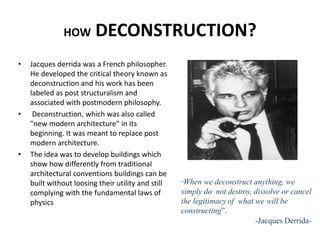
• Jacques derrida was a French philosopher.
He developed the critical theory known as
deconstruction and his work has been
labeled as post structuralism and
associated with postmodern philosophy.
• Deconstruction, which was also called
"new modern architecture" in its
beginning. It was meant to replace post
modern architecture.
• The idea was to develop buildings which
show how differently from traditional
architectural conventions buildings can be
built without loosing their utility and still
complying with the fundamental laws of
physics
“When we deconstruct anything, we
simply do not destroy, dissolve or cancel
the legitimacy of what we will be
constructing”.
-Jacques Derrida-
HOW DECONSTRUCTION?
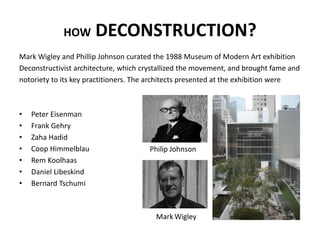
Mark Wigley and Phillip Johnson curated the 1988 Museum of Modern Art exhibition
Deconstructivist architecture, which crystallized the movement, and brought fame and
notoriety to its key practitioners. The architects presented at the exhibition were
• Peter Eisenman
• Frank Gehry
• Zaha Hadid
• Coop Himmelblau
• Rem Koolhaas
• Daniel Libeskind
• Bernard Tschumi
Philip Johnson
Mark Wigley
WHAT IS DECONSTRUCTION?
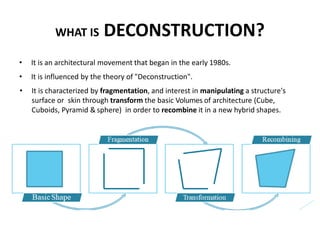
• It is an architectural movement that began in the early 1980s.
• It is influenced by the theory of "Deconstruction".
• It is characterized by fragmentation, and interest in manipulating a structure's
surface or skin through transform the basic Volumes of architecture (Cube,
Cuboids, Pyramid & sphere) in order to recombine it in a new hybrid shapes.
WHY DECONSTRUCTION?
Deconstructivism rejected the postmodern acceptance of thehistorical references, as
well as the idea of ornament as an after-thought ordecoration.
GOALS IN DECONSTRUCTION
Deconstructivism attempts to move away from the supposedly constricting 'rules' of
modernism such as:
DESIGN CHARACTERISTICS
• No physically pure basic volume.
• FragmentedMass.
• New Material (Metals, Glass,Concrete).
• Complicated Structure, and thus advanced structuralsystems.
• Relatively high Voidpercentage.
• OpenPlan.
• Distinguishing from context.
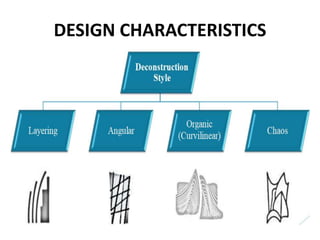
DESIGN CHARACTERISTICS
DESIGN CHARACTERISTICS:LAYERING
Definition: essentially based on fragmenting pure basic
Volumes into vertical & horizontal Planes which create
different layers.
RICHARD MEIER
Nationality:American.
Born: 1934.
Qualifications: BCS of Architecture degree
from Cornell University.
Philosophy:
•Main figure in the “New York Five”
•Main concepts: Light, Color and Place.
•Main focus – placeness: “What is it that makes a space a place.”
•Plain geometry, layered definition of spaces and effects of light and
shade.
•Forms interlaced in landscape.
•Usually designs white Neo-Corbusian forms with enameled panels
and glass
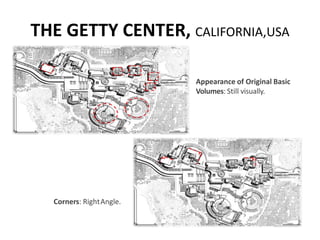
THE GETTY CENTER, CALIFORNIA,USA
Lines: Straight parallel lines &Arch.
Articulation: through relation between
layers & Masses.
Openings: by Subtraction & Addition.
THE GETTY CENTER, CALIFORNIA,USA
Corners: RightAngle.
Appearance of Original Basic
Volumes: Still visually.
PETER EISENMAN
Nationality:American.
Born: 1932.
Qualifications: Ph.D. of Architecture degrees from
the University of Cambridge.
Philosophy:
•He rejected the functional concept of modernism by designing
stairways that led nowhere or columns that did not function as
support
•His works were characterized by disconcerting forms, angles and
materials
•According to eisenman, when you can sense the incompleteness of a
finished structure, it is a paradoxical experience. If the parts that make
up a whole are in conflict, the sensation of the incomplete contests the
fact that the structure is, in fact, a finished and fully enclosed space
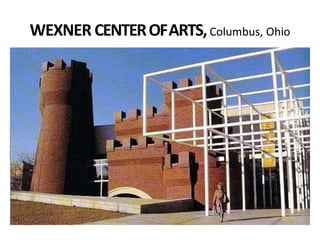
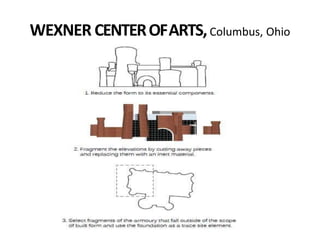
WEXNER CENTEROFARTS,Columbus, Ohio
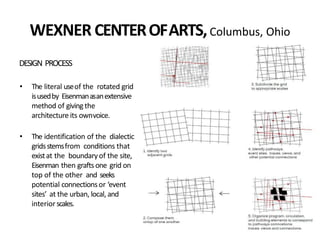
DESIGN PROCESS
• The literal useof the rotated grid
isusedby Eisenmanasanextensive
method of giving the
architecture its ownvoice.
• The identification of the dialectic
gridsstemsfrom conditions that
existat the boundaryof the site,
Eisenman then grafts one grid on
top of the other and seeks
potential connectionsor ‘event
sites’ at the urban, local, and
interiorscales.
WEXNER CENTEROFARTS,Columbus, Ohio
• Eisenmancoupledhisgrid abstractionswith aseriesof figuresthatwould playakey
role in hisaimof linking the pastwith the present.
• Themostprominent of these figuresexistsasareconstruction of apartof the armory
that occupiedthe site from 1898until it wasterminally damagedbyfire on May
17th1958.
• Thefigure of the armory Eisenmanhaspresented alongthe south pedestrian access
(the most visually accessibleelevation of thebuilding) hasbeenreduced to aseriesof
fragmentsof armory-like formsthat indicatethe ‘essence’of the armory without
reproducinganyof the original intricatedetail.
WEXNER CENTEROFARTS,Columbus, Ohio
DESIGN CHARACTERISTICS:ANGULAR
Definition: essentially consists of complicated
composition of hybrid volumes with Acute
angles.
DANIEL LIBESKIND
Nationality:American.
Born: 1946.
Qualifications: BCS of Architecture degree from
University of Essex.
Philosophy:
•Architecture tells a story about the world, our desires and dreams. Architecture, and the
buildings, are much more than a place, they are destinations meant to evoke emotion and
to make you think about the world we all live in.
•Buildings and urban projects are crafted with perceptible human energy and that they
speak to the larger cultural community in which they are built.
•The Museum Is At A Site Which Is Close To The Rocky Mountains.
•Daniel Libeskind Has Derived This Form Consisting Sharp Geometric Volumes By Getting
Inspired By The Peaks And Valleys Of The Majestic Rocky Mountains.
•He Wanted Different Functions Of A Public Space To Come Together And Form A Single
Volume.
DENVER ART MUSEUM, COLORADO, USA
Appearance of Original Basic
Volumes:Disappear.
Lines: Almost Straight Non-
parallellines.
DENVER ART MEUSEUM, COLORADO, USA
Corners: Acute
angles.
Articulation: through
relation between Masses.
Openings: Mainly by
Subtraction
REM KOOLHAAS
Nationality: Dutch.
Born: 1944.
Qualifications: BCS of Architecture degrees from
Architectural Association inLondon.
Philosophy:
• Boldly produces buildings that differ visually to their surroundings
• Celebrates the "chance-like" nature of city
• Interrogated the "Program“ to oppose the notion “ an act to edit function and human
activities “ as the pretext of architectural design
• His work emphatically embraces the contradictions of two disciplines- architecture and
urban design
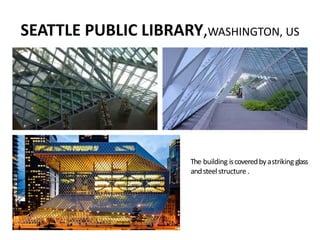
SEATTLE PUBLIC LIBRARY,WASHINGTON, US
•The concept involvesthe reinvention of the
library asan access point to information
presented in avariety ofmedia
•Koolhaas applied its interpretation of the
feature setandarchitecture for the project
that the buildingwould beflexiblefor future
expansions.
•Flexibility in contemporarylibraries is
conceivedasthe creationof genericfloors on
which almost anyactivity canbedeveloped.
SEATTLE PUBLIC LIBRARY,WASHINGTON, US
• This formof flexibility ,the librarystranglesthe veryattractions that differentiate it
from other information resources.
• Insteadof its currentambiguousflexibility ,the librarycouldcultivate a more refined
approachin organizing spatial compartments,each dedicatedto andequipped forspecific
services.
SEATTLE PUBLIC LIBRARY,WASHINGTON, US
The building iscoveredbyastriking glass
andsteelstructure .
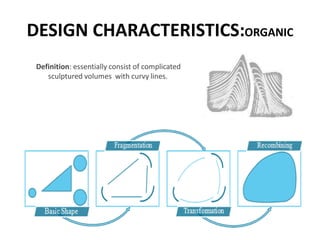
DESIGN CHARACTERISTICS:ORGANIC
Definition: essentially consist of complicated
sculptured volumes with curvy lines.
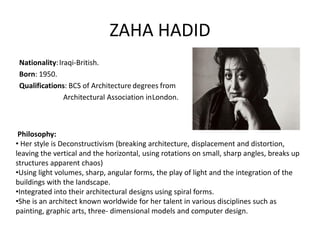
ZAHA HADID
Nationality:Iraqi-British.
Born: 1950.
Qualifications: BCS of Architecture degrees from
Architectural Association inLondon.
Philosophy:
• Her style is Deconstructivism (breaking architecture, displacement and distortion,
leaving the vertical and the horizontal, using rotations on small, sharp angles, breaks up
structures apparent chaos)
•Using light volumes, sharp, angular forms, the play of light and the integration of the
buildings with the landscape.
•Integrated into their architectural designs using spiral forms.
•She is an architect known worldwide for her talent in various disciplines such as
painting, graphic arts, three- dimensional models and computer design.
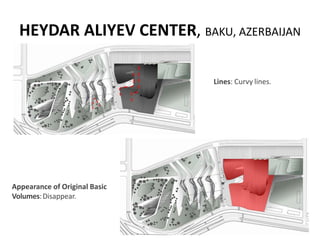
HEYDAR ALIYEV CENTER, BAKU, AZERBAIJAN
Lines: Curvy lines.
Appearance of Original Basic
Volumes:Disappear.
HEYDAR ALIYEV CENTER, BAKU, AZERBAIJAN
Corners: Almost No
Corners butcurves.
Articulation: sculpturing.
Openings: Mainly by Subtraction.
DESIGN CHARACTERISTICS:CHAOS
Definition: essentially consists of complicated
composition of hybrid volumes with wide
variety of lines & angles.
Vitra Design Museum And Factory,
Frank Gehry
Walt Disney Concert Hall,
Frank Gehry And Vlado Milunic
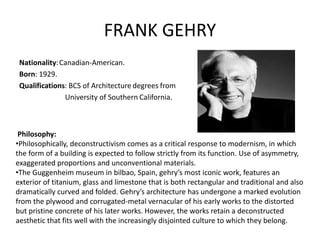
FRANK GEHRY
Nationality:Canadian-American.
Born: 1929.
Qualifications: BCS of Architecture degrees from
University of Southern California.
Philosophy:
•Philosophically, deconstructivism comes as a critical response to modernism, in which
the form of a building is expected to follow strictly from its function. Use of asymmetry,
exaggerated proportions and unconventional materials.
•The Guggenheim museum in bilbao, Spain, gehry’s most iconic work, features an
exterior of titanium, glass and limestone that is both rectangular and traditional and also
dramatically curved and folded. Gehry’s architecture has undergone a marked evolution
from the plywood and corrugated-metal vernacular of his early works to the distorted
but pristine concrete of his later works. However, the works retain a deconstructed
aesthetic that fits well with the increasingly disjointed culture to which they belong.
GUGGENHEIM MUSEUM, BILBAO, SPAIN
Lines: Both Straight & Curvy
lines.
Articulation: through relation
between Masses.
Openings: by Subtraction
&Addition.
GUGGENHEIM MUSEUM, BILBAO, SPAIN
Corners: Both Right &Acute
angles & curves.
Appearance of Original Basic
Volumes:Disappear.
THANK YOU…

DECONSTRUCTION

  • 1.
  • 2.
    HOW DECONSTRUCTION? • Jacquesderrida was a French philosopher. He developed the critical theory known as deconstruction and his work has been labeled as post structuralism and associated with postmodern philosophy. • Deconstruction, which was also called "new modern architecture" in its beginning. It was meant to replace post modern architecture. • The idea was to develop buildings which show how differently from traditional architectural conventions buildings can be built without loosing their utility and still complying with the fundamental laws of physics “When we deconstruct anything, we simply do not destroy, dissolve or cancel the legitimacy of what we will be constructing”. -Jacques Derrida-
  • 3.
    HOW DECONSTRUCTION? Mark Wigleyand Phillip Johnson curated the 1988 Museum of Modern Art exhibition Deconstructivist architecture, which crystallized the movement, and brought fame and notoriety to its key practitioners. The architects presented at the exhibition were • Peter Eisenman • Frank Gehry • Zaha Hadid • Coop Himmelblau • Rem Koolhaas • Daniel Libeskind • Bernard Tschumi Philip Johnson Mark Wigley
  • 4.
    WHAT IS DECONSTRUCTION? •It is an architectural movement that began in the early 1980s. • It is influenced by the theory of "Deconstruction". • It is characterized by fragmentation, and interest in manipulating a structure's surface or skin through transform the basic Volumes of architecture (Cube, Cuboids, Pyramid & sphere) in order to recombine it in a new hybrid shapes.
  • 5.
    WHY DECONSTRUCTION? Deconstructivism rejectedthe postmodern acceptance of thehistorical references, as well as the idea of ornament as an after-thought ordecoration.
  • 6.
    GOALS IN DECONSTRUCTION Deconstructivismattempts to move away from the supposedly constricting 'rules' of modernism such as:
  • 7.
    DESIGN CHARACTERISTICS • Nophysically pure basic volume. • FragmentedMass. • New Material (Metals, Glass,Concrete). • Complicated Structure, and thus advanced structuralsystems. • Relatively high Voidpercentage. • OpenPlan. • Distinguishing from context.
  • 8.
  • 9.
    DESIGN CHARACTERISTICS:LAYERING Definition: essentiallybased on fragmenting pure basic Volumes into vertical & horizontal Planes which create different layers.
  • 10.
    RICHARD MEIER Nationality:American. Born: 1934. Qualifications:BCS of Architecture degree from Cornell University. Philosophy: •Main figure in the “New York Five” •Main concepts: Light, Color and Place. •Main focus – placeness: “What is it that makes a space a place.” •Plain geometry, layered definition of spaces and effects of light and shade. •Forms interlaced in landscape. •Usually designs white Neo-Corbusian forms with enameled panels and glass
  • 11.
    THE GETTY CENTER,CALIFORNIA,USA Lines: Straight parallel lines &Arch. Articulation: through relation between layers & Masses. Openings: by Subtraction & Addition.
  • 12.
    THE GETTY CENTER,CALIFORNIA,USA Corners: RightAngle. Appearance of Original Basic Volumes: Still visually.
  • 13.
    PETER EISENMAN Nationality:American. Born: 1932. Qualifications:Ph.D. of Architecture degrees from the University of Cambridge. Philosophy: •He rejected the functional concept of modernism by designing stairways that led nowhere or columns that did not function as support •His works were characterized by disconcerting forms, angles and materials •According to eisenman, when you can sense the incompleteness of a finished structure, it is a paradoxical experience. If the parts that make up a whole are in conflict, the sensation of the incomplete contests the fact that the structure is, in fact, a finished and fully enclosed space
  • 14.
  • 15.
    WEXNER CENTEROFARTS,Columbus, Ohio DESIGNPROCESS • The literal useof the rotated grid isusedby Eisenmanasanextensive method of giving the architecture its ownvoice. • The identification of the dialectic gridsstemsfrom conditions that existat the boundaryof the site, Eisenman then grafts one grid on top of the other and seeks potential connectionsor ‘event sites’ at the urban, local, and interiorscales.
  • 16.
    WEXNER CENTEROFARTS,Columbus, Ohio •Eisenmancoupledhisgrid abstractionswith aseriesof figuresthatwould playakey role in hisaimof linking the pastwith the present. • Themostprominent of these figuresexistsasareconstruction of apartof the armory that occupiedthe site from 1898until it wasterminally damagedbyfire on May 17th1958. • Thefigure of the armory Eisenmanhaspresented alongthe south pedestrian access (the most visually accessibleelevation of thebuilding) hasbeenreduced to aseriesof fragmentsof armory-like formsthat indicatethe ‘essence’of the armory without reproducinganyof the original intricatedetail.
  • 17.
  • 18.
    DESIGN CHARACTERISTICS:ANGULAR Definition: essentiallyconsists of complicated composition of hybrid volumes with Acute angles.
  • 19.
    DANIEL LIBESKIND Nationality:American. Born: 1946. Qualifications:BCS of Architecture degree from University of Essex. Philosophy: •Architecture tells a story about the world, our desires and dreams. Architecture, and the buildings, are much more than a place, they are destinations meant to evoke emotion and to make you think about the world we all live in. •Buildings and urban projects are crafted with perceptible human energy and that they speak to the larger cultural community in which they are built. •The Museum Is At A Site Which Is Close To The Rocky Mountains. •Daniel Libeskind Has Derived This Form Consisting Sharp Geometric Volumes By Getting Inspired By The Peaks And Valleys Of The Majestic Rocky Mountains. •He Wanted Different Functions Of A Public Space To Come Together And Form A Single Volume.
  • 20.
    DENVER ART MUSEUM,COLORADO, USA Appearance of Original Basic Volumes:Disappear. Lines: Almost Straight Non- parallellines.
  • 21.
    DENVER ART MEUSEUM,COLORADO, USA Corners: Acute angles. Articulation: through relation between Masses. Openings: Mainly by Subtraction
  • 22.
    REM KOOLHAAS Nationality: Dutch. Born:1944. Qualifications: BCS of Architecture degrees from Architectural Association inLondon. Philosophy: • Boldly produces buildings that differ visually to their surroundings • Celebrates the "chance-like" nature of city • Interrogated the "Program“ to oppose the notion “ an act to edit function and human activities “ as the pretext of architectural design • His work emphatically embraces the contradictions of two disciplines- architecture and urban design
  • 23.
    SEATTLE PUBLIC LIBRARY,WASHINGTON,US •The concept involvesthe reinvention of the library asan access point to information presented in avariety ofmedia •Koolhaas applied its interpretation of the feature setandarchitecture for the project that the buildingwould beflexiblefor future expansions. •Flexibility in contemporarylibraries is conceivedasthe creationof genericfloors on which almost anyactivity canbedeveloped.
  • 24.
    SEATTLE PUBLIC LIBRARY,WASHINGTON,US • This formof flexibility ,the librarystranglesthe veryattractions that differentiate it from other information resources. • Insteadof its currentambiguousflexibility ,the librarycouldcultivate a more refined approachin organizing spatial compartments,each dedicatedto andequipped forspecific services.
  • 25.
    SEATTLE PUBLIC LIBRARY,WASHINGTON,US The building iscoveredbyastriking glass andsteelstructure .
  • 26.
    DESIGN CHARACTERISTICS:ORGANIC Definition: essentiallyconsist of complicated sculptured volumes with curvy lines.
  • 27.
    ZAHA HADID Nationality:Iraqi-British. Born: 1950. Qualifications:BCS of Architecture degrees from Architectural Association inLondon. Philosophy: • Her style is Deconstructivism (breaking architecture, displacement and distortion, leaving the vertical and the horizontal, using rotations on small, sharp angles, breaks up structures apparent chaos) •Using light volumes, sharp, angular forms, the play of light and the integration of the buildings with the landscape. •Integrated into their architectural designs using spiral forms. •She is an architect known worldwide for her talent in various disciplines such as painting, graphic arts, three- dimensional models and computer design.
  • 28.
    HEYDAR ALIYEV CENTER,BAKU, AZERBAIJAN Lines: Curvy lines. Appearance of Original Basic Volumes:Disappear.
  • 29.
    HEYDAR ALIYEV CENTER,BAKU, AZERBAIJAN Corners: Almost No Corners butcurves. Articulation: sculpturing. Openings: Mainly by Subtraction.
  • 30.
    DESIGN CHARACTERISTICS:CHAOS Definition: essentiallyconsists of complicated composition of hybrid volumes with wide variety of lines & angles. Vitra Design Museum And Factory, Frank Gehry Walt Disney Concert Hall, Frank Gehry And Vlado Milunic
  • 31.
    FRANK GEHRY Nationality:Canadian-American. Born: 1929. Qualifications:BCS of Architecture degrees from University of Southern California. Philosophy: •Philosophically, deconstructivism comes as a critical response to modernism, in which the form of a building is expected to follow strictly from its function. Use of asymmetry, exaggerated proportions and unconventional materials. •The Guggenheim museum in bilbao, Spain, gehry’s most iconic work, features an exterior of titanium, glass and limestone that is both rectangular and traditional and also dramatically curved and folded. Gehry’s architecture has undergone a marked evolution from the plywood and corrugated-metal vernacular of his early works to the distorted but pristine concrete of his later works. However, the works retain a deconstructed aesthetic that fits well with the increasingly disjointed culture to which they belong.
  • 32.
    GUGGENHEIM MUSEUM, BILBAO,SPAIN Lines: Both Straight & Curvy lines. Articulation: through relation between Masses. Openings: by Subtraction &Addition.
  • 33.
    GUGGENHEIM MUSEUM, BILBAO,SPAIN Corners: Both Right &Acute angles & curves. Appearance of Original Basic Volumes:Disappear.
  • 34.