Notes on Networking : Transfer Modes Jean-Lou Dupont jl @ jldupont . com http://www.jldupont.com/  
Context Setting The  Time Domain  is omnipresent Information  is related to change in state Change implies the Time Domain
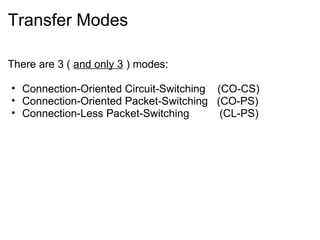
Transfer Modes There are 3 (  and only 3  ) modes: Connection-Oriented Circuit-Switching    (CO-CS) Connection-Oriented Packet-Switching   (CO-PS) Connection-Less Packet-Switching          (CL-PS)    
Why only 3 modes? To answer this question,  some more background information is required. ( hint: it comes down to how communications are identified & delivered )
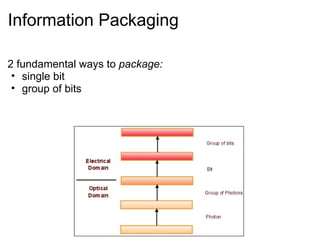
Information Packaging 2 fundamental ways to  package: single bit group of bits
Information Packaging A group of bits can either be interpreted as: client information client information with overhead information Overhead information serves many purposes: increases reliability of information allows for verifying integrity of information etc. we will not be focusing on this topic in this presentation
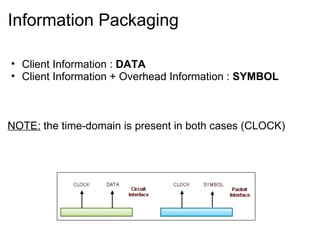
Information Packaging Client Information :  DATA Client Information + Overhead Information :  SYMBOL NOTE:  the time-domain is present in both cases (CLOCK)
The support of  NOTHING An interface either supports or not the semantic of  NOTHING Client Information (DATA) is present Client Information (DATA) is  not  present NOTE:  Sometimes referred to as  IDLE  code. The conveyance of IDLE requires overhead information and thus a  symbol . 
Information Exchange 2 fundamental ways to  exchange : continuous flow ( aka  stream  ) => circuit asynchronous exchange => packet Synchronous interface : information is always present Or at least assumed... the source can get disconnected The concept of NOTHING (IDLE) is not supported Asynchronous interface: information availability is signaled Explicit signal is required => the concept of NOTHING must be supported as it is what defines it in the first place
Circuit Continuous stream of DATA no  holes  possible (else => loss of information) Each DATA from a slot   can be extracted from the stream Need to synchronize in the time-domain to extract A circuit consists in timed DATA  slots
Packet A  packet  is a group of DATA bits delivered over an asynchronous interface.  The DATA bits are packaged in SYMBOLS :  This is to support the IDLE / NOTHING semantic.
Why 3 modes? ( We are half way there answering this question ) We now acknowledge we have 2 fundamental ways to exchange information through an interface Circuit Interface Packet Interface Next, we need to be focusing on delivering the information...
Delivering Information Communication comes down to  copying  information from a  source  to  destination (s) (aka sink(s)). If information can not be  identified   unambiguously, then valuable communication is not possible To identify communications,  labelling  is required. Labelling implies  overhead .
Labelling Labelling consists in information used to deliver the information to the destination(s). 2 fundamental ways: Label  travels with  Client Information Label  does not travel  with Client Information Transport Container  serves as  label 
Labelling Label travels with Client Information -- In-band Overhead information travelling with the Client information E.g.: Address (e.g. IPv4) Communication Instance Identifier (e.g. ATM VPI:VCI) Label is related to the Transport Container -- Out-of-band E.g.  physical connection time-slot
Interfaces & Labelling Circuit Interface Only DATA signals => no in-band label Label information can only be associated with Transport Container (i.e. the server layer which transport the Client Information) Packet Interface Label travels with the Client Information Note:  The Label must travel with the Client Information in case of a packet interface.
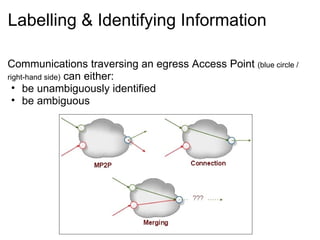
Labelling & Identifying Information Communications traversing an egress Access Point  (blue circle / right-hand side)  can either: be unambiguously identified be ambiguous
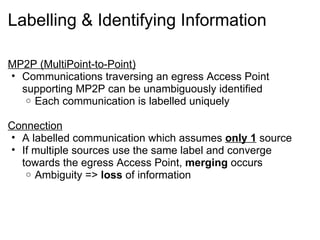
Labelling & Identifying Information MP2P (MultiPoint-to-Point) Communications traversing an egress Access Point supporting MP2P can be unambiguously identified Each communication is labelled uniquely Connection A labelled communication which assumes  only 1  source If multiple sources use the same label and converge towards the egress Access Point,  merging  occurs Ambiguity =>  loss  of information
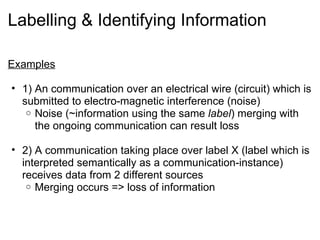
Labelling & Identifying Information Examples 1) An communication over an electrical wire (circuit) which is submitted to electro-magnetic interference (noise) Noise (~information using the same  label ) merging with the ongoing communication can result loss 2) A communication taking place over label X (label which is interpreted semantically as a communication-instance) receives data from 2 different sources  Merging occurs => loss of information
Labelling & Identifying Information Thus, we have 2 fundamental cases: 1 source is allowed :  Connection >1 sources are allowed :  Connection-Less If >1 sources are allowed (to egress at an Access Point), then  additional information  is required to identify individual sources Furthermore, this additional information must be unambiguous.
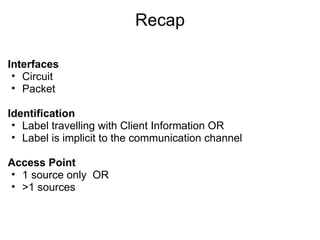
Recap Interfaces Circuit Packet Identification Label travelling with Client Information OR Label is implicit to the communication channel Access Point 1 source only  OR >1 sources
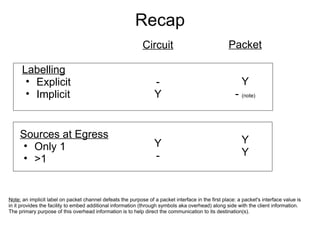
Recap Circuit - Y Y - Packet Y -  (note) Y Y Labelling Explicit Implicit Sources at Egress Only 1 >1 Note:  an implicit label on packet channel defeats the purpose of a packet interface in the first place: a packet's interface value is in it provides the facility to embed additional information (through symbols aka overhead) along side with the client information. The primary purpose of this overhead information is to help direct the communication to its destination(s).
Goal Before putting it all together, we must remember the ultimate goal: Communication is only valuable if it is unambiguous
Putting it all together From the recap page, we can deduce: The  circuit  construct only supports the  connection  oriented transfer mode The  packet  construct supports both  connection  and  connection-less  transfer modes The Connection-Less Circuit-Oriented  construct  does not make sense (see next slide)
Connection-Less  Circuit-Switched ? Why CL-CS does not make sense? Connection-Less => no pre-established connection needed before communication takes place between  a   source  and  destination (s) But we already  ruled-out   multiple (>1) sources merging their communication in a circuit context

Notes On Networking 2

  • 1.
    Notes on Networking: Transfer Modes Jean-Lou Dupont jl @ jldupont . com http://www.jldupont.com/  
  • 2.
    Context Setting The Time Domain  is omnipresent Information is related to change in state Change implies the Time Domain
  • 3.
    Transfer Modes Thereare 3 ( and only 3 ) modes: Connection-Oriented Circuit-Switching    (CO-CS) Connection-Oriented Packet-Switching   (CO-PS) Connection-Less Packet-Switching          (CL-PS)    
  • 4.
    Why only 3modes? To answer this question,  some more background information is required. ( hint: it comes down to how communications are identified & delivered )
  • 5.
    Information Packaging 2fundamental ways to package: single bit group of bits
  • 6.
    Information Packaging Agroup of bits can either be interpreted as: client information client information with overhead information Overhead information serves many purposes: increases reliability of information allows for verifying integrity of information etc. we will not be focusing on this topic in this presentation
  • 7.
    Information Packaging Client Information: DATA Client Information + Overhead Information : SYMBOL NOTE: the time-domain is present in both cases (CLOCK)
  • 8.
    The support of NOTHING An interface either supports or not the semantic of  NOTHING Client Information (DATA) is present Client Information (DATA) is not present NOTE: Sometimes referred to as IDLE code. The conveyance of IDLE requires overhead information and thus a symbol . 
  • 9.
    Information Exchange 2fundamental ways to exchange : continuous flow ( aka stream ) => circuit asynchronous exchange => packet Synchronous interface : information is always present Or at least assumed... the source can get disconnected The concept of NOTHING (IDLE) is not supported Asynchronous interface: information availability is signaled Explicit signal is required => the concept of NOTHING must be supported as it is what defines it in the first place
  • 10.
    Circuit Continuous streamof DATA no holes possible (else => loss of information) Each DATA from a slot   can be extracted from the stream Need to synchronize in the time-domain to extract A circuit consists in timed DATA  slots
  • 11.
    Packet A packet is a group of DATA bits delivered over an asynchronous interface.  The DATA bits are packaged in SYMBOLS :  This is to support the IDLE / NOTHING semantic.
  • 12.
    Why 3 modes?( We are half way there answering this question ) We now acknowledge we have 2 fundamental ways to exchange information through an interface Circuit Interface Packet Interface Next, we need to be focusing on delivering the information...
  • 13.
    Delivering Information Communicationcomes down to  copying  information from a  source  to  destination (s) (aka sink(s)). If information can not be identified   unambiguously, then valuable communication is not possible To identify communications, labelling is required. Labelling implies overhead .
  • 14.
    Labelling Labelling consistsin information used to deliver the information to the destination(s). 2 fundamental ways: Label  travels with Client Information Label does not travel with Client Information Transport Container serves as label 
  • 15.
    Labelling Label travelswith Client Information -- In-band Overhead information travelling with the Client information E.g.: Address (e.g. IPv4) Communication Instance Identifier (e.g. ATM VPI:VCI) Label is related to the Transport Container -- Out-of-band E.g.  physical connection time-slot
  • 16.
    Interfaces & LabellingCircuit Interface Only DATA signals => no in-band label Label information can only be associated with Transport Container (i.e. the server layer which transport the Client Information) Packet Interface Label travels with the Client Information Note: The Label must travel with the Client Information in case of a packet interface.
  • 17.
    Labelling & IdentifyingInformation Communications traversing an egress Access Point (blue circle / right-hand side) can either: be unambiguously identified be ambiguous
  • 18.
    Labelling & IdentifyingInformation MP2P (MultiPoint-to-Point) Communications traversing an egress Access Point supporting MP2P can be unambiguously identified Each communication is labelled uniquely Connection A labelled communication which assumes only 1 source If multiple sources use the same label and converge towards the egress Access Point, merging occurs Ambiguity => loss of information
  • 19.
    Labelling & IdentifyingInformation Examples 1) An communication over an electrical wire (circuit) which is submitted to electro-magnetic interference (noise) Noise (~information using the same label ) merging with the ongoing communication can result loss 2) A communication taking place over label X (label which is interpreted semantically as a communication-instance) receives data from 2 different sources  Merging occurs => loss of information
  • 20.
    Labelling & IdentifyingInformation Thus, we have 2 fundamental cases: 1 source is allowed : Connection >1 sources are allowed : Connection-Less If >1 sources are allowed (to egress at an Access Point), then additional information is required to identify individual sources Furthermore, this additional information must be unambiguous.
  • 21.
    Recap Interfaces CircuitPacket Identification Label travelling with Client Information OR Label is implicit to the communication channel Access Point 1 source only  OR >1 sources
  • 22.
    Recap Circuit -Y Y - Packet Y - (note) Y Y Labelling Explicit Implicit Sources at Egress Only 1 >1 Note: an implicit label on packet channel defeats the purpose of a packet interface in the first place: a packet's interface value is in it provides the facility to embed additional information (through symbols aka overhead) along side with the client information. The primary purpose of this overhead information is to help direct the communication to its destination(s).
  • 23.
    Goal Before puttingit all together, we must remember the ultimate goal: Communication is only valuable if it is unambiguous
  • 24.
    Putting it alltogether From the recap page, we can deduce: The circuit construct only supports the connection oriented transfer mode The packet construct supports both connection and connection-less transfer modes The Connection-Less Circuit-Oriented  construct  does not make sense (see next slide)
  • 25.
    Connection-Less Circuit-Switched? Why CL-CS does not make sense? Connection-Less => no pre-established connection needed before communication takes place between a source and destination (s) But we already ruled-out   multiple (>1) sources merging their communication in a circuit context