NEAR FIELD COMMUNICATION
MONIKA
08EL
CONTENTS
 Introduction
 History
 How NFC works ?
 NFC phone architecture
 Comparison of NFC with Bluetooth
 Uses and Applications
 Project trials and full-scale deployments
 NFC forum
 Security aspects
 NFC-enabled handsets
 Conclusion
INTRODUCTION
 Near field communication (NFC) : It is a short-range
communication technology that enables devices to
exchange information with other NFC-enabled devices
or certain NFC supporting cards .
 It can be done by touching the devices together or
bringing them into close proximity, usually no more than
a few centimeters.
 NFC operates at 13.56 MHz on ISO/IEC 18000-3 air
interface and at rates ranging from 106 kbit/s to 424
kbit/s .
HISTORY
 NFC traces its roots back to Radio-frequency identification, or
RFID.
 RFID allows a reader to send radio waves to a passive
electronic tag for identification and tracking.
 1983 : The first patent to be associated with the
abbreviation RFID was granted to Charles Walton.
 2004 : Nokia, Philips and Sony established the Near Field
Communication (NFC) Forum
 2006: Nokia 6131 was the first NFC phone .
 2011: NFC support becomes part of the Symbian mobile
operating system with the release of Symbian Anna version.
HOW NFC WORK’S
 Near-field communication uses magnetic induction between
two loop antennas located within each other's near
field, effectively forming an air-core transformer. It operates
within the globally available and unlicensed radio frequency ISM
band of 13.56 MHz , with a bandwidth of 14KHz .
 NFC always involves an initiator and a target .
 There are two modes of communication :
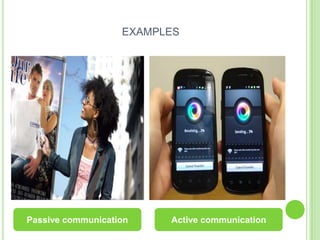
 Passive communication mode
 Active communication mode
PASSIVE COMMUNICATION MODE
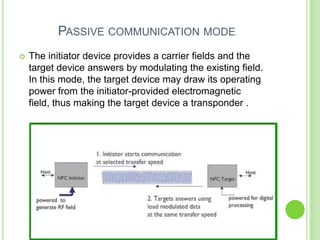
 The initiator device provides a carrier fields and the
target device answers by modulating the existing field.
In this mode, the target device may draw its operating
power from the initiator-provided electromagnetic
field, thus making the target device a transponder .
ACTIVE COMMUNICATION MODE
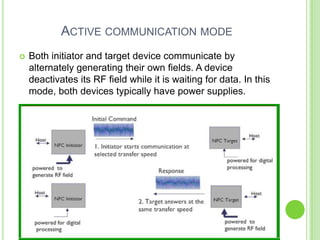
 Both initiator and target device communicate by
alternately generating their own fields. A device
deactivates its RF field while it is waiting for data. In this
mode, both devices typically have power supplies.
EXAMPLES
Passive communication Active communication
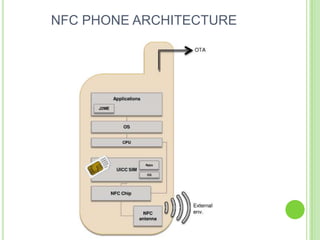
NFC PHONE ARCHITECTURE
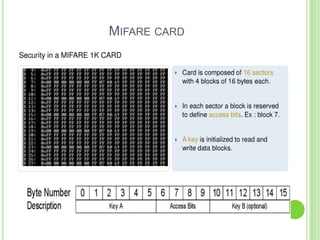
MIFARE CARD
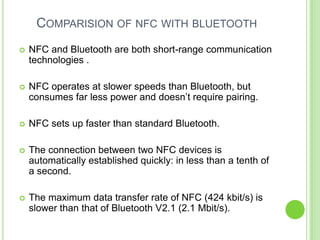
COMPARISION OF NFC WITH BLUETOOTH
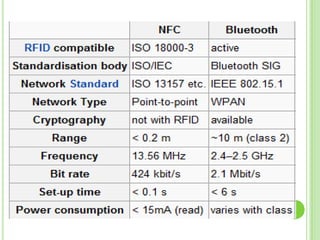
 NFC and Bluetooth are both short-range communication
technologies .
 NFC operates at slower speeds than Bluetooth, but
consumes far less power and doesn’t require pairing.
 NFC sets up faster than standard Bluetooth.
 The connection between two NFC devices is
automatically established quickly: in less than a tenth of
a second.
 The maximum data transfer rate of NFC (424 kbit/s) is
slower than that of Bluetooth V2.1 (2.1 Mbit/s).
USES AND APPLICATIONS
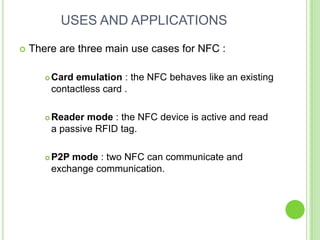
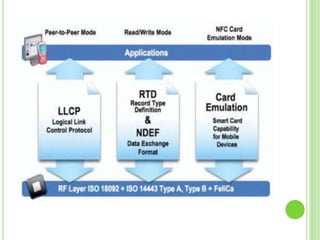
 There are three main use cases for NFC :
 Card emulation : the NFC behaves like an existing
contactless card .
 Reader mode : the NFC device is active and read
a passive RFID tag.
 P2P mode : two NFC can communicate and
exchange communication.
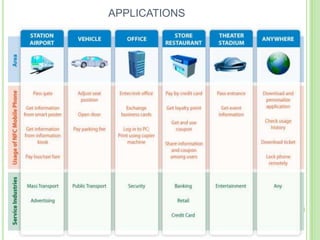
APPLICATIONS
PROJECT TRIALS AND FULL-SCALE DEPLOYMENTS
India
 Mobile banking: A Little World , Citibank India
 Tata Docomo, Mega Soft XIUS (Hyderabad)
United States
 Mobile payments: AT&T, Verizon, T-Mobile
 Public transit: New York City Transit, NJ Transit, and , LA
Metro .
 Community Marketing : Google Places,Portland
Russia
 Public transport: Moscow Metro and Mobile TeleSystems
France
 Home healthcare: ADMR, Extelia, Inside Contactless
 Field service: Orange France
 Event ticketing: Stade de France, Orange
 Museum services: Centre Pompidou
 National NFC infrastructure: Paris, Bordeaux, French Government
 Loyalty programs: La Croissanterie, Rica Lewis, Game in Nice
 Public transport: Veolia Transport in Nice
Japan
 Banking services: Softbank Mobile, Credit Saison
 Consumer services: KDDI, Toyota, Orient Corporation, Credit
Saison, Aiwa Card Services, MasterCard, Nomura Research
Institute, All Nippon Airways, Japan Airlines, NTT Data, IBM, Hitachi,
 Network services: NTT Docomo and KT
 Social networking: Mixi
NFC FORUM
(RESPONSIBLE FOR NFC PROTOCOLS)
NFC is a standard defined by the NFC Forum, a global
consortium of hardware, software / application , credit
card companies ,banking ,network providers , and
others who are interested in the advancement and
standardization of this promising technology.
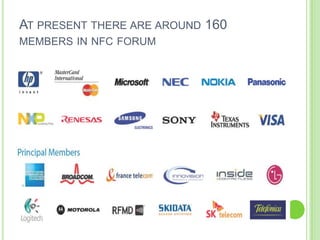
AT PRESENT THERE ARE AROUND 160
MEMBERS IN NFC FORUM
SECURITY ASPECTS
 Applications makers will use higher-layer cryptographic
protocols (e.g., SSL) to establish a secure channel.
 Application providers and transaction parties, who will
need to use anti-virus and other security solutions to
prevent spyware and malware from infecting systems.
 Customers, can also protect their personal devices and
data with passwords, keypad locks, and anti-virus
software.
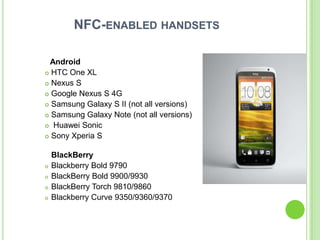
NFC-ENABLED HANDSETS
Android
 HTC One XL
 Nexus S
 Google Nexus S 4G
 Samsung Galaxy S II (not all versions)
 Samsung Galaxy Note (not all versions)
 Huawei Sonic
 Sony Xperia S
BlackBerry
 Blackberry Bold 9790
 BlackBerry Bold 9900/9930
 BlackBerry Torch 9810/9860
 Blackberry Curve 9350/9360/9370
Bada
 Samsung Wave 578
 samsung wave Y
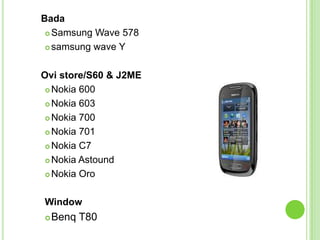
Ovi store/S60 & J2ME
 Nokia 600
 Nokia 603
 Nokia 700
 Nokia 701
 Nokia C7
 Nokia Astound
 Nokia Oro
Window
Benq T80
CONCLUSION
 Market research suggests that over the next few
years, Near Field Communication (NFC) technology will
be in use all around us.
 Shipments for NFC enabled phones are forecasted to
reach 700 million units in 2016.
 For consumers, the technology will become omnipresent
in our lives, and NFC-enabled mobile phones will
emerge as our primary consumer ID credential.
THANK YOU

Nfc

  • 1.
  • 2.
    CONTENTS  Introduction  History How NFC works ?  NFC phone architecture  Comparison of NFC with Bluetooth  Uses and Applications  Project trials and full-scale deployments  NFC forum  Security aspects  NFC-enabled handsets  Conclusion
  • 3.
    INTRODUCTION  Near fieldcommunication (NFC) : It is a short-range communication technology that enables devices to exchange information with other NFC-enabled devices or certain NFC supporting cards .  It can be done by touching the devices together or bringing them into close proximity, usually no more than a few centimeters.  NFC operates at 13.56 MHz on ISO/IEC 18000-3 air interface and at rates ranging from 106 kbit/s to 424 kbit/s .
  • 4.
    HISTORY  NFC tracesits roots back to Radio-frequency identification, or RFID.  RFID allows a reader to send radio waves to a passive electronic tag for identification and tracking.  1983 : The first patent to be associated with the abbreviation RFID was granted to Charles Walton.  2004 : Nokia, Philips and Sony established the Near Field Communication (NFC) Forum  2006: Nokia 6131 was the first NFC phone .  2011: NFC support becomes part of the Symbian mobile operating system with the release of Symbian Anna version.
  • 5.
    HOW NFC WORK’S Near-field communication uses magnetic induction between two loop antennas located within each other's near field, effectively forming an air-core transformer. It operates within the globally available and unlicensed radio frequency ISM band of 13.56 MHz , with a bandwidth of 14KHz .  NFC always involves an initiator and a target .  There are two modes of communication :  Passive communication mode  Active communication mode
  • 6.
    PASSIVE COMMUNICATION MODE The initiator device provides a carrier fields and the target device answers by modulating the existing field. In this mode, the target device may draw its operating power from the initiator-provided electromagnetic field, thus making the target device a transponder .
  • 7.
    ACTIVE COMMUNICATION MODE Both initiator and target device communicate by alternately generating their own fields. A device deactivates its RF field while it is waiting for data. In this mode, both devices typically have power supplies.
  • 8.
  • 9.
  • 10.
  • 11.
    COMPARISION OF NFCWITH BLUETOOTH  NFC and Bluetooth are both short-range communication technologies .  NFC operates at slower speeds than Bluetooth, but consumes far less power and doesn’t require pairing.  NFC sets up faster than standard Bluetooth.  The connection between two NFC devices is automatically established quickly: in less than a tenth of a second.  The maximum data transfer rate of NFC (424 kbit/s) is slower than that of Bluetooth V2.1 (2.1 Mbit/s).
  • 13.
    USES AND APPLICATIONS There are three main use cases for NFC :  Card emulation : the NFC behaves like an existing contactless card .  Reader mode : the NFC device is active and read a passive RFID tag.  P2P mode : two NFC can communicate and exchange communication.
  • 15.
  • 16.
    PROJECT TRIALS ANDFULL-SCALE DEPLOYMENTS India  Mobile banking: A Little World , Citibank India  Tata Docomo, Mega Soft XIUS (Hyderabad) United States  Mobile payments: AT&T, Verizon, T-Mobile  Public transit: New York City Transit, NJ Transit, and , LA Metro .  Community Marketing : Google Places,Portland Russia  Public transport: Moscow Metro and Mobile TeleSystems
  • 17.
    France  Home healthcare:ADMR, Extelia, Inside Contactless  Field service: Orange France  Event ticketing: Stade de France, Orange  Museum services: Centre Pompidou  National NFC infrastructure: Paris, Bordeaux, French Government  Loyalty programs: La Croissanterie, Rica Lewis, Game in Nice  Public transport: Veolia Transport in Nice Japan  Banking services: Softbank Mobile, Credit Saison  Consumer services: KDDI, Toyota, Orient Corporation, Credit Saison, Aiwa Card Services, MasterCard, Nomura Research Institute, All Nippon Airways, Japan Airlines, NTT Data, IBM, Hitachi,  Network services: NTT Docomo and KT  Social networking: Mixi
  • 18.
    NFC FORUM (RESPONSIBLE FORNFC PROTOCOLS) NFC is a standard defined by the NFC Forum, a global consortium of hardware, software / application , credit card companies ,banking ,network providers , and others who are interested in the advancement and standardization of this promising technology.
  • 19.
    AT PRESENT THEREARE AROUND 160 MEMBERS IN NFC FORUM
  • 20.
    SECURITY ASPECTS  Applicationsmakers will use higher-layer cryptographic protocols (e.g., SSL) to establish a secure channel.  Application providers and transaction parties, who will need to use anti-virus and other security solutions to prevent spyware and malware from infecting systems.  Customers, can also protect their personal devices and data with passwords, keypad locks, and anti-virus software.
  • 21.
    NFC-ENABLED HANDSETS Android  HTCOne XL  Nexus S  Google Nexus S 4G  Samsung Galaxy S II (not all versions)  Samsung Galaxy Note (not all versions)  Huawei Sonic  Sony Xperia S BlackBerry  Blackberry Bold 9790  BlackBerry Bold 9900/9930  BlackBerry Torch 9810/9860  Blackberry Curve 9350/9360/9370
  • 22.
    Bada  Samsung Wave578  samsung wave Y Ovi store/S60 & J2ME  Nokia 600  Nokia 603  Nokia 700  Nokia 701  Nokia C7  Nokia Astound  Nokia Oro Window Benq T80
  • 23.
    CONCLUSION  Market researchsuggests that over the next few years, Near Field Communication (NFC) technology will be in use all around us.  Shipments for NFC enabled phones are forecasted to reach 700 million units in 2016.  For consumers, the technology will become omnipresent in our lives, and NFC-enabled mobile phones will emerge as our primary consumer ID credential.
  • 25.