Page 1
Consumer Protection Act-1986
“NEED FOR CONSUMER PROTECTION ACT
IN AN ERA OF FREE COMPETITION
WHERE CONSUMER IS THE KING
THEREFORE, KING NEED PROTECTION”
Page 2
Consumer Protection Act-1986
TABLE OF CONTENT
SR.
NO.
TOPIC
PAGE
NO.
1 Introduction………………………………………………...……… 4
2 Problems Faced By Consumers……………………………………. 6
3 Evolution Of Consumer Protection Rights In India……..………… 8
4 Consumer Protection Act - 1986…………………………………... 9
5 Consumer…………………………..……………………………… 10
6 International Scenario …………………………………....……….. 12
7 Rights Of A Consumer/ Objectives Of The Act ………………….. 14
8 Complaint …………………………….…………………………… 18
9 Procedure Of Filing A Complaint………………………………… 22
10 Forums ………………………………………………………..…… 23
11 “Jago Grahak Jago” Scheme Of Govt. Of India ……………….… 25
12 Consumer Guidance Society Of India (CGSI)…………………..… 31
13 Statistical Data …………………………………………..………… 34
14 Comparison Of Consumer Protection Act In India And Brazil…… 36
15 Case Studies ……………………………………………………… 49
16 Recommendations…………………………………………………. 46
17 Conclusion………………………………….…………………….... 47
18 Webliography…………………………………………………….... 50
Page 3
Consumer Protection Act-1986
INTRODUCTION
“A customer is the most important visitor on our premises.
He is not dependent on us. We are dependent on him.
He is not an interruption of our work. He is the purpose of it.
He is not an outsider of our business. He is part of it.
We are not doing him a favour by serving him.
He is doing us a favour by giving us the opportunity to do so.”
-By Mahatma Gandhi
To any business, customer eccentricity is as important as product. Today the markets are guided by the
desire of customers. There are companies like Marks & Spencer whose principal is based on its tagline
i.e. “The customer is always and completely right!” Customer eccentricity is extremely essential to a
business, because without customers no business can survive.
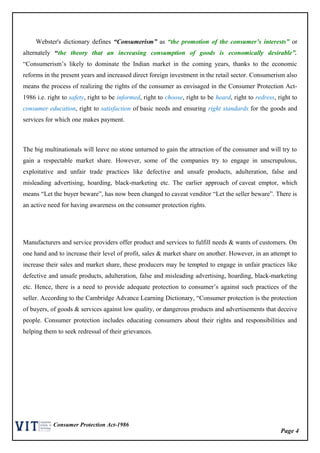
It has been studied that customer are very prone to lose interest in the
product with every new product launch. Therefore, in today’s world the
firms do not leave any stone unturned to attract the consumer and gain a
significant market share. The companies have started differentiating their
own products with the consumers’ eyes.
Today’s consumers are at a far better position than that of past as consumers with more safety, security
and choices towards product, as the products are made as per their convenience, needs and desires. Lately
the markets have been transformed from “sellers’ market” to “buyers’ market” where the choice
exercised by the consumer will be influenced by the level of consumer awareness achieved. When it
comes to customer preferences, it is not a matter of right, wrong or what might ultimately be acceptable.
It’s simply a matter of what the customer wants to buy. Therefore, consumers are considered to be king in
a free market.
Page 4
Consumer Protection Act-1986
Webster's dictionary defines “Consumerism” as “the promotion of the consumer’s interests” or
alternately “the theory that an increasing consumption of goods is economically desirable”.
“Consumerism’s likely to dominate the Indian market in the coming years, thanks to the economic
reforms in the present years and increased direct foreign investment in the retail sector. Consumerism also
means the process of realizing the rights of the consumer as envisaged in the Consumer Protection Act-
1986 i.e. right to safety, right to be informed, right to choose, right to be heard, right to redress, right to
consumer education, right to satisfaction of basic needs and ensuring right standards for the goods and
services for which one makes payment.
The big multinationals will leave no stone unturned to gain the attraction of the consumer and will try to
gain a respectable market share. However, some of the companies try to engage in unscrupulous,
exploitative and unfair trade practices like defective and unsafe products, adulteration, false and
misleading advertising, hoarding, black-marketing etc. The earlier approach of caveat emptor, which
means “Let the buyer beware”, has now been changed to caveat venditor “Let the seller beware”. There is
an active need for having awareness on the consumer protection rights.
Manufacturers and service providers offer product and services to fulfill needs & wants of customers. On
one hand and to increase their level of profit, sales & market share on another. However, in an attempt to
increase their sales and market share, these producers may be tempted to engage in unfair practices like
defective and unsafe products, adulteration, false and misleading advertising, hoarding, black-marketing
etc. Hence, there is a need to provide adequate protection to consumer’s against such practices of the
seller. According to the Cambridge Advance Learning Dictionary, “Consumer protection is the protection
of buyers, of goods & services against low quality, or dangerous products and advertisements that deceive
people. Consumer protection includes educating consumers about their rights and responsibilities and
helping them to seek redressal of their grievances.
Page 5
Consumer Protection Act-1986
REASONS FOR WHICH CONSUMER NEEDS PROTECTION/
PROBLEMS FACED BY CONSUMERS
1. Illiteracy and Ignorance: -
Consumers in India are mostly illiterate and ignorant. They do not understand their rights.
A system is required to protect them from unscrupulous businessmen.
2. Unorganized Consumers: -
In India consumers are widely dispersed and are not united.
They are at the mercy of businessmen. On the other hand,
producers and traders are organized and powerful.
3. Spurious Goods: -
There is increasing supply of duplicate products. It is very
difficult for an ordinary consumer to distinguish between a genuine product and its imitation. It is
necessary to protect consumers from such exploitation by ensuring compliance with prescribed
norms of quality and safety.
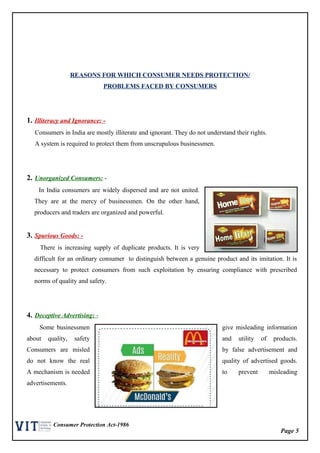
4. Deceptive Advertising: -
Some businessmen give misleading information
about quality, safety and utility of products.
Consumers are misled by false advertisement and
do not know the real quality of advertised goods.
A mechanism is needed to prevent misleading
advertisements.
Page 6
Consumer Protection Act-1986
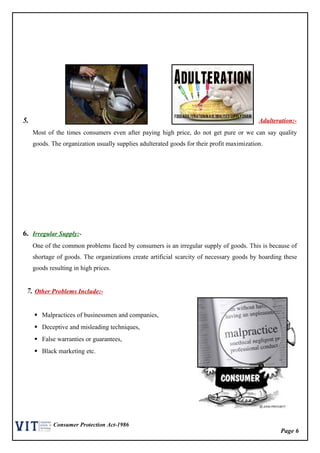
5. Adulteration:-
Most of the times consumers even after paying high price, do not get pure or we can say quality
goods. The organization usually supplies adulterated goods for their profit maximization.
6. Irregular Supply:-
One of the common problems faced by consumers is an irregular supply of goods. This is because of
shortage of goods. The organizations create artificial scarcity of necessary goods by hoarding these
goods resulting in high prices.
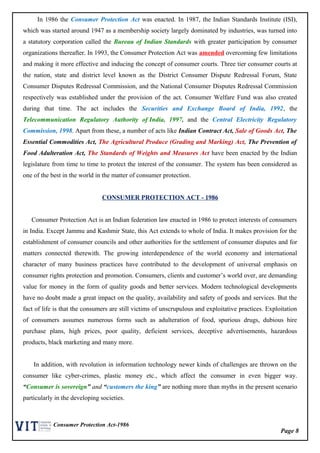
7. Other Problems Include:-
 Malpractices of businessmen and companies,
 Deceptive and misleading techniques,
 False warranties or guarantees,
 Black marketing etc.
Page 7
Consumer Protection Act-1986
EVOLUTION OF CONSUMER PROTECTION RIGHTS IN INDIA
The consumer movement in India is as old as trade and commerce. In Kautilya's Arthashastra, there
are references to the concept of consumer protection against exploitation by the trade and industry, short
weights and measures, adulteration and punishment for these offences. However, there was no organized
and systematic movement actually safeguarding the interests of the consumers. Prior to independence, the
main law under which the consumer interests were considered were the Indian Penal Code, Agricultural
Production, Grading and Marketing Act, 1937, Drugs and Cosmetics Act, 1940. Even though different
parts of India exhibited different levels of awareness, in general, the level of awareness was pretty low.
Indian consumer movement began with Passengers and Traffic Relief Association (PATRA) in
Mumbai, in 1915. The growth from there has been incredible and the momentum of this growth started
during the‘60s. In 1969, Monopolies and Restrictive Trade Practices Act was enacted and MRTP
commission was set up under the provision of the act. The act deals with cases of restrictive trade
practices adversely affecting competition and with unfair trade practices arising largely out of false and
misleading advertisements. After this act, consumer groups emerged. The emergence of Consumer
Education and Research Centre in Ahmadabad, in 1978, was a milestone in the consumer movement of
India. It provided a thrust and a direction to the movement in terms of a result-oriented approach through
effective uses of the law and the courts, and injecting professional inputs into the movement. In 1980s
various consumer rights and many consumer groups were formed in different parts of the country.
Page 8
Consumer Protection Act-1986
In 1986 the Consumer Protection Act was enacted. In 1987, the Indian Standards Institute (ISI),
which was started around 1947 as a membership society largely dominated by industries, was turned into
a statutory corporation called the Bureau of Indian Standards with greater participation by consumer
organizations thereafter. In 1993, the Consumer Protection Act was amended overcoming few limitations
and making it more effective and inducing the concept of consumer courts. Three tier consumer courts at
the nation, state and district level known as the District Consumer Dispute Redressal Forum, State
Consumer Disputes Redressal Commission, and the National Consumer Disputes Redressal Commission
respectively was established under the provision of the act. Consumer Welfare Fund was also created
during that time. The act includes the Securities and Exchange Board of India, 1992, the
Telecommunication Regulatory Authority of India, 1997, and the Central Electricity Regulatory
Commission, 1998. Apart from these, a number of acts like Indian Contract Act, Sale of Goods Act, The
Essential Commodities Act, The Agricultural Produce (Grading and Marking) Act, The Prevention of
Food Adulteration Act, The Standards of Weights and Measures Act have been enacted by the Indian
legislature from time to time to protect the interest of the consumer. The system has been considered as
one of the best in the world in the matter of consumer protection.
CONSUMER PROTECTION ACT - 1986
Consumer Protection Act is an Indian federation law enacted in 1986 to protect interests of consumers
in India. Except Jammu and Kashmir State, this Act extends to whole of India. It makes provision for the
establishment of consumer councils and other authorities for the settlement of consumer disputes and for
matters connected therewith. The growing interdependence of the world economy and international
character of many business practices have contributed to the development of universal emphasis on
consumer rights protection and promotion. Consumers, clients and customer’s world over, are demanding
value for money in the form of quality goods and better services. Modern technological developments
have no doubt made a great impact on the quality, availability and safety of goods and services. But the
fact of life is that the consumers are still victims of unscrupulous and exploitative practices. Exploitation
of consumers assumes numerous forms such as adulteration of food, spurious drugs, dubious hire
purchase plans, high prices, poor quality, deficient services, deceptive advertisements, hazardous
products, black marketing and many more.
In addition, with revolution in information technology newer kinds of challenges are thrown on the
consumer like cyber-crimes, plastic money etc., which affect the consumer in even bigger way.
“Consumer is sovereign” and “customers the king” are nothing more than myths in the present scenario
particularly in the developing societies.
Page 9
Consumer Protection Act-1986
However, it has been realized and rightly said so that the Consumer protection is a socio- economic
programed pursued by the government as well as the businesses for the satisfaction of the consumers is in
the interest of both. In this context, the government, however, has a primary responsibility to protect the
consumers’ interests and rights through appropriate policy measures, legal structure and administrative
framework. The intention and object of the Consumer Protection Act, is to provide a speedy remedy and
for better protection of interests of consumer.
The Consumer Protection Act, 1986 has defined the term ‘Consumer’. Only the customers who falls
under the definition of Consumer can be benefited through Consumer Protection Act. Hence the
definition of consumer is of much importance to determine the applicability of the Act.
CONSUMER
Any person who buys any commodity or service or is a user of such commodity or service is known as
consumer. Any person must satisfy two conditions to claim himself as a consumer:-
1) The service must have been rendered to him
2) He must have paid or promised to pay for the same.
If any person buy capital goods to provide services to other individuals, then he is also recognized as
consumer.
Who is not a consumer?
 If any person buys a commodity with an intention to resale.
 A person who obtains services without consideration.
 A person who obtains services for commercial purpose.
Example:-
Page 10
Consumer Protection Act-1986
1.When a person buys milk to consume for himself or his family than he can be considered as consumer
but if he buys the milk for selling purpose than he is not a consumer he is termed as seller.
2. Television is made for purpose of entertainment, so when the person is just sitting and watching the
television and getting entertained is the consumer and the person who is manufacturing the television for
the purpose of entertainment is not a consumer he is the manufacturer or producer.
DEFECT
Defect means any fault, imperfection or shortcoming in the quality, quantity, potency, purity or
standard which is required to be maintained by or under any law for the time being in force or under any
contract, express or implied or as is claimed by the trader in any manner whatsoever in relation to any
goods. Defect means lack or absence of something essential for completeness. If seller fails to deliver the
goods which he agreed to sell will be treated as defect.
Examples:-
i. Suppose a customer buys a refrigerator and finds that the cooling is not proper then the product is
defective.
ii. A customer purchases chocolate and finds worms in it then the product i.e. chocolate is considered to
be defective.
SERVICE
Page 11
Consumer Protection Act-1986
Service means service of any description which is made available to potential users and includes the
provision of facilities in connection with banking, financing insurance, transport, processing, supply of
electrical or other energy, board or lodging or both, housing construction, entertainment, amusement or
the purveying of news or other information, but does not include the rendering of any service free of
charge or under a contract of personal service.
Examples:-
1. Whenever we travel in flights, the food which is provided to us is a service which the flight agency
gives to us.
2. whereas now a days we get all the alert messages on our smart phones regarding our bank transactions
that is also a service provided to us by banks
INTERNATIONAL SCENARIO
The process of development coupled with increasing liberalization and globalization across the
country has enabled consumers to realize their increasingly important role in society and governance.
However, concentration of the market power in the hands of a select few has affected consumers’
behavior over time. In a developing country like India where the incidence of poverty and unemployment
is very high and the level of literacy is very low, the people face a volume of problems, particularly in the
context of consumer related issues. Unlike in the developed world, consumers in these countries have not
been able to play a greater role in the development process.
The purpose of economic planning is to allocate resources, as far as possible, for the maximum
satisfaction of consumers’ needs. Any goods or services produced in an economy are ultimately meant for
consumers. There is a logical, moral and political force in the proposition that the consumers themselves
should have the right to take decisions about the allocation of resources for their own needs.
Page 12
Consumer Protection Act-1986
Realizing this need, the International Organization of Consumer Unions, now known as Consumers
International, took the initiative and under its consistent lobbying, the United Nations adopted a set of
Guidelines for Consumer Protection on April 9, 1985 which was revised in 1999. The Guidelines address
the interests and needs of consumers worldwide and provide a framework for Governments, particularly
those of developing and newly independent countries, to use for elaborating and strengthening consumer
protection policies and legislation.
The UN Guidelines have outlined the following eight areas for
Developing policies for consumer protection:
 Physical safety,
 Promotion and protection of consumers’ economic interests,
 Standards for safety and quality of consumer goods and services,
 Distribution facilities for essential consumer goods and services,
 Measures enabling consumers to obtain redress,
 Education and information programs,
 Promotion of sustainable consumption and
 Measures relating to specific areas like water, food and pharmaceuticals.
These areas have been translated into the following six
Consumer rights by the Consumers’ International.
 Right to Basic Needs,
 Right to Safety,
 Right to Choice,
 Right to Information,
 Right to Consumer Education,
 Right to Redressed,
Page 13
Consumer Protection Act-1986
Consumers International Strategy is to unlocking consumer power on a global scale. Imagine a world
where individuals are as powerful as the governments and corporations they interact with. A global
marketplace where consumers have the power to challenge unfair, unsafe and unethical corporate
practice and win. To achieve this each individual need to think big & act global.
It is now more than 50 years since President John F Kennedy articulated the concept of consumer
rights in his historic message to the US Congress in which he outlined his vision of consumer rights. This
was the first time any politician had formerly set out such principles.
Consumers by definition include us all,' Kennedy said in his Congressional Statement, 'They are the
largest economic group, affecting and affected by almost every public and private economic decision.
Yet they are the only important group, whose views are often not heard.'
Even today in many countries the goal of realizing these rights is still a long way off. CI believes that
the time is ripe for a more concerted, intensive and aggressive effort to put new consumer protection
measures in place and make this goal a reality.
OBJECTIVES OF THE ACT
The legislative intention behind this Act is to clear all hurdles in promoting competition among
business units whether of domestic or foreign origin. The Consumer Protection Act of 1986 was enacted
with an objective to provide better protection of the interests of the Consumers, to make provision for
the establishment of Consumer Councils and other authorities for the settlement of consumer disputes.
This is indeed a very unique and highly progressive piece of Social Welfare Legislation. The provisions
of this Act are intended to provide effective and efficient safeguards to the consumers against various
types of exploitations and unfair dealings.
Page 14
Consumer Protection Act-1986
Unlike other laws, which are basically punitive or preventive in nature, the provisions of the Act are
compensatory. It is a matter of great satisfaction that we can legitimately boast that we now have in our
country a statute, which provides more effective protection to the consumers than any corresponding
legislation in force in countries, which are considered to be much more advanced and industrialized.
CPA has been in operation for about 18 years. A number of deficiencies and shortcoming in respect of
its operation have come to light there by requiring amendments thrice, still leaving scope for further
improvements. Despite all this it is a handy weapon for consumers to ensure accountability of producers
of goods and providers of services.
In the International Conference on Consumer Protection held in Malaysia in 1997, the Indian
Consumer Protection Act was described as one “which has set in motion a revolution in the field of
consumer rights, the parallel of which has not been seen anywhere else in the world”.
 Basic purpose for the Consumer Protection Act:-
 Right To Safety,
 Right To Be Informed,
 Right To Choose,
 Right To Be Heard,
 Right To Seek Redressal and
 Right To Consumer Education.
 They are being explained in detail as follows:-
1. Right To Safety:-
Page 15
Consumer Protection Act-1986
Consumer has the right to be protected against marketing of such goods and services which are
hazardous to health, life and property. There are several fake, adulterated, inferior, defective, ineffective
and dangerous goods available in market. They are injurious to body and health. Consumer, therefore,
has the right to safety from all such goods which are likely to cause harm to his body and health, besides
causing loss of money. Here the consumer’s responsibility is to use the product safely.
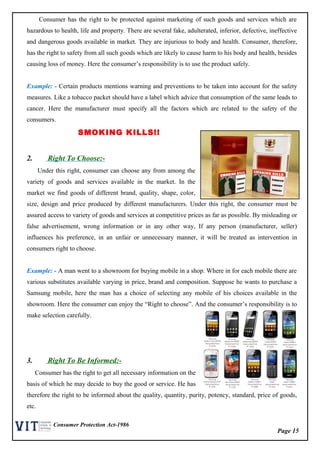
Example: - Certain products mentions warning and preventions to be taken into account for the safety
measures. Like a tobacco packet should have a label which advice that consumption of the same leads to
cancer. Here the manufacturer must specify all the factors which are related to the safety of the
consumers.
SMOKING KILLS!!
2. Right To Choose:-
Under this right, consumer can choose any from among the
variety of goods and services available in the market. In the
market we find goods of different brand, quality, shape, color,
size, design and price produced by different manufacturers. Under this right, the consumer must be
assured access to variety of goods and services at competitive prices as far as possible. By misleading or
false advertisement, wrong information or in any other way, If any person (manufacturer, seller)
influences his preference, in an unfair or unnecessary manner, it will be treated as intervention in
consumers right to choose.
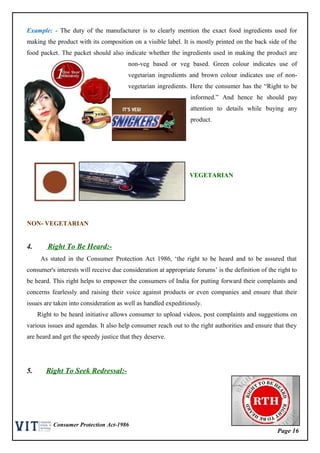
Example: - A man went to a showroom for buying mobile in a shop. Where in for each mobile there are
various substitutes available varying in price, brand and composition. Suppose he wants to purchase a
Samsung mobile, here the man has a choice of selecting any mobile of his choices available in the
showroom. Here the consumer can enjoy the “Right to choose”. And the consumer’s responsibility is to
make selection carefully.
3. Right To Be Informed:-
Consumer has the right to get all necessary information on the
basis of which he may decide to buy the good or service. He has
therefore the right to be informed about the quality, quantity, purity, potency, standard, price of goods,
etc.
Page 16
Consumer Protection Act-1986
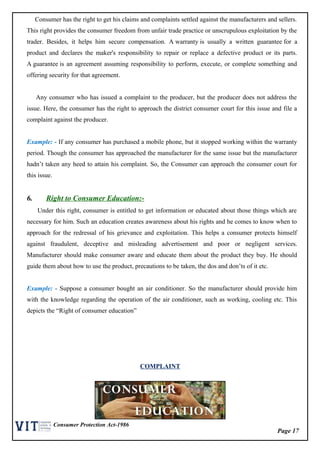
Example: - The duty of the manufacturer is to clearly mention the exact food ingredients used for
making the product with its composition on a visible label. It is mostly printed on the back side of the
food packet. The packet should also indicate whether the ingredients used in making the product are
non-veg based or veg based. Green colour indicates use of
vegetarian ingredients and brown colour indicates use of non-
vegetarian ingredients. Here the consumer has the “Right to be
informed.” And hence he should pay
attention to details while buying any
product.
VEGETARIAN
NON- VEGETARIAN
4. Right To Be Heard:-
As stated in the Consumer Protection Act 1986, ‘the right to be heard and to be assured that
consumer's interests will receive due consideration at appropriate forums’ is the definition of the right to
be heard. This right helps to empower the consumers of India for putting forward their complaints and
concerns fearlessly and raising their voice against products or even companies and ensure that their
issues are taken into consideration as well as handled expeditiously.
Right to be heard initiative allows consumer to upload videos, post complaints and suggestions on
various issues and agendas. It also help consumer reach out to the right authorities and ensure that they
are heard and get the speedy justice that they deserve.
5. Right To Seek Redressal:-
Page 17
Consumer Protection Act-1986
Consumer has the right to get his claims and complaints settled against the manufacturers and sellers.
This right provides the consumer freedom from unfair trade practice or unscrupulous exploitation by the
trader. Besides, it helps him secure compensation. A warranty is usually a written guarantee for a
product and declares the maker's responsibility to repair or replace a defective product or its parts.
A guarantee is an agreement assuming responsibility to perform, execute, or complete something and
offering security for that agreement.
Any consumer who has issued a complaint to the producer, but the producer does not address the
issue. Here, the consumer has the right to approach the district consumer court for this issue and file a
complaint against the producer.
Example: - If any consumer has purchased a mobile phone, but it stopped working within the warranty
period. Though the consumer has approached the manufacturer for the same issue but the manufacturer
hadn’t taken any heed to attain his complaint. So, the Consumer can approach the consumer court for
this issue.
6. Right to Consumer Education:-
Under this right, consumer is entitled to get information or educated about those things which are
necessary for him. Such an education creates awareness about his rights and he comes to know when to
approach for the redressal of his grievance and exploitation. This helps a consumer protects himself
against fraudulent, deceptive and misleading advertisement and poor or negligent services.
Manufacturer should make consumer aware and educate them about the product they buy. He should
guide them about how to use the product, precautions to be taken, the dos and don’ts of it etc.
Example: - Suppose a consumer bought an air conditioner. So the manufacturer should provide him
with the knowledge regarding the operation of the air conditioner, such as working, cooling etc. This
depicts the “Right of consumer education”
COMPLAINT
Page 18
Consumer Protection Act-1986
In legal terminology, a complaint is any formal legal document that sets out the facts and legal
reasons that the filing party or parties believes are sufficient to support a claim against the party or
parties against whom the claim is brought that entitles the filing party to a remedy (either money
damages or injunctive relief). Any allegation in writing made by a complainant.
Complaint is filed for:-
Defect in goods,
Deficiency in service,
Charging of excess price,
Hazardous goods,
Unfair trade practice or restrictive trade practice.
GUIDELINES FOR FILING A COMPLAINT BEFORE THE DISTRICT CONSUMER
DISPUTES REDRESSAL FORUM
Following is an outline of the procedure for filing a complaint before the District Forum or the State
Commission. We have attempted to give simple information and key pointers, but you may consult the
Consumer Protection Act for further details.
1. Jurisdiction: If the relief claimed in the complaint is less than Rs. 20,00,000/-, then the complaint
must be filed before the District Consumer Forum. If the relief claimed is between Rs. 20,00,000/-
and Rs. 1,00,00,000/-, then the complaint must be filed before the State Commission. When the
relief claim exceeds Rs. 1,00,00,000/- then the complaint must be filed before the National
Commission at New Delhi. However, see point 6(j) for more details regarding jurisdiction of the
Consumer Courts.
2. A ‘prescribed fee’ is payable for filing a complaint before the District Forum,
State Commission or National Commission as follows:
Page 19
Consumer Protection Act-1986
FORUM/ RANGE OF LOSE FEES
DISTICT FORUM
Upto 1 lakh Rs.100/-
1 lakh to 5 lakhs Rs.200/-
5 lakhs to 10 lakhs Rs.400/-
10 lakhs to 20 lakhs Rs.500/-
STATE COMMISSION
20 lakhs to 50 lakhs Rs.2000/-
50 lakhs to 1 crore Rs.4000/-
NATIONAL COMMISSION
Above 1 crore Rs.5000/-
3. The complainant can present his / her complaint in person or by his / her authorised representative to
the District Forum / State Commission. There is no requirement for a lawyer or consumer group to
represent the complainant.
4. The complaint can be sent by Registered Post to the District Forum / State Commission. A
minimum of 5 copies of the complaint have to be filed. This includes three copies for the Forum [in
green (Court) paper] plus one for the Office of the Forum and one for the opposite party. Do
remember to keep one copy for yourself. An additional copy for each additional opposite party has
to be filed. Since the Forum / Commission have the power to pass ex parte orders or dismiss your
complaint, please ensure that you carry out regular follow-up after filing the complaint. Every
hearing date has to be attended to prevent any damage to the complaint.
5. The complaint should be signed by you, the complainant. If you are authorising someone to
represent you, give him / her a signed authorisation letter. In the event of the death of a
complainant, his/her legal heir or representative can continue as a complainant.
Page 20
Consumer Protection Act-1986
6. A complaint should contain the following information:
a. A cause-title before the main heading. For example,
Before the Hon’ble Chennai District Consumer Redressal Forum
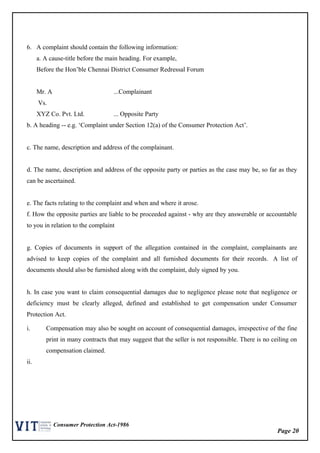
Mr. A ...Complainant
Vs.
XYZ Co. Pvt. Ltd. ... Opposite Party
b. A heading -- e.g. ‘Complaint under Section 12(a) of the Consumer Protection Act’.
c. The name, description and address of the complainant.
d. The name, description and address of the opposite party or parties as the case may be, so far as they
can be ascertained.
e. The facts relating to the complaint and when and where it arose.
f. How the opposite parties are liable to be proceeded against - why are they answerable or accountable
to you in relation to the complaint
g. Copies of documents in support of the allegation contained in the complaint, complainants are
advised to keep copies of the complaint and all furnished documents for their records. A list of
documents should also be furnished along with the complaint, duly signed by you.
h. In case you want to claim consequential damages due to negligence please note that negligence or
deficiency must be clearly alleged, defined and established to get compensation under Consumer
Protection Act.
i. Compensation may also be sought on account of consequential damages, irrespective of the fine
print in many contracts that may suggest that the seller is not responsible. There is no ceiling on
compensation claimed.
ii.
Page 21
Consumer Protection Act-1986
j. The value of the relief includes (where applicable) refunds, damages, litigation costs and interest.
Please remember that the Act provides for adequate litigation costs to the parties. If you are asking for
compensation, quantify the amount and state the break-up i.e., how the amount is arrived at and under
what heads. If the relief cannot be quantified, give a notional value. Remember the District Forum can
entertain complaints of value up to Rs. 20,00,000/- and the State Commission, complaints of value from
Rs. 20,00,000/- up to 1,00,00,000/-.
k. State how the case falls within the jurisdiction of the tribunal - whether the opposite party resides or
carries on business or has a branch office or personally works within the jurisdiction of the Forum or
whether the cause of action (for defective, spurious, fake, substandard or dangerous goods OR deficient
or delayed services or services not carried out OR for misleading advertisements OR for unfair trade
practices) started within the Forum’s jurisdiction. The cause of action can be defined as the factor from
which this dispute arose. For example, if you are buying shares for which you have not received the
share certificates, then the cause for this action in the Consumer Courts arose when you bought the share
certificates. Therefore the Forum situated in the place where you bought these shares will have
jurisdiction to adjudicate your complaint.
l. The relief which the complainant is seeking: here state whether you want removal of defects,
replacement of goods, refund of excess price, refund of charges paid for deficient services, cessation of
unfair trade practice, correction of misleading advertisements etc. apart from damages and costs of filing
the complaint.
m. With the coming into force of the 2002 Amendment (on 15.03.2003) the Consumer Forum and
Commission can also pass interim orders and grant punitive damages. Specifically if your complaint is
about the sale of hazardous goods, the Forum / Commission can direct the Opposite Party not to offer
the hazardous goods for sale and to withdraw the hazardous goods from being offered for sale.
n. You are also entitled to claim the costs of your complaint from the opposite party. Hence include
that amount in your complaint.
o. The limitation period for filing complaint is two years from the date of the cause of action. In case the
limitation period expires, the Forum or Commission may still take your complaint on board, if they are
convinced about the reasonableness of the cause for the delay. However, do avoid delays, since you will
be required to provide explanations for every single day.
Page 22
Consumer Protection Act-1986
6. Consumers facing the same problem can come together and file a single complaint. Enclosing a
petition with the complaint stating that the facts and circumstances relating to the complaint and the
relief claimed are the same for all the petitioners and that they may be allowed to join together and file a
single complaint.
7. Complainants who appear in person often are asked to present an affidavit of proof when there is no
recorded evidence on a point of fact. This affidavit of proof must be in first person and should contain
the details given in the format enclosed.
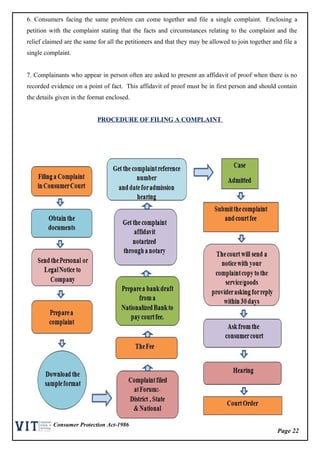
PROCEDURE OF FILING A COMPLAINT
Page 23
Consumer Protection Act-1986
FORUMS
Page 24
Consumer Protection Act-1986
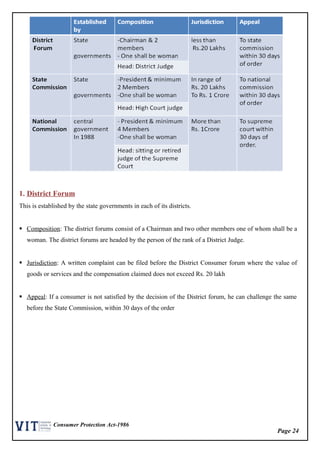
1. District Forum
This is established by the state governments in each of its districts.
 Composition: The district forums consist of a Chairman and two other members one of whom shall be a
woman. The district forums are headed by the person of the rank of a District Judge.
 Jurisdiction: A written complaint can be filed before the District Consumer forum where the value of
goods or services and the compensation claimed does not exceed Rs. 20 lakh
 Appeal: If a consumer is not satisfied by the decision of the District forum, he can challenge the same
before the State Commission, within 30 days of the order
Page 25
Consumer Protection Act-1986
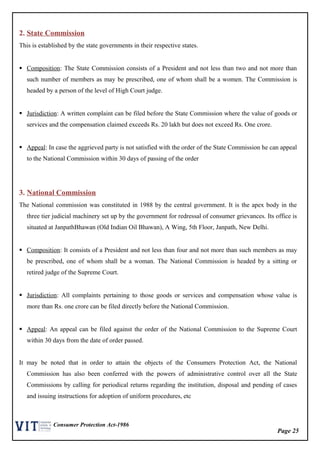
2. State Commission
This is established by the state governments in their respective states.
 Composition: The State Commission consists of a President and not less than two and not more than
such number of members as may be prescribed, one of whom shall be a women. The Commission is
headed by a person of the level of High Court judge.
 Jurisdiction: A written complaint can be filed before the State Commission where the value of goods or
services and the compensation claimed exceeds Rs. 20 lakh but does not exceed Rs. One crore.
 Appeal: In case the aggrieved party is not satisfied with the order of the State Commission he can appeal
to the National Commission within 30 days of passing of the order
3. National Commission
The National commission was constituted in 1988 by the central government. It is the apex body in the
three tier judicial machinery set up by the government for redressal of consumer grievances. Its office is
situated at JanpathBhawan (Old Indian Oil Bhawan), A Wing, 5th Floor, Janpath, New Delhi.
 Composition: It consists of a President and not less than four and not more than such members as may
be prescribed, one of whom shall be a woman. The National Commission is headed by a sitting or
retired judge of the Supreme Court.
 Jurisdiction: All complaints pertaining to those goods or services and compensation whose value is
more than Rs. one crore can be filed directly before the National Commission.
 Appeal: An appeal can be filed against the order of the National Commission to the Supreme Court
within 30 days from the date of order passed.
It may be noted that in order to attain the objects of the Consumers Protection Act, the National
Commission has also been conferred with the powers of administrative control over all the State
Commissions by calling for periodical returns regarding the institution, disposal and pending of cases
and issuing instructions for adoption of uniform procedures, etc
Page 26
Consumer Protection Act-1986
Page 27
Consumer Protection Act-1986
“JAGO GRAHAK JAGO”
SCHEME OF GOVT. OF INDIA
An enlightened consumer is an empowered consumer. An aware consumer not only protects himself
from exploitation but induces efficiency, transparency and accountability in the entire manufacturing and
services sector. Realizing the importance of consumer awareness, Government has accorded top priority
to ‘Consumer Education, Consumer Protection and Consumer Awareness.
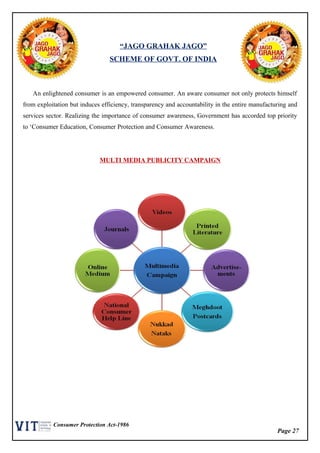
MULTI MEDIA PUBLICITY CAMPAIGN
Page 28
Consumer Protection Act-1986
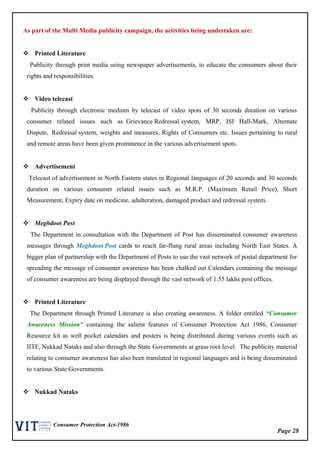
As part of the Multi Media publicity campaign, the activities being undertaken are:
 Printed Literature
Publicity through print media using newspaper advertisements, to educate the consumers about their
rights and responsibilities.
 Video telecast
Publicity through electronic medium by telecast of video spots of 30 seconds duration on various
consumer related issues such as Grievance Redressal system, MRP, ISI Hall-Mark, Alternate
Dispute, Redressal system, weights and measures, Rights of Consumers etc. Issues pertaining to rural
and remote areas have been given prominence in the various advertisement spots.
 Advertisement
Telecast of advertisement in North Eastern states in Regional languages of 20 seconds and 30 seconds
duration on various consumer related issues such as M.R.P. (Maximum Retail Price), Short
Measurement, Expiry date on medicine, adulteration, damaged product and redressal system.
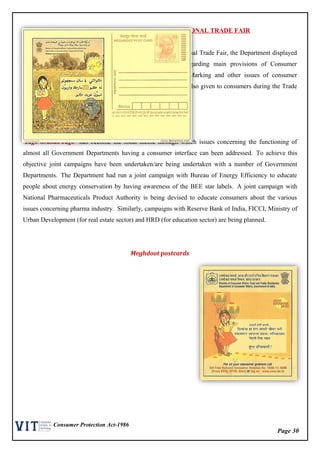
 Meghdoot Post
The Department in consultation with the Department of Post has disseminated consumer awareness
messages through Meghdoot Post cards to reach far-flung rural areas including North East States. A
bigger plan of partnership with the Department of Posts to use the vast network of postal department for
spreading the message of consumer awareness has been chalked out Calendars containing the message
of consumer awareness are being displayed through the vast network of 1.55 lakhs post offices.
 Printed Literature
The Department through Printed Literature is also creating awareness. A folder entitled “Consumer
Awareness Mission” containing the salient features of Consumer Protection Act 1986, Consumer
Resource kit as well pocket calendars and posters is being distributed during various events such as
IITF, Nukkad Nataks and also through the State Governments at grass root level. The publicity material
relating to consumer awareness has also been translated in regional languages and is being disseminated
to various State Governments.
 Nukkad Nataks
Page 29
Consumer Protection Act-1986
Nukkad Nataks are being performed in consultation with Song & Drama division of the Ministry of
Information and Broadcasting. More than 1000 programmes in all the States/UTs have
been organised to create awareness at grass root level.
 National Consumer Help Line
A pilot project National Consumer Help Line initiated can be accessed through a
Toll Free Number 1800-11-4000 which is being operated by Delhi University for counseling the
Consumers to redress their grievances. The timing of toll free number facility is available to consumers
from 9-30 A.M. to 5-30 P.M. on all the working days (Monday—Saturday). Through the various
advertisements pertaining to Department of Consumer Awareness adequate publicity has been given to
National Helpline so that the affected consumers could seek guidelines/counseling through the national
helpline.
 Online Medium
In order to reach maximum number of consumers, the Department has telecast video spots containing
consumer related information during the popular sports events such as Tri-series cricket tournament,
Indo-Pak Series, Indo-Australia Series, Indo- England Cricket Series etc.
India is a country with more than 70% population being under 35 years. The youngsters are using the
internet in a big way for various purposes and also happen to be major consumers. Realizing this, a
major initiative is being taken to spread consumer awareness through the online medium. The
advertisements being brought out by the Department are also being displayed on the website of the
Ministry www.fcamin.nic.in.
 journals
Advertisements are being carried in journals of Publication Division such
as Yojana, Kurukshetra, Bal Bharti, Aajkal and their regional editions. Focused articles on consumer
awareness are being published in these magazines keeping in view their target readership. Employment
News, the flagship publication of Publication Division, which is the largest selling career weekly of its
kind occasionally publishes articles that are of interest to youngsters in keeping them informed about
their rights. The advertisements of Department are also published regularly in Employment
News/Rojgar Samachar so that the youth of the country are made aware of their consumer rights.
Page 30
Consumer Protection Act-1986
PARTICIPATION IN INDIA INTERNATIONAL TRADE FAIR
Keeping in view the large number of visitors to India International Trade Fair, the Department displayed
its activities through a stall in IIPA. Publicity material regarding main provisions of Consumer
Protection, Standardization, Weights & Measures, ISI, Hall Marking and other issues of consumer
interest was distributed free of cost. On the spot guidance was also given to consumers during the Trade
Fair.
Joint Campaign
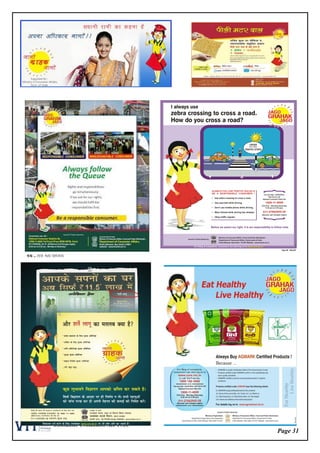
‘Jago Grahak Jago’ has become the focal theme through which issues concerning the functioning of
almost all Government Departments having a consumer interface can been addressed. To achieve this
objective joint campaigns have been undertaken/are being undertaken with a number of Government
Departments. The Department had run a joint campaign with Bureau of Energy Efficiency to educate
people about energy conservation by having awareness of the BEE star labels. A joint campaign with
National Pharmaceuticals Product Authority is being devised to educate consumers about the various
issues concerning pharma industry. Similarly, campaigns with Reserve Bank of India, FICCI, Ministry of
Urban Development (for real estate sector) and HRD (for education sector) are being planned.
Meghdoot postcards
Page 31
Consumer Protection Act-1986
Page 32
Consumer Protection Act-1986
NCH is a project of the Union Ministry of Consumer Affairs operates under the Centre for Consumer
Studies at Indian Institute Of Public Administration from The Project recognizes the need of consumers
for a Telephone Helpline to deal with multitude of problems arising in their day-to-day dealings with
business and service providers.
NCH provides a National Toll Free No-1800-11-4000. SMS can also be sent to +918130009809
(charges apply) mentioning the name and city. A consumer can call to seek information, advice or
guidance for his queries and complaints.
NATIONAL CONSUMER HELPLINE SUPPORTS CONSUMERS BY
 Guiding consumers in finding solutions to problems related to Products & Services.
 Providing information related to Companies and Regulatory Authorities.
 Facilitating consumers in filing complaints against defaulting Service Providers
 Empowering consumers to use available Consumer Grievances Redressal
 Mechanisms, Educating Consumers about their Rights and Responsibilities.
NCH VISION
“A Nation of awakened, empowered and responsible consumers and socially and legally responsible
Corporations."
NCH MISSION
"To provide telephonic advice, information and guidance to empower Indian consumers and persuade
businesses to reorient their policy and management systems to address consumer concerns and grievances
adopting world class standards."
NCH provides a National Toll Free No-1800-11-4000 (for BSNL/MTNL Users), Other users can
dial- 011-27006500 (normal call charges applicable). SMS to 8800939717 can also be sent mentioning
the name and city. Users can also file the online complaint by using its website.
(Source- http://www.nationalconsumerhelpline.in/)
CONSUMER ONLINE RESOURCE & EMPOWERMENT CENTRE (CORE)
Consumer Online Resources and Empowerment (CORE) Centre helps in consumer advocacy and online
redressal of consumer grievances. Users can also call at the toll free number 1800-180-4566.
Page 33
Consumer Protection Act-1986
CONSUMER GUIDANCE SOCIETY OF INDIA (CGSI)
Since Independence, India has been striving to develop and strengthen its industrial base. In this
pursuit of “self-sufficiency”, however, the consumer has been made to endure sub-standard products and
services: adulterated foods, short weights and measure, spurious and hazardous drugs, exorbitant prices,
endemic shortages leading to black marketing and profiteering, unfulfilled manufacture guarantees,and a
host of other ills. In one infamous case, forty persons were struck with dropsy and glaucoma after
consuming groundnut oil adulterated with toxic Argemone oil. The culprits were never brought to justice.
This outrage energized nine ladies to organize a movement to fight for consumer rights. They formed the
Consumer Guidance Society of India (CGSI) to resist consumer exploitation of all forms.
The Consumer Guidance Society of India (CGSI) is the first and foremost consumer body of the country.
The Maharashtra State Government has entrusted CGSI to establish and manage the Maharashtra State
Consumer Helpline. You can reach out to the CGSI – Maharashtra State Consumer Helpline by calling
the Toll-free Number : 1800 22 22 62 or by e-mail : mah.helpline@gmail.com. Register your complaint
CGSI has reached out to lakhs of consumers and conducted workshops and seminars on consumer
awareness topics like food adulteration, becoming a smart investor and consumer protection.
CGSI has been actively championing the rights of consumers for more than 40 years. The Society was
founded by women activists in the year 1966. Their aim was to protect the rights of consumers, who
found themselves helpless whenever they were supplied with defective goods or services.
Activities taken up by CGSI:
CGSI’s involvement in consumer education is concentrated in rural areas on the outskirts of Mumbai
and among the urban poor. CGSI first started its rural project in 1997 and by 1999, its work extended to
people from 112 villages. The following are CGSI’s achievement in consumer education:
Over 32,000 people received consumer education in two years, through talks, demonstrations and
exhibitions.
107 training programs were organized and 5,700 potential activists were given special training in
consumer activism. This resulted in many local consumer groups in remote villages, set up by the
consumers themselves.
Page 34
Consumer Protection Act-1986
Due to its efforts, the Maharashtra Education Board introduced consumer education at the 9th standard
level, progressively covering students from 4th standard upwards. Consumer education is also introduced
in colleges.
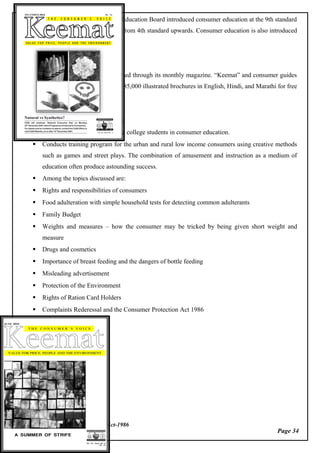
Consumer education is also promoted through its monthly magazine. “Keemat” and consumer guides
published by CGSI. It has also printed 85,000 illustrated brochures in English, Hindi, and Marathi for free
distribution.
 Currently conducting ‘Training
 Provides training for school and college students in consumer education.
 Conducts training program for the urban and rural low income consumers using creative methods
such as games and street plays. The combination of amusement and instruction as a medium of
education often produce astounding success.
 Among the topics discussed are:
 Rights and responsibilities of consumers
 Food adulteration with simple household tests for detecting common adulterants
 Family Budget
 Weights and measures – how the consumer may be tricked by being given short weight and
measure
 Drugs and cosmetics
 Importance of breast feeding and the dangers of bottle feeding
 Misleading advertisement
 Protection of the Environment
 Rights of Ration Card Holders
 Complaints Rederessal and the Consumer Protection Act 1986
Page 35
Consumer Protection Act-1986
COMPLAINT REDRESSAL BY CGSI
CGSI handles consumer complaints and offers legal guidance to those wishing to file suits in the
Consumer Court. In case where there are a number of complaint against a particular party, both sides are
brought together to resolve the issue. The CGSI'S Complaints Committee meets twice a week. Many
thousands of grievances have been handled over the years, with 70% success in favor of the complaints
cover medical/surgical malpractice and negligence; insurance non-payment; sub-standard drugs and
medicines; home remedies; defective household appliances; poor quality foods and drinks; misleading
advertising claims; and grievances concerning investments, real estate, insurance, telephones, electricity
supply, etc.
Following are some of the landmarks achieved by CGSI:
 CGSI is the earliest consumer organization in India, founded in 1966.
 CGSI was the first to demand a Consumer Protection Act with Consumer Course
to implement it. This becomes a reality in 1986.
 To date, 70% of the thousands of complaints referred to CGSI have been redressed.
 CGSI established formal Product Testing in India.
 CGSI was the first to publish a monthly magazine "Keemat" carrying information
of importance to consumer.
 CGSI promotes consumer education; initiates training projects in rural areas;
Promotes publicity drives; represents consumer interests with Government and other bodies.
 CGSI received the National Award for consumer Protection in 1991.
 CGSI is the only Indian consumer organization to be a council member of
Consumer International for 25 years.
 CGSI is a member of the Maharashtra State Consumer Protection Council.
 CGSI participates in a large number of technical committees and government
decision-making bodies.
Page 36
Consumer Protection Act-1986
Example:
March – April 2011
CGSI had
taken up
the
issue of
high
content of trans-fats in Vanaspati, which is health hazard. The good news is that many biscuit
manufactures have switched over to edible oil instead of vanaspati in biscuits, in order to comply with
“O” (zero) trans-fat requirements for the export of Indian Biscuit.
STATISTICAL DATA
Page 37
Consumer Protection Act-1986
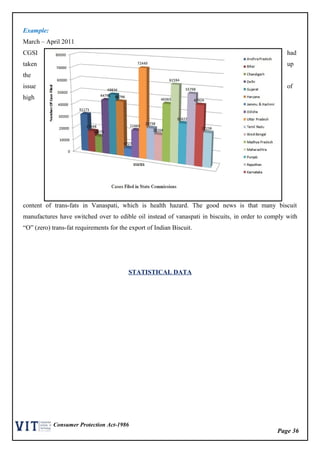
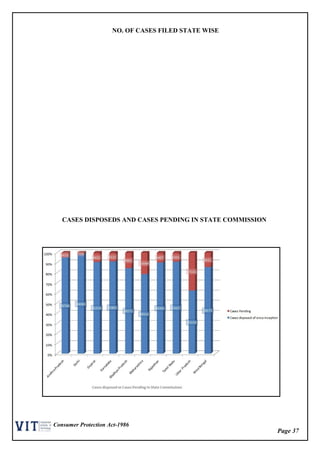
NO. OF CASES FILED STATE WISE
CASES DISPOSEDS AND CASES PENDING IN STATE COMMISSION
Page 38
Consumer Protection Act-1986
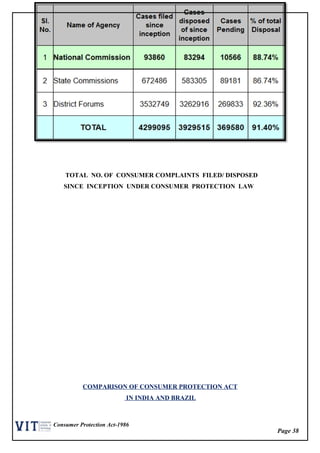
TOTAL NO. OF CONSUMER COMPLAINTS FILED/ DISPOSED
SINCE INCEPTION UNDER CONSUMER PROTECTION LAW
COMPARISON OF CONSUMER PROTECTION ACT
IN INDIA AND BRAZIL
Page 39
Consumer Protection Act-1986
INDIA
The Act provide for better protection of the interests of consumers and for that purpose to make
provision for the establishment of consumer councils and other authorities for the settlement of
consumers disputes and for matters connected therewith.
1. The Act aims to provide better and all-round protection to consumers. It applies to all goods and
services unless otherwise expressly notified by the Central Government. Goods under this Act have the
same meaning as assigned to them under the sale of goods Act, 1930 (Sec. 2(7) (i)). Accordingly,
Goods means every kind of movable property other than actionable claims and money; and includes
stock and shares, growing crops, grass and things attached to or forming part of the land which are
agreed to be served before sale or under the contract of sale.
2. The definition of service in the Act in very wide and comprehensive. In fact, it will take in service of
any description rendered for consideration by any person or organisation including public sector
undertakings (PSUs) and Government agencies. However, services rendered free of charge or under
any contract of personal service, are excluded. Thus, the following services do not fall within its scope,
Health Services provided by Government hospitals, Civic amenities provided by municipal authorities.
All suppliers of goods and services, both in the private and in the public sector and the cooperative
sector, are covered by the Act.
3. The Act allows filling of "class action" complaints on behalf of groups of consumers having common
interest.
Page 40
Consumer Protection Act-1986
4. To organize consumer resistance further and educate them, the Act also provides for the formation of
consumer protection councils in every State. These councils do not have any legal authority under the
Act but are meant to promote the cause of consumer protection and cover the six consumer rights -
right to safety, to be informed, to choose, to be heard, to redress, and to consumer education.
5. For enforcement of the rights of the consumers, the Act has created special consumer Courts. As Act
provides for a three-tier consumer grievance redressal machinery with the District Forums at the base,
the State Commission at the middle level and the National Commission at the apex level. Any verdict
given by the National Commission can be challenged in the Supreme Court.
6. Under this Act there is provision to settle the complaint within three months of filing it. If the
complaint needs laboratory testing, the period is extended to five months.
7. Where a trader or a person against whom a complaint is made fails or omits to comply with any order
made by the District Forum, the State Commission or the National Commission, as the case may be,
such trader or person or complainant shall be punishable with imprisonment for a term which shall not
be less than one month but which may extend to three years, or with fine which shall not be less than
two thousands rupees but which may extend to ten thousand rupees, or with both
BRAZIL
Brazil has one of the most complete Consumer Defense system of the world, counting with the
support of several institutions and regulations. Know more about how national laws protect the
consumers and what to do in case you feel damaged Consumer Rights in Brazil only acquired visibility
after the Constitution of 1988, responsible for reestablishing democracy in the country after a long
dictatorship. Following the US model, the Government issued the Consumer Defense Code (Código de
Defesa do Consumidor) in 1990, a law that would organize all the rules to protect consumers. Also, the
Code came to discipline the relations and responsibilities between providers and consumers, establishing
standards of conduct, terms and penalties.
Page 41
Consumer Protection Act-1986
The Consumer Defense Code the Brazilian Consumer Defense Code (Federal Law 8.078) can
be summarized in the following ten points:
1. Life and Health protection: Before selling, providers must warn their consumers about the possible
risks a determined product or service can offer.
2. Education for consumption: Consumers have the right to be given proper orientation about the
adequate use of products and services.
3. Freedom of choice: Consumers have the right to choose the products and services that better fill their
needs.
4. Information: Every product must bring clear information about its amount, weight, composition,
price, possible risks and how to use it. Consumers also have the right to know every detail about their
purchased services.
5. Protection against misleading or abusive advertisement: Consumers have the right to demand for
everything that was promised in the adds. If what was announced was not complied, then consumers
have the right to cancel the purchase and have their money back. Misleading or abusive advertisements
are considered a crime according to the Code (art. 67)
6. Contractual protection: The Code protects consumers in case of no fulfillment of contract terms or
when the terms are damaging to them. In this case, the judge can cancel or modify the clauses.
7. Indemnity: When damaged, consumers have the right to be indemnified by who sold the product or
provided the service, including moral damage.
8. Access to Justice: The consumer whose rights were violated can appeal to court and ask the judge to
force the provider to respect his rights.
9. Facilitation of rights defense: An example is the inversion of the burden of the proof. That means that
it will be the provider the one obliged to bring proof that he is innocent, not the consumer will have to
prove that the provider is guilty.
Page 42
Consumer Protection Act-1986
10. Quality of Public Services: There are rules present in the Code that assure the quality in public
services, as well as a good customer service by public institutions or concessionary companies of those
services.
CASE STUDY 01
PATIENT WINS BATTLE AGAINST INSURANCE COMPANY, GETS 1.2L
MUMBAI,| JUN 8, 2011
Coming to the aid of policy holders who are often short-changed by medical insurance companies, a
consumer forum recently ruled in favour of an Andheri resident whose claim had been rejected by his
insurance provider.
The Mumbai Suburban Consumer Redressal Forum ordered HDFC Ergo General Insurance Company
Ltd to reimburse Rs 1.18 lakh at 9% interest to Dharamdas Pritiani, a heart patient who underwent a rare
and state-of-the-art treatment. The interest is to be calculated from the date Pritiani filed the claim. The
company has also been directed to pay an addition Rs 5,000 to Pritiani for mental agony.
Pritiani bought a medical insurance policy from the company for the period 2008-09. Pritiani
experienced difficulty in breathing and underwent a series of tests to ascertain the cause. An angiography
revealed that he suffered from a heart ailment, following which he was advised to undergo treatment
immediately. Pritiani then underwent a treatment called Enhanced External Counter Pulsation (EECP).
The treatment was completed in 45 sittings and required both medicines and special equipment. Pritiani
incurred expenses amounting to Rs 1.18 lakh and claimed this amount from his insurance company.
However, the company rejected his claim in May 2009 saying the treatment was experimental and not
recognized by it.
Pritiani argued that the treatment was recognized by the US and over 700 hospitals abroad provided
EECP. As many as 40 hospitals in India use EECP method to treat heart patients, he claimed. Pritiani then
filed a complaint in the forum on November 23, 2009.
Justifying its rejection of Pritiani`s claim, the insurance company said that a policy holder must be
hospitalized for at least 24 hours for reimbursement.
Page 43
Consumer Protection Act-1986
Pritiani filed documents in the forum showing that another insurance company had reimbursed a client
in a similar case. He also submitted documents describing the exact nature and method used in the
treatment. Pritiani also cited a 2007 order passed by the Thane District Consumer Redressal Forum
directing an insurance company to pay the reimbursement to another patient who had undergone EECP.
Taking the medicines and the equipment into consideration the forum observed that EECP looked like
it was "state-of-the-art treatment". It observed that the company did not provide any evidence to support
its claim that the treatment was only being implemented on an experimental basis in India. The forum
relied on a clause of the insurance company stating that the 24-hour rule will not apply if a "state-of-the-
art treatment" did not require hospitalization
Further it observed that the insurance company has nowhere stated that the order passed by the Thane
forum was stayed by a senior forum or been reversed. The bills produced by Pritiani support his claim,
the forum said.
The Mumbai Suburban Consumer Redressal Forum ruled in favour of Andheri (w) resident whose
insurance claim was rejected on the ground that his treatment did not require hospitalization for a
minimum of 24 hours. The forum ordered that Dharamdas Pritiani, a heart patient who underwent a rare
and state of the art treatment should be reimbursed Rs 1.18 lakh. The forum relied on a clause of the
insurance company that stated that in case a state of the art treatment did not require hospitilisation, the 24
hour mandatory hospitilisation clause will not apply. The forum has ordered the insurance company to
pay the amount with a 9 percent interest and addition Rs 5,000 for the mental agony caused to Pritiani.
Page 44
Consumer Protection Act-1986
CASE STUDY 02
COMPUTER INSTITUTE FINED RS 94K FOR REFUSING REFUND
MUMBAI, MAR 19, 2013
A consumer forum has directed MET-Institute of Computer Science to
return the course fee of Rs 62,200 to a Worli student who had to withdraw from a postgraduate course
after he failed to clear his BSc exam. The institute will also have to pay the complainant, Chetan Prakash,
Rs 32,000 as compensation for harassment.
The Mumbai Suburban District Consumer Disputes Redress Forum pointed out that the student had
not withdrawn the admission after securing a seat in another institute but had done so after he failed his
exams. Under such circumstances, not refunding the fees would amount to deficiency in service, said the
forum.
According to his complaint lodged in March 2009, Prakash was still a third year BSc student when he
had sought admission in the computer institute for a Masters in Computer Science (MCS) course. On
August 9, 2008, he reportedly paid Rs 63,200 as fee. The institute had stipulated that in order to pursue
the MSC course, a student has to clear third-year exams. While Prakash took his BSc exams in April
2008, his results were declared on August 18, 2008. Seeing that he had failed to clear the exams, Prakash
tried to withdraw the admission from the computer institute on the very day the results were declared. But
despite several attempts, the institute reportedly did not respond to his requests for a refund. Finally on
January 29, 2009, Prakash sent a legal notice to the institute, but to no avail. Aggrieved, he lodged a
complaint in the consumer forum.
Contesting the charges against them, the institute claimed that even after the results were announced,
Prakash did not get in touch with them. They also said that the final list of eligible candidates was
updated on the website on August 20, 2008 and his name was on it. Alleging that as Prakash did not
inform them about his disposition, a seat remained vacant and so his fee could not be refunded. The
institute claimed Prakash came to them only in September 2008.
The forum, however, said there was no justification to support the institute's claim and that the seat
would remain vacant for three years.
Page 45
Consumer Protection Act-1986
CASE STUDY 03
PEPSICO PENALIZED FOR SHORT-CHANGING CONSUMER
AHMEDABAD, SEPTEMBER 14, 2012
Contrary to the commonly-held belief that well-known, leading brands live up to their name and
refrain from duping consumers, Consumer Education & Research Society (CERS), Ahmedabad, has
brought to light one case wherein the Indian subsidiary of the international food & beverages giant
PepsiCo was found selling underweight packets of its popular potato chips brand “Lay’s”.
CERS had received a complaint from Krishan Kumar Bajaj about a “Lay’s – Shipra Tangy Twist” potato
chips packet bought by him being underweight. When the weight was checked, the sealed packet was
found to weigh a mere 8 gm instead of 30 gm mentioned on the packet, a shocking 72% less!
CERS filed a case against PepsiCo at the Consumer Disputes Redressal Forum. In a landmark
judgement, issued on 7 September 2012, the Forum ordered PepsiCo India Holdings Ltd. to deposit Rs.
50,000 in the Consumer Welfare Fund of India within 90 days from the receipt of the order. PepsiCo was
also asked to pay the complainant Rs. 5,000/- for mental agony and Rs. 2,000 for the litigation cost.
While just one packet was randomly discovered to be underweight by an alert consumer, a simple
calculation indicates that the company can earn an extra profit worth around Rs. 2.75 lakh, if the entire
production of 36,700 packets under the batch mentioned on the packet is sold underweight. This holds
significance since, on CERS’ query, the company could not totally rule out this possibility. CERS
resorted to legal action in its attempt to compel PepsiCo to pay compensation and punitive damages, and
uphold consumer rights.
Bajaj, a resident of Vastrapur, Ahmedabad, had purchased the disputed packet from a shop in Thaltej
area on 28 June 2010 and had immediately sensed its being underweight. His doubt was confirmed when
he actually weighed the pack. The manufacturing date on the pack was 19 April 2010 and the production
batch no. was N-207 C. He wrote twice to the manufacturer. While the first letter got no response, in
reply to the record, the company accepted that the packet was underweight but didn’t take the complaint
seriously. It offered Bajaj a gift hamper from PepsiCo which he refused.
Page 46
Consumer Protection Act-1986
Bajaj approached CERS and the pack was weighed in the in-house laboratory of the organisation. On
ascertaining that it weighed only 8 gm, i.e. 22gm less than that claimed, CERS immediately wrote to
PepsiCo. “There is practically no possibility of such a pack coming out of our plant,” replied PepsiCo.
CERS in turn demanded an explanation as to how the pack reached the market and finally to the
consumer. The company gave several unsatisfactory clarifications. It explained that sometimes, due to
technical glitch, packets might be underweight at the beginning and the end of the packaging process.
Such packets are “segregated in a separate hold area and destroyed”, it claimed.
Further probe by CERS led to startling revelations : Simi Mehta, a PepsiCo spokesperson, admitted on
phone that the company had been getting complaints about underweight packets from its Pune plant. This
was, therefore, not an isolated incident. CERS had good reasons to believe that the sale of underweight
packets to consumers was not a freak incident. This could happen with their various products in several
batches from different PepsiCo plants. Even if such an instance / technical glitch occurs at PepsiCo on a
given day, it has huge implications for the company and its consumers.
Eventually, CERS took the issue to the Consumer Disputes Redressal Forum, Ahmedabad (Rural),
alleging unfair trade practice. The forum also gave a favourable ruling dismissing all the arguments made
by PepsiCo. On PepsiCo’s request, the Forum got the pack weighed at a government laboratory and the
report from the lab revealed that the weight of the pack was 8.42 gm. The company argued that the
complaint should not be entertained, as Bajaj could not produce the bill for the purchase. For a product
of Rs.10/- very often consumers may not have a bill. To address this issue, Bajaj submitted on affidavit
that he had bought the “Lay’s” packet from Brahmani Provision Stores, Thaltej, Ahmedabad.
The Court was of the view that, as PepsiCo could not deny that the packet bought by Bajaj was their
product, the argument of his not having a bill and, therefore, his not being a consumer under the C P Act
was overruled.
CERS in its prayer had requested the court to direct PepsiCo to immediately stop such unfair trade
practice, deposit Rs.2,00,000 in the Consumer Welfare Fund and award Rs.2,75,250 as punitive damages.
CERS had also appealed to the court to order PepsiCo to give Rs.75,000 as costs of litigation and also
inform the media. If PepsiCo stands to gain Rs. 2,75,250 from underweight delivery in one single
product, in one single batch of one particular manufacturing plant, the implications of this happening
more often are simply huge and that too at the cost of consumers.
Page 47
Consumer Protection Act-1986
The court gave the order with the comment that if PepsiCo claims to be an international company, then
this kind of negligence is not acceptable.
CASE STUDY 04
PUNJAB STATE CONSUMER COMMISSION FINES MARUTI & ITS DEALER
OF RS.1 LAKH EACH
PUNJAB, JANUARY 1, 2011
The Punjab State Consumer Disputes Redressal Commission at Chandigarh has fined of Rs.1 lakh
each on Regional Manager, Maruti Suzuki, Chandigarh and Tara Automobiles, Jalalabad on account of
selling a defective Wagon R VXI Model car to a soldier Hav Kulwinder Singh of Indian Army.
On 10.9.2010, Hav Kulwinder Singh of Indian Army Purchased a Maruti Wagon R XVI car
manufactured by Maruti Suzuki Company from its authorised dealer Tara Automobiles under ‘Army
Quota’ through Canteen Stores department Bathinda after payment of entire sale consideration vide
delivery Challa No.147.
Finding a deficiency in service on pointing a manufacturing defect and unfair trader practice,
Kulwinder Singh filed a complaint before the District Consumer Disputes Redressal Forum, Ferozepur
but the dealer did not come present despite service of notice and was proceeded against ex-parte.
The Company and its Regional Manager appeared before the Consumer Forum Ferozepur and pleaded
that the claim of the complainant is not covered under the warranty because the complainant drove the
vehicle in water flooded area where the water entered into the engine of the vehicle and resulted into
Hydrostatic Lock and only the repairs are to be carried on chargeable basis as this fact has been
mentioned in the job card issued by Shakti Motors Sirsa. The company further denied its liability being
the dealer to be liable for the defect, if any.
The District Consumer Forum, Ferozepur consisting of Sanjay Garg, president and Tarlok Singh
member, after considering all the facts brought record that the seller and the manufacturer are guilty of
selling a defective car to the complainant and ordered to refund the complainant, the price of the car to the
tune of Rs.356295 plus insurance charges of Rs.10775 and Rs.550 paid as accessories along with interest
@ 7% per annum from the date of complaint i.e. from 1.10.2010 till realization along with Rs.2000 as
litigation expenses. The said order in complaint No.541 of 2010 was passed by the District Consumer
Forum on 19.1.2011.
Page 48
Consumer Protection Act-1986
Aggrieved from the said order, the Company Maruti Suzuki through its Regional Manager, Chandigarh as
well as the dealer Tara Automobiles Jalalabad (W) filed two separate appeals before the Punjab State
Consumer Disputes Redressal Commission, Chandigarh for setting aside the award passed against them.
The Punjab State Consumer Disputes Redressal Commission, Chandigarh has decided both the appeals
in a single order dated 23.7.2012 holding the dealer and the Company guilty and also concluded that the
Company as well as dealer at Jalalabad are also guilty of tempering with the Job card issued by Shakti
Motors Sirsa by writing on the said computerized Job card mentioning, “Vehicle stopped due to water
enter in engine, Engine Need O/H.” There was a warranty for the vehicle for a period of 24 months or
40000 KMs from the date of purchase but the defect occurred on the same day of sale of car only after a
run of 269 KMs.
The Punjab State Consumer Disputes Redressal Commission, Chandigarh held that both the appeals
by dealer Tara Automobile Jalalabad, are merit less and dismissed with exemplary costs of Rs.1 lakh each
to be paid by the Regional Manager, Maruti Suzuki, Chandigarh and Tara Automobiles, Jalalabad(W) to
Hav Kulwinder Singh within one month from the date of receipt of copy of order.
So that in future no person in India dares to harass such like a present case, to a soldier, who is always
ready to sacrifice his life without bothering his responsibilities towards his family.
So, both the appeals are dismissed with costs of Rs.1,00,000/- each to be paid by the appellants of both
the appeals to have Kulwinder Singh within one month from the date of receipt of copy of order.
Page 49
Consumer Protection Act-1986
RECOMMENDATIONS
Very few consumers are fully aware about the rights, responsibilities and Consumer Protection
Act. Hence, it is necessary to educate them on their rights and responsibilities as consumers, to make
them vigilant, rational and aware buyers. In the current situation media can play an important role which
can help people to get aware about possible unfair practices in the market. The government has been
fruitful in providing protection to the consumers in the real sense of the term and served the purpose of
the Act Consumers have to be aware of their rights.
Also consumer activism, organizations, civil society and other voluntary associations needs to play
their part in the furtherance of consumer movement. In all consumers need to know their rights and
should assert them in the market place.
In today's rampant changing market scenario, there is an increasing necessity to empowering the
consumers through education and motivation regarding their rights and responsibilities. He/she should be
equipped to be fully vigilant so as to be able to protect himself/herself from any wrongful act on the part
of the seller/trader. Several steps have been taken by the Government, both at the Central and State level
towards generating awareness among the consumers.
• Consumers should always conduct market surveys and tap all the sources of information (TV,
magazines, newspapers, salespersons, and if possible somebody who is already using the product)
before buying a product.
• Consumers should buy from fair price shops, authorised company showrooms, cooperative stores or
other reliable shops of good reputation in your area. This will enable you to buy good quality products
at right price.
• Consumers should obtain bills, receipts and guarantee cards for all purchases made and keep them
safely. They will be of use in case of any fault in the products.
• Instead of loose items, preferably buy properly packed and labelled products.
Page 50
Consumer Protection Act-1986
• Read labels carefully for brand names, ingredients, net weight, MRP (maximum retail price), expiry
date and standardization mark.
• They should not accept irregular weight and be alert vigilant about the weights and measures and the
procedure used by the seller.
• Consumers should report any unfair trade practices to redressal agencies.
• Consumers should only buy goods carrying standardized marks.
• The State should ensure that the ordinary citizen is a lot more aware about the procedure for filing a
complaint and the necessary helplines should be advertised.
• The State should make the system more transparent and encourage the participation of the ordinary
citizens.
CONCLUSION
Business houses have the right to make profits in order to survive. Similarly, consumers have the
legitimate right to expect goods and services promised by business houses and advertisements; and if it is
not to their expectations, have a right to complaint and seek redressal. Complaining and getting justice
helps, all of us to improve the manner, we treat each other. Taking appropriate action helps in improving
the overall goods and services quality in the country. One point however, to note is that consumer bodies
only cannot protect all the consumers from irresponsible profiteers, or even resolve all their related
complaints. Consumers alone can take the fight forward and safeguard the legitimate consumer protection
rights granted by the Indian constitution.
As a matter of fact, three major problems are confronting the consumer protagonists in India. The first
problem concerns active functioning of the Consumer Forums throughout the country. Notwithstanding
the fact that these Forums have now been established, by and large, throughout the country, consumer
activists and organizations have been repeatedly voicing their grievances against the smooth functioning
of these Forums. They argue that these Forums have also started behaving like Civil Courts and are likely
to have mounting arrears soon. In addition, these Forums still lack basic infrastructural facilities. The
members sit only part-time and 90 days decision- making requirement is not strictly adhered to. There are
also ego and status problems between judicial members and the members with non-judicial background.
Another significant problem is that the stay orders from the High Courts have begun to hold up a large
number of cases filed before the Consumer Forums, thereby denying the benefits of speedy and
inexpensive redressal machinery promised under the Consumer protection Act, 1986.
Page 51
Consumer Protection Act-1986
The second problem concerns the applicability of the Consumer protection Act, 1986 to various
services. As is evident, ever since the implementation of the 1986 Act, whereas there has hardly been any
significant case in which the ‘goods’ has been vehemently contested, there is a voluminous amount of
case law which involved determination of the meaning, definition, and ambit of the term ‘service’.
The definition of the term ‘service’ had already been kept very wide and now with the inclusion of the
two terms ‘housing and construction’ by the Consumer Protection (Amendment) Act, 1993, it has been
further widened. Only two types of services have been kept out of the ambit of the 1986 Act. They are
services rendered free of charge and services rendered under a contract of personal service. The non-
mentioning of services like education, health, housing, posts and telegraphs and telecommunications had
presumably given these services an impression of their exclusion from the ambit of this legislation. At the
initial stages, therefore, these services contested the jurisdiction of the 1986 Act, thereby claiming
complete immunity from their governance by it. The Consumer Forums, however, have appreciably stood
the test of time and have brought all these services within the ambit of the 1986 Act.
Making consumers aware of their rights and taking consumer movement to the rural India is the third
and perhaps the most important problem and a challenge before the consumer organizations. As is well
known, most consumers are still ignorant of their rights, much less of being assertive about them. Though
the Government appears to be serious of this issue, much however depends upon the consumer
organizations. They have still to cover a very long distance so far as taking the movement to rural areas is
concerned.
We, therefore, concluded that even though the Consumer is in a dominant position with respect to
numerous choices of products and services available in the market due to fierce competition between the
companies, he is still in a vulnerable position. Consumers as a class can be called as King but an
individual consumer barely enjoys such a status. The king, in this case, is vulnerable and requires
protection form unfair trade practices.
Page 52
Consumer Protection Act-1986
The efficient and effective program of Consumer Protection is of special significance to all of us
because we all are consumers. Even a manufacturer or provider of a service is a consumer of some other
goods or services. If both the producers/providers and consumers realize the need for co-existence,
adulterated products, spurious goods and other deficiencies in services would become a thing of the past.
The active involvement and participation from all quarters i.e. the central and state governments, the
educational Institutions, the NGO’s, the print and electronic media and the adoption and observance of a
voluntary code of conduct by the trade and industry and the citizen’s charter by the service providers is
necessary to see that the consumers get their due. The need of the hour is for total commitment to the
consumer cause and social responsiveness to consumer needs. This should, however, proceed in a
harmonious manner so that our society becomes a better place for all of us to live in.
a) Addition of substances in food material which are injurious to health or removal of substances which
are nutritious to health or by lowering their quality standards.
b) Improper delivery of after sales services, supply of defective goods, hidden price component,
production of low quality goods in bulk quantities, Use of deceptive or incorrect rates on products
c) Illegal fixation of Maximum Retail Price (MRP)
d) Selling above the MRP
e) Non-compliance with the terms and conditions of sales and services
f) Supply of false or incomplete information regarding the product
g) Poor customer services
h) Non-fulfillment of guarantee or warrantee
All such issues and problems must be handled more efficiently both at the Centre and the State level with
a view to protect the interests of the consumers and promote their welfare.
Page 53
Consumer Protection Act-1986
WEBLIOGRAPHY
 http://ncdrc.nic.in/statistics.html
 http://timesofindia.indiatimes.com/city/mumbai/Patient-wins-battle
-against-insurance-company-gets1-2L/articleshow/8767206.cms
 http://timesofindia.indiatimes.com/city/mumbai/Computer-institute-
fined-Rs-94k-for-refusing-refund/articleshow/19051870.cms
 http://consumerresources.in/2012/10/05/pepsico-penalized-for-
shortchanging-consumer/
 http://www.consumercourt.in/address/14149-commentary-consumer-
protection-act.html
 http://www.cag.org.in/guidelines-filing-complaint
Page 54
Consumer Protection Act-1986
 http://consumerresources.in/2012/09/20/how-to-prepare-and-submit-a-complaint-to-
a-consumer-forum/
 http://www.consumersinternational.org/who-we-are/un-guidelines-on-consumer-
protection
 http://www.consumerredressal.com/content/contentID/14/consumer_protection_act
 Legal aspects of Business By Akhileshwar Pathak

Consumer Protection Act 1986

  • 1.
    Page 1 Consumer ProtectionAct-1986 “NEED FOR CONSUMER PROTECTION ACT IN AN ERA OF FREE COMPETITION WHERE CONSUMER IS THE KING THEREFORE, KING NEED PROTECTION”
  • 2.
    Page 2 Consumer ProtectionAct-1986 TABLE OF CONTENT SR. NO. TOPIC PAGE NO. 1 Introduction………………………………………………...……… 4 2 Problems Faced By Consumers……………………………………. 6 3 Evolution Of Consumer Protection Rights In India……..………… 8 4 Consumer Protection Act - 1986…………………………………... 9 5 Consumer…………………………..……………………………… 10 6 International Scenario …………………………………....……….. 12 7 Rights Of A Consumer/ Objectives Of The Act ………………….. 14 8 Complaint …………………………….…………………………… 18 9 Procedure Of Filing A Complaint………………………………… 22 10 Forums ………………………………………………………..…… 23 11 “Jago Grahak Jago” Scheme Of Govt. Of India ……………….… 25 12 Consumer Guidance Society Of India (CGSI)…………………..… 31 13 Statistical Data …………………………………………..………… 34 14 Comparison Of Consumer Protection Act In India And Brazil…… 36 15 Case Studies ……………………………………………………… 49 16 Recommendations…………………………………………………. 46 17 Conclusion………………………………….…………………….... 47 18 Webliography…………………………………………………….... 50
  • 3.
    Page 3 Consumer ProtectionAct-1986 INTRODUCTION “A customer is the most important visitor on our premises. He is not dependent on us. We are dependent on him. He is not an interruption of our work. He is the purpose of it. He is not an outsider of our business. He is part of it. We are not doing him a favour by serving him. He is doing us a favour by giving us the opportunity to do so.” -By Mahatma Gandhi To any business, customer eccentricity is as important as product. Today the markets are guided by the desire of customers. There are companies like Marks & Spencer whose principal is based on its tagline i.e. “The customer is always and completely right!” Customer eccentricity is extremely essential to a business, because without customers no business can survive. It has been studied that customer are very prone to lose interest in the product with every new product launch. Therefore, in today’s world the firms do not leave any stone unturned to attract the consumer and gain a significant market share. The companies have started differentiating their own products with the consumers’ eyes. Today’s consumers are at a far better position than that of past as consumers with more safety, security and choices towards product, as the products are made as per their convenience, needs and desires. Lately the markets have been transformed from “sellers’ market” to “buyers’ market” where the choice exercised by the consumer will be influenced by the level of consumer awareness achieved. When it comes to customer preferences, it is not a matter of right, wrong or what might ultimately be acceptable. It’s simply a matter of what the customer wants to buy. Therefore, consumers are considered to be king in a free market.
  • 4.
    Page 4 Consumer ProtectionAct-1986 Webster's dictionary defines “Consumerism” as “the promotion of the consumer’s interests” or alternately “the theory that an increasing consumption of goods is economically desirable”. “Consumerism’s likely to dominate the Indian market in the coming years, thanks to the economic reforms in the present years and increased direct foreign investment in the retail sector. Consumerism also means the process of realizing the rights of the consumer as envisaged in the Consumer Protection Act- 1986 i.e. right to safety, right to be informed, right to choose, right to be heard, right to redress, right to consumer education, right to satisfaction of basic needs and ensuring right standards for the goods and services for which one makes payment. The big multinationals will leave no stone unturned to gain the attraction of the consumer and will try to gain a respectable market share. However, some of the companies try to engage in unscrupulous, exploitative and unfair trade practices like defective and unsafe products, adulteration, false and misleading advertising, hoarding, black-marketing etc. The earlier approach of caveat emptor, which means “Let the buyer beware”, has now been changed to caveat venditor “Let the seller beware”. There is an active need for having awareness on the consumer protection rights. Manufacturers and service providers offer product and services to fulfill needs & wants of customers. On one hand and to increase their level of profit, sales & market share on another. However, in an attempt to increase their sales and market share, these producers may be tempted to engage in unfair practices like defective and unsafe products, adulteration, false and misleading advertising, hoarding, black-marketing etc. Hence, there is a need to provide adequate protection to consumer’s against such practices of the seller. According to the Cambridge Advance Learning Dictionary, “Consumer protection is the protection of buyers, of goods & services against low quality, or dangerous products and advertisements that deceive people. Consumer protection includes educating consumers about their rights and responsibilities and helping them to seek redressal of their grievances.
  • 5.
    Page 5 Consumer ProtectionAct-1986 REASONS FOR WHICH CONSUMER NEEDS PROTECTION/ PROBLEMS FACED BY CONSUMERS 1. Illiteracy and Ignorance: - Consumers in India are mostly illiterate and ignorant. They do not understand their rights. A system is required to protect them from unscrupulous businessmen. 2. Unorganized Consumers: - In India consumers are widely dispersed and are not united. They are at the mercy of businessmen. On the other hand, producers and traders are organized and powerful. 3. Spurious Goods: - There is increasing supply of duplicate products. It is very difficult for an ordinary consumer to distinguish between a genuine product and its imitation. It is necessary to protect consumers from such exploitation by ensuring compliance with prescribed norms of quality and safety. 4. Deceptive Advertising: - Some businessmen give misleading information about quality, safety and utility of products. Consumers are misled by false advertisement and do not know the real quality of advertised goods. A mechanism is needed to prevent misleading advertisements.
  • 6.
    Page 6 Consumer ProtectionAct-1986 5. Adulteration:- Most of the times consumers even after paying high price, do not get pure or we can say quality goods. The organization usually supplies adulterated goods for their profit maximization. 6. Irregular Supply:- One of the common problems faced by consumers is an irregular supply of goods. This is because of shortage of goods. The organizations create artificial scarcity of necessary goods by hoarding these goods resulting in high prices. 7. Other Problems Include:-  Malpractices of businessmen and companies,  Deceptive and misleading techniques,  False warranties or guarantees,  Black marketing etc.
  • 7.
    Page 7 Consumer ProtectionAct-1986 EVOLUTION OF CONSUMER PROTECTION RIGHTS IN INDIA The consumer movement in India is as old as trade and commerce. In Kautilya's Arthashastra, there are references to the concept of consumer protection against exploitation by the trade and industry, short weights and measures, adulteration and punishment for these offences. However, there was no organized and systematic movement actually safeguarding the interests of the consumers. Prior to independence, the main law under which the consumer interests were considered were the Indian Penal Code, Agricultural Production, Grading and Marketing Act, 1937, Drugs and Cosmetics Act, 1940. Even though different parts of India exhibited different levels of awareness, in general, the level of awareness was pretty low. Indian consumer movement began with Passengers and Traffic Relief Association (PATRA) in Mumbai, in 1915. The growth from there has been incredible and the momentum of this growth started during the‘60s. In 1969, Monopolies and Restrictive Trade Practices Act was enacted and MRTP commission was set up under the provision of the act. The act deals with cases of restrictive trade practices adversely affecting competition and with unfair trade practices arising largely out of false and misleading advertisements. After this act, consumer groups emerged. The emergence of Consumer Education and Research Centre in Ahmadabad, in 1978, was a milestone in the consumer movement of India. It provided a thrust and a direction to the movement in terms of a result-oriented approach through effective uses of the law and the courts, and injecting professional inputs into the movement. In 1980s various consumer rights and many consumer groups were formed in different parts of the country.
  • 8.
    Page 8 Consumer ProtectionAct-1986 In 1986 the Consumer Protection Act was enacted. In 1987, the Indian Standards Institute (ISI), which was started around 1947 as a membership society largely dominated by industries, was turned into a statutory corporation called the Bureau of Indian Standards with greater participation by consumer organizations thereafter. In 1993, the Consumer Protection Act was amended overcoming few limitations and making it more effective and inducing the concept of consumer courts. Three tier consumer courts at the nation, state and district level known as the District Consumer Dispute Redressal Forum, State Consumer Disputes Redressal Commission, and the National Consumer Disputes Redressal Commission respectively was established under the provision of the act. Consumer Welfare Fund was also created during that time. The act includes the Securities and Exchange Board of India, 1992, the Telecommunication Regulatory Authority of India, 1997, and the Central Electricity Regulatory Commission, 1998. Apart from these, a number of acts like Indian Contract Act, Sale of Goods Act, The Essential Commodities Act, The Agricultural Produce (Grading and Marking) Act, The Prevention of Food Adulteration Act, The Standards of Weights and Measures Act have been enacted by the Indian legislature from time to time to protect the interest of the consumer. The system has been considered as one of the best in the world in the matter of consumer protection. CONSUMER PROTECTION ACT - 1986 Consumer Protection Act is an Indian federation law enacted in 1986 to protect interests of consumers in India. Except Jammu and Kashmir State, this Act extends to whole of India. It makes provision for the establishment of consumer councils and other authorities for the settlement of consumer disputes and for matters connected therewith. The growing interdependence of the world economy and international character of many business practices have contributed to the development of universal emphasis on consumer rights protection and promotion. Consumers, clients and customer’s world over, are demanding value for money in the form of quality goods and better services. Modern technological developments have no doubt made a great impact on the quality, availability and safety of goods and services. But the fact of life is that the consumers are still victims of unscrupulous and exploitative practices. Exploitation of consumers assumes numerous forms such as adulteration of food, spurious drugs, dubious hire purchase plans, high prices, poor quality, deficient services, deceptive advertisements, hazardous products, black marketing and many more. In addition, with revolution in information technology newer kinds of challenges are thrown on the consumer like cyber-crimes, plastic money etc., which affect the consumer in even bigger way. “Consumer is sovereign” and “customers the king” are nothing more than myths in the present scenario particularly in the developing societies.
  • 9.
    Page 9 Consumer ProtectionAct-1986 However, it has been realized and rightly said so that the Consumer protection is a socio- economic programed pursued by the government as well as the businesses for the satisfaction of the consumers is in the interest of both. In this context, the government, however, has a primary responsibility to protect the consumers’ interests and rights through appropriate policy measures, legal structure and administrative framework. The intention and object of the Consumer Protection Act, is to provide a speedy remedy and for better protection of interests of consumer. The Consumer Protection Act, 1986 has defined the term ‘Consumer’. Only the customers who falls under the definition of Consumer can be benefited through Consumer Protection Act. Hence the definition of consumer is of much importance to determine the applicability of the Act. CONSUMER Any person who buys any commodity or service or is a user of such commodity or service is known as consumer. Any person must satisfy two conditions to claim himself as a consumer:- 1) The service must have been rendered to him 2) He must have paid or promised to pay for the same. If any person buy capital goods to provide services to other individuals, then he is also recognized as consumer. Who is not a consumer?  If any person buys a commodity with an intention to resale.  A person who obtains services without consideration.  A person who obtains services for commercial purpose. Example:-
  • 10.
    Page 10 Consumer ProtectionAct-1986 1.When a person buys milk to consume for himself or his family than he can be considered as consumer but if he buys the milk for selling purpose than he is not a consumer he is termed as seller. 2. Television is made for purpose of entertainment, so when the person is just sitting and watching the television and getting entertained is the consumer and the person who is manufacturing the television for the purpose of entertainment is not a consumer he is the manufacturer or producer. DEFECT Defect means any fault, imperfection or shortcoming in the quality, quantity, potency, purity or standard which is required to be maintained by or under any law for the time being in force or under any contract, express or implied or as is claimed by the trader in any manner whatsoever in relation to any goods. Defect means lack or absence of something essential for completeness. If seller fails to deliver the goods which he agreed to sell will be treated as defect. Examples:- i. Suppose a customer buys a refrigerator and finds that the cooling is not proper then the product is defective. ii. A customer purchases chocolate and finds worms in it then the product i.e. chocolate is considered to be defective. SERVICE
  • 11.
    Page 11 Consumer ProtectionAct-1986 Service means service of any description which is made available to potential users and includes the provision of facilities in connection with banking, financing insurance, transport, processing, supply of electrical or other energy, board or lodging or both, housing construction, entertainment, amusement or the purveying of news or other information, but does not include the rendering of any service free of charge or under a contract of personal service. Examples:- 1. Whenever we travel in flights, the food which is provided to us is a service which the flight agency gives to us. 2. whereas now a days we get all the alert messages on our smart phones regarding our bank transactions that is also a service provided to us by banks INTERNATIONAL SCENARIO The process of development coupled with increasing liberalization and globalization across the country has enabled consumers to realize their increasingly important role in society and governance. However, concentration of the market power in the hands of a select few has affected consumers’ behavior over time. In a developing country like India where the incidence of poverty and unemployment is very high and the level of literacy is very low, the people face a volume of problems, particularly in the context of consumer related issues. Unlike in the developed world, consumers in these countries have not been able to play a greater role in the development process. The purpose of economic planning is to allocate resources, as far as possible, for the maximum satisfaction of consumers’ needs. Any goods or services produced in an economy are ultimately meant for consumers. There is a logical, moral and political force in the proposition that the consumers themselves should have the right to take decisions about the allocation of resources for their own needs.
  • 12.
    Page 12 Consumer ProtectionAct-1986 Realizing this need, the International Organization of Consumer Unions, now known as Consumers International, took the initiative and under its consistent lobbying, the United Nations adopted a set of Guidelines for Consumer Protection on April 9, 1985 which was revised in 1999. The Guidelines address the interests and needs of consumers worldwide and provide a framework for Governments, particularly those of developing and newly independent countries, to use for elaborating and strengthening consumer protection policies and legislation. The UN Guidelines have outlined the following eight areas for Developing policies for consumer protection:  Physical safety,  Promotion and protection of consumers’ economic interests,  Standards for safety and quality of consumer goods and services,  Distribution facilities for essential consumer goods and services,  Measures enabling consumers to obtain redress,  Education and information programs,  Promotion of sustainable consumption and  Measures relating to specific areas like water, food and pharmaceuticals. These areas have been translated into the following six Consumer rights by the Consumers’ International.  Right to Basic Needs,  Right to Safety,  Right to Choice,  Right to Information,  Right to Consumer Education,  Right to Redressed,
  • 13.
    Page 13 Consumer ProtectionAct-1986 Consumers International Strategy is to unlocking consumer power on a global scale. Imagine a world where individuals are as powerful as the governments and corporations they interact with. A global marketplace where consumers have the power to challenge unfair, unsafe and unethical corporate practice and win. To achieve this each individual need to think big & act global. It is now more than 50 years since President John F Kennedy articulated the concept of consumer rights in his historic message to the US Congress in which he outlined his vision of consumer rights. This was the first time any politician had formerly set out such principles. Consumers by definition include us all,' Kennedy said in his Congressional Statement, 'They are the largest economic group, affecting and affected by almost every public and private economic decision. Yet they are the only important group, whose views are often not heard.' Even today in many countries the goal of realizing these rights is still a long way off. CI believes that the time is ripe for a more concerted, intensive and aggressive effort to put new consumer protection measures in place and make this goal a reality. OBJECTIVES OF THE ACT The legislative intention behind this Act is to clear all hurdles in promoting competition among business units whether of domestic or foreign origin. The Consumer Protection Act of 1986 was enacted with an objective to provide better protection of the interests of the Consumers, to make provision for the establishment of Consumer Councils and other authorities for the settlement of consumer disputes. This is indeed a very unique and highly progressive piece of Social Welfare Legislation. The provisions of this Act are intended to provide effective and efficient safeguards to the consumers against various types of exploitations and unfair dealings.
  • 14.
    Page 14 Consumer ProtectionAct-1986 Unlike other laws, which are basically punitive or preventive in nature, the provisions of the Act are compensatory. It is a matter of great satisfaction that we can legitimately boast that we now have in our country a statute, which provides more effective protection to the consumers than any corresponding legislation in force in countries, which are considered to be much more advanced and industrialized. CPA has been in operation for about 18 years. A number of deficiencies and shortcoming in respect of its operation have come to light there by requiring amendments thrice, still leaving scope for further improvements. Despite all this it is a handy weapon for consumers to ensure accountability of producers of goods and providers of services. In the International Conference on Consumer Protection held in Malaysia in 1997, the Indian Consumer Protection Act was described as one “which has set in motion a revolution in the field of consumer rights, the parallel of which has not been seen anywhere else in the world”.  Basic purpose for the Consumer Protection Act:-  Right To Safety,  Right To Be Informed,  Right To Choose,  Right To Be Heard,  Right To Seek Redressal and  Right To Consumer Education.  They are being explained in detail as follows:- 1. Right To Safety:-
  • 15.
    Page 15 Consumer ProtectionAct-1986 Consumer has the right to be protected against marketing of such goods and services which are hazardous to health, life and property. There are several fake, adulterated, inferior, defective, ineffective and dangerous goods available in market. They are injurious to body and health. Consumer, therefore, has the right to safety from all such goods which are likely to cause harm to his body and health, besides causing loss of money. Here the consumer’s responsibility is to use the product safely. Example: - Certain products mentions warning and preventions to be taken into account for the safety measures. Like a tobacco packet should have a label which advice that consumption of the same leads to cancer. Here the manufacturer must specify all the factors which are related to the safety of the consumers. SMOKING KILLS!! 2. Right To Choose:- Under this right, consumer can choose any from among the variety of goods and services available in the market. In the market we find goods of different brand, quality, shape, color, size, design and price produced by different manufacturers. Under this right, the consumer must be assured access to variety of goods and services at competitive prices as far as possible. By misleading or false advertisement, wrong information or in any other way, If any person (manufacturer, seller) influences his preference, in an unfair or unnecessary manner, it will be treated as intervention in consumers right to choose. Example: - A man went to a showroom for buying mobile in a shop. Where in for each mobile there are various substitutes available varying in price, brand and composition. Suppose he wants to purchase a Samsung mobile, here the man has a choice of selecting any mobile of his choices available in the showroom. Here the consumer can enjoy the “Right to choose”. And the consumer’s responsibility is to make selection carefully. 3. Right To Be Informed:- Consumer has the right to get all necessary information on the basis of which he may decide to buy the good or service. He has therefore the right to be informed about the quality, quantity, purity, potency, standard, price of goods, etc.
  • 16.
    Page 16 Consumer ProtectionAct-1986 Example: - The duty of the manufacturer is to clearly mention the exact food ingredients used for making the product with its composition on a visible label. It is mostly printed on the back side of the food packet. The packet should also indicate whether the ingredients used in making the product are non-veg based or veg based. Green colour indicates use of vegetarian ingredients and brown colour indicates use of non- vegetarian ingredients. Here the consumer has the “Right to be informed.” And hence he should pay attention to details while buying any product. VEGETARIAN NON- VEGETARIAN 4. Right To Be Heard:- As stated in the Consumer Protection Act 1986, ‘the right to be heard and to be assured that consumer's interests will receive due consideration at appropriate forums’ is the definition of the right to be heard. This right helps to empower the consumers of India for putting forward their complaints and concerns fearlessly and raising their voice against products or even companies and ensure that their issues are taken into consideration as well as handled expeditiously. Right to be heard initiative allows consumer to upload videos, post complaints and suggestions on various issues and agendas. It also help consumer reach out to the right authorities and ensure that they are heard and get the speedy justice that they deserve. 5. Right To Seek Redressal:-
  • 17.
    Page 17 Consumer ProtectionAct-1986 Consumer has the right to get his claims and complaints settled against the manufacturers and sellers. This right provides the consumer freedom from unfair trade practice or unscrupulous exploitation by the trader. Besides, it helps him secure compensation. A warranty is usually a written guarantee for a product and declares the maker's responsibility to repair or replace a defective product or its parts. A guarantee is an agreement assuming responsibility to perform, execute, or complete something and offering security for that agreement. Any consumer who has issued a complaint to the producer, but the producer does not address the issue. Here, the consumer has the right to approach the district consumer court for this issue and file a complaint against the producer. Example: - If any consumer has purchased a mobile phone, but it stopped working within the warranty period. Though the consumer has approached the manufacturer for the same issue but the manufacturer hadn’t taken any heed to attain his complaint. So, the Consumer can approach the consumer court for this issue. 6. Right to Consumer Education:- Under this right, consumer is entitled to get information or educated about those things which are necessary for him. Such an education creates awareness about his rights and he comes to know when to approach for the redressal of his grievance and exploitation. This helps a consumer protects himself against fraudulent, deceptive and misleading advertisement and poor or negligent services. Manufacturer should make consumer aware and educate them about the product they buy. He should guide them about how to use the product, precautions to be taken, the dos and don’ts of it etc. Example: - Suppose a consumer bought an air conditioner. So the manufacturer should provide him with the knowledge regarding the operation of the air conditioner, such as working, cooling etc. This depicts the “Right of consumer education” COMPLAINT
  • 18.
    Page 18 Consumer ProtectionAct-1986 In legal terminology, a complaint is any formal legal document that sets out the facts and legal reasons that the filing party or parties believes are sufficient to support a claim against the party or parties against whom the claim is brought that entitles the filing party to a remedy (either money damages or injunctive relief). Any allegation in writing made by a complainant. Complaint is filed for:- Defect in goods, Deficiency in service, Charging of excess price, Hazardous goods, Unfair trade practice or restrictive trade practice. GUIDELINES FOR FILING A COMPLAINT BEFORE THE DISTRICT CONSUMER DISPUTES REDRESSAL FORUM Following is an outline of the procedure for filing a complaint before the District Forum or the State Commission. We have attempted to give simple information and key pointers, but you may consult the Consumer Protection Act for further details. 1. Jurisdiction: If the relief claimed in the complaint is less than Rs. 20,00,000/-, then the complaint must be filed before the District Consumer Forum. If the relief claimed is between Rs. 20,00,000/- and Rs. 1,00,00,000/-, then the complaint must be filed before the State Commission. When the relief claim exceeds Rs. 1,00,00,000/- then the complaint must be filed before the National Commission at New Delhi. However, see point 6(j) for more details regarding jurisdiction of the Consumer Courts. 2. A ‘prescribed fee’ is payable for filing a complaint before the District Forum, State Commission or National Commission as follows:
  • 19.
    Page 19 Consumer ProtectionAct-1986 FORUM/ RANGE OF LOSE FEES DISTICT FORUM Upto 1 lakh Rs.100/- 1 lakh to 5 lakhs Rs.200/- 5 lakhs to 10 lakhs Rs.400/- 10 lakhs to 20 lakhs Rs.500/- STATE COMMISSION 20 lakhs to 50 lakhs Rs.2000/- 50 lakhs to 1 crore Rs.4000/- NATIONAL COMMISSION Above 1 crore Rs.5000/- 3. The complainant can present his / her complaint in person or by his / her authorised representative to the District Forum / State Commission. There is no requirement for a lawyer or consumer group to represent the complainant. 4. The complaint can be sent by Registered Post to the District Forum / State Commission. A minimum of 5 copies of the complaint have to be filed. This includes three copies for the Forum [in green (Court) paper] plus one for the Office of the Forum and one for the opposite party. Do remember to keep one copy for yourself. An additional copy for each additional opposite party has to be filed. Since the Forum / Commission have the power to pass ex parte orders or dismiss your complaint, please ensure that you carry out regular follow-up after filing the complaint. Every hearing date has to be attended to prevent any damage to the complaint. 5. The complaint should be signed by you, the complainant. If you are authorising someone to represent you, give him / her a signed authorisation letter. In the event of the death of a complainant, his/her legal heir or representative can continue as a complainant.
  • 20.
    Page 20 Consumer ProtectionAct-1986 6. A complaint should contain the following information: a. A cause-title before the main heading. For example, Before the Hon’ble Chennai District Consumer Redressal Forum Mr. A ...Complainant Vs. XYZ Co. Pvt. Ltd. ... Opposite Party b. A heading -- e.g. ‘Complaint under Section 12(a) of the Consumer Protection Act’. c. The name, description and address of the complainant. d. The name, description and address of the opposite party or parties as the case may be, so far as they can be ascertained. e. The facts relating to the complaint and when and where it arose. f. How the opposite parties are liable to be proceeded against - why are they answerable or accountable to you in relation to the complaint g. Copies of documents in support of the allegation contained in the complaint, complainants are advised to keep copies of the complaint and all furnished documents for their records. A list of documents should also be furnished along with the complaint, duly signed by you. h. In case you want to claim consequential damages due to negligence please note that negligence or deficiency must be clearly alleged, defined and established to get compensation under Consumer Protection Act. i. Compensation may also be sought on account of consequential damages, irrespective of the fine print in many contracts that may suggest that the seller is not responsible. There is no ceiling on compensation claimed. ii.
  • 21.
    Page 21 Consumer ProtectionAct-1986 j. The value of the relief includes (where applicable) refunds, damages, litigation costs and interest. Please remember that the Act provides for adequate litigation costs to the parties. If you are asking for compensation, quantify the amount and state the break-up i.e., how the amount is arrived at and under what heads. If the relief cannot be quantified, give a notional value. Remember the District Forum can entertain complaints of value up to Rs. 20,00,000/- and the State Commission, complaints of value from Rs. 20,00,000/- up to 1,00,00,000/-. k. State how the case falls within the jurisdiction of the tribunal - whether the opposite party resides or carries on business or has a branch office or personally works within the jurisdiction of the Forum or whether the cause of action (for defective, spurious, fake, substandard or dangerous goods OR deficient or delayed services or services not carried out OR for misleading advertisements OR for unfair trade practices) started within the Forum’s jurisdiction. The cause of action can be defined as the factor from which this dispute arose. For example, if you are buying shares for which you have not received the share certificates, then the cause for this action in the Consumer Courts arose when you bought the share certificates. Therefore the Forum situated in the place where you bought these shares will have jurisdiction to adjudicate your complaint. l. The relief which the complainant is seeking: here state whether you want removal of defects, replacement of goods, refund of excess price, refund of charges paid for deficient services, cessation of unfair trade practice, correction of misleading advertisements etc. apart from damages and costs of filing the complaint. m. With the coming into force of the 2002 Amendment (on 15.03.2003) the Consumer Forum and Commission can also pass interim orders and grant punitive damages. Specifically if your complaint is about the sale of hazardous goods, the Forum / Commission can direct the Opposite Party not to offer the hazardous goods for sale and to withdraw the hazardous goods from being offered for sale. n. You are also entitled to claim the costs of your complaint from the opposite party. Hence include that amount in your complaint. o. The limitation period for filing complaint is two years from the date of the cause of action. In case the limitation period expires, the Forum or Commission may still take your complaint on board, if they are convinced about the reasonableness of the cause for the delay. However, do avoid delays, since you will be required to provide explanations for every single day.
  • 22.
    Page 22 Consumer ProtectionAct-1986 6. Consumers facing the same problem can come together and file a single complaint. Enclosing a petition with the complaint stating that the facts and circumstances relating to the complaint and the relief claimed are the same for all the petitioners and that they may be allowed to join together and file a single complaint. 7. Complainants who appear in person often are asked to present an affidavit of proof when there is no recorded evidence on a point of fact. This affidavit of proof must be in first person and should contain the details given in the format enclosed. PROCEDURE OF FILING A COMPLAINT
  • 23.
  • 24.
    Page 24 Consumer ProtectionAct-1986 1. District Forum This is established by the state governments in each of its districts.  Composition: The district forums consist of a Chairman and two other members one of whom shall be a woman. The district forums are headed by the person of the rank of a District Judge.  Jurisdiction: A written complaint can be filed before the District Consumer forum where the value of goods or services and the compensation claimed does not exceed Rs. 20 lakh  Appeal: If a consumer is not satisfied by the decision of the District forum, he can challenge the same before the State Commission, within 30 days of the order
  • 25.
    Page 25 Consumer ProtectionAct-1986 2. State Commission This is established by the state governments in their respective states.  Composition: The State Commission consists of a President and not less than two and not more than such number of members as may be prescribed, one of whom shall be a women. The Commission is headed by a person of the level of High Court judge.  Jurisdiction: A written complaint can be filed before the State Commission where the value of goods or services and the compensation claimed exceeds Rs. 20 lakh but does not exceed Rs. One crore.  Appeal: In case the aggrieved party is not satisfied with the order of the State Commission he can appeal to the National Commission within 30 days of passing of the order 3. National Commission The National commission was constituted in 1988 by the central government. It is the apex body in the three tier judicial machinery set up by the government for redressal of consumer grievances. Its office is situated at JanpathBhawan (Old Indian Oil Bhawan), A Wing, 5th Floor, Janpath, New Delhi.  Composition: It consists of a President and not less than four and not more than such members as may be prescribed, one of whom shall be a woman. The National Commission is headed by a sitting or retired judge of the Supreme Court.  Jurisdiction: All complaints pertaining to those goods or services and compensation whose value is more than Rs. one crore can be filed directly before the National Commission.  Appeal: An appeal can be filed against the order of the National Commission to the Supreme Court within 30 days from the date of order passed. It may be noted that in order to attain the objects of the Consumers Protection Act, the National Commission has also been conferred with the powers of administrative control over all the State Commissions by calling for periodical returns regarding the institution, disposal and pending of cases and issuing instructions for adoption of uniform procedures, etc
  • 26.
  • 27.
    Page 27 Consumer ProtectionAct-1986 “JAGO GRAHAK JAGO” SCHEME OF GOVT. OF INDIA An enlightened consumer is an empowered consumer. An aware consumer not only protects himself from exploitation but induces efficiency, transparency and accountability in the entire manufacturing and services sector. Realizing the importance of consumer awareness, Government has accorded top priority to ‘Consumer Education, Consumer Protection and Consumer Awareness. MULTI MEDIA PUBLICITY CAMPAIGN
  • 28.
    Page 28 Consumer ProtectionAct-1986 As part of the Multi Media publicity campaign, the activities being undertaken are:  Printed Literature Publicity through print media using newspaper advertisements, to educate the consumers about their rights and responsibilities.  Video telecast Publicity through electronic medium by telecast of video spots of 30 seconds duration on various consumer related issues such as Grievance Redressal system, MRP, ISI Hall-Mark, Alternate Dispute, Redressal system, weights and measures, Rights of Consumers etc. Issues pertaining to rural and remote areas have been given prominence in the various advertisement spots.  Advertisement Telecast of advertisement in North Eastern states in Regional languages of 20 seconds and 30 seconds duration on various consumer related issues such as M.R.P. (Maximum Retail Price), Short Measurement, Expiry date on medicine, adulteration, damaged product and redressal system.  Meghdoot Post The Department in consultation with the Department of Post has disseminated consumer awareness messages through Meghdoot Post cards to reach far-flung rural areas including North East States. A bigger plan of partnership with the Department of Posts to use the vast network of postal department for spreading the message of consumer awareness has been chalked out Calendars containing the message of consumer awareness are being displayed through the vast network of 1.55 lakhs post offices.  Printed Literature The Department through Printed Literature is also creating awareness. A folder entitled “Consumer Awareness Mission” containing the salient features of Consumer Protection Act 1986, Consumer Resource kit as well pocket calendars and posters is being distributed during various events such as IITF, Nukkad Nataks and also through the State Governments at grass root level. The publicity material relating to consumer awareness has also been translated in regional languages and is being disseminated to various State Governments.  Nukkad Nataks
  • 29.
    Page 29 Consumer ProtectionAct-1986 Nukkad Nataks are being performed in consultation with Song & Drama division of the Ministry of Information and Broadcasting. More than 1000 programmes in all the States/UTs have been organised to create awareness at grass root level.  National Consumer Help Line A pilot project National Consumer Help Line initiated can be accessed through a Toll Free Number 1800-11-4000 which is being operated by Delhi University for counseling the Consumers to redress their grievances. The timing of toll free number facility is available to consumers from 9-30 A.M. to 5-30 P.M. on all the working days (Monday—Saturday). Through the various advertisements pertaining to Department of Consumer Awareness adequate publicity has been given to National Helpline so that the affected consumers could seek guidelines/counseling through the national helpline.  Online Medium In order to reach maximum number of consumers, the Department has telecast video spots containing consumer related information during the popular sports events such as Tri-series cricket tournament, Indo-Pak Series, Indo-Australia Series, Indo- England Cricket Series etc. India is a country with more than 70% population being under 35 years. The youngsters are using the internet in a big way for various purposes and also happen to be major consumers. Realizing this, a major initiative is being taken to spread consumer awareness through the online medium. The advertisements being brought out by the Department are also being displayed on the website of the Ministry www.fcamin.nic.in.  journals Advertisements are being carried in journals of Publication Division such as Yojana, Kurukshetra, Bal Bharti, Aajkal and their regional editions. Focused articles on consumer awareness are being published in these magazines keeping in view their target readership. Employment News, the flagship publication of Publication Division, which is the largest selling career weekly of its kind occasionally publishes articles that are of interest to youngsters in keeping them informed about their rights. The advertisements of Department are also published regularly in Employment News/Rojgar Samachar so that the youth of the country are made aware of their consumer rights.
  • 30.
    Page 30 Consumer ProtectionAct-1986 PARTICIPATION IN INDIA INTERNATIONAL TRADE FAIR Keeping in view the large number of visitors to India International Trade Fair, the Department displayed its activities through a stall in IIPA. Publicity material regarding main provisions of Consumer Protection, Standardization, Weights & Measures, ISI, Hall Marking and other issues of consumer interest was distributed free of cost. On the spot guidance was also given to consumers during the Trade Fair. Joint Campaign ‘Jago Grahak Jago’ has become the focal theme through which issues concerning the functioning of almost all Government Departments having a consumer interface can been addressed. To achieve this objective joint campaigns have been undertaken/are being undertaken with a number of Government Departments. The Department had run a joint campaign with Bureau of Energy Efficiency to educate people about energy conservation by having awareness of the BEE star labels. A joint campaign with National Pharmaceuticals Product Authority is being devised to educate consumers about the various issues concerning pharma industry. Similarly, campaigns with Reserve Bank of India, FICCI, Ministry of Urban Development (for real estate sector) and HRD (for education sector) are being planned. Meghdoot postcards
  • 31.
  • 32.
    Page 32 Consumer ProtectionAct-1986 NCH is a project of the Union Ministry of Consumer Affairs operates under the Centre for Consumer Studies at Indian Institute Of Public Administration from The Project recognizes the need of consumers for a Telephone Helpline to deal with multitude of problems arising in their day-to-day dealings with business and service providers. NCH provides a National Toll Free No-1800-11-4000. SMS can also be sent to +918130009809 (charges apply) mentioning the name and city. A consumer can call to seek information, advice or guidance for his queries and complaints. NATIONAL CONSUMER HELPLINE SUPPORTS CONSUMERS BY  Guiding consumers in finding solutions to problems related to Products & Services.  Providing information related to Companies and Regulatory Authorities.  Facilitating consumers in filing complaints against defaulting Service Providers  Empowering consumers to use available Consumer Grievances Redressal  Mechanisms, Educating Consumers about their Rights and Responsibilities. NCH VISION “A Nation of awakened, empowered and responsible consumers and socially and legally responsible Corporations." NCH MISSION "To provide telephonic advice, information and guidance to empower Indian consumers and persuade businesses to reorient their policy and management systems to address consumer concerns and grievances adopting world class standards." NCH provides a National Toll Free No-1800-11-4000 (for BSNL/MTNL Users), Other users can dial- 011-27006500 (normal call charges applicable). SMS to 8800939717 can also be sent mentioning the name and city. Users can also file the online complaint by using its website. (Source- http://www.nationalconsumerhelpline.in/) CONSUMER ONLINE RESOURCE & EMPOWERMENT CENTRE (CORE) Consumer Online Resources and Empowerment (CORE) Centre helps in consumer advocacy and online redressal of consumer grievances. Users can also call at the toll free number 1800-180-4566.
  • 33.
    Page 33 Consumer ProtectionAct-1986 CONSUMER GUIDANCE SOCIETY OF INDIA (CGSI) Since Independence, India has been striving to develop and strengthen its industrial base. In this pursuit of “self-sufficiency”, however, the consumer has been made to endure sub-standard products and services: adulterated foods, short weights and measure, spurious and hazardous drugs, exorbitant prices, endemic shortages leading to black marketing and profiteering, unfulfilled manufacture guarantees,and a host of other ills. In one infamous case, forty persons were struck with dropsy and glaucoma after consuming groundnut oil adulterated with toxic Argemone oil. The culprits were never brought to justice. This outrage energized nine ladies to organize a movement to fight for consumer rights. They formed the Consumer Guidance Society of India (CGSI) to resist consumer exploitation of all forms. The Consumer Guidance Society of India (CGSI) is the first and foremost consumer body of the country. The Maharashtra State Government has entrusted CGSI to establish and manage the Maharashtra State Consumer Helpline. You can reach out to the CGSI – Maharashtra State Consumer Helpline by calling the Toll-free Number : 1800 22 22 62 or by e-mail : mah.helpline@gmail.com. Register your complaint CGSI has reached out to lakhs of consumers and conducted workshops and seminars on consumer awareness topics like food adulteration, becoming a smart investor and consumer protection. CGSI has been actively championing the rights of consumers for more than 40 years. The Society was founded by women activists in the year 1966. Their aim was to protect the rights of consumers, who found themselves helpless whenever they were supplied with defective goods or services. Activities taken up by CGSI: CGSI’s involvement in consumer education is concentrated in rural areas on the outskirts of Mumbai and among the urban poor. CGSI first started its rural project in 1997 and by 1999, its work extended to people from 112 villages. The following are CGSI’s achievement in consumer education: Over 32,000 people received consumer education in two years, through talks, demonstrations and exhibitions. 107 training programs were organized and 5,700 potential activists were given special training in consumer activism. This resulted in many local consumer groups in remote villages, set up by the consumers themselves.
  • 34.
    Page 34 Consumer ProtectionAct-1986 Due to its efforts, the Maharashtra Education Board introduced consumer education at the 9th standard level, progressively covering students from 4th standard upwards. Consumer education is also introduced in colleges. Consumer education is also promoted through its monthly magazine. “Keemat” and consumer guides published by CGSI. It has also printed 85,000 illustrated brochures in English, Hindi, and Marathi for free distribution.  Currently conducting ‘Training  Provides training for school and college students in consumer education.  Conducts training program for the urban and rural low income consumers using creative methods such as games and street plays. The combination of amusement and instruction as a medium of education often produce astounding success.  Among the topics discussed are:  Rights and responsibilities of consumers  Food adulteration with simple household tests for detecting common adulterants  Family Budget  Weights and measures – how the consumer may be tricked by being given short weight and measure  Drugs and cosmetics  Importance of breast feeding and the dangers of bottle feeding  Misleading advertisement  Protection of the Environment  Rights of Ration Card Holders  Complaints Rederessal and the Consumer Protection Act 1986
  • 35.
    Page 35 Consumer ProtectionAct-1986 COMPLAINT REDRESSAL BY CGSI CGSI handles consumer complaints and offers legal guidance to those wishing to file suits in the Consumer Court. In case where there are a number of complaint against a particular party, both sides are brought together to resolve the issue. The CGSI'S Complaints Committee meets twice a week. Many thousands of grievances have been handled over the years, with 70% success in favor of the complaints cover medical/surgical malpractice and negligence; insurance non-payment; sub-standard drugs and medicines; home remedies; defective household appliances; poor quality foods and drinks; misleading advertising claims; and grievances concerning investments, real estate, insurance, telephones, electricity supply, etc. Following are some of the landmarks achieved by CGSI:  CGSI is the earliest consumer organization in India, founded in 1966.  CGSI was the first to demand a Consumer Protection Act with Consumer Course to implement it. This becomes a reality in 1986.  To date, 70% of the thousands of complaints referred to CGSI have been redressed.  CGSI established formal Product Testing in India.  CGSI was the first to publish a monthly magazine "Keemat" carrying information of importance to consumer.  CGSI promotes consumer education; initiates training projects in rural areas; Promotes publicity drives; represents consumer interests with Government and other bodies.  CGSI received the National Award for consumer Protection in 1991.  CGSI is the only Indian consumer organization to be a council member of Consumer International for 25 years.  CGSI is a member of the Maharashtra State Consumer Protection Council.  CGSI participates in a large number of technical committees and government decision-making bodies.
  • 36.
    Page 36 Consumer ProtectionAct-1986 Example: March – April 2011 CGSI had taken up the issue of high content of trans-fats in Vanaspati, which is health hazard. The good news is that many biscuit manufactures have switched over to edible oil instead of vanaspati in biscuits, in order to comply with “O” (zero) trans-fat requirements for the export of Indian Biscuit. STATISTICAL DATA
  • 37.
    Page 37 Consumer ProtectionAct-1986 NO. OF CASES FILED STATE WISE CASES DISPOSEDS AND CASES PENDING IN STATE COMMISSION
  • 38.
    Page 38 Consumer ProtectionAct-1986 TOTAL NO. OF CONSUMER COMPLAINTS FILED/ DISPOSED SINCE INCEPTION UNDER CONSUMER PROTECTION LAW COMPARISON OF CONSUMER PROTECTION ACT IN INDIA AND BRAZIL
  • 39.
    Page 39 Consumer ProtectionAct-1986 INDIA The Act provide for better protection of the interests of consumers and for that purpose to make provision for the establishment of consumer councils and other authorities for the settlement of consumers disputes and for matters connected therewith. 1. The Act aims to provide better and all-round protection to consumers. It applies to all goods and services unless otherwise expressly notified by the Central Government. Goods under this Act have the same meaning as assigned to them under the sale of goods Act, 1930 (Sec. 2(7) (i)). Accordingly, Goods means every kind of movable property other than actionable claims and money; and includes stock and shares, growing crops, grass and things attached to or forming part of the land which are agreed to be served before sale or under the contract of sale. 2. The definition of service in the Act in very wide and comprehensive. In fact, it will take in service of any description rendered for consideration by any person or organisation including public sector undertakings (PSUs) and Government agencies. However, services rendered free of charge or under any contract of personal service, are excluded. Thus, the following services do not fall within its scope, Health Services provided by Government hospitals, Civic amenities provided by municipal authorities. All suppliers of goods and services, both in the private and in the public sector and the cooperative sector, are covered by the Act. 3. The Act allows filling of "class action" complaints on behalf of groups of consumers having common interest.
  • 40.
    Page 40 Consumer ProtectionAct-1986 4. To organize consumer resistance further and educate them, the Act also provides for the formation of consumer protection councils in every State. These councils do not have any legal authority under the Act but are meant to promote the cause of consumer protection and cover the six consumer rights - right to safety, to be informed, to choose, to be heard, to redress, and to consumer education. 5. For enforcement of the rights of the consumers, the Act has created special consumer Courts. As Act provides for a three-tier consumer grievance redressal machinery with the District Forums at the base, the State Commission at the middle level and the National Commission at the apex level. Any verdict given by the National Commission can be challenged in the Supreme Court. 6. Under this Act there is provision to settle the complaint within three months of filing it. If the complaint needs laboratory testing, the period is extended to five months. 7. Where a trader or a person against whom a complaint is made fails or omits to comply with any order made by the District Forum, the State Commission or the National Commission, as the case may be, such trader or person or complainant shall be punishable with imprisonment for a term which shall not be less than one month but which may extend to three years, or with fine which shall not be less than two thousands rupees but which may extend to ten thousand rupees, or with both BRAZIL Brazil has one of the most complete Consumer Defense system of the world, counting with the support of several institutions and regulations. Know more about how national laws protect the consumers and what to do in case you feel damaged Consumer Rights in Brazil only acquired visibility after the Constitution of 1988, responsible for reestablishing democracy in the country after a long dictatorship. Following the US model, the Government issued the Consumer Defense Code (Código de Defesa do Consumidor) in 1990, a law that would organize all the rules to protect consumers. Also, the Code came to discipline the relations and responsibilities between providers and consumers, establishing standards of conduct, terms and penalties.
  • 41.
    Page 41 Consumer ProtectionAct-1986 The Consumer Defense Code the Brazilian Consumer Defense Code (Federal Law 8.078) can be summarized in the following ten points: 1. Life and Health protection: Before selling, providers must warn their consumers about the possible risks a determined product or service can offer. 2. Education for consumption: Consumers have the right to be given proper orientation about the adequate use of products and services. 3. Freedom of choice: Consumers have the right to choose the products and services that better fill their needs. 4. Information: Every product must bring clear information about its amount, weight, composition, price, possible risks and how to use it. Consumers also have the right to know every detail about their purchased services. 5. Protection against misleading or abusive advertisement: Consumers have the right to demand for everything that was promised in the adds. If what was announced was not complied, then consumers have the right to cancel the purchase and have their money back. Misleading or abusive advertisements are considered a crime according to the Code (art. 67) 6. Contractual protection: The Code protects consumers in case of no fulfillment of contract terms or when the terms are damaging to them. In this case, the judge can cancel or modify the clauses. 7. Indemnity: When damaged, consumers have the right to be indemnified by who sold the product or provided the service, including moral damage. 8. Access to Justice: The consumer whose rights were violated can appeal to court and ask the judge to force the provider to respect his rights. 9. Facilitation of rights defense: An example is the inversion of the burden of the proof. That means that it will be the provider the one obliged to bring proof that he is innocent, not the consumer will have to prove that the provider is guilty.
  • 42.
    Page 42 Consumer ProtectionAct-1986 10. Quality of Public Services: There are rules present in the Code that assure the quality in public services, as well as a good customer service by public institutions or concessionary companies of those services. CASE STUDY 01 PATIENT WINS BATTLE AGAINST INSURANCE COMPANY, GETS 1.2L MUMBAI,| JUN 8, 2011 Coming to the aid of policy holders who are often short-changed by medical insurance companies, a consumer forum recently ruled in favour of an Andheri resident whose claim had been rejected by his insurance provider. The Mumbai Suburban Consumer Redressal Forum ordered HDFC Ergo General Insurance Company Ltd to reimburse Rs 1.18 lakh at 9% interest to Dharamdas Pritiani, a heart patient who underwent a rare and state-of-the-art treatment. The interest is to be calculated from the date Pritiani filed the claim. The company has also been directed to pay an addition Rs 5,000 to Pritiani for mental agony. Pritiani bought a medical insurance policy from the company for the period 2008-09. Pritiani experienced difficulty in breathing and underwent a series of tests to ascertain the cause. An angiography revealed that he suffered from a heart ailment, following which he was advised to undergo treatment immediately. Pritiani then underwent a treatment called Enhanced External Counter Pulsation (EECP). The treatment was completed in 45 sittings and required both medicines and special equipment. Pritiani incurred expenses amounting to Rs 1.18 lakh and claimed this amount from his insurance company. However, the company rejected his claim in May 2009 saying the treatment was experimental and not recognized by it. Pritiani argued that the treatment was recognized by the US and over 700 hospitals abroad provided EECP. As many as 40 hospitals in India use EECP method to treat heart patients, he claimed. Pritiani then filed a complaint in the forum on November 23, 2009. Justifying its rejection of Pritiani`s claim, the insurance company said that a policy holder must be hospitalized for at least 24 hours for reimbursement.
  • 43.
    Page 43 Consumer ProtectionAct-1986 Pritiani filed documents in the forum showing that another insurance company had reimbursed a client in a similar case. He also submitted documents describing the exact nature and method used in the treatment. Pritiani also cited a 2007 order passed by the Thane District Consumer Redressal Forum directing an insurance company to pay the reimbursement to another patient who had undergone EECP. Taking the medicines and the equipment into consideration the forum observed that EECP looked like it was "state-of-the-art treatment". It observed that the company did not provide any evidence to support its claim that the treatment was only being implemented on an experimental basis in India. The forum relied on a clause of the insurance company stating that the 24-hour rule will not apply if a "state-of-the- art treatment" did not require hospitalization Further it observed that the insurance company has nowhere stated that the order passed by the Thane forum was stayed by a senior forum or been reversed. The bills produced by Pritiani support his claim, the forum said. The Mumbai Suburban Consumer Redressal Forum ruled in favour of Andheri (w) resident whose insurance claim was rejected on the ground that his treatment did not require hospitalization for a minimum of 24 hours. The forum ordered that Dharamdas Pritiani, a heart patient who underwent a rare and state of the art treatment should be reimbursed Rs 1.18 lakh. The forum relied on a clause of the insurance company that stated that in case a state of the art treatment did not require hospitilisation, the 24 hour mandatory hospitilisation clause will not apply. The forum has ordered the insurance company to pay the amount with a 9 percent interest and addition Rs 5,000 for the mental agony caused to Pritiani.
  • 44.
    Page 44 Consumer ProtectionAct-1986 CASE STUDY 02 COMPUTER INSTITUTE FINED RS 94K FOR REFUSING REFUND MUMBAI, MAR 19, 2013 A consumer forum has directed MET-Institute of Computer Science to return the course fee of Rs 62,200 to a Worli student who had to withdraw from a postgraduate course after he failed to clear his BSc exam. The institute will also have to pay the complainant, Chetan Prakash, Rs 32,000 as compensation for harassment. The Mumbai Suburban District Consumer Disputes Redress Forum pointed out that the student had not withdrawn the admission after securing a seat in another institute but had done so after he failed his exams. Under such circumstances, not refunding the fees would amount to deficiency in service, said the forum. According to his complaint lodged in March 2009, Prakash was still a third year BSc student when he had sought admission in the computer institute for a Masters in Computer Science (MCS) course. On August 9, 2008, he reportedly paid Rs 63,200 as fee. The institute had stipulated that in order to pursue the MSC course, a student has to clear third-year exams. While Prakash took his BSc exams in April 2008, his results were declared on August 18, 2008. Seeing that he had failed to clear the exams, Prakash tried to withdraw the admission from the computer institute on the very day the results were declared. But despite several attempts, the institute reportedly did not respond to his requests for a refund. Finally on January 29, 2009, Prakash sent a legal notice to the institute, but to no avail. Aggrieved, he lodged a complaint in the consumer forum. Contesting the charges against them, the institute claimed that even after the results were announced, Prakash did not get in touch with them. They also said that the final list of eligible candidates was updated on the website on August 20, 2008 and his name was on it. Alleging that as Prakash did not inform them about his disposition, a seat remained vacant and so his fee could not be refunded. The institute claimed Prakash came to them only in September 2008. The forum, however, said there was no justification to support the institute's claim and that the seat would remain vacant for three years.
  • 45.
    Page 45 Consumer ProtectionAct-1986 CASE STUDY 03 PEPSICO PENALIZED FOR SHORT-CHANGING CONSUMER AHMEDABAD, SEPTEMBER 14, 2012 Contrary to the commonly-held belief that well-known, leading brands live up to their name and refrain from duping consumers, Consumer Education & Research Society (CERS), Ahmedabad, has brought to light one case wherein the Indian subsidiary of the international food & beverages giant PepsiCo was found selling underweight packets of its popular potato chips brand “Lay’s”. CERS had received a complaint from Krishan Kumar Bajaj about a “Lay’s – Shipra Tangy Twist” potato chips packet bought by him being underweight. When the weight was checked, the sealed packet was found to weigh a mere 8 gm instead of 30 gm mentioned on the packet, a shocking 72% less! CERS filed a case against PepsiCo at the Consumer Disputes Redressal Forum. In a landmark judgement, issued on 7 September 2012, the Forum ordered PepsiCo India Holdings Ltd. to deposit Rs. 50,000 in the Consumer Welfare Fund of India within 90 days from the receipt of the order. PepsiCo was also asked to pay the complainant Rs. 5,000/- for mental agony and Rs. 2,000 for the litigation cost. While just one packet was randomly discovered to be underweight by an alert consumer, a simple calculation indicates that the company can earn an extra profit worth around Rs. 2.75 lakh, if the entire production of 36,700 packets under the batch mentioned on the packet is sold underweight. This holds significance since, on CERS’ query, the company could not totally rule out this possibility. CERS resorted to legal action in its attempt to compel PepsiCo to pay compensation and punitive damages, and uphold consumer rights. Bajaj, a resident of Vastrapur, Ahmedabad, had purchased the disputed packet from a shop in Thaltej area on 28 June 2010 and had immediately sensed its being underweight. His doubt was confirmed when he actually weighed the pack. The manufacturing date on the pack was 19 April 2010 and the production batch no. was N-207 C. He wrote twice to the manufacturer. While the first letter got no response, in reply to the record, the company accepted that the packet was underweight but didn’t take the complaint seriously. It offered Bajaj a gift hamper from PepsiCo which he refused.
  • 46.
    Page 46 Consumer ProtectionAct-1986 Bajaj approached CERS and the pack was weighed in the in-house laboratory of the organisation. On ascertaining that it weighed only 8 gm, i.e. 22gm less than that claimed, CERS immediately wrote to PepsiCo. “There is practically no possibility of such a pack coming out of our plant,” replied PepsiCo. CERS in turn demanded an explanation as to how the pack reached the market and finally to the consumer. The company gave several unsatisfactory clarifications. It explained that sometimes, due to technical glitch, packets might be underweight at the beginning and the end of the packaging process. Such packets are “segregated in a separate hold area and destroyed”, it claimed. Further probe by CERS led to startling revelations : Simi Mehta, a PepsiCo spokesperson, admitted on phone that the company had been getting complaints about underweight packets from its Pune plant. This was, therefore, not an isolated incident. CERS had good reasons to believe that the sale of underweight packets to consumers was not a freak incident. This could happen with their various products in several batches from different PepsiCo plants. Even if such an instance / technical glitch occurs at PepsiCo on a given day, it has huge implications for the company and its consumers. Eventually, CERS took the issue to the Consumer Disputes Redressal Forum, Ahmedabad (Rural), alleging unfair trade practice. The forum also gave a favourable ruling dismissing all the arguments made by PepsiCo. On PepsiCo’s request, the Forum got the pack weighed at a government laboratory and the report from the lab revealed that the weight of the pack was 8.42 gm. The company argued that the complaint should not be entertained, as Bajaj could not produce the bill for the purchase. For a product of Rs.10/- very often consumers may not have a bill. To address this issue, Bajaj submitted on affidavit that he had bought the “Lay’s” packet from Brahmani Provision Stores, Thaltej, Ahmedabad. The Court was of the view that, as PepsiCo could not deny that the packet bought by Bajaj was their product, the argument of his not having a bill and, therefore, his not being a consumer under the C P Act was overruled. CERS in its prayer had requested the court to direct PepsiCo to immediately stop such unfair trade practice, deposit Rs.2,00,000 in the Consumer Welfare Fund and award Rs.2,75,250 as punitive damages. CERS had also appealed to the court to order PepsiCo to give Rs.75,000 as costs of litigation and also inform the media. If PepsiCo stands to gain Rs. 2,75,250 from underweight delivery in one single product, in one single batch of one particular manufacturing plant, the implications of this happening more often are simply huge and that too at the cost of consumers.
  • 47.
    Page 47 Consumer ProtectionAct-1986 The court gave the order with the comment that if PepsiCo claims to be an international company, then this kind of negligence is not acceptable. CASE STUDY 04 PUNJAB STATE CONSUMER COMMISSION FINES MARUTI & ITS DEALER OF RS.1 LAKH EACH PUNJAB, JANUARY 1, 2011 The Punjab State Consumer Disputes Redressal Commission at Chandigarh has fined of Rs.1 lakh each on Regional Manager, Maruti Suzuki, Chandigarh and Tara Automobiles, Jalalabad on account of selling a defective Wagon R VXI Model car to a soldier Hav Kulwinder Singh of Indian Army. On 10.9.2010, Hav Kulwinder Singh of Indian Army Purchased a Maruti Wagon R XVI car manufactured by Maruti Suzuki Company from its authorised dealer Tara Automobiles under ‘Army Quota’ through Canteen Stores department Bathinda after payment of entire sale consideration vide delivery Challa No.147. Finding a deficiency in service on pointing a manufacturing defect and unfair trader practice, Kulwinder Singh filed a complaint before the District Consumer Disputes Redressal Forum, Ferozepur but the dealer did not come present despite service of notice and was proceeded against ex-parte. The Company and its Regional Manager appeared before the Consumer Forum Ferozepur and pleaded that the claim of the complainant is not covered under the warranty because the complainant drove the vehicle in water flooded area where the water entered into the engine of the vehicle and resulted into Hydrostatic Lock and only the repairs are to be carried on chargeable basis as this fact has been mentioned in the job card issued by Shakti Motors Sirsa. The company further denied its liability being the dealer to be liable for the defect, if any. The District Consumer Forum, Ferozepur consisting of Sanjay Garg, president and Tarlok Singh member, after considering all the facts brought record that the seller and the manufacturer are guilty of selling a defective car to the complainant and ordered to refund the complainant, the price of the car to the tune of Rs.356295 plus insurance charges of Rs.10775 and Rs.550 paid as accessories along with interest @ 7% per annum from the date of complaint i.e. from 1.10.2010 till realization along with Rs.2000 as litigation expenses. The said order in complaint No.541 of 2010 was passed by the District Consumer Forum on 19.1.2011.
  • 48.
    Page 48 Consumer ProtectionAct-1986 Aggrieved from the said order, the Company Maruti Suzuki through its Regional Manager, Chandigarh as well as the dealer Tara Automobiles Jalalabad (W) filed two separate appeals before the Punjab State Consumer Disputes Redressal Commission, Chandigarh for setting aside the award passed against them. The Punjab State Consumer Disputes Redressal Commission, Chandigarh has decided both the appeals in a single order dated 23.7.2012 holding the dealer and the Company guilty and also concluded that the Company as well as dealer at Jalalabad are also guilty of tempering with the Job card issued by Shakti Motors Sirsa by writing on the said computerized Job card mentioning, “Vehicle stopped due to water enter in engine, Engine Need O/H.” There was a warranty for the vehicle for a period of 24 months or 40000 KMs from the date of purchase but the defect occurred on the same day of sale of car only after a run of 269 KMs. The Punjab State Consumer Disputes Redressal Commission, Chandigarh held that both the appeals by dealer Tara Automobile Jalalabad, are merit less and dismissed with exemplary costs of Rs.1 lakh each to be paid by the Regional Manager, Maruti Suzuki, Chandigarh and Tara Automobiles, Jalalabad(W) to Hav Kulwinder Singh within one month from the date of receipt of copy of order. So that in future no person in India dares to harass such like a present case, to a soldier, who is always ready to sacrifice his life without bothering his responsibilities towards his family. So, both the appeals are dismissed with costs of Rs.1,00,000/- each to be paid by the appellants of both the appeals to have Kulwinder Singh within one month from the date of receipt of copy of order.
  • 49.
    Page 49 Consumer ProtectionAct-1986 RECOMMENDATIONS Very few consumers are fully aware about the rights, responsibilities and Consumer Protection Act. Hence, it is necessary to educate them on their rights and responsibilities as consumers, to make them vigilant, rational and aware buyers. In the current situation media can play an important role which can help people to get aware about possible unfair practices in the market. The government has been fruitful in providing protection to the consumers in the real sense of the term and served the purpose of the Act Consumers have to be aware of their rights. Also consumer activism, organizations, civil society and other voluntary associations needs to play their part in the furtherance of consumer movement. In all consumers need to know their rights and should assert them in the market place. In today's rampant changing market scenario, there is an increasing necessity to empowering the consumers through education and motivation regarding their rights and responsibilities. He/she should be equipped to be fully vigilant so as to be able to protect himself/herself from any wrongful act on the part of the seller/trader. Several steps have been taken by the Government, both at the Central and State level towards generating awareness among the consumers. • Consumers should always conduct market surveys and tap all the sources of information (TV, magazines, newspapers, salespersons, and if possible somebody who is already using the product) before buying a product. • Consumers should buy from fair price shops, authorised company showrooms, cooperative stores or other reliable shops of good reputation in your area. This will enable you to buy good quality products at right price. • Consumers should obtain bills, receipts and guarantee cards for all purchases made and keep them safely. They will be of use in case of any fault in the products. • Instead of loose items, preferably buy properly packed and labelled products.
  • 50.
    Page 50 Consumer ProtectionAct-1986 • Read labels carefully for brand names, ingredients, net weight, MRP (maximum retail price), expiry date and standardization mark. • They should not accept irregular weight and be alert vigilant about the weights and measures and the procedure used by the seller. • Consumers should report any unfair trade practices to redressal agencies. • Consumers should only buy goods carrying standardized marks. • The State should ensure that the ordinary citizen is a lot more aware about the procedure for filing a complaint and the necessary helplines should be advertised. • The State should make the system more transparent and encourage the participation of the ordinary citizens. CONCLUSION Business houses have the right to make profits in order to survive. Similarly, consumers have the legitimate right to expect goods and services promised by business houses and advertisements; and if it is not to their expectations, have a right to complaint and seek redressal. Complaining and getting justice helps, all of us to improve the manner, we treat each other. Taking appropriate action helps in improving the overall goods and services quality in the country. One point however, to note is that consumer bodies only cannot protect all the consumers from irresponsible profiteers, or even resolve all their related complaints. Consumers alone can take the fight forward and safeguard the legitimate consumer protection rights granted by the Indian constitution. As a matter of fact, three major problems are confronting the consumer protagonists in India. The first problem concerns active functioning of the Consumer Forums throughout the country. Notwithstanding the fact that these Forums have now been established, by and large, throughout the country, consumer activists and organizations have been repeatedly voicing their grievances against the smooth functioning of these Forums. They argue that these Forums have also started behaving like Civil Courts and are likely to have mounting arrears soon. In addition, these Forums still lack basic infrastructural facilities. The members sit only part-time and 90 days decision- making requirement is not strictly adhered to. There are also ego and status problems between judicial members and the members with non-judicial background. Another significant problem is that the stay orders from the High Courts have begun to hold up a large number of cases filed before the Consumer Forums, thereby denying the benefits of speedy and inexpensive redressal machinery promised under the Consumer protection Act, 1986.
  • 51.
    Page 51 Consumer ProtectionAct-1986 The second problem concerns the applicability of the Consumer protection Act, 1986 to various services. As is evident, ever since the implementation of the 1986 Act, whereas there has hardly been any significant case in which the ‘goods’ has been vehemently contested, there is a voluminous amount of case law which involved determination of the meaning, definition, and ambit of the term ‘service’. The definition of the term ‘service’ had already been kept very wide and now with the inclusion of the two terms ‘housing and construction’ by the Consumer Protection (Amendment) Act, 1993, it has been further widened. Only two types of services have been kept out of the ambit of the 1986 Act. They are services rendered free of charge and services rendered under a contract of personal service. The non- mentioning of services like education, health, housing, posts and telegraphs and telecommunications had presumably given these services an impression of their exclusion from the ambit of this legislation. At the initial stages, therefore, these services contested the jurisdiction of the 1986 Act, thereby claiming complete immunity from their governance by it. The Consumer Forums, however, have appreciably stood the test of time and have brought all these services within the ambit of the 1986 Act. Making consumers aware of their rights and taking consumer movement to the rural India is the third and perhaps the most important problem and a challenge before the consumer organizations. As is well known, most consumers are still ignorant of their rights, much less of being assertive about them. Though the Government appears to be serious of this issue, much however depends upon the consumer organizations. They have still to cover a very long distance so far as taking the movement to rural areas is concerned. We, therefore, concluded that even though the Consumer is in a dominant position with respect to numerous choices of products and services available in the market due to fierce competition between the companies, he is still in a vulnerable position. Consumers as a class can be called as King but an individual consumer barely enjoys such a status. The king, in this case, is vulnerable and requires protection form unfair trade practices.
  • 52.
    Page 52 Consumer ProtectionAct-1986 The efficient and effective program of Consumer Protection is of special significance to all of us because we all are consumers. Even a manufacturer or provider of a service is a consumer of some other goods or services. If both the producers/providers and consumers realize the need for co-existence, adulterated products, spurious goods and other deficiencies in services would become a thing of the past. The active involvement and participation from all quarters i.e. the central and state governments, the educational Institutions, the NGO’s, the print and electronic media and the adoption and observance of a voluntary code of conduct by the trade and industry and the citizen’s charter by the service providers is necessary to see that the consumers get their due. The need of the hour is for total commitment to the consumer cause and social responsiveness to consumer needs. This should, however, proceed in a harmonious manner so that our society becomes a better place for all of us to live in. a) Addition of substances in food material which are injurious to health or removal of substances which are nutritious to health or by lowering their quality standards. b) Improper delivery of after sales services, supply of defective goods, hidden price component, production of low quality goods in bulk quantities, Use of deceptive or incorrect rates on products c) Illegal fixation of Maximum Retail Price (MRP) d) Selling above the MRP e) Non-compliance with the terms and conditions of sales and services f) Supply of false or incomplete information regarding the product g) Poor customer services h) Non-fulfillment of guarantee or warrantee All such issues and problems must be handled more efficiently both at the Centre and the State level with a view to protect the interests of the consumers and promote their welfare.
  • 53.
    Page 53 Consumer ProtectionAct-1986 WEBLIOGRAPHY  http://ncdrc.nic.in/statistics.html  http://timesofindia.indiatimes.com/city/mumbai/Patient-wins-battle -against-insurance-company-gets1-2L/articleshow/8767206.cms  http://timesofindia.indiatimes.com/city/mumbai/Computer-institute- fined-Rs-94k-for-refusing-refund/articleshow/19051870.cms  http://consumerresources.in/2012/10/05/pepsico-penalized-for- shortchanging-consumer/  http://www.consumercourt.in/address/14149-commentary-consumer- protection-act.html  http://www.cag.org.in/guidelines-filing-complaint
  • 54.
    Page 54 Consumer ProtectionAct-1986  http://consumerresources.in/2012/09/20/how-to-prepare-and-submit-a-complaint-to- a-consumer-forum/  http://www.consumersinternational.org/who-we-are/un-guidelines-on-consumer- protection  http://www.consumerredressal.com/content/contentID/14/consumer_protection_act  Legal aspects of Business By Akhileshwar Pathak