



Consumer
Behavior
Case Study
Which of the four
ads described above
will work best?
why?
1. Anecdotal evidence v/s
Statistical evidence
2. Potential losses v/s Potential
Gains
- Anecdotal (also called story, narrative, case,) evidence messages typically present the history or
experience of a particular person or case, and usually focus on elaborating one compelling case that
provides details that allow the message recipient to create a picture of the person and situation.
The use of anecdotal evidence is believed to be effective because the reader can relate to the
person in the story.
- Statistical evidence messages (scientific) most often contain information regarding someone’s
relative risk for a particular condition or negative consequence, or the likelihood of a protective
effect if they follow the advice in the particular message. Typically, this includes information such
as ‘‘the risk of getting this particular disease is eight times higher if someone does not perform a
particular behavior,’’ or ‘‘75% of people who perform a particular behavior avoid getting a
particular disease.’’ These messages generally focus on scientific facts about the likelihood of risk
and how to protect oneself against the threat.
-The superiority of the evidence type may depend on the topic, message quality, or individual
characteristics.
-Whether statistical or narrative evidence is more persuasive depends on whether the message is
congruent with the person’s values.
- If the message was value-congruent, statistical messages were more persuasive.
-However, among those where the message was counter-attitudinal, anecdotes were superior.
-In a research comparing statistical and anecdotal messages regarding organ donation ,
researchers found that statistical messages produced more cognitive reactions, although
narrative messages led to greater affective reactions.
SOURCE : Communication Quarterly Vol. 58, No. 2, April–June 2010, pp. 111–132 , Comparing Normative, Anecdotal, and Statistical Risk Evidence to Discourage Tanning Bed
Use
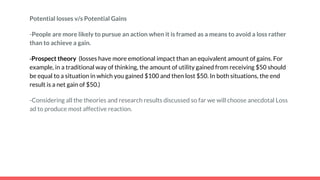
Potential losses v/s Potential Gains
-People are more likely to pursue an action when it is framed as a means to avoid a loss rather
than to achieve a gain.
-Prospect theory (losses have more emotional impact than an equivalent amount of gains. For
example, in a traditional way of thinking, the amount of utility gained from receiving $50 should
be equal to a situation in which you gained $100 and then lost $50. In both situations, the end
result is a net gain of $50.)
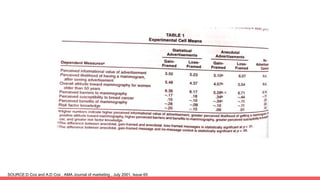
-Considering all the theories and research results discussed so far we will choose anecdotal Loss
ad to produce most affective reaction.
SOURCE:D Cox and A.D Cox , AMA Journal of marketing , July 2001, Issue 65
How would you trigger problem recognition for the early
detection of diseases among groups who have a relatively
(Q2) low risk for the disease?
(Q3) high risk for the disease?
Problem
recognition
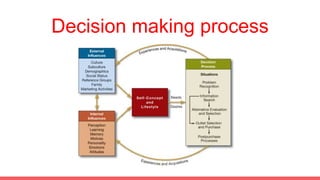
Decision making process
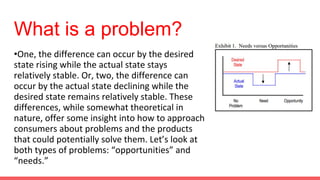
What is a problem?
•One, the difference can occur by the desired
state rising while the actual state stays
relatively stable. Or, two, the difference can
occur by the actual state declining while the
desired state remains relatively stable. These
differences, while somewhat theoretical in
nature, offer some insight into how to approach
consumers about problems and the products
that could potentially solve them. Let’s look at
both types of problems: “opportunities” and
“needs.”
4.Describe the decision process a typical individual would go
through in deciding to test for a disease.
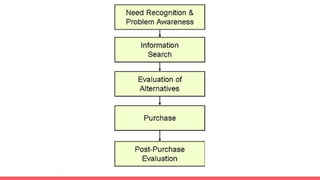
Problem or Need Recognition
- In general situations, the recognition of needs is likely to occur when a
consumer is faced with a problem.
- This role of the marketers in this case is to trigger the problem
recognition.
- Any sort of awareness campaign, statistics , anecdotal advertisements
that the consumer encounters act as a trigger thereby making the
consumer “recognize” the problem.
Information Search
- During this stage, a consumer who recognizes a specific problem or
need will then likely be persuaded to search for information, whether
Evaluation of Alternatives
- Evaluation of alternatives is the third stage in the Consumer Buying Decision process. During this stage,
consumers evaluate all of their options on a scale of attributes which have the ability to deliver the benefit
that the customer is seeking.
- Consumer Decision rules
Purchase
- The consumer undertakes the test
Post Purchase Behaviour
- How the customer feels about a purchase will significantly influence whether he will purchase the product
again or consider other products within the brand repertoire.
- Cognitive dissonance is when the customer experiences feelings of post-purchase psychological tension or
anxiety.
- Some companies like to engage their consumers with post-purchase communications in an effort to influence
their feelings about their purchase and future purchases.
5. What decision rule do consumers use in deciding
to test for a disease?
Consumer decision rules are the procedures used by consumers to
facilitate brand (or other consumption related) choices. These rules
reduce the burden of making complex decisions by providing
guidelines or routines that make the process less taxing.
Consumer Decision Rules
Consumer Decision Rules Types:
1. Compensatory rule- A type of decision rule in which a consumer evaluates
each brand in terms of each relevant attribute and then selects the brand with the
highest weighted score.
2. Non-compensatory rule- A type of consumer decision rule by which positive
evaluation of a brand attribute does not compensate for a negative evaluation of the
same brand on some other attribute.
● Conjunctive decision rule
● Disjunctive decision rule
● Lexicographic decision rule
When deciding whether to go for a test for a particular disease or not,
(HIV-AIDS, Breast Cancer, Ovary Cancer, etc) a person processes information
collected from different sources.
While deciding what test to choose from a consumer will follow compensatory
decision rule. According to compensatory decision rule a consumer determines a
brand in terms of each relevant attribute and computes a weighted or summated
score for each brand. The assumption is that consumer will select the brand that
scores the highest among the alternatives evaluated. Compensatory decision
allows a positive evaluation of a brand on one attribute to balance out a negative
evaluation on some other attribute.
6. What sources of information do consumers use in
deciding to test for a disease?
Sources of Information
Sources of information are people, things, places and experiences
you come across everyday in your life that provide you information
about anything you were not aware of partially or fully.
A consumer would look both internally and externally for his
information to help him make a decision.
INTERNAL search involves the consumer identifying alternatives from
his or her memory. This plays a very important role when deciding to go
for a test.
● Any experience consumer might have had in the past
● Education of the consumer
● Interaction with patients related to the consumer
EXTERNAL search is a process of seeking information from the
outside environment.
● Patients— interaction with people who suffered from same disease
● Friends/reference groups— consumers ask friends, family and
coworkers about their experiences with the test
● Doctors and medical staff
● Internet- youtube videos by people sharing their own experiences
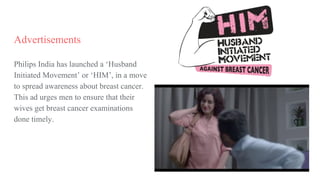
Advertisements
Philips India has launched a ‘Husband
Initiated Movement’ or ‘HIM’, in a move
to spread awareness about breast cancer.
This ad urges men to ensure that their
wives get breast cancer examinations
done timely.
Social media campaigns
Lavie on their social networks, the entire month of October have been sharing articles and
tips. They are encouraging their target audience, women to talk to their mothers about such
important causes and have created a special hashtag for it #talktoyourmom. On 31st
October they had arranged a Twitter chat with Dr. Sumeet Shah so he could solve certain
queries regarding this disease and enlighten the women.
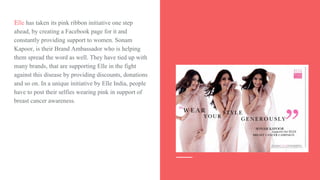
Elle has taken its pink ribbon initiative one step
ahead, by creating a Facebook page for it and
constantly providing support to women. Sonam
Kapoor, is their Brand Ambassador who is helping
them spread the word as well. They have tied up with
many brands, that are supporting Elle in the fight
against this disease by providing discounts, donations
and so on. In a unique initiative by Elle India, people
have to post their selfies wearing pink in support of
breast cancer awareness.
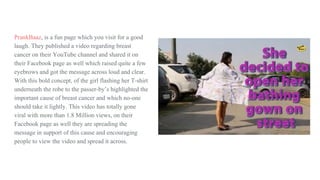
PrankBaaz, is a fun page which you visit for a good
laugh. They published a video regarding breast
cancer on their YouTube channel and shared it on
their Facebook page as well which raised quite a few
eyebrows and got the message across loud and clear.
With this bold concept, of the girl flashing her T-shirt
underneath the robe to the passer-by’s highlighted the
important cause of breast cancer and which no-one
should take it lightly. This video has totally gone
viral with more than 1.8 Million views, on their
Facebook page as well they are spreading the
message in support of this cause and encouraging
people to view the video and spread it across.
direction
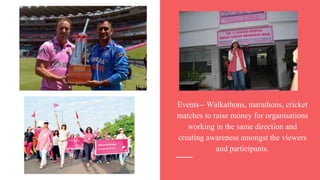
Events-- Walkathons, marathons, cricket
matches to raise money for organisations
working in the same direction and
creating awareness amongst the viewers
and participants.
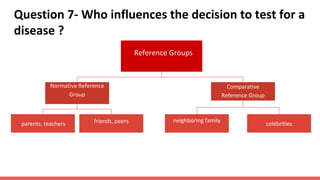
Question 7- Who influences the decision to test for a
disease ?
Reference Groups
Normative Reference
Group
Comparative
Reference Group
celebrities
neighboring familyfriends, peersparents, teachers
Develop a strategy to encourage people to test for a disease or
health risk factor of your choice?
What all should the Indian Market know about?
1. What exactly is breast cancer
2. What are it symptoms
3. What is screening and what is its importance?
How can the Indian market know about breast cancer?
AEPE
1. Awareness
2. Education
3. Promotion
4. Encouragement
AEPE
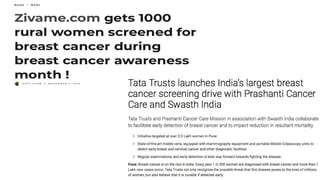
- Campaigns which includes a diverse set of individuals such as
corporate representatives, breast cancer survivors, volunteers,
doctors who can provide information to the consumers.
- government-sponsored schemes that spreads awareness about
self screening as well as timely checkups, which include
mammography and diet control, prove good safety mechanisms
for early detection crucial to curb the spread of the curable
disease, advice doctors.
AEPE1. Informal sessions at the office, college etc.
2. Materials provided at events/ conferences
3. Online ads in form of pop-ups
Promotion can be carried out by social media, television and radio interviews,
electronic and print media and word of mouth.
Example - The forum, supported by Hard Rock Cafe, is organizing a women’s car rally
from Delhi to Agra, to raise funds and generate awareness about breast cancer
prevention and its early detection.
Government advertisements also should talk about mammography techniques like
digital ones and should focus on disseminating ordinary ones.
AEPE
AEPE
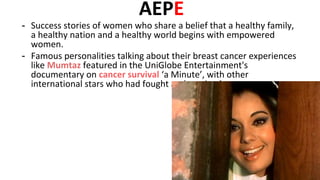
- Success stories of women who share a belief that a healthy family,
a healthy nation and a healthy world begins with empowered
women.
- Famous personalities talking about their breast cancer experiences
like Mumtaz featured in the UniGlobe Entertainment's
documentary on cancer survival ‘a Minute’, with other
international stars who had fought and survived cancer
Thank You

Consumer behavior- Case Study

  • 1.
  • 2.
    Which of thefour ads described above will work best? why? 1. Anecdotal evidence v/s Statistical evidence 2. Potential losses v/s Potential Gains
  • 3.
    - Anecdotal (alsocalled story, narrative, case,) evidence messages typically present the history or experience of a particular person or case, and usually focus on elaborating one compelling case that provides details that allow the message recipient to create a picture of the person and situation. The use of anecdotal evidence is believed to be effective because the reader can relate to the person in the story. - Statistical evidence messages (scientific) most often contain information regarding someone’s relative risk for a particular condition or negative consequence, or the likelihood of a protective effect if they follow the advice in the particular message. Typically, this includes information such as ‘‘the risk of getting this particular disease is eight times higher if someone does not perform a particular behavior,’’ or ‘‘75% of people who perform a particular behavior avoid getting a particular disease.’’ These messages generally focus on scientific facts about the likelihood of risk and how to protect oneself against the threat.
  • 4.
    -The superiority ofthe evidence type may depend on the topic, message quality, or individual characteristics. -Whether statistical or narrative evidence is more persuasive depends on whether the message is congruent with the person’s values. - If the message was value-congruent, statistical messages were more persuasive. -However, among those where the message was counter-attitudinal, anecdotes were superior. -In a research comparing statistical and anecdotal messages regarding organ donation , researchers found that statistical messages produced more cognitive reactions, although narrative messages led to greater affective reactions. SOURCE : Communication Quarterly Vol. 58, No. 2, April–June 2010, pp. 111–132 , Comparing Normative, Anecdotal, and Statistical Risk Evidence to Discourage Tanning Bed Use
  • 5.
    Potential losses v/sPotential Gains -People are more likely to pursue an action when it is framed as a means to avoid a loss rather than to achieve a gain. -Prospect theory (losses have more emotional impact than an equivalent amount of gains. For example, in a traditional way of thinking, the amount of utility gained from receiving $50 should be equal to a situation in which you gained $100 and then lost $50. In both situations, the end result is a net gain of $50.) -Considering all the theories and research results discussed so far we will choose anecdotal Loss ad to produce most affective reaction.
  • 6.
    SOURCE:D Cox andA.D Cox , AMA Journal of marketing , July 2001, Issue 65
  • 7.
    How would youtrigger problem recognition for the early detection of diseases among groups who have a relatively (Q2) low risk for the disease? (Q3) high risk for the disease?
  • 8.
  • 9.
  • 10.
    What is aproblem? •One, the difference can occur by the desired state rising while the actual state stays relatively stable. Or, two, the difference can occur by the actual state declining while the desired state remains relatively stable. These differences, while somewhat theoretical in nature, offer some insight into how to approach consumers about problems and the products that could potentially solve them. Let’s look at both types of problems: “opportunities” and “needs.”
  • 12.
    4.Describe the decisionprocess a typical individual would go through in deciding to test for a disease.
  • 15.
    Problem or NeedRecognition - In general situations, the recognition of needs is likely to occur when a consumer is faced with a problem. - This role of the marketers in this case is to trigger the problem recognition. - Any sort of awareness campaign, statistics , anecdotal advertisements that the consumer encounters act as a trigger thereby making the consumer “recognize” the problem. Information Search - During this stage, a consumer who recognizes a specific problem or need will then likely be persuaded to search for information, whether
  • 16.
    Evaluation of Alternatives -Evaluation of alternatives is the third stage in the Consumer Buying Decision process. During this stage, consumers evaluate all of their options on a scale of attributes which have the ability to deliver the benefit that the customer is seeking. - Consumer Decision rules Purchase - The consumer undertakes the test Post Purchase Behaviour - How the customer feels about a purchase will significantly influence whether he will purchase the product again or consider other products within the brand repertoire. - Cognitive dissonance is when the customer experiences feelings of post-purchase psychological tension or anxiety. - Some companies like to engage their consumers with post-purchase communications in an effort to influence their feelings about their purchase and future purchases.
  • 17.
    5. What decisionrule do consumers use in deciding to test for a disease?
  • 18.
    Consumer decision rulesare the procedures used by consumers to facilitate brand (or other consumption related) choices. These rules reduce the burden of making complex decisions by providing guidelines or routines that make the process less taxing. Consumer Decision Rules
  • 19.
    Consumer Decision RulesTypes: 1. Compensatory rule- A type of decision rule in which a consumer evaluates each brand in terms of each relevant attribute and then selects the brand with the highest weighted score. 2. Non-compensatory rule- A type of consumer decision rule by which positive evaluation of a brand attribute does not compensate for a negative evaluation of the same brand on some other attribute. ● Conjunctive decision rule ● Disjunctive decision rule ● Lexicographic decision rule
  • 20.
    When deciding whetherto go for a test for a particular disease or not, (HIV-AIDS, Breast Cancer, Ovary Cancer, etc) a person processes information collected from different sources. While deciding what test to choose from a consumer will follow compensatory decision rule. According to compensatory decision rule a consumer determines a brand in terms of each relevant attribute and computes a weighted or summated score for each brand. The assumption is that consumer will select the brand that scores the highest among the alternatives evaluated. Compensatory decision allows a positive evaluation of a brand on one attribute to balance out a negative evaluation on some other attribute.
  • 21.
    6. What sourcesof information do consumers use in deciding to test for a disease?
  • 22.
    Sources of Information Sourcesof information are people, things, places and experiences you come across everyday in your life that provide you information about anything you were not aware of partially or fully. A consumer would look both internally and externally for his information to help him make a decision.
  • 23.
    INTERNAL search involvesthe consumer identifying alternatives from his or her memory. This plays a very important role when deciding to go for a test. ● Any experience consumer might have had in the past ● Education of the consumer ● Interaction with patients related to the consumer
  • 24.
    EXTERNAL search isa process of seeking information from the outside environment. ● Patients— interaction with people who suffered from same disease ● Friends/reference groups— consumers ask friends, family and coworkers about their experiences with the test ● Doctors and medical staff ● Internet- youtube videos by people sharing their own experiences
  • 25.
    Advertisements Philips India haslaunched a ‘Husband Initiated Movement’ or ‘HIM’, in a move to spread awareness about breast cancer. This ad urges men to ensure that their wives get breast cancer examinations done timely.
  • 26.
    Social media campaigns Lavieon their social networks, the entire month of October have been sharing articles and tips. They are encouraging their target audience, women to talk to their mothers about such important causes and have created a special hashtag for it #talktoyourmom. On 31st October they had arranged a Twitter chat with Dr. Sumeet Shah so he could solve certain queries regarding this disease and enlighten the women.
  • 27.
    Elle has takenits pink ribbon initiative one step ahead, by creating a Facebook page for it and constantly providing support to women. Sonam Kapoor, is their Brand Ambassador who is helping them spread the word as well. They have tied up with many brands, that are supporting Elle in the fight against this disease by providing discounts, donations and so on. In a unique initiative by Elle India, people have to post their selfies wearing pink in support of breast cancer awareness.
  • 28.
    PrankBaaz, is afun page which you visit for a good laugh. They published a video regarding breast cancer on their YouTube channel and shared it on their Facebook page as well which raised quite a few eyebrows and got the message across loud and clear. With this bold concept, of the girl flashing her T-shirt underneath the robe to the passer-by’s highlighted the important cause of breast cancer and which no-one should take it lightly. This video has totally gone viral with more than 1.8 Million views, on their Facebook page as well they are spreading the message in support of this cause and encouraging people to view the video and spread it across.
  • 29.
    direction Events-- Walkathons, marathons,cricket matches to raise money for organisations working in the same direction and creating awareness amongst the viewers and participants.
  • 30.
    Question 7- Whoinfluences the decision to test for a disease ? Reference Groups Normative Reference Group Comparative Reference Group celebrities neighboring familyfriends, peersparents, teachers
  • 31.
    Develop a strategyto encourage people to test for a disease or health risk factor of your choice? What all should the Indian Market know about? 1. What exactly is breast cancer 2. What are it symptoms 3. What is screening and what is its importance? How can the Indian market know about breast cancer? AEPE 1. Awareness 2. Education 3. Promotion 4. Encouragement
  • 32.
    AEPE - Campaigns whichincludes a diverse set of individuals such as corporate representatives, breast cancer survivors, volunteers, doctors who can provide information to the consumers. - government-sponsored schemes that spreads awareness about self screening as well as timely checkups, which include mammography and diet control, prove good safety mechanisms for early detection crucial to curb the spread of the curable disease, advice doctors.
  • 34.
    AEPE1. Informal sessionsat the office, college etc. 2. Materials provided at events/ conferences 3. Online ads in form of pop-ups Promotion can be carried out by social media, television and radio interviews, electronic and print media and word of mouth. Example - The forum, supported by Hard Rock Cafe, is organizing a women’s car rally from Delhi to Agra, to raise funds and generate awareness about breast cancer prevention and its early detection. Government advertisements also should talk about mammography techniques like digital ones and should focus on disseminating ordinary ones. AEPE
  • 36.
    AEPE - Success storiesof women who share a belief that a healthy family, a healthy nation and a healthy world begins with empowered women. - Famous personalities talking about their breast cancer experiences like Mumtaz featured in the UniGlobe Entertainment's documentary on cancer survival ‘a Minute’, with other international stars who had fought and survived cancer
  • 37.