Consumer Rights
• Name- SOUMYA TAYADE
• Class :- X-DYANAMIC
• Roll No:-35
SUBJECT:- S.S.T
What a consumer (customer) Expects?
Focus
Trust
positive
Conviction
Loyalty
Commitment
Feeling
Experience
Introduction-
• The definition of Consumer
right is 'the right to have
information about the quality,
potency, quantity, purity, price
and standard of goods or
services', as it may be the case,
but the consumer is to be
protected against any unfair
practices of trade. It is very
essential for the consumers to
know these rights.
Consumer Rights
Consumer rights are a set of rights governed by the law that gives allows customers to have
the necessaryinformationabout goods and services while purchasing.Similarly,consumer
responsibilities indicate that customershavea specific responsibilitytowards the society
and other consumers and help them to fight against the unfair practice or at least be
aware of it. These rights and responsibilities are registered under the Consumer
Protection Act 1986.
Consumer Rights:-Right to Safety - Before buying,a consumer can insist on the qualityand
guarantee ofthe goods.Theyshould ideallypurchase a certified product like ISI or
AGMARK.Right to Choose-Consumer should havethe right to choose from a varietyof
goods and in a competitiveprice Right to be informed-The buyers should be informed
with all the necessarydetails of the product,make her/himact wise, and change the
buyingdecision.Right to Consumer Education-Consumer shouldbe aware of his/her
rights and avoid exploitation.Ignorance can cost them more.Right to be heard-This
means the consumer will get due attention to express their grievances at a suitable
forum.
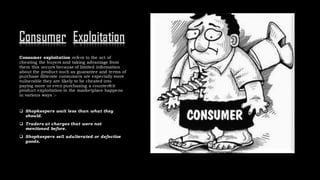
Consumer exploitation refers to the act of
cheating the buyers and taking advantage from
them this occurs because of limited information
about the product such as guarantee and terms of
purchase illiterate consumers are especially more
vulnerable they are likely to be cheated into
paying more or even purchasing a counterfeit
product exploitation in the marketplace happens
in various ways :-
❑ Shopkeepers wait less than what they
should.
❑ Traders at charges that were not
mentioned before.
❑ Shopkeepers sell adulterated or defective
goods.
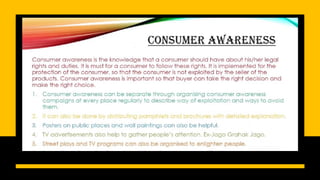
Jaago Grahak
Jaago
• Recognizing the importance of promoting
consumer awareness, Department of
Consumer Affairs (DoCA) has been
conducting country-wide multimedia
awareness campaigns titled "JagoGrahak
Jago". Through simple messages,
consumers are made aware of fraudulent
practices and problems and the mechanism
to seek redressal.
1. The Sales of Goods Act 1930 (protection against false products)
2. The Essential Commodities Act 1955 (control production, distribution of
essential items)
3. The Essential Commodities Act 1955 (control production, distribution of
essential items)
4. The Prevention of Food Adulteration Act 1954 (check adulteration and
ensures purity)
5. The Standard of Weights and Measurements Act 2976 (protection against
malpractices-underweight, undermeasure)
6. The Trade Mark Act 1999 (prevents use of fraudulent marks on products)
7. The Competition Act 2002 (healthy competition and protect consumers)
8. The Bureau of Indian Standard Act 1986 (provide special marks for quality
standards)
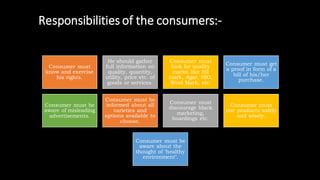
Responsibilities of the consumers:-
Consumer must
know and exercise
his rights.
He should gather
full information on
quality, quantity,
utility, price etc. of
goods or services.
Consumer must
look for quality
marks like ISI
mark, Agar, ISO,
Wool Mark, etc.
Consumer must get
a proof in form of a
bill of his/her
purchase.
Consumer must be
aware of misleading
advertisements.
Consumer must be
informed about all
varieties and
options available to
choose.
Consumer must
discourage black
marketing,
hoardings etc.
Consumer must
use products safely
and wisely.
Consumer must be
aware about the
thought of ‘healthy
environment’.
Consumer Rights

Consumer Rights

  • 1.
    Consumer Rights • Name-SOUMYA TAYADE • Class :- X-DYANAMIC • Roll No:-35 SUBJECT:- S.S.T
  • 2.
    What a consumer(customer) Expects? Focus Trust positive Conviction Loyalty Commitment Feeling Experience
  • 3.
    Introduction- • The definitionof Consumer right is 'the right to have information about the quality, potency, quantity, purity, price and standard of goods or services', as it may be the case, but the consumer is to be protected against any unfair practices of trade. It is very essential for the consumers to know these rights.
  • 4.
    Consumer Rights Consumer rightsare a set of rights governed by the law that gives allows customers to have the necessaryinformationabout goods and services while purchasing.Similarly,consumer responsibilities indicate that customershavea specific responsibilitytowards the society and other consumers and help them to fight against the unfair practice or at least be aware of it. These rights and responsibilities are registered under the Consumer Protection Act 1986. Consumer Rights:-Right to Safety - Before buying,a consumer can insist on the qualityand guarantee ofthe goods.Theyshould ideallypurchase a certified product like ISI or AGMARK.Right to Choose-Consumer should havethe right to choose from a varietyof goods and in a competitiveprice Right to be informed-The buyers should be informed with all the necessarydetails of the product,make her/himact wise, and change the buyingdecision.Right to Consumer Education-Consumer shouldbe aware of his/her rights and avoid exploitation.Ignorance can cost them more.Right to be heard-This means the consumer will get due attention to express their grievances at a suitable forum.
  • 5.
    Consumer exploitation refersto the act of cheating the buyers and taking advantage from them this occurs because of limited information about the product such as guarantee and terms of purchase illiterate consumers are especially more vulnerable they are likely to be cheated into paying more or even purchasing a counterfeit product exploitation in the marketplace happens in various ways :- ❑ Shopkeepers wait less than what they should. ❑ Traders at charges that were not mentioned before. ❑ Shopkeepers sell adulterated or defective goods.
  • 6.
    Jaago Grahak Jaago • Recognizingthe importance of promoting consumer awareness, Department of Consumer Affairs (DoCA) has been conducting country-wide multimedia awareness campaigns titled "JagoGrahak Jago". Through simple messages, consumers are made aware of fraudulent practices and problems and the mechanism to seek redressal.
  • 8.
    1. The Salesof Goods Act 1930 (protection against false products) 2. The Essential Commodities Act 1955 (control production, distribution of essential items) 3. The Essential Commodities Act 1955 (control production, distribution of essential items) 4. The Prevention of Food Adulteration Act 1954 (check adulteration and ensures purity) 5. The Standard of Weights and Measurements Act 2976 (protection against malpractices-underweight, undermeasure) 6. The Trade Mark Act 1999 (prevents use of fraudulent marks on products) 7. The Competition Act 2002 (healthy competition and protect consumers) 8. The Bureau of Indian Standard Act 1986 (provide special marks for quality standards)
  • 9.
    Responsibilities of theconsumers:- Consumer must know and exercise his rights. He should gather full information on quality, quantity, utility, price etc. of goods or services. Consumer must look for quality marks like ISI mark, Agar, ISO, Wool Mark, etc. Consumer must get a proof in form of a bill of his/her purchase. Consumer must be aware of misleading advertisements. Consumer must be informed about all varieties and options available to choose. Consumer must discourage black marketing, hoardings etc. Consumer must use products safely and wisely. Consumer must be aware about the thought of ‘healthy environment’.