Consumer Protection
CHAPTER 12
Syllabus
Concept the student/learner would be able to:
Concept and importance of
consumer protection
• Understand the concept of consumer protection.
• Describe the importance of consumer protection.
• Discuss the scope of Consumer Protection Act, 1986
Consumer Protection Act 1986:
Meaning of consumer Rights
and responsibilities of
consumers
Who can file a complaint?
Redressal machinery Remedies
available
• Understand the concept of a consumer according to the
Consumer protection Act 1986.
• Explain the consumer rights Understand the
responsibilities of consumers
• Understand who can file a complaint and against whom?
• Discuss the legal redressal machinery under Consumer
• protection Act 1986.
• Examine the remedies available to the consumer under
Consumer protection Act 1986.
Consumer awareness - Role of
consumer organizations and
Non-Governmental
Organizations (NGOs)
• Describe the role of consumer organizations and NGOs
in protecting consumers’ interests.
Introduction
• Consumer is said to be the king in a free market economy. The earlier
approach of “Caveat emptor” (let the buyer beware) has been changed to
“Caveat venditor” (let the seller beware).
• With the growing competition and to push up the sales, businessmen
indulge in exploitative and unfair trade practices which include supply of
defective and unsafe products, adulteration, false and misleading
advertising, hoarding, black marketing etc., so there arises the need for
providing protection to consumers.
Consumer - Definition
Consumer - A ‘consumer’ is generally understood as a person who uses or consumes
goods or avails of any service.
Under the Consumer Protection Act, a consumer is defined as:
● Any person who buys any goods for a consideration,
● Any person who hires or avails of any service, for a consideration.
Importance of Consumer Protection
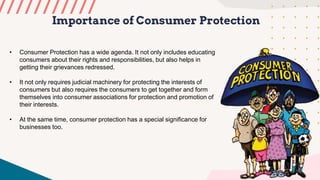
• Consumer Protection has a wide agenda. It not only includes educating
consumers about their rights and responsibilities, but also helps in
getting their grievances redressed.
• It not only requires judicial machinery for protecting the interests of
consumers but also requires the consumers to get together and form
themselves into consumer associations for protection and promotion of
their interests.
• At the same time, consumer protection has a special significance for
businesses too.
From Consumers’ point of view
A. Consumer Ignorance: consumers are ignorant about their rights and reliefs
available to them; it becomes necessary to educate them to achieve consumer
awareness.
B. Unorganized Consumers: Consumers need to be organized in the form of
consumer organizations which would take care of their interests.
C. Widespread Exploitation of Consumers: Consumers need protection
against Unscrupulous, exploitative and unfair trade practices like defective
and unsafe products, adulteration, false and misleading advertising,
hoarding, black marketing etc.
From the point of view of Business
1. Long-term Interest of Business: Enlightened businesses realize that satisfied customers
lead to repeat sales and provide good feedback to prospective customers. Thus, business
firms
2. Business uses Society’s Resources: They, thus, have a responsibility to supply such
products and render such services which are in public interest and would not impair public
confidence in them.
3. Social Responsibility: Business organizations make money by selling
goods and providing services to consumers. Thus, consumers form an
important group among the many stakeholders of business and like
other stakeholders; their interest has to be well taken care of.
From the point of view of Business
4. Moral Justification: It is the moral duty of any business to take care of consumer’s interest
and avoid any form of their exploitation. Thus, a business must avoid unscrupulous,
exploitative and unfair trade practices.
5. Government Intervention: A business engaging in any form of exploitative trade practices
would invite government intervention or action. This can impair and tarnish the image of the
company.
Legal Protection to Consumers
• The Indian legal framework consists of a number of regulations which
provide protection to consumers.
• As per the Right to Information Act 2005, Section 4, all relevant
information is required to be made available to all citizens of the country.
• Other regulations are as under.
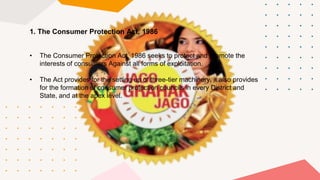
• The Consumer Protection Act, 1986 seeks to protect and promote the
interests of consumers Against all forms of exploitation.
• The Act provides for the setting up of three-tier machinery, it also provides
for the formation of consumer protection councils in every District and
State, and at the apex level.
1. The Consumer Protection Act, 1986
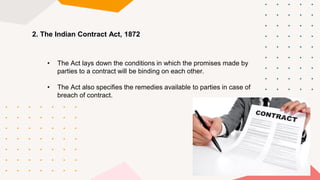
• The Act lays down the conditions in which the promises made by
parties to a contract will be binding on each other.
• The Act also specifies the remedies available to parties in case of
breach of contract.
2. The Indian Contract Act, 1872
• The Act provides some safe guards and reliefs to the buyers of the
goods in case the goods purchased do not comply with express or
implied conditions or warranties.
3. The Sale of Goods Act, 1930
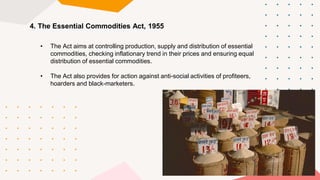
• The Act aims at controlling production, supply and distribution of essential
commodities, checking inflationary trend in their prices and ensuring equal
distribution of essential commodities.
• The Act also provides for action against anti-social activities of profiteers,
hoarders and black-marketers.
4. The Essential Commodities Act, 1955
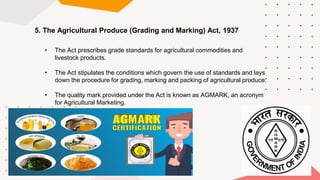
• The Act prescribes grade standards for agricultural commodities and
livestock products.
• The Act stipulates the conditions which govern the use of standards and lays
down the procedure for grading, marking and packing of agricultural produce.
• The quality mark provided under the Act is known as AGMARK, an acronym
for Agricultural Marketing.
5. The Agricultural Produce (Grading and Marking) Act, 1937
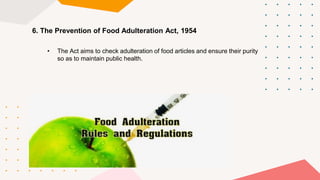
• The Act aims to check adulteration of food articles and ensure their purity
so as to maintain public health.
6. The Prevention of Food Adulteration Act, 1954
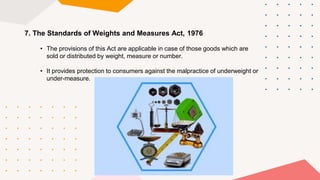
7. The Standards of Weights and Measures Act, 1976
• The provisions of this Act are applicable in case of those goods which are
sold or distributed by weight, measure or number.
• It provides protection to consumers against the malpractice of underweight or
under-measure.
8. The Trade Marks Act, 1999
• This Act has repealed and replaced the Trade and Merchandise Marks Act, 1958.
• The Act prevents the use of fraudulent marks on products and thus, provides
protection to the consumers against such products.
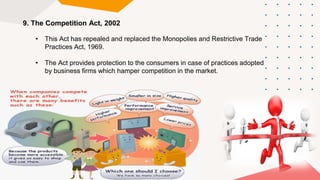
9. The Competition Act, 2002
• This Act has repealed and replaced the Monopolies and Restrictive Trade
Practices Act, 1969.
• The Act provides protection to the consumers in case of practices adopted
by business firms which hamper competition in the market.
10. The Bureau of Indian Standards Act, 1986
• The Bureau of Indian Standards has been set up under the Act. The Bureau has two
major activities:
A. formulation of quality standards for goods
B. Their certification through the BIS certification scheme.
The Consumer Protection Act, 1986
• The Consumer Protection Act (CPA) seeks to protect and promote the
consumers’ interest through speedy and inexpensive redressal of their
grievances.
• The scope of the Act is very wide. It is applicable to all types of undertakings;
• The Act confers certain rights to consumers with a view to empowering them and
to protect their interests.

The Consumer Protection Act provides for six rights of consumers. The
consumer protection councils set up under the Act are intended to promote and
protect the various rights of consumers.
1. Right to Safety:
 The consumer has a right to be protected against goods and services which
are hazardous to life and health.
 For instance, electrical appliances which are manufactured with
substandard products or do not conform to the safety norms might cause
serious injury.
 Thus, consumers are educated that they should use electrical appliances
which are ISI marked as this would be an assurance of such products
meeting quality specifications.
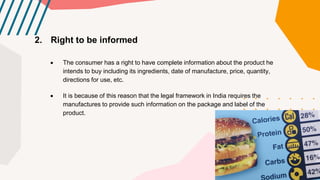
2. Right to be informed
 The consumer has a right to have complete information about the product he
intends to buy including its ingredients, date of manufacture, price, quantity,
directions for use, etc.
 It is because of this reason that the legal framework in India requires the
manufactures to provide such information on the package and label of the
product.
3. Right to Choose:
 The consumer has the freedom to choose from a variety of products at
competitive prices.
 This implies that the marketers should offer a wide variety of products in
terms of quality, brand, prices, size, etc. and allow the consumer to make a
choice from amongst these.
4. Right to be heard:
 The consumer has a right to file a complaint and to be heard in case of
dissatisfaction with a good or a service.
 It is because of this reason that many enlightened business firms have set up
their own consumer service and grievance cells.
 Many consumer organizations are also working towards this direction and
helping consumers in redressal of their grievances.
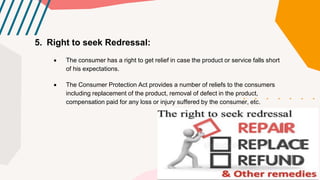
5. Right to seek Redressal:
 The consumer has a right to get relief in case the product or service falls short
of his expectations.
 The Consumer Protection Act provides a number of reliefs to the consumers
including replacement of the product, removal of defect in the product,
compensation paid for any loss or injury suffered by the consumer, etc.
6. Right to Consumer Education
 The consumer has a right to acquire knowledge and to be a well-informed
consumer throughout life.
 He should be aware about his rights and the reliefs available to him in case
of a product or service falling short of his expectations.
 Many consumer organizations and some enlightened businesses are
taking an active part in educating consumers in this respect.
Consumer Responsibilities
• Consumer rights, by themselves, cannot be effective in achieving the objective
of consumer protection.
• Consumer protection can, in effect, be achieved only when the consumers also
understand their responsibilities.
• A consumer should keep in mind the following responsibilities while
purchasing, using and consuming goods and services.
Awareness
Be aware about various
goods and services available
in the market so that an
intelligent and wise choice
can be made.
The consumer must be
quality conscious
Buy only standardized goods as
they provide quality assurance.
Thus, look for ISI mark on
electrical goods
Understand the risks
Learn about the risks
associated with products
and services, follow
manufacturer’s instructions
and use the products safely.
Cautious consumer
Read labels carefully so as to
have information about
prices, net weight,
manufacturing and expiry
dates, etc.
Assert yourself
to ensure that
you get a fair
deal
Be honest
Be honest in your dealings.
Choose only from legal
goods and services and
discourage unscrupulous
practices like black-
marketing, hoarding etc.
Insist on cash
memo
Ask for a cash memo on
purchase of goods or
services. This would serve as
a proof of the purchase made
File complaints
file a complaint in an
appropriate consumer
forum in case of a short
coming in the quality of
goods purchased or
services availed.
Educate consumers
Form consumer societies
which would play an active
part in educating consumers
and safeguarding their
interests.

Filing complaints for
redressal of genuine
grievances
Sometimes, consumers ignore
the deception (dishonesty) of
traders believing that the loss
is small. This attitude
encourages corrupt business
practices to continue.
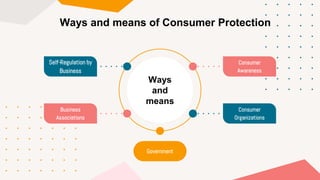
Ways and means of Consumer Protection
Ways
and
means
Consumer
Awareness
Consumer
Organizations
Self-Regulation by
Business
Business
Associations
Government
Self-Regulation by Business
• Enlightened business firms realize that it is in their long-term interest to
serve the customers well. Socially responsible firms follow ethical
standards and practices in dealing with their customers.
• Many firms have set up their customer service and grievance cells to
redress the problems and grievances of their consumers.
Business Associations
• The associations of trade, commerce and business like Federation of
Indian Chambers of Commerce of India (FICCI) and Confederation of
Indian Industries (CII) have laid down their code of conduct which lay
down for their members the guidelines in their dealings with the
customers.
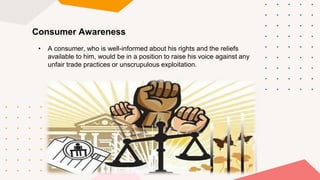
Consumer Awareness
• A consumer, who is well-informed about his rights and the reliefs
available to him, would be in a position to raise his voice against any
unfair trade practices or unscrupulous exploitation.
Consumer Organizations
• Consumer organizations play an important role in educating consumers
about their rights and providing protection to them.
• They can force business firms to avoid malpractices and exploitation of
consumers.
Government
• The government can protect the interests of the consumers by
enacting various measures.
• The legal framework in India encompasses various legislations
which provide protection to consumers.
Who can file a complaint?
 Any consumer can file a complaint and does not need the services of
advocate/professionals
 Any registered consumer association
 The Central Government
 The State Government;
 One or more consumers, on behalf of numerous consumers having the same
interest
 A legal heir or representative of a deceased consumer
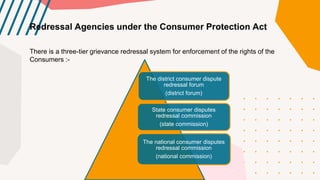
Redressal Agencies under the Consumer Protection Act
There is a three-tier grievance redressal system for enforcement of the rights of the
Consumers :-
The district consumer dispute
redressal forum
(district forum)
State consumer disputes
redressal commission
(state commission)
The national consumer disputes
redressal commission
(national commission)
District Forum
 There are 644 district commissions in India.
 The District Forum consists of a President and two other members, one of whom
should be a woman. They all are appointed by the State Government concerned.
 A complaint can to be made when the value of the goods or services in question,
along with the compensation claimed, does not exceed Rs. 20 lakhs.
District Forum
 On receiving the complaint, the District Forum shall refer the complaint to the party
against whom the complaint is filed.
 If required, the goods or a sample there of, shall be sent for testing in a laboratory. The
District Forum shall pass an order after considering the test report from the laboratory and
hearing to the party against whom the complaint is filed.
 In case the aggrieved party is not satisfied with the order of the District Forum, he can
appeal before the State Commission within 30 days of the passing of the order.
State Commission
 There are 365 State Commission of India.
 Each State Commission consists of a President and not less than two other members, one of whom
should be a woman. They are appointed by the State Government concerned.
 A complaint can to be made when the value of the goods or services in question, along with the
compensation claimed, exceeds Rs. 20 lakhs but does not exceed Rs. 1 crore.
 The appeals against the orders of a District Forum can also be filed before the State Commission.
State Commission
 On receiving the complaint, the State Commission shall refer the complaint to the party
against whom the complaint is filed.
 If required, the goods or a sample there of, shall be sent for testing in a laboratory. The
State Commission shall pass an order after considering the test report from the laboratory
and hearing to the party against whom the complaint is filed.
 In case the aggrieved party is not satisfied with the order of the State Commission, he can
appeal before the National Commission within 30 days of the passing of the order.
National Commission
 The National Commission has territorial jurisdiction over the whole country, except the
state of Jammu and Kashmir.
 The National Commission consists of a President and at least four other members, one
of whom should be a woman. They are appointed by the Central Government.
 A complaint can to be made to the National Commission when the value of the goods or
services in question, along with the compensation claimed, exceeds Rs. 1 crore.
National Commission
 The appeals against the orders of a State Commission can also be filed before the National
Commission.
 On receiving the complaint, the National Commission shall refer the complaint to the party
against whom the complaint is filed.
 If required, the goods or a sample there of, shall be sent for testing in a laboratory. The National
Commission shall pass an order after considering the test report from the laboratory and hearing
to the party against whom the complaint is filed.
 An order passed by the National Commission in a matter of its original jurisdiction is appealable
before the Supreme Court.
Relief Available
If the consumer court is satisfied about the genuineness of the complaint, it can issue one or more of
the following directions to the opposite party.
 To remove the defect in goods or deficiency in service.
 To replace the defective product with a new one, free from any defect.
 To refund the price paid for the product, or the charges paid for the service.
 To pay a reasonable amount of compensation for any loss or injury suffered by the consumer
due to the negligence of the opposite party.
 To pay punitive damages inappropriate circumstances.
 To discontinue the unfair/restrictive trade practice and not to repeat it in the future.
 Not to offer hazardous goods for sale.
 To withdraw the hazardous goods from sale.
 To cease manufacture of hazardous goods and to desist from offering hazardous
services.
 To pay any amount
 To issue corrective advertisement to neutralize the effect of a misleading
advertisement.
 To pay adequate costs to the appropriate party.
Role of Consumer Organizations and NGOs
In India, several consumer organizations and non-governmental
organizations (NGOs) have been setup for the protection and promotion
of consumers’ interests. Non-governmental organizations are non-profit

organizations which aim at promoting the welfare of people.
They have a constitution of their own and are free from government
interference. Consumer organizations and NGOs perform several
functions for the protection and promotion of interest of consumers.
These include:
 Educating the general public about consumer rights by organizing training programme,
seminars and workshops.
 Publishing periodicals and other publications to impart knowledge about consumer
problems, legal reporting, reliefs available and other matters of interest
 Carrying out comparative testing of consumer products in accredited laboratories to test
relative qualities of competing brands and publishing the test results for the benefit of
consumers.
 Encouraging consumers to strongly protest and take an action against unscrupulous,
exploitative and unfair trade practices of sellers.
 Providing legal assistance to consumers by way of providing aid, legal advice etc. in
seeking legal remedy.
 Filing complaints in appropriate consumer courts on behalf of the consumers.
 Taking an initiative in filing cases in consumer courts in the interest of the general public,
not for any individual.
Some of the important consumer organizations
and NGOs are:-
• Consumer Coordination Council, Delhi
• Common Cause, Delhi
• Voluntary Organization in Interest of Consumer Education (VOICE),Delhi
• Consumer education and research Centre ( CERC ) ,Ahmedabad
• Consumer Protection Council(CPC), Ahmedabad
• Consumer Guidance Society of India (CGSI), Mumbai
• Mumbai Grahak Panchayat, Mumbai
• Karnataka Consumer Service Society, Bangalore
• Consumers’ Association, Kolkata
• Consumer Unity and Trust Society (CUTS), Jaipur
THANKS !
©KAVITA JAIN 2020

CONSUMER PROTECTION.pdfdvfggfgfgffgfgfgf

  • 1.
  • 3.
    Syllabus Concept the student/learnerwould be able to: Concept and importance of consumer protection • Understand the concept of consumer protection. • Describe the importance of consumer protection. • Discuss the scope of Consumer Protection Act, 1986 Consumer Protection Act 1986: Meaning of consumer Rights and responsibilities of consumers Who can file a complaint? Redressal machinery Remedies available • Understand the concept of a consumer according to the Consumer protection Act 1986. • Explain the consumer rights Understand the responsibilities of consumers • Understand who can file a complaint and against whom? • Discuss the legal redressal machinery under Consumer • protection Act 1986. • Examine the remedies available to the consumer under Consumer protection Act 1986. Consumer awareness - Role of consumer organizations and Non-Governmental Organizations (NGOs) • Describe the role of consumer organizations and NGOs in protecting consumers’ interests.

  • 4.
    Introduction • Consumer issaid to be the king in a free market economy. The earlier approach of “Caveat emptor” (let the buyer beware) has been changed to “Caveat venditor” (let the seller beware). • With the growing competition and to push up the sales, businessmen indulge in exploitative and unfair trade practices which include supply of defective and unsafe products, adulteration, false and misleading advertising, hoarding, black marketing etc., so there arises the need for providing protection to consumers.
  • 5.
    Consumer - Definition Consumer- A ‘consumer’ is generally understood as a person who uses or consumes goods or avails of any service. Under the Consumer Protection Act, a consumer is defined as: ● Any person who buys any goods for a consideration, ● Any person who hires or avails of any service, for a consideration.
  • 6.
    Importance of ConsumerProtection • Consumer Protection has a wide agenda. It not only includes educating consumers about their rights and responsibilities, but also helps in getting their grievances redressed. • It not only requires judicial machinery for protecting the interests of consumers but also requires the consumers to get together and form themselves into consumer associations for protection and promotion of their interests. • At the same time, consumer protection has a special significance for businesses too.

  • 7.
    From Consumers’ pointof view A. Consumer Ignorance: consumers are ignorant about their rights and reliefs available to them; it becomes necessary to educate them to achieve consumer awareness. B. Unorganized Consumers: Consumers need to be organized in the form of consumer organizations which would take care of their interests. C. Widespread Exploitation of Consumers: Consumers need protection against Unscrupulous, exploitative and unfair trade practices like defective and unsafe products, adulteration, false and misleading advertising, hoarding, black marketing etc.
  • 8.
    From the pointof view of Business 1. Long-term Interest of Business: Enlightened businesses realize that satisfied customers lead to repeat sales and provide good feedback to prospective customers. Thus, business firms 2. Business uses Society’s Resources: They, thus, have a responsibility to supply such products and render such services which are in public interest and would not impair public confidence in them. 3. Social Responsibility: Business organizations make money by selling goods and providing services to consumers. Thus, consumers form an important group among the many stakeholders of business and like other stakeholders; their interest has to be well taken care of.
  • 9.
    From the pointof view of Business 4. Moral Justification: It is the moral duty of any business to take care of consumer’s interest and avoid any form of their exploitation. Thus, a business must avoid unscrupulous, exploitative and unfair trade practices. 5. Government Intervention: A business engaging in any form of exploitative trade practices would invite government intervention or action. This can impair and tarnish the image of the company.
  • 10.
    Legal Protection toConsumers • The Indian legal framework consists of a number of regulations which provide protection to consumers. • As per the Right to Information Act 2005, Section 4, all relevant information is required to be made available to all citizens of the country. • Other regulations are as under.
  • 11.
    • The ConsumerProtection Act, 1986 seeks to protect and promote the interests of consumers Against all forms of exploitation. • The Act provides for the setting up of three-tier machinery, it also provides for the formation of consumer protection councils in every District and State, and at the apex level. 1. The Consumer Protection Act, 1986
  • 12.
    • The Actlays down the conditions in which the promises made by parties to a contract will be binding on each other. • The Act also specifies the remedies available to parties in case of breach of contract. 2. The Indian Contract Act, 1872
  • 13.
    • The Actprovides some safe guards and reliefs to the buyers of the goods in case the goods purchased do not comply with express or implied conditions or warranties. 3. The Sale of Goods Act, 1930
  • 14.
    • The Actaims at controlling production, supply and distribution of essential commodities, checking inflationary trend in their prices and ensuring equal distribution of essential commodities. • The Act also provides for action against anti-social activities of profiteers, hoarders and black-marketers. 4. The Essential Commodities Act, 1955
  • 15.
    • The Actprescribes grade standards for agricultural commodities and livestock products. • The Act stipulates the conditions which govern the use of standards and lays down the procedure for grading, marking and packing of agricultural produce. • The quality mark provided under the Act is known as AGMARK, an acronym for Agricultural Marketing. 5. The Agricultural Produce (Grading and Marking) Act, 1937
  • 16.
    • The Actaims to check adulteration of food articles and ensure their purity so as to maintain public health. 6. The Prevention of Food Adulteration Act, 1954
  • 17.
    7. The Standardsof Weights and Measures Act, 1976 • The provisions of this Act are applicable in case of those goods which are sold or distributed by weight, measure or number. • It provides protection to consumers against the malpractice of underweight or under-measure.
  • 18.
    8. The TradeMarks Act, 1999 • This Act has repealed and replaced the Trade and Merchandise Marks Act, 1958. • The Act prevents the use of fraudulent marks on products and thus, provides protection to the consumers against such products.
  • 19.
    9. The CompetitionAct, 2002 • This Act has repealed and replaced the Monopolies and Restrictive Trade Practices Act, 1969. • The Act provides protection to the consumers in case of practices adopted by business firms which hamper competition in the market.
  • 20.
    10. The Bureauof Indian Standards Act, 1986 • The Bureau of Indian Standards has been set up under the Act. The Bureau has two major activities: A. formulation of quality standards for goods B. Their certification through the BIS certification scheme.
  • 22.
    The Consumer ProtectionAct, 1986 • The Consumer Protection Act (CPA) seeks to protect and promote the consumers’ interest through speedy and inexpensive redressal of their grievances. • The scope of the Act is very wide. It is applicable to all types of undertakings; • The Act confers certain rights to consumers with a view to empowering them and to protect their interests.
  • 23.
    The Consumer ProtectionAct provides for six rights of consumers. The consumer protection councils set up under the Act are intended to promote and protect the various rights of consumers.
  • 24.
    1. Right toSafety:  The consumer has a right to be protected against goods and services which are hazardous to life and health.  For instance, electrical appliances which are manufactured with substandard products or do not conform to the safety norms might cause serious injury.  Thus, consumers are educated that they should use electrical appliances which are ISI marked as this would be an assurance of such products meeting quality specifications.
  • 25.
    2. Right tobe informed  The consumer has a right to have complete information about the product he intends to buy including its ingredients, date of manufacture, price, quantity, directions for use, etc.  It is because of this reason that the legal framework in India requires the manufactures to provide such information on the package and label of the product.
  • 26.
    3. Right toChoose:  The consumer has the freedom to choose from a variety of products at competitive prices.  This implies that the marketers should offer a wide variety of products in terms of quality, brand, prices, size, etc. and allow the consumer to make a choice from amongst these.
  • 27.
    4. Right tobe heard:  The consumer has a right to file a complaint and to be heard in case of dissatisfaction with a good or a service.  It is because of this reason that many enlightened business firms have set up their own consumer service and grievance cells.  Many consumer organizations are also working towards this direction and helping consumers in redressal of their grievances.
  • 28.
    5. Right toseek Redressal:  The consumer has a right to get relief in case the product or service falls short of his expectations.  The Consumer Protection Act provides a number of reliefs to the consumers including replacement of the product, removal of defect in the product, compensation paid for any loss or injury suffered by the consumer, etc.
  • 29.
    6. Right toConsumer Education  The consumer has a right to acquire knowledge and to be a well-informed consumer throughout life.  He should be aware about his rights and the reliefs available to him in case of a product or service falling short of his expectations.  Many consumer organizations and some enlightened businesses are taking an active part in educating consumers in this respect.
  • 30.
    Consumer Responsibilities • Consumerrights, by themselves, cannot be effective in achieving the objective of consumer protection. • Consumer protection can, in effect, be achieved only when the consumers also understand their responsibilities. • A consumer should keep in mind the following responsibilities while purchasing, using and consuming goods and services.
  • 31.
    Awareness Be aware aboutvarious goods and services available in the market so that an intelligent and wise choice can be made. The consumer must be quality conscious Buy only standardized goods as they provide quality assurance. Thus, look for ISI mark on electrical goods
  • 32.
    Understand the risks Learnabout the risks associated with products and services, follow manufacturer’s instructions and use the products safely. Cautious consumer Read labels carefully so as to have information about prices, net weight, manufacturing and expiry dates, etc.
  • 33.
    Assert yourself to ensurethat you get a fair deal Be honest Be honest in your dealings. Choose only from legal goods and services and discourage unscrupulous practices like black- marketing, hoarding etc.
  • 34.
    Insist on cash memo Askfor a cash memo on purchase of goods or services. This would serve as a proof of the purchase made File complaints file a complaint in an appropriate consumer forum in case of a short coming in the quality of goods purchased or services availed.
  • 35.
    Educate consumers Form consumersocieties which would play an active part in educating consumers and safeguarding their interests. Filing complaints for redressal of genuine grievances Sometimes, consumers ignore the deception (dishonesty) of traders believing that the loss is small. This attitude encourages corrupt business practices to continue.
  • 36.
    Ways and meansof Consumer Protection Ways and means Consumer Awareness Consumer Organizations Self-Regulation by Business Business Associations Government
  • 37.
    Self-Regulation by Business •Enlightened business firms realize that it is in their long-term interest to serve the customers well. Socially responsible firms follow ethical standards and practices in dealing with their customers. • Many firms have set up their customer service and grievance cells to redress the problems and grievances of their consumers.
  • 38.
    Business Associations • Theassociations of trade, commerce and business like Federation of Indian Chambers of Commerce of India (FICCI) and Confederation of Indian Industries (CII) have laid down their code of conduct which lay down for their members the guidelines in their dealings with the customers.
  • 39.
    Consumer Awareness • Aconsumer, who is well-informed about his rights and the reliefs available to him, would be in a position to raise his voice against any unfair trade practices or unscrupulous exploitation.
  • 40.
    Consumer Organizations • Consumerorganizations play an important role in educating consumers about their rights and providing protection to them. • They can force business firms to avoid malpractices and exploitation of consumers.
  • 41.
    Government • The governmentcan protect the interests of the consumers by enacting various measures. • The legal framework in India encompasses various legislations which provide protection to consumers.
  • 42.
    Who can filea complaint?  Any consumer can file a complaint and does not need the services of advocate/professionals  Any registered consumer association  The Central Government  The State Government;  One or more consumers, on behalf of numerous consumers having the same interest  A legal heir or representative of a deceased consumer
  • 43.
    Redressal Agencies underthe Consumer Protection Act There is a three-tier grievance redressal system for enforcement of the rights of the Consumers :- The district consumer dispute redressal forum (district forum) State consumer disputes redressal commission (state commission) The national consumer disputes redressal commission (national commission)
  • 44.
    District Forum  Thereare 644 district commissions in India.  The District Forum consists of a President and two other members, one of whom should be a woman. They all are appointed by the State Government concerned.  A complaint can to be made when the value of the goods or services in question, along with the compensation claimed, does not exceed Rs. 20 lakhs.
  • 45.
    District Forum  Onreceiving the complaint, the District Forum shall refer the complaint to the party against whom the complaint is filed.  If required, the goods or a sample there of, shall be sent for testing in a laboratory. The District Forum shall pass an order after considering the test report from the laboratory and hearing to the party against whom the complaint is filed.  In case the aggrieved party is not satisfied with the order of the District Forum, he can appeal before the State Commission within 30 days of the passing of the order.
  • 46.
    State Commission  Thereare 365 State Commission of India.  Each State Commission consists of a President and not less than two other members, one of whom should be a woman. They are appointed by the State Government concerned.  A complaint can to be made when the value of the goods or services in question, along with the compensation claimed, exceeds Rs. 20 lakhs but does not exceed Rs. 1 crore.  The appeals against the orders of a District Forum can also be filed before the State Commission.
  • 47.
    State Commission  Onreceiving the complaint, the State Commission shall refer the complaint to the party against whom the complaint is filed.  If required, the goods or a sample there of, shall be sent for testing in a laboratory. The State Commission shall pass an order after considering the test report from the laboratory and hearing to the party against whom the complaint is filed.  In case the aggrieved party is not satisfied with the order of the State Commission, he can appeal before the National Commission within 30 days of the passing of the order.
  • 48.
    National Commission  TheNational Commission has territorial jurisdiction over the whole country, except the state of Jammu and Kashmir.  The National Commission consists of a President and at least four other members, one of whom should be a woman. They are appointed by the Central Government.  A complaint can to be made to the National Commission when the value of the goods or services in question, along with the compensation claimed, exceeds Rs. 1 crore.
  • 49.
    National Commission  Theappeals against the orders of a State Commission can also be filed before the National Commission.  On receiving the complaint, the National Commission shall refer the complaint to the party against whom the complaint is filed.  If required, the goods or a sample there of, shall be sent for testing in a laboratory. The National Commission shall pass an order after considering the test report from the laboratory and hearing to the party against whom the complaint is filed.  An order passed by the National Commission in a matter of its original jurisdiction is appealable before the Supreme Court.
  • 50.
    Relief Available If theconsumer court is satisfied about the genuineness of the complaint, it can issue one or more of the following directions to the opposite party.  To remove the defect in goods or deficiency in service.  To replace the defective product with a new one, free from any defect.  To refund the price paid for the product, or the charges paid for the service.  To pay a reasonable amount of compensation for any loss or injury suffered by the consumer due to the negligence of the opposite party.  To pay punitive damages inappropriate circumstances.  To discontinue the unfair/restrictive trade practice and not to repeat it in the future.
  • 51.
     Not tooffer hazardous goods for sale.  To withdraw the hazardous goods from sale.  To cease manufacture of hazardous goods and to desist from offering hazardous services.  To pay any amount  To issue corrective advertisement to neutralize the effect of a misleading advertisement.  To pay adequate costs to the appropriate party.
  • 52.
    Role of ConsumerOrganizations and NGOs In India, several consumer organizations and non-governmental organizations (NGOs) have been setup for the protection and promotion of consumers’ interests. Non-governmental organizations are non-profit organizations which aim at promoting the welfare of people. They have a constitution of their own and are free from government interference. Consumer organizations and NGOs perform several functions for the protection and promotion of interest of consumers. These include:
  • 53.
     Educating thegeneral public about consumer rights by organizing training programme, seminars and workshops.  Publishing periodicals and other publications to impart knowledge about consumer problems, legal reporting, reliefs available and other matters of interest  Carrying out comparative testing of consumer products in accredited laboratories to test relative qualities of competing brands and publishing the test results for the benefit of consumers.  Encouraging consumers to strongly protest and take an action against unscrupulous, exploitative and unfair trade practices of sellers.  Providing legal assistance to consumers by way of providing aid, legal advice etc. in seeking legal remedy.  Filing complaints in appropriate consumer courts on behalf of the consumers.  Taking an initiative in filing cases in consumer courts in the interest of the general public, not for any individual.
  • 54.
    Some of theimportant consumer organizations and NGOs are:- • Consumer Coordination Council, Delhi • Common Cause, Delhi • Voluntary Organization in Interest of Consumer Education (VOICE),Delhi • Consumer education and research Centre ( CERC ) ,Ahmedabad • Consumer Protection Council(CPC), Ahmedabad • Consumer Guidance Society of India (CGSI), Mumbai • Mumbai Grahak Panchayat, Mumbai • Karnataka Consumer Service Society, Bangalore • Consumers’ Association, Kolkata • Consumer Unity and Trust Society (CUTS), Jaipur
  • 55.