
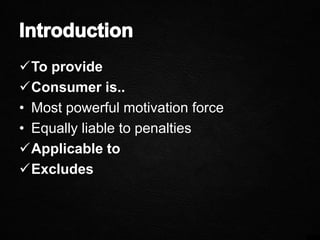






To provide
Consumer is..
• Most powerful motivation force
• Equally liable to penalties
Applicable to
Excludes
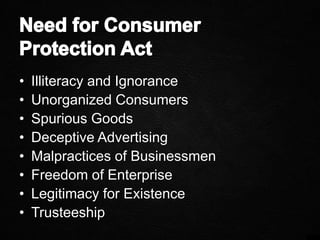
• Illiteracy and Ignorance
• Unorganized Consumers
• Spurious Goods
• Deceptive Advertising
• Malpractices of Businessmen
• Freedom of Enterprise
• Legitimacy for Existence
• Trusteeship
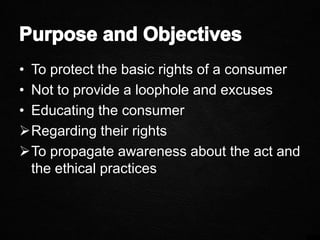
• To protect the basic rights of a consumer
• Not to provide a loophole and excuses
• Educating the consumer
Regarding their rights
To propagate awareness about the act and
the ethical practices
The Act applies to all goods and services
unless specially exempted by Union
Government
It covers all sectors
Provisions of the Act are compensatory in
nature
It envisages establishment of consumer
protection councils
Provisions of this act are in addition to and
not in derogation of the provisions of any
other act.
• Complainant
• Complaint
• Consumer
• Consumer dispute
• Defect
• Deficiency
• Goods
• Manufacturer
• Service
• Trader
• Eg: Brazil, Kenya, India, United
Kingdom, Nicaragua and Peru
among others.
• Freedom of choice
Example- 1.online shopping 2.Ford model T
• Rational decisions
example- 1.Return on investment,
Technological evaluation, Business Expansion
2. Sportswear
• large number of firms- homogenous product.
Example- 1.Pepsi and Coke 2.Smartphone
Companies
• Easy entry and exit (low “barriers to entry”)
Example-
1. Telecommunications, energy
2. Consulting, education
3. Hotels, ironworks
4. Retail, electronic commerce
• The actions of an individual firm have little to no
effect on market price.
Example- 1.Nokia
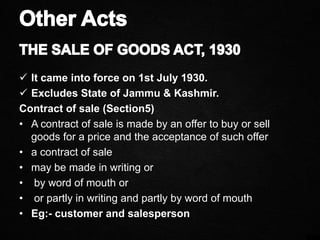
 It came into force on 1st July 1930.
 Excludes State of Jammu & Kashmir.
Contract of sale (Section5)
• A contract of sale is made by an offer to buy or sell
goods for a price and the acceptance of such offer
• a contract of sale
• may be made in writing or
• by word of mouth or
• or partly in writing and partly by word of mouth
• Eg:- customer and salesperson
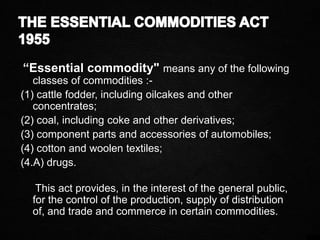
“Essential commodity" means any of the following
classes of commodities :-
(1) cattle fodder, including oilcakes and other
concentrates;
(2) coal, including coke and other derivatives;
(3) component parts and accessories of automobiles;
(4) cotton and woolen textiles;
(4.A) drugs.
This act provides, in the interest of the general public,
for the control of the production, supply of distribution
of, and trade and commerce in certain commodities.
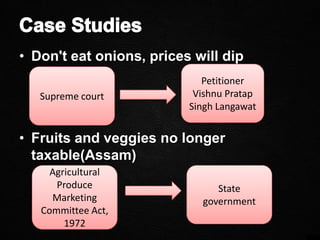
• Don't eat onions, prices will dip
• Fruits and veggies no longer
taxable(Assam)
Supreme court
Petitioner
Vishnu Pratap
Singh Langawat
Agricultural
Produce
Marketing
Committee Act,
1972
State
government
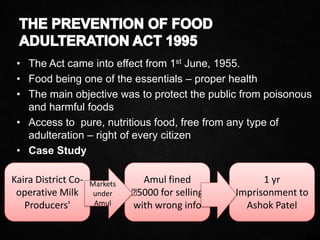
• The Act came into effect from 1st June, 1955.
• Food being one of the essentials – proper health
• The main objective was to protect the public from poisonous
and harmful foods
• Access to pure, nutritious food, free from any type of
adulteration – right of every citizen
• Case Study
Amul fined
₹5000 for selling
with wrong info
Kaira District Co-
operative Milk
Producers'
Markets
under
Amul
1 yr
Imprisonment to
Ashok Patel
 Aims at introducing standards in relation to
weights and measures used in trade and commerce.
 Objectives
– Establish standards of weights and measures.
– Regulate inter-state trade or commerce
Manufacture/sale/distribution
Penal provisions
• A fine of ₹500/- to ₹1000
• And imprisonment up to seven years
Eg:-Bisleri(1 ltr and 800 ml)
• Right to safety
• Right to be choose
• Right to be heard
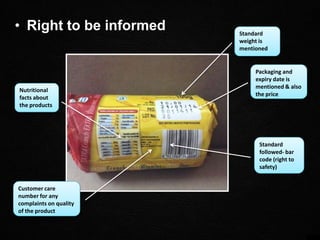
• Right to be informed
Customer care
number for any
complaints on quality
of the product
Nutritional
facts about
the products
Packaging and
expiry date is
mentioned & also
the price
Standard
followed- bar
code (right to
safety)
Standard
weight is
mentioned
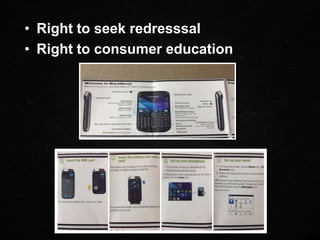
• Right to seek redresssal
• Right to consumer education
• OBJECTIVES OF THE ACT
 Greater Transparency .
 Informed Citizenry for promotion.
 Improvement in Accountability and performance
 Reduction in Corruption
SECTION 6 : REQUEST FOR INFORMATION :
Steps:
 Make a request
• In writing or
• Through electronic means
• In English/Hindi/regional language
SECTION 8 : INFORMATION THAT CANNOT BE
GIVEN
 There shall be no obligation to give any citizen Information:-
• disclosure of which would affect the sovereignty and integrity of India.
• which is forbidden to be published by any court of law or tribunal.
• the disclosure of which would cause a breach of privilege of parliament
or the state legislature.
• received in confidence from foreign government
The central or state commission:-
 Penalty of ₹250 is imposed each day till application is
received
 Total amount shall not exceed ₹25000
 Recommend for disciplinary action against
1. The central public information officer or
2. The state public information officer
 As the case may be, under the service rules applicable
to him.
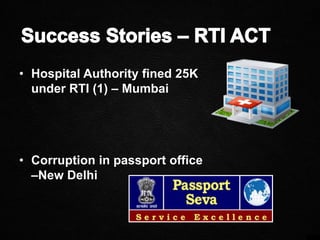
• Hospital Authority fined 25K
under RTI (1) – Mumbai
• Corruption in passport office
–New Delhi
• The Act postulates establishment of Consumer
Protection Councils for the purpose of spreading
consumer awareness.
• Central level- central consumer protection
council & State level- state consumer protection
council.
• To promote and protect all the rights mentioned
above of consumers.
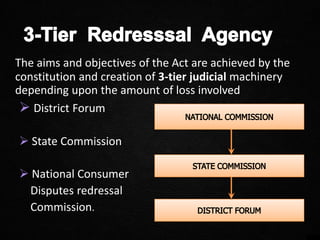
The aims and objectives of the Act are achieved by the
constitution and creation of 3-tier judicial machinery
depending upon the amount of loss involved
 District Forum
 State Commission
 National Consumer
Disputes redressal
Commission.
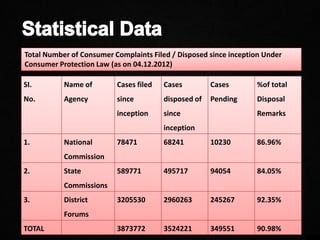
SI.
No.
Name of
Agency
Cases filed
since
inception
Cases
disposed of
since
inception
Cases
Pending
%of total
Disposal
Remarks
1. National
Commission
78471 68241 10230 86.96%
2. State
Commissions
589771 495717 94054 84.05%
3. District
Forums
3205530 2960263 245267 92.35%
TOTAL 3873772 3524221 349551 90.98%
Total Number of Consumer Complaints Filed / Disposed since inception Under
Consumer Protection Law (as on 04.12.2012)
• Buying quality products at rea-sonable price.
• To check the weights and meas-ures before
making purchases.
• Reading the label carefully.
• Beware of false and attractive
advertisements.
• Beware of misleading schemes.
• To procure the bill, cash received
warranty, etc.
• Buying from reputed shops
• Don't make purchases from black market
• To buy standardized product
• To use a product as per the instruction of
the manufacturer
• Knowledge of consumer rights
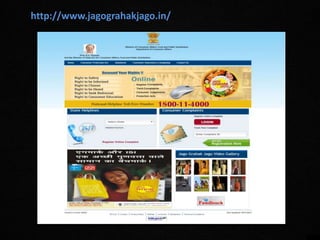
http://www.jagograhakjago.in/
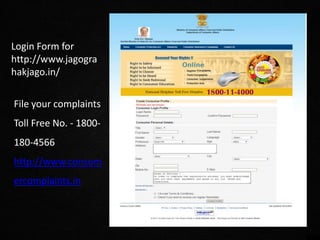
Login Form for
http://www.jagogra
hakjago.in/
File your complaints
Toll Free No. - 1800-
180-4566
http://www.consum
ercomplaints.in
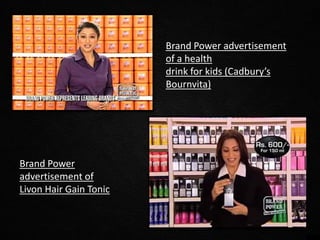
Brand Power advertisement
of a health
drink for kids (Cadbury’s
Bournvita)
Brand Power
advertisement of
Livon Hair Gain Tonic
• Background of Consumer protection Act
• The Purpose of the Consumer Protection
Act
• Who does the Consumer Protection Act
Affect?
• What are the Consumer Rights in Terms of
the Consumer Protection Act?
• Key Points of the Consumer Protection Act
• Mechanisms of the Consumer Protection Act
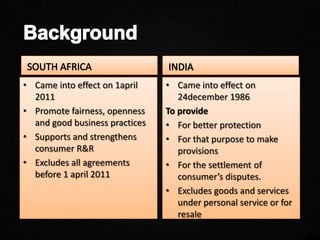
• Came into effect on 1april
2011
• Promote fairness, openness
and good business practices
• Supports and strengthens
consumer R&R
• Excludes all agreements
before 1 april 2011
• Came into effect on
24december 1986
To provide
• For better protection
• For that purpose to make
provisions
• For the settlement of
consumer’s disputes.
• Excludes goods and services
under personal service or for
resale
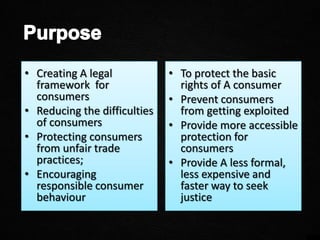
• Creating A legal
framework for
consumers
• Reducing the difficulties
of consumers
• Protecting consumers
from unfair trade
practices;
• Encouraging
responsible consumer
behaviour
• To protect the basic
rights of A consumer
• Prevent consumers
from getting exploited
• Provide more accessible
protection for
consumers
• Provide A less formal,
less expensive and
faster way to seek
justice
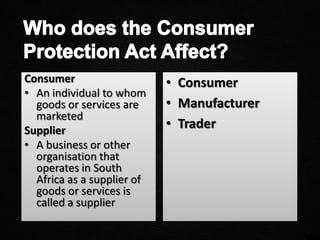
Consumer
• An individual to whom
goods or services are
marketed
Supplier
• A business or other
organisation that
operates in South
Africa as a supplier of
goods or services is
called a supplier
• Consumer
• Manufacturer
• Trader
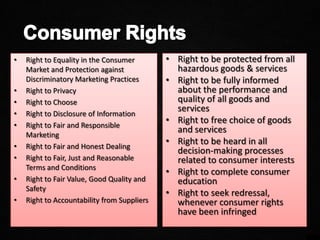
• Right to Equality in the Consumer
Market and Protection against
Discriminatory Marketing Practices
• Right to Privacy
• Right to Choose
• Right to Disclosure of Information
• Right to Fair and Responsible
Marketing
• Right to Fair and Honest Dealing
• Right to Fair, Just and Reasonable
Terms and Conditions
• Right to Fair Value, Good Quality and
Safety
• Right to Accountability from Suppliers
• Right to be protected from all
hazardous goods & services
• Right to be fully informed
about the performance and
quality of all goods and
services
• Right to free choice of goods
and services
• Right to be heard in all
decision-making processes
related to consumer interests
• Right to complete consumer
education
• Right to seek redressal,
whenever consumer rights
have been infringed
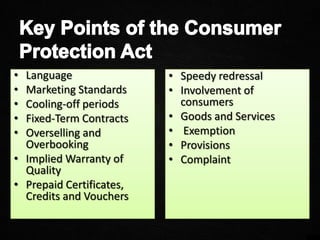
• Language
• Marketing Standards
• Cooling-off periods
• Fixed-Term Contracts
• Overselling and
Overbooking
• Implied Warranty of
Quality
• Prepaid Certificates,
Credits and Vouchers
• Speedy redressal
• Involvement of
consumers
• Goods and Services
• Exemption
• Provisions
• Complaint
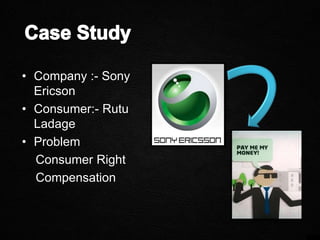
• Company :- Sony
Ericson
• Consumer:- Rutu
Ladage
• Problem
Consumer Right
Compensation
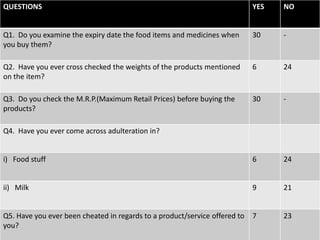
QUESTIONS YES NO
Q1. Do you examine the expiry date the food items and medicines when
you buy them?
30 -
Q2. Have you ever cross checked the weights of the products mentioned
on the item?
6 24
Q3. Do you check the M.R.P.(Maximum Retail Prices) before buying the
products?
30 -
Q4. Have you ever come across adulteration in?
i) Food stuff 6 24
ii) Milk 9 21
Q5. Have you ever been cheated in regards to a product/service offered to
you?
7 23
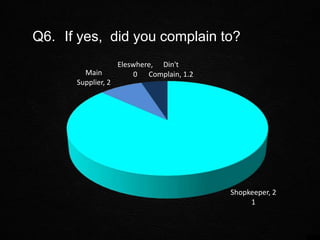
Q6. If yes, did you complain to?
Shopkeeper, 2
1
Main
Supplier, 2
Eleswhere,
0
Din't
Complain, 1.2
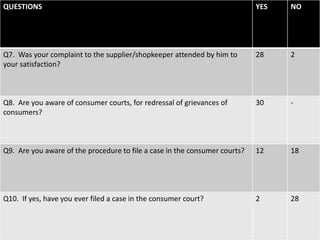
QUESTIONS YES NO
Q7. Was your complaint to the supplier/shopkeeper attended by him to
your satisfaction?
28 2
Q8. Are you aware of consumer courts, for redressal of grievances of
consumers?
30 -
Q9. Are you aware of the procedure to file a case in the consumer courts? 12 18
Q10. If yes, have you ever filed a case in the consumer court? 2 28
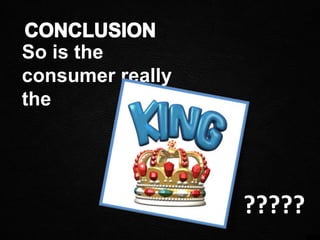
So is the
consumer really
the
?????
• Providing Consumer Education
• Adulteration
• Building Pressure On Government
• Arranging Consumer Protection
Programmes or Organising Public
Opinion
• Providing Guidance To Consumer
• Misleading advertisement
• http://www.ummid.com/news/2014/January/10.01.2014/sc-on-
onion-price.html#sthash.natkhtap.dpuf
• http://www.medindia.net/indian_health_act/consumer_protecti
on_act_and_medical_profession_consumer_disputes_redress
al_agencies.htm#ixzz2s4jBl9QE
• http://indiankanoon.in/doc/1819218/
• http://pib.nic.in/newsite/erelease.aspx?relid=79338
• http://dc-siwan.bih.nic.in/Consumer_Act.pdf
• Consumer Protection » Center for Finance, Law & Policy |
Boston University
• http://nvonews.com/2011/01/19/%E2%80%98jago-grahak-
jago%E2%80%99-%E2%80%93-an-initiative-towards-
consumer-education-and-awareness/

consumer protection act- (with digital exposure)

  • 3.
    To provide Consumer is.. •Most powerful motivation force • Equally liable to penalties Applicable to Excludes
  • 4.
    • Illiteracy andIgnorance • Unorganized Consumers • Spurious Goods • Deceptive Advertising • Malpractices of Businessmen • Freedom of Enterprise • Legitimacy for Existence • Trusteeship
  • 5.
    • To protectthe basic rights of a consumer • Not to provide a loophole and excuses • Educating the consumer Regarding their rights To propagate awareness about the act and the ethical practices
  • 6.
    The Act appliesto all goods and services unless specially exempted by Union Government It covers all sectors Provisions of the Act are compensatory in nature It envisages establishment of consumer protection councils Provisions of this act are in addition to and not in derogation of the provisions of any other act.
  • 7.
    • Complainant • Complaint •Consumer • Consumer dispute • Defect • Deficiency • Goods • Manufacturer • Service • Trader
  • 8.
    • Eg: Brazil,Kenya, India, United Kingdom, Nicaragua and Peru among others.
  • 9.
    • Freedom ofchoice Example- 1.online shopping 2.Ford model T • Rational decisions example- 1.Return on investment, Technological evaluation, Business Expansion 2. Sportswear • large number of firms- homogenous product. Example- 1.Pepsi and Coke 2.Smartphone Companies
  • 10.
    • Easy entryand exit (low “barriers to entry”) Example- 1. Telecommunications, energy 2. Consulting, education 3. Hotels, ironworks 4. Retail, electronic commerce • The actions of an individual firm have little to no effect on market price. Example- 1.Nokia
  • 11.
     It cameinto force on 1st July 1930.  Excludes State of Jammu & Kashmir. Contract of sale (Section5) • A contract of sale is made by an offer to buy or sell goods for a price and the acceptance of such offer • a contract of sale • may be made in writing or • by word of mouth or • or partly in writing and partly by word of mouth • Eg:- customer and salesperson
  • 12.
    “Essential commodity" meansany of the following classes of commodities :- (1) cattle fodder, including oilcakes and other concentrates; (2) coal, including coke and other derivatives; (3) component parts and accessories of automobiles; (4) cotton and woolen textiles; (4.A) drugs. This act provides, in the interest of the general public, for the control of the production, supply of distribution of, and trade and commerce in certain commodities.
  • 13.
    • Don't eatonions, prices will dip • Fruits and veggies no longer taxable(Assam) Supreme court Petitioner Vishnu Pratap Singh Langawat Agricultural Produce Marketing Committee Act, 1972 State government
  • 14.
    • The Actcame into effect from 1st June, 1955. • Food being one of the essentials – proper health • The main objective was to protect the public from poisonous and harmful foods • Access to pure, nutritious food, free from any type of adulteration – right of every citizen • Case Study Amul fined ₹5000 for selling with wrong info Kaira District Co- operative Milk Producers' Markets under Amul 1 yr Imprisonment to Ashok Patel
  • 15.
     Aims atintroducing standards in relation to weights and measures used in trade and commerce.  Objectives – Establish standards of weights and measures. – Regulate inter-state trade or commerce Manufacture/sale/distribution Penal provisions • A fine of ₹500/- to ₹1000 • And imprisonment up to seven years Eg:-Bisleri(1 ltr and 800 ml)
  • 17.
    • Right tosafety • Right to be choose • Right to be heard
  • 18.
    • Right tobe informed Customer care number for any complaints on quality of the product Nutritional facts about the products Packaging and expiry date is mentioned & also the price Standard followed- bar code (right to safety) Standard weight is mentioned
  • 19.
    • Right toseek redresssal • Right to consumer education
  • 20.
    • OBJECTIVES OFTHE ACT  Greater Transparency .  Informed Citizenry for promotion.  Improvement in Accountability and performance  Reduction in Corruption
  • 21.
    SECTION 6 :REQUEST FOR INFORMATION : Steps:  Make a request • In writing or • Through electronic means • In English/Hindi/regional language SECTION 8 : INFORMATION THAT CANNOT BE GIVEN  There shall be no obligation to give any citizen Information:- • disclosure of which would affect the sovereignty and integrity of India. • which is forbidden to be published by any court of law or tribunal. • the disclosure of which would cause a breach of privilege of parliament or the state legislature. • received in confidence from foreign government
  • 22.
    The central orstate commission:-  Penalty of ₹250 is imposed each day till application is received  Total amount shall not exceed ₹25000  Recommend for disciplinary action against 1. The central public information officer or 2. The state public information officer  As the case may be, under the service rules applicable to him.
  • 23.
    • Hospital Authorityfined 25K under RTI (1) – Mumbai • Corruption in passport office –New Delhi
  • 24.
    • The Actpostulates establishment of Consumer Protection Councils for the purpose of spreading consumer awareness. • Central level- central consumer protection council & State level- state consumer protection council. • To promote and protect all the rights mentioned above of consumers.
  • 25.
    The aims andobjectives of the Act are achieved by the constitution and creation of 3-tier judicial machinery depending upon the amount of loss involved  District Forum  State Commission  National Consumer Disputes redressal Commission.
  • 26.
    SI. No. Name of Agency Cases filed since inception Cases disposedof since inception Cases Pending %of total Disposal Remarks 1. National Commission 78471 68241 10230 86.96% 2. State Commissions 589771 495717 94054 84.05% 3. District Forums 3205530 2960263 245267 92.35% TOTAL 3873772 3524221 349551 90.98% Total Number of Consumer Complaints Filed / Disposed since inception Under Consumer Protection Law (as on 04.12.2012)
  • 27.
    • Buying qualityproducts at rea-sonable price. • To check the weights and meas-ures before making purchases. • Reading the label carefully. • Beware of false and attractive advertisements. • Beware of misleading schemes.
  • 28.
    • To procurethe bill, cash received warranty, etc. • Buying from reputed shops • Don't make purchases from black market • To buy standardized product • To use a product as per the instruction of the manufacturer • Knowledge of consumer rights
  • 31.
  • 32.
    Login Form for http://www.jagogra hakjago.in/ Fileyour complaints Toll Free No. - 1800- 180-4566 http://www.consum ercomplaints.in
  • 34.
    Brand Power advertisement ofa health drink for kids (Cadbury’s Bournvita) Brand Power advertisement of Livon Hair Gain Tonic
  • 36.
    • Background ofConsumer protection Act • The Purpose of the Consumer Protection Act • Who does the Consumer Protection Act Affect? • What are the Consumer Rights in Terms of the Consumer Protection Act? • Key Points of the Consumer Protection Act • Mechanisms of the Consumer Protection Act
  • 37.
    • Came intoeffect on 1april 2011 • Promote fairness, openness and good business practices • Supports and strengthens consumer R&R • Excludes all agreements before 1 april 2011 • Came into effect on 24december 1986 To provide • For better protection • For that purpose to make provisions • For the settlement of consumer’s disputes. • Excludes goods and services under personal service or for resale
  • 38.
    • Creating Alegal framework for consumers • Reducing the difficulties of consumers • Protecting consumers from unfair trade practices; • Encouraging responsible consumer behaviour • To protect the basic rights of A consumer • Prevent consumers from getting exploited • Provide more accessible protection for consumers • Provide A less formal, less expensive and faster way to seek justice
  • 39.
    Consumer • An individualto whom goods or services are marketed Supplier • A business or other organisation that operates in South Africa as a supplier of goods or services is called a supplier • Consumer • Manufacturer • Trader
  • 40.
    • Right toEquality in the Consumer Market and Protection against Discriminatory Marketing Practices • Right to Privacy • Right to Choose • Right to Disclosure of Information • Right to Fair and Responsible Marketing • Right to Fair and Honest Dealing • Right to Fair, Just and Reasonable Terms and Conditions • Right to Fair Value, Good Quality and Safety • Right to Accountability from Suppliers • Right to be protected from all hazardous goods & services • Right to be fully informed about the performance and quality of all goods and services • Right to free choice of goods and services • Right to be heard in all decision-making processes related to consumer interests • Right to complete consumer education • Right to seek redressal, whenever consumer rights have been infringed
  • 41.
    • Language • MarketingStandards • Cooling-off periods • Fixed-Term Contracts • Overselling and Overbooking • Implied Warranty of Quality • Prepaid Certificates, Credits and Vouchers • Speedy redressal • Involvement of consumers • Goods and Services • Exemption • Provisions • Complaint
  • 43.
    • Company :-Sony Ericson • Consumer:- Rutu Ladage • Problem Consumer Right Compensation
  • 44.
    QUESTIONS YES NO Q1.Do you examine the expiry date the food items and medicines when you buy them? 30 - Q2. Have you ever cross checked the weights of the products mentioned on the item? 6 24 Q3. Do you check the M.R.P.(Maximum Retail Prices) before buying the products? 30 - Q4. Have you ever come across adulteration in? i) Food stuff 6 24 ii) Milk 9 21 Q5. Have you ever been cheated in regards to a product/service offered to you? 7 23
  • 45.
    Q6. If yes,did you complain to? Shopkeeper, 2 1 Main Supplier, 2 Eleswhere, 0 Din't Complain, 1.2
  • 46.
    QUESTIONS YES NO Q7.Was your complaint to the supplier/shopkeeper attended by him to your satisfaction? 28 2 Q8. Are you aware of consumer courts, for redressal of grievances of consumers? 30 - Q9. Are you aware of the procedure to file a case in the consumer courts? 12 18 Q10. If yes, have you ever filed a case in the consumer court? 2 28
  • 47.
    So is the consumerreally the ?????
  • 48.
    • Providing ConsumerEducation • Adulteration • Building Pressure On Government • Arranging Consumer Protection Programmes or Organising Public Opinion • Providing Guidance To Consumer • Misleading advertisement
  • 50.
    • http://www.ummid.com/news/2014/January/10.01.2014/sc-on- onion-price.html#sthash.natkhtap.dpuf • http://www.medindia.net/indian_health_act/consumer_protecti on_act_and_medical_profession_consumer_disputes_redress al_agencies.htm#ixzz2s4jBl9QE •http://indiankanoon.in/doc/1819218/ • http://pib.nic.in/newsite/erelease.aspx?relid=79338 • http://dc-siwan.bih.nic.in/Consumer_Act.pdf • Consumer Protection » Center for Finance, Law & Policy | Boston University • http://nvonews.com/2011/01/19/%E2%80%98jago-grahak- jago%E2%80%99-%E2%80%93-an-initiative-towards- consumer-education-and-awareness/

Editor's Notes

  • #4 Consumer Protection Act, 1986 is an act to provide for better protection of the interest of consumers and for that purpose to make provisions for the establishments of consumer councils and other authorities for the settlement of consumer’s disputes and for matters connected therewith.Consumer is considered as the most powerful motivating force and also the purpose of production. At the same time consumer is equally liable to higher penalties segment of the whole marketing system. There were attempts to safe guard the interest of the consumer in a sporadic (occasional) way till 1986 until the Government of India enacted a comprehensive legislation-Consumer Protection Act. The act applies to all the goods and services excluding goods for resale or for commercial purpose and services rendered free of charge and under a contract for personal service.
  • #5 1. Illiteracy and Ignorance: Consumers in India are mostly illiterate and ignorant. They do not understand their rights. A system is required to protect them from unscrupulous businessmen.Eg. Illiterate people in india often buy nokai mobile phones considering it as nokia brand. 2. Unorganized Consumers: In India consumers are widely dispersed and are not united. They are at the mercy of businessmen. On the other hand, producers and traders are organized and powerful. Eg. Consumers in India often agree to buy substitute products which are relatively cheaper than the standard products. Tooth brush which are not branded but cheaper are introduced to consumers possessing low purchasing power. 3. Spurious Goods: There is increasing supply of duplicate products. It is very difficult for an ordinary consumer to distinguish between a genuine product and its imitation. It is necessary to protect consumers from such exploitation by ensuring compliance with prescribed norms of quality and safety.Ex. Eclare were sold as duplicate product of Eclair which is a branded chocolate bit. 4. Deceptive Advertising: Some businessmen give misleading information about quality, safety and utility of products. Consumers are misled by false advertisement and do not know the real quality of advertised goods. A mechanism is needed to prevent misleading advertisements. Ex. Pan bahar pan masala is advertised as a safe and symbol of royalty however it contains tobacco, excessive use of which may have adverse effects. 5. Malpractices of Businessmen: Fraudulent, unethical and monopolistic trade practices on the part of businessmen lead to exploitation of consumers. Consumers often get defective, inferior and substandard goods and poor service. Certain measures are required to protect the consumers against such malpractices. Ex. Cases of expired products being sold with new expiry dates have been registered, in order to gain profits from unsold products . 6. Freedom of Enterprise: Businessmen must ensure satisfaction of consumers. In the long run, survival and growth of business is not possible without the support and goodwill of consumers. If business does not protect consumers' interests, Government intervention and regulatory measures will grow to curb unfair trade practices. Ex. Cost of products will vary informally in order to maximize profits if no control is empowered over business enterprises. 7. Legitimacy for Existence: Business exists to satisfy the needs and desires of consumers. Goods are produced with the purpose of selling them. Goods will, in the long run, sell only when they meet the needs of consumers. Ex. Indian markets are flooded with variety of fabrics many of which do not fill quality needs, atractive outlook of such fabric cheats consumer on quality points. 8. Trusteeship: Businessmen are trustees of the society's wealth. Therefore, they should use this wealth for the benefit of people.
  • #6 The purpose of Consumer Protection act was to protect the basic rights of a consumer as defined by the constitution of India. The basic objective/purpose of this Act is to provide for better protection of the interest of the consumers and for that purpose to make provisions for the establishment of consumer councils and other authorities for the settlement of consumer’s dispute and for matters connected therewith. Hence, the basic objective is to PROTECT and not to provide a loophole and excuses to well organized traders, producers and big business houses and manufactures on technical grounds. Educating the consumer regarding their rights and to propagate awareness about the Act and the ethical practices/means was the other purpose of the act.
  • #7  2) public, private or cooperative 4) at the central and state levels.
  • #8 Amendments on right- complaint and service (b) "Complainant" means—(i) A consumer; or(ii) Any voluntary consumer association registered under the Companies Act, 1956 (1of 1956) or under any other law for the time being in force; or (iii) One or more consumers, where there are numerous consum­ers having the same interest;(iv) In case of death of a consumer, his legal heir or representative; who or which makes a complaint; (c) "Complaint" means any allegation in writing made by a complain­ant that— (i) An unfair trade practice or a restrictive trade practice has been adopted by any trader or service provider;(ii) The goods bought by him or agreed to be bought by him; suffer from one or more defects;(iii) The services hired or availed of or agreed to be hired or availed of by him suffer from deficiency in any respect;Amendments made (1993):-To enlarge the scope of the Act so as to enable the consumers to file class action complaints where such consumers have a common interest and to file complaints relating to restrictive trade practices adopted by a trader;To enable filing of class complaints on behalf of groups of consumers having the same interest;To impose punishment on the complainant in cases of frivolous or vexations complaints;To provide for the limitation period of one year for filing complaints.Amendments made (2002):-Prescribing the period within which complaints are to be admitted, notices are to be issued to opposite party and the complaints are to be decided. Similarly provisions have been proposed also in respect of appeals(d) "Consumer" means any person who—(i) Buys any goods for a consideration which has been paid or promised or partly paid and partly promised, or under any system of deferred payment and includes any user of such goods other than the person who buys such goods for consideration paid or promised or partly paid or partly promised, or under any system of deferred payment when such use is made with the approval of such person, but does not include a person who obtains such goods for resale or for any commercial purpose; or(ii) Hires or avails of any services for a consideration which has been paid or promised or partly paid and partly prom­ised, or under any system of deferred payment and includes any beneficiary of such services other than the person who 'hires or avails of the services for consideration paid or promised, or partly paid and partly promised, or under any system of deferred payment, when such services are availed of with the approval of the first mentioned person but does not include a person who avails of such services for any commercial purposes;(e) "Consumer dispute" means a dispute where the person against whom a complaint has been made, denies or disputes the allega­tions contained in the complaint. (f) "Defect" means any fault, imperfection or shortcoming in the quality, quantity, potency, purity or standard which is required to be maintained by or under any law for the time being in force under any contract, express or implied or as is claimed by the trader in any manner whatsoever in relation to any goods;(g)     "Deficiency" means any fault, imperfection, shortcoming or inade­quacy in the quality, nature and manner of performance which is required to be maintained by or under any law for the time being in force or has been undertaken to be performed by a person in pursuance of a contract or otherwise in relation to any service;(h)    "Goods"— means goods as defined in the Sale of goods act 1930 Goods means every kind of movable property, other than actionable claims and money; and includes stocks, shares, growing crops, grass, and things attached to or forming part of the land which are agreed to be severed before sale or under the contract of sale. (i)      “Manufacturer” means a person who—(i) Makes or manufactures any goods or part thereof; or(ii) Does not make or manufacture any goods but assembles parts thereof made or manufactured by others; or(iii) Puts or causes to be put his own mark on any goods made or manufactured by any other manufacturer; Explanation — Where a manufacturer dispatches any goods or part thereof to any branch office maintained by him, such branch office shall not be deemed to be the manufacturer even though the parts so dispatched to it are assembled at such branch office and are sold or distributed from such branch office;   (j)"Service" means— service of any description which is made avail­able to potential users and includes, but not limited to, the provision of facilities in connection with banking, financing insurance, transport, processing, supply of electrical or other energy, board or lodging or both, housing construction, entertainment, amusement or the purveying of news or other information, but does not include the rendering of any service free of charge or under a contract of personal service.Amendments made (1993):-To add “services” relating to housing constructions.(k)     "Trader" means— in relation to any goods means a person who sells or distributes any goods for sale and includes the manufacturer thereof, and where such goods are sold or distributed in package form, includes the packer thereof;
  • #9 Free market A free market is a market economy in which the forces of supply and demand are not controlled by a government or other authority. A free market contrasts with a controlled market or regulated market, in which government intervenes in supply and demand through non-market methods such as laws controlling who is allowed to enter the market, mandating what type of product or service is supplied, or directly setting prices In today’s world there are no perfect free markets, they are rather partial free markets. Some examples of countries with a free market economy are Brazil, Kenya, India, United Kingdom, Nicaragua and Peru among others.
  • #10 1.The information regarding the prices, goods and services is available to consumer for free. The above 3 things are offered in different combinations by different companies – which gives rise to freedom of choice to the consumer The primary condition for consumer satisfaction is freedom of choice. It allows consumers to select the option that provides the best match with personal requirements and desires. The categorising of markets becomes difficult if consumer is not able to choose, because of no availability or limited supply of products. Free choice, then, relates to the number of options available in the market, the variety within the set of alternatives, and the costs to be incurred for obtaining the alternatives.Eg 1: Suppose a consumer wants to buy a book online, he has the choice to look into many sites such as ebay, flipkart, olx, etc then he can select the book as per his needs taking the quality, price and the mode of payment into considerationEg 2: Ford car model T – “Any customer can have a car painted any colour that he wants so long as it is black”. However, in the first years of production from 1908 to 1913, the Model T was not available in black but rather only grey, green, blue, and red. By 1912, all cars were being painted midnight blue with black fenders. It was only in 1914 that the "any colour as long as it is black" policy was finally implemented.2.Investors do not make decisions based solely on price, but also depending on the length of time they expect for a return.  The assumption of rationality also ignores interpersonal aspects of consumers and producers, such as emotional purchases or production decisions, and decisions made based on social preferences and priorities.  For this assumption to hold true, the information would also need to be perfect, which as described above, is not often in the best interest of a profit-maximizing firmEgs:Return on InvestmentFor example, a company may have to decide whether to fund research and development into a new product, acquire a competitor with a similar product or form a joint venture with another company. Technology EvaluationFor example, a small business could be selecting a hardware or software platform for its next generation of productsBusiness ExpansionFor a small business, this growth may come from developing new products, increasing the sales of existing products and exploring new markets. In economics a rational consumer is defined as the people who act in a rational way and make rational choices, namely spending their money wisely. In other words, people who buy products which are best fit for their personal use and can be purchased through their disposable income. Eg: - If consumer A needs some sportswear, he goes to a shop to buy it – finds it expensive. He comes to Bandra, likes a sportswear at a stall and finds it comfortable and cheap so buys it3. - A real-world condition that represents this assumption has yet to be found.  Homogenous products are just not good for business (General Motors is one example).  Industries where products are largely homogenous trend in real-world examples towards fewer firms, such as with Coke and Pepsi. Large number homogenous products give consumer a choice to select the product which fits his/her personal needs.Eg: - Smart phones of Samsung, Sony, HTC, Apple, Micromax, LG, etc
  • #11 4.In short, barriers to entry are advantages held by established firms over firms entering the market, such as up-front capital costs, reputation, and revenue to support operating costs.  In modern times, this assumption holds true only in a very limited number of industries, such as some consulting services, computer programming, and internet retailing.  The technological knowledge required to participate in lower barrier to entry industries often requires significant personal investment of time and money For the majority of industries, a start-up competing with established firms requires a huge influx of resources, investments of both time and money, to compete with firms that have established reputations and economies of scale.  The resources required to compete in today’s landscape are available to very few.High barrier to entry and high exit barrier (for example, telecommunications, energy)High barrier to entry and low exit barrier (for example, consulting, education)Low barrier to entry and high exit barrier (for example, hotels, ironworks)Low barrier to entry and low exit barrier (for example, retail, electronic commerce)5.To see the fallacies of this assumption, one only need look to the effects of Wal-Mart on local small businesses.  In today’s economy, large firms have amassed sufficient market power to be able to affect market prices by influencing suppliers, driving down price and margin to levels that competitors cannot maintain.Eg: -Nokia is offered Rs. 13,500 off on the purchase of new Lumia 1020. The phone is so phenomenal and also comes with a 41MP image sensor on the back. All you need to trade an old phone of yours and get the Lumia 1020 for Rs. 36,499. This offer didn’t have an effect on prices offered by other brands mentioned above.
  • #12 This Act aims at providing goods that must be: of satisfactory quality' 'fit for the purpose' for which they are intended 'as described' by the seller. 1. Contract of sale (Section5)A contract of sale is made by an offer to buy or sell goods for a price and the acceptance of such offer. The contract may provide for the immediate delivery of the goods or immediate payment of the price or both, or for the delivery or payment by instalments, or that the delivery or payment or both shall be postponed.Eg:-A customer enters a mobile shop with the intent of buying a smart phone, as per the requirements of the customer the salesperson makes various offers to the customer, the customer may accept or deny them depends on the customer, depending on the payment method and availability of the product, he may pay immediately by cash, by cheque, or by emi payments and may get the product ar that time or later or by delivery.Subject to the provisions of any law for the time being in force, a contract of sale may be made in writing or by word of mouth, or partly in writing and partly by word of mouth or may be implied from the conduct of the parties.
  • #15 THE PREVENTION OF FOOD ADULTERATION ACT 1995Food is one of the essentials for proper maintenance of human health. Access to pure, nutritious food, free from any type of adulteration is the right of every citizen. The Directorate of prevention of Food Adulteration is responsible for checking adulteration misbranding of food articles.The Prevention of Food Adulteration Act was enacted in 1954 to strengthen the system for preventing food adulteration. The Act came into effect from 1st June, 1955. The Act was subsequently amended several times. CASE STUDYAmul fined Rs 5000 for selling products with wrong informationA local court here sentenced an employee of the Kaira District Co-operative Milk Producers' Union to one year's simple imprisonment and levied a fine of Rs 5,000 on Amul Dairy for selling products with wrong information. Additional Chief Judicial Magistrate R S Rajput sentenced Ashok Patel, an employee of the Kaira District Co-operative Milk Producers' Union (which is a part of the Gujarat Co-operative Milk Marketing Federation (GCMMF) which markets its products under the brand name Amul Dairy), to one year's simple imprisonment and levied a fine of Rs 5,000 on Amul Dairy for selling products with wrong information. When a Food and Drugs department had raided Amul Dairy in January 25, 2005, it was discovered that it had printed the packaging date, a day later than it was actually packed. Pouches of seized milk were sent to a Vadodara laboratory for testing and a complaint was registered against Amul Dairy and Ashok Patel, the employee who was in-charge of packaging milk packets, under relevant sections of the Prevention of Food Adulteration Act, 1954. The prosecution produced 27 documentary evidences, based on which Magistrate Rajput sentenced Patel to one year simple imprisonment and levied a fine of Rs 5,000 on Amul Dairy.
  • #16 THE STANDARDS OF WEIGHTS AND MEASURES ACT 1976The Standards of Weights and Measures Act 1976 aims at introducing standards in relation to weights and measures used in trade and commerce. The ultimate objective is to protect the interests of the consumers.Objectives: The act enlists the following objectives-Establish standards of weights and measures.Regulate inter-State trade or commerce in weights and measures and other goods, which are sold or distributed by weights, measures and number.Manufacture/Sale/Distribution:Only licence holder can manufacture weights and measures and shall have approved models.Penal provisions:Authorities also have the power to inspect, search, seize and forfeit the goods involved in the offence. A fine of ₹500/- to ₹1000/- and imprisonment up to seven years, if violation (use of non-standard units in non-metric system for weights and measures) of any provisions of the Act is found.Eg:-Suppose a customer goes to buy a bisleri 1 litre bottle at a shop, he gets at ₹20 and then goes to another shop to get it cheaper, but he gets bisleri 800ml bottle at ₹17. Now at this stage the customer is confused whether to purchase the 1 litre bottle or the 800ml bottle
  • #18 Right to safety:Consumers have a right to be protected against marketing of goods which are injurious to health and life. As a consumer if you are conscious of this right, you can take precautions to prevent the injury or if injury is caused in spite of precaution, you have a right to complain against the dealer and even claim compensation. Before purchasing, consumers should inspect on the quality of the products as well as on the guarantee of the products and services. They should preferably purchase quality marked products such as ISI, AGMARK, etcExample: If gas cylinder which is used for cooking, you need to check that it does not leak when it is supplied to you. If it starts leaking afterwards, the supplier will be liable to pay compensation if the leakage of gas leads to fire and causes injury or death to anyone.Right to choose: Every consumer has the right to choose the goods needed from a wide variety of similar goods. Very often dealers and traders try to use pressure tactics to sell goods of poor quality. Sometimes, consumers are also carried away by advertisements on the TV. These possibilities can be avoided if consumers are conscious of this right.Example: Consumer should be given choice to choose between TATA POWER and RELIANCE ENERGY for household electricity supply.Right to be heard: This right has three interpretations. Broadly speaking, this right means that consumers have a right to be consulted by Government and public bodies when decisions and policies are made affecting consumer interests. Also, consumers have a right to be heard by manufactures, dealers and advertisers about their opinion on production and marketing decisions.
  • #19 Right to be informed:Consumers also have the right to be informed about the quantity, quality, purity, standard or grade and price of the goods available so that they can make proper choice before buying any product or service. Also, where necessary, the consumer must be informed about the safety precautions to be taken while using the product to avoid loss or injury.Example: Cigarette Smokers should be informed that smoking of cigar is HARMFUL and causes CANCER.
  • #20 Right to seek redressal :If and when any consumer has a complaint or grievance due to unfair trade practices like charging higher price, selling of poor quality or unsafe products, lack of regularity in supply of services etc. or if he has suffered loss or injury due to defective or adulterated products, he has the right to seek remedies. He has a right to get the defective goods replaced or money refunded by the seller or dealer.Example: If you took a mobile connection and the bill shows many hidden charges which were not explained to you earlier. Or the mobile company activated a ringtone without your permission. Then you can go to the consumer court to put your case. (vi) Right to consumer education: To prevent market malpractices and exploitation of consumers, consumer awareness and education are essentially required. Steps have been already taken by many consumer bodies to educate consumers through pamphlets, journals and posters. TV programmes have also come to play an effective role in this connection.Example: Booklets inside with cellphone box which contains instruction and manuals to understand operation of headset.
  • #21 Objectives Greater transparency in functioning public authoritiesInformed Citizenry for promotion of partnership between citizens and the government in decision making process.Improvement in Accountability and performance of the Government andReduction in Corruption in the Government departments.ProvisionsThe RTI Act 2005 was introduced to secure access to information under the control of public authorities. The main objective of this act was to promote transparency and accountability in the working of every public authority. It extends to the whole of India except the State of Jammu and Kashmir .Subject to the provisions of this act, all citizens shall have the right to information
  • #22  A person, who desires to obtain any information under this act , shall make a request in writing or through electronic means in English or hindi or in the official language of the area in which the application is being made , accompanying such fee as may be prescribed toThe central public information officer or state public information officer ,as the case may be ,The central assistant public information officer or state assistant public information officer , as the case may be , specifying the particulars of the information sought by him or her.Section 8shall be no obligation to give any citizen :Information , disclosure of which would affect the sovereignity and integrity of india.Information which is forbidden to be published by any court of law or tribunal.Information,the disclosure of which would cause a breach of privilege of parliament or the state legislature.Information received in confidence from foreign government
  • #23 The central/state information commission shall impose a penalty of 2 hundred and 50rs each day till application is received or information is furnished by the central/state public information officer. However ,the total amount of such penalty shall not exceed 25000rs.The central/state information commission shall also recommend for disciplinary action against the central public information officer or the state public information officer, as the case may be , under the service rules applicable to him.
  • #24  Hospital Authority fined 25K under RTI (1) – Mumbai:-A public information officer (PIO) from the civic rum Sion Hospital was penalized for not providing details sought under the Right to information Act (RTI).State information commissioner RatnakarGaikwad fined assistant dean Dr. RakeshVerma₹25,000. He also asked the BMC authorities to initiate disciplinary action against deputy dean. UmeshPai, the first appellate authority, who behaved rudely with the RTI applicant SamirZaveri and even threatened him over the phone. Dr. Verma has to pay the fine in five equal instalments from his salary and payoff by December 2012. Zaveri had written a letter to the hospital authorities informing them that many railway accident victims were allegedly turned away without treatment. On march this year, he asked the authorities under RTI about the steps being taken following this letter. But, Zaveri was given only incomplete information and told that rest of the papers could not be provided. However only when Zaveri threatened to file a police complaint did Verma agree to part with the documents. Zaveri told TOI that Dr. Pai called him recently and threatened him and told him that he will not be allowed entry into the hospital premises. Zaveri claimed he had taped the conversation and presented it before Gaikwad (Times of India 22/8/2012)Corruption in passport office While Drive against Bribes campaign was in progress in 55 cities during 1st till 15th July, 2006. Dr. MohiniGoswami had submitted the applications for issuing the passports to her, her husband and her son on 24.5.2006. Police verification was done on 8.6.2006. Police verification was satisfactory and they were to receive their passports by 2.8.2006 as per the website of Ministry of External Affairs. This writing period exceeded the 45 days limit. She consulted the experts on 15.7.2006 at RTI camp held at IG stadium, New Delhi and submitted the documents to the PIO, passport office on 17.7.2006. Separate letters were also posted by the Regional passport Office (RPO) expressing regrets in the delay and asking us to seek RPO’s appointment for information on other queries raised by us and perusal of files.
  • #25 1.The Consumer Councils are created to advise and assist the consumers in seeking and enforcing their rights. We have Consumer Protection Councils both at Centre level and State level, that is one Central Council and many State Councils.These councils work towards the promotion and protection of consumers. They make investigations and give publicity to the matters concerning consumer interests, take steps towards furthering consumer education and protecting consumer from exploitation, advice the Government in the matter of policy formulation keeping consumer interest as pivotal concern, etc. Although their suggestions are recommendatory in nature, but they have significant impact in policy making.2.Central level - Is regulated by Central Government.It consists of maximum 150 members.Chairman : Minister of Consumer Affairs.1 meeting is to be held every yearState level- Is regulated by State Government.It consists of maximum 21 members.Chairman : Minister incharge of Consumer Affairs in State government.Atleast 2 meeting is to be held every year3. Rights or objectives:1.To be protected 2. To be informed3. To be assured4. To be heard5. To seek redressal against unfair trade practices6. To consumer education7. Against consumer exploitation
  • #26 JURISDICTIONForum / Commission Where the value of the goods or services and the compensation, if any claimed,District Forum Does not exceed Rs. 20 lakhsState Commission Rs. 20 lakhs and above but not exceeding One CroreNational CommissionAbove One CroreBesides, State and National Commission have appellate jurisdiction also. LIMITATION PERIODState Commission /National Commission Should be filed within 2 years Ifthere are sufficient grounds - extension may be grantedPENALTIESWhen any party fails to comply with the ordersPunishable with a term at least one month – 3yrsFine of at least ₹2000 -₹10000exceptional circumstances the penalties may be reduced further.
  • #28 1. Buying quality products at reasonable price.It is the responsibility of a consumer to buy a product after having a thorough knowledge of its price and quality. He should enquire about the price from 2-3 shops and if possible from government stores to get an idea of its price. He can have the knowledge about the quality from his own experiences, from the experiences of other persons and through the medium of advertisement. Hence it is the duty of the consumer to buy quality product at right price only.2. To check the weights and measures before making purchases.Generally, the sellers often cheat consumer by using unfair weights and measures. The consumer should ensure that he is getting the product of right weight and measure. He should check the weights and balance. While buying cloth, ensure that the shopkeeper is not stretching the cloth while measuring. He should not buy a product which has been weighed along with its packing. Therefore the consumer should remain vigilant when the seller is measuring or weighing the product.3. Reading the label carefully.It is the duty of the consumer to read the label of the product. It should have complete and true information about the product.4. Beware of false and attractive advertisements.Often the product is not that attractive as it is made out in the adver­tisement by the seller. Hence, the duty of consumer is not to be misleading by the attractive advertisements.5. Beware of misleading schemes.It is the duty of the consumer to beware of misleading schemes. These days almost every product in the market is available with a gift, discount, or a free product. For example, a free comb with soap, a discount of on the soap or one free soap on buying one. Often a consumer allured by such schemes and buys such products even when it is not needed because he is getting one item free.The fact is that the seller has already inflated the price of the product and recovered its cost price in the scheme. Hence the consumer should be aware of the fact that he is getting anything free and should not b unwanted things in greed.
  • #29 6. To procure the bill, cash received warranty, etc.Often the consumer does ask for a bill or cash receipt in order to avail sales tax. Later on, if the product comes o to be defective, he becomes helpless. Hence is the duty of the consumer to get the cash receipt, and warranty card, etc. so r he may be able to go to the consumer co; for the redressal of his grievances. 7. Buying from reputed shopsIt the duty of the consumer to make purchase' from the reputed shops or government like super bazaar, cooperative stores, etc. Bf making purchases from such shops, the consumer can escape from the malpractices of the manufacturers and shopkeepers. 8. Don't make purchases from black marketThe consumer should discharge hill duties of responsible citizen. He should not] buy from black market and in excess of his requirements. In case of scarcity, like milk in' summer, required quantity of the producing should be purchased, so that others may able to get some.9. To buy standardized productOf­ten the consumer buys cheap products which are not durable or are not safe. Therefore, it is the duty of the consumer to by products with standardization marks and is safe in every respect. Eg: check the ISI mark, bar codes, AGMARK etc.10. To use a product as per the in­struction of the manufacturerIt is the 1 duty of the consumer to use the product as per its instructions, e.g., if a medicine carries instructions-'Store in cool place-it should be stored in the fridge. This would help in prevention of any damage to the medicine and loss to the consumer.11. Knowledge of consumer rightsThese days the seller is trying to cheat the consumer in every possible way to earn maxi­mum profits. It is the duty of the consumer to be aware of his rights. If a consumer is cheated by a seller, then he should lodge a complaint rather than to remain a silent spectator.
  • #30 Consumers can be benefited by Digital Technology only if they are given proper exposure and knowledge about it.Consumer has to create an account by creating login id and password and can register/file their complaints against the product online where they will be given a complaint id for their complaint.The process to register/file complaint is very simple and the end-user can adapt to it very quickly.
  • #31 The multi media publicity to educate consumers and make them aware about their rights.The scheme will go a long way in introducing greater accountability and transparency.‘Jago Grahak Jago’ is thus an initiative which empowers consumers by making them aware about their rights as well as the Grievance Redressal Mechanism.The slogan ‘Jago Grahak Jago’ has now become a household name as a result of the publicity campaign undertaken in the last 4 years. Through the increased thrust on consumer awareness in the XIth Five Year Plan, the Government has endeavoured to inform the common man of his rights as a consumer. As part of the consumer awareness scheme, the rural and remote areas have been given top priority.Continuation of Multi Media Publicity Campaign under the tag line ‘Jago Grahak Jago’. Elements of the strategic plan in this area of activityA Focussed Campaign addressing the emerging areas such as education, telecom, travel services, banking, insurance, medicines etc. Activation of the Multi Media campaign active coordination and liaisoning with other Government Departments that have consumers as a major inter face as part of their functional area.
  • #34 Brand Power uses direct communication techniques to explain a products features, giving consumers genuine reasons to choose that product from their supermarket shelf.As a consumer, you have every right to access information about the goods and services available to you. In short, Brand Power aims to provide you with rational information about grocery products to help you make a more informed purchase when you’re at the supermarket. Brand Power is a unique advertising vehicle that’s quite different to many of the other ads you’ll see on television. Below, you can find out about Brand Power in a little more detail. Brand Power is trying to achieve Brand Power is an advertising product used by leading manufacturers and their advertising agencies as a different method for promoting their brands. It's different from traditional advertising as it focuses on providing rational information about grocery products. The aim of Brand Power television commercials, informative catalogues, even this web site, is to provide you with 'Facts and Value' through information.Why Brand PowerWhat makes Brand Power appealing to manufacturers and their advertising agencies is its ability to provide detailed explanation to shoppers. In particular, Brand Power draws shoppers' attention to facts that weren't previously known. We like to think that Brand Power treats shoppers with respect by providing useful information that helps when it comes time to decide which product to take from the supermarket shelf.SponsorsBrand Power is an advertising vehicle sponsored and paid for by leading manufacturers. Brand Power produces television commercials, campaigns and flyers that inform consumers of the features and benefits of products - in a very clear and easy to understand style. A strict criteria of content and accuracy has been developed by Brand Power. 
  • #36 Behind Brand PowerBrand Power is an advertising service owned by Buchanan Group. Buchanan Group also has created other Informative advertising services. They are Infotalk, Great Chef's Show You How, MediFacts and Zoot Review. Each of these advertising services sets out to provide viewers with information to help them make purchase decisions across a variety of product categories.
  • #38 South AfricaOn 1 April 2011, the South African National Consumer Protection Act, 68 of 2009, came into effect. The Consumer Protection Act (CPA) aims to “promote fairness, openness and good business practices between suppliers of goods and services and Consumers of these goods and services”. The CPA is the result of the Department of Trade and Industry’s (dti) intention to “create and promote an economic environment that supports and strengthens a culture of Consumer rights and responsibilities”. The Consumer Protection Act excludes all agreements before 1 April 2011, but all suppliers of goods and services after this date need to comply with the CPA.IndiaConsumer Protection Act, 1986 is an act of Parliament of India enacted in 1986 to protect interests of consumers in India. It makes provision for the establishment of consumer councils and other authorities for the settlement of consum­ers' disputes and for matters connected therewith.
  • #39 South AfricaThe purpose of the Act is “to promote and advance the social and economic welfare of Consumers in South Africa,” Section 3 (1) of the Act.The Consumer Protection Act does this by, amongst others, creating a legal framework to foster a fair, accessible and efficient marketplace for Consumers; reducing the difficulties vulnerable Consumers experience when accessing goods or services; protecting Consumers from unfair trade practices; encouraging responsible Consumer behaviour; advancing Consumer empowerment and providing an efficient system of redress for Consumers; and consolidating and replacing existing Consumer protection.IndiaConsumer Protection Act 1986 is a social welfare legislation which was enacted as a result of widespread consumer protection movement. The main object of the legislature in the enactment of this act is to provide for the better protection of the interests of the consumer and to make provisions for establishment of consumer councils and other authorities for settlement of consumer disputes and matter therewith connected and prevent consumers from getting exploited. Under this act consumers have been provided with many rights which prevent them from exploitation.-Provide more accessible protection for consumers. -Provide a less formal, less expensive and faster way to seek justice relative to perceived and to safeguard against problems/damages associated with consumer goods and services which is applicable to all and it covers all sectors (private, public and cooperative).
  • #40 South AfricaThe ConsumerAn individual or Juristic persons (a legal entity with turnover or assets below R2 million) to whom goods or services are marketed, who has entered into transactions with suppliers, users of particular goods or recipients/beneficiaries of services.The SupplierA business or other organisation that operates in South Africa as a supplier of goods or services is called a supplier. Goods include any tangible objects or intangible products and legal interest in immovable property. Services include any work or undertaking performed by one person for the direct or indirect benefit of another, counsel, financial services, transport and the provision of accommodation.. IndiaThe Consumer The Manufacturer The TraderDefinitions given above
  • #42 South AfricaLanguageThe Consumer Protection Act does not contain a provision for information to be in an official language. However, it does require information to be in plain and understandable language. The CPA also requires that the language for goods or services be appropriate to the target group.Marketing StandardsThe Consumer Protection Act deals with marketing by promoting marketing standards, restricting unwanted marketing and prohibiting discriminatory marketing. Marketing efforts must be factual and accurate and may not mislead the Consumer in any way. This includes information distributed by third parties engaged in business. The CPA also enables pre-emptive blocking of email, phone or printed direct marketing.Cooling-off periodsThe Consumer Protection Act provides a five business day cooling-off period for transactions that come from direct marketing i.e. transactions not initiated by the Consumer, but includes both verbal and written agreements. The five business day period will commence after the day on which the transaction or agreement was concluded, or the day on which the goods or services were delivered to the Consumer. The Consumer has the right to cancel without reason or penalty, by notice to the supplier in writing, or another recorded manner and form. This applies to bookings and reservations, but the Consumer may be liable for a “reasonable charge”.Fixed-Term ContractsThe Consumer Protection Act regulates the term, renewal and cancellation of fixed-term contracts. The Act prevents the automatic renewal of a fixed term contract, the Consumer has the responsibility to terminate or renew the contract. If the Consumer fails to renew or terminate, the contract will continue on a month on month basis on the new terms as notified by the supplier. Consumers can also cancel a contract before the term by providing a 20 day notice, but will be liable for “a reasonable cancellation penalty”.  Overselling and OverbookingThe CPA provides for the “reasonableness” test for overselling and overbooking. A supplier may not accept payment for goods or services if it has no reasonable intention to supply the goods or services, or if it intends to supply goods or services that are materially different to those the Consumer has paid for. The supplier can be penalised if they fail to deliver goods, services or reservations for which they have accepted payment. Implied Warranty of QualityThe Consumer Protection Act provides for an implied warranty of quality. In terms of this warranty the producer/importer, distributor and retailer each warrant that the goods comply with the requirements and standards outlined in the CPA. Failed, unsafe or defective goods may be returned to the supplier within six months after the delivery of the goods to a Consumer. The Consumer has the choice to be refunded, or have the goods replaced or repaired.Prepaid Certificates, Credits and VouchersThe Consumer Protection Act states that gift or similar vouchers expire either upon redemption or after three years, which prevents vouchers under the CPA from expiring within a couple of months of issue, and before Consumer has the opportunity to use themIndiaSpeedy redressal1. The Act provides speedy redressal to consumer complainants. The Bill provides for setting up of a Consumer Redressal Forum in every district, a commission at the state level and the National Commission at the Centre. Involvement of consumers2. To promote voluntary consumer movement and to ensure involvement of consumers. The Bill provides for the establishment of Consumer Protection Councils at centre and in the states. These Councils will have both non-official and official members. The objects of the Councils will be to promote and protect the rights of the consumers.Goods and Services3. It shall apply to all goods and classes of goods or all services or classes of services except those which are specially exempted by notification by the central government.Exemption4. The provisions of the Bill shall be in addition to and not in derogation (exemption) of any other law for the time being in force.Provisions5. Necessary penal and punitive provisions have been corporate to ensure that the proposed legislation is effective in protecting consumers.Complaint 6. The complaint can be filed by a consumer or an organization being a society registered under the Societies Registration Act, or a company registered under the Companies Act, representing consumers or by the central or state government. The complaint can be filed on account of any unfair trade practices resulting in loss or damage, defect in the goods, deficiency in the services, prices charged in excess of the prices fixed by or under any law or displayed on the goods/packets.
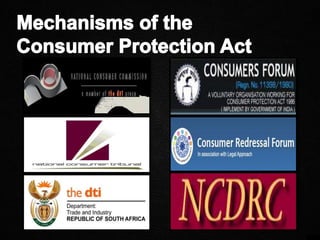
  • #43 South AfricaNational Consumer Commission (NCC)Website:www.thenct.org.zaNational Consumer Tribunal (NCT)Website:www.thenct.org.zaDepartment Of Trade and Industry Website: www.thedti.gov.zaPlease note that is only as a brief summary of the main provision of the Act and should not be relied upon as a legal document. There are many other provisions and exemptions under the legislation. For more detailed information and the full Act please visit the National Consumer Commission website.IndiaDistrict ForumState commissionNational Consumer dispute Redressal Commission 
  • #44 Sony Ericsson, the mobile phone maker, has been ordered by a consumer panel to pay more than Rs13, 000 as compensation for a faulty handset sold to a customer more than three years ago.According to the order of the Mumbai Suburban Additional District Consumer Redressal Forum, the firm will have to pay the customer Rs10, 000 with 9% interest from May 16, 2010, and an additional Rs3, 000 for the mental agony she suffered.The customer, Rutu Ladage, purchased the Sony Ericsson mobile phone (model no. C-903) for Rs10, 000 from a store in Vile Parle on May 2010, but within a month - she found numerous problems with the instrument.“The buttons, speakers and software of the handset were in a bad shape from the time of purchase of the handset,” the Ghatkopar resident stated in her complaint.She approached Sony Ericsson’s service centre to get the phone repaired and was asked by the service provider to deposit it there. However, when she collected the phone some days later she realised that the problems continued.Subsequently, Ladage approached the service centre eight times, but the handset was not repaired. As she had a warranty for the phone, she asked the firm to compensate the loss or provide her a new handset. But again she was asked to hand over the phone to the service centre.Aggrieved by their attitude, Ladage filed a complaint against the firm with the consumer forum in March 2011. The forum ruled that the company had terribly failed to provide proper services to the customer and hence directed it to pay the compensation.Tech troubleAs per the order of the consumer redressal forum, the firm will have to pay the customer Rs10, 000 with 9% interest from May 16, 2010, and an additional Rs3, 000 for the mental agony she sufferedRutu Ladage had bought the mobile phone (C-903) for Rs10, 000 from a store in Vile Parle in May 2010, but within a month she found numerous problems with the instrument.
  • #48 The consumer protection Act in India is considered as notable social welfare legislation, as we studied above under the provisions of this Act, a complainant can ask for protection of his interest in a wide range of subject, say against bank which refuses to give back fixed deposit after the maturity period, defective electronic appliances, wrong medical treatment being administered, or against educational institutions on the grounds of it being a fake university, for examination not being held or results not given out or against the builder who failed to provide amenities assured in the construction project etc. Thus let us now look at some recent cases in which this Act has helped protect consumer rights:So is consumer really the king?Saying that a consumer is a king signifies that the customer is driving the market and the products are produced according to his needs.Yes after the liberalization and globalization in our country it can be said that markets are now driven by and products are produced according to the demands of the consumers only.As there's no single product in the market of a particular type but are many. A consumer has many choices. He is free to choose and hence the most chosen product becomes the product in demand and is more produced by the producer. We are not forced to purchase a single product.ACCORDING TO USAccording to our opinion the consumer pretends to act as a king but actually not. On an over view we think that consumer is a king of any business because any business or a firm gets fame only if it satisfies the consumer needs and if the product attracts the consumers by its model or application or else design.But, when consumer gets attracted to a design or a product its prices sits on peak and as a common man could not effort to buy it so he gets though the other products which lies in his budget and gets promoting it as a best one to the nearby people and they too buy the same product and slowly its craze improves and it again sits at stake after few period or manufacturing such product gradually stops and due to this he again shows attention to another product. Due to this a customer is finally forced to buy a product and from this we can understand that the firms are showing the consumer as king but actually he's not.Not only this, the consumer is attracted by the offers and discounts on the product though he is actually not interested in them. For example consider soaps, if the consumer is attracted to a lux by its fragmence. But, beside when he sees that santoor has an offer that buy 3 and get one free. A common man would rather go for the santhoor even his interest was on lux. This shows that the firms are making the consumers pretend to act as a king but he's not.  
  • #49 Recommendation.There is a great need of making the consumers aware about their rights; 1. In general the consumers are ignorant about their rights; 2. The Government is also not making sufficient attempts to make the consumers aware; 3. Certain rules and regulations are still needed to protect the consumers; 4. Let us all unite to beware of poor quality, poor service and poor after sales care etc.According to the survey done, we can see from the statistical data that many people are aware about the rights but are not aware about the legal process. We can recommend that Consumer Protection movement to be effective and meaningful needs active involvement and participation from all quarters i.e. support of the government, organizations of Civil Society, Educational Institutions – Schools, Colleges, Universities and Research Institutions, the NGO’s, the print and electronic media and the adoption and observance of a voluntary code of conduct by the trade and industry and the citizen’s charter by the service providers is necessary to see that the consumers get their due.A number of schemes have already been in operation such as, Grahak Jagaran, Consumer Clubs in Schools, Promoting involvement of Research Institutions, Universities, Colleges, etc. in Consumer Protection and Welfare.The following are the recommendation can be given from the survey done.Providing Consumer EducationPeople are aware of their rights and consumer court but they are not aware about the procedure of launching their complaint. So the efforts should be made to educate the consumer about the procedure. This can be done through the means of television, radios and can go to school and colleges to educate the youths.Adulteration Adulteration is adding something inferior to the product being sold. This is a practice we come across in the case of cereals, spices, tea leaves, edible oil, petrol, etc. For example, mustard oil may be adulterated with rape seed oil or argemone oil, blace pepper is known to be adulterated with dry papaya seeds, petrol is mixed with kerosene oil, vanaspati may be mixed with ghee/butter. Sometimes, the inferior material used with the product may be injurious to health.Building Pressure On GovernmentThe consumer who are aware about the procedure to launch complaint in consumer court have come across some fault in their product which they purchased but they did not launched an official complaint it is because they feel that court takes lot of time to solve the case and it consumes lot of time. So it is necessary to pressure the government to make the case solving process fast.Arranging Consumer Protection Programmes or Organising Public OpinionThere should be the team of people in all areas and who will meet once or twice in three months and share their problems if they ever come across while buying the product. This will create more awareness among the consumer about their rights and responsibility Providing Guidance To Consumer Government have come up with many programmes to make aware consumer about their rights and also given the helpline number but still illiterate people are not aware about it. So for such illiterate people proper guidance should be formed.Misleading advertisementMisleading advertisement is yet another practice by which consumers are deceived. Such advertisements falsely represent a product or service to be of superior quality, grade or standard, or falsely assert the need for or usefulness of a product or service. A pharmaceutical company advertised that use of its Paracetamol tablet did not have any side effects like aspirin, but it suppressed the experts’ report that the use of Paracetamol had adverse effect on the liver. A company announced in its advertisement that it was manufacturing 150 cc. scooters in technical collaboration with a foreign company, although no such collaboration had been entered into. In another case, a company used the trademark of a well-known company ‘Philips’ in its advertisement for TV sets. On enquiry it was found that the company did not have the necessary permission from Philips for the use of its trade mark on TV sets. It was a case of misrepresentation of facts although that company was authorized to use the trademark ‘Philips’ on its audio products (radio sets) only.