To provide
Consumer is..
• Most powerful motivation force
• Equally liable to penalties
Applicable to
Excludes
• Illiteracy and Ignorance
• Unorganized Consumers
• Spurious Goods
• Deceptive Advertising
• Malpractices of Businessmen
• Freedom of Enterprise
• Legitimacy for Existence
• Trusteeship
• To protect the basic rights of a consumer
• Not to provide a loophole and excuses
• Educating the consumer
Regarding their rights
To propagate awareness about the act and
the ethical practices
The Act applies to all goods and services
unless specially exempted by Union
Government
It covers all sectors
Provisions of the Act are compensatory in
nature
It envisages establishment of consumer
protection councils
Provisions of this act are in addition to and
not in derogation of the provisions of any
other act.
• Complainant
• Complaint
• Consumer
• Consumer dispute
• Defect
• Deficiency
• Goods
• Manufacturer
• Service
• Trader
• Eg: Brazil, Kenya, India, United
Kingdom, Nicaragua and Peru
among others.
• Freedom of choice
Example- 1.online shopping 2.Ford model T
• Rational decisions
example- 1.Return on investment,
Technological evaluation, Business Expansion 2.
Sportswear
• large number of firms- homogenous product.
Example- 1.Pepsi and Coke 2.Smartphone
Companies
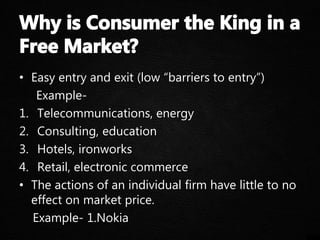
• Easy entry and exit (low “barriers to entry”)
Example-
1. Telecommunications, energy
2. Consulting, education
3. Hotels, ironworks
4. Retail, electronic commerce
• The actions of an individual firm have little to no
effect on market price.
Example- 1.Nokia
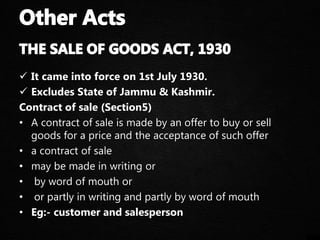
 It came into force on 1st July 1930.
 Excludes State of Jammu & Kashmir.
Contract of sale (Section5)
• A contract of sale is made by an offer to buy or sell
goods for a price and the acceptance of such offer
• a contract of sale
• may be made in writing or
• by word of mouth or
• or partly in writing and partly by word of mouth
• Eg:- customer and salesperson
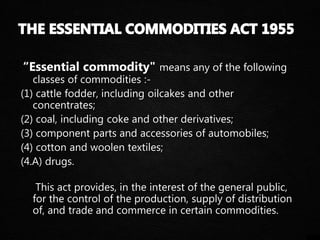
“Essential commodity" means any of the following
classes of commodities :-
(1) cattle fodder, including oilcakes and other
concentrates;
(2) coal, including coke and other derivatives;
(3) component parts and accessories of automobiles;
(4) cotton and woolen textiles;
(4.A) drugs.
This act provides, in the interest of the general public,
for the control of the production, supply of distribution
of, and trade and commerce in certain commodities.
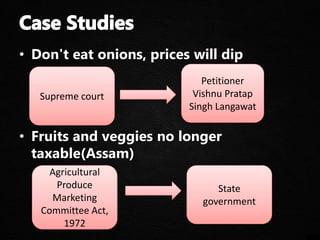
• Don't eat onions, prices will dip
• Fruits and veggies no longer
taxable(Assam)
Supreme court
Petitioner
Vishnu Pratap
Singh Langawat
Agricultural
Produce
Marketing
Committee Act,
1972
State
government
• The Act came into effect from 1st June, 1955.
• Food being one of the essentials – proper health
• The main objective was to protect the public from
poisonous and harmful foods
• Access to pure, nutritious food, free from any type of
adulteration – right of every citizen
• Case Study
Amul fined
₹5000 for selling
with wrong info
Kaira District Co-
operative Milk
Producers'
Markets
under
Amul
1 yr
Imprisonment to
Ashok Patel
 Aims at introducing standards in relation to
weights and measures used in trade and commerce.
 Objectives
– Establish standards of weights and measures.
– Regulate inter-state trade or commerce
Manufacture/sale/distribution
Penal provisions
• A fine of ₹500/- to ₹1000
• And imprisonment up to seven years
Eg:-Bisleri(1 ltr and 800 ml)
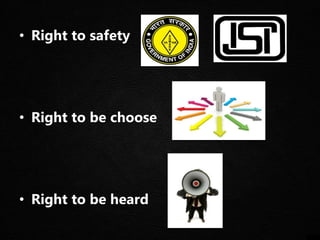
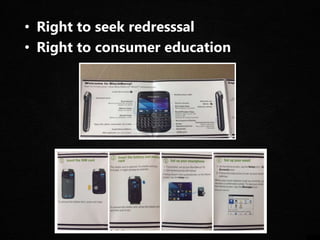
• Right to safety
• Right to be choose
• Right to be heard
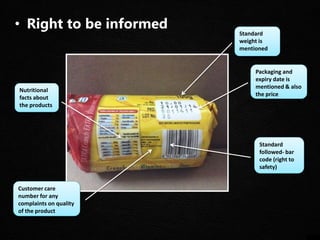
• Right to be informed
Customer care
number for any
complaints on quality
of the product
Nutritional
facts about
the products
Packaging and
expiry date is
mentioned & also
the price
Standard
followed- bar
code (right to
safety)
Standard
weight is
mentioned
• Right to seek redresssal
• Right to consumer education
• OBJECTIVES OF THE ACT
 Greater Transparency .
 Informed Citizenry for promotion.
 Improvement in Accountability and performance
 Reduction in Corruption
SECTION 6 : REQUEST FOR INFORMATION :
Steps:
 Make a request
• In writing or
• Through electronic means
• In English/Hindi/regional language
SECTION 8 : INFORMATION THAT CANNOT BE
GIVEN
 There shall be no obligation to give any citizen Information:-
• disclosure of which would affect the sovereignty and integrity of India.
• which is forbidden to be published by any court of law or tribunal.
• the disclosure of which would cause a breach of privilege of parliament
or the state legislature.
• received in confidence from foreign government
The central or state commission:-
 Penalty of ₹250 is imposed each day till application is
received
 Total amount shall not exceed ₹25000
 Recommend for disciplinary action against
1. The central public information officer or
2. The state public information officer
 As the case may be, under the service rules applicable to
him.
• Hospital Authority fined 25K
under RTI (1) – Mumbai
• Corruption in passport office –
New Delhi
• The Act postulates establishment of Consumer
Protection Councils for the purpose of spreading
consumer awareness.
• Central level- central consumer protection
council & State level- state consumer protection
council.
• To promote and protect all the rights mentioned
above of consumers.
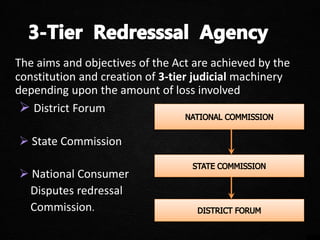
The aims and objectives of the Act are achieved by the
constitution and creation of 3-tier judicial machinery
depending upon the amount of loss involved
 District Forum
 State Commission
 National Consumer
Disputes redressal
Commission.
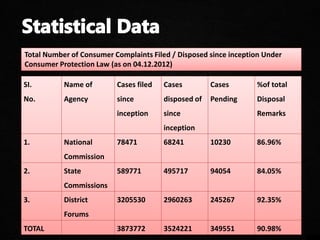
SI.
No.
Name of
Agency
Cases filed
since
inception
Cases
disposed of
since
inception
Cases
Pending
%of total
Disposal
Remarks
1. National
Commission
78471 68241 10230 86.96%
2. State
Commissions
589771 495717 94054 84.05%
3. District
Forums
3205530 2960263 245267 92.35%
TOTAL 3873772 3524221 349551 90.98%
Total Number of Consumer Complaints Filed / Disposed since inception Under
Consumer Protection Law (as on 04.12.2012)
• Buying quality products at reasonable price.
• To check the weights and measures before
making purchases.
• Reading the label carefully.
• Beware of false and attractive
advertisements.
• Beware of misleading schemes.
• To procure the bill, cash received
warranty, etc.
• Buying from reputed shops
• Don't make purchases from black market
• To buy standardized product
• To use a product as per the instruction of
the manufacturer
• Knowledge of consumer rights
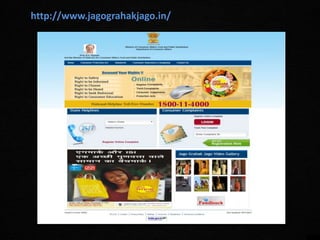
http://www.jagograhakjago.in/
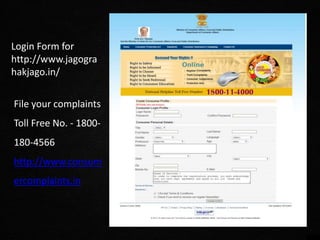
Login Form for
http://www.jagogra
hakjago.in/
File your complaints
Toll Free No. - 1800-
180-4566
http://www.consum
ercomplaints.in
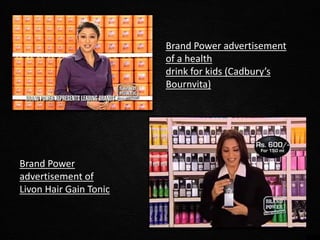
Brand Power advertisement
of a health
drink for kids (Cadbury’s
Bournvita)
Brand Power
advertisement of
Livon Hair Gain Tonic
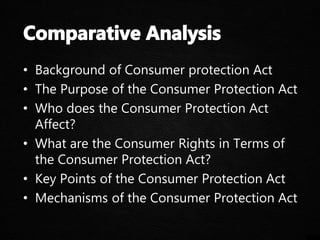
• Background of Consumer protection Act
• The Purpose of the Consumer Protection Act
• Who does the Consumer Protection Act
Affect?
• What are the Consumer Rights in Terms of
the Consumer Protection Act?
• Key Points of the Consumer Protection Act
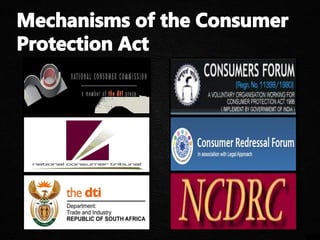
• Mechanisms of the Consumer Protection Act
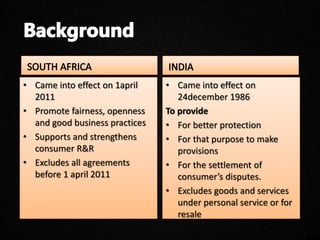
• Came into effect on 1april
2011
• Promote fairness, openness
and good business practices
• Supports and strengthens
consumer R&R
• Excludes all agreements
before 1 april 2011
• Came into effect on
24december 1986
To provide
• For better protection
• For that purpose to make
provisions
• For the settlement of
consumer’s disputes.
• Excludes goods and services
under personal service or for
resale
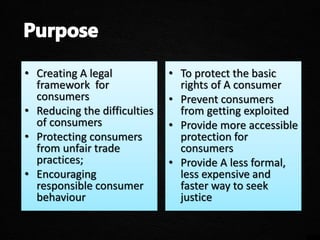
• Creating A legal
framework for
consumers
• Reducing the difficulties
of consumers
• Protecting consumers
from unfair trade
practices;
• Encouraging
responsible consumer
behaviour
• To protect the basic
rights of A consumer
• Prevent consumers
from getting exploited
• Provide more accessible
protection for
consumers
• Provide A less formal,
less expensive and
faster way to seek
justice
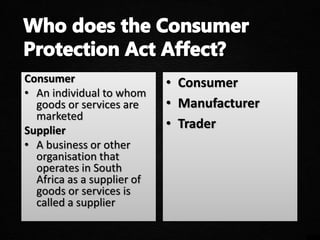
Consumer
• An individual to whom
goods or services are
marketed
Supplier
• A business or other
organisation that
operates in South
Africa as a supplier of
goods or services is
called a supplier
• Consumer
• Manufacturer
• Trader
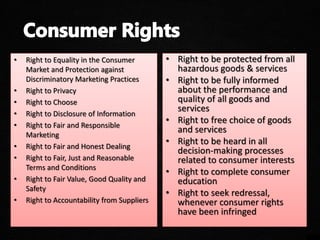
• Right to Equality in the Consumer
Market and Protection against
Discriminatory Marketing Practices
• Right to Privacy
• Right to Choose
• Right to Disclosure of Information
• Right to Fair and Responsible
Marketing
• Right to Fair and Honest Dealing
• Right to Fair, Just and Reasonable
Terms and Conditions
• Right to Fair Value, Good Quality and
Safety
• Right to Accountability from Suppliers
• Right to be protected from all
hazardous goods & services
• Right to be fully informed
about the performance and
quality of all goods and
services
• Right to free choice of goods
and services
• Right to be heard in all
decision-making processes
related to consumer interests
• Right to complete consumer
education
• Right to seek redressal,
whenever consumer rights
have been infringed
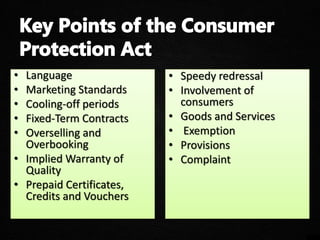
• Language
• Marketing Standards
• Cooling-off periods
• Fixed-Term Contracts
• Overselling and
Overbooking
• Implied Warranty of
Quality
• Prepaid Certificates,
Credits and Vouchers
• Speedy redressal
• Involvement of
consumers
• Goods and Services
• Exemption
• Provisions
• Complaint
• Company :- Sony
Ericson
• Consumer:- Rutu
Ladage
• Problem
Consumer Right
Compensation
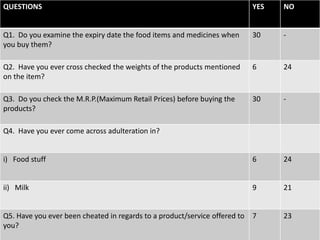
QUESTIONS YES NO
Q1. Do you examine the expiry date the food items and medicines when
you buy them?
30 -
Q2. Have you ever cross checked the weights of the products mentioned
on the item?
6 24
Q3. Do you check the M.R.P.(Maximum Retail Prices) before buying the
products?
30 -
Q4. Have you ever come across adulteration in?
i) Food stuff 6 24
ii) Milk 9 21
Q5. Have you ever been cheated in regards to a product/service offered to
you?
7 23
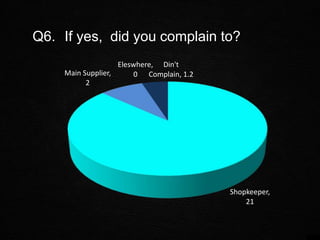
Q6. If yes, did you complain to?
Shopkeeper,
21
Main Supplier,
2
Eleswhere,
0
Din't
Complain, 1.2
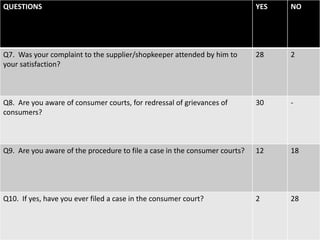
QUESTIONS YES NO
Q7. Was your complaint to the supplier/shopkeeper attended by him to
your satisfaction?
28 2
Q8. Are you aware of consumer courts, for redressal of grievances of
consumers?
30 -
Q9. Are you aware of the procedure to file a case in the consumer courts? 12 18
Q10. If yes, have you ever filed a case in the consumer court? 2 28
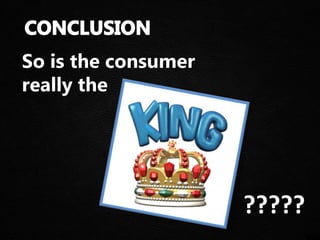
So is the consumer
really the
?????
• Providing Consumer Education
• Adulteration
• Building Pressure On Government
• Arranging Consumer Protection
Programmes or Organising Public
Opinion
• Providing Guidance To Consumer
• Misleading advertisement
• http://www.ummid.com/news/2014/January/10.01.2014/sc-
on-onion-price.html#sthash.natkhtap.dpuf
• http://www.medindia.net/indian_health_act/consumer_protect
ion_act_and_medical_profession_consumer_disputes_redressal
_agencies.htm#ixzz2s4jBl9QE
• http://indiankanoon.in/doc/1819218/
• http://pib.nic.in/newsite/erelease.aspx?relid=79338
• http://dc-siwan.bih.nic.in/Consumer_Act.pdf
• Consumer Protection » Center for Finance, Law & Policy |
Boston University
• http://nvonews.com/2011/01/19/%E2%80%98jago-grahak-
jago%E2%80%99-%E2%80%93-an-initiative-towards-
consumer-education-and-awareness/

NEED FOR CONSUMER PROTECTION ACT IN AN ERA OF FREE COMPETITION WHERE ‘CONSUMER IS A KING’

  • 3.
    To provide Consumer is.. •Most powerful motivation force • Equally liable to penalties Applicable to Excludes
  • 4.
    • Illiteracy andIgnorance • Unorganized Consumers • Spurious Goods • Deceptive Advertising • Malpractices of Businessmen • Freedom of Enterprise • Legitimacy for Existence • Trusteeship
  • 5.
    • To protectthe basic rights of a consumer • Not to provide a loophole and excuses • Educating the consumer Regarding their rights To propagate awareness about the act and the ethical practices
  • 6.
    The Act appliesto all goods and services unless specially exempted by Union Government It covers all sectors Provisions of the Act are compensatory in nature It envisages establishment of consumer protection councils Provisions of this act are in addition to and not in derogation of the provisions of any other act.
  • 7.
    • Complainant • Complaint •Consumer • Consumer dispute • Defect • Deficiency • Goods • Manufacturer • Service • Trader
  • 8.
    • Eg: Brazil,Kenya, India, United Kingdom, Nicaragua and Peru among others.
  • 9.
    • Freedom ofchoice Example- 1.online shopping 2.Ford model T • Rational decisions example- 1.Return on investment, Technological evaluation, Business Expansion 2. Sportswear • large number of firms- homogenous product. Example- 1.Pepsi and Coke 2.Smartphone Companies
  • 10.
    • Easy entryand exit (low “barriers to entry”) Example- 1. Telecommunications, energy 2. Consulting, education 3. Hotels, ironworks 4. Retail, electronic commerce • The actions of an individual firm have little to no effect on market price. Example- 1.Nokia
  • 11.
     It cameinto force on 1st July 1930.  Excludes State of Jammu & Kashmir. Contract of sale (Section5) • A contract of sale is made by an offer to buy or sell goods for a price and the acceptance of such offer • a contract of sale • may be made in writing or • by word of mouth or • or partly in writing and partly by word of mouth • Eg:- customer and salesperson
  • 12.
    “Essential commodity" meansany of the following classes of commodities :- (1) cattle fodder, including oilcakes and other concentrates; (2) coal, including coke and other derivatives; (3) component parts and accessories of automobiles; (4) cotton and woolen textiles; (4.A) drugs. This act provides, in the interest of the general public, for the control of the production, supply of distribution of, and trade and commerce in certain commodities.
  • 13.
    • Don't eatonions, prices will dip • Fruits and veggies no longer taxable(Assam) Supreme court Petitioner Vishnu Pratap Singh Langawat Agricultural Produce Marketing Committee Act, 1972 State government
  • 14.
    • The Actcame into effect from 1st June, 1955. • Food being one of the essentials – proper health • The main objective was to protect the public from poisonous and harmful foods • Access to pure, nutritious food, free from any type of adulteration – right of every citizen • Case Study Amul fined ₹5000 for selling with wrong info Kaira District Co- operative Milk Producers' Markets under Amul 1 yr Imprisonment to Ashok Patel
  • 15.
     Aims atintroducing standards in relation to weights and measures used in trade and commerce.  Objectives – Establish standards of weights and measures. – Regulate inter-state trade or commerce Manufacture/sale/distribution Penal provisions • A fine of ₹500/- to ₹1000 • And imprisonment up to seven years Eg:-Bisleri(1 ltr and 800 ml)
  • 17.
    • Right tosafety • Right to be choose • Right to be heard
  • 18.
    • Right tobe informed Customer care number for any complaints on quality of the product Nutritional facts about the products Packaging and expiry date is mentioned & also the price Standard followed- bar code (right to safety) Standard weight is mentioned
  • 19.
    • Right toseek redresssal • Right to consumer education
  • 20.
    • OBJECTIVES OFTHE ACT  Greater Transparency .  Informed Citizenry for promotion.  Improvement in Accountability and performance  Reduction in Corruption
  • 21.
    SECTION 6 :REQUEST FOR INFORMATION : Steps:  Make a request • In writing or • Through electronic means • In English/Hindi/regional language SECTION 8 : INFORMATION THAT CANNOT BE GIVEN  There shall be no obligation to give any citizen Information:- • disclosure of which would affect the sovereignty and integrity of India. • which is forbidden to be published by any court of law or tribunal. • the disclosure of which would cause a breach of privilege of parliament or the state legislature. • received in confidence from foreign government
  • 22.
    The central orstate commission:-  Penalty of ₹250 is imposed each day till application is received  Total amount shall not exceed ₹25000  Recommend for disciplinary action against 1. The central public information officer or 2. The state public information officer  As the case may be, under the service rules applicable to him.
  • 23.
    • Hospital Authorityfined 25K under RTI (1) – Mumbai • Corruption in passport office – New Delhi
  • 24.
    • The Actpostulates establishment of Consumer Protection Councils for the purpose of spreading consumer awareness. • Central level- central consumer protection council & State level- state consumer protection council. • To promote and protect all the rights mentioned above of consumers.
  • 25.
    The aims andobjectives of the Act are achieved by the constitution and creation of 3-tier judicial machinery depending upon the amount of loss involved  District Forum  State Commission  National Consumer Disputes redressal Commission.
  • 26.
    SI. No. Name of Agency Cases filed since inception Cases disposedof since inception Cases Pending %of total Disposal Remarks 1. National Commission 78471 68241 10230 86.96% 2. State Commissions 589771 495717 94054 84.05% 3. District Forums 3205530 2960263 245267 92.35% TOTAL 3873772 3524221 349551 90.98% Total Number of Consumer Complaints Filed / Disposed since inception Under Consumer Protection Law (as on 04.12.2012)
  • 27.
    • Buying qualityproducts at reasonable price. • To check the weights and measures before making purchases. • Reading the label carefully. • Beware of false and attractive advertisements. • Beware of misleading schemes.
  • 28.
    • To procurethe bill, cash received warranty, etc. • Buying from reputed shops • Don't make purchases from black market • To buy standardized product • To use a product as per the instruction of the manufacturer • Knowledge of consumer rights
  • 31.
  • 32.
    Login Form for http://www.jagogra hakjago.in/ Fileyour complaints Toll Free No. - 1800- 180-4566 http://www.consum ercomplaints.in
  • 34.
    Brand Power advertisement ofa health drink for kids (Cadbury’s Bournvita) Brand Power advertisement of Livon Hair Gain Tonic
  • 36.
    • Background ofConsumer protection Act • The Purpose of the Consumer Protection Act • Who does the Consumer Protection Act Affect? • What are the Consumer Rights in Terms of the Consumer Protection Act? • Key Points of the Consumer Protection Act • Mechanisms of the Consumer Protection Act
  • 37.
    • Came intoeffect on 1april 2011 • Promote fairness, openness and good business practices • Supports and strengthens consumer R&R • Excludes all agreements before 1 april 2011 • Came into effect on 24december 1986 To provide • For better protection • For that purpose to make provisions • For the settlement of consumer’s disputes. • Excludes goods and services under personal service or for resale
  • 38.
    • Creating Alegal framework for consumers • Reducing the difficulties of consumers • Protecting consumers from unfair trade practices; • Encouraging responsible consumer behaviour • To protect the basic rights of A consumer • Prevent consumers from getting exploited • Provide more accessible protection for consumers • Provide A less formal, less expensive and faster way to seek justice
  • 39.
    Consumer • An individualto whom goods or services are marketed Supplier • A business or other organisation that operates in South Africa as a supplier of goods or services is called a supplier • Consumer • Manufacturer • Trader
  • 40.
    • Right toEquality in the Consumer Market and Protection against Discriminatory Marketing Practices • Right to Privacy • Right to Choose • Right to Disclosure of Information • Right to Fair and Responsible Marketing • Right to Fair and Honest Dealing • Right to Fair, Just and Reasonable Terms and Conditions • Right to Fair Value, Good Quality and Safety • Right to Accountability from Suppliers • Right to be protected from all hazardous goods & services • Right to be fully informed about the performance and quality of all goods and services • Right to free choice of goods and services • Right to be heard in all decision-making processes related to consumer interests • Right to complete consumer education • Right to seek redressal, whenever consumer rights have been infringed
  • 41.
    • Language • MarketingStandards • Cooling-off periods • Fixed-Term Contracts • Overselling and Overbooking • Implied Warranty of Quality • Prepaid Certificates, Credits and Vouchers • Speedy redressal • Involvement of consumers • Goods and Services • Exemption • Provisions • Complaint
  • 43.
    • Company :-Sony Ericson • Consumer:- Rutu Ladage • Problem Consumer Right Compensation
  • 44.
    QUESTIONS YES NO Q1.Do you examine the expiry date the food items and medicines when you buy them? 30 - Q2. Have you ever cross checked the weights of the products mentioned on the item? 6 24 Q3. Do you check the M.R.P.(Maximum Retail Prices) before buying the products? 30 - Q4. Have you ever come across adulteration in? i) Food stuff 6 24 ii) Milk 9 21 Q5. Have you ever been cheated in regards to a product/service offered to you? 7 23
  • 45.
    Q6. If yes,did you complain to? Shopkeeper, 21 Main Supplier, 2 Eleswhere, 0 Din't Complain, 1.2
  • 46.
    QUESTIONS YES NO Q7.Was your complaint to the supplier/shopkeeper attended by him to your satisfaction? 28 2 Q8. Are you aware of consumer courts, for redressal of grievances of consumers? 30 - Q9. Are you aware of the procedure to file a case in the consumer courts? 12 18 Q10. If yes, have you ever filed a case in the consumer court? 2 28
  • 47.
    So is theconsumer really the ?????
  • 48.
    • Providing ConsumerEducation • Adulteration • Building Pressure On Government • Arranging Consumer Protection Programmes or Organising Public Opinion • Providing Guidance To Consumer • Misleading advertisement
  • 50.
    • http://www.ummid.com/news/2014/January/10.01.2014/sc- on-onion-price.html#sthash.natkhtap.dpuf • http://www.medindia.net/indian_health_act/consumer_protect ion_act_and_medical_profession_consumer_disputes_redressal _agencies.htm#ixzz2s4jBl9QE •http://indiankanoon.in/doc/1819218/ • http://pib.nic.in/newsite/erelease.aspx?relid=79338 • http://dc-siwan.bih.nic.in/Consumer_Act.pdf • Consumer Protection » Center for Finance, Law & Policy | Boston University • http://nvonews.com/2011/01/19/%E2%80%98jago-grahak- jago%E2%80%99-%E2%80%93-an-initiative-towards- consumer-education-and-awareness/