CONSUMER PROTECTION
PREPARED
BY
SOWNDARYA SHREE A.S
INTRODUCTION
 Safeguarding the buyers of goods & services
against unfair trade practices in market
areas.
 We (consumer) must be aware about our
rights and duties.
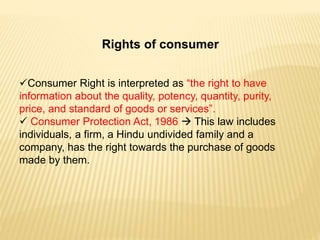
Rights of consumer
Consumer Right is interpreted as “the right to have
information about the quality, potency, quantity, purity,
price, and standard of goods or services”.
 Consumer Protection Act, 1986  This law includes
individuals, a firm, a Hindu undivided family and a
company, has the right towards the purchase of goods
made by them.
John F. Kennedy’s view on Consumer Rights
The former president of U.S.A Mr. John F. Kennedy defined
the basic consumer rights as:
The Right of Safety
The Right to be informed
 The Right to choose
 The Right to be heard
1.Right to safety:
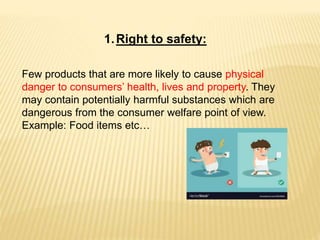
Few products that are more likely to cause physical
danger to consumers’ health, lives and property. They
may contain potentially harmful substances which are
dangerous from the consumer welfare point of view.
Example: Food items etc…
2. Right to be Informed:
Advertising and labeling on the package should provide
objective information to buyers. The package should
contain the full details about the name of the product,
composition, dosage, date of manufacturing, date of
expiry, batch number, warnings, antidote etc.
3. Right to choose:
Consumer satisfaction can be increased by giving the
consumer the widest choice. Choice means offering the
widest range of products in quality and brand varieties at
reasonable prices. In short consumers should have
access to varieties of goods in terms of colour, quality,
design, size etc.
4. Right to be heard:
If consumer feels he / she exploited in the market have
the rights to approach a consumer Court to voice his
complaint. The rights give him/ her a due respect that
complaint will be heard.
5. Right to seek redressal:
The complaints and protests are not just to be heard
but the aggrieved party is to be granted compensation
within a reasonable time period . There should be
prompt settlement of complaints and claims lodged by
the aggrieved customers. There should be fair and just
settlement of deserving claims in a definite timeframe.
6. Right to consumer education:
The consumer has a right to acquire knowledge
and stay well-informed all through his life. He
should be aware about his rights and the reliefs
granted to him where a product or service falls
short of his expectations.
7. Right to basic needs:
Every consumer has a right to get basic necessities
of life such as food, clothing and water, and right to
pure and healthy environment. It is the latest addition
to consumer bill of rights. Community life should be
free from various modes of pollution. This will
enhance the quality of human life.
DUTIES OF CONSUMER
 Buying quality products at fair price
 check the weights and measurement before buying the products.
 Misleading schemes
 Beware of fake advertisements
 Ensuring the receipt of cash bills
 Read the label carefully
 Buying from reputed shops
 Never purchase from black market
 Buying standardized products (Bench marking)
 Follow the instruction of manufacturer
RESPONSIBILITIES OF CONSUMER
Consumers should keep in mind their
responsibilities while purchasing, using and
consuming goods and services. Rights and
responsibilities are two sides of the same
coin. Just as consumers enjoy certain rights,
they owe certain responsibilities.
LIST OF RESPONSIBILITIES
 Buying quality products at reasonable price.
 Delivering goods at right time to consumer.
 consumer has to bear any loss.
 Delay payments consumer has to pay Interest
 Consumer has to follow the instruction as per the details
given in the products. (complete information)
 Consumer must collect cash receipt bill (includes
warranty date, stamp of seller and signature of bearer)
 The consumer should never compromise on the quality of
goods. The consumers must watch for ISI, Agmark, FPO,
the standard quality certification marks and the like in the
label.
Consumer protection

Consumer protection

  • 1.
  • 2.
    INTRODUCTION  Safeguarding thebuyers of goods & services against unfair trade practices in market areas.  We (consumer) must be aware about our rights and duties.
  • 4.
    Rights of consumer ConsumerRight is interpreted as “the right to have information about the quality, potency, quantity, purity, price, and standard of goods or services”.  Consumer Protection Act, 1986  This law includes individuals, a firm, a Hindu undivided family and a company, has the right towards the purchase of goods made by them.
  • 5.
    John F. Kennedy’sview on Consumer Rights The former president of U.S.A Mr. John F. Kennedy defined the basic consumer rights as: The Right of Safety The Right to be informed  The Right to choose  The Right to be heard
  • 6.
    1.Right to safety: Fewproducts that are more likely to cause physical danger to consumers’ health, lives and property. They may contain potentially harmful substances which are dangerous from the consumer welfare point of view. Example: Food items etc…
  • 7.
    2. Right tobe Informed: Advertising and labeling on the package should provide objective information to buyers. The package should contain the full details about the name of the product, composition, dosage, date of manufacturing, date of expiry, batch number, warnings, antidote etc.
  • 8.
    3. Right tochoose: Consumer satisfaction can be increased by giving the consumer the widest choice. Choice means offering the widest range of products in quality and brand varieties at reasonable prices. In short consumers should have access to varieties of goods in terms of colour, quality, design, size etc.
  • 9.
    4. Right tobe heard: If consumer feels he / she exploited in the market have the rights to approach a consumer Court to voice his complaint. The rights give him/ her a due respect that complaint will be heard.
  • 10.
    5. Right toseek redressal: The complaints and protests are not just to be heard but the aggrieved party is to be granted compensation within a reasonable time period . There should be prompt settlement of complaints and claims lodged by the aggrieved customers. There should be fair and just settlement of deserving claims in a definite timeframe.
  • 11.
    6. Right toconsumer education: The consumer has a right to acquire knowledge and stay well-informed all through his life. He should be aware about his rights and the reliefs granted to him where a product or service falls short of his expectations.
  • 12.
    7. Right tobasic needs: Every consumer has a right to get basic necessities of life such as food, clothing and water, and right to pure and healthy environment. It is the latest addition to consumer bill of rights. Community life should be free from various modes of pollution. This will enhance the quality of human life.
  • 14.
    DUTIES OF CONSUMER Buying quality products at fair price  check the weights and measurement before buying the products.  Misleading schemes  Beware of fake advertisements  Ensuring the receipt of cash bills  Read the label carefully  Buying from reputed shops  Never purchase from black market  Buying standardized products (Bench marking)  Follow the instruction of manufacturer
  • 16.
    RESPONSIBILITIES OF CONSUMER Consumersshould keep in mind their responsibilities while purchasing, using and consuming goods and services. Rights and responsibilities are two sides of the same coin. Just as consumers enjoy certain rights, they owe certain responsibilities.
  • 17.
    LIST OF RESPONSIBILITIES Buying quality products at reasonable price.  Delivering goods at right time to consumer.  consumer has to bear any loss.  Delay payments consumer has to pay Interest  Consumer has to follow the instruction as per the details given in the products. (complete information)  Consumer must collect cash receipt bill (includes warranty date, stamp of seller and signature of bearer)  The consumer should never compromise on the quality of goods. The consumers must watch for ISI, Agmark, FPO, the standard quality certification marks and the like in the label.