Consumer and Consumerism
By Ekta Kapri
Content
• Related terminology
• Consumer definition
• Types of consumer
• Factors affecting consumer behavior
• Consumerism introduction
• Consumerism definition
• Consumerism in India
• Gained moment
• Component of consumerism
• conclusion
Related terminology
• Consumer
• Buyer
• Consumption
• Manufacturer/producer
• Production
• Utility
• Market
• Marketing
• Price
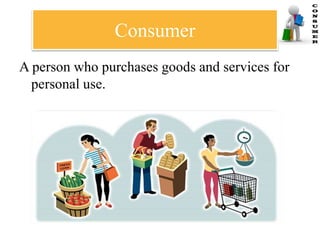
Consumer
A person who purchases goods and services for
personal use.
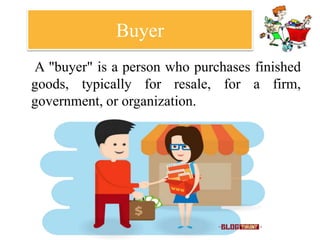
Buyer
A "buyer" is a person who purchases finished
goods, typically for resale, for a firm,
government, or organization.
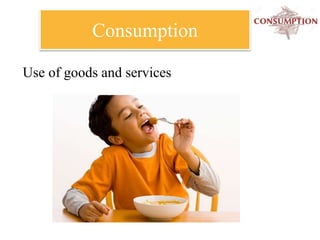
Consumption
Use of goods and services
Manufacturer/producer
A person or company that makes goods for sale.
Or
A person who supervises or finances a work (such as a
staged or recorded performance) for exhibition or
dissemination to the public
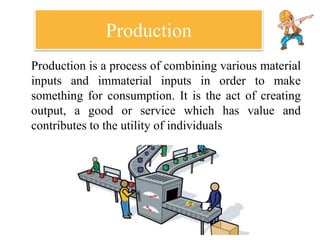
Production
Production is a process of combining various material
inputs and immaterial inputs in order to make
something for consumption. It is the act of creating
output, a good or service which has value and
contributes to the utility of individuals
Utility
-is want satisfying power of the commodity.
Or
-Of being the practical use
Market
A market is a medium that allows buyers and sellers of
a specific good or service to interact in order to
facilitate an exchange.
Or
It is the place where the transaction take place between
the buyer and seller.
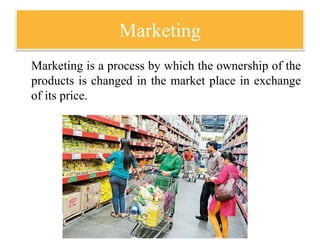
Marketing
Marketing is a process by which the ownership of the
products is changed in the market place in exchange
of its price.
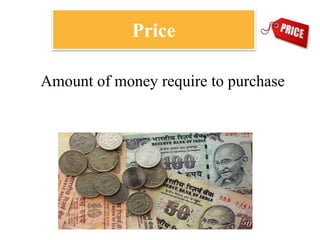
Price
Amount of money require to purchase
A consumer is the ultimate user of goods and
services. Thus everyone is a consumer in one-
way or the other.
Consumer create demand for the variety of
materials like food, clothing, furniture,
equipment etc.
Every buyer may not be user of that product
thus all buyer are consumer of something but
all consumer are not necessarily buyer of that
product.
Under Consumer Protection Act (CPA 1986): the
term consumer has been defined separately for
the purpose of goods and services as follows:
A} for the purpose of goods
- One who buys any good
- One who use any good
B} for the purpose of the services
- One who heirs any services
- One who use such services
1. Personal consumer
2. Organizational consumer
3. Green consumer
4. Rational consumer
5. Habitual consumer
6. Impulsive consumer
The person who buy goods and services for his
own use.
The institution or organization or private
business which buys products, equipment and
services in order to run the organization
successfully and smoothly, either for profit or
non-profit.
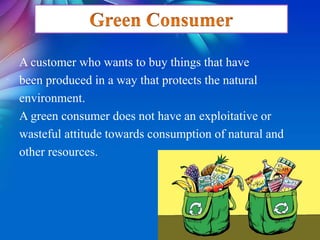
A customer who wants to buy things that have
been produced in a way that protects the natural
environment.
A green consumer does not have an exploitative or
wasteful attitude towards consumption of natural and
other resources.
A rational consumer is considered to be that person who makes
rational consumption decisions. In other words, the consumer
who makes his choices after considering all the other
alternative goods (and services) available in the market is
called a rational consumer.
A rational consumer should make a choice in such a way it gives
maximum utility and satisfaction.
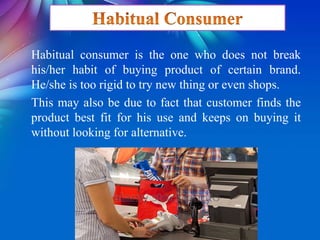
Habitual consumer is the one who does not break
his/her habit of buying product of certain brand.
He/she is too rigid to try new thing or even shops.
This may also be due to fact that customer finds the
product best fit for his use and keeps on buying it
without looking for alternative.
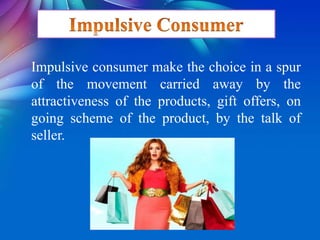
Impulsive consumer make the choice in a spur
of the movement carried away by the
attractiveness of the products, gift offers, on
going scheme of the product, by the talk of
seller.
FACTORS AFFECTING CONSUMER BEHAVIOR
1. Cultural factors
Consumer behaviour is deeply influenced by
cultural factors, such as buyer’s culture,
subculture and social class.
2. Social factors
Social factors also influence the purchasing
behaviour of consumers. Social factors are:
the reference groups, family, the role and
status.
3. Personal factors
Personal factors may also affect consumer
behaviour. Some of the important factors that
influence personal buying behaviour are: lifestyle,
economic status, occupation, age, personality and
self esteem.
4. Psychological factors
There are four major psychological factors that
affect the purchasing behaviour of consumers.
These are: perception, motivation, learning,
beliefs and attitudes.
Consumerism
• Consumer is the king in the market is no longer true.
Consumer exploitation is not a new phenomenon. Consumers
are exploited by middlemen in the channel of distribution of
goods, in the form of charging high prices.
• Today, the market is flooded with goods of several kinds and
with their substitutes. Consumer is unable to make proper
choice of goods or products due to external attraction of
package , label, size and shapes of various products.
• This is also because of improper knowledge of consumers
about products which they intend to buy. Taking this as a
chance, many businessmen are capitalizing the ignorance of
consumers by charging high prices, supplying poor quality
products etc.
• Consumerism means, Organized-efforts by
individuals, groups, and governments to help
protect consumers from policies and practices
that infringe consumer rights to fair business
practices.
• According to Philip Kotler “Consumerism is a
social movement seeking to augment the rights
and powers of buyers in relation to sellers”.
• Consumerism is a social movement to inform
consumers so that, they can make
knowledgeable judgments regarding purchase
of good and services. It is a movement to take
corrective action against the misuse of both
market and political power held by the
suppliers of these goods.
The term “consumerism” identified the consumer
launched in 1950 by an activist Ralph Nader in
US and by US President John F. Kennedy, who
made effort to establish the right of consumer
viz., right to safety, to informed, to choose and to
be heard.
The movement encompasses a set of activities of the
government, business, independent organizations
and concerned to protect the rights of the
consumers.
In real sense, it is a response of people and
organizations to consumer problem and
dissatisfaction.
On 15 march 1962, J.F.Kennedy gave four
consumer right to their citizens.
-Right to safety
-Right to informed
-Right to choose
-Right to heard
Later International Organization of Consumer
Union (IOCU) gave
-Right to redress
-Right to healthy environment
-Right to education
Consumerism in India
Consumerism in India is backward due to following reasons
1. Short supply of many goods and services, especially of
essential items, is a very serious problem in front of the
Indian consumer. The demand-supply imbalance has
produced all the associated evils of profiteering, hoarding and
black-marketing, corruption, irresponsiveness and arrogance
towards consumers.
2. The Indian consumer is also the victim of lack of effective
or workable competition. Effective competition depends
also upon the general availability of essential information.
3. Many products with which consumers in
advanced countries are still new to a very large
segment of the Indian consumers. The unfamiliarity
of the consumers with product features makes the sale
of substandard, inferior or even defective products
easier in India than in advanced countries.
4. Due to low literacy levels and unsatisfactory
information flows, the Indian consumers, by and
large, are not conscious of all their rights.
5. The legal process in India is comparatively time-
consuming and cumbersome.
Consumerism however gained momentum in the
recent times due to following reasons
1. Spread of education making people aware of
their rights
2. Rising income and purchasing power of people
3. Rise in prices and expectation of better quality
4. Growing variety and complexity of products
5. Legislation for consumer protection creating an
awareness among consumers (Consumer
Councils)
COMPONENTS OF CONSUMERISM
First and foremost is self-protection by consumers. Consumer
must be aware of his rights, raise voice against exploitation
and seek redressal of his grievances. Consumers consciousness
determines the effectiveness of consumerism. It is the duty of
the consumer to identify his rights and to protect them.
1. Business Associations : Little attention from the business
will not only serve consumers interest but will also
benefit them. Regulation of business through legislation
is one of the important means of protecting the
consumers.
eg. Advertising Standards Council of India (ASCI)
(1985) has adopted a code for self-regulation in
advertising. It is a commitment to honest advertising and
to fair competition in the market-place. It stands for the
protection of the legitimate interests of consumers and all
concerned with advertising - advertisers, media,
advertising agencies and others who help in the creation
or placement of advertisements.
2. Voluntary Consumer Organisations engaged in organising
consumers and encouraging them to safeguard their interests is
another important element of consumer movement
Eg: Consumer Groups in India
• Voluntary Organization in Interest of Consumer Education (VOICE)
• Consumer Care Society
• Bombay Telephone Users' Association
• Civic Action Group (CAG)
• Consumer Guidance Society of India
• All India Chamber of Consumers (AICOC)
• Consumer Coordination Council
• Akhil Bhartiya Upbhokta Congress
• Consortium of South India Consumer Organisations (COSICO)
• Consumer Rights Education & Awareness Trust (CREAT)
• Indian Federation of Consumer Organizations (IFCO)
• Society for Civic Rights
• Grahak Shakti
3. Government Intervention: The government has enacted
nearly 50 laws which can be interpreted in favour of consumer.
Government of India has armed itself with a number of
statutory weapons to control the production, supply,
distribution, price and quality of a large number of goods and
services. It is empowered to regulate the terms and conditions
of sale, the nature of trade and commerce, etc. Some of such
acts have been as follows.
• Sale of Goods Act, 1930
• Agricultural Produce (Grading and Marketing) Act, 1937
• Industries (Development and Regulation) Act, 1951
• Prevention of Food Adulteration Act, 1954
• Essential Commodities Act, 1955
• Essential Service Maintenance Act, 1968
• Monopolies and Retributive Trade Practices
Act, 1969
• Standard to Weights and Measures Act, 1976
• Bureau of Indian Standard Act, 1986
• Environmental Protection Act, 1986
• Consumer Protection Act, 1986 etc.
However, consumer awareness through more
consumer education and actions by the
government, consumer activists, and
associations are needed the most to make
consumer protection movement a success in
the country.
Consumer and consumerism

Consumer and consumerism

  • 1.
  • 2.
    Content • Related terminology •Consumer definition • Types of consumer • Factors affecting consumer behavior • Consumerism introduction • Consumerism definition • Consumerism in India • Gained moment • Component of consumerism • conclusion
  • 3.
    Related terminology • Consumer •Buyer • Consumption • Manufacturer/producer • Production • Utility • Market • Marketing • Price
  • 4.
    Consumer A person whopurchases goods and services for personal use.
  • 5.
    Buyer A "buyer" isa person who purchases finished goods, typically for resale, for a firm, government, or organization.
  • 6.
  • 7.
    Manufacturer/producer A person orcompany that makes goods for sale. Or A person who supervises or finances a work (such as a staged or recorded performance) for exhibition or dissemination to the public
  • 8.
    Production Production is aprocess of combining various material inputs and immaterial inputs in order to make something for consumption. It is the act of creating output, a good or service which has value and contributes to the utility of individuals
  • 9.
    Utility -is want satisfyingpower of the commodity. Or -Of being the practical use
  • 10.
    Market A market isa medium that allows buyers and sellers of a specific good or service to interact in order to facilitate an exchange. Or It is the place where the transaction take place between the buyer and seller.
  • 11.
    Marketing Marketing is aprocess by which the ownership of the products is changed in the market place in exchange of its price.
  • 12.
    Price Amount of moneyrequire to purchase
  • 14.
    A consumer isthe ultimate user of goods and services. Thus everyone is a consumer in one- way or the other. Consumer create demand for the variety of materials like food, clothing, furniture, equipment etc. Every buyer may not be user of that product thus all buyer are consumer of something but all consumer are not necessarily buyer of that product.
  • 15.
    Under Consumer ProtectionAct (CPA 1986): the term consumer has been defined separately for the purpose of goods and services as follows: A} for the purpose of goods - One who buys any good - One who use any good B} for the purpose of the services - One who heirs any services - One who use such services
  • 16.
    1. Personal consumer 2.Organizational consumer 3. Green consumer 4. Rational consumer 5. Habitual consumer 6. Impulsive consumer
  • 17.
    The person whobuy goods and services for his own use.
  • 18.
    The institution ororganization or private business which buys products, equipment and services in order to run the organization successfully and smoothly, either for profit or non-profit.
  • 19.
    A customer whowants to buy things that have been produced in a way that protects the natural environment. A green consumer does not have an exploitative or wasteful attitude towards consumption of natural and other resources.
  • 20.
    A rational consumeris considered to be that person who makes rational consumption decisions. In other words, the consumer who makes his choices after considering all the other alternative goods (and services) available in the market is called a rational consumer. A rational consumer should make a choice in such a way it gives maximum utility and satisfaction.
  • 21.
    Habitual consumer isthe one who does not break his/her habit of buying product of certain brand. He/she is too rigid to try new thing or even shops. This may also be due to fact that customer finds the product best fit for his use and keeps on buying it without looking for alternative.
  • 22.
    Impulsive consumer makethe choice in a spur of the movement carried away by the attractiveness of the products, gift offers, on going scheme of the product, by the talk of seller.
  • 23.
    FACTORS AFFECTING CONSUMERBEHAVIOR 1. Cultural factors Consumer behaviour is deeply influenced by cultural factors, such as buyer’s culture, subculture and social class. 2. Social factors Social factors also influence the purchasing behaviour of consumers. Social factors are: the reference groups, family, the role and status.
  • 24.
    3. Personal factors Personalfactors may also affect consumer behaviour. Some of the important factors that influence personal buying behaviour are: lifestyle, economic status, occupation, age, personality and self esteem. 4. Psychological factors There are four major psychological factors that affect the purchasing behaviour of consumers. These are: perception, motivation, learning, beliefs and attitudes.
  • 25.
  • 26.
    • Consumer isthe king in the market is no longer true. Consumer exploitation is not a new phenomenon. Consumers are exploited by middlemen in the channel of distribution of goods, in the form of charging high prices. • Today, the market is flooded with goods of several kinds and with their substitutes. Consumer is unable to make proper choice of goods or products due to external attraction of package , label, size and shapes of various products. • This is also because of improper knowledge of consumers about products which they intend to buy. Taking this as a chance, many businessmen are capitalizing the ignorance of consumers by charging high prices, supplying poor quality products etc.
  • 27.
    • Consumerism means,Organized-efforts by individuals, groups, and governments to help protect consumers from policies and practices that infringe consumer rights to fair business practices. • According to Philip Kotler “Consumerism is a social movement seeking to augment the rights and powers of buyers in relation to sellers”.
  • 28.
    • Consumerism isa social movement to inform consumers so that, they can make knowledgeable judgments regarding purchase of good and services. It is a movement to take corrective action against the misuse of both market and political power held by the suppliers of these goods.
  • 29.
    The term “consumerism”identified the consumer launched in 1950 by an activist Ralph Nader in US and by US President John F. Kennedy, who made effort to establish the right of consumer viz., right to safety, to informed, to choose and to be heard. The movement encompasses a set of activities of the government, business, independent organizations and concerned to protect the rights of the consumers. In real sense, it is a response of people and organizations to consumer problem and dissatisfaction.
  • 30.
    On 15 march1962, J.F.Kennedy gave four consumer right to their citizens. -Right to safety -Right to informed -Right to choose -Right to heard Later International Organization of Consumer Union (IOCU) gave -Right to redress -Right to healthy environment -Right to education
  • 31.
    Consumerism in India Consumerismin India is backward due to following reasons 1. Short supply of many goods and services, especially of essential items, is a very serious problem in front of the Indian consumer. The demand-supply imbalance has produced all the associated evils of profiteering, hoarding and black-marketing, corruption, irresponsiveness and arrogance towards consumers. 2. The Indian consumer is also the victim of lack of effective or workable competition. Effective competition depends also upon the general availability of essential information.
  • 32.
    3. Many productswith which consumers in advanced countries are still new to a very large segment of the Indian consumers. The unfamiliarity of the consumers with product features makes the sale of substandard, inferior or even defective products easier in India than in advanced countries. 4. Due to low literacy levels and unsatisfactory information flows, the Indian consumers, by and large, are not conscious of all their rights. 5. The legal process in India is comparatively time- consuming and cumbersome.
  • 33.
    Consumerism however gainedmomentum in the recent times due to following reasons 1. Spread of education making people aware of their rights 2. Rising income and purchasing power of people 3. Rise in prices and expectation of better quality 4. Growing variety and complexity of products 5. Legislation for consumer protection creating an awareness among consumers (Consumer Councils)
  • 34.
    COMPONENTS OF CONSUMERISM Firstand foremost is self-protection by consumers. Consumer must be aware of his rights, raise voice against exploitation and seek redressal of his grievances. Consumers consciousness determines the effectiveness of consumerism. It is the duty of the consumer to identify his rights and to protect them.
  • 35.
    1. Business Associations: Little attention from the business will not only serve consumers interest but will also benefit them. Regulation of business through legislation is one of the important means of protecting the consumers. eg. Advertising Standards Council of India (ASCI) (1985) has adopted a code for self-regulation in advertising. It is a commitment to honest advertising and to fair competition in the market-place. It stands for the protection of the legitimate interests of consumers and all concerned with advertising - advertisers, media, advertising agencies and others who help in the creation or placement of advertisements.
  • 36.
    2. Voluntary ConsumerOrganisations engaged in organising consumers and encouraging them to safeguard their interests is another important element of consumer movement Eg: Consumer Groups in India • Voluntary Organization in Interest of Consumer Education (VOICE) • Consumer Care Society • Bombay Telephone Users' Association • Civic Action Group (CAG) • Consumer Guidance Society of India • All India Chamber of Consumers (AICOC) • Consumer Coordination Council • Akhil Bhartiya Upbhokta Congress • Consortium of South India Consumer Organisations (COSICO) • Consumer Rights Education & Awareness Trust (CREAT) • Indian Federation of Consumer Organizations (IFCO) • Society for Civic Rights • Grahak Shakti
  • 37.
    3. Government Intervention:The government has enacted nearly 50 laws which can be interpreted in favour of consumer. Government of India has armed itself with a number of statutory weapons to control the production, supply, distribution, price and quality of a large number of goods and services. It is empowered to regulate the terms and conditions of sale, the nature of trade and commerce, etc. Some of such acts have been as follows. • Sale of Goods Act, 1930 • Agricultural Produce (Grading and Marketing) Act, 1937 • Industries (Development and Regulation) Act, 1951 • Prevention of Food Adulteration Act, 1954 • Essential Commodities Act, 1955 • Essential Service Maintenance Act, 1968
  • 38.
    • Monopolies andRetributive Trade Practices Act, 1969 • Standard to Weights and Measures Act, 1976 • Bureau of Indian Standard Act, 1986 • Environmental Protection Act, 1986 • Consumer Protection Act, 1986 etc.
  • 39.
    However, consumer awarenessthrough more consumer education and actions by the government, consumer activists, and associations are needed the most to make consumer protection movement a success in the country.