Professor
Varsha Mam
Created By
Prathamesh
Navale
Definition & Motivation Process
Definition
“Motivation is an inner drive that reflects goal-directed arousal.
In consumer behavior context, the result is a desire for a
product, service, or experience. It is the drive to satisfy needs
and wants, both physiological and psychological, through the
purchase and use of products and services”.
MOTIVATION
PROCESS
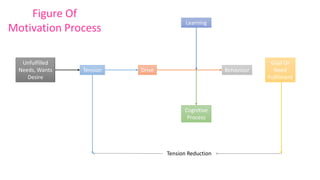
Unfulfilled
Needs, Wants
Desire
Tension Drive Behaviour
Goal Or
Need
Fulfilment
Learning
Cognitive
Process
Tension Reduction
Figure Of
Motivation Process
MASLOW’S
NEED
THEORY
Self- Actualization Needs
(Self Development)
Esteem Needs
(Prestige-Status)
Social Needs
(Sense of Belonging, Love)
Safety Needs
(Security)
Physiological Needs
(Food, Water, Shelter, Clothing)
Maslow Theory of Hierarchy of Needs:
This theory classifies motives into five
groupings and suggests the degree to
which each would influence behaviour.
The classification divides need of an
individual across the following
categories: Physiological, safety,
belongingness & love, self-esteem and
lastly, self-actualization.
While the physiological motives would have the greatest influence on behaviour until they are adequately satisfied. Once each
level of need is taken care of, the individual is likely to seek the next potent motive, graduating all through the top of the pyramid
of needs drawn above.
 Physiological Needs : These form the most dominant needs as they are key for basic survival. They include food, clothing
and shelter. If these are not satisfied, the person cannot function optimally. Potential Example : The ‘Meri Masala Maggi’
campaign that features faces of real-life customers on pack.
 Safety Needs : Once physiological needs are satisfied, one looks for security and safety and that becomes the driving force
of survival. This includes stability/ control over one’s life. Potential Example : LIC ‘Zindagi ke saath bhi, Zindagi ke baad bhi’
 Social Needs : People seek relationships with other people to feel a sense of belonging, that also adds a stronger purpose
for living. Potential Example : LinkedIn’s ‘In It Together’ campaign that talks about belonging from a professional network
point of view.
 Esteem Needs : This category of needs satisfies the ego at large. It helps one gain social status/prestige and helps build an
image either for self or the larger world. Potential Example : Royal Stag Music’s ‘Make it Large’ campaign.
 Self- Actualization Needs : Self-actualization is achieved when you’re able to reach your full potential. It is about
experiencing the feeling of being limitless. Most people do not reach this stage of needs as they are busy meeting pressing
needs. Potential Example : Nike’s ‘Find your Greatness’ campaign illustrates this beautifully.
McClelland’s Theory
of
Need Achievement
Power
Affiliation
Achievement
McClelland identified three motivators that he believed we all have: a need for achievement, a need for
affiliation, and a need for power. People will have different characteristics depending on their dominant
motivator. According to him, these motivators are learned (which is why this theory is sometimes called
the Learned Needs Theory) and he says that, regardless of our gender, culture, or age, we all have three
motivating drivers, and one of these will be our dominant motivating driver at each phase in life. This
dominant motivator is largely dependent on our culture and life experiences:
 Need for Achievement: People motivated by achievement need challenging, but not impossible,
projects. They thrive on overcoming difficult problems or situations.
 Need for Affiliation: People motivated by affiliation work best in a group environment, versus
working alone, whenever possible as they constantly seek social validation and warmth/affection.
They also don't like uncertainty and risk. These people often don't want to stand out.
 Need for Power: Those with a high need for power work best when they're in charge of situations
as they enjoy competition. They do well with goal-oriented tasks and are very effective in
negotiations. They like to stand out/get attention at all times.
Thank
You !

Consumer Motivation

  • 1.
  • 2.
  • 3.
    Definition & MotivationProcess Definition “Motivation is an inner drive that reflects goal-directed arousal. In consumer behavior context, the result is a desire for a product, service, or experience. It is the drive to satisfy needs and wants, both physiological and psychological, through the purchase and use of products and services”.
  • 4.
  • 5.
    Unfulfilled Needs, Wants Desire Tension DriveBehaviour Goal Or Need Fulfilment Learning Cognitive Process Tension Reduction Figure Of Motivation Process
  • 6.
  • 7.
    Self- Actualization Needs (SelfDevelopment) Esteem Needs (Prestige-Status) Social Needs (Sense of Belonging, Love) Safety Needs (Security) Physiological Needs (Food, Water, Shelter, Clothing) Maslow Theory of Hierarchy of Needs: This theory classifies motives into five groupings and suggests the degree to which each would influence behaviour. The classification divides need of an individual across the following categories: Physiological, safety, belongingness & love, self-esteem and lastly, self-actualization.
  • 8.
    While the physiologicalmotives would have the greatest influence on behaviour until they are adequately satisfied. Once each level of need is taken care of, the individual is likely to seek the next potent motive, graduating all through the top of the pyramid of needs drawn above.  Physiological Needs : These form the most dominant needs as they are key for basic survival. They include food, clothing and shelter. If these are not satisfied, the person cannot function optimally. Potential Example : The ‘Meri Masala Maggi’ campaign that features faces of real-life customers on pack.  Safety Needs : Once physiological needs are satisfied, one looks for security and safety and that becomes the driving force of survival. This includes stability/ control over one’s life. Potential Example : LIC ‘Zindagi ke saath bhi, Zindagi ke baad bhi’  Social Needs : People seek relationships with other people to feel a sense of belonging, that also adds a stronger purpose for living. Potential Example : LinkedIn’s ‘In It Together’ campaign that talks about belonging from a professional network point of view.  Esteem Needs : This category of needs satisfies the ego at large. It helps one gain social status/prestige and helps build an image either for self or the larger world. Potential Example : Royal Stag Music’s ‘Make it Large’ campaign.  Self- Actualization Needs : Self-actualization is achieved when you’re able to reach your full potential. It is about experiencing the feeling of being limitless. Most people do not reach this stage of needs as they are busy meeting pressing needs. Potential Example : Nike’s ‘Find your Greatness’ campaign illustrates this beautifully.
  • 9.
  • 10.
  • 11.
    McClelland identified threemotivators that he believed we all have: a need for achievement, a need for affiliation, and a need for power. People will have different characteristics depending on their dominant motivator. According to him, these motivators are learned (which is why this theory is sometimes called the Learned Needs Theory) and he says that, regardless of our gender, culture, or age, we all have three motivating drivers, and one of these will be our dominant motivating driver at each phase in life. This dominant motivator is largely dependent on our culture and life experiences:  Need for Achievement: People motivated by achievement need challenging, but not impossible, projects. They thrive on overcoming difficult problems or situations.  Need for Affiliation: People motivated by affiliation work best in a group environment, versus working alone, whenever possible as they constantly seek social validation and warmth/affection. They also don't like uncertainty and risk. These people often don't want to stand out.  Need for Power: Those with a high need for power work best when they're in charge of situations as they enjoy competition. They do well with goal-oriented tasks and are very effective in negotiations. They like to stand out/get attention at all times.
  • 12.