© B.Moghimi@yahoo.co.uk 
1
Prof. Bahman Moghimi 
Doctor of Business Administration 
Master of Industrial Marketing & E-commerce 
University of Georgia. Tbilisi 
Source: Michael R. Solomon. 9e 
B.Moghimi@yahoo.co.uk
Chapter Objectives 
When you finish this chapter, you should understand why: 
• The self-concept strongly influences consumer behavior. 
• Products often play a pivotal role in defining the self-concept. 
• Sex-role identity is different from gender, and society’s expectations 
of masculinity and femininity help to determine the products we buy 
to be consistent with these expectations. 
• A person’s sex-role identity is a major component of self-definition. The 
media plays a key role in teaching us how to behave as “proper” males and 
females. 
• The way we think about our bodies (and the way our culture tells us we 
should think) is a key component of self-esteem. 
© B.Moghimi@yahoo.co.uk 3
Perspectives on the Self 
• We buy products to highlight/hide aspects of the self 
• Eastern cultures focus on: 
• The collective self (person’s identity comes from group) 
• The interdependent self (person’s identity defined from 
relationships with others) 
• Western cultures focus on: 
• Individuality 
• Individual appearance 
© B.Moghimi@yahoo.co.uk 4
Self-Concept 
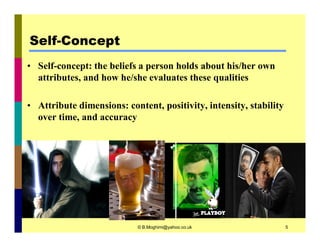
• Self-concept: the beliefs a person holds about his/her own 
attributes, and how he/she evaluates these qualities 
• Attribute dimensions: content, positivity, intensity, stability 
over time, and accuracy 
© B.Moghimi@yahoo.co.uk 5
Self-Esteem 
• Self-esteem: the positivity of a person’s 
self-concept 
– Low self-esteem: think they will not 
perform well 
– High self-esteem: think they will be 
successful and will take risks 
• Ads can trigger social comparison 
• Attractive models using products 
 In social comparison, the person tries to 
evaluate her appearance by comparing it to 
the people depicted in ads. 
© B.Moghimi@yahoo.co.uk 6
Discussion 
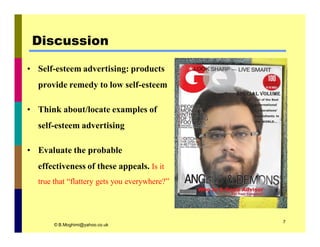
• Self-esteem advertising: products 
provide remedy to low self-esteem 
• Think about/locate examples of 
self-esteem advertising 
• Evaluate the probable 
effectiveness of these appeals. Is it 
true that “flattery gets you everywhere?” 
© B.Moghimi@yahoo.co.uk 
7
Real and Ideal Selves 
• Ideal self: our conception of how we would like to be 
• Actual self: our more realistic appraisal of the qualities we 
have 
• Products can: 
• Help us reach ideal self 
• Be consistent with actual self 
• Impression management means that we work to “manage” what 
others think of us 
 We choose some products because we think they are consistent with 
our actual self, while we buy others to help us reach an ideal standard. 
We may strategically choose clothing and other products to show off 
to others. In other words, we are managing their impression of us with 
our product choices. 
© B.Moghimi@yahoo.co.uk 8
What Impression-Management do you have on FB? 
People may manage impressions with 
their posts on social networking sites. 
These impressions, however, may 
ultimately be positive or negative. 
How would a prospective employer 
view your posts? How do you think 
your friends view your posts? Are 
you impression managing when you 
use social networks? 
© B.Moghimi@yahoo.co.uk
Fantasy Appeals 
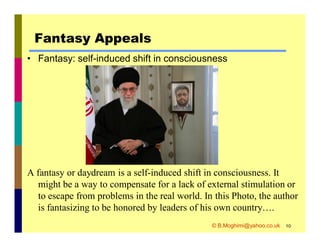
• Fantasy: self-induced shift in consciousness 
A fantasy or daydream is a self-induced shift in consciousness. It 
might be a way to compensate for a lack of external stimulation or 
to escape from problems in the real world. In this Photo, the author 
is fantasizing to be honored by leaders of his own country…. 
© B.Moghimi@yahoo.co.uk 10
Multiple Selves 
• Each of us has many selves and roles 
• Marketers pitch products needed to facilitate active role 
identities 
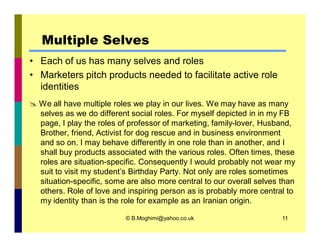
 We all have multiple roles we play in our lives. We may have as many 
selves as we do different social roles. For myself depicted in in my FB 
page, I play the roles of professor of marketing, family-lover, Husband, 
Brother, friend, Activist for dog rescue and in business environment 
and so on. I may behave differently in one role than in another, and I 
shall buy products associated with the various roles. Often times, these 
roles are situation-specific. Consequently I would probably not wear my 
suit to visit my student’s Birthday Party. Not only are roles sometimes 
situation-specific, some are also more central to our overall selves than 
others. Role of love and inspiring person as is probably more central to 
my identity than is the role for example as an Iranian origin. 
© B.Moghimi@yahoo.co.uk 11
Virtual Identity 
• People are assuming virtual identities in cyberspace 
• Avatars represent visual identity 
• How do online “selves” affect consumer behavior? 
© B.Moghimi@yahoo.co.uk 12 
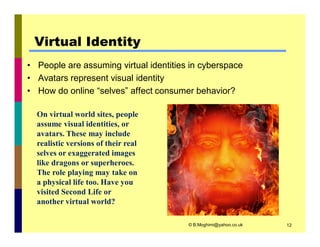
On virtual world sites, people 
assume visual identities, or 
avatars. These may include 
realistic versions of their real 
selves or exaggerated images 
like dragons or superheroes. 
The role playing may take on 
a physical life too. Have you 
visited Second Life or 
another virtual world?
Symbolic Interactionism 
• Symbolic interactionism: relationships with others play a 
large part in forming the self 
 If each person potentially has many social selves, how does 
each develop? “Who am I in this situation?” … “Who do 
other people think I am?” How do we decide which to 
activate at any point in time? 
• Symbolic interactionism stresses that relationships with other 
people play a large part in forming the self. We pattern our 
behavior on the perceived expectation of others—a self-fulfilling 
prophecy 
 When we act the way we assume others expect us to 
act, we are confirming perceptions of who we are and 
who others think we are! © B.Moghimi@yahoo.co.uk 13
Looking-Glass Self 
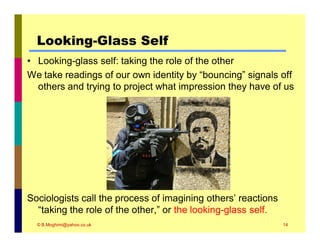
• Looking-glass self: taking the role of the other 
We take readings of our own identity by “bouncing” signals off 
others and trying to project what impression they have of us 
Sociologists call the process of imagining others’ reactions 
“taking the role of the other,” or the looking-glass self. 
© B.Moghimi@yahoo.co.uk 14
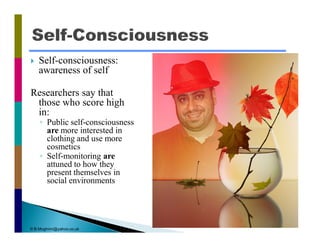
 Self-consciousness: 
awareness of self 
Researchers say that 
those who score high 
in: 
◦ Public self-consciousness 
are more interested in 
clothing and use more 
cosmetics 
◦ Self-monitoring are 
attuned to how they 
present themselves in 
social environments 
© B.Moghimi@yahoo.co.uk 
5- 
15
Consumption and Self-Concept 
• Identity marketing: consumers alter some aspects of their selves 
to advertise for a branded product 
Product consumption = Definition of the self 
 Identity marketing is a promotional strategy where consumers 
alter some aspects of their selves to advertise for a branded 
product. 
For instance, Air New Zealand created “cranial billboards” in exchange for a 
round-trip ticket to New Zealand. 30 participants shaved their heads and 
walked around with an ad for the airline on their skulls. 
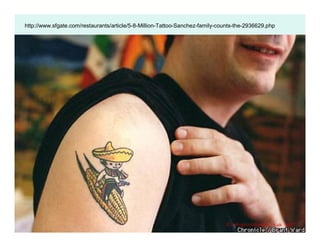
The Casa Sanchez restaurant in San Francisco gives free lunches for life to 
anyone who gets its logo tattooed on their body. The restaurant estimates that 
the cost of the identity marketing promotion is $5.8 million – in terms of the 
free lunches redeemed. 
© B.Moghimi@yahoo.co.uk 16
http://www.sfgate.com/restaurants/article/5-8-Million-Tattoo-Sanchez-family-counts-the-2936629.php 
© B.Moghimi@yahoo.co.uk 5-17
You Are What You Consume 
• Social identity as individual consumption behaviors 
• Question: Who am I now? 
• Answer: To some extent, your possessions! 
 The reflected self helps shape self-concept, which implies that people see 
themselves as they imagine others see them. Because what others see 
includes a person’s clothing, jewelry, furniture, car, and so on, it stands to 
reason that these products also help to create the perceived self. A 
consumer’s possessions place her into a social role which helps to answer the 
question, “Who am I now?” 
• Symbolic self-completion theory: people who have an 
incomplete self-definition complete the identity by acquiring 
and displaying symbols associated with it. 
© B.Moghimi@yahoo.co.uk 
18
Self/Product Congruence 
• Consumers demonstrate their values through their purchase 
behavior 
• Self-image congruence models: we choose products when 
attributes matches the self 
Product Usage = Self-Image 
• Research supports this idea that there is a match between product 
usage and self-image. In one study, car owners’ rating of 
themselves tended to match their perceptions of their cars. In 
another study, observers were able to match photos of male and 
female drivers to the cars they drove 70% of the time. 
© B.Moghimi@yahoo.co.uk 19
The Extended Self 
• Extended self: external objects that 
we consider a part of us 
• Levels of extended self: 
• Individual: personal possessions 
(cars, clothing) 
• Family: residence and furnishings 
• Community: neighborhood or 
town where you live 
• Group: social or other groups 
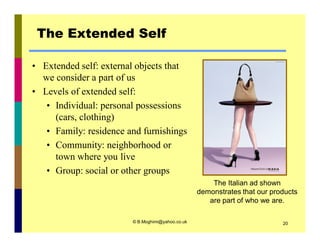
The Italian ad shown 
demonstrates that our products 
are part of who we are. 
© B.Moghimi@yahoo.co.uk 20
Class Discussion 
• Construct a “consumption biography” of 
a friend, family member, or classmate. 
• Make a list of his/her most favorite 
possessions, and see if you or others can 
describe this person’s personality just 
from the information provided by this 
catalogue. 
© B.Moghimi@yahoo.co.uk 21
Gender Differences in Socialization 
• Gender roles vary by culture but are changing 
• Many societies still expect traditional roles: 
• Men are expected to be assertive and have certain skills 
• Women are taught to foster harmonious relationships 
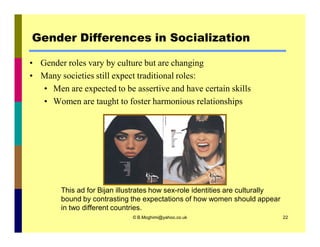
This ad for Bijan illustrates how sex-role identities are culturally 
bound by contrasting the expectations of how women should appear 
in two different countries. 
© B.Moghimi@yahoo.co.uk 22
Sex-Typed Traits and Products 
• Sex-typed traits: characteristics we stereotypically associate 
with one gender or the other. 
• Sex-types products: take on masculine or feminine attributes 
© B.Moghimi@yahoo.co.uk 23 
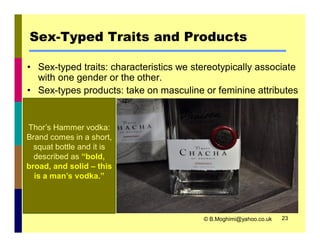
Thor’s Hammer vodka: 
Brand comes in a short, 
squat bottle and it is 
described as “bold, 
broad, and solid – this 
is a man’s vodka.”
Androgyny 
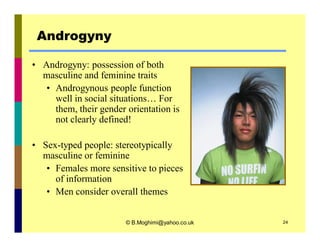
• Androgyny: possession of both 
masculine and feminine traits 
• Androgynous people function 
well in social situations… For 
them, their gender orientation is 
not clearly defined! 
• Sex-typed people: stereotypically 
masculine or feminine 
• Females more sensitive to pieces 
of information 
• Men consider overall themes 
© B.Moghimi@yahoo.co.uk 24
Female Sex Roles 
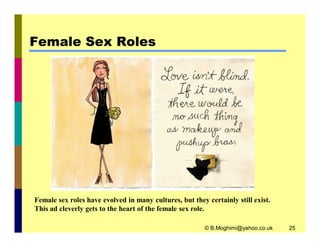
Female sex roles have evolved in many cultures, but they certainly still exist. 
This ad cleverly gets to the heart of the female sex role. 
© B.Moghimi@yahoo.co.uk 25
Male Sex Roles 
• Masculinism: study of male image and the complex cultural 
meanings of masculinity 
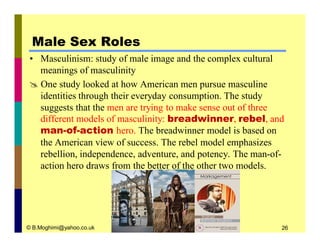
 One study looked at how American men pursue masculine 
identities through their everyday consumption. The study 
suggests that the men are trying to make sense out of three 
different models of masculinity: breadwinner, rebel, and 
man-of-action hero. The breadwinner model is based on 
the American view of success. The rebel model emphasizes 
rebellion, independence, adventure, and potency. The man-of-action 
hero draws from the better of the other two models. 
© B.Moghimi@yahoo.co.uk 26
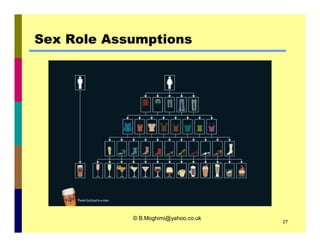
Sex Role Assumptions 
© B.Moghimi@yahoo.co.uk 27
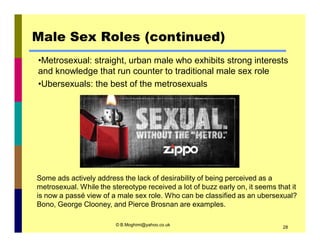
Male Sex Roles (continued) 
•Metrosexual: straight, urban male who exhibits strong interests 
and knowledge that run counter to traditional male sex role 
•Ubersexuals: the best of the metrosexuals 
Some ads actively address the lack of desirability of being perceived as a 
metrosexual. While the stereotype received a lot of buzz early on, it seems that it 
is now a passé view of a male sex role. Who can be classified as an ubersexual? 
Bono, George Clooney, and Pierce Brosnan are examples. 
© B.Moghimi@yahoo.co.uk 28
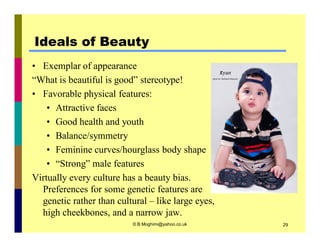
Ideals of Beauty 
• Exemplar of appearance 
“What is beautiful is good” stereotype! 
• Favorable physical features: 
• Attractive faces 
• Good health and youth 
• Balance/symmetry 
• Feminine curves/hourglass body shape 
• “Strong” male features 
Virtually every culture has a beauty bias. 
Preferences for some genetic features are 
genetic rather than cultural – like large eyes, 
high cheekbones, and a narrow jaw. 
© B.Moghimi@yahoo.co.uk 29
Waist-Hip Ratio 
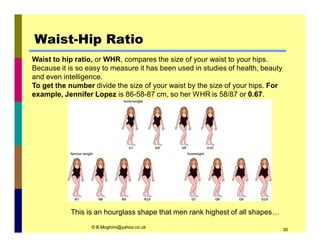
Waist to hip ratio, or WHR, compares the size of your waist to your hips. 
Because it is so easy to measure it has been used in studies of health, beauty 
and even intelligence. 
To get the number divide the size of your waist by the size of your hips. For 
example, Jennifer Lopez is 86-58-87 cm, so her WHR is 58/87 or 0.67. 
This is an hourglass shape that men rank highest of all shapes… 
© B.Moghimi@yahoo.co.uk 30
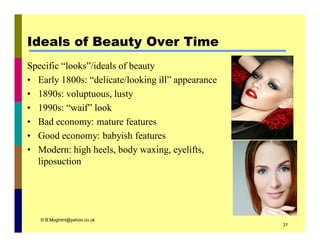
Ideals of Beauty Over Time 
Specific “looks”/ideals of beauty 
• Early 1800s: “delicate/looking ill” appearance 
• 1890s: voluptuous, lusty 
• 1990s: “waif” look 
• Bad economy: mature features 
• Good economy: babyish features 
• Modern: high heels, body waxing, eyelifts, 
liposuction 
© B.Moghimi@yahoo.co.uk 
31
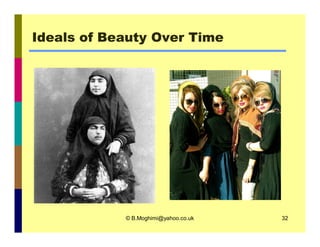
Ideals of Beauty Over Time 
© B.Moghimi@yahoo.co.uk 32
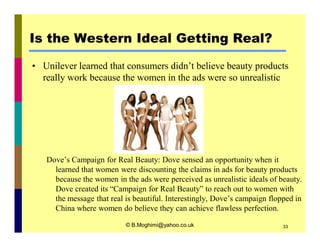
Is the Western Ideal Getting Real? 
• Unilever learned that consumers didn’t believe beauty products 
really work because the women in the ads were so unrealistic 
Dove’s Campaign for Real Beauty: Dove sensed an opportunity when it 
learned that women were discounting the claims in ads for beauty products 
because the women in the ads were perceived as unrealistic ideals of beauty. 
Dove created its “Campaign for Real Beauty” to reach out to women with 
the message that real is beautiful. Interestingly, Dove’s campaign flopped in 
China where women do believe they can achieve flawless perfection. 
© B.Moghimi@yahoo.co.uk 33
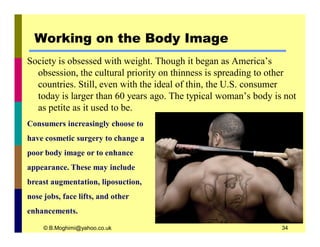
Working on the Body Image 
Society is obsessed with weight. Though it began as America’s 
obsession, the cultural priority on thinness is spreading to other 
countries. Still, even with the ideal of thin, the U.S. consumer 
today is larger than 60 years ago. The typical woman’s body is not 
as petite as it used to be. 
Consumers increasingly choose to 
have cosmetic surgery to change a 
poor body image or to enhance 
appearance. These may include 
breast augmentation, liposuction, 
nose jobs, face lifts, and other 
enhancements. 
© B.Moghimi@yahoo.co.uk 34
Decorating the self can serve 
Decorating the self can serve several purposes. Some 
of these are to: 
1. Distinguish group members from nonmembers 
2. Place the individual in the social organization 
3. Place the person in a gender category 
4. Enhance sex-role identification 
5. Indicate desired social conduct 
6. Indicate high status or rank 
7. Provide a sense of security 
© B.Moghimi@yahoo.co.uk 35
Chapter Summary 
• Self-concept as an influence on behavior 
• The role of products in defining self-concept 
• The influence of sex-role identity on purchases 
• Self-esteem and our body image 
• Cultural expectations of appearance 
We’ve covered several key concepts in this chapter. You should now understand 
that self-concept strongly influences our behavior as consumers and that 
products can play a crucial role in defining our self-concept. Society’s 
expectations of masculinity and femininity help to determine the products we 
buy in that we seek to be consistent with expectations. The way we think 
about our bodies is a key component of our self-esteem. Every culture has 
norms for beauty which will influence how we view our bodies and decorate 
ourselves. 
© B.Moghimi@yahoo.co.uk 36
37 
Thanks for Attention 
Bahman Moghimi (DBA) 
University of Georgia 
B.Moghimi@yahoo.co.uk 
B.Moghimi@ug.edu.ge
© B.Moghimi@yahoo.co.uk 5-38

Consumer behavior SELF ch05 solomon-book By: Bahman Moghimi

  • 1.
  • 2.
    Prof. Bahman Moghimi Doctor of Business Administration Master of Industrial Marketing & E-commerce University of Georgia. Tbilisi Source: Michael R. Solomon. 9e B.Moghimi@yahoo.co.uk
  • 3.
    Chapter Objectives Whenyou finish this chapter, you should understand why: • The self-concept strongly influences consumer behavior. • Products often play a pivotal role in defining the self-concept. • Sex-role identity is different from gender, and society’s expectations of masculinity and femininity help to determine the products we buy to be consistent with these expectations. • A person’s sex-role identity is a major component of self-definition. The media plays a key role in teaching us how to behave as “proper” males and females. • The way we think about our bodies (and the way our culture tells us we should think) is a key component of self-esteem. © B.Moghimi@yahoo.co.uk 3
  • 4.
    Perspectives on theSelf • We buy products to highlight/hide aspects of the self • Eastern cultures focus on: • The collective self (person’s identity comes from group) • The interdependent self (person’s identity defined from relationships with others) • Western cultures focus on: • Individuality • Individual appearance © B.Moghimi@yahoo.co.uk 4
  • 5.
    Self-Concept • Self-concept:the beliefs a person holds about his/her own attributes, and how he/she evaluates these qualities • Attribute dimensions: content, positivity, intensity, stability over time, and accuracy © B.Moghimi@yahoo.co.uk 5
  • 6.
    Self-Esteem • Self-esteem:the positivity of a person’s self-concept – Low self-esteem: think they will not perform well – High self-esteem: think they will be successful and will take risks • Ads can trigger social comparison • Attractive models using products  In social comparison, the person tries to evaluate her appearance by comparing it to the people depicted in ads. © B.Moghimi@yahoo.co.uk 6
  • 7.
    Discussion • Self-esteemadvertising: products provide remedy to low self-esteem • Think about/locate examples of self-esteem advertising • Evaluate the probable effectiveness of these appeals. Is it true that “flattery gets you everywhere?” © B.Moghimi@yahoo.co.uk 7
  • 8.
    Real and IdealSelves • Ideal self: our conception of how we would like to be • Actual self: our more realistic appraisal of the qualities we have • Products can: • Help us reach ideal self • Be consistent with actual self • Impression management means that we work to “manage” what others think of us  We choose some products because we think they are consistent with our actual self, while we buy others to help us reach an ideal standard. We may strategically choose clothing and other products to show off to others. In other words, we are managing their impression of us with our product choices. © B.Moghimi@yahoo.co.uk 8
  • 9.
    What Impression-Management doyou have on FB? People may manage impressions with their posts on social networking sites. These impressions, however, may ultimately be positive or negative. How would a prospective employer view your posts? How do you think your friends view your posts? Are you impression managing when you use social networks? © B.Moghimi@yahoo.co.uk
  • 10.
    Fantasy Appeals •Fantasy: self-induced shift in consciousness A fantasy or daydream is a self-induced shift in consciousness. It might be a way to compensate for a lack of external stimulation or to escape from problems in the real world. In this Photo, the author is fantasizing to be honored by leaders of his own country…. © B.Moghimi@yahoo.co.uk 10
  • 11.
    Multiple Selves •Each of us has many selves and roles • Marketers pitch products needed to facilitate active role identities  We all have multiple roles we play in our lives. We may have as many selves as we do different social roles. For myself depicted in in my FB page, I play the roles of professor of marketing, family-lover, Husband, Brother, friend, Activist for dog rescue and in business environment and so on. I may behave differently in one role than in another, and I shall buy products associated with the various roles. Often times, these roles are situation-specific. Consequently I would probably not wear my suit to visit my student’s Birthday Party. Not only are roles sometimes situation-specific, some are also more central to our overall selves than others. Role of love and inspiring person as is probably more central to my identity than is the role for example as an Iranian origin. © B.Moghimi@yahoo.co.uk 11
  • 12.
    Virtual Identity •People are assuming virtual identities in cyberspace • Avatars represent visual identity • How do online “selves” affect consumer behavior? © B.Moghimi@yahoo.co.uk 12 On virtual world sites, people assume visual identities, or avatars. These may include realistic versions of their real selves or exaggerated images like dragons or superheroes. The role playing may take on a physical life too. Have you visited Second Life or another virtual world?
  • 13.
    Symbolic Interactionism •Symbolic interactionism: relationships with others play a large part in forming the self  If each person potentially has many social selves, how does each develop? “Who am I in this situation?” … “Who do other people think I am?” How do we decide which to activate at any point in time? • Symbolic interactionism stresses that relationships with other people play a large part in forming the self. We pattern our behavior on the perceived expectation of others—a self-fulfilling prophecy  When we act the way we assume others expect us to act, we are confirming perceptions of who we are and who others think we are! © B.Moghimi@yahoo.co.uk 13
  • 14.
    Looking-Glass Self •Looking-glass self: taking the role of the other We take readings of our own identity by “bouncing” signals off others and trying to project what impression they have of us Sociologists call the process of imagining others’ reactions “taking the role of the other,” or the looking-glass self. © B.Moghimi@yahoo.co.uk 14
  • 15.
     Self-consciousness: awarenessof self Researchers say that those who score high in: ◦ Public self-consciousness are more interested in clothing and use more cosmetics ◦ Self-monitoring are attuned to how they present themselves in social environments © B.Moghimi@yahoo.co.uk 5- 15
  • 16.
    Consumption and Self-Concept • Identity marketing: consumers alter some aspects of their selves to advertise for a branded product Product consumption = Definition of the self  Identity marketing is a promotional strategy where consumers alter some aspects of their selves to advertise for a branded product. For instance, Air New Zealand created “cranial billboards” in exchange for a round-trip ticket to New Zealand. 30 participants shaved their heads and walked around with an ad for the airline on their skulls. The Casa Sanchez restaurant in San Francisco gives free lunches for life to anyone who gets its logo tattooed on their body. The restaurant estimates that the cost of the identity marketing promotion is $5.8 million – in terms of the free lunches redeemed. © B.Moghimi@yahoo.co.uk 16
  • 17.
  • 18.
    You Are WhatYou Consume • Social identity as individual consumption behaviors • Question: Who am I now? • Answer: To some extent, your possessions!  The reflected self helps shape self-concept, which implies that people see themselves as they imagine others see them. Because what others see includes a person’s clothing, jewelry, furniture, car, and so on, it stands to reason that these products also help to create the perceived self. A consumer’s possessions place her into a social role which helps to answer the question, “Who am I now?” • Symbolic self-completion theory: people who have an incomplete self-definition complete the identity by acquiring and displaying symbols associated with it. © B.Moghimi@yahoo.co.uk 18
  • 19.
    Self/Product Congruence •Consumers demonstrate their values through their purchase behavior • Self-image congruence models: we choose products when attributes matches the self Product Usage = Self-Image • Research supports this idea that there is a match between product usage and self-image. In one study, car owners’ rating of themselves tended to match their perceptions of their cars. In another study, observers were able to match photos of male and female drivers to the cars they drove 70% of the time. © B.Moghimi@yahoo.co.uk 19
  • 20.
    The Extended Self • Extended self: external objects that we consider a part of us • Levels of extended self: • Individual: personal possessions (cars, clothing) • Family: residence and furnishings • Community: neighborhood or town where you live • Group: social or other groups The Italian ad shown demonstrates that our products are part of who we are. © B.Moghimi@yahoo.co.uk 20
  • 21.
    Class Discussion •Construct a “consumption biography” of a friend, family member, or classmate. • Make a list of his/her most favorite possessions, and see if you or others can describe this person’s personality just from the information provided by this catalogue. © B.Moghimi@yahoo.co.uk 21
  • 22.
    Gender Differences inSocialization • Gender roles vary by culture but are changing • Many societies still expect traditional roles: • Men are expected to be assertive and have certain skills • Women are taught to foster harmonious relationships This ad for Bijan illustrates how sex-role identities are culturally bound by contrasting the expectations of how women should appear in two different countries. © B.Moghimi@yahoo.co.uk 22
  • 23.
    Sex-Typed Traits andProducts • Sex-typed traits: characteristics we stereotypically associate with one gender or the other. • Sex-types products: take on masculine or feminine attributes © B.Moghimi@yahoo.co.uk 23 Thor’s Hammer vodka: Brand comes in a short, squat bottle and it is described as “bold, broad, and solid – this is a man’s vodka.”
  • 24.
    Androgyny • Androgyny:possession of both masculine and feminine traits • Androgynous people function well in social situations… For them, their gender orientation is not clearly defined! • Sex-typed people: stereotypically masculine or feminine • Females more sensitive to pieces of information • Men consider overall themes © B.Moghimi@yahoo.co.uk 24
  • 25.
    Female Sex Roles Female sex roles have evolved in many cultures, but they certainly still exist. This ad cleverly gets to the heart of the female sex role. © B.Moghimi@yahoo.co.uk 25
  • 26.
    Male Sex Roles • Masculinism: study of male image and the complex cultural meanings of masculinity  One study looked at how American men pursue masculine identities through their everyday consumption. The study suggests that the men are trying to make sense out of three different models of masculinity: breadwinner, rebel, and man-of-action hero. The breadwinner model is based on the American view of success. The rebel model emphasizes rebellion, independence, adventure, and potency. The man-of-action hero draws from the better of the other two models. © B.Moghimi@yahoo.co.uk 26
  • 27.
    Sex Role Assumptions © B.Moghimi@yahoo.co.uk 27
  • 28.
    Male Sex Roles(continued) •Metrosexual: straight, urban male who exhibits strong interests and knowledge that run counter to traditional male sex role •Ubersexuals: the best of the metrosexuals Some ads actively address the lack of desirability of being perceived as a metrosexual. While the stereotype received a lot of buzz early on, it seems that it is now a passé view of a male sex role. Who can be classified as an ubersexual? Bono, George Clooney, and Pierce Brosnan are examples. © B.Moghimi@yahoo.co.uk 28
  • 29.
    Ideals of Beauty • Exemplar of appearance “What is beautiful is good” stereotype! • Favorable physical features: • Attractive faces • Good health and youth • Balance/symmetry • Feminine curves/hourglass body shape • “Strong” male features Virtually every culture has a beauty bias. Preferences for some genetic features are genetic rather than cultural – like large eyes, high cheekbones, and a narrow jaw. © B.Moghimi@yahoo.co.uk 29
  • 30.
    Waist-Hip Ratio Waistto hip ratio, or WHR, compares the size of your waist to your hips. Because it is so easy to measure it has been used in studies of health, beauty and even intelligence. To get the number divide the size of your waist by the size of your hips. For example, Jennifer Lopez is 86-58-87 cm, so her WHR is 58/87 or 0.67. This is an hourglass shape that men rank highest of all shapes… © B.Moghimi@yahoo.co.uk 30
  • 31.
    Ideals of BeautyOver Time Specific “looks”/ideals of beauty • Early 1800s: “delicate/looking ill” appearance • 1890s: voluptuous, lusty • 1990s: “waif” look • Bad economy: mature features • Good economy: babyish features • Modern: high heels, body waxing, eyelifts, liposuction © B.Moghimi@yahoo.co.uk 31
  • 32.
    Ideals of BeautyOver Time © B.Moghimi@yahoo.co.uk 32
  • 33.
    Is the WesternIdeal Getting Real? • Unilever learned that consumers didn’t believe beauty products really work because the women in the ads were so unrealistic Dove’s Campaign for Real Beauty: Dove sensed an opportunity when it learned that women were discounting the claims in ads for beauty products because the women in the ads were perceived as unrealistic ideals of beauty. Dove created its “Campaign for Real Beauty” to reach out to women with the message that real is beautiful. Interestingly, Dove’s campaign flopped in China where women do believe they can achieve flawless perfection. © B.Moghimi@yahoo.co.uk 33
  • 34.
    Working on theBody Image Society is obsessed with weight. Though it began as America’s obsession, the cultural priority on thinness is spreading to other countries. Still, even with the ideal of thin, the U.S. consumer today is larger than 60 years ago. The typical woman’s body is not as petite as it used to be. Consumers increasingly choose to have cosmetic surgery to change a poor body image or to enhance appearance. These may include breast augmentation, liposuction, nose jobs, face lifts, and other enhancements. © B.Moghimi@yahoo.co.uk 34
  • 35.
    Decorating the selfcan serve Decorating the self can serve several purposes. Some of these are to: 1. Distinguish group members from nonmembers 2. Place the individual in the social organization 3. Place the person in a gender category 4. Enhance sex-role identification 5. Indicate desired social conduct 6. Indicate high status or rank 7. Provide a sense of security © B.Moghimi@yahoo.co.uk 35
  • 36.
    Chapter Summary •Self-concept as an influence on behavior • The role of products in defining self-concept • The influence of sex-role identity on purchases • Self-esteem and our body image • Cultural expectations of appearance We’ve covered several key concepts in this chapter. You should now understand that self-concept strongly influences our behavior as consumers and that products can play a crucial role in defining our self-concept. Society’s expectations of masculinity and femininity help to determine the products we buy in that we seek to be consistent with expectations. The way we think about our bodies is a key component of our self-esteem. Every culture has norms for beauty which will influence how we view our bodies and decorate ourselves. © B.Moghimi@yahoo.co.uk 36
  • 37.
    37 Thanks forAttention Bahman Moghimi (DBA) University of Georgia B.Moghimi@yahoo.co.uk B.Moghimi@ug.edu.ge
  • 38.