Theories of Personality & Self concept and how they
affect one’s consumption patterns
Personality
Some theorists prefer to view personality as a
unified whole.
Others focus on specific traits.
Definition
“Those inner psychological characteristics
that both determine and reflects how a person
responds to his or her environment”.
Nature Of Personality
Personality reflects individual differences
Unique combination of inner characteristics –
No two individuals are exactly alike
Venturesome (scuba diving, rock climbing) to some
others who are not venturesome.
Personality allows marketers to divide people into
different groups based on their traits.
Nature Of Personality
Personality is Consistent & Enduring
Mother – “child has been impulsive from the day
he was born” – enduring & consistent.
Marketers cannot change consumers personalities
to meet their products.
But understanding which specific characteristics
bring in required responses, can help marketers to
appeal to these traits in their target audience.
Nature Of Personality
Personality Can Change
May be altered by major life events – birth of a child,
death of a loved one, personal tragedies – accident,
health problem, divorce, significant career
promotion.
Personality changes can also be part of maturing
process.
Women’s personality in general has been changing
faster. (Indica V2 Ad)
Theories of Personality
Freudian Theory
Neo – Freudian Theory
Trait Theory
Freudian Theory
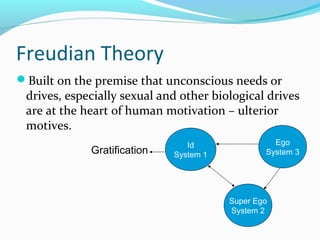
Personality consists of three interacting systems.
Id – related to physiological or impulsive needs to
which one seeks immediate satisfaction.
Super Ego – individuals internal expression of
moral / ethical codes of conduct; socio–cultural
forces.
Ego – The individuals conscious control. Functions
as an internal monitor that attempts to balance the
impulsive needs and socio cultural constraints.
Freudian Theory
Built on the premise that unconscious needs or
drives, especially sexual and other biological drives
are at the heart of human motivation – ulterior
motives.
Id
System 1
Ego
System 3
Super Ego
System 2
Gratification
Although Ego is capable of resolving many
of the conflicts that arise between the
personality components, ------- there are
certain occassions when no solutions could
be achieved, leading to tensions within
Defense mechanisms are unconsciously
determined techniques for avoiding or
escaping from such high levels of tension.
Defense Mechanisms
Repression: resolving conflict by minimizing aspects
of the conflicting situation.
(conflict about watching sporting event which brings in
violent and entertaining aspects. As ego cannot reach the
compromise, the individual will work to reduce the violent
aspects of the sport in his mind).
Projection: feelings generated by individual’s id or
super ego is ascribed to another person or group;
(a persons disdain for others who constantly purchase
products and display them can be from their own desire to
engage in same behavior).
Identification: the individual unconsciously
imitates the behavior of another person who
has successfully handled a similar conflict.
Vijay Mallya appearing in ads which says, “I
enjoy my drink, but I never drive after I drink”.
Reaction Formation: unconscious feelings held
toward others are consciously expressed as
opposites. … a partner who is un-loyal might
actually purchase many gifts for the other
person.
Neo Freudian Personality Theory
Social relationships are fundamental to formation
of personality (Freud - impulsive and sexual in
nature)
Three personality Groups
1. Compliant Individuals – those who move towards
others (desire to be loved, wanted and appreciated).
2. Aggressive Individuals – those who move against
others (desire to excel / win admiration).
3. Detached Individuals- those who move away
from others (desire independence, self reliance, self
sufficiency - freedom from obligation)
Trait Theory
Departure from qualitative measures that
typify the earlier theories.
Quantitative or empirical in approach.
Measurement of personality in terms of
specific psychological characteristics called
‘traits’.
Checks personality traits related to how
consumer makes his choices ----
The trait theory is based on three
assumptions.
1. Individuals possess relatively stable
behavioral tendencies.
2. Different people differ in the degree to
which they possess these tendencies.
3. When identified and measured, these
relative differences between individuals are
useful in characterizing their personalities.
Personality Traits
1. Consumer Innovativeness:
Nature and boundaries of a consumers willingness to
innovate
2. Dogmatism:
Trait that measures the degree of rigidity (vs.
openness) that they show toward an information that
is contrary to their own established beliefs.
3. Social Character:
Ranges from inner-directedness to other
directedness. Inner directed consumers tend to rely
on their own inner values while evaluating new
products. While outer-directed tend to look for
other’s opinion.
Personality Traits (contd.)
4. Need for uniqueness: for such people, conformity
to others expectations or standards either in
appearance or in their possessions is something to
be avoided.
5. Optimum Stimulation Level: Some people prefer
a simple, uncluttered and calm existence (whereas
others prefer complex and unusual experiences).
High OSL is linked to greater willingness to risks, try
new products ….
6. Sensation Seeking: characterized by the need for
varied, novel and complex experiences and
willingness to take physical and social risks.
Brand Personality
Consumers attribute various descriptive personality
like traits to different brands in a wide variety of
product categories.
Volvo – representing safety / family orientation
Levi’s 501 jeans – dependable, rugged & American
BMW - performance driven
Nivea – Mild and caring
Nike - the athlete in all of us.
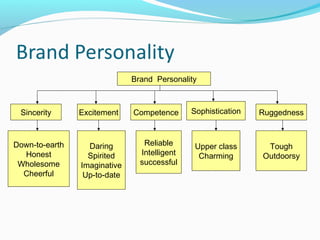
Brand Personality
Sincerity
Down-to-earth
Honest
Wholesome
Cheerful
Excitement
Daring
Spirited
Imaginative
Up-to-date
Competence
Reliable
Intelligent
successful
Sophistication
Upper class
Charming
Ruggedness
Tough
Outdoorsy
Is defined as the totality of individuals thoughts and
feelings having reference to him/ her as an object.
Life style, in many ways, is an outward expression of
ones self-concept.
Self Concept - Theory
Holds that an individuals have a concept of self
based on who they think they are (the actual self)
………… and a concept of who they think they would
like to be (the ideal self).
Related to two key concepts of psycho-analytic
theory, the ego and the super ego.
Ego is similar to one’s objective reality, so its similar
to actual self.
Superego is defined by the way things should be and
hence can be seen as a reflection of ideal self.
Actual Self
There is no one actual self.
Consumers have various role identities –
mother, wife, working woman, volunteer etc.
One of these roles is dominant in specific
situations. This particular role affects the
behavior (dressing style, talking, way they
conduct etc)
The amalgam of individuals roles makes up
the individual self.
Studies have confirmed that consumers buy
products related to their self concept.
Dolich – studied buying of beer, cigarettes, soaps
and tooth paste and found that respondents tend to
prefer brands they rate similar to themselves.
The same is in the case of automobiles too.
Marketing takeaways: the concept of ‘actual self’,
says that image consumers have of themselves
influences their purchases.
They attain ‘self consistency’, by buying products
they perceive as similar to their self-concept
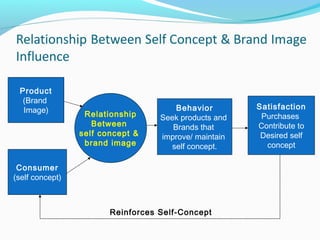
Product
(Brand
Image)
Consumer
(self concept)
Relationship
Between
self concept &
brand image
Behavior
Seek products and
Brands that
improve/ maintain
self concept.
Satisfaction
Purchases
Contribute to
Desired self
concept
Reinforces Self-Concept
Ideal Self
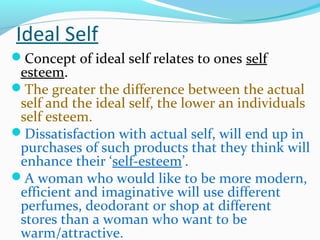
Concept of ideal self relates to ones self
esteem.
The greater the difference between the actual
self and the ideal self, the lower an individuals
self esteem.
Dissatisfaction with actual self, will end up in
purchases of such products that they think will
enhance their ‘self-esteem’.
A woman who would like to be more modern,
efficient and imaginative will use different
perfumes, deodorant or shop at different
stores than a woman who want to be
warm/attractive.
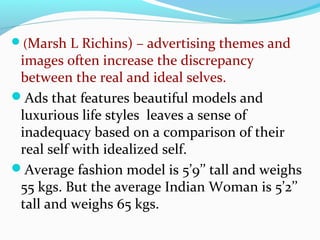
(Marsh L Richins) – advertising themes and
images often increase the discrepancy
between the real and ideal selves.
Ads that features beautiful models and
luxurious life styles leaves a sense of
inadequacy based on a comparison of their
real self with idealized self.
Average fashion model is 5’9’’ tall and weighs
55 kgs. But the average Indian Woman is 5’2’’
tall and weighs 65 kgs.
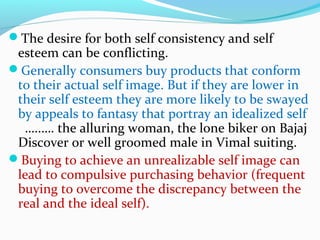
The desire for both self consistency and self
esteem can be conflicting.
Generally consumers buy products that conform
to their actual self image. But if they are lower in
their self esteem they are more likely to be swayed
by appeals to fantasy that portray an idealized self
…..…. the alluring woman, the lone biker on Bajaj
Discover or well groomed male in Vimal suiting.
Buying to achieve an unrealizable self image can
lead to compulsive purchasing behavior (frequent
buying to overcome the discrepancy between the
real and the ideal self).
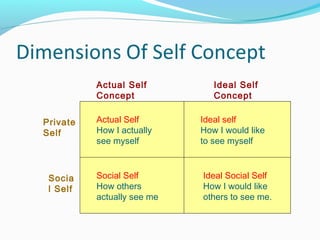
Actual Self
Concept
Ideal Self
Concept
Private
Self
Socia
l Self
Actual Self
How I actually
see myself
Ideal self
How I would like
to see myself
Social Self
How others
actually see me
Ideal Social Self
How I would like
others to see me.
In different contexts, consumer’s behavior
might be guided by different self concepts.
Daily use items including consumer durables
purchase will be more guided by actual self
concept.
Socially conspicuous products or status
products will be guided by social self image.
Fantasy products cosmetics, fashion items or
accessories will be guided by ideal self image
or ideal social self image.
Extended Self
Not only does our self image influence the
products we choose, but the products (of
symbolic value) we possess frequently
influence our self image.
Extended self incorporates some of our more
important possessions into our self concept.
We are what we wear, and what we use.
“People seek, express, confirm and ascertain
a sense of being through what they have”.
The symbolic role that products play in
shaping the consumer’s self concept.
Marketers have understood the role of
product constellations in projecting an image.
Advertising for jewelry might show
fashionably dressed models or expensive
automobiles ….. And ads for clothing might
show jewelry.
This brings in opportunity for co-branding
Life style, in many ways, is an outward expression of
ones self-concept.
Life style it can be viewed as a unique pattern of
living which influences and reflected by one’s buying
habits.
Psychographics may be viewed as the method of
defining lifestyle in measurable terms.
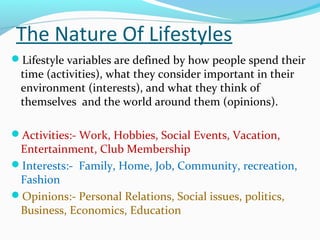
The Nature Of Lifestyles
Lifestyle variables are defined by how people spend their
time (activities), what they consider important in their
environment (interests), and what they think of
themselves and the world around them (opinions).
Activities:- Work, Hobbies, Social Events, Vacation,
Entertainment, Club Membership
Interests:- Family, Home, Job, Community, recreation,
Fashion
Opinions:- Personal Relations, Social issues, politics,
Business, Economics, Education

Personality self-concept-121215095455-phpapp01

  • 1.
    Theories of Personality& Self concept and how they affect one’s consumption patterns
  • 2.
    Personality Some theorists preferto view personality as a unified whole. Others focus on specific traits. Definition “Those inner psychological characteristics that both determine and reflects how a person responds to his or her environment”.
  • 3.
    Nature Of Personality Personalityreflects individual differences Unique combination of inner characteristics – No two individuals are exactly alike Venturesome (scuba diving, rock climbing) to some others who are not venturesome. Personality allows marketers to divide people into different groups based on their traits.
  • 4.
    Nature Of Personality Personalityis Consistent & Enduring Mother – “child has been impulsive from the day he was born” – enduring & consistent. Marketers cannot change consumers personalities to meet their products. But understanding which specific characteristics bring in required responses, can help marketers to appeal to these traits in their target audience.
  • 5.
    Nature Of Personality PersonalityCan Change May be altered by major life events – birth of a child, death of a loved one, personal tragedies – accident, health problem, divorce, significant career promotion. Personality changes can also be part of maturing process. Women’s personality in general has been changing faster. (Indica V2 Ad)
  • 6.
    Theories of Personality FreudianTheory Neo – Freudian Theory Trait Theory
  • 7.
    Freudian Theory Personality consistsof three interacting systems. Id – related to physiological or impulsive needs to which one seeks immediate satisfaction. Super Ego – individuals internal expression of moral / ethical codes of conduct; socio–cultural forces. Ego – The individuals conscious control. Functions as an internal monitor that attempts to balance the impulsive needs and socio cultural constraints.
  • 8.
    Freudian Theory Built onthe premise that unconscious needs or drives, especially sexual and other biological drives are at the heart of human motivation – ulterior motives. Id System 1 Ego System 3 Super Ego System 2 Gratification
  • 9.
    Although Ego iscapable of resolving many of the conflicts that arise between the personality components, ------- there are certain occassions when no solutions could be achieved, leading to tensions within Defense mechanisms are unconsciously determined techniques for avoiding or escaping from such high levels of tension.
  • 10.
    Defense Mechanisms Repression: resolvingconflict by minimizing aspects of the conflicting situation. (conflict about watching sporting event which brings in violent and entertaining aspects. As ego cannot reach the compromise, the individual will work to reduce the violent aspects of the sport in his mind). Projection: feelings generated by individual’s id or super ego is ascribed to another person or group; (a persons disdain for others who constantly purchase products and display them can be from their own desire to engage in same behavior).
  • 11.
    Identification: the individualunconsciously imitates the behavior of another person who has successfully handled a similar conflict. Vijay Mallya appearing in ads which says, “I enjoy my drink, but I never drive after I drink”. Reaction Formation: unconscious feelings held toward others are consciously expressed as opposites. … a partner who is un-loyal might actually purchase many gifts for the other person.
  • 12.
    Neo Freudian PersonalityTheory Social relationships are fundamental to formation of personality (Freud - impulsive and sexual in nature) Three personality Groups 1. Compliant Individuals – those who move towards others (desire to be loved, wanted and appreciated). 2. Aggressive Individuals – those who move against others (desire to excel / win admiration). 3. Detached Individuals- those who move away from others (desire independence, self reliance, self sufficiency - freedom from obligation)
  • 13.
    Trait Theory Departure fromqualitative measures that typify the earlier theories. Quantitative or empirical in approach. Measurement of personality in terms of specific psychological characteristics called ‘traits’. Checks personality traits related to how consumer makes his choices ----
  • 14.
    The trait theoryis based on three assumptions. 1. Individuals possess relatively stable behavioral tendencies. 2. Different people differ in the degree to which they possess these tendencies. 3. When identified and measured, these relative differences between individuals are useful in characterizing their personalities.
  • 15.
    Personality Traits 1. ConsumerInnovativeness: Nature and boundaries of a consumers willingness to innovate 2. Dogmatism: Trait that measures the degree of rigidity (vs. openness) that they show toward an information that is contrary to their own established beliefs. 3. Social Character: Ranges from inner-directedness to other directedness. Inner directed consumers tend to rely on their own inner values while evaluating new products. While outer-directed tend to look for other’s opinion.
  • 16.
    Personality Traits (contd.) 4.Need for uniqueness: for such people, conformity to others expectations or standards either in appearance or in their possessions is something to be avoided. 5. Optimum Stimulation Level: Some people prefer a simple, uncluttered and calm existence (whereas others prefer complex and unusual experiences). High OSL is linked to greater willingness to risks, try new products …. 6. Sensation Seeking: characterized by the need for varied, novel and complex experiences and willingness to take physical and social risks.
  • 17.
    Brand Personality Consumers attributevarious descriptive personality like traits to different brands in a wide variety of product categories. Volvo – representing safety / family orientation Levi’s 501 jeans – dependable, rugged & American BMW - performance driven Nivea – Mild and caring Nike - the athlete in all of us.
  • 18.
  • 19.
    Is defined asthe totality of individuals thoughts and feelings having reference to him/ her as an object. Life style, in many ways, is an outward expression of ones self-concept.
  • 20.
    Self Concept -Theory Holds that an individuals have a concept of self based on who they think they are (the actual self) ………… and a concept of who they think they would like to be (the ideal self). Related to two key concepts of psycho-analytic theory, the ego and the super ego. Ego is similar to one’s objective reality, so its similar to actual self. Superego is defined by the way things should be and hence can be seen as a reflection of ideal self.
  • 21.
    Actual Self There isno one actual self. Consumers have various role identities – mother, wife, working woman, volunteer etc. One of these roles is dominant in specific situations. This particular role affects the behavior (dressing style, talking, way they conduct etc) The amalgam of individuals roles makes up the individual self.
  • 22.
    Studies have confirmedthat consumers buy products related to their self concept. Dolich – studied buying of beer, cigarettes, soaps and tooth paste and found that respondents tend to prefer brands they rate similar to themselves. The same is in the case of automobiles too. Marketing takeaways: the concept of ‘actual self’, says that image consumers have of themselves influences their purchases. They attain ‘self consistency’, by buying products they perceive as similar to their self-concept
  • 23.
    Product (Brand Image) Consumer (self concept) Relationship Between self concept& brand image Behavior Seek products and Brands that improve/ maintain self concept. Satisfaction Purchases Contribute to Desired self concept Reinforces Self-Concept
  • 24.
    Ideal Self Concept ofideal self relates to ones self esteem. The greater the difference between the actual self and the ideal self, the lower an individuals self esteem. Dissatisfaction with actual self, will end up in purchases of such products that they think will enhance their ‘self-esteem’. A woman who would like to be more modern, efficient and imaginative will use different perfumes, deodorant or shop at different stores than a woman who want to be warm/attractive.
  • 25.
    (Marsh L Richins)– advertising themes and images often increase the discrepancy between the real and ideal selves. Ads that features beautiful models and luxurious life styles leaves a sense of inadequacy based on a comparison of their real self with idealized self. Average fashion model is 5’9’’ tall and weighs 55 kgs. But the average Indian Woman is 5’2’’ tall and weighs 65 kgs.
  • 26.
    The desire forboth self consistency and self esteem can be conflicting. Generally consumers buy products that conform to their actual self image. But if they are lower in their self esteem they are more likely to be swayed by appeals to fantasy that portray an idealized self …..…. the alluring woman, the lone biker on Bajaj Discover or well groomed male in Vimal suiting. Buying to achieve an unrealizable self image can lead to compulsive purchasing behavior (frequent buying to overcome the discrepancy between the real and the ideal self).
  • 27.
    Actual Self Concept Ideal Self Concept Private Self Socia lSelf Actual Self How I actually see myself Ideal self How I would like to see myself Social Self How others actually see me Ideal Social Self How I would like others to see me.
  • 28.
    In different contexts,consumer’s behavior might be guided by different self concepts. Daily use items including consumer durables purchase will be more guided by actual self concept. Socially conspicuous products or status products will be guided by social self image. Fantasy products cosmetics, fashion items or accessories will be guided by ideal self image or ideal social self image.
  • 29.
    Extended Self Not onlydoes our self image influence the products we choose, but the products (of symbolic value) we possess frequently influence our self image. Extended self incorporates some of our more important possessions into our self concept. We are what we wear, and what we use. “People seek, express, confirm and ascertain a sense of being through what they have”.
  • 30.
    The symbolic rolethat products play in shaping the consumer’s self concept. Marketers have understood the role of product constellations in projecting an image. Advertising for jewelry might show fashionably dressed models or expensive automobiles ….. And ads for clothing might show jewelry. This brings in opportunity for co-branding
  • 31.
    Life style, inmany ways, is an outward expression of ones self-concept. Life style it can be viewed as a unique pattern of living which influences and reflected by one’s buying habits. Psychographics may be viewed as the method of defining lifestyle in measurable terms.
  • 32.
    The Nature OfLifestyles Lifestyle variables are defined by how people spend their time (activities), what they consider important in their environment (interests), and what they think of themselves and the world around them (opinions). Activities:- Work, Hobbies, Social Events, Vacation, Entertainment, Club Membership Interests:- Family, Home, Job, Community, recreation, Fashion Opinions:- Personal Relations, Social issues, politics, Business, Economics, Education